
rural

Inside Strictly’s Karen Hauer’s quiet rural life with famous boyfriend and dogs after quitting show

When Strictly foxtrots back on to our screens later this month, it will be the first time in 14 years without longest serving female pro dancer Karen Hauer, who shimmied her way through more than 100 numbers on the show. But she’s not ready to kick off her dancing shoes just yet – revealing her ambition to cha-cha her way into the role of fiery Puerto Rican, Anita, in West Side Story. She says: “My dream role would be Anita in West Side Story. The world is my oyster.”

When Strictly’s new season launches on Saturday 19 September, it will also be the first time Karen has watched it live. She says: “I’ve never watched it live – I was always in it.”

And Karen – who announced her departure in a statement on social media in March – is not the only high profile departure. Longtime hosts Claudia Winkleman and Tess Daly have also left, as have pro dancers Gorka Márquez, Nadiya Bychkova, Luba Mushtuk and Michelle Tsiakkas. Karen says: “Things have to evolve. Whether people like it or not.”

But Karen will be rooting for the new hosts, Emma Willis, Josh Widdicombe and Johannes Rabede. She says: “The new series is so exciting. I’ll definitely be watching my friends and I’m really looking forward to seeing Johannes, Emma and especially Josh. I danced with him on the Christmas Special dressed as penguins.”

Karen, who was in the show from 2012 to 2025, has already started her new chapter – playing teacher Mavis in Devonshire Park Theatre’s production of the Richard Harris comedy, Stepping Out in Eastbourne until the end of April, before taking it on tour until the end of September. She will then be playing the Wicked Queen in Snow White at The Princess Theatre, Torquay, in December and January.

She says: “I’d been preparing myself mentally for a long time to leave [Strictly]. I’m doing great, I’m really happy. I’m going to miss Strictly, but I’m definitely enjoying my new chapter.”

But the dancer was shocked by the outpouring of love she felt from fans when she announced her departure. She says: “I’ve never felt so much love. I made such an impact without even actually knowing. I was shocked. I was like, ‘how come you guys didn’t vote for me to win?’ Goddamn it.”

Giving no dramatic reason for going, she simply says it was “the right time” to go, adding: “There’s a time when you just have to go, ‘okay, well, that’s a wrap.’ Now I have free time. I don’t know what’s going to happen in five years. So, I’m literally living the best life that I can right now, and not overthinking about the future.”

The first to admit to being a romantic, Karen has had three husbands. She was married to dancer Matthew Hauer from 2000 to 2009, to fellow Strictly pro dancer Kevin Clifton from 2015 to 2018 and then to fitness professional Jordan Wyn-Jones from 2022 to 2023.

But she now shares her rural home near Preston, Greater Manchester, with her boyfriend of three years, rugby player Simon Davidson and four rescue dogs, Betty, Phoebe, Marley and Joe. After her hectic Strictly schedule, she says of Simon: “It’s probably really weird for him to have me home.”

Positive she has now found ‘The One,’ she continues: “I love love. I think love is incredible, and I found it in Simon. I love being in a partnership, and in a partnership that’s healthy. “Knowing what a healthy relationship looks like and being in it … I think that’s what I love is, and that’s what I’ve been searching for. Joy for me is being at home with Simon and the dogs.”

Honouring her love of dogs, in November, Karen is hosting the The Burns Bravery Awards, in which the pet nutrition brand is calling on people to nominate Britain’s Bravest Dogs. Research from Burns Pet Nutrition reveals that three-quarters of owners say they turn to their dog when they’ve had a bad day.

And Karen can see why, saying: “My rescue dogs are the best thing to ever happen to me. Mentally, physically, my dogs get me out of bed, they get me out for a walk. My dogs have been through all my ups and downs. I think my dogs need therapy now.”

The dancer also turns to her mum Mirian when she needs comfort or inspiration. She says: “She inspires me every day. ‘It’s not going to be easy, kid, but you got this’ – that’s what I’ve always known since I was a kid. I’ve always fought and I’ve seen my mum struggle. I’ve seen what it takes to make it – not just as a person on television, but to make it in life.

“My mum raised three kids in New York City, in the Bronx, on her own. She always says, ‘don’t let your head get to the clouds.’ And that’s why I’ve always been very grounded, no matter what kind of job or who I’ve met. We’re all the same. On Strictly, I was never the flashy one, I was always grateful that first of all I had a job – and one that I loved and which entertained the entire nation.”

Karen made it to the Strictly final twice, with partners Jamie Laing and Mark Wright, but never lifted the glitterball. She says: “I was winning every year just being there. It’s great getting a 10, it’s fantastic, but it’s the moments that bring a smile to people’s faces and make them go, ‘That was really funny’, that I’ll remember the most.”

One such moment was when Anton Du Beke and Ann Widdecombe danced together at the Blackpool Tower Ballroom in 2010. This hilarious moment was how she likes to remember the long serving former Conservative MP, who died on July 9, aged 78, and whose death is now the subject of a murder inquiry.

Speaking fondly of Ann and Anton, Karen says: “He took her by the hand and the foot and was just swinging her around in a yellow dress. I was on the floor, peeing myself. It’s those moments, that’s what Strictly’s about.” Meanwhile, Karen gave her many famous Strictly partners – who included Westlife’s Nicky Byrne, actor Greg Wise and comedian Jayde Adams – the same advice.

She says: “I told all of my celebrities, ‘you have to enjoy it. We’re going to work hard, but I want to have a laugh. If you’re not having a laugh, then this is not going to work.’ A lot of people find it really hard to enjoy it, because there’s so much panic.”

Another of Karen’s favourite moments came in 2019, during Halloween week, when her wig came clean off her head on live TV.

“It was hilarious,” says Karen. “But so what if your wig comes off? People are going to remember that you made them smile. That’s what I’ll remember when I’m 85 … or dancing with Jeremy Vine coming out of a bath, or with the late Dave Myers, who I absolutely adored. Wow, I was living the dream, wasn’t I?”

*Following a public voting period, winners will be announced at the Burns Bravery Awards in November. For more information, and to nominate your dog, enter at burnspet.co.uk/pages/burns-bravery-awards
Source link

In rural Chad, solar kiosks bring healthcare closer | News

Bitkine, Chad – For Ache Kodo, seeing a doctor once meant saving money for the journey.

Living in Bitkine, in central Chad, she said a medical visit could mean paying for transport, the consultation and other costs of travelling to a larger town.

Now, she can consult a doctor remotely through a Telemedan kiosk closer to home.

“Telemedan changed how my family accessed healthcare services,” Ache told Al Jazeera. “It was difficult before, as it involved me saving money to travel just to see a doctor. Now I’m able to do it on time with fewer costs from where I am. It has also enhanced my economic status.”

For people in rural Chad, distance can be as much of a barrier to healthcare as the shortage of doctors themselves. Medical facilities and specialists are concentrated in larger towns and cities, leaving many communities far from basic services.

Abakar Mahamat grew up with that reality.

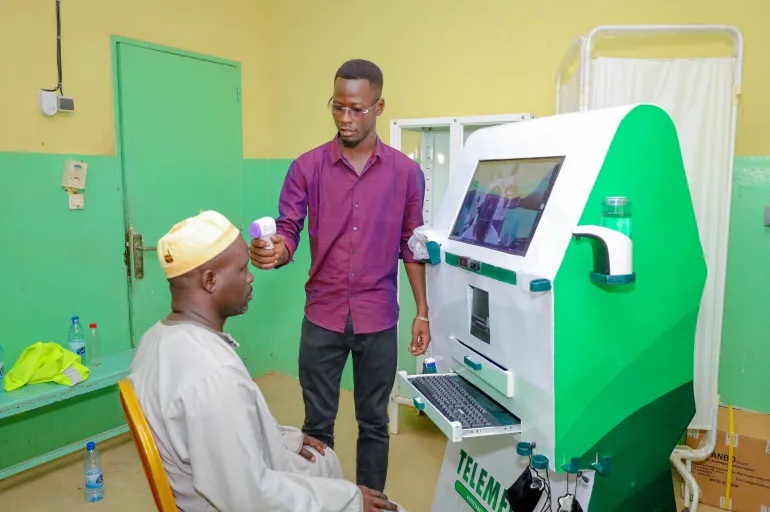
A patient uses a Telemedan kiosk in rural Chad to access healthcare remotely, with the solar-powered facility helping overcome distance and limited medical services
A patient uses a Telemedan kiosk in rural Chad to access healthcare remotely, with the solar-powered facility helping overcome distance and limited medical services [Yahuza Bawage/ Al Jazeera]

“The problem wasn’t only the lack of doctors,” he said. “It was also the distance between those doctors and the communities that needed them.”

In 2021, he launched Telemedan, a telemedicine initiative designed to bring consultations closer to communities where electricity, internet access and medical infrastructure are limited.

“Instead of asking people to travel hundreds of kilometres to find a doctor, I wanted to use technology to bring the doctor closer to them,” Abakar told Al Jazeera.

A clinic powered by the sun

The kiosks run on solar panels and batteries, allowing them to operate without reliable grid electricity.

A local operator registers the patient and takes basic measurements using equipment including blood-pressure monitors, glucometers, thermometers, pulse oximeters and electrocardiogram (ECG) machines.

The doctor joins remotely, appearing on a screen as the operator assists with the examination.

Telemedan says its kiosks can also be equipped with diagnostic tools including stethoscopes, temperature sensors and, in some cases, ultrasound equipment. A trained local operator helps patients use them.

The system is designed for places where internet access may be unreliable. Patient information can be stored locally and synchronised when connectivity returns. An Unstructured Supplementary Service Data (USSD) service allows people without internet access to book appointments and access health information.

A Telemedan solar-powered kiosk helps patients in rural Chad access doctors remotely, reducing the need to travel long distances for medical care [Yahuza Bawage/ Al Jazeera]
A Telemedan solar-powered kiosk helps patients in rural Chad access doctors remotely, reducing the need to travel long distances for medical care [Yahuza Bawage/Al Jazeera]

Depending on the location, the kiosks can connect through mobile networks or satellite links.

“We want to see that the absence of reliable electricity or the internet should not mean the absence of healthcare,” Abakar said.

The cost of getting to a doctor

Abakar said some journeys for medical care can cost $200 or more once transport, accommodation, logistics and medical consultations are included.

Telemedan consultations cost between $2 and $15, depending on the service.

For Abakar, the issue is also about what families can afford to give up to obtain care.

“A patient should not have to choose between seeking medical care and being able to feed their family,” he said.

From pilot to wider network

Telemedan began as a pilot and has expanded with support from grants and institutional partnerships, including Chad’s Ministry of Public Health and Prevention.

Abakar said the initiative now has 37 kiosks across 11 provinces and has reached an estimated 143,000 people.

A Telemedan kiosk in rural Chad is equipped with medical devices that allow local health workers to conduct examinations while doctors consult patients remotely.
A Telemedan kiosk in rural Chad is equipped with medical devices that allow local health workers to conduct examinations while doctors consult patients remotely [Yahuza Bawage/Al Jazeera]

Telemedan has also begun using artificial intelligence to help screen for diabetic retinopathy, a complication of diabetes that can damage vision. The initiative says the technology is intended to assist healthcare professionals rather than replace them.

But a remote consultation has limits.

A kiosk cannot provide emergency treatment or perform every examination. Patients who need specialist care, laboratory tests, medicines or hospital treatment still have to reach the next level of the health system.

Can the kiosks last?

Telemedan’s expansion comes as Chad develops its wider digital health system.

Youssouf Silay, an assistant to the coordinator of Chad’s National Digital Health Programme, told Al Jazeera that the country’s National Health Development Plan for 2022–2030 identifies digital health as a way to expand access to care.

Chad established the National Telemedicine Programme in 2021 and launched its National Digital Health Programme in 2023, Youssouf said. The Ministry of Health is also developing a legal and regulatory framework for digital health services.

“The objective is to promote innovative solutions that can improve access to healthcare, particularly in areas with limited medical and energy infrastructure,” Youssouf told Al Jazeera. “Solutions such as solar-powered telemedicine kiosks can contribute to this effort by bringing healthcare services closer to underserved populations.”

But putting a kiosk in a village is only the beginning.

The equipment has to keep working. Connectivity has to be available. Local operators need training. Doctors need to be there when patients call. And people who need care beyond the kiosk need a way to reach it.

In Chad, solar-powered Telemedan kiosks are designed to overcome two rural healthcare challenges at once: unreliable electricity and the long distances patients often travel to see a doctor.
In Chad, solar-powered Telemedan kiosks are designed to overcome two rural healthcare challenges at once: unreliable electricity and the long distances patients often travel to see a doctor [Yahuza Bawage/ Al Jazeera]

Each kiosk costs about $10,000, according to Abakar. Telemedan sells the units to governments, public health programmes and partner organisations, which then operate them. The model means patients are not paying for the infrastructure itself.

Telemedan says it wants to reach one million people in rural communities across sub-Saharan Africa.

A solar-powered kiosk cannot replace a hospital. It cannot replace a doctor in every circumstance.

But it can shorten the distance between a patient and the health system.

“We want Telemedan to become a sustainable layer of healthcare infrastructure, not simply a collection of technology projects,” Abakar told Al Jazeera.

Source link