room

Here’s what we know about Everything Is Terrible’s new Meow Wolf L.A. installation

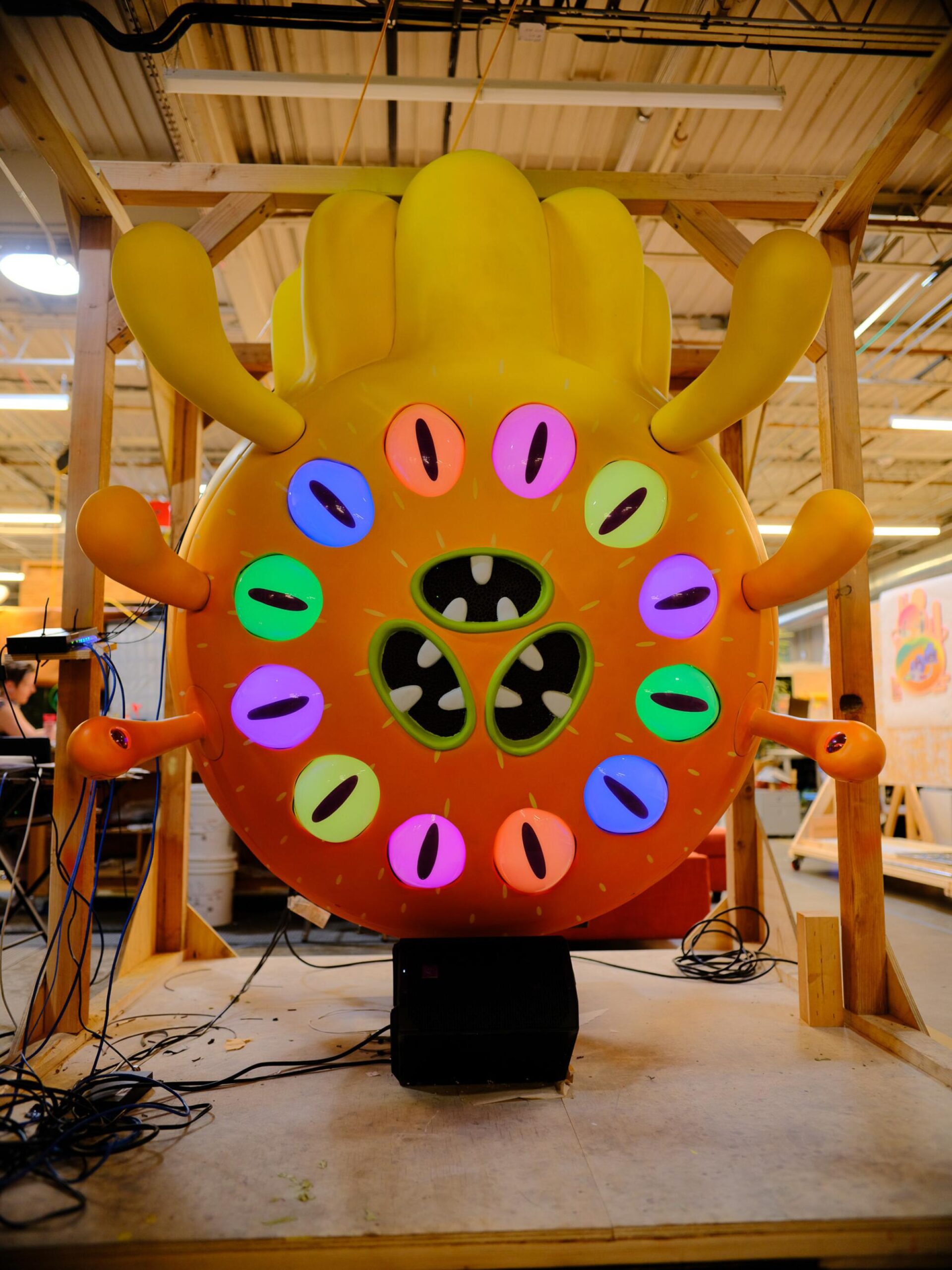
When Meow Wolf’s Los Angeles location opens later this year, one of its biggest residents will be a 20-foot-tall, 1,000-pound amoeba-like creature named WoWoW.

Created by the L.A.-based multimedia collective Everything Is Terrible, WoWoW is alternately described as a “cosmic entity” and a “cartoony, root vegetable floating alien god.” The multi-eyed organism will serve as the centerpiece of “the N.E.S.T.,” an EIT-designed section of Meow Wolf’s new 26,000-square-foot immersive exhibition space.

A pyschedelic sculpture.

In-progress detail of Everything Is Terrible’s WoWoW sculpture for the forthcoming Meow Wolf Los Angeles, shown with multi-color eye lighting.

(Photo by Allyson Lupovich / Meow Wolf)

That acronym has yet to be explained, and is cloaked in Meow Wolf’s intentionally mysterious messaging about its latest incarnation, which is set in an old Cinemark movie theater in West L.A. and will tackle the ephemeral joys and hardships of Hollywood’s dream factory. The L.A. location will be the Santa Fe, N.M.-based immersive art and entertainment company’s fifth outpost after Denver, Las Vegas, Houston and the Dallas suburbs.

The L.A. space boasts 45 local collaborating artists including Gabriela Ruiz, David Altmejd and more. Each is building their own unique installation featuring a variety of sculptures, dioramas and new media.

Everything Is Terrible is one of Meow Wolf’s most prolific partners, creating a variety of psychedelic characters for various installations over the years. The collective dreamed up the N.E.S.T. about two years ago as a way of paying tribute to maximalist roadside attractions like Wisconsin’s House on the Rock or New Mexico’s Tinkertown Museum. It also tells the story of the Noothies, a made-up community of former below-the-line film workers who stumbled upon a god — and a hidden truth about the nature of reality.

The installation presents a paradox by being a Hollywood idea that is completely un-Hollywood. It may wink at the industry’s unseen heroes, but who can afford to make art for art’s sake in the entertainment industry anymore? That seeming contradiction makes it a very Everything Is Terrible idea.

Founded nearly 20 years ago by a group of friends who met at Ohio University, Everything Is Terrible was launched as a found-footage website that created wild and singular art pieces using thrifted VHS tapes. It found viral success with videos about cat massage, and a dancing dinosaur who warns kids about the dangers of pedophilia, as well as its lauded quest to amass as many VHS copies of “Jerry Maguireas humanly possible. (The group has about 45,000 at the moment, all stuffed in boxes and waiting to be unleashed on the world — perhaps as a pyramid in the desert or maybe featured in some sort of coffee table book.)

“I think our outlook on life has become, ‘look at the worlds that these people created,’” says EIT co-founder Dimitri Simakis. “No one asked them to do this. Someone just wanted to do a kids puppet show in some garage in North Carolina and now they’ve created a simulacra.”

That’s also what the collective is doing with its Meow Wolf exhibit, adds Nic Maier, another EIT member. “It’s what we’ve done for the last 20 years, really. We’re just a bunch of kooks who got together to obsessively make things in celebration of life and in appreciation of each other’s time.”

The marriage of Everything Is Terrible and Meow Wolf is a match made in heaven. The groups first met in 2009, bonded by a shared commitment to interactive art experiences that twist reality using an ornate handmade aesthetic.

A few years later, Maier was hired to work on what would become Meow Wolf’s first large-scale installation, Santa Fe’s “House of Eternal Return.” As he spent hours sculpting large, foam trees for the group, he says he fell in love.

A fantastical, psychedelic take on a forest at Meow Wolf's Santa Fe, N.M., exhibit.

A mystical, neon-colored forest in Meow Wolf’s Santa Fe, N.M., exhibition, “The House of Eternal Return.”

(Meow Wolf)

“We always joke that ever since then, EIT has been a barnacle on the side of the Meow Wolf ship, just hanging on but also occasionally hopping in to contribute,” Maier says.

When Meow Wolf announced it was opening two new spaces, in Las Vegas and Denver, it called on EIT for ideas. Simakis and Maier threw out a few pitches for Denver and one landed: a McDonald’s-like retro freak-out known as Pizza Pals Play Zone, which went on to become one of the attraction’s most talked about, photographed and beloved spaces.

“Pizza Pals Play Zone is super character dense,” says Han Sayles, Meow Wolf’s director of artist collaboration. “It’s just one of those spaces that feels like Meow Wolf. There’s hundreds of different pieces of media framed all around, featuring all of these different characters they created. They even made a bible … that had the narrative backstory of every single character and every deliverable they wanted for that room.”

An immersive art installation.

Pizza Pals Playzone, created by Everything Is Terrible, at Meow Wolf’s Convergence Station in Denver.

(Jess Gallo / Meow Wolf)

When Meow Wolf’s Los Angeles project became a possibility, Sayles says Everything Is Terrible was one of the first groups she pitched as a potential contributor. EIT ended up being offered a custom project, in which the group used Meow Wolf’s extensive production facilities and resources to create their vision for the space, weighing in on everything from the shape of their room to the merch it might inspire in the Meow Wolf gift shop.

“We had a super trusting relationship with them,” Sayles says. “We recruited them as partners and negotiated a deal without knowing what they were going to put in the room. Both Nic and Dimitri have such a beautiful, strong sense of the exact genre of whimsy that we go for and they always deliver super deeply, so we knew it would be amazing.”

Sayles says she also thought the group’s experience of Los Angeles would lend itself well to the overall theme of the venue. Shakti Howeth, a creative director at Meow Wolf, agrees, saying that while Meow Wolf attractions are typically pretty otherworldly, they’re always built around an overarching story.

Meow Wolf's "Omega Mart" starts with a twisted take on a grocery store, complete with fake produts.

At Meow Wolf’s “Omega Mart,” in Las Vegas, guests first enter a satiric take on a grocery store, where portals lead to otherworldly art exhibitions.

(Christopher DeVargas / Meow Wolf)

The N.E.S.T., Howeth teases, will relate to some of the L.A. attraction’s character groups and themes, as well as its overall story. How audiences first encounter WoWoW and the N.E.S.T. will depend on which door they use to enter the room. From there, the points of visual interest will compound upon each other.

“We’re just incorporating all the things we love,” says Maier, noting that includes roadside attractions, folk art and anything “outsider.”

“It involves everything from the importance of dirt and worms to video games to experimental film to worker uprisings to entering literal other dimensions where you can meet what might be God, all within a [553]-square-foot space,” Simakis adds. “There have been times when we’ve been in the N.E.S.T. and thought we crammed in too much … but then you realize it has to be like that, because we’re trying to tell the whole story of the universe in just that room.”

For example, Maier spent much of the last two years building 45 beautifully weird costumes for the attraction, only two of which will be physically in the N.E.S.T. The other 43, he explains, are there for “world-building” and to make the story feel lived in. Everything in the space will have been created by Everything Is Terrible and Meow Wolf, including what seems like real found footage.

Simakis calls the group’s vision for the space “unrelenting joy mixed with benevolent chaos,” as well as “a beautiful folk art museum that’s also a space rave.” He likens what the group is doing to “building a puzzle out of thousands of other puzzles, gluing it together to make a new thing.”

“It’s like we’re making a movie that’s not a movie,” Simakis adds. “It’s a video game. It’s a living space. It’s all of these things, but you get to walk around in it.”

If that’s confusing, it’s because it’s meant to be — at least a little. How each visitor absorbs or receives the space will be entirely up to them. And while that could be a bit terrifying for some artists, to pour everything into a piece only to have the public possibly misinterpret or even ignore it, Maier and Simakis say they’re open to whatever comes.

“Millions of people are going to potentially walk through our space, so it has to be really special,” Simakis says. “We’ve also thought about all the different ways people could enjoy it, whether they’re a baby or a stoner or someone who’s just really into immersive entertainment or escape rooms. Even if you just go to take selfies, great. We’re pro-that. But also, if you want to keep going back or you want to spend hours there, I promise we’ve made it worth your while.”

Meow Wolf L.A. opens later this year. You can catch both Meow Wolf and Everything Is Terrible in the Los Angeles County Museum of Art’s Art Parade on June 20, marching in some of Maier’s 45 costumes from the N.E.S.T.
Source link

I stayed in the new Spanish island hotel resort where EVERY room has a sea view

I COULD feel my body softening with each wave of my masseuse’s hand.

She scrubbed in circular motions, massaging the salt into my skin until it sparkled like the sea just beyond the spa door.

Learn from the experts how to harvest your own jar of salt flakes Credit: Unknown
The pool at Iberostar Selection Es Trenc Credit: supplied

Salt, it turns out, is so much more than just a seasoning to sprinkle on your food — especially here on this picturesque stretch of Majorca’s southern coast.

I was staying at recently-opened five-star hotel Iberostar Selection Es Trenc, in the town of Colonia de Sant Jordi, half an hour’s drive from Palma airport.

It oozes relaxation, with its seafront location, ocean-coloured decor and knock-out spa treatments.

The hotel is also big on using local produce — including the nearby salt flats’ Flor de Sal.

WAIL OF A TIME

I drove Irish Route 66 with deserted golden beaches and pirate-like islands


TEMPTED?

Tiny ‘Bali of Europe’ town with stunning beaches, €3 cocktails and £20 flights

This is used in massages and scrubs, as well as food served at the hotel and even cocktails.

Keep your eyes peeled for the picante salt, used to rim some of the hotel’s signature cocktails like mezcalitas and spicy margaritas.

Should you wish, you can visit the salt flats — a 20-minute cab ride from the hotel and home to fabulous wildlife.

You can even try harvesting some salt — it’s harder than it looks, but you’ll leave with your own jar of the flakes.

If that’s not enough physical exertion, the Iberostar Selection Es Trenc also offers rental bikes.

I weaved my way along the sun-drenched local roads for a gentle ten minutes toward the Far de la Colonia de Sant Jordi lighthouse.

The views from here are breathtaking and great for photos.

Those who prefer a more intense workout can pick from kickboxing, TRX gym work and Zumba classes.

The local salt is used in food and drinks Credit: supplied
Soak up the breathtaking sea view from the hotel room Credit: supplied

I opted instead for a dip in the pool on the hotel’s rooftop terrace, also used for sunrise yoga classes.

I’m sadly not a very nimble yogi, but did join a session and felt serenely relaxed.

Not that I needed to unwind any more — the hotel is designed so every room has a sea view, and I opened my curtains each morning to soothing views of the waves.

Another treat is the hotel’s a la carte restaurant, Salvient, which has a homely feel.

The Sun’s Tilly Pearce visits the Majorcan salt flats Credit: supplied
A Flor De Sal salt flats tour costs from €10 per adult and €6 per child Credit: supplied

It takes its name from the Spanish word for salt — sal — and you will not struggle to guess why.

If you’ve developed a taste for Es Trenc’s “white gold”, as the locals call it, make sure to order the dentex — a sea bream-style fish cooked whole and served on a huge bed of salt.

The large fish can be shared with family or friends, but was so light and flaky I reckon I could have eaten the entire thing by myself.

Or the hotel has a buffet-style restaurant — and there’s plenty of restaurants in town, too.

5Illes restaurant, by the town beach and about a 15-minute walk from the Iberostar, is well worth a visit.

It specialises in rice dishes and my paella was one of the best I’ve ever tasted, served sizzling in a large pan and stacked with seafood.

Tummy well and truly satisfied, I ended my Majorca getaway with a private boat trip around the island to soak up my final sunset.

I’m not sure what was better — the view from the Iberostar rooftop or this one from the sea.

As long as I have a salt-rimmed cocktail in hand, who cares?

GO: MAJORCA

GETTING THERE: EasyJet flies from London Gatwick to Majorca from £28.99 each way.

See easyjet.com.

STAYING THERE: Double rooms at the 5H Iberostar Selection Es Trenc start from £237 on a B&B basis.

See iberostar.com.

OUT & ABOUT: A Flor De Sal salt flats tour costs from €10 per adult and €6 per child.

See flordesal.com.

Private boat trips with Llaut Corb Mari start at €380 for two-and-a-half hours for up to seven passengers.

See llautcorbmari.com.

Source link

Coronado’s new Baby Grand hotel is a maximalist dream

Brace yourself, Coronado. The hospitality maven who brought San Diego its most over-the-top maximalist hotel — the Lafayette in North Park — is back with another glitzy project, this time in the wealthy island city known for its traditional bent.

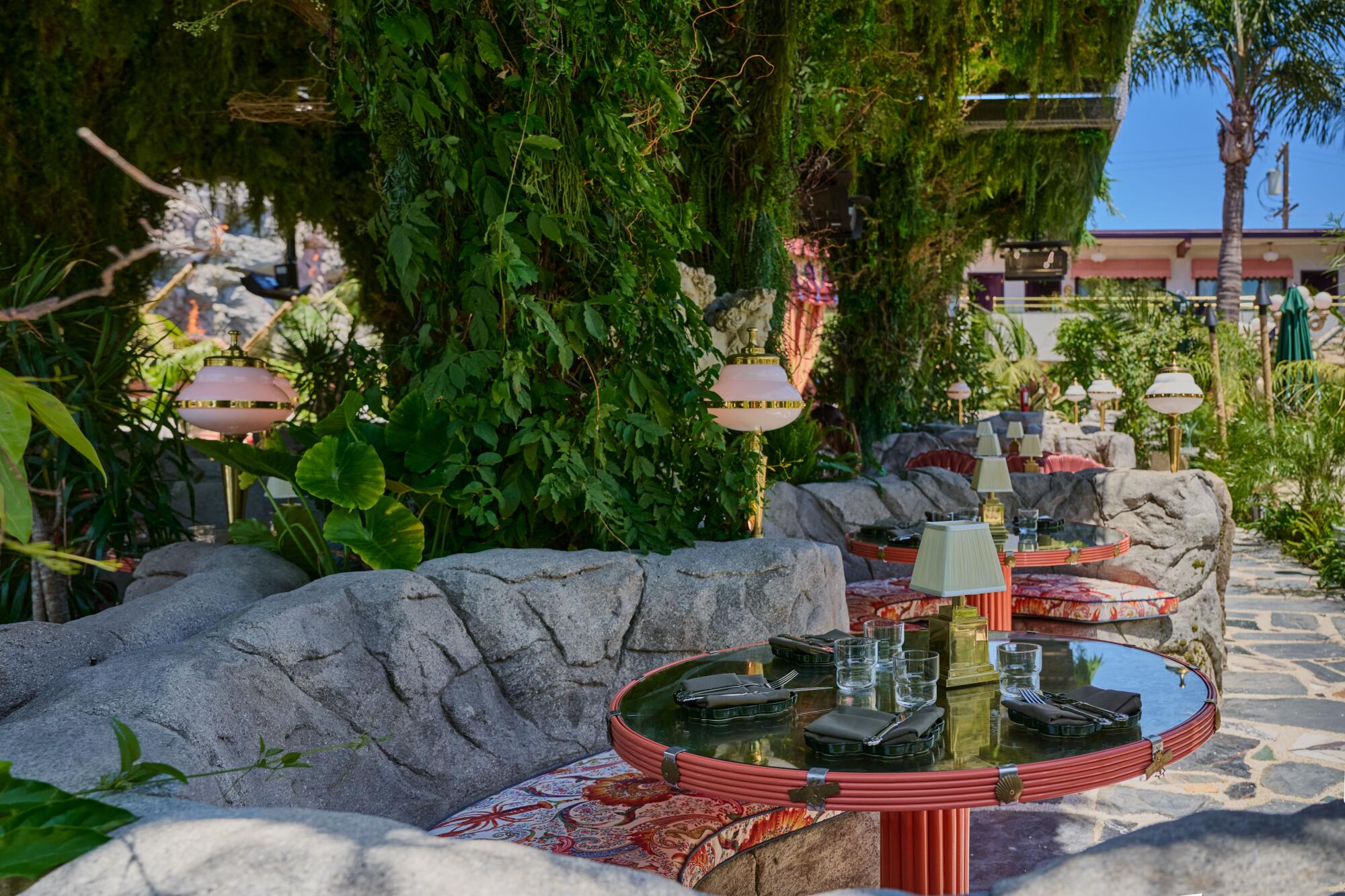
Opening Thursday, Baby Grand includes a 35-foot faux rock wall, a 20-foot waterfall, a Mediterranean restaurant that feels like a Greek ruin being consumed by a jungle and a hidden oyster bar full of crystal and mirrors. All of this, including the Spanish statuary, Moroccan fixtures and Murano glass, is squeezed onto an Orange Avenue lot that once held a 1950s motel. If Liberace had run away with an art historian, they might have landed here.

The idea was “to create this little mirage within the mirage that is Coronado,” said Arsalun Tafazoli, founder of CH Projects, the group behind a multitude of design-intensive establishments across San Diego including the speakeasy Raised by Wolves, the hi-fi listening bar Part Time Lover and the Middle Eastern restaurant Leila.

The Baby Grand hotel and its restaurant Night Hawk stands along Orange Avenue about a block from the Hotel del Coronado.

The Baby Grand hotel and its restaurant Night Hawk stands along Orange Avenue about a block from the Hotel del Coronado.

The patio dining area of Coronado's new Night Hawk includes seating for about 150.

The patio dining area of Coronado’s new Night Hawk includes seating for about 150.

Baby Grand’s high-density, high-gloss environment, which cost about $17 million and took about five years to complete, will come as no surprise to those who have followed Tafazoli’s earlier ventures.

Asked about the design philosophy behind the 2023 renovation of the Lafayette — the company’s first hotel — Tafazoli had a simple answer: “More is more.”

The Baby Grand project, put together in collaboration with design studio Post Company, is cut from the same cloth, describing itself as a “polychromatic pastiche” on its website. The goal, Tafazoli said, is to enrich Coronado’s culture and give people a respite in an anxiety-ridden time. But “it is different,” he said. “I don’t know if it is going to be embraced.”

Getting the necessary city permissions “was definitely a struggle,” Tafazoli said. “Had I known how difficult this was going to be, I don’t know …”

In the days before the hotel’s opening, Tafazoli, 44, led a tour of the site. The entrepreneur, whose heritage is Persian, wore his hair in braids and a button-down Supreme shirt featuring Barack Obama.

The Baby Grand hotel's guest rooms feature separate tub and shower.
A shadow is cast on marble flooring in courtyard near oyster bar.
Wall detail outside the lobby.

The Baby Grand hotel’s guest rooms feature separate tub and shower.

“I have a very one-dimensional existence. I’m single. I have no kids. This is what I do,” said Tafazoli, who grew up in San Diego and studied at UC San Diego. He lives now in downtown San Diego’s East Village, where his company is based and where his first CH venture, Neighborhood, opened in 2007.

Though his company started with eating and drinking establishments, Tafazoli said, his goals were always to create and run hotels, “the pinnacle of hospitality.” As a child of divorce, he said, he may have a heightened awareness of when the energy feels right in a room and when it doesn’t. Creating social environments, he said, gives him some control over that. Moreover, he added later, “beauty is important to me, because it conveys care.”

To make the most of Baby Grand’s compact location (2/3 of an acre), the CH team has exported parking. Instead of leaving their cars on site, guests will hand keys to valets who will deposit vehicles in a Bank of America parking structure a block away. That move freed up space for not only palm trees, torches, tables, booths and 21 pieces of statuary from Spain, but also a little faux beach with a 4-foot-deep wading pool that can hold a handful of people.

“I can’t tell you how many iterations of sand were brought in and taken out,” Tafazoli said. “Sand is its own universe. You want local sand. But local sand was not conducive to that feeling.” So the sand is from Turkey.

1

Guest shower in an en suite bathroom.

2

Hotel design touches include guest bathroom door handles.

3

Fiberglass clamshells serve as headboard in guest rooms.

1. Guest shower in an en suite bathroom. 2. Hotel design touches include guest bathroom door handles. 3. Fiberglass clamshells serve as headboard in guest rooms.

The property’s main restaurant, Night Hawk, is Mediterranean, with cooking by open fire, a Greek ruins vibe and seating for about 150. The second restaurant lurks behind the lobby — a hidden oyster-and-Champagne bar that holds about 35 people, reservation only. The space, called Fallen Empire, features red mohair booths, built-in Champagne buckets, mirrored walls and chandeliers, sconces and lamps from the Italian glass-blowing island of Murano. The floor is a custom mosaic of sea creatures.

There are 31 guest rooms, beginning at $350 per night. Each is dominated by a custom-made clamshell headboard (fiberglass). Beds are surrounded by animal-print seating, parquet oak flooring, marble tables, mirrored cabinets and custom wallpaper. The rooms measure roughly 300 square feet each, nearly half of that space taken up by their elaborate bathrooms, each with separate tub and shower, sinks from Morocco.

Now picture all of that placed in the heart of Coronado (population 20,192), which sits next to Naval Air Station North Island and is known for attracting well-heeled retirees. The median home value is $2.5 million.

Up the block from the Baby Grand is the grand dame of San Diego County tourism, the Hotel del Coronado, which went up in 1888, completed a $550-million renovation last year and starts its rates north of $600. Another option is the Bower Coronado, also a dramatically upgraded motel that reopened in 2025 with prices similar to Baby Grand’s but a much more buttoned-down style.

This view from above at the Night Hawk restaurant space shows a stone booth, elaborately patterned cushion and table top.

This view from above at the Night Hawk restaurant space shows a stone booth, elaborately patterned cushion and table top.

All of those properties stand close to Coronado’s wide, sandy beaches — which means they all face challenges as waters are often fouled by the northward flow of untreated sewage from greater Tijuana. The longstanding problem has worsened in recent years, and Coronado’s Central Beach was closed to bathers on 129 days in 2025 because of unsafe bacteria levels. The U.S. and Mexican government say they have sewage-treatment projects in progress, with improvements expected by the end of 2027.

“We are, unfortunately, not marine scientists just a group of deeply overcaffeinated hoteliers with strong opinions about lighting, linen textures, and good design. So please check local water conditions before swimming,” Tafazoli wrote in a statement.

Asked his target market for the new hotel, Tafazoli said he was looking close to home.

“I see this as a staycation for locals” from San Diego County, Tafazoli said. “The big risk is that we don’t get locals and it doesn’t resonate with tourists who like the status quo.”

That said, Baby Grand and Coronado might be a better match than some imagine. Christine Stokes, executive director of the Coronado Historical Assn. and Museum, sees at least a few parallels to Baby Grand in local history, beginning with the historical association’s own building. From the 1950s into the 1990s, Stokes noted in an email, Marco’s Restaurant operated in the space, with a “Roman Room” bar — “a dark and immersive hidden gem where bartenders performed sleight-of-hand magic tricks.”

Guest rooms, including No. 103, are labeled with inscribed brass clamshells.

Guest rooms, including No. 103, are labeled with inscribed brass clamshells.

Then there was the Hotel del Coronado’s Circus Room restaurant, open from the 1930s into the 1960s. That was “an immersive environment, using specialized murals and striped tents on the walls,” Stokes wrote. It’s also where, in 1950, the manager of an L.A. TV station spotted a promising young piano player and decided to give him a chance on screen. The pianist’s name was Liberace.

However people respond to the particulars of the new hotel, Tafazoli said, he knows that the larger setting of Coronado is a special place.

From his office in San Diego’s East Village, “it’s a six-minute drive,” he said. “I come off that bridge, and I feel like I’m in a different place.” It’s amazing, he said, “to be so close and feel so far away.”

Source link