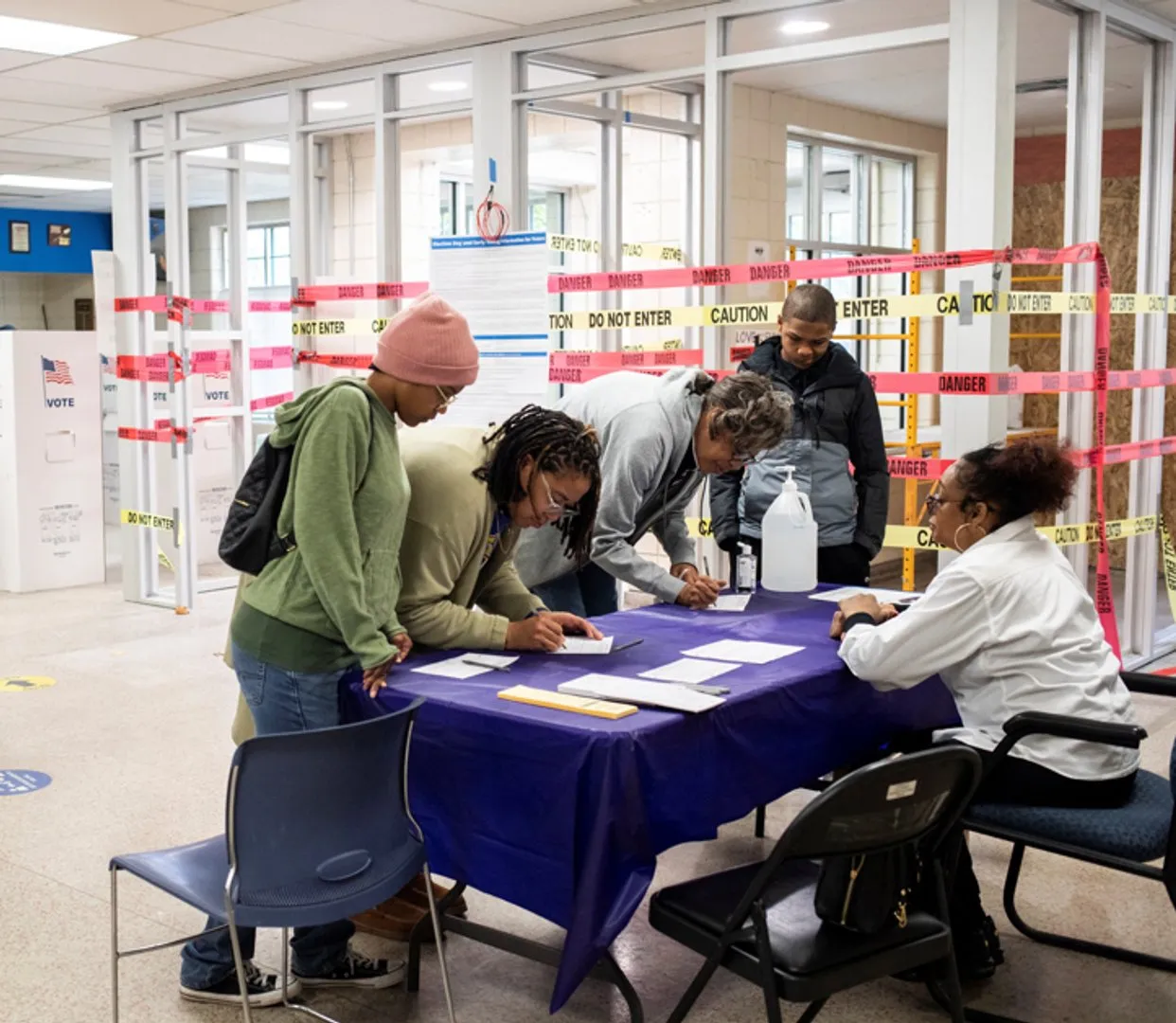
Less than two weeks before the midterm elections, some Michigan voters are still deciding between Republican Mike Rogers and Democrat Abdul El-Sayed in the race for a US Senate seat. At an event in Detroit this week, one voter questioned why El-Sayed won’t say his ‘real name.’
ATLANTA — Not long ago, Georgia gubernatorial nominee Rick Jackson eagerly compared himself to his fellow billionaire in the Oval Office. He promised to be Donald Trump “with a Southern tone.” And sharing a summer rally stage, Jackson pointed at the president and declared, “I’m going to be this man’s favorite governor.”
On the debate stage this week with his Democratic opponent, however, Jackson discussed Trump only when Keisha Lance Bottoms brought him up. And he assured his audience that he’d “stand up to anybody.”
Jackson is not alone in his recalibration: Republican nominees for Senate, the U.S. House and governor’s offices across the country are sidestepping President Trump or openly distancing themselves as they debate before Election Day.
Those tactics, not unlike Republicans scrubbing Trump from their campaign websites, are the latest signs of how much Trump’s standing has fallen because of voters’ frustration with inflation, the Iran war and other matters. And the dynamics highlight the perilous options many Republicans face as they try to stitch together winning coalitions that go beyond Trump’s core supporters.
“Republicans right now are facing a voter turnout problem” in their own party, said GOP pollster Paul Shumaker, and must win “unaffiliated voters” who care most about the economy.
“You have to have something significant to change this narrative,” Shumaker said. But, he explained, that means “a significant victory in Iran” and seismic economic improvements — not something any Republican midterm candidate can force from behind a debate podium.
There’s a Trump tightrope on Iran, tariffs and rhetoric
Some Republicans are taking specific positions at odds with the president.
Michigan Senate candidate Mike Rogers said in his debate Thursday with Democrat Abdul El-Sayed that he’d urged the White House privately to reach a trade deal with Canada and end the president’s tariffs. Canada is Michigan’s largest trading partner, as it is for many Great Lakes and Midwestern states.
Days before, Rogers unveiled a new ad in which he said, “We know that Canada is not our enemy. We need to end the tariff war — now.”
That’s a noticeable departure from Rogers’ earlier, less specific statements praising Trump’s “America First” economic agenda while saying tariffs are not a “one-size-fits-all” solution.
Another Michigan Republican, Rep. Tom Barrett, already had bucked the president by voting for a war powers resolution intended to assert congressional authority over military actions in Iran. But debating Democrat Will Lawrence in their central Michigan district, Barrett added a criticism of Trump’s rhetoric Monday in Nebraska, where he floated the possibility of Iran attacking San Diego and Los Angeles.
The president mentioned those cities as part of his argument that higher gas prices because of his Iran war are a “small price to pay” to keep the country safe. But Democrats seized on the remarks, some insisting that Trump was calling for Iran to attack U.S. cities.
Barrett was asked whether Trump’s words were acceptable. Given the opportunity to echo the White House explanation that Trump was offhandedly mentioning a worst-case scenario he was trying to prevent, Barrett offered no defense.
“Nope,” he said flatly.
Many Republicans prefer a more generalized stiff arm
Reflecting the complex electoral balance, most Republicans have attempted to separate themselves without naming any firm difference with the president.
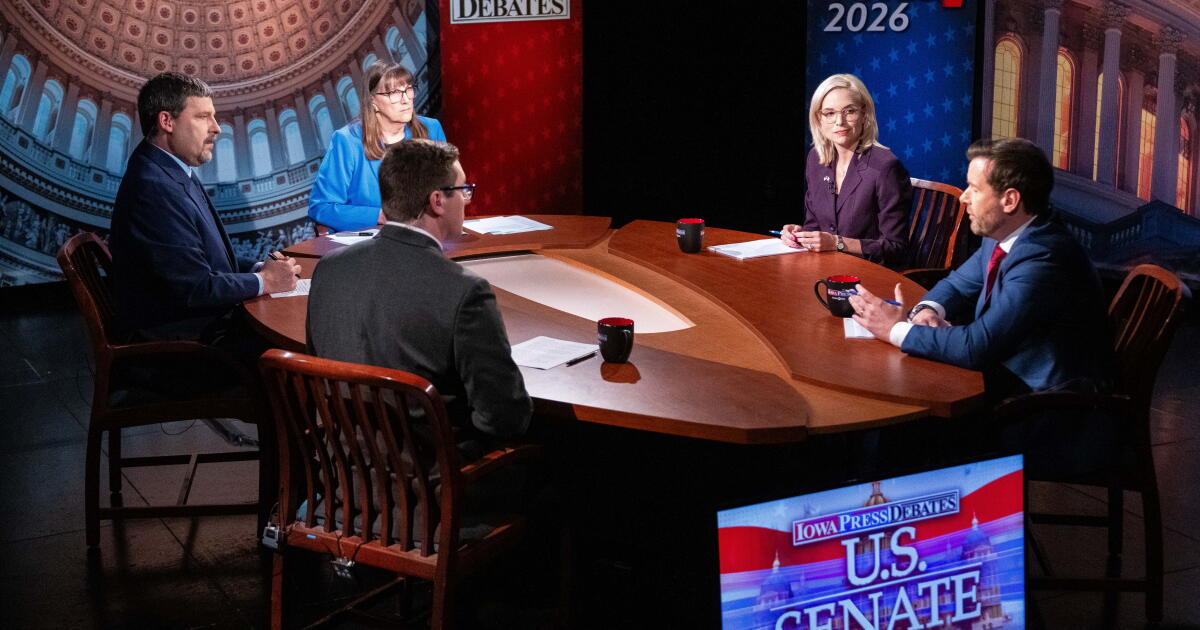
Running for a promotion to the Senate, Iowa U.S. Rep. Ashley Hinson tried in her debate Wednesday against Democrat Josh Turek to reconcile her earlier promises to be a Trump ally in Congress’s upper chamber. She said it would be “really easy” to keep her word and still be bipartisan — a buzz word she’s already been featuring in her campaign.
“I’ll be President Donald Trump’s ally when it is important for Iowa, but I will push back on him — he knows this, because I talk to him regularly — on things that are wrong for our state,” she said. “That’s true no matter who’s in the White House. That’s true no matter who is governing and who has the gavel.”
That’s the same path Jackson took in Georgia, as he pivoted away from Trump by embracing outgoing Georgia Gov. Brian Kemp, a Republican who has clashed with the president, starting with Trump’s false claims that he won Georgia in the 2020 presidential election.
“I will stand up to anybody, just like Brian Kemp has done,” Jackson said.
Another Republican House member, Mike Lawler of New York, made a point of name-checking a Democratic colleague, New Jersey’s Josh Gottheimer, and discussing bills they’d work on together. It was part of his argument that he’s able to challenge Trump and the party line.
“When I agree with the president I say it. When I disagree with the president, I say it,” he said in his closing remarks.
Hinson, meanwhile, referenced bills she’s worked on in the House that have been signed into law by both President Joe Biden and Trump.
But she also avoided criticizing Trump when asked about the president sending Affordable Care Act rebate checks to some Americans and promising a $5,000 bonus after the midterm elections if Republicans retain control of the House and Senate.
She said she “cares very deeply” about making sure Congress maintains the power of the purse and thinks it’s important to “live better within our means.”
Democrats pounce on either approach
Regardless of the Republican efforts, Democrats have continued peppering them with attacks and retorts about Trump. The most heated moments came when Democrat Cait Conley repeatedly said Lawler always voted with Trump.
“No matter how many times you say 100% of the time,” the congressman answered, “it’s provably false.”
When Rogers conceded in his back-and-forth with El-Sayed that the administration “probably” made errors in its mass deportation strategy, the Democrat answered swiftly.
“He said it was probably not right. I mean, it’s definitely not right,” El-Sayed said. “They killed two people.”
And while Georgia’s Jackson seemed uncomfortable talking about Trump, Bottoms was more than happy to mention him.
“I’m not running to be his favorite governor,” she said. “I’m running to work on behalf of people like you.” ___ Associated Press reporters Joey Cappelletti in Washington; Hannah Fingerhut in Des Moines, Iowa; and Jill Colvin in New York contributed to this report.
The leading candidates in Michigan’s heated Senate race have faced off in their first televised debate, with less than a month remaining before the United States midterm elections.
Thursday’s hour-long debate was a microcosm of how tense the toss-up race has become.
Recommended Stories
list of 3 itemsend of list
Democratic nominee Abdul El-Sayed, formerly the health director for Wayne County, repeatedly sought to paint his Republican adversary Mike Rogers as a yacht-owning millionaire out of touch with ordinary voters.
For his part, Rogers, a former member of the US House of Representatives, lobbed accusations at El-Sayed that he was soft on “terrorism” and had foreign sympathies.
The Michigan-born El-Sayed has repeatedly faced Islamophobic attacks while on the campaign trail, with Republican President Donald Trump labelling him an “extremist, terrorist sympathizer” whose history “goes back to the days of the Jihad”. If elected, El-Sayed would be the first Muslim member of the US Senate.
The two candidates spent much of their hour onstage together speaking over one another, as they exchanged pointed barbs.
“He can’t condemn a terrorist act that happened on our soil in the state of Michigan. He can’t bring himself to condemn –,” Rogers began, referencing a March attack on a synagogue.
“I did condemn it,” El-Sayed said, jumping in. “No, you did not,” Rogers replied, with El-Sayed quickly responding, “You make stuff up. You make stuff up.”
The Senate race in Michigan is considered key to the battle for control of the US Senate. Democrats are seeking to flip both chambers of Congress, but shifting control of the Senate will be a tougher prospect, given that only a third of its 100 seats are on the November 3 ballot.
Host Rick Albin at times struggled to keep the debate on track, as tensions rose.
“We’ve got dozens of questions we want to get to. You can’t litigate all of these with 14 different rebuttals, so please work with me,” Albin told the two candidates at one point.
Here are the key takeaways from the evening’s debate.
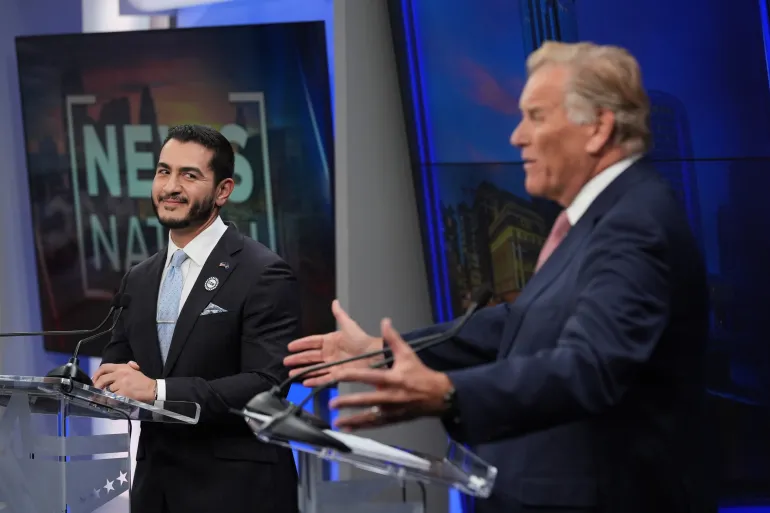
Republican nominee Mike Rogers, right, speaks during a televised debate with Democratic nominee Abdul El-Sayed [Paul Sancya/Pool via AP Photo]
Rogers insinuates El-Sayed family ties to ‘terrorism watch list’
The ferocity of the debate was underscored by the high volume of ad hominem attacks the candidates deployed against each other.
But Rogers repeatedly pushed a series of attacks that seemed to centre on El-Sayed’s identity as a Muslim.
In response to a question about healthcare, Rogers said that El-Sayed has “taken money from individuals on his campaign who openly support Hamas, Hezbollah, al-Qaeda”.
Later, when asked about his position on surveillance by Flock cameras, Rogers argued that such technology has helped catch people suspected of terrorism. He then implied that El-Sayed’s concerns about the cameras were suggestive.
“Why would that bother you?” Rogers asked El-Sayed. “Well, if you have somebody in your family that might be on the terrorism watch list …”
El-Sayed interjected, seeming to dare Rogers to continue his thought.
“Are you going to go ahead and say that I’m a – go ahead and say it,” El-Sayed said. “You’ve been tiptoeing about it the whole time. Just say it. Just say it. Go ahead and say it.”
Muslim and Arab candidates in the US have frequently been subjected to Islamophobic attacks on the campaign trail, accusing them of support for “terrorism” and Islamic fundamentalism.
Republican Mike Rogers insinuated El-Sayed may have family on the ‘terrorism watch list’ [Paul Sancya/Pool via AP Photo]
Both sides agree on ending the Iran war
There were issues, however, on which both candidates found a measure of common ground.
Both Rogers and El-Sayed agreed the US-Israeli war against Iran should end, but they had opposite views on Washington’s relationship with Israel and its role in the conflict.
High gasoline prices and inflation, El-Sayed said, were directly caused by the Iran war, and he blamed the Trump administration for Iran’s decision to shut down the Strait of Hormuz, a critical trade route.
“This is what happens when you start wars you never should be fighting,” El-Sayed said. “We literally taught the Iranian regime that they have a choke on the Strait of Hormuz, and now we’re living in that reality.”
Rogers agreed that “we need [the war] to come to an end”, but he also justified the conflict, saying that Iran’s uranium enrichment programme had been “set back twenty years”, echoing a frequent White House talking point.
The Trump administration has argued that the war was necessary to prevent Iran from creating a nuclear weapon, a goal Tehran has long denied.
Rogers’s position led El-Sayed to accuse him of “cheerleading” for the war and the Trump administration.
Democratic nominee Abdul El-Sayed pushed for an end to unconditional support for Israel [Paul Sancya/Pool via AP Photo]
Rogers backs continued Israel aid, El-Sayed calls for end
As part of the debate about US foreign policy, the candidates were also pressed on their positions about the US alliance with Israel.
The country is considered the largest overall recipient of US aid since World War II. From the start of Israel’s genocidal war on Gaza in October 2023 through September 2025, experts estimate that Israel received nearly $21.7bn in military aid.
El-Sayed has openly called for ending aid to Israel, and he has repeatedly denounced the conflict in Gaza as a genocide, in line with evaluations from United Nations experts and human rights watchdogs.
During the debate, he indicated he preferred US taxpayer dollars to be spent on domestic concerns like education and healthcare, rather than Israeli aid.
“He wants unconditional support for a foreign government,” El-Sayed said of Rogers. “I want unconditional support for kids in our schools, unconditional support for our healthcare, childcare.”
He also blamed Israel for the US military action in Iran. “I don’t want to be pushed into war by Israel, and I don’t want to be in war with Iran,” El-Sayed said.
Rogers, meanwhile, has joined most of his fellow Republicans in continuing to support aid for Israel. He argued that the country had “the right to defend itself in a very difficult neighbourhood”.
“Is there anything Israel could do that would lose your support?” the debate host asked.
“Listen, if they’re talking about using nuclear weapons, they would definitely lose my support,” Rogers replied.
Abdul El-Sayed, right, and Mike Rogers shake hands prior to their debate [Paul Sancya/Pool via AP Photo]
Another hot-button issue during the debate was Trump’s crackdown on immigration.
The Republican leader has pledged to carry out the largest mass deportation effort in US history, and his campaign has spurred human rights concerns.
When asked how they would approach the crackdown, both Rogers and El-Sayed agreed on tempering the militarised nature of the campaign.
In several cities, including Minneapolis, Minnesota, immigration authorities have been accused of racial profiling and using excessive force against immigrants and protesters, as well as violating their rights to due process.
Multiple fatal shootings have occurred during immigration enforcement operations, including the deaths of Renee Good and Alex Pretti in January.
Rogers indicated he would not have supported such confrontational operations, but he repeated a Trump claim that the raids were taking dangerous criminals off the streets.
“I think the public efforts in Minnesota were probably not appropriate,” Rogers said. “You always want to go in quiet, get the bad guy, get out of the neighbourhood for less problems. So that, to me, was something that they could have done differently.”
He later claimed that, under Trump, the country had seen “the largest decrease in murders ever recorded”.
El-Sayed, meanwhile, has previously voiced support for abolishing Immigration and Customs Enforcement (ICE), a key agency in Trump’s deportation campaign. He defended that stance on the debate stage.
“ICE right now is not about immigration enforcement. ICE is about terrorising our streets,” he said.
Mike Rogers speaks to reporters in the spin room after the debate on October 8, 2026 [Jim Vondruska/Reuters]
Candidates debate Canada trade war and tariffs
Donald Trump’s trade war with Canada, felt acutely in neighbouring Michigan, was another key topic of conversation.
El-Sayed depicted Rogers as an uncritical backer of Trump and his tariffs and tied him to past free trade deals such as the North American Free Trade Agreement (NAFTA), which paved the way for companies to shift manufacturing facilities out of the US – though Rogers did not enter Congress until 2001, eight years after NAFTA passed.
“You did that, man. That was your policy. NAFTA, that was your policy,” said El-Sayed.
Rogers sought to distance himself from the current trade war but expressed support for a deal with Canada that would loosen some of Ottawa’s tariffs on US goods.
“I would like to see the deal made,” said Rogers, adding that high Canadian tariffs for US goods “should be eliminated”.
Both candidates tried to strike a balance between criticism of the economic fallout of the trade war and qualifying their support for more selective tariffs, favoured by some industries and labour unions as a means of protecting domestic jobs.