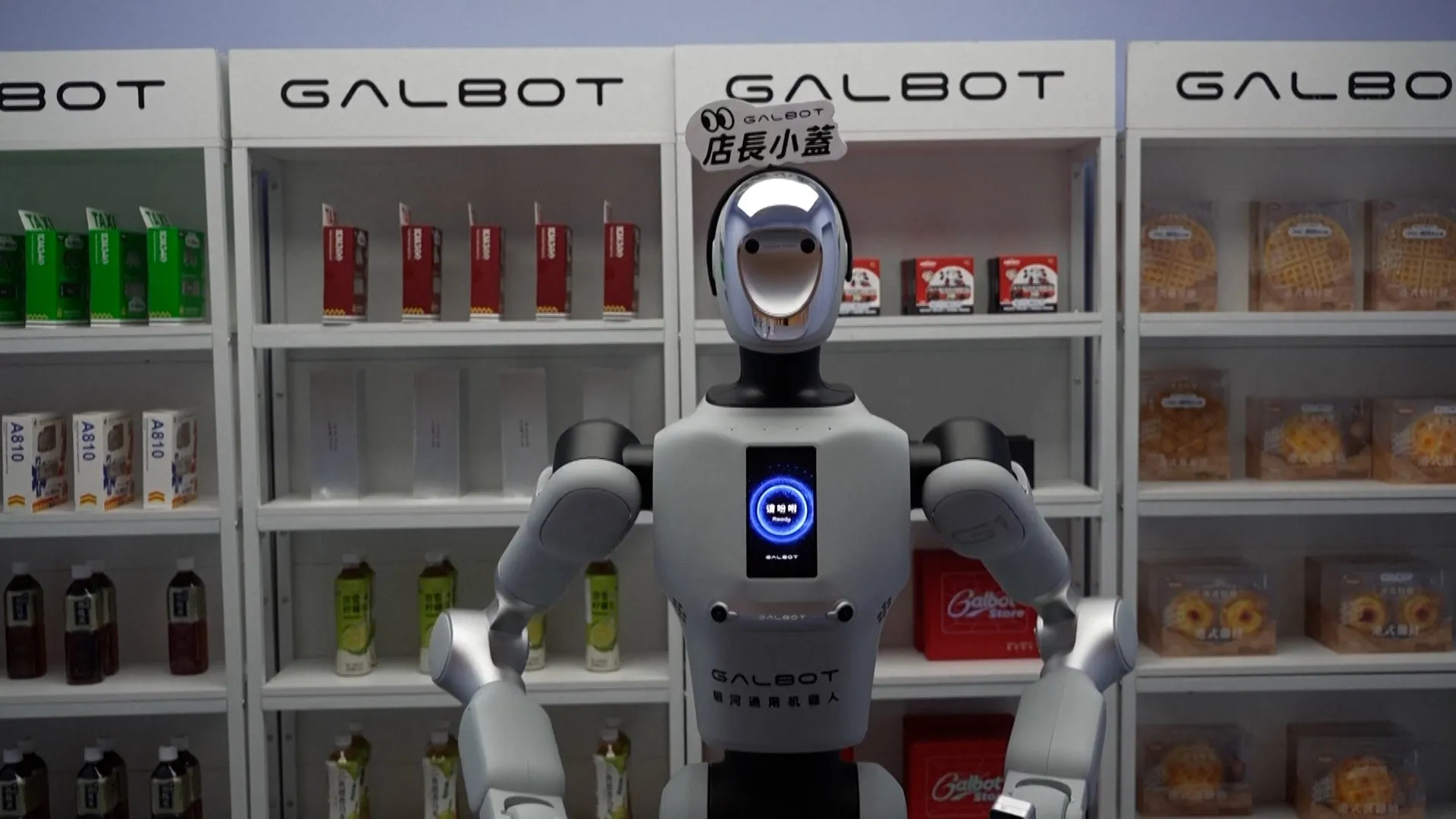
Shoppers interact with Hong Kong’s first robot shopkeeper | Technology
Humanoid robots have begun serving shoppers at convenience stores in Hong Kong. The robot, known as Xiaogai, can speak Mandarin, Cantonese and English.
Published On 5 Sep 2026
Humanoid robots have begun serving shoppers at convenience stores in Hong Kong. The robot, known as Xiaogai, can speak Mandarin, Cantonese and English.
Published On 5 Sep 20265 Sep 2026
Share
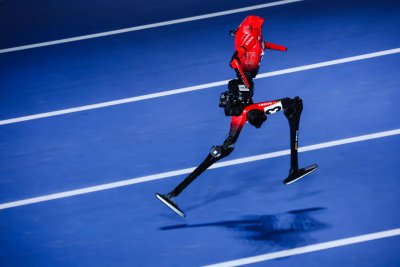

LIghtning, a Chinese humanoid robot, ran a 100-meter sprint in 9.32 seconds at the Humanoid Robot Games in Beijing, surpassing the world record set by Jamaican legend Usain Bolt. Photo by Wu Hao/EPA
Aug. 22 (UPI) — A Chinese humanoid robot on Saturday ran a 100-meter sprint in 9.32 seconds, surpassing the world record set by Jamaican legend Usain Bolt.
The robot, named Lightning and produced by robotics company Honor, reached a peak speed of 14.5 meters per second during a test run.
Lightning is one of 2,000 robots participating in the second World Humanoid Robot Games in Beijing.
The robot’s sprint on Saturday was .26 seconds faster than Bolt’s world record of 9.58 seconds, set 17 years ago at Berlin’s World Athletics Championships.
Another robot cleared 2.88 meters at the standing high jump, higher than the 2.45-meter world record set by Cuban athlete Javier Sotomayor in 1993.
The Beijing games also include competitions in tablet tennis, long jump and weightlifting.
China remains the world’s largest producer of humanoid robots.
The Trump administration in July banned imports of humanoid robots into the United States, citing “unacceptable risks” to national security.
“China firmly opposes the U.S. overstretching the concept of national security and going after Chinese companies,” Foreign Ministry spokeswoman Mao Ning told reporters.
“Protectionism does not make the U.S. more competitive and will only hurt the interests of U.S. companies and consumers,”
THREE fab theme parks, three unique experiences – which one will you pick?
From magical fairy-tale worlds to high-octane thrills and waterpark adventures, there’s something for every family.
Lifestyle Editor Catherine Bennion-Pedley and her family fell for fairy-tale fun in Kaatsheuvel.
As we whizz past trolls swinging from trees and down to the sparkling rainforest floor, the kids are completely spellbound.
From this ride, Droomvlucht, we head back into daylight to find fairies twirling around the lawn, bubbles filling the air.
Efteling is the very definition of enchanting. From musical toadstools to talking bins that suck up litter through their mouths, we find ourselves staring in awe at all the quaint details.
The Fairytale Forest brings much-loved stories to life through animatronics, and Poppy, seven, and Raffy, five, are delighted by a donkey that poos out gold coins when you pop in 50 cents.
But there are plenty of wilder attractions, too – wooden coaster Joris En De Draak feels way faster than 47mph as it swerves around corners, and Baron 1898 drops you into freefall for almost 40 metres.
Baby Switch cards mean husband Andy and I don’t need to queue twice for rides the kids are too short for, either.
Our best foodie finds in the park are the soft-serve ice creams, which cost less than £2, and hotdogs drenched in truffle mayo with parmesan and rocket, £5.50.
But it’s the Polles Keuken eatery that is unmissable, with its musical stove and huge pancakes – my favourite is stuffed with apple slices and topped with whipped goat’s cheese, candied walnuts and rocket, £15.
Opened last year, Efteling Grand Hotel is home to gorgeous art-deco interiors and luxurious bedrooms that are the antithesis of the bright and brash themed rooms at some parks.
Chocolate coins are hidden in the coffee drawer, superb Zenology toiletries are in the bathroom and there’s a sweet elf night light built into the wardrobe.
We also get early access to some rides and use of the sauna, steam room and pretty pool with its blue and white checkerboard tiles and impressive water chandelier – although it’s not a place for swimming lengths!
Brasserie 7, with its cascading faux-flower displays, serves up quality breakfasts with fizz, as well as a delicious, albeit pricey, dinner.
The greatest thing, however, are the miming piccolos, bell boys and girls dressed in cute purple uniforms, who have us giggling through mealtimes with their comedy antics.
As the rain hits on our last day, we drop by the on-site theatre to catch illusion show Magicaluna, which is packed with stunning tricks.
It sums up the Efteling experience in its final line: “You’re never too old to wonder.” Yep, this park is magic.
Stays for up to six at Efteling Grand Hotel cost from £496 B&B, including two-day park access (Efteling.com).
Acting Senior Designer Sasha Cunningham and her son enjoyed robot rides, tech storytelling and making a splash in Poitiers.
Strapped into the hand of a giant robotic arm with my eight-year-old son, we are thrust into the air, twisting, flipping and turning.
The robot’s movements synchronise with the pumping music and flashing lights on this Dance With Robots ride.
And as soon as we’re released, a beaming Oscar announces we have to do it again!
Made up of Futuroscope Xperiences and Aquascope water park, the resort is home to more than 40 attractions housed in geometric buildings.
We hop on a rollercoaster to Mars and even get swept into the eye of a tornado on a 5D adventure.
Brightly coloured playgrounds and beanbag chill-out zones line the paths, while the Futuropolis zone lets smaller ones operate their own rides.
After a morning of adrenalin rushes, we kick back in Europe’s largest 360-degree circular theatre for nature documentary Antarctica, listening to Benedict Cumberbatch’s narration on our headphones.
But it’s the Key To Dreams show that closes the park that’s our favourite, with its spectacular projections, lasers and 3D water effects.
Oscar’s mouth drops open once again as his bright-blue burger, £14, spirals down the rollercoaster tracks covering the ceiling and lands at our table.
We’re dining at Space Loop restaurant – advance booking is essential – where my pork mignon, £14.50, also arrives amazingly intact and we dive into meringue tart, £7, and candy-floss-topped sorbet, £3.50, for pud.
Just over the road is Hôtel Ecolodgee and our lakeside lodge.
Come morning, a basket with pastries, yoghurts, breads and juice is delivered to our door, and we arrive at neighbouring Aquascope for 9am to beat the crowds.
Each of the eight large indoor slides has its own theme – from sudden drops and light shows to the mega-twisty Spiral.
One of the most fun is Alien, where we’re flushed down a chute in a double ring, racing against another pair.
We also meet octopus Kraki, the star of Europe’s first aquatic cinema, before floating down a glowing lazy river.
Looking for a theme park that’s out of this world? This is it.
Stays for four at Hôtel Ecolodgee with two-day access to Futuroscope plus Aquascope tickets cost from £431 (Futuroscope.com).
Our pick on home soil gets better each year, says Lifestyle Editor Catherine Bennion-Pedley.
This place is consistently voted the UK’s fave theme park for good reason, and fun new zone Valgard: Realm Of The Vikings opened in May.
Climbing vertically up 75ft to then plunge down a 95-degree drop and be whizzed upside down makes Drakon the standout.
And while smart people pack budget-friendly picnics, the Feasting Hall does serve scrumptious chicken burgers, £11.95.
The best thing about Paultons is that an average-height seven year old can go on all the rides, and only a couple rule five year olds out.
We adore flying through the air on Flight Of The Pterosaur, hurtling backwards on Velociraptor and racing down Buffalo Falls in inflatable boats.
There’s also Peppa Pig World and a mini zoo with lemurs and flamingoes.
Close by is thatched gastropub The Potter’s Heron. Recently given a serious glow-up, it’s deceivingly huge and has a lively bar.
Bedrooms are decked out in rich colours and prints, bathrooms have rainfall showers and Bramley toiletries, and a Roberts Radio, coffee machine and home-made treats complete the package.
At dinner, highlights are a prawn and crayfish cocktail with paprika and lime mayo, £9.95, and signature pistachio soufflé, £8.95.
The kids’ chicken roulade stuffed with ham and gruyère, £7, is also a hit.
The next day, the Full English sets us up nicely for exploring the New Forest before our easy drive home.
Paultons Park day tickets cost from £43 per person over a metre tall (Paultonspark.co.uk). Family rooms at The Potter’s Heron cost from £199 per night (Pottersheronampfield.com).

THE biggest Legoland in the world has just celebrated its first birthday – and its MUCH bigger than the one in the UK.
The park in Shanghai is a whopping 318,000 square metres and it’s home to largest Lego figurine in the world.
Legoland Shanghai Resort is the only one in the country and in its first year of opening, saw two million visitors through its doors.
Aimed at families with children between 2-12 years old, the park has immersive experiences, eight themed zones and a Lego-themed hotel.

Legoland Shanghai makes an impression before visitors even enter the park thanks to its enormous Lego figure called Dada.
The figure is 26 metres tall and holds the record for the largest ever built.
It sets the tone for the theme park which has 75 attractions overall.
They are set in amongst the eight lands: Brick Street, Bricktopia, Legoland Creative World, Lego City, Lego Ninjago, Lego Friends, Lego Castle, and Lego Monkie Kid.
Rides vary but the biggest and longest rollercoaster at Legoland Shanghai is the Big Lego Coaster.
The ride actually passes through the hands of the Dada figurine and has a top speed of 52.8mph.
One unique experience the world-first water-town boat tour, which takes them on a cruise through a Chinese water town built entirely from Lego bricks.
Another first for the brand at this resort is Legoland Creative World – which allows visitors to see the largest Lego Minifigure in history.

There are also a number of live shows at Brick Street and Bricktopia.
Another attraction is a jet-ski based Water Race Challenge, there’s also boat building competitions and a ‘Beach Party’.
In the Lego Castle land, guests are transported into a magical land with wizards and dragons.
Fans of the UK’s Legoland in Windsor will be familiar with the driving school where kids can complete a circuit in their very own car and get their driving licence.
If any visitors need help, they can communicate with the world’s first AI Brick Girl Minifigure that helps visitors explore the Creative World.
And amongst all the rides and models, guests can also interact with robotic minifigures.
Guests can talk to them and according to Blooloop, they ‘respond to you in real time’.
That’s not the only part that has it’s very own AI robot – there are more at the 250-room hotel.
Called Little O, the fully interactive astronaut-themed robot talks to guests, welcomes them at check-in, shares facts and performs dances.
Inside the hotel are themed rooms like Monkie Kid and Ninjago with character meet-ups and even pyjama dance parties.
When it’s time to eat, the park has six restaurants, for example, Bricks Restaurant offers Lego-themed dining from Brick House Burgers with buns in the shape of Lego bricks, Brick fries and Apple Fries with ice cream.
Of course, there are souvenirs are everywhere, visitors can build their own Minifigures, engrave their own bricks and buy Lego sets.
As for tickets, Legoland Shanghai offers day passes from ¥300 (£33.33) and has offers like half-price one-day child ticket from ¥175 (£19.44).


