The Middle East has been a difficult region to deal with in oil markets. When it comes to energy geographies, the region has proven to be a disproportionately significant part of the world’s energy resources, with export facilities traversing a handful of maritime routes and political situations that have been tense, if not outright volatile, at times. The change in 2025 and into 2026 isn’t the nature of the forces but rather the confluence of overlapping pressures: ongoing sanctions enforcement, multiple theaters of conflict, OPEC+ tensions that are more public than ever in previous years, and disruptions to shipping in the Red Sea, which now seem to have become a semi-permanent part of the shipping route landscape.
There is no background information for commodity traders, market analysts, and energy investors. It’s a real-time, constantly evolving dynamic that can make all the difference in the day-to-day performance of prices, and it’s particularly important when prices are sliding around rapidly, and the stories behind them are changing just as fast.
The Behavior of Prices and the Risk of Middle East Supplies
The area is responsible for about one-third of the world’s crude production. That should make it significant in and of itself. What makes matters worse is that export infrastructure is concentrated in a handful of terminals, pipelines, and maritime corridors where a disproportionately large share of oil is exported. The disruption of any of them (even for a moment) reduces a large supply signal to an extremely short time frame.
Traders who follow crude oil price live data are the first ones to witness this. Real-time feeds are a reflection of more than just the fundamental supply-demand elements, but the market’s real-time assessment of the value of geopolitical risk and how much it “should” be worth at any given moment. A news event, which is a minor detail in a more stable environment, can cause future prices to move $5 or more in less than an hour. The consistent and tough question – and it is a tough one – is, which events actually have physical supply implications and which ones are sentiment-driven moves that die in a session or two?
The Strait of Hormuz
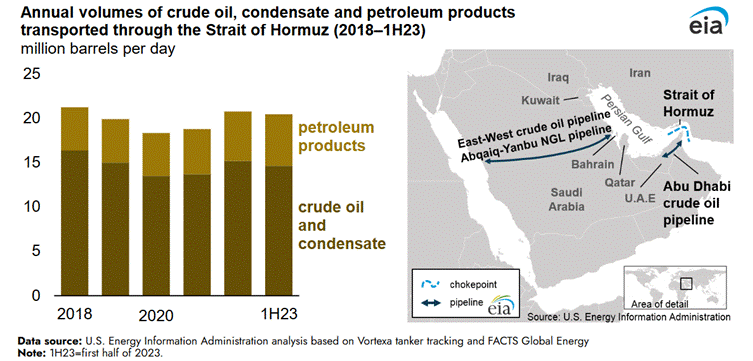
About 20-21 million barrels per day of crude oil and petroleum products go through the Strait of Hormuz, which is about 20% of the world’s oil consumption. No readily available bypasses can be found that can absorb that flow at a similar cost. There are partial alternatives, including the IPSA pipeline and Saudi Arabia’s East-West pipeline, but they would not even come close to filling the deficit should the Hormuz be closed en masse.
It is a strait between Oman and Iran. Geography makes it so that any serious disruption in U.S.-Iran relations or of security conditions in the Gulf in general puts Hormuz back on the market’s agenda. Traders are all familiar with this: when there is a lot of Iranian tension, the futures positioning will always reflect the chokepoint risk, even if there is no incident per se.
Production Outages That Don’t Make the Front Page
The issue of the supply is something that generally doesn’t get the same kind of attention it should get, but the clearest example of this recurring issue is Libya. In recent years, internal political squabbles about how to divide up oil revenues have led to several production shutdowns that have temporarily increased the tightness of the light sweet crude grades refined by European and Asian plants. The disruptions are likely to persist when there is no political agreement, and the pattern is robust. In recent years, Iraq’s export pipeline to the North through Turkey has also been down for extended periods of time. These relatively inconspicuous disruptions can add up and impact medium-term supply dynamics, though not necessarily have the same impact as a more conspicuous incident.
Key Risk Factors Shaping Market Sentiment in 2026
The Middle East is a geopolitical risk that has many variables. It’s a combination of interwoven pressures that work in various ways and to varying effects on the length of the price impact. The issues that currently have the greatest attention of serious analysts are generally of three types:
Export infrastructure and production infrastructure are currently under physical threat to production.
Sanctions regimes and the dynamics of their enforcement.
Disruption of shipping routes and attendant disruption of the trade economics.
Everything is unique, and sometimes they are not in the same direction at the same time. That’s part of what makes the current situation more complicated than any one risk headline implies.
Active Conflict Zones and Exposure to Infrastructure
The latest example of large-scale infrastructure targeting is the 2019 attack on Saudi Aramco’s Abqaiq and Khurais facilities in the country, which was carried out using drones and missiles. The loss in output occurred temporarily, amounting to about 5.7 million bpd, the largest sudden supply shock in modern oil market history. The recovery was quicker than many expected, partly because of the operational robustness of Aramco and partly because the situation was swiftly contained diplomatically. But the event has permanently changed the way markets view the vulnerability of infrastructure in the Gulf, and that repricing has not been complete.
The Persistent Iranian Supply Question
Iran’s petroleum sales have also been sustained in the face of sanctions, largely via Asian markets out of reach to Western sanctions. A full-fledged deal between Tehran and Western governments has yet to be hammered out, as of early 2026. That has left volumes of Iranian supply in a limbo of sorts: they could be rapidly reduced by stepped-up enforcement, and they could be dramatically increased by a change in diplomatic circumstances. Both of these results can have significant price consequences, and even the uncertainty can be a factor in the market without a clear decision.
Infrastructure Concentration Risk
The concentration levels in Saudi Arabia’s export system warrant a more significant focus than is generally found outside of export specialist circles. Abqaiq processes and stabilizes a huge percentage of Saudi crude before it is shipped to export terminals, removing the sulfur from it. That kind of ‘single point of failure’ is not typical in most industrial supply chains. In the case of oil, it’s a structural aspect of the market and one that has been proven, not just thought.
OPEC+ Internal Dynamics
However, OPEC+ compliance has been quite lackluster at times, notably from Iraq and Kazakhstan, which have had a history of overproduction. This gives rise to an everlasting discrepancy between OPEC+ declarations and the actual supply data. For analysts, the bottom line is that it is important not to take production decisions at face value but to also consider the track record of implementation once a deal has been agreed on to see what the real supply impact was.
Non-State Actor Activity and Shipping Friction
Since late 2023, the Houthis have started to attack commercial shipping vessels in the Red Sea more frequently, and these attacks have persisted through 2025. What those disruptions drove home is that it’s not necessary to blow a wellhead to impact oil market economics. A round-the-Cape voyage will increase the time in transit by about ten to fourteen days, as well as the fuel costs. During periods of increased Houthi activity, insurance costs for tankers traveling in the Gulf area skyrocketed. Both impacts are not a direct factor in the crude benchmarks, but both impact the effective landed cost of Middle East barrels in destination markets.
How the Market Prices Geopolitical Risk
Knowing the difference is important, as geopolitical events do not affect oil prices in a single manner. Some effects are immediate and visible: a surge in the price of Brent futures within minutes of an incident report. Others come more slowly, via changes in freight rates, changes in the repricing of insurance, and changes in buyer behavior, which may take days or weeks to be reflected in trade flow data. The rate of these impacts varies, and so do their effects.
Then there is the issue of what the market “already” had in place whether there was an event or not. When there is a constant regional tension, there is usually some risk premium in prices. The incremental market move may therefore be less than anticipated when an event then reinforces concerns, the surprise element of the event, which is typically the one that produces the biggest market moves, is already discounted.
Risk Premium in Practice
Geopolitical risk premiums in times of heightened Middle East tension have varied from around $4 to $10 per barrel, depending on the market participants’ views on the probability of actual physical supply disruptions in the case of Brent crude, according to S&P Global Commodity Insights. That’s a fairly broad window for economic trading, and it has a tendency to close up very fast when the tension subsides and without a supply event, which is the more common scenario.
The geopolitical risk premium factors analysts may consider are:
The nearness to active conflict, producing fields, or the working export terminals.
Production capacity that would be available to make up for the loss of production elsewhere.
The availability and magnitude of the IEA’s strategic stockpiles to be tapped.
Current tanker market conditions and the viability of an alternative route.
Diplomatic messages sent by governments in the area, including the United States and other great powers
Past examples of similar events, which have had identifiable supply impacts.
It is not easy to give exact weights to these inputs. Part of the reason for the price action to seemingly be different with comparable geopolitical events can be due to different analysts forming different conclusions from the same events.
Historical Supply Disruptions and Price Responses
The following table shows some of the more significant supply events that took place in the Middle East and the approximate market impact. The trend of most entries was that the first price movement has been greater than the actual physical supply effect, at times much greater, and then it has partially retraced to a more stable situation.
Event
Year
Estimated Supply Impact
Approximate Brent Price Reaction
Abqaiq/Khurais Attacks (Saudi Arabia)
2019
~5.7 mb/d temporary loss
~15% intraday spike
Libyan Civil War Output Collapse
2011
~1.4 mb/d reduction
~$20/bbl over several weeks
U.S. Re-imposition of Iran Sanctions
2018
~1-1.5 mb/d reduction
~15% sustained over several months
Iraq-Northern Field Disruptions
2014
Partial northern output loss
~$10/bbl elevated premium
Houthi Red Sea Disruptions
2023-24
Rerouting; limited direct supply loss
Moderate – primarily freight cost impact
Iran Sanctions + Red Sea Friction
2025-26
~0.8-1.2 mb/d constrained Iranian output
Persistent $4-8/bbl risk premium in Brent
The 2025-2026 entry is a more diffuse form of market pressure than those acute events listed above. It is not one particular incident, but rather sanctions enforcement and Iranian volumes kept low and shipping activity in the Red Sea continuing to cause friction in the transport system, which has kept transport costs elevated. The World Economic Outlook from the IMF pointed out that this type of persistent supply constraint is likely to have a longer-lasting impact on medium-term price expectations than acute supply shocks, which markets have historically been able to absorb and turn around in relatively short periods of time. Thus, a slow-burning risk premium can be more ‘sticky’ than a dramatic risk premium.
Broader Market Implications
Crude oil benchmarks are not the only place where supply risk from the Middle East exists. It extends out to related markets in ways that are not always apparent when the world’s focus is on the Brent or WTI headline price.
The second-order victim is likely to be refined product markets. In times of crude supply shortages or increased uncertainty, refinery margins and regional product availability may be affected to a greater extent, and the effects on end consumers may be magnified, especially in regions where there is little local refining or a high concentration of import logistics. The energy crisis of 2022 in Europe was a prime example of how the upstream pressure to supply energy flows through the downstream more quickly than most market players would have thought.
Other segments of the market that are impacted by increased supply risks in the Middle East are:
Tanker freight rates, which can also rise sharply without reference to crude prices during times of major-scale rerouting.
In oil-dependent economies, currency markets can be affected by changes in the prices of the oil that the state supplies, which change expectations of fiscal revenue and sovereign credit risk.
LNG markets with some short-term fuel switching demand in the exposed economies as a result of regional geopolitical pressure.
In agricultural commodity markets, where there is known overlap between energy input costs and food production, processing, and transport economics
Strategic Reserve Releases (SRRs) as a Counterweight
During the IEA’s coordinated strategic reserve release in 2022, it was seen that policy tools are in place to mitigate short-term supply shocks and that they can be implemented on a material scale when political conditions are right. However, there are drawbacks to those processes. During that time, reservoir levels were lowered significantly, and a rebuild takes time. There are also doubts about the effectiveness as a deterrent because, over time, markets will factor in the possibility of a release during the next big disruption event, effectively canceling the effect of a release in advance.
Geopolitical Risk Analysis: What It Does and Doesn’t Accomplish
It’s easy to fall into the temptation, because of the amounts of money potentially involved, of viewing geopolitical risk analysis as a predictive tool. It generally lacks it there. It’s actually helpful for comprehending markets and its actions, as well as for charting structural weaknesses that are price-relevant. What it doesn’t do well is tell you when an event will happen, or how big the market’s reaction will be when it does.
Instead of getting lost in qualifications, the specific limitations should be called out:
Escalation and de-escalation are non-linear and unpredictable to a great extent. Conflict situations that appear to be intractable can be solved in a flash, and stable times can fall apart in an instant. Both directions remain silent and don’t herald themselves.
When demand for a commodity is the same, the market price may be quite different in the two market conditions. There are interactions between the geopolitical trigger and positioning, sentiment and open interest that are not modelable in advance.
Secondary effects (such as freight repricing, product supply shifts and insurance cost changes) happen at varying rates to the initial crude price move, and thus the total impact of the market is more difficult to gauge in real time.
Analytical path dependency can occur when geopolitical narratives set up a framework that later information gets filtered through, without being recognized as such.
All this does not negate the analysis. It’s about calibration and about honesty when the power of explanation runs out, and speculation sets in.
Conclusion
Middle East supply risk is not a succession of shocks that will come and go and be completely addressed but rather a structural state in global oil markets. The combination of production weight, geographic concentration of export infrastructure, and political complexity of the region always comes with a certain level of supply uncertainty as a base case. The level of that uncertainty and the extent to which that uncertainty is priced into securities on a given day are what change.
The hard part for traders, analysts, and energy investors is not recognizing that there is risk – that’s obvious. It’s gaining a good enough sense of what matters most at a given moment, what the big picture supply-demand dynamics are, and at what point a careful study of the facts begins to look like well-informed guesswork. The clear understanding of that boundary is, in fact, probably more valuable than any single analytical framework that can be applied to the boundary.
Disclaimer
This article is provided for informational and educational purposes only. It does not constitute financial advice, investment advice, or a recommendation to buy, sell, or hold any financial instrument, commodity, or derivative product. Trading in energy markets, including crude oil futures, CFDs, and related instruments, involves substantial risk of loss, including the possible loss of capital invested. Past market behavior and historical price patterns referenced in this article are not reliable indicators of future performance. Geopolitical developments described may not materialize as anticipated or may evolve in ways that differ materially from historical precedent. Readers should conduct their own independent research and consult a qualified financial professional before making any investment or trading decisions. Nothing in this article should be interpreted as a trading signal, directional market recommendation, or endorsement of any specific trading approach.
Western governments are pouring tens of billions of dollars into critical minerals projects as they attempt to reduce dependence on China for materials essential to clean energy, defence technology and advanced manufacturing.
But industry executives, analysts and investors are increasingly warning that poorly coordinated state-backed investment could create severe oversupply problems similar to past commodity booms that ended in market crashes.
The concerns come as countries including the United States, Australia, European Union and Japan accelerate efforts to build strategic reserves and expand production of rare earths and other critical minerals.
Governments Ramp Up Critical Minerals Spending
The United States has committed more than $20 billion toward critical minerals development through multiple financing programmes, including Project Vault, a strategic stockpiling initiative worth around $10 billion.
Australia has also allocated at least A$13 billion to support critical minerals projects and reserves through several government-backed programmes.
These investments are designed to secure supplies of metals used in electric vehicles, semiconductors, renewable energy systems, aerospace equipment and military technologies.
Particular attention has focused on rare earth elements, a group of 17 metals essential for producing powerful magnets used in advanced defence systems and high-tech manufacturing.
Although the global rare earths market was valued at only about $6.4 billion in 2024, combined Western financial commitments to rare earth projects have already exceeded that figure.
Fears Grow Over Potential Oversupply
Mining executives and analysts warn that aggressive subsidies and overlapping national strategies could eventually flood global markets with excess supply.
Brett Beatty of Resource Capital Funds said the biggest danger lies in governments pursuing independent strategies without coordination.
According to Beatty, simultaneous efforts to rapidly increase production could create volumes far beyond global demand, ultimately crushing prices and undermining the very industries governments are trying to build.
Analysts drew comparisons to historical commodity gluts, including Europe’s “butter mountains” of the 1980s, Russian aluminium oversupply and Australia’s wool crisis, where subsidies and state support distorted markets and triggered sharp price collapses.
Rare Earth Market Could Face Surplus Pressures
Consultancy Project Blue warned that several rare earth markets are already on track to move into surplus over the coming years due to expanding state-backed production.
However, analyst David Merriman said governments may still be able to avoid major imbalances if they carefully adjust subsidies, stockpiling programmes and guaranteed purchasing arrangements.
Industry leaders say current stockpiles remain relatively small, limiting immediate risks of market disruption.
Lynas Rare Earths CEO Amanda Lacaze recently said rare earth stockpiles around the world remain modest and are not yet large enough to destabilise markets.
Australian Resources Minister Madeleine King also argued that today’s critical minerals policies differ significantly from past commodity intervention failures because they are more targeted and linked to long-term industrial supply chains.
Global Coordination Emerging Among Western Allies
Concerns about duplication and oversupply are pushing Western governments toward greater policy coordination.
The Group of Seven is reportedly discussing the creation of a permanent secretariat focused on coordinating critical mineral strategies and ensuring continuity between rotating national presidencies.
Industry experts say such coordination could help prevent destructive competition between allied nations while supporting more stable investment planning.
Lessons From Congo and Indonesia
Governments outside the West have already experimented with aggressive intervention in mineral markets.
The Democratic Republic of the Congo boosted cobalt prices by introducing export quotas and stockpiling measures designed to increase mining revenues.
While the policy initially lifted prices, analysts warn prolonged restrictions could encourage manufacturers to seek alternative materials or suppliers.
Similarly, Indonesia dramatically expanded its dominance in nickel production after banning exports of raw nickel ore in 2020 to force domestic processing investment.
Indonesia’s production surged within just a few years, but authorities have since struggled with falling prices and oversupply, forcing Jakarta to tighten mining quotas and centralise export controls.
These examples highlight the difficulty governments face in balancing national industrial ambitions with long-term market stability.
Analysis
The global race for critical minerals is increasingly becoming a strategic contest shaped as much by geopolitics as by economics.
Western governments view supply chain independence as essential after years of relying heavily on China for processing capacity and rare earth production. The push is not simply about commercial competition — it is tied directly to national security, technological leadership and energy transition goals.
However, the very scale of state intervention now unfolding raises the risk of creating distorted markets. If multiple governments simultaneously subsidise production, guarantee prices and build stockpiles without coordination, supply could rapidly outpace actual industrial demand.
That scenario would likely trigger sharp price declines, weaken private investment and potentially create another boom-and-bust cycle in the mining sector.
At the same time, the market dynamics of critical minerals differ from traditional commodities. Many of these materials are essential for emerging technologies, and demand is expected to rise significantly over the next two decades as countries expand renewable energy infrastructure, battery production and semiconductor manufacturing.
This means governments are not only competing to secure supply today but also positioning themselves for future industrial dominance.
Another key challenge is that refining and processing capabilities remain heavily concentrated in China. Even if Western countries succeed in expanding mining output, they may still depend on Chinese infrastructure unless domestic processing networks are developed alongside extraction projects.
The growing emphasis on “friend-shoring” and allied supply chains reflects an attempt to address this vulnerability.
Industry experts also point to a more sustainable model emerging through byproduct extraction. Instead of building entirely new mines based purely on high prices, companies are increasingly looking to recover critical minerals from existing industrial operations, reducing the risk of uncontrolled supply growth.
Projects involving Alcoa, Sojitz and Trafigura illustrate how governments and corporations are experimenting with lower-risk approaches to expanding supply.
Ultimately, the success of Western critical minerals strategies may depend less on how much money governments spend and more on whether they can coordinate policies, manage supply carefully and build integrated processing ecosystems capable of competing with China over the long term.
Here’s everything UK holidaymakers need to know before heading there this summer, from entry requirements to taxi use and dress code
Sonia Sharma Multi-Media Journalist and Rachel Vickers-Price UK and World News Reporter
01:15, 25 May 2026
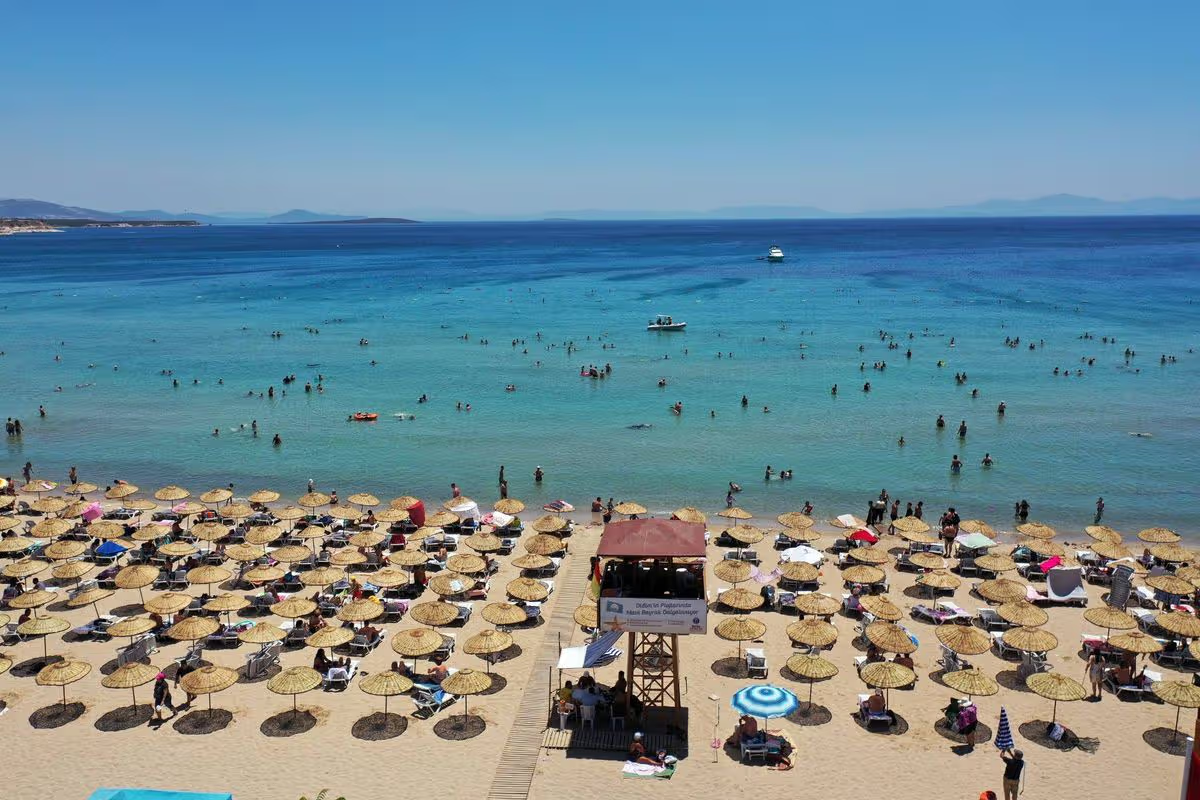
Anyone planning to go to Turkey is being urged to brush up on passport rules(Image: Ferdi Uzun/Anadolu via Getty Images)
Turkey remains a firm favourite amongst British holidaymakers, with thousands of people flying out to the country each year. Anyone planning a trip there this year is strongly advised to familiarise themselves with all current travel guidance and any warnings in place.
The UK Foreign, Commonwealth and Development Office (FCDO) provides a wealth of information on its website, covering countries across the globe. It’s an invaluable resource for anyone with holidays booked or considering travelling abroad, reports Chronicle Live..
The Foreign Office states: “If you choose to travel, research your destinations and get appropriate travel insurance. Insurance should cover your itinerary, planned activities and expenses in an emergency.” It also cautions: “Your travel insurance could be invalidated if you travel against advice from the Foreign, Commonwealth and Development Office (FCDO).”
Warning over Turkey- Syria border
The FCDO advises against all travel to within 10km of the border with Syria due to ongoing fighting and an increased risk of terrorism. The FCDO states: “Fighting in Syria continues in areas close to the Turkish border and there is a heightened risk of terrorism in the region. Due to the ongoing conflict in Syria, roads in Hatay Province leading towards the border may be closed at short notice.”
Entry requirements
To enter Turkey, your passport must have an ‘expiry date’ at least 150 days beyond the date you arrive and at least one blank page. If you’re entering at a land border, ensure officials stamp and date your passport at the border crossing.
The FCDO says: “Check with your travel provider that your passport and other travel documents meet requirements. Renew your passport if you need to. You will be denied entry if you do not have a valid travel document or try to use a passport that has been reported lost or stolen.” You can visit Turkey without a visa for up to 90 days within any 180-day period, for business or tourism purposes.
Political situation
The Foreign Office states: “Regular demonstrations and protests are currently taking place in Istanbul and other cities across Turkey. Demonstrations may become violent. The police response has included use of tear gas and water cannons.
“Events in Israel and Palestine have led to heightened tensions in the region and in locations across Turkey. Demonstrations continue to occur outside diplomatic missions connected to the conflict in major cities, particularly Israeli diplomatic missions in Ankara and Istanbul. Avoid all demonstrations and leave the area if one develops. Local transport routes may be disrupted.”
Drink and food spiking
The FCDO warns: “Be wary of strangers approaching you to change money, or to take you to a restaurant or nightclub. If strangers offer you food and drink these could be spiked. Buy your own drinks and always keep sight of them.”
Holidaymakers are being cautioned that there have previously been instances of severe illness caused by alcoholic beverages containing methanol in popular tourist destinations across the globe. The FCDO says: “In Turkey, including Ankara and Istanbul, people have died or suffered serious illness after drinking illegally produced local spirits and counterfeit bottles of branded alcohol.
“Even small amounts of methanol can kill. It is not possible to identify methanol in alcoholic drinks by taste or smell. See Travel Aware Drink Spiking and methanol poisoning for information about how to reduce the risks. Seek urgent medical attention if you or someone you are travelling with show the signs of methanol poisoning after drinking.”
Taxis The website says: “Accepting lifts from drivers of unofficial taxis is highly risky. Find a registered taxi, note the registration number before entering and ensure the fare is metered. App-based taxis and pre-booked taxis are also widely available.”
Carry your ID
It is illegal not to carry some form of photographic ID in Turkey. Always carry your passport or residence permit. In some busy areas, especially Istanbul, the authorities may stop people for ID checks. There are also several police checkpoints on main roads across Turkey. Cooperate with officials conducting checks.
Dress code
Holidaymakers are also given guidance on appropriate attire. The FCDO advises people to “dress modestly if you’re visiting a mosque or a religious shrine to avoid causing offence”.
Stray dogs
The Foreign Office says: “Most towns and cities have stray dogs. Packs congregate in parks and wastelands and can be aggressive. Take care and do not approach stray dogs. If you’re bitten, get medical advice immediately. Rabies and other animal borne diseases are present in Turkey.”
Rules over sale of antiquities
Purchasing or exporting antiquities is prohibited. You could face a fine and a prison sentence of 5 to 12 years. Certain historical items found at local markets and in antique shops may be sold within Turkey but are forbidden from being exported. Always verify the status of antique items before making a purchase.