This photo, taken Tuesday, shows the trading room of Hana Bank in Seoul as South Korean stocks rose by almost one percent as investors watched for a resumption of U.S.-Iran talks. Photo by Yonhap
South Korean stocks ended nearly 1 percent higher Tuesday, led by gains in technology shares, as investors watched for a possible resumption of U.S.-Iran talks in Qatar aimed at easing tensions in the Strait of Hormuz. The Korean won weakened against the U.S. dollar.
The benchmark Korea Composite Stock Price Index (KOSPI) gained 81.83 points, or 0.97 percent, to close at 8,476.47.
Investor sentiment improved after the United States and Iran were set to resume talks in Qatar aimed at easing tensions in the Strait of Hormuz, alleviating concerns over a prolonged disruption to global oil supplies.
Overnight, Wall Street rebounded sharply as investors returned to tech stocks.
The Dow Jones Industrial Average gained 0.59 percent to close at a record high, while the Nasdaq composite jumped 2.07 percent and the S&P 500 advanced 1.18 percent.
Crude prices rose modestly as investors monitored implementation of the U.S.-Iran peace framework.
Trade volume was moderate at 444.61 million shares worth 41.08 trillion won (US$26.51 billion), with losers outnumbering losers 621 to 261
Institutions and individuals bought a net 2.93 trillion won and 833.45 billion won worth of shares, respectively, while foreigners sold a net 3.79 trillion won.
“Investors scooped up semiconductor shares following recent losses, while IT infrastructure and electricity stocks rose on hopes for major investment in semiconductor infrastructure in the southwestern region announced by the government and chipmakers,” said Lee Kyoung-min, an analyst at Daishin Securities.
Tech shares lifted the overall market.
Market bellwether Samsung Electronics rose 3.41 percent to 334,000 won, and chip giant SK hynix gained 0.84 percent to 1.65 million won. SK Square, the parent of SK hynix, advanced 3.48 percent to 1.69 million won.
Chip components maker Samsung Electro-Mechanics jumped 7.16 percent to 1.18 million won after announcing a 454 billion-won supply deal for multilayer ceramic capacitors (MLCCs) for artificial intelligence servers to a U.S.-based customer.
Battery shares retreated on profit-taking after sharp gains the previous session.
LG Energy Solution plunged 9.61 percent to 362,000 won, and its smaller rival Samsung SDI sank 4.88 percent to 487,000 won.
The Korean won was quoted at 1,549.4 won per U.S. dollar as of 3:30 p.m., down 4.2 won from the previous session.
Copyright (c) Yonhap News Agency prohibits its content from being redistributed or reprinted without consent, and forbids the content from being learned and used by artificial intelligence systems.
Brent crude edges up as tit-for-tat strikes imperial return to normality in key waterway.
Published On 29 Jun 202629 Jun 2026
Oil prices have climbed following the latest flare-up in hostilities between the United States and Iran.
Brent crude, the primary international benchmark, rose about 0.9 percent on Monday after tit-for-tat US and Iranian strikes over the weekend renewed doubts about a return to normal shipping in the Strait of Hormuz.
Recommended Stories
list of 4 itemsend of list
Brent futures for August delivery stood at $73.21 a barrel as of 03:30 GMT, 127 cents higher than the day before the US and Israel launched their war on Iran on February 28.
“Brent’s partial rebound this morning reflects a market that had perhaps run too quickly on ceasefire optimism,” Fabien Yip, a market analyst at IG in Sydney, Australia, told Al Jazeera.
“Oil had nearly unwound its entire war premium, despite an MoU with no enforcement details and ongoing strikes. Thursday’s attack on a commercial vessel was a reality check, and this weekend’s tit-for-tat exchanges have compounded that,” Yip said.
Asian stock markets were mixed on Monday morning, with losses in Tokyo and Seoul and gains in Hong Kong and Taipei.
Japan’s benchmark Nikkei 225 was 0.7 percent lower, while South Korea’s Kospi was down 1.9 percent.
Japanese and Korean stocks tied to the AI boom saw some of the biggest losses amid heated debate about whether tech firms’ massive investments in the emerging technology will pay off.
Japanese tech giant SoftBank Group fell about 5 percent, while Advantest Corporation, a key maker of semiconductor testing equipment, slumped 3.7 percent.
South Korean memory chip giants Samsung Electronics and SK Hynix dropped about 5 percent and 4 percent, respectively.
Hong Kong’s benchmark Hang Seng Index and Taiwan’s Taiex both rose, gaining 2.2 percent and 1.4 percent, respectively.
“Quarter-end profit-taking is adding to the selling pressure, with investors locking in gains from what has been a remarkable run. The Kospi is up roughly 95 percent this year, and the Nikkei up 37 percent,” IG’s Yip said.
“The underlying concern, however, is whether the AI boom can continue to translate into sustained earnings growth, or whether margin pressure is arriving sooner than the market anticipated.”
US Central Command announced strikes against Iran on Friday and Saturday, citing Iranian attacks on two commercial vessels in the Strait of Hormuz, which in peacetime serves as a conduit for about one-fifth of the global trade in oil and liquified natural gas.
Iran responded to the strikes by launching a series of missiles and drones targeting US military assets in Bahrain and Kuwait.
Washington and Tehran agreed to cease their attacks and renew their negotiations on ending the war, multiple media outlets reported late on Sunday, citing unnamed US officials.
Axios, citing an unnamed senior US official, reported that the sides would hold talks in Doha, Qatar, on Tuesday.
Iran has yet to comment on the reported agreement to cease hostilities or the planned talks.
US President Donald Trump and Iranian President Masoud Pezeshkian signed a memorandum of understanding to end the war on June 17, but the agreement has repeatedly come under strain due to flare-ups in hostilities and disagreements about the meaning of the text.
Artificial intelligence is increasingly being used in the military for planning and operations as a decision support tool at multiple stages. The US’s use of Anthropic’s Claude model against Iran marks a significant moment in the history of warfare. Integrated via Palantir’s Maven Smart System, AI-supported intelligence analysis, target identification, and operational simulations enabled planners to process information faster than human capabilities. While analysts have framed this as an “AI war,” the more significant shift lies in the growing influence of algorithmic systems in shaping military decision-making architectures.
Admiral Brad Cooper, who led Operation Epic Fury, said that AI systems processed massive amounts of intelligence and surveillance data, allowing commanders to gain insights within seconds. This is part of a wider movement to shift more complex intelligence tasks to algorithmic systems, raising questions about transparency, oversight, and reliance on algorithmic assessments.
This is also observed in other conflict zones, but in different operational roles. In Gaza, Israel’s Lavender system, developed by Unit 8200, assisted in the targeting of 37,000 suspected individuals, based on reported affiliations, using AI. Structural strikes and real-time tracking were made possible through the use of additional tools like “The Gospel” and “Where’s Daddy?” These systems reduced human review into quick, seconds-long “stamp of approval” decisions, moving targeting to machine-driven validation. In Ukraine, AI tools were used to assist in drone operations and battlefield analysis by training datasets. Initial programs, like Project Maven, relied on manually labeling 150,000 images. Currently, the Brave1 has enabled over 100 defense-tech firms to train combat AI on millions of annotated images from ongoing missions to improve these AI models.
The modern battlefield produces unprecedented volumes of data from interwoven sensor networks, drones, satellite imagery, and localized communications streams. This information comes at high speed and volume, which can overload the human brain. AI is being used to deal with this information overload, but there are concerns about the accuracy of AI-driven assessments and how much human oversight might be required to rely on AI. Military officials emphasize that humans have the final authority, but systematic integration poses challenges to oversight quality. The other predicament is automation bias, a psychological phenomenon in which a human operator, particularly under pressure or high stress, is likely to rely on the system’s recommendations. Therefore, striking a balance between speed and responsibility, ethical judgment, and accountability in the use of force is a key challenge.
Stay ahead of the geopolitical week.
MD Briefing delivers expert analysis across five global fronts — the Indo-Pacific, energy, geoeconomics, European security, and the Middle East — every Monday morning. Free.
Another area of concern pertains to legal and ethical issues. International humanitarian law is based on the principles of distinction, proportionality, and precaution. With the growing use of AI in military operations, it becomes more difficult to apply these principles, thereby making accountability and scrutiny more difficult. The International Committee of the Red Cross has warned that, when algorithmic systems provide input for analysis, targeting, or operational planning, it is hard to assign responsibility for any errors. Even with humans “in the loop,” the black-box nature of machine learning limits transparency and complicates legal review. It is not just a theoretical problem; it has been seen in practice. In the early US campaign against Iran, an AI-assisted missile struck a girls’ school near an IRGC compound, killing 120 children, likely due to a classification error. Anthropic’s CEO’s admission of limited awareness over Claude’s use in the strike highlights a broader issue. AI developers are fully aware of the risks associated with delegating autonomous functions to AI, yet they continue to promote its adoption. As AI assumes greater decision-making roles, concerns over misidentification and the possibility of AI acting against human directives are often overshadowed by narratives emphasizing its benefits.
For Pakistan, these developments are neither distant nor theoretical. In a region where crises can escalate quickly, AI-enabled decision support offers advantages but also carries risks. It improves situational awareness and accelerates analysis but compresses decision time, limits verification, and heightens the risk of miscalculation. Considering both, Pakistan is accelerating efforts to build AI capacity and strengthen its supporting infrastructure. At the policy level, this translates to a recognition that successful adoption is not just about adopting algorithms but about enhancing data governance, institutional maturity, and a skilled workforce capable of embedding AI into decision-making processes. Thus, Pakistan’s approach remains focused on leveraging AI to bolster human judgment in intelligence fusion, surveillance, logistics, and cyber defense.
There is a clear lesson from the academic literature and initial operational experience: algorithmic systems are transforming military information processing. However, as their role in decision-making grows, they also entail bias, error propagation, lack of transparency, and overreliance on machine-generated recommendations. AI, therefore, must be used as a support system, with humans retaining final decision-making responsibility. This requires investment in training, auditability, and institutional safeguards to ensure that human decision-makers are meaningfully engaged, rather than merely present in form. The future of warfare will likely be defined not by machines acting alone, but by humans making increasingly time-pressured decisions shaped by machine-generated insights. The central strategic challenge is not whether to adopt algorithmic tools, but how to ensure that their speed never outpaces sound judgment.
When Morocco reached the semi-finals of the 2022 FIFA World Cup, the achievement immediately transcended the boundaries of sport. It was the first time an African and Arab national team had reached that stage of the tournament. Yet what drew the greatest attention from international observers was not simply the result itself, but the way it confirmed changes that had already been unfolding elsewhere.
Football rarely exists in isolation. The fortunes of a national team often reflect deeper developments in governance, investment, youth development, and a country’s capacity to pursue long-term objectives. Morocco’s World Cup campaign brought into focus the broader transformation of a nation whose international profile has steadily expanded through diplomacy, infrastructure development, strategic investment, and regional cooperation.
That distinction matters. The World Cup did not create a new geopolitical reality for Morocco; it revealed one that had already taken shape. For several weeks, hundreds of millions of viewers encountered a Morocco that differed from the image long associated with the Kingdom. To many, Morocco had primarily been known as a tourist destination, a close European partner, or a North African state. Qatar 2022 introduced another image: a country capable of competing with football’s traditional powers, rallying a global diaspora, and projecting ambitions that extend well beyond its immediate neighborhood.
The scale of that exposure helps explain why the tournament proved so consequential. The 2022 FIFA World Cup reached an estimated audience of more than five billion people across television and digital platforms, giving Morocco a level of global visibility that few international events could ever provide.
Stay ahead of the geopolitical week.
MD Briefing delivers expert analysis across five global fronts — the Indo-Pacific, energy, geoeconomics, European security, and the Middle East — every Monday morning. Free.
This evolution reflects broader changes in the international system. Throughout much of the twentieth century, a state’s influence was measured primarily through military capabilities, economic strength, and diplomatic reach. While these pillars remain essential, they cannot fully explain how a country’s international image is shaped. In an era shaped by digital communication and instantaneous information flows, the ability to capture global attention, generate narratives, and engage international audiences has become another source of influence.
Football occupies a unique position within that landscape. No other sport crosses cultural, linguistic, and geographic boundaries with comparable ease. A World Cup captures the attention of governments, businesses, media organizations, and public opinion all at once. For several weeks, it places a country under a level of global scrutiny that no public diplomacy campaign could realistically achieve.
Morocco benefited from that exposure in remarkable fashion. Victories over Belgium, Spain, and Portugal naturally attracted worldwide attention. Yet the significance of Morocco’s campaign also lay in what it revealed about the Kingdom’s distinctive position at the intersection of multiple geopolitical spaces. Throughout the tournament, the Atlas Lions received support far beyond their domestic fan base. Celebrations unfolded across cities in Africa, the Arab world, and Europe. Those scenes illustrated something analysts had long observed but rarely witnessed so vividly: Morocco simultaneously belongs to several geopolitical spheres.
The team’s appeal was not built on sporting success alone. It also rested on a moral and ethical capital that substantially strengthened its international standing. Across much of the Global South, Morocco came to embody the possibility that a nation operating outside football’s traditional centers of power could challenge the established hierarchy without abandoning values deeply rooted in its own identity. Images of players embracing their mothers after victories, the importance given to family, and the respect shown toward opponents throughout the tournament resonated in ways that athletic performance alone rarely achieves.
Competitiveness, humility, and attachment to deeply held values combined to create a powerful sense of identification. That helps explain why Morocco inspired support far beyond its own borders.
Looking back, the 2022 World Cup stands out as a genuine turning point. It did not, by itself, redefine Morocco’s place in the world. What it did accomplish was introducing much of international public opinion to a modern Morocco—confident in its identity, proud of its history, and already engaged in a far-reaching process of transformation.
When Performance Becomes an International Language
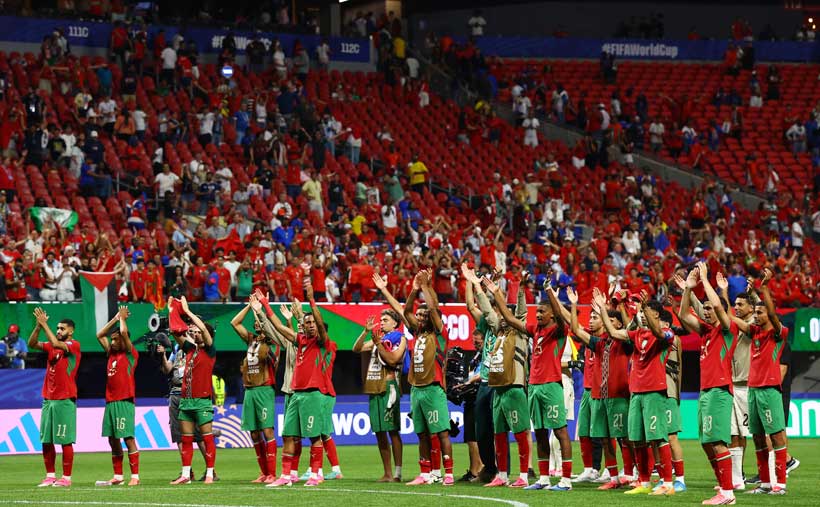
Morocco’s 1–1 draw with Brazil at the 2026 FIFA World Cup lends itself to a reading that reaches well beyond football. For decades, African national teams were largely viewed through the prism of isolated upsets against the sport’s established powers. Morocco now appears to have moved beyond that perception. Consistent results over several years have established the image of a team capable of competing regularly with the world’s elite.
This evolution reflects a broader pattern often found in international affairs. A country’s status rarely changes because of a single success. It changes when success ceases to be viewed as exceptional. The result against Brazil therefore says less about an unexpected sporting achievement than about Morocco’s growing place within world football’s established hierarchy.
The real shift is not that Morocco earned a result against Brazil. It is that such a result has become part of normal expectations.
The Foundations of Influence
Morocco’s growing stature on the football field is also the product of sustained investment in talent development. The Mohammed VI Football Academy has become one of the clearest expressions of that long-term strategy. With some of Africa’s most advanced training facilities, an integrated sports medicine center, and highly qualified coaching staff, the academy has helped build a generation of players capable of competing in the world’s leading leagues. The objective has never been limited to short-term success. It has been to establish the conditions for Moroccan football to remain competitive over time.
The success of this development model now extends well beyond the senior national team. Morocco won its first FIFA U-20 World Cup by defeating Argentina 2–0 in the final of the 2025 tournament in Chile. This dynamic illustrates the depth of the country’s football structure and suggests that recent achievements are part of a broader trajectory rather than an isolated cycle. The ability to produce successive generations of highly competitive players has become one of the defining features of Moroccan football.
Few countries possess the ability to inspire such diverse audiences. Morocco’s history, geography, and human ties connect it simultaneously to Africa, Europe, the Arab world, the Mediterranean basin, and, increasingly, the Atlantic community. Football has made that distinctive position visible in a way that few other instruments could.
A broader picture also emerges. Morocco’s achievements on the pitch have encouraged many foreign observers to look beyond football and discover a country they previously understood only in part. Behind the national team stands a state investing heavily in modern infrastructure, expanding its international partnerships, and strengthening its role across Africa while deepening its engagement throughout the Mediterranean.
Football has become one of the clearest expressions of that broader trajectory. It has drawn international attention to developments that were already reshaping the country.
It likewise strengthens one of Morocco’s most effective sources of soft power. Without replacing diplomacy, economic policy, or cultural outreach, football helps shape how the Kingdom is perceived abroad. Sporting success, world-class infrastructure, the organization of international competitions, and the presence of Moroccan players in Europe’s leading clubs all enhance the country’s visibility among audiences that may have little direct interest in political or economic affairs. Football has therefore become another instrument through which Morocco projects influence beyond its borders.
In today’s international environment, influence is measured not only by the ability to deter, but also by the capacity to inspire, attract, and unite. A successful national team can sometimes do more to strengthen a country’s international standing than demonstrations of hard power that no one hopes to witness.
Football, however, does not operate in a strategic vacuum. Its impact forms part of a broader national trajectory in which diplomacy, economic policy, institutional reform, and international partnerships reinforce one another.
Morocco’s return to the African Union in 2017, the expansion of its economic engagement across Sub-Saharan Africa, the implementation of major strategic infrastructure projects, and the consolidation of its diplomatic position on several regional issues all reflect a broader transformation whose significance extends far beyond sport.
The same pattern is evident in Morocco’s ability to organize major sporting events. The Africa Cup of Nations confirmed the results of years of investment in stadiums, transportation networks, and supporting infrastructure. Tournament management, logistical coordination, hospitality, and operational efficiency demonstrated capabilities already visible in other sectors of national development. The experience further strengthened Morocco’s credibility within international sporting institutions while reinforcing its reputation as a country capable of hosting events of global significance.
From Recognition to Projection
Against this backdrop, the decision to award the 2030 FIFA World Cup jointly to Morocco, Spain, and Portugal carries particular importance. Beyond its symbolic value, the decision reflects confidence in Morocco’s organizational capacity and in the institutional ecosystem that has been developed over many years.
In addition, the tournament carries a broader civilizational meaning. Its Moroccan, Spanish, and Portuguese framework creates a new narrative connecting Africa, Europe, the Mediterranean, and the Atlantic. For Morocco, this configuration reinforces the image of a country located at the intersection of these spaces and capable of transforming geography, history, and culture into instruments of dialogue, visibility, and influence.
Hosting one of the world’s most watched events requires more than modern stadiums. It demands political stability, efficient institutions, and the ability to coordinate complex operations over an extended period.
For that reason, the 2030 World Cup represents far more than another sporting milestone. It will serve as a large-scale test of credibility as well. For several weeks, Morocco will be observed by billions of viewers, thousands of businesses, and hundreds of official delegations. Few international events offer such an opportunity to showcase a country’s transformation before a truly global audience.
Morocco’s experience reflects another broader international trend. An increasing number of states now use major sporting events to support their integration into global political and economic networks. China’s Olympic Games, Qatar’s hosting of the 2022 FIFA World Cup, and Saudi Arabia’s expanding sports strategy all illustrate this evolution. Sport has become a platform through which countries project national ambition and shape how they are perceived abroad.
Morocco’s trajectory nevertheless stands apart. Unlike countries whose sporting influence depends primarily on financial resources, Morocco benefits from a combination of history, geography, and culture that allows it to engage multiple regions simultaneously. Few countries occupy such a position. At a time when the international system is increasingly fragmented by geopolitical rivalries, economic competition, and identity politics, that characteristic has acquired growing strategic value.
Football ultimately raises a broader question about the changing nature of power itself. For decades, influence was measured largely through military capabilities, economic resources, and demographic weight. Those factors remain fundamental, yet they cannot fully account for how countries are perceived today. The emerging international landscape increasingly rewards countries able to connect regions, facilitate exchanges, and build relationships across political, economic, and cultural divides.
From that standpoint, Morocco’s evolution may signal the emergence of what could be described as a connective power. Unlike traditional middle powers, a connective power derives its influence less from the resources it controls than from its ability to connect regions, facilitate exchanges, and create strategic interfaces between political, economic, and cultural spaces. Its comparative advantage lies not in domination, but in connectivity.
Football represents only one expression of that broader transformation. Infrastructure development, Atlantic initiatives, expanding African economic partnerships, growing human mobility, and the country’s capacity to host major international events all reinforce the same strategic trajectory. Taken together, they point toward a distinctive role for Morocco within the emerging international order.
Football, then, accompanies a much deeper national transformation. It reflects Morocco’s gradual evolution from a respected regional partner into a country whose initiatives and ambitions increasingly attract attention well beyond its immediate neighborhood. The Kingdom’s Atlantic vision, its expanding role across Africa, continuing investment in infrastructure, and ability to host major international gatherings all belong to the same strategic narrative.
The geopolitical importance of football lies precisely in its ability to make visible changes that often develop far from public attention. Sporting achievements can reveal broader shifts in economic development, diplomatic influence, and a country’s strategic positioning.
For Morocco, football has become one of the clearest mirrors of a broader national ambition. It is neither the source nor the principal driver of the Kingdom’s rise. Rather, it provides one of its most visible expressions. As Morocco strengthens its position between Africa, Europe, and the Atlantic, football continues to reflect changes that extend well beyond the sporting arena.
Behind the achievements of the Atlas Lions lies a Royal Vision that places human development at the center of national progress while pursuing a broader ambition: establishing Morocco as a connective power capable of linking Africa, Europe, the Mediterranean, and the Atlantic.
Football did not transform Morocco’s place in the world. It simply made that transformation impossible to ignore.
Investors turned to defensive stocks on Tuesday as a sell-off in the tech sector accelerated. The selling in stocks seen as AI beneficiaries led some investors to take shelter in consumer staples names. Household prodicts giant Procter & Gamble (
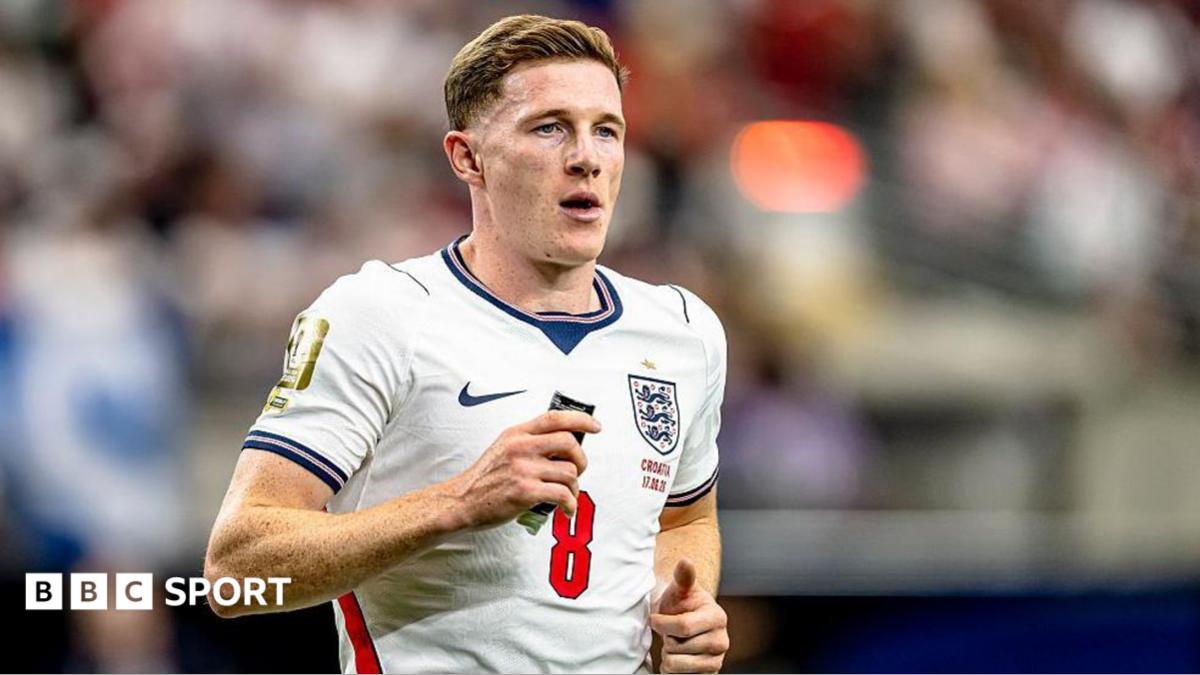
Anderson, who played 55 times in all competitions for Newcastle United, made his debut in an FA Cup defeat against Arsenal in January 2021 before joining Bristol Rovers on loan a year later.
It was here that he completed a vital part of his education – while also figuring in what might still be the most remarkable match of his career.
Former Republic of Ireland international Glenn Whelan was player coach at Bristol Rovers, and vividly remembering the impact the confident “but never arrogant” Anderson made in the west country.
He told BBC Sport: “He just came into the building and showed his potential straight away. Nothing seemed to faze him. You could see straight away this boy was different.
“As the coach, there were certain scenarios in training when I tried to put him under a little pressure. Some kids would be a little bit more reserved and fall back. Elliot was right on the front foot. He took the bull by the horns.”
And the date 5 February 2022 was one of significance in Anderson’s development, as recalled by Whelan: “We were away to Sutton United. They were doing well and were a proper men’s team with a lot of grit. Some of the coaching team were a little wary of throwing him in against them.
“We were losing at half-time and I basically said ‘we need to get this lad on because he’s a game-changer.’ He came on and made an impact. He won a penalty and we drew. I think he played pretty much every minute after that.”
Anderson’s attitude and determination stood out as he excelled at Bristol Rovers – ending in a dramatic climax to the season.
“He just had a confidence about him to show everyone how good he was,” says Whelan. “It was not arrogance. He’d obviously had a great upbringing from his family and he had that Geordie in him.
“He played off the left wing, but if the ball wasn’t coming to him he would go and look for it. He didn’t care who was marking him. He could take the ball under pressure and make things happen.
“Elliot loved training. He wanted to learn, do the extras. He had the attitude to stay behind and get better. We could tell straight away he was going to be a top player.”
And Anderson left Bristol Rovers after one of the greatest days in their history, when they clinched promotion to League One on the final day of the season.
The Pirates started the day needing to better the result of third-placed Northampton or win by five goals more than their rivals – they won 7-0, Anderson getting the final goal with five minutes remaining to help Rovers move into the top three for the first time all season.
Anderson made his triumphant farewell chaired off by jubilant Bristol Rovers supporters.
Crude prices retreated on Monday as US President Donald Trump confirmed a peace agreement with Iran and both sides announced a lifting of their respective blockades of the Strait of Hormuz.
ADVERTISEMENT
ADVERTISEMENT
At the time of writing, the front month contract on US West Texas Intermediate (WTI) crude was down almost 6% from Friday’s close to roughly $80 per barrel, while Brent crude, the international standard, dropped around 5% to about $83 per barrel.
The specific concessions made by each side are still unclear and there are questions surrounding whether the Prime Minister of Israel will respect the withdrawal of troops from southern Lebanon, which, according to the Prime Minister of Pakistan is included in the deal.
Benjamin Netanyahu has yet to publicly address the US-Iran deal, or the issue of Lebanon, and CNN has reported that the Prime Minister of Israel is seeking an urgent meeting with US President Donald Trump after this week’s G7 summit.
Nonetheless, markets are reacting swiftly to the prospect of the Strait of Hormuz slowly reopening and the potential that the Iran war is closer to ending than reigniting.
The freshly announced peace deal is currently expected to be signed on Friday.
European, Asian and US markets
At the open, European markets also rose on the news that there is meaningful progress in ending the Iran war.
Both the Euro Stoxx 50 and the broader pan-European Stoxx 600 traded over 1% higher at the start of Monday’s session.
The UK’s FTSE 100, Germany’s DAX 30, Italy’s FTSE MIB, Spain’s IBEX 35, the Netherlands’ AEX and Switzerland’s CH20, all traded between 0.5% and 1% higher than their Friday close.
France’s CAC 40 led the pack and rose almost 1.5%.
In the US, S&P500 futures traded over 2% higher and the teach-heavy Nasdaq 100 rose more than 3%.
In other trade dealings on Monday, Asia-Pacific markets jumped overnight with South Korea’s Kospi climbing over 5%, recovering from a 4% drop on Friday, while Japan’s Nikkei 225 also traded roughly 3% higher.
Australia’s S&P/ASX 200 rose 0.8%, while Hong Kong’s Hang Seng Index jumped about 0.5% and Shangai’s SSE climbed over 1.5%.
Ariel Atkins’ head whipped back. After taking an elbow from Indiana’s Monique Billings on May 13, the Sparks’ team doctors spotted the potential for a head injury and sent her to the locker room.
It was the second concussion of her career, but she didn’t know that at the time. All she knew was that her head hurt.
“You just don’t feel like yourself,” Atkins said. “It’s hard to even be a part of society. Luckily, this wasn’t a serious one.”
There have been eight diagnosed concussions in the WNBA already this year after just a quarter of the season. There were eight total in 2025, four in 2024 and six in 2023.
The “why” could be bad luck, better awareness in diagnosing concussions or something else. Atkins thought the lack of game flow because of new officiating standards might be making things harder.
“You would think it should be down,” Atkins said. “Maybe there is no rhythm when there are stoppages.”
Atkins got hit in the nose against the Wings three weeks after returning from her concussion. She stayed in the game after a quick check on the bench.
She didn’t have a concussion that time, but players do seem to be getting hit in the head at a higher rate. Minnesota-based sports scientist Lucas Seehafer thinks it’s too early to make a definitive declaration of why that is happening.
“Some players and coaches in the past have talked about the physicality of the play,” he said. “I know some people have talked about how the rules are kind of lax, or you’re maybe not as rigorous as what they could be in terms of like punishing blows above the shoulders and that kind of stuff. But it’s tough to say with any certainty until we get more data.”
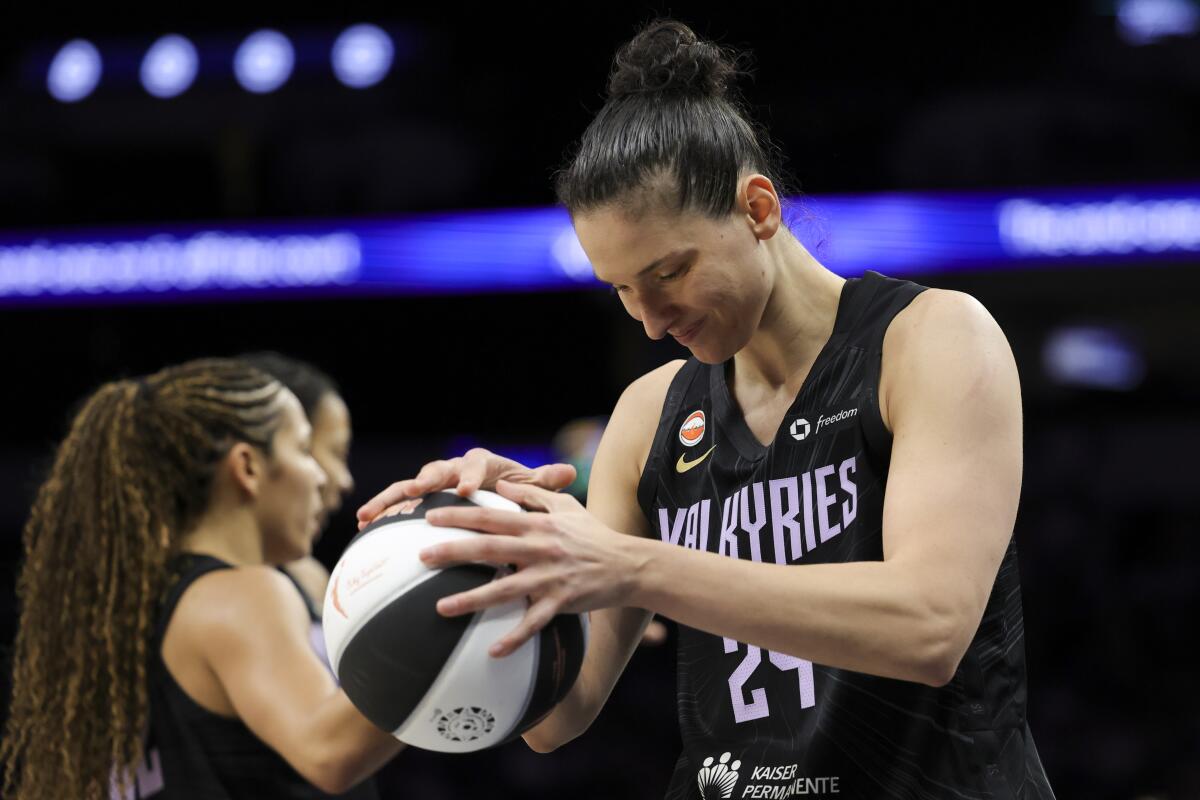
On opening night in Seattle, Golden State forward Cecilia Zandalasini suffered her first concussion when elbowed by the Storm’s Zia Cooke.
She called the process to return a “nightmare.”
“It was so weird with the feeling of always having a headache,” she said. “I had to wait until it was gone, I couldn’t move.”
Valkyries forward Cecilia Zandalasini called working through concussion protocal a “nightmare” earlier this season.
(Ellen Schmidt / Getty Images)
Seehafer said that when it comes to women’s sports, hockey and soccer have a reputation for having higher concussion rates, but basketball can be just as physical.
“Compared to the rest of the [pro sports] leagues, the WNBA is pretty much doing exactly what the other leagues are doing, but again, is that enough?” he said. “It’s tough to say. I would say they’re not, but I don’t think they’re egregiously leaving athletes open to even more severe injuries, necessarily. My bias is just that everything can be safer.”
The WNBA follows the same concussion protocol as the NBA, by which a player must undergo a locker room evaluation after getting hit in the head. If the player is cleared by medical staff, they can return to the game.
Any player showing concussion-related symptoms, such as a headache or dizziness, must be monitored for 24 hours by the team’s medical staff. Once they are symptom-free, they go through a range of activities from light physical activity to full-contact practice. They must stay symptom-free throughout that entire process to be allowed back into games.
“Back when I played, I didn’t know what concussion meant,” said Sparks coach Lynne Roberts. “I think now we understand the science of how serious it is, and we don’t rush them back. Once they’re back, there’s really nothing you can do. It’s a contact sport, and the players just kind of play through that, but obviously we’re very cautious with not letting a player play until the doctor’s fully certain that she’s symptom-free and at no risk.”
The hardest part with concussions can be the initial diagnosis. Oftentimes, symptoms show up hours or even days later. For Zandalasini, she was originally diagnosed with a jaw injury before dealing with a headache the next day.
Atkins knew a little bit about what concussions felt like, and even this time was different. Why concussions are up this year is still a mystery, and perhaps it will even out as the season goes on.
But for now, players and medical staff are on alert.
“It’s the thing with athletes, right?” Atkins said. “We’re trying to figure out pain versus injury, like, is it something serious? Is it not? I don’t want to hurt myself further. So, yeah, it can be hard to decipher that with a head injury.”
Karachi, Pakistan – Over a few breezy winter weeks in Karachi, boxing coach Younus Qambrani sent a steady stream of WhatsApp messages from his neighbourhood of Lyari – videos, photos, old newspaper clippings that together formed an extensive archive of how he teaches girls to throw a punch.
In one of the videos, the bearded and skullcap-clad Qambrani, 60, uses the palms of his hands and ducks as his young students practice throwing their punches. The thuds of the colliding boxing gloves and the scuff of the sneakers against the concrete floor of Qambrani’s Pak-Shaheen boxing club mask the din on the street.
Outside, motorcycles speed and sputter on narrow, labyrinthine roads, past omelettes sizzling on outdoor skillets in the many kebab bun stalls that pepper the neighbourhood of nearly 950,000 people: that is the population of Amsterdam packed into about three percent of the Dutch city’s land area.
To millions of followers of Bollywood, the Indian film industry across the border, Lyari is synonymous with brutal gang warfare waged against a perpetually grey background. It is where Bollywood’s highest grossing film of all time, Dhurandhar and its recently released sequel, Dhurandhar The Revenge are set.
The films — about a fictionalised covert mission conducted by India’s Research and Analysis Wing (R&AW) on Pakistani soil — have each earned more than $100m. In the first film, an Indian spy infiltrates Lyari’s criminal underworld and neutralises threats to India’s national security. In the sequel, the same agent continues his deep-cover operation inside Pakistan’s crime networks, again moving through Lyari’s streets.
But to Lyari locals, the neighbourhood is much more than the backdrop to blood and gore: It is a melting pot of cultures and tradition, rooted in history far deeper than Bollywood has dared to explore. It has an emerging rap and hip-hop scene, launching acts such as hip hop group, Lyari Underground, and masked rapper, Eva B, onto the national stage. The neighbourhood has also earned the nickname of Mini Brazil for being Pakistan’s mecca of football.
To be sure, Lyari has had a past rife with gang violence and unrest. Armed groups held significant influence from the mid‑2000s into the early 2010s, when battles between rival syndicates were at their peak. Gangs led by figures such as Rehman Dakait and, later, Uzair Baloch – both depicted in the Dhurandhar film and its sequel – turned parts of the neighbourhood into a militarised conflict zone. At the height of the violence, human rights groups reported about 800 people killed in Karachi in a single year, many of them in and around Lyari.
In 2012, the government launched what became known as Operation Lyari, a major crackdown in which police, backed by the Sindh Rangers paramilitary force, moved against armed groups in the area. The operation, and subsequent security campaigns, dismantled the main gang hierarchies and largely ended the era of open, large‑scale gang warfare in Lyari, even if other forms of crime persisted.
But Lyari, said social anthropologist Adeem Suhail, has always been about much more than that period of violence.
“Think of Naples or Sicily in Italy, which are among the major cultural hubs of the country (food, literature, music, etc) despite having long been associated with Mafia violence,” Suhail, an assistant professor at Pennsylvania-based Franklin and Marshall College, told Al Jazeera.
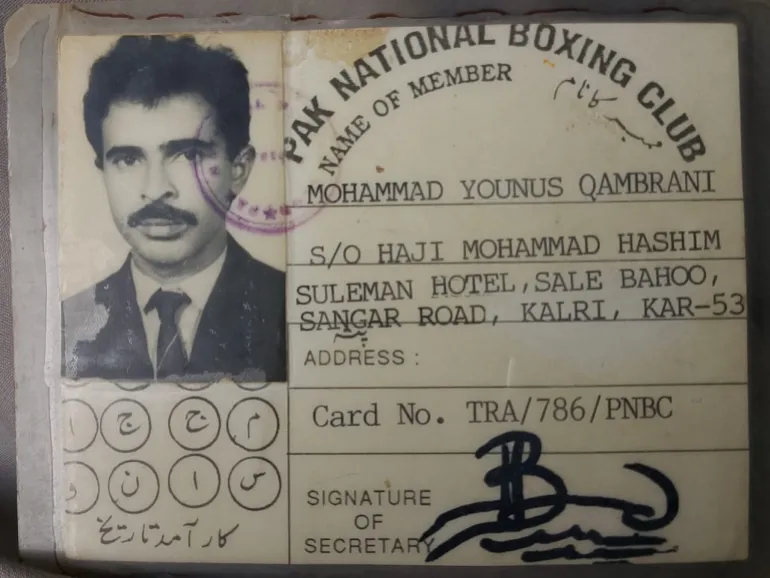
An undated picture of Qambrani’s membership card for Pak National Boxing Club. [Courtesy of Younus Qambrani]
‘Preparing for war’ — of a different kind
Qambrani has been boxing alongside his brothers for as long as he can remember. He began when he was five years old, and was introduced to the sport by his father, uncles and brothers — all boxers. Throughout his childhood, Qambrani says he was a sick and frail child. But he was determined to build muscle and throw punches like the men who had inspired him as he was growing up.
Boxing is so popular in Lyari that in 1989 boxing legend Muhammad Ali visited the neighbourhood, when he was a special guest at the Asian Games in the capital, Islamabad.
Qambrani’s high school, Haji Abdullah Haroon Government College, opened its own boxing club while he was there. He joined, but the club shut down in a few years. So he found another club a little further away and began cycling there to train.
After honing his skills there, Qambrani founded Pak Shaheen Boxing Club in 1992. “I wanted to open a club in my own area,” Qambrani said. At Pak Shaheen, he started out by teaching young boys, aged seven to 16, how to box.
A recent photo at his boxing club. [Courtesy of Younus Qambrani]
A sports enthusiast, Qambrani built friendships with coaches across the city, often visiting their training centres. At a friend’s karate classes at the YMCA (Young Men’s Christian Association) in central Karachi, he noticed young girls practicing kicks and elbow strikes shoulder-to-shoulder with boys. “If girls can do karate, why not boxing?” he wondered.
Qambrani’s students train to spar [Wania Farhan/Al Jazeera]
Soon he began voicing this question to his peers in the local boxing community, saying he wanted to start training young girls. One of them told him that “little girls have weak brains” — a remark that left Qambrani silent.
Then he went home and began looking through news reports featuring stories of girls and women boxing internationally. He would cut out the news clippings and paste them into a notebook. “My eyes were on the whole world,” he recalled. “Girls are boxing in the outside world, why not here?” he would wonder.
So he started at home: when his daughter Anum turned three, he began playfully sparring with her. She would gaze at the many photos of her father and uncles at boxing championships, slip on his medals, and traipse into the living room, mimicking the victorious poses he struck in those pictures. “She couldn’t even run properly, but she would box,” Qambrani said.
Then, in 2013, he opened the doors of his club to young girls. Anum was 16 at the time, and became its first female member.
In 2015, several of Qambrani’s students participated in the South Asian Games, the biennial multi-sport event where athletes from Bangladesh, Bhutan, India, Maldives, Nepal, Pakistan and Sri Lanka compete against each other.
A year later, Anum won a district level championship called the Jinnah First Ever Karachi Women Boxing Championship held at a Lyari stadium. In the same year, she attended a training camp for women organised by the Sindh Boxing Association. Local media reports described this camp as the country’s first government-supported boxing event held for women.
It was Qambrani’s club where Aliya Soomro, Pakistan’s first woman to win a world boxing title, began her training. Last year, Soomro took a mere 45 seconds to knock out her opponent from Thailand to win the WBA (World Boxing Association) Asia 105-pound category.
For Qambrani, though, boxing is about more than medals and trophies. To him, it’s a vital defensive skill.
“Whoever is prepared for war is prepared for peace,” he told Al Jazeera, adding that the defenceless are the ones most likely to be attacked.
With its legion of young boxers, Lyari’s not defenceless. As its reputation and image are mangled by Bollywood, those who know the neighbourhood also turn to its history for support.
An undated childhood photo of son, Munir (L) and daughter Anam [Courtesy of Younus Qambrani]
Lyari’s colonial history
It is not just the Dhurandhar films and Bollywood that Suhail, the social anthropologist, blames for what he describes as “terrible and exploitative” representations of Lyari. Journalistic and scholarly literature have been guilty too, he said.
Lyari is Karachi’s oldest recorded settlement — the earliest inhabitants of the neighbourhood came in 1728. The neighbourhood has survived British colonialism, the partition of the subcontinent, and nearly eight decades in independent Pakistan.
Suhail said Lyari had been a diverse working-class cultural hub since before the 1947 partition of British India.
Some of those working class communities were Baloch and Sindhi, because Karachi is at the tip of the southern Sindh province, which neighbours Balochistan province. Others were Marathi, Gujarati, Afghan and Siraiki migrants from labouring and artisan classes.
“This was because the British required labourers and artisans to develop Karachi into a burgeoning Indian Ocean port city.”
Suhail said that most of these labourers settled on the unplanned sides of the Lyari river, a small 50km-long seasonal river originating in the hills of Sindh, which flows through Lyari before emptying into the Arabian Sea.
“These cosmopolitan working class populations brought with them culinary traditions, dances, religious practices (multi-religious, multi-caste), songs, sports and more,” Suhail said.
He added that Lyari has a “strong cultural memory of East Africa and the Arabian Gulf, which adds to its uniqueness.” The neighbourhood is home to both Baloch and Afro-Baloch communities—people of African ancestry living in Balochistan.
Suhail explained that Lyari’s long history as a cultural hub of Karachi is often forgotten “because, after partition, the city’s demographics shifted drastically and Karachi became an Urdu-speaking Muhajir-majority city.” Muhajirs are Urdu‑speaking Muslims who migrated to Pakistan from India during and after the 1947 partition.
Sarwat Viqar, a professor of humanities at John Abbott College in Montreal, Canada, echoed Suhail’s views.
“Because Lyari has been represented one-dimensionally in the media as only a hotbed of criminality, drugs and the gang wars, what has been overlooked are the rich cultural practices that have always been part of life here,” Viqar told Al Jazeera.
Suhail added that Lyari had also consistently been at the heart of labour movements, and a base of support for reformers, anti-colonial activists and later campaigns for the rights of Pakistan’s various ethnic groups, including the Baloch, Sindhi and Pashtun communities.
“Lyari — because it was the first, most diverse, and most vibrant working-class zone as Karachi was becoming a city — also became the hub of working-class politics,” he told Al Jazeera.
But the neighbourhood’s own fortunes have also oscillated over the years.
“The degree of ‘development’ in Lyari has always been a function of how strong the working-class movement in Karachi was,” Suhail said. “When it was strong—such as in the 1930s and again in the 1970s—Lyari saw development. When ruling elites were strong, it did not.”
What Dhurandhar gets wrong
In the film, Lyari first comes into focus when a long-haired Ranveer Singh, playing undercover Indian RAW [Research and Analysis Wing] agent Jaskirat Singh Rangi, eyes the “Welcome to Lyari town” gate.
The gate looks very similar to the real one in Karachi. Other elements on screen ring familiar too: juice shop owners chanting idiosyncrasies to cajole customers; quick and garbled salams; and the somewhat unkempt colonial era architecture of old Karachi.
But then, the three-hour film’s dusty colour grading seems to wash out Lyari’s cultural depth and its vibrant subcultures.
“We can see how the obscene fetishisation of Lyari and the Baloch with violence and criminality is evident” in the film, Suhail said.
Describing Dhurandhar as “mediocre”, he said it lacks the depth of other Indian gangster films.
For example, in Ram Gopal Varma’s Satya 1998 and Anurag Kashyap’s Gangs of Wasseypur 2012, we see “culturally dense but non-apologetic depictions of Mumbaikar or Bihari gangs that understand the political economy of colonial and post-colonial state formation and how it crystallises in the gangsters portrayed,” Suhail opined.
Satya unpacks the criminal underworld of India’s metropolis Mumbai, following the titular character who arrives in Mumbai seeking a job but is falsely imprisoned and subsequently introduced to the underworld. Gangs of Wasseypur is set in a time before India’s independence in 1947 and follows power struggles, mafias and generational cycles of revenge in India’s eastern state of Jharkand.
In contrast to these films, Dhurandhar, has “heavy-handed homophobic, Islamophobic, hyper-masculine jingoism” and “the characters themselves appear to have no history at all,” Suhail added.
Unlike Lyari
Back at Qambrani’s club, 10 girls aged eight to 16 gather for an hour of sparring every day except Sunday, training for city tournaments that they compete in every two months.
Qambrani is looking to buy a folding, portable boxing ring to take school to school. His dream: to make boxing accessible to as many girls in the neighbourhood as possible. His challenge: he is struggling to find a portable ring in Pakistan and needs funding.
Dhurandhar and Bollywood do not matter at his Lyari club. Qambrani has a new generation of girl boxers to train.