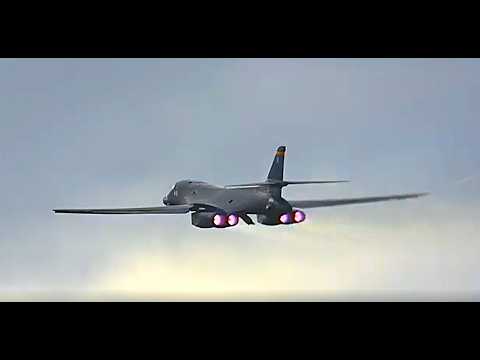
Before the hasty and unexpected departure of the bombers on Sunday, B-1s had been deployed to RAF Fairford continuously since March, initially in support of Operation Epic Fury against Iran. A contingent of B-52s had also conducted strikes on Iran from Fairford, but left back in July. The base is a major operational hub for the U.S. military in the United Kingdom, and regularly hosts strategic aircraft, including bombers and U-2 spy planes.
B-1s first mission to Iran out of RAF Fairford UK
Dan Rivers, U.S. correspondent for ITV News in the United Kingdom, was among the first to report on Monday that the B-1’s quick departure had been prompted by concerns about a potential Spiderweb-like drone attack ordered by Iran, citing an unnamed source. Other outlets have subsequently reported similar details, all sourced to anonymous U.S. and British officials.
“They didn’t fly out by accident,” U.S. President Donald Trump told reporters during a gaggle at the White House on Monday when asked about why the B-1s had left Fairford. “There were some threats.”
“I can’t tell you that, but if they did, they’ll suffer greatly,” Trump added in response to a separate question about whether Iran might have managed to get weaponized drones into the United Kingdom.
“What you saw there was the Secretary of War [Pete Hegseth], out of an abundance of caution, trying to protect our guys,” U.S. Vice President J.D. Vance said during a separate press engagement on Monday. “We do feel, with some confidence, that the Iranians are – they’re trying to do what the Iranian state has done for 49 years, which is engage in acts of terrorism against the United States, and a lot of other people, as well. So, we are being extremely cautious.”
Another satellite image offering an overall view of RAF Fairford. Google Earth
“We’ve documented what happened [near Fairford] last week. I wouldn’t just directly tie that to the move that was made,” U.S. Secretary of State and National Security Advisor Marco Rubio also told members of the press on Monday. “The only reason why you guys are focused on how many planes are at Fairford is because of the threat that happened last week.”
“We have confidence in the security of all of our bases, because all of our bases are [sic] theoretically could be threatened at any moment,” he added.
LIVE: UK police gives update on explosive-related arrests near air base used by US
Rubio’s comments notwithstanding, the remarks from Trump and Vance make clear that there was some recent threat intelligence that contributed to the decision to pull the bombers from Fairford. There are still many questions about the exact nature of the potential attacks, and how imminent, or not, the danger may have been.
Regardless, as mentioned, the prospect of a near-field drone attack on a base like Fairford carried out by actors in close proximity is extremely plausible, and the barrier to entry to such an operation is relatively low. Spiderweb may have thrust this reality into the public consciousness in dramatic fashion, but the danger well predates that operation, and even the start of Russia’s all-out invasion of Ukraine in 2022.
TWZ has been highlighting exactly these kinds of threats in the course of a decade or so now of regular reporting on drone incursions over U.S. and foreign military facilities and critical infrastructure, as well as American naval vessels operating offshore. Langley Air Force Base in Virginia and Barksdale Air Force Base in Louisiana, some of America’s most strategic airbases domestically, are among the facilities that have had to grapple with this in the past. After the Langley incident, in particular, it had become clear to the larger public what we had been reporting for many years, that the United States does not control the airspace over even its most critical military installations.
New footage of yet another act of Russian terrorism on EU soil, showing the drone loaded with explosives on the tarmac at Leipzig/Halle Airport, just meters from a Ukrainian Antonov An-124 cargo aircraft.
— SPRAVDI — Stratcom Centre (@StratcomCentre) August 5, 2026
A drone attack on Fairford would also not necessarily have had to come from somewhere very close by. Longer-range one-way attack drones are steadily proliferating, and can be launched using a variety of methods from positions on the ground, as well as vessels at sea. TWZ explored the very real threat of sea-based drone attacks, including ones conducted covertly, and Iran’s specific ability to carry them out globally, following the leak of an FBI alert back in March.
The proliferation of lower-end one-way-attack drones has ‘democratized’ precision-guided attacks, even for non-state actors. The fielding of automated targeting capabilities, driven by developments in artificial intelligence and machine learning, is also becoming more and more widespread. That technology will soon enable these weapons to find and strike even moving targets on their own. Even without anyone at the controls and without the drone putting out any detectable radio emissions, very effective precision attacks can still be launched at static targets, like known parking areas for aircraft at airbases, just by using basic map coordinates or Google Earth. It’s also worth pointing out here that the definition of a stand-off attack is becoming increasingly blurry, with even quadcopter-type drones capable of flying miles away to conduct a kamikaze attack on a target based on a set of GPS coordinates.
Ukrainian Saker UAV with AI capabilities. The video shows the process of target recognition. It has reportedly already been put to use several times against Russian targets. pic.twitter.com/NVNJyxUjGP
Overall, it is an indisputable fact that aircraft sitting exposed on a flightline are particularly vulnerable to drone attacks, as well as other threats. This is something U.S. military officials have acknowledged themselves. Fairford, where B-1s and other bombers have no option but to park out in the open in well-established areas that are plainly visible from outside the base’s immediate perimeter, is indicative of how American military aircraft are generally positioned on the ground abroad and at home.
As we wrote all the way back in 2017:
“Similar swarming strikes could be unleashed behind the front lines as well, with hugely expensive and low density/high demand combat aircraft being especially vulnerable to this sort of tactic—something General James Holmes alluded to inadvertently while speaking to the Air Force Association, stating:
‘Imagine a world where somebody flies a couple hundred of those and flies one down the intake of my F-22s with just a small weapon on it.’
Actually, it would be even easier to just strike the jets as they sit idle and vulnerable on the flight line. One swarm could see a whole squadron of tightly packed fighters destroyed without even having a chance to fight back.“
This picture of a B-1 at Fairford on March 7 shows how bombers and other aircraft are typically parked at the base. The line of photographers along the fence line also underscores how close those parking spots are to the base’s immediate perimeter. JUSTIN TALLIS / AFP via Getty Images
“I’m not a big fan of hardening infrastructure,” Gen. Kenneth Wilsbach said at a roundtable at the Air and Space Forces Association’s main annual symposium in 2023, offering a prime example of this viewpoint. “The reason is because of the advent of precision-guided weapons … you saw what we did to the Iraqi Air Force and their hardened aircraft shelters. They’re not so hard when you put a 2,000-pound bomb right through the roof.”
Wilsbach was commander of Pacific Air Forces (PACAF) at the time. He subsequently became head of ACC and is now Chief of Staff of the Air Force, the service’s top officer.
“I think that I don’t want to spend a lot of money on hardening shelters. Unless you’re going to send something 100 feet or more underground, we can blow it up, and so can they,” Wilsbach said in an interview with Breaking Defense in July of this year when asked explicitly if his position changed. “So, the economics of building a shelter that is impervious to a strike doesn’t work.”
U.S. Air Force Chief of Staff Gen. Ken Wilsbach speaks during an all-call with personnel at RAF Mildenhall, another base in the United Kingdom, on July 13, 2026. USAF
“I think the economics favor defending your airspace, defending your ground space with systems that can defeat the incoming rounds, versus building a shelter,” he added. “Some people would argue, well, you should do both. Well, that’s even more expensive. And the other thing is, the shelter doesn’t go anywhere.”
It is fair to point out that typical above-ground hardened aircraft shelters are not invulnerable, especially to attacks involving ballistic, cruise, and certain air-launched threats. There are also substantial cost and other factors to consider when it comes to any major military construction effort.
That being said, having more hardened infrastructure also imposes costs and complexities on opponents, who have to dedicate more advanced and costly munitions and other resources to ensure targets are neutralized. Shelters have the knock-on benefit of complicating the targeting process for an enemy by obscuring where aircraft are or are not positioned, to begin with. An opponent has to treat shelters like they are full even if they are empty.
When thinking about hardened aircraft shelters, stereotypical Cold War-era reinforced concrete structures typically come to mind. However, they do not all have to be built to a one-size-fits-all standard with the same degree of hardening across the board to be useful. Shorter-range drone attacks are typically carried out by platforms carrying small explosive charges or that are designed to drop small bomblets. Even longer-range one-way-attack drones generally have smaller warheads than traditional missiles, they also hit with less kinetic energy.
A US Air Force F-16 fighter sits inside a traditional hardened aircraft shelter. USAF
A structure that shields against smaller blasts and shrapnel, also including from cluster munitions that can be readily scattered across wide areas, is one that then has to be addressed by more capable weapons. This could even include mobile or otherwise temporary shelters that offer sufficient concealment and protection.
This picture shows what the Air Force described as a “prototype portable camouflage, concealment, and deception hangar” in use during Exercise Hoodoo Sea in 2023. Air National Guard The prototype portable hangar intended to support camouflage, concealment, and deception efforts in use during an Air National Guard-led exercise in 2023. Air National Guard
Eliminating, or at least substantially mitigating, the lowest rung of threats creates a dilemma for opponents, who then have to decide whether it is even worthwhile to attempt certain types of attacks. There is clear value in narrowing the available options for the enemy and pushing them toward having to expend higher-end, more expensive munitions, that are available in smaller quantities, and that traditional active defenses may be better optimized to handle. As an example, it may be more viable to shoot down a small barrage of incoming cruise missiles than a swarm of dozens of drones.
There are magazine and stockpile depth issues at play here, too. This is something that has also been brought front and center by the conflict with Iran, which has fueled already long-standing concerns about the sufficiency of stockpiles of air defense interceptors, other critical munitions, and the capacity to replenish them quickly. This is something the British government, among others, is also grappling with, as you can read more about in our separate reporting here.
Furthermore, losses of aircraft on the ground are not without their own costs, which are even more lopsided if an opponent can simply use lower-cost weaponized drones. U.S. bombers are particularly expensive and prized assets that are in short supply compared to the level of demand, as seen during the height of combat operations earlier this year against Iran. When it comes to B-1s, specifically, there are only 45 of them left in service today. A dozen of them being knocked out in one go would have major repercussions strategically. Losing even one would also be a propaganda coup for whoever might be responsible.
How many shelters can we build for the upgrade cost of one Zumwalt class DDG that will probably be parted out in 10 years anyway?
On top of all this, the U.S. military simply will not always have the luxury of being able to rapidly relocate aircraft in response to threats. Moving a dozen bombers on short notice takes massive resources. It is not just aircraft that have to be repositioned, but supporting personnel and assets, as well as weapons and fuel. Having to shift to alternate locations could easily have negative impacts on tempo and other aspects of operations, especially in the midst of actual conflict. RAF Fairford is one of only a few bases globally that can support bomber operations for a prolonged period.
“There is value in some light protection against small, unmanned threats,” Gen. Wilsbach also told Breaking Defense in July. “Some of them — just nets that are up that keep a small, few-$100 drone from getting next to a $2 billion aircraft. That actually works, [and is] really cheap.”
A graphic included a contracting notice put out by authorities at Langley Air Force Base in 2024 showing how sunshade-type shelters at the base might be equipped with anti-drone nets. USAF
“It’s not either or,” Wilsbach said in a separate interview with Air & Space Forces Magazine in July. “The net keeps the small UAS [uncrewed aerial system] from getting close to an aircraft that you’re trying to protect… That’s a very inexpensive way to give you some modicum of protection without killing your checkbook on really exquisite defensive systems.”
In spite of these institutional developments, action to implement such recommendations on a broad basis has continued to lag. There still does not appear to be any major department-wide push to build new hardened aircraft shelters or other fortified structures at facilities globally. The U.S. Air Force does have a certain number of hardened aircraft shelters at bases now, especially in the Pacific and Europe.
This is all despite a very visible trend in the construction of new aircraft shelters and other hardened infrastructure elsewhere around the globe, including in China, Russia, North Korea, and Iran. Even before Operation Spiderweb, Russia had already initiated a large-scale effort to build new hardened shelters at various bases, especially on the occupied Crimean Peninsula, in the face of expanding Ukrainian drone and missile attacks. This effort has now extended to building the huge hardened shelters for the country’s bomber force, something the country has never done before.
“It is inappropriate to discuss matters of intelligence, and we will not discuss specific force protection measures,” a U.S. Air Force spokesperson told TWZ yesterday when asked about the reports that Iranian drone threats prompted the recent removal of the B-1s from Fairford. “The Department will continue to assess the threat environment surrounding our installations and take appropriate actions to protect our people, our platforms and the bases where our forces operate from.”
We still do not know exactly how serious or imminent any recent threat to the B-1s at Fairford was that contributed to their hasty departure. Regardless, the reports of concerns about potential drone attacks remain very plausible. The reality here is that a dozen bombers were yanked from a forward operating location in Europe without an adversary ever having to fire a shot. This is a problem set that is only growing, especially as lessons and expertise on low-end weaponized drones from the war in Ukraine are spreading around the globe.
A B-1 bomber seen parked out in the open at RAF Fairford on March 15, 2026. Matthew Horwood/Getty Images
Erecting new aircraft shelters and other hardened infrastructure would not be a full solution to those threats by themselves. At the same time, they would be a valuable added layer of defense, and a passive one that would have a huge logistical footprint to operate once the initial investment is made. The lack of movement to better fortify American airbases globally is only becoming more and more glaring, and it remains to be seen if real action will not occur until lessons are learned in a most unfortunate way.
Guests can tuck into festive food from Christmas Eve to Boxing Day with special stays in the Lake District, Yorkshire and more
This article contains affiliate links, we will receive a commission on any sales we generate from it. Learn more
The Waterhead Inn is perched on Lake Windermere(Image: Inn Collection Group)
It may be known as the most wonderful time of the year, but Christmas can be a stressful one, too, with all the planning and preparation that goes into the big day. For those who fancy leaving the hassle of hosting behind, one hotel group is offering up the option of a peaceful mini-break instead.
The Inn Collection Group has announced Christmas holiday packages at all of its hotels, with more than 30 locations to choose from. Priced from £599 for two people, these three-night breaks from December 24-27 include breakfast each morning, dinner for two on Christmas Eve, Christmas Day lunch and an evening buffet for two, plus dinner for two on Boxing Day.
For those seeking inspiration on where to book their break, the number one top-rated Inn Collection Group hotel according to reviews from guests left on Tripadvisor is The Waterhead Inn in Ambleside. This Lake District getaway combines a picturesque waterfront location with traditional pub character, with pet-friendly rooms available and the heart of Ambleside town just a short stroll away.
READ MORE:
The Waterhead Inn is one of 10 Inn Collection Group hotels across the Lake District, which promises a magical backdrop for a peaceful festive getaway. Other highly rated stays available to book for Christmas include The Temperance Inn and The Wordsworth elsewhere in Ambleside, as well as The Angel Inn in Bowness-on-Windermere and The Swan in Grasmere, all of which have earned a rating of 4.3 out of five stars on Tripadvisor.
For more places to stay elsewhere in the Lake District, one of the top-rated choices over on Booking.com is Langdale Chase Hotel, which stands on the shores of Lake Windermere and has been welcoming visitors since 1891. Another favourite is Hazel Bank Country House in the Borrowdale Valley, offering easy access to the likes of Keswick, Buttermere and Derwentwater with plenty of scenic walks from the doorstep in the surrounding fells.
These three-night getaways from December 24-27 include breakfast each morning, dinner for two on Christmas Eve, Christmas Day lunch and an evening buffet for two, and dinner for two on Boxing Day.
Another Inn Collection Group stay that has earned glowing reviews from guests is Dean Court in York. A stay at the heart of the city with views of York Minster, having originally been built in the 1800s to house the clergy, this hotel is a short walk away from iconic attractions such as The Shambles, the Jorvik Viking Centre, the National Railway Museum, and the world-famous Betty’s Tea Rooms.
York is also the ideal setting for a festive city break with plenty of special events for those staying for Christmas to enjoy, from the Winter Wonderland in York Designer Outlet with its outdoor ice rink and Alpine Chalet café to the Christmas Tree Festival at York Minster. There are also Christmas-themed sightseeing walks and cruises on offer across the city, as well as festive chocolate and wreath-making workshops.
Elsewhere in York, visitors can opt for unique self-catering stays steeped in history with a choice of two properties in the city owned by the National Trust. Minstergate is a quirky medieval apartment for two with wonky beams, sloping floors and a Georgian staircase, while Draper’s Flat also sits above the city’s National Trust shop and offers space for up to four guests, although both are only available from January 2027.
For those looking to spend Christmas by the sea, another top-rated option with the Inn Collection Group elsewhere in Yorkshire is The Stables in Whitby. With Whitby Beach just a 10-minute drive away, this former 17th-century farmhouse boasts far-reaching countryside views and offers a quiet spot to stay just outside the seaside town with its famous abbey that inspired Bram Stoker’s Dracula.
One recent guest at The Stables wrote in a five-star review on Tripadvisor: “From the moment we arrived, we could not have asked for anything more! Brilliant location, welcoming, clean, great food and such friendly staff. We would definitely come again and have told family/friends with or without dogs to do the same!”
Meanwhile, over at Dean Court in York, another visitor said: “This hotel was a wonderful find! It is very quaint and well-maintained and upgraded. We would certainly consider this as a top lodging destination next time we come to York because it is centrally located to everything that we wanted to see. The morning breakfast that is included is just outstanding and top-notch in selection and food quality. The service is impeccable.”
And someone who stayed at The Waterhead Inn praised: “Had a fantastic few days at this beauty of a place. Everything was top-notch. The rooms are exceptional, the food is beautiful and mouth-watering, along with fantastic presentation. From walking through the door to leaving, we were treated with utmost respect by all the staff. Everyone had a smile, and nothing was too much trouble.”
However, not everyone was as satisfied with their stay, with another guest at The Waterhead Inn feeding back: “The rates charged for a dog are a bit excessive. I think a one-off charge, regardless of the length of stay, would be better.”
But another guest raved: “Wonderful three-night stay at The Waterhead Inn. Beautiful room with a balcony and overlooking the lake. Breakfasts and dinners superb every day. Waterhead pier just a few metres from the pier with trips to Bowness and beyond.”
Those booking a Christmas stay with the Inn Collection Group should note that prices vary by inn and room type, and that dinner on Christmas Eve and Boxing Day has an allowance of £25 per adult. Full terms and conditions can be found on the Inn Collection Group website.
VISITING one of Portugal’s top golfing regions without an ounce of experience of the game was certainly a nerve-racking move.
But I needn’t have worried.
The Algarve is so much more than a golfer’s paradise — but it’s also the perfect place to learnCredit: SuppliedWhether you want to spend your days down at the driving range, sipping cocktails by the beach or trying to master the splits in Pilates, this Portuguese playground is the place to do soCredit: Jenna Stevens
The Algarve is so much more than a golfer’s paradise — but it’s also the perfect place to learn.
With a nature park that’s home to a 37-mile lagoon and salt marshes frequented by flamingos, otters and Mediterranean chameleons — plus breathtaking island beaches reminiscent of the Caribbean — this beauty spot is a haven for anyone seeking R&R.
Sign up for the Travel newsletter
Thank you!
I was staying at the 4H Magnolia Hotel in Quinta do Lago, a lavish complex tucked away within the Ria Formosa Nature Park that features four hotels and a private villa estate spread across 2,000 acres.
While the complex may be luxury, the price tag needn’t be. The Magnolia, one of the entry-level hotels, is affordable yet stylish and oozes retro glamour with its Palm Springs theme.
A bright pink, neon ‘Welcome’ sign sits above the entrance, which is flanked by two cactus plants. Outside you’ll find a pool around which palm trees and stripey yellow sun loungers are dotted. Inside, the rooms are light, airy and unfussy.
Staying here means you’ll also get access to the same shared facilities as the fancier hotels within Quinta do Lago, like the 5H Conrad.
This includes a gigantic lake with an inflatable obstacle course and watersports galore, plus a beach boardwalk that leads you straight down to the turquoise sea.
While golf is far from the only activity available to guests, the three championship courses are undoubtedly a big selling point to many.
The Campus in the Quinta do Lago resort has facilities used by top sports starsCredit: SuppliedEnjoy a tasty bite by the lake at The ShackCredit: Supplied
The legendary South Course has hosted the Portuguese Open eight times and each of the pristine fairways is backed by wildflowers and umbrella pines — pretty hard to resist.
So it wasn’t long until I found myself at the driving range, picking up a club for the first time.
Confronted with pyramids of perfectly-stacked golf balls, I wondered how many I would get through before I made a decent shot.
But a beginner’s lesson from coach Callum had me swinging like a pro in no time, with simple drills and explanations that I could take away with me.
If golf isn’t your sport, though, you can also try your hand at tennis, cycling, padel and Pilates.
Many of these activities are at The Campus, which looks more like a glam beach club.
It has a flawless football pitch on one side, and a patchwork of blue and orange sports courts on another.
These grounds have been run on by elite athletes, including Chelsea and Everton footballers, during warm weather training camps, so you can be sure that the facilities here are top-notch.
Have a game of padelCredit: SuppliedThe Sun’s Jenna Stevens gives golf a goCredit: Jenna Stevens
But despite its championship status and the reel of famous faces that have visited, I soon came to understand that Quinta do Lago is a place to relax and try new things, not one where you’re expected to step up to the plate and perform.
If your aching muscles need soothing, then head to the wellness centre, which offers a sauna, steam room and plunge pool.
There’s also Dano’s Sports Bar, a chillout spot where you can order wings and beers then sink back into a beanbag to catch a game on the big screen.
I fuelled up on Caesar salad and bites of pizza before trying my hand at padel, which is basically tennis’s cooler, younger sibling. It’s a lot less strenuous and makes for easy rallies — ideal for beginners.
My days at Quinta soon fell into a relaxed routine: wake up, spend the morning and afternoon trying new sports, go for a dip, then relax with dinner and cocktails.
To fuel the body for all that sport, guests can pick from 14 dining spots spread across the resort and available to all guests.
For an unbeatable breakfast, Pure backs on to the eighth hole of the North Golf Course and serves up freshly-squeezed juice and protein pancakes on a sun terrace shaded by pines.
For lunch by the lake, stroll over to The Shack, where you can grab bites such as burgers and crispy fish tacos.
And for a classy evening meal, I recommend Casa do Lago or Bovino — the former offers delicious fish from local markets, while the latter serves up juicy steaks and bold Portuguese red wines to match.
Looking for the perfect way to end your night? Follow the boardwalk to its end to find Gigi’s, a cocktail bar that will happily shake up anything you like, and enjoy views of birds dipping down into the marshland.
I left Quinta do Lago with not just a golden tan, but some muscle definition that I hadn’t seen in a while (a pleasant change from the usual extra holiday pounds) and a newfound love for golf — if you can’t beat them, join them.
Holidays here feel like a health retreat that is actually fun and the exercise feels easy. There’s zero pressure to be perfect.
Whether you want to spend your days down at the driving range, sipping cocktails by the beach or trying to master the splits in Pilates, this Portuguese playground is the place to do so.
Who knew breaking a sweat could feel so incredibly glamorous?
GO: FARO, PORTUGAL
GETTING THERE: Jet2 offers return flights from London to Faro from £68. See jet2.com.
STAYING THERE: Standard double rooms at The Magnolia Hotel are from £170pn on a B&B basis. See quintadolago.com/en.