
resilient

US Muslims concerned but resilient as ‘hate’ attacks target Abdul El-Sayed | US Midterm Elections 2026 News

Dearborn, Michigan – Jake Lang, a far-right provocateur in a bulletproof vest, shouts anti-Muslim obscenities on a bullhorn outside a rally featuring former US President Barack Obama in Detroit.

His associates, wearing crusader-themed accessories – including a tin shield featuring a black cross – hold campaign signs for Mike Rogers, the Republican Senate candidate in Michigan, who is in a close race with Democrat Abdul El-Sayed.

Recommended Stories

list of 4 itemsend of list

If it weren’t for the bigoted slogans, the people lining up around them to attend the campaign event for El-Sayed and other Democrats could have mistakenly thought the protesters were in Halloween costumes.

“Get the f*** out, Muslims,” Lang shouted. “The crusade is coming. Self-deport.”

Lang may appear like a fringe agitator. But Muslim American activists say the bigotry he is spreading is going mainstream, especially in the context of the Senate race in Michigan.

Anti-Muslim attacks against El-Sayed have been perpetuated at the highest level of the US government, including by President Donald Trump and his cabinet members.

Suehaila Amen, a prominent Arab and Muslim advocate in the Detroit area, said bigotry against her community is reaching an all-time high.

“They make immediately post 9/11 look like a walk in the park for us. This has been absolutely disgusting to witness,” Amen told Al Jazeera.

One of Lang’s allies, Pastor Lorenzo Sewell, is an official faith adviser to the Rogers campaign.

Sewell helped Lang organise an anti-Muslim march in the Detroit suburb of Dearborn – home to a large Arab and Muslim community – in August.

Muslim American activist Suehaila Amen in Dearborn, Michigan, October 26 [Ali Harb/Al Jazeera]
Muslim American activist Suehaila Amen in Dearborn, Michigan, on October 26 [Ali Harb/Al Jazeera]

Abdullah Hammoud, the mayor of Dearborn, said the city – which has long been a target for anti-Muslim provocateurs – has been receiving an increased number of threats in recent months.

“The general public is unaware of how many threats are aimed towards the city of Dearborn on a daily basis, via social [media], via our dispatch when they’re calling 911 or calling our call centre, and lobbing these threats against the residents of the city each and every single day,” Hammoud told Al Jazeera.

“That does worry me.”

Escalating attacks

While the Rogers campaign did not respond to Al Jazeera’s request for comment about the Republican candidate’s links to Sewell, Rogers defended his focus on El-Sayed’s background, saying it was for national security.

“This is not about the way you pray; it’s the way you think,” Rogers told reporters after his debate with El-Sayed earlier this month.

Local leaders say their community is not cowering in the face of such threats and Trump’s near-daily attacks, and is pushing back through civic engagement and rallying around the El-Sayed campaign.

“Trump is a fascist,” Hammoud told Al Jazeera. “I think the best thing we can do, the best response, is to send Abdul to the US Senate, somebody who’s got two doctorates, someone who is a son of this country, a son of the state, someone who is the captain of his high school team … I think that that’s the best response that we can give fascism.”

Trump has repeatedly mocked El-Sayed’s name, misrepresenting it as Mohammed, and called the Democratic candidate a “jihadist”.

Amen said Arab and Muslim Americans are used to being targeted for their names, but when the president does it, it legitimises bigotry and racism.

“It’s not just some loser that lives around the block who may call you a racist expletive; it’s the loser who lives in the White House,” she said.

Amen added that Arab and Muslim communities are going about their daily lives and organising politically despite the escalating attacks, stressing that they reject attempts to cast them as foreigners or outsiders.

“We are an integral part of the fabric of this nation, whether people like it or not,” she told Al Jazeera.

Republicans across US target El-Sayed

As the Senate race intensifies, Rogers has been baselessly accusing El-Sayed of ties to the Muslim Brotherhood, Hamas, Hezbollah and Iran.

Last month, Rogers went as far as agreeing with a social media post calling El-Sayed, a doctor and former public health official, a “terrorist”.

Trump has suggested that El-Sayed would be a physical threat to the Capitol, saying that he would want him to go through a metal detector.

At an event in western Michigan earlier this week, Health and Human Services Secretary Robert F Kennedy Jr incorrectly claimed that Arabs do not produce literature or science and “don’t win Nobel Prizes”. He argued that the Muslim Brotherhood – which only briefly held power in Egypt between 2012 and 2013 – has destroyed Arab civilisation.

Texas Senator Ted Cruz joined in on such attacks, describing El-Sayed as a “jihadist leprechaun”.

Cruz warned that El-Sayed, a Michigan-born and raised father of two with a medical degree and a doctorate in public health, could end up on the Senate Intelligence Committee and endanger national security.

“If I am correct that he is a passionate supporter of the Muslim Brotherhood, there is a very real risk that Americans will die as a result,” he said.

On Wednesday, Ohio Republican gubernatorial candidate Vivek Ramaswamy invoked Dearborn – one of the safest and fastest-growing cities in Michigan – to drum up fear of immigration.

“Look at what’s happening in Dearborn, Michigan, for God’s sake. We’re not going to let that come to our state of Ohio,” he said.

Dearborn Mayor Abdullah Hammoud speaks to Al Jazeera, October 28 [Ali Harb/Al Jazeera]
Dearborn Mayor Abdullah Hammoud, October 28 [Ali Harb/Al Jazeera]

Trump supporters weigh in

El-Sayed, who is of Egyptian descent, has avoided focusing on the attacks, calling them “deflections and deceptions”.

It’s not clear how attacks linked to El-Sayed’s Muslim faith and Arab heritage will affect the race.

About 38 percent of respondents in a survey of potential voters conducted by Michigan State University said a candidate being a Muslim would make them less likely to offer support to their campaign.

After a Trump rally for Rogers in Port Huron, northeast of Detroit, where the president spent most of his nearly two-hour speech attacking El-Sayed, some attendees appeared to agree that El-Sayed may be a threat to national security.

As the US president spoke, shouts of “traitor”, referring to El-Sayed, erupted from the crowd.

Trump supporter David Beamer, whose son died in the 9/11 attacks in 2001, spoke at the event and questioned El-Sayed’s American identity.

“Abdul has a birth certificate. The birth certificate says he’s a citizen of America. You know what? A birth certificate doesn’t make you an American,” Beamer said.

Al Jazeera asked Duane Crempa, a 72-year-old Republican in a Batman mask who attended the Trump speech on Sunday, whether he believes that El-Sayed is a “jihadist” as Trump claims.

Crempa said he is a good judge of character. “Yeah, there is something not right with him. That’s all I’ll say; there’s definitely something not right,” he added.

Jermaine Miller, who also was at the rally, told Al Jazeera he hopes El-Sayed is not a “terrorist”.

“But I mean, it sounds convincing, but it is believable,” he said of Trump’s allegations that the Democratic candidate is a “jihadist”.

‘It’s awful to live this way’

In the Detroit area, Arab and Muslim advocates say the issue is bigger than a Senate seat, arguing that such rhetoric endangers their communities and risks ripping the social fabric of the state.

“We’ve seen the increase in hate marches and hate speech and people being very comfortable sharing their hateful views online and coming into our city and harassing people for no reason – people who are just trying to live and function in this country,” Amen said.

“It’s been tremendously heartbreaking to watch our community constantly have to question why people are maliciously maligning them in public.”

Earlier this year, two gunmen killed three people outside a mosque complex in San Diego in southern California in what authorities said was a hate crime.

Congresswoman Rashida Tlaib, who represents Dearborn and parts of Detroit, said she fears for her two Muslim boys, Adam and Yousif, amid the rise of hate with the election campaign.

“Yesterday, we were all watching the football game, and we literally had to turn off the ads every time in between [plays] because we didn’t want our babies to see these awful, racist ads,” Tlaib told Al Jazeera.

“It’s awful to live this way right now.”

With petrol in Michigan nearing record highs, Arab and Muslim advocates say their communities are being scapegoated to cover up the shortcomings of the Trump administration, including the war in Iran.

Abdelhalim Abdelrahman, communication director for American Muslims for Palestine (AMP), said the attacks against El-Sayed amount to “disgusting Islamophobia” that serves as a distraction.

“Abdul El-Sayed’s name is a visibly Muslim name, and it’s being treated as inherently suspicious, as if a Muslim American cannot willfully execute their duties as an active member of Congress to protect the American people,” Abdelrahman told Al Jazeera.

At the Trump rally in Port Huron, one of Trump’s allies appeared to weigh El-Sayed’s candidacy against petrol prices.

Brian Pannebecker, a retiree from an auto manufacturing company Trump invited to the stage on Sunday, stressed that Michiganders need to vote for the Republican ticket.

“I don’t care if they’re paying a buck and a half more a gallon for gasoline. That is no excuse to vote for a socialist Islamist for the US Senate,” Pannebecker said.

Source link

Gulf States Prove Resilient in the Face of US-Iran Conflict

Strong foreign reserves and new export routes help GCC economies weather the US-Iran conflict.

This article appears in the November issue of Global Finance Magazine.

For Iran’s neighbors in the Persian Gulf, proximity to the Islamic Republic has long meant geopolitical uncertainty.

Those concerns intensified in late February after U.S. and Israeli attacks on Iran triggered a conflict that effectively closed the Strait of Hormuz to normal commercial shipping. The strait normally carries about a fifth of global oil consumption.

The disruption threatened a major revenue source for Gulf states, raising concerns about pressure on their foreign exchange reserves.The disruption threatened a major source of revenue for Gulf states, raising concerns about pressure on their foreign exchange reserves.

Thus far, however, the region has demonstrated greater financial resilience than many thought possible.

The six Gulf Cooperation Council states entered the conflict with substantial foreign exchange reserves, which provided a buffer against lost oil revenues and higher costs.

“Foreign reserves have been more resilient than initially feared,” said Said Bakr, a research associate in political economy at the Arab Gulf States Institute. The region entered the conflict with substantial financial buffers, while rising crude prices have offset a decline in export volumes.

Finding New Routes

Iran’s disruption of the Strait of Hormuz and attacks by Yemen’s Houthi rebels near the Bab el-Mandeb Strait have forced Gulf oil exporters to seek alternative routes to international markets. Saudi Arabia continues to reroute crude through its East-West Pipeline to the Red Sea port of Yanbu after a temporary shutdown caused by a September drone attack. The UAE has relied on its Habshan-Fujairah pipeline, which carries oil to the Gulf of Oman, bypassing the Strait of Hormuz. Shipping has also been rerouted to Africa, where ports in countries like South Africa along the coast have benefited greatly.

The continued export of crude, albeit at lower volumes, coupled with prices rising from an average of $66 per barrel in January to over $100 in September, has been instrumental in sustaining Gulf-state revenues. Earnings from non-oil sectors are also booming as the Gulf Cooperation Council states diversify their economies.

All this has combined to keep their FX reserves resilient. Saudi Arabia’s reserves have increased to 1.82 trillion Saudi riyals ($485.3 billion) in August from 1.78 trillion riyals ($474.6 billion) in January. The UAE reserves have remained relatively stable, ending the second quarter at 931.4 billion dirhams ($253.6 billion). 

“The war and the Strait closure will impact the flow and direction of reserves but will not structurally dent the comparative advantage of the Gulf states,” said Bader Al-Saif, assistant professor at Kuwait University and associate fellow at Chatham House. Thus far, stable reserves have helped them maintain currency stability, meet trade obligations, and avoid disruptive measures like sharp spending cuts. Large sovereign wealth assets have provided additional buffers.

However, not all Gulf states have maintained positive flows. In Bahrain, servicing high government debt and a widening budget deficit pushed reserves down to $3.9 billion in June, down from $7.1 billion in February.

John Nijraini is a contributing writer based in Kenya.

Source link

90 Days No Help: Fortress America’s Goal To Make Bases Resilient Bastions In A Crisis

The Pentagon is reportedly aiming for U.S. military installations to be able to continue essential operations for at least 90 days, or roughly three months, without any external support. The installation of new small nuclear reactors and other infrastructure is key to this part of a larger plan called Fortress America. The main intent is to ensure America’s armed forces can remain functional and ready to protect the homeland in the face of any massive disruptions to power grids and other supply chains due to major conflicts or other crises. For years, TWZ has been sounding the alarm about the glaring vulnerabilities of America’s critical civilian energy infrastructure, including to drone swarms and cyberattacks, which could cripple key military capabilities right where they live.

Fox News was first to report on the 90-day base resiliency goal yesterday, citing documents it said it reviewed. This is part of the extremely wide-reaching Fortress America initiative the Pentagon announced last month, which covers everything from improved physical and cyber defenses at facilities to securing reliable access to critical defense industrial resources. The “Fortress” in Fortress America is technically an acronym that stands for Federal Operations for Resilience, Troop Resources, Energy Supply, and Survivability.

“Under FORTRESS [sic], every major military installation in the continental United States would be expected to sustain essential operations independently for at least 90 days, including access to electricity, water, fuel and communications,” according to Fox.

Fox News’ story also includes comments about Fortress America from Pentagon chief spokesperson Sean Parnell, but it is unclear if he explicitly confirmed the 90-day target. TWZ has reached out for more information.

Parnell did put particular emphasis on the importance of reducing reliance on civilian power generation as part of the larger Fortress America plan. Previous reports have said that Parnell was key to formulating this initiative. He has also been discussed as a potential frontrunner to become the next Secretary of the Army.

“Power is combat now. Without electricity, you lose communications, water, logistics, assembly lines and just basic military command structures,” Parnell told Fox. “We don’t want to rely on standard civilian municipal infrastructure to run our national defense. We just simply can’t. It’s an intolerable risk.”

It should be pointed out here that some U.S. military bases do have their own power plants now, but this is not something that is far from universal across the board.

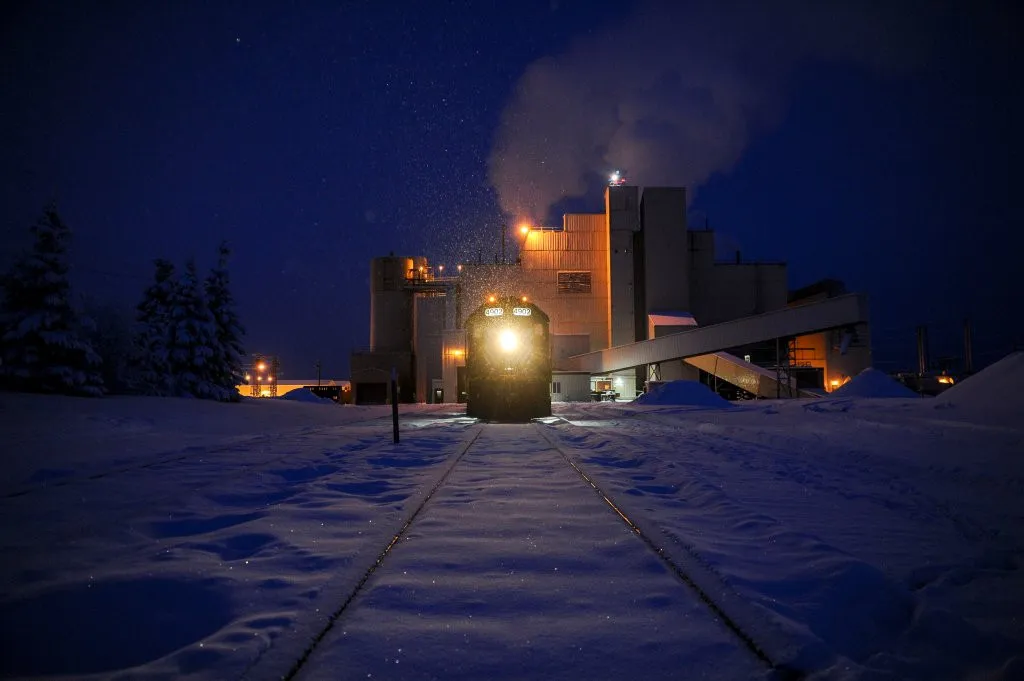
A train seen delivering coal to the power plant at Eielson Air Force Base in Alaska. USAF

Secretary Pete Hegseth made similar comments when he first unveiled the Fortress America initiative during a speech to service members at the U.S. Marine Corps’ base in Quantico, Virginia, in September.

“We are launching Fortress America, a national insurance policy for the American homeland,” Hegseth said at that time. “Every major military installation in America is going to generate its own power, independent of the civilian grid. If an adversary takes down the grid by cyber attack, by sabotage, or by any means, our bases stay lit, our aircraft keep flying, our command centers never go dark.”

Fox News’ report says that “portable nuclear reactors,” as well as “large-scale battery storage and microgrids capable of disconnecting military installations from the civilian electrical grid,” are key elements of the plan to achieve this independence when it comes to generating electricity.

The U.S. military, in cooperation with the Department of Energy, has already been heavily investing in the development and installation of so-called microreactors at bases across the country. In August, the U.S. Army, in partnership with the Pentagon’s Defense Innovation Unit (DIU), notably cut new deals with five companies as part of a plan to install more than 20 microreactors at bases, starting in 2028. This effort, called the Janus program, is not limited to Army installations.

The video below offers an overview of one of several microreactor designs the U.S. military is currently pursuing.

Introducing Kaleidos, a Portable Microreactor from Radiant thumbnail

Introducing Kaleidos, a Portable Microreactor from Radiant

Establishing new microgrids and other supporting energy infrastructure has also been an important focus for the U.S. military in recent years.

Details about how bases are expecting to maintain supplies of water and fuel, as well as communications connectivity, for 90 days or more are, as yet, still not entirely clear. All branches of the U.S. military have already been exploring new and novel options for ensuring the availability of water and fuel in future contingencies, though generally with more of an eye toward tactical operations. Relevant developments, including the possibility of using a process called carbon transformation to turn ambient air into fuel, could easily be applicable in a homeland defense scenario.

Fox News’ story also makes no mention of how sufficient food for personnel at these facilities would be sustained, but that would have to be part of the equation. In his remarks in September, Secretary Hegseth also made clear that making sure supply chains delivering munitions, medicine, and even blood would be unbroken in any future crisis was part of the Fortress America vision. As already mentioned, the initiative also extends much more broadly into matters of physical force protection, cyber defense, and the resilience of America’s defense industrial base.

“For decades, we built the most powerful military in the world,” Hegseth said at Quantico. Then we “regrettably made it dependent on foreign mines for rare earths, on overseas factories for microchips, on foreign supply chains for weapons, and on a civilian power grid to keep the lights on at our bases.”

Secretary Pete Hegseth signs a missile component during a visit to a defense contractor’s facility in Febraury 2026. US Military

“We’re bringing our critical supply chains home: the rare earths, the specialty metals, the semiconductors, the propellants, mined in America, refined in America, built in America by American workers,” he added at the time. “We are building long-overdue strategic reserves, deep enough to fight through disruption.”

More specific details about how the Pentagon now intends to pursue these aims have yet to be more fully defined.

“The Under Secretary of War for Acquisition and Sustainment is directed to stand up the FORTRESS America Program Office within thirty (30) days,” according to a memo dated September 30, which was released after Hegseth’s September speech. “The Program Office shall report directly to the Under Secretary of War for Acquisition and Sustainment who will appoint a member of the Senior Executive Service to lead the day-to-day operations, assisted by a two-star Military Advisor, and shall begin as a lean core cell that scales to full operating capability within months – delivering results in weeks, not years”

There is also a question of how much of the Fortress America initiative will actually be new. As mentioned, just when it comes to increased energy resiliency, including through the installation of new microreactors, this is something that has already been top of mind for the U.S. military for years now. In 2022, the U.S. Army had a publicly stated goal for every one of its bases to have its own microgrid by 2035 as part of a larger plan to reduce dependence on fossil fuels. In 2024, the Department of the Air Force rolled out its own Installation Infrastructure Action Plan (I2AP) that included a target to have new microgrids in place at 16 bases by Fiscal Year 2030. In May, the U.S. Navy announced plans to demonstrate the ability of the supercarrier USS Gerald R. Ford to act as a floating nuclear power plant as part of broader “energy resilience and mission assurance” plans.

A stock picture of the USS Gerald R. Ford. US Navy

The U.S. military has also already been heavily engaged in efforts to secure access to critical resources, especially rare Earth elements in light of China’s continued dominance in that market globally, and otherwise expand America’s domestic defense industrial base. Physical hardening of bases, especially against emerging drone threats, has been more of a heated debate, as TWZ has been following closely for some time now. However, even before Fortress America was unveiled last month, there had been signs that institutional attitudes were shifting.

“The [Fortress America] program aligns basing and infrastructure projects to ensure they are collectively advancing toward greater independence,” the aforementioned September 30 memo itself notes.

There are additional questions to be answered as to how the U.S. military expects to fund its expansive Fortress America ambitions and the schedules for implementing them. This will all be heavily influenced by how much the initiative leverages efforts that were already ongoing. At the same time, concerns about underinvestment in infrastructure modernization, in general, across America’s armed forces, and the worrisome cascading impacts thereof, are hardly new.

There are still key elements of the Fortress America initiative that have yet to be fully proven out. This is particularly visible when it comes to microreactors, which hold the promise of being simpler and safer to build and operate compared to traditional nuclear power plants. Despite significant progress with this technology just in recent years, environmental, proliferation, and other concerns continue to be raised. You can read more about all of this can read more about here.

On top of all this, it should be noted here that the U.S. military and the rest of the U.S. government already have mechanisms in place to ensure the key functions can continue, even in the midst of the gravest of crises, such as a limited nuclear attack. This is known as continuity of government planning, and includes a network of hardened and otherwise resilient facilities designed to support continued military operations and other activities in those ‘doomsday’ scenarios. But these facilities are few in number and are focus on strategic capabilities compared to what the Fortress America plan envisions.

At the same time, the dangers posed to civilian power grids in the United States, in particular, are only growing in scale and scope, both in the physical and cyber domains. Existing domestic U.S. energy infrastructure is aging and has been increasingly strained to meet routine day-to-day demands for decades now.

The potential for uncrewed aerial attacks on power plants and power lines has been real for years. The basic barrier to entry when it comes to weaponized drones, including converted commercial types, is also already low. Drone threats, broadly speaking, are only set to expand as swarming technology and artificial intelligence-driven capabilities continue to proliferate, as you can read more about this in this past TWZ feature. A well-informed enemy could concentrate a small number of resources on highly critical points in the grid to have vastly outsized effects, using drones or any other kinetic means.

The threat of various types of cyberattacks is also no longer limited to blockbuster movies and other popular media. This was made clear all the way back in 2021 with the ransomware attack on Colonial Pipeline, a key American oil pipeline system, and has only become more evident since then, including in the course of the war in Ukraine. U.S. authorities have run major exercises to help prepare for exactly these kinds of threats in the past. These are also capabilities where the barrier to entry has been steadily lowering over the years. Increasingly open access to powerful artificial intelligence agents with the ability to overwhelm networks and software to find critical vulnerabilities faster than humans can react is perhaps the most concerning layer of risk.

We have been reporting on this coming together for some time, it’s incredibly important. More so than a new fighter or an additional destroyer every couple years. Absolutely critical, and becoming more so with each passing day. Yes it’s scary, but it’s far scarier not doing this https://t.co/u09x0PeHZ7

— Tyler Rogoway (@Aviation_Intel) October 25, 2026

If a major conflict with a global competitor like China were to break out, physical and cyberattacks on energy infrastructure would be an extremely attractive avenue to hobble U.S. military forces, including airpower, before they can even leave their bases. The capacity to threaten grids in the United States, at least to certain degrees, has become worryingly within reach of smaller nation-states, as well as non-state actors and even lone wolf attackers, too. Firmly attributing cyberattacks to a nation-state, at all, can be challenging.

There is also a secondary component to all of this for responding to major natural disasters, which are another way U.S. grids can end up being knocked out for extended periods of time. These same circumstances could easily leave military bases, as well as their surrounding communities, without access to fresh water and other supplies. The U.S. military routinely plays a key role in responding to such crises.

“This is not a wait-and-see kind of a thing. We want to move out pretty quickly to get to that energy [resilience]. Those solutions can include investments in microgrids, battery backup storage,” a senior U.S. defense official said last week at a Defense Writers Group roundtable, according to a separate report from Air & Space Forces Magazine. “First and foremost, it’s doing the assessments of the installations to make sure we understand power generation and where we’re going to go with that, and then getting those deployed.”

The Pentagon is certainly making a new push now to make sure that, as Secretary Hegseth put it last month, “America cannot be starved out, shut down, or cut off.” However, there is clearly still work to be done to meet a goal of bases being able to go three months without outside help and the many other aims of the Fortress America plan.

Contact the author: joe@twz.com

Joseph is TWZ’s Deputy Editor, helping to oversee the site’s highly experienced and dedicated team, while also writing informative and impactful defense and national security content. He lives right in the thick of it in the Washington, D.C. area.


Source link

Carney, Erdogan launch ‘strong and resilient’ Canada-Turkiye partnership | Business and Economy News

On trade, investment and innovation, leaders will work toward conclusion of a Canada-Turkiye Free Trade Agreement.

Canadian Prime Minister Mark Carney and Turkish President Recep Tayyip Erdogan have announced the launch of a Canada-Turkiye Strategic Partnership, backed by a three-year action plan.

“In an increasingly complex global security environment, rising geopolitical uncertainties, and evolving humanitarian challenges, a strong and resilient Canada-Turkiye partnership is essential, providing a foundation to mitigate shared threats and capitalise on new opportunities,” said a statement by the two leaders on Thursday.

This comes as Carney is on a two-day visit to Turkiye, seeking to forge a new partnership as Canada looks to reduce its dependence on the United States.

The partnership’s three-year action plan rests on four pillars: trade and investment; defence and security; energy; and ties between people, the statement said.

On trade, investment and innovation, the two leaders agreed to “work toward successful conclusion of a Canada-Turkiye Free Trade Agreement”, it said. They will also expand bilateral trade and investments in priority sectors including energy supply, defence production, aerospace, and Artificial Intelligence (AI).

On defence and security, the leaders “underlined their intent to deepen bilateral and multilateral cooperation”. They also agreed to “strengthen cooperation in support of peace and security in the Euro-Atlantic region and beyond including Ukraine, South Caucasus, and the Middle East, in particular Gaza”.

Meanwhile, energy ministers from both countries will work on areas such as LNG, nuclear energy and critical minerals.

‘Launching a new era’

Speaking to reporters in Ankara alongside Carney on Thursday, Erdogan said the two countries “hope to increase our trade volume, which currently stands at around $3 billion, to $5 billion initially and then to $10 billion through the steps we will take”.

He said the two sides had agreed to begin free trade agreement negotiations before the end of the year to boost trade and investment, adding that elevating Turkiye-Canada relations to the level of a strategic partnership would not be merely a symbolic step on paper.

“We have today overcome the disconnect that had persisted between Turkiye and Canada for many years. Now we are launching a new era between Turkiye and Canada,” he said.

Canadian and Turkish leaders will convene next month in Ankara for the first round of trade talks, the joint statement said.

Carney is on the first bilateral visit by a Canadian prime minister to Turkiye, although he travelled to Ankara in July to attend the NATO summit.

He was scheduled to meet with Erdogan and other officials before travelling to Istanbul for talks with Turkish business groups as the two countries seek to deepen trade ties.

The Canadian prime minister has sought to diversify partnerships and reduce reliance on the US amid an escalating trade war with President Donald Trump, marked by US tariffs on Canadian goods, retaliatory measures by Canada and statements questioning Canadian sovereignty.

Source link