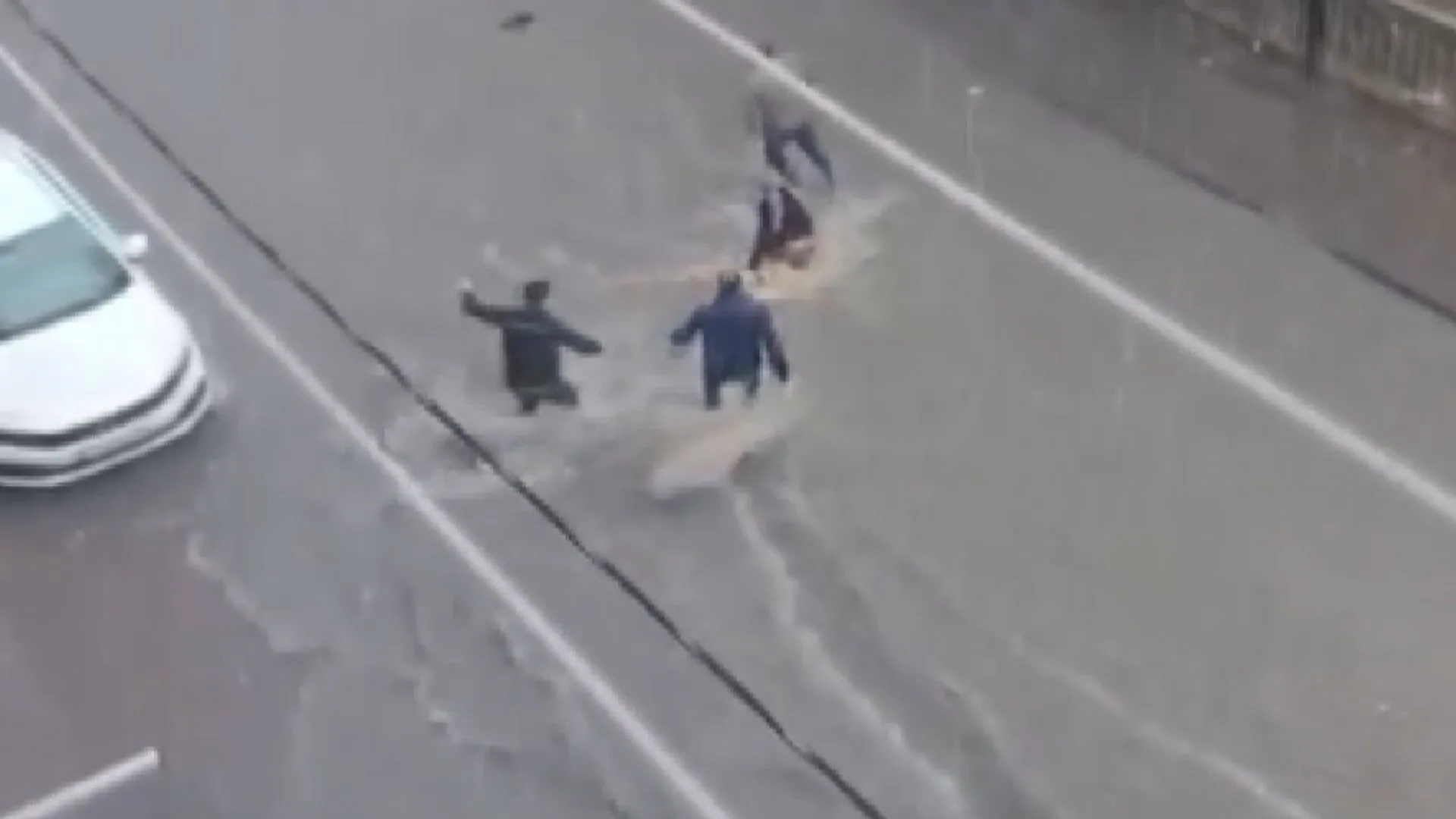
rescued

Guyana ferry with 116 people on board capsizes; more than 50 rescued | News

Rescue operations for remaining passengers and crew ongoing, authorities say.

Rescuers in Guyana are racing to find dozens of people missing at sea after a ferry carrying 116 passengers and crew capsized off the country’s coast, according to local authorities.

The MV Barima, which issued a distress call at about 11pm on Saturday (03:00 GMT on Sunday), capsized near Iron Punt while travelling from Guyana’s capital Georgetown to Port Kaituma.

Recommended Stories

list of 3 itemsend of list

Guyana’s Prime Minister Mark Phillips told the AFP news agency on Sunday that 53 people had been rescued. He said authorities expected to rescue more people as the search operation progresses during daylight hours.

The operation involves Guyana’s coastguard and private vessels, according to Guyana’s Public Works Minister Juan Edghill.

Edghill said the ferry was equipped with some 250 life jackets, eight lifeboats and other safety gear.

He added that a medical team was being dispatched to the search area to treat people “as soon as they are rescued”.

“There is an active search and rescue operation that is taking place, and we pray for the safety of all,” Edghill said in a video post shared on Facebook.

The circumstances surrounding the boat accident were not immediately clear.

Source link

Five people rescued after Indonesia boat sinks, at least 20 still missing | News

The survivors were found clinging to a fish trap and floating debris at sea three days after the boat sank.

Five people have been rescued, including a seven-year-old girl, who were stranded at sea off the Indonesian coast for three days after their boat sank south of Sulawesi. A search is ongoing for at least 20 others.

The five survivors – one man, three women and the girl – were located by a fishing boat before dark on Saturday near Matallang Island off the coast of Sulawesi and taken to a search-and-rescue vessel.

Recommended Stories

list of 3 itemsend of list

They had stayed afloat by clinging to a fish trap and buoyant debris after the KM Nurul Salsa suffered engine failure and sank on Wednesday with 78 passengers and crew members on board.

“After the ship sank, each of them saved themselves using whatever equipment or makeshift flotation they could find,” local search-and-rescue official Muhammad Arif Anwar said.

“They rigged together jerry cans and pieces of cork tied up with rope, then climbed on top of them.”

They told rescuers they had been part of a group of 25 people, but during their ordeal they were separated from the others by strong winds.

Local media reported 47 people had been rescued the day after the boat sank, and one person is known to have drowned.

Five large ships, a reconnaissance aircraft and a helicopter are being used in ongoing search efforts for those still missing.

The KM Nurul Salsa was en route from Jampea Island to the port of Benteng on Selayar Island in South Sulawesi province. It sank about 43 nautical miles (79km) from the port.

Passenger boats are a common form of transport in Indonesia, an archipelago with more than 17,000 islands. Lax safety standards and problems with overcrowding frequently result in accidents.

Earlier this month, at least six people died and dozens went missing after a ferry carrying 65 people sank off Indonesia’s resort island of Bali.

Source link

‘I rescued a bat on holiday in Greece and it left me in hospital’

She wasn’t even aware to begin with

A woman was bitten by a bat on holiday and ended up seeking rabies treatment thanks to AI.

Laura Horton, 53, was on a two-week birthday trip to Lesbos, Greece, in May 2026 when she found a bat drowning in the swimming pool at the apartment complex where she was visiting a friend. She grabbed the animal from the water and let it sit in her hand for 10 minutes to “dry off” – unaware it had bitten her before flying away.

Laura wanted to know what type of bat she had rescued, so she uploaded a photo of it sitting in the palm of her hand to Google Lens. As well as identifying it as a pipistrelle bat, the AI programme alerted her to seek medical treatment immediately due to the risk of contracting rabies from handling the animal.

She also claimed Google Lens warned her that she would be unable to feel a bat bite as their teeth are too small, and on closer inspection, Laura noticed two tiny pin-prick bite marks. According to the NHS website, rabies is a rare but serious infection that is usually caught from an infected animal’s bite or scratch, and it is almost always fatal once symptoms appear.

Laura went to the Hospital of Mytilene, Lesbos, the following day, May 8, where she started a course of preventative rabies post-exposure vaccines. She had a total of three jabs in Greece, followed by her fourth and final jab when she returned to the UK on June 1 at the School of Tropical Medicine, Liverpool.

Laura, a personal trainer from Mossley Hill, Liverpool, who spoke to Talk to the Press, said: “I had no idea you could catch rabies from a bat. I grabbed it from the water on instinct because it was drowning – I had no idea of the risks.

“It sat on my hand for about 10 minutes, drying off. We all thought it looked cute, so I took a photo of it.”

After uploading the image to Google Lens to determine the species of bat, Laura was met with a series of questions from the AI tool.

She said: “It started asking questions like, ‘are those your hands?’ and ‘have you washed your hands for 15 minutes after handling it?’ It warned me of the risk of rabies and said I wouldn’t feel a bite, as their teeth are too small.

“I thought it was all a bit dramatic. But when I took a photo of my hand, I saw two tiny bite marks.”

Laura was four days into her two-week holiday in Petra, a village on the Greek island of Lesbos, with friends when she was bitten. She rang her insurance company the following day, May 8, which confirmed she should seek medical attention.

She needed to undergo a course of rabies post-exposure prophylaxis (PEP) – a life-saving treatment given immediately after a potential bite or scratch from a rabid animal. Later that day, Laura went to the hospital, but claims a language barrier nearly prevented her from getting the correct treatment.

“At first, they tried to send me away with antibiotics,” she said. “I’m not sure they understood what happened.

“I was sent to a travel clinic and a nurse was furious I hadn’t been given the first dose yet. I went back to the hospital and found the infectious diseases department – they were brilliant.”

She returned on May 11 and May 15 for two more jabs while in Greece and had a fourth when she returned to the UK on June 1.

She said: “My GP didn’t actually know what to do. Luckily, we have the School of Tropical Medicine in Liverpool and I was able to get my fourth injection arranged with them very easily.

“I later found out there is a dedicated rabies hotline in the UK that would have delivered it to my doctor’s surgery. It was lucky Google Lens told me to go to hospital – who knows what might have happened.

“I read the tragic case about the boy in Canada who died after a bat landed on his face. A lot of people aren’t aware of the dangers of these wild animals and the risks. Hopefully I can help raise awareness.”

Source link

One dead, hundreds rescued in devastating Missouri flooding

July 11 (UPI) — One person was found dead and hundreds evacuated in Missouri after an intense day of flash flooding across the state, authorities said Saturday.

More than 350 people were rescued in Iron, Reynolds and Crawford counties on Friday as floodwaters rapidly took over the area.

Officials said 250 of those were staff and children at Camp Taum Sauk, all of whom were safely evacuated. Another 100 were water rescues.

“It was very harrowing,” Jennifer Box, mother of of two you boys at the camp, told The New York Times. “We knew they were safe, but we didn’t know how to get to them, and that’s kind of your worst nightmare.”

One Crawford County woman, Faith Gregory, was found dead a mile downstream from her home in Huzzah Creek, officials said.

Authorities said Gregory was swept away after part of her home collapsed in the floodwaters.

“It’s definitely not the outcome we were hoping for, but it’s a tragic reminder of how strong Mother Nature can be and how forceful it can be,” Missouri State Highway Patrol Sergeant Eddie Young told FOX Weather.

The region was battered by more than 12 inches of rain, leaving many area residents remained strained throughout Saturday.

“But they’re OK,” spokeswoman Kate Moore, of Missouri Region C, told ABC News. “They’re just stranded because the roads are washed away. We have a lot of damage — the trees, buildings, a lot of things have gone and ripped the roads away.”

Olympic canoeist David Hearn departs the Moultrie Courthouse after pleading not guilty to damaging the Lincoln Memorial Reflecting Pool on Thursday. Hearn was indicted on July 2 on one count of destruction of property of more than $1,000 for allegedly damaging the Reflecting Pool, carrying a maximum penalty of 10 years in prison if convicted. Photo by Bonnie Cash/UPI | License Photo

Source link

Can the agreement between Iran and the US be rescued? | US-Israel war on Iran News

Latest attacks jeopardise ceasefire and memorandum of understanding.

United States President Donald Trump declared that the agreement pausing the war with Iran was over this week – and ordered a series of strikes.

He accused Iranian forces of violating the ceasefire by attacking ships in the Strait of Hormuz.

Tehran was quick to respond, targeting US interests in Kuwait, Bahrain and Qatar.

The escalation was the worst since the two sides signed a memorandum of understanding last month.

It was meant to pave the way to more talks and a permanent deal to end the war.

Now regional mediators are working to ease the tension.

But does diplomacy still stand a chance?

Presenter: Per Nyberg

Guests:

Hakimeh Saghaye-Biria – Assistant professor at the University of Tehran

Salman Shaikh – Founder of The Shaikh Group, a peacebuilding organisation

Kirsten Fontenrose – Non-resident senior fellow at the Scowcroft Middle East Security Initiative at the Atlantic Council

Source link

How a son rescued his father from the rubble of Venezuela’s earthquakes | Earthquakes News

At first, Jesus did not believe it was possible, but then he heard his father shouting out from the rubble, saying: “Don’t leave me here.”

“I said, ‘Trust me: Stay calm. Keep the kids calm over there. I’m not leaving here without you,'” Jesus recalled.

Jose had been trapped for more than an hour by that point, unsure of his fate. He and his two younger sons had survived the collapse with relatively minor injuries, but dangers remained. The debris could still shift and crush them.

“The first thing I thought of was my children. I had the little one right here,” Jose recalled, lifting his hands to his chest. “And I still had the other one. He was right next to me but buried. I couldn’t see his face; I could only see one foot and one hand.”

Still, Jose put on a brave face for his boys. A friendly voice had pierced the rubble: Jesus’s friend, the firefighter.

He had been shouting for survivors. He had also brought Jesus’s old firefighting equipment to the site.

Jesus Garcia looks at the remains of the Ritasol Palace apartment complex
Jesus Garcia looks at the remains of the Ritasol Palace apartment complex [Alfie Pannell]

After finding out his father and brothers were alive, Jesus began desperately trying to get them out. But he realised he would have to wait until the next day for the sun to come up and, crucially, to get his hands on a jackhammer that could drill through the floors of rubble separating him from his family.

Finally, the next morning, a specialist squad from the police arrived with the gear they needed to carry out the rescue.

With the help of his firefighting team from La Guaira, who showed up to help their old comrade, Jesus was able to pull his father and two younger brothers from the rubble at about 3:30pm on June 25, more than 20 hours after the earthquakes.

He quickly swept Diego and Santiago into his arms.

“When I saw them, I hugged them, gave them a kiss, and said, ‘I love you, brother,'” Jesus recalled. “Then I stepped away for a moment and started crying.”

Jose is still shaken from the experience, which has changed his life forever. “I am someone who will be grateful for the rest of my life that I was given this opportunity. Not just me, but my two young children.”

Source link

‘Miracle’: Trapped man rescued eight days after Venezuela earthquakes | Earthquakes News

A man has been rescued from a collapsed building eight days after twin earthquakes devastated Venezuela.

The rescue on Thursday came as attention has begun to shift from finding survivors under the rubble to addressing the humanitarian needs of the thousands of residents displaced.

Recommended Stories

list of 3 itemsend of list

An estimated 60,000 buildings were damaged or destroyed in last week’s earthquakes, which hit magnitudes of 7.2 and 7.5, respectively. An estimated 13,000 people have been left homeless.

In its last official update, Venezuela’s government said that at least 2,295 people have been confirmed killed, with 11,000 injured. The death toll was expected to rise, with about 50,000 people reported missing.

But in a rare ray of hope, rescue workers were able to reach 43-year-old security guard Hernan Gil on Thursday, after days of trying to retrieve him from a collapsed seven-storey building where he worked in the hard-hit coastal area of Catia La Mar.

Gil had been located three days earlier. Rescue teams from seven countries, including Venezuela, Chile, the United States, Portugal, Costa Rica, El Salvador and Mexico, worked to free him.

“This is truly a miracle,” Gil’s wife, Gusbimar Gonzalez, told the news agency AFP.

Cristian Vera, the leader of the Chilean rescue team, told AFP that rescuers eventually were able to dig a three-metre (9.8-foot) tunnel to extract Gil. They had been able to provide him water via a hose and oxygen tube in recent days.

“It wasn’t easy to reach the exact spot where the victim was located,” he said.

Reporting from the state of La Guaira, Al Jazeera correspondent Zein Basravi said that, while Gil’s recovery has given some families hope, countless rescue attempts across the country have ended in tragedy.

Many of the collapsed buildings in La Guaira, located north of Caracas, have already been marked with the letter D for “deceased”, signalling no signs of life could be detected.

“One search-and-rescue expert we spoke to on the ground said the footprint of this disaster is so big, there are 58,000 buildings that have been destroyed or damaged, there’s so much area to search, and so many days into the aftermath of this earthquake, it is less and less likely that anyone can be found alive,” Basravi said.

He added that the emergency response is set to “move away from rescue and recovery into a very different phase of this disaster, which will see more relief work, more humanitarian work needed on the ground”.

Risks of health crisis

Humanitarian workers have warned that the aftermath of the earthquake could lead to a health crisis, as understaffed medical centres are likely to face cases of untreated injuries and infectious disease.

For years, the country’s health system has been strained by shortages of critical medical equipment, highly trained staff and electrical power.

The World Food Programme has appealed for $50m to feed some 500,000 people for three months. The United Nations Development Programme has put the estimated cost for the physical damage at $6.7bn, based on satellite imagery.

Several countries and regional blocs have pledged funding to help with relief efforts.

That has included $300m from the US, according to the Department of State. The administration of US President Donald Trump, who abducted Venezuelan leader Nicolas Maduro earlier this year, has continued to support the country’s interim President Delcy Rodriguez despite criticism over a lack of preparedness.

Reporting for Al Jazeera from Caracas, journalist Noris Soto said that international aid will be “more than necessary” in the months and weeks ahead.

“Venezuela has been struggling with economic hardships for the past two decades. So, if you add this disaster to that economic crisis that Venezuelans were already suffering, they will need help for years to come,” she said.

Source link

Venezuela: Newborn baby rescued from earthquake rubble

This is the moment rescuers pulled a newborn baby from beneath the rubble of a collapsed building, after two deadly earthquakes hit Venezuela.

Videos shared on social media show rescuers in the city of La Guaira moving the baby away from the rubble and handing it over to a man, who appears to be the father. The mother was also pulled alive from the rubble a while later, AFP reports.

Rescue efforts are continuing in the country, after back-to-back quakes struck the country, killing at least 920 people and injuring more than 3,360.

More on this story.

Source link

AH-64 Apache Crew Rescued By Drone Boat After Going Down Near Strait Of Hormuz

A U.S. Navy uncrewed surface vessel (USV) found and rescued the crew of a U.S. Army Apache that went down overnight near the Strait of Hormuz, in the Gulf of Oman. This is the first known use of a drone boat executing a personnel recovery action as part of a military search and rescue operation, and it’s likely a glimpse of what’s to come. The cause of the incident is otherwise under investigation.

Navy Capt. Tim Hawkins, a U.S. Central Command (CENTCOM) spokesman, has confirmed the use of the Navy USV in the rescue effort to TWZ. This had already been hinted at by mention of Task Force 59, the Navy’s main drone force in the Middle East, in an official CENTCOM statement. What specific type of drone boat was utilized in this case is not yet known. Task Force 59 operates a variety of USVs, including speedboat-like types. The Task Force has been experimenting with all types of new uncrewed naval technologies and this rescue is clearly a major win for the forward-looking unit.

One of several types of speedboat-type USVs Task Force 59 operates, seen here during an exercise. USN

“At 7:33 p.m. ET on June 8, two crew members from a U.S. Army AH-64 Apache were rescued by American forces after their helicopter went down near the coast of Oman while patrolling regional waters,” per CENTCOM’s statement. “The Soldiers were safely rescued within approximately two hours and are in stable condition. The cause of the incident is under investigation.”

“Rescue efforts were led by U.S. Naval Forces Central Command and the 82nd Airborne Division, with support from U.S. Air Force and Navy units including U.S. 5th Fleet’s Task Force 59,” the statement added.

A flight of U.S. Army AH-64 Apache attack helicopters, armed with rockets and Hellfire missiles, taxi out to conduct a scheduled flight in the U.S. Central Command area of responsibility. In addition to rockets and missiles, the Apache is additionally armed with a 30mm chain gun. (U.S. Army photo)
A flight of U.S. Army AH-64 Apache attack helicopters, armed with rockets and Hellfire missiles, taxi out to conduct a scheduled flight in the U.S. Central Command area of responsibility. In addition to rockets and missiles, the Apache is additionally armed with a 30mm chain gun. (U.S. Army photo) U.S. Army Central

The New York Times was first to report that an Apache had gone down near the Strait of Hormuz. President Donald Trump had also confirmed the crew was safe while speaking to reporters earlier this morning.

“We are going to issue a report tomorrow, but the pilots are fine,” Trump said after returning to Washington from the NBA Finals in New York.

As we have reported in the past, Army AH-64s have been part of an effort by the U.S. military to enforce the ongoing blockade of Iran and protect commercial shipping. Last month, Apaches and U.S. Navy MH-60 Seahawk helicopters destroyed six small Iranian boats that were threatening commercial ships in and around the Strait of Hormuz, according to Navy Adm. Brad Cooper, head of CENTCOM. Apaches had already been conducting missions targeting Iranian naval assets in and around the Strait of Hormuz before the announcement of the ceasefire in April. All of this has shown that armed helicopters remain important assets in maritime operations, especially for defending against swarms of small boats.

As TWZ regularly highlights, search and rescue operations present inherent complexities and risks, especially when conducted in or near hostile territory. The F-15E rescue effort in Iran put a particular spotlight on the immense risks that combat search and rescue (CSAR) forces take, with helicopters and C-130 variants sent into areas where even a high-end fighter aircraft didn’t survive.

Open-water recoveries can present distinct additional challenges. There is always the possibility of the loss of additional assets and personnel in the process, no matter where a CSAR mission occurs.

HH-60Ws refuel from an HH-130J. (USAF)

The use of Navy drone boat in the rescue overnight highlights a new dimension for maritime CSAR going forward. These uncrewed assets can be more readily pre-positioned in a distributed manner. For example, in the broad expanse of the Pacific, USVs could be forward-deployed at multiple points along certain flight paths for this exact purpose. USVs could offer other distinct advantages in certain scenarios where they might be able to get into areas where traditional assets cannot and without risking additional personnel. These realities extend well beyond the maritime domain, and we are only likely to see uncrewed platforms of all kinds increasingly taking part in rescue efforts, especially in denied areas. The U.S. military is coming to terms with just how vulnerable their CSAR assets are and the ranges that would be needed to access highly defended areas, especially during a peer fight. Using drones to execute personnel recovery is being viewed as one part of a larger set of solutions to this pressing problem.

With the Apache going down near the Strait of Hormuz, the U.S. military has now lost at least seven crewed fixed-wing aircraft and helicopters since the start of the latest operations against Iran in February. In addition, several aircraft have been damaged in the air and on the ground, including by Iranian fire. The TWZ graphic below offers a visual tally of damaged and destroyed aircraft as of April 10.

TWZ

Despite the loss of the Apache, the use of a USV in the rescue effort is a major development and a sign of things to come.

Contact the author: howard@twz.com

Howard is a Senior Staff Writer for The War Zone, and a former Senior Managing Editor for Military Times. Prior to this, he covered military affairs for the Tampa Bay Times as a Senior Writer. Howard’s work has appeared in various publications including Yahoo News, RealClearDefense, and Air Force Times.


Joseph has been a member of The War Zone team since early 2017. Prior to that, he was an Associate Editor at War Is Boring, and his byline has appeared in other publications, including Small Arms Review, Small Arms Defense Journal, Reuters, We Are the Mighty, and Task & Purpose.


Tyler’s passion is the study of military technology, strategy, and foreign policy and he has fostered a dominant voice on those topics in the defense media space. He was the creator of the hugely popular defense site Foxtrot Alpha before developing The War Zone.


Source link

U.S. helicopter crew rescued after coming down near Strait of Hormuz

June 9 (UPI) — Two U.S. Army helicopter crew members were rescued and brought to safety within two hours after their Apache gunship crashed near the Strait of Hormuz.

U.S. President Donald Trump said early Tuesday that the two service personnel were “fine” and promised a report on the incident would be released in the next 24 hours or so.

U.S. Central Command said the pair were in a stable condition with spokesperson Capt. Tim Hawkins telling NBC News that a Task Force 59 unmanned surface vessel found and recovered the soldiers — the first time the U.S. military had carried out such an operation with a drone boat.

A source told the New York Times that it was yet to be established whether the aircraft came under Iranian fire, sustained a technical malfunction or encountered another issue.

The loss of a Hellfire missile-armed AH-64 Apache — which patrol the strait, downing Iranian drones and preventing small boats from attacking shipping — is a first for the U.S. military since the conflict started Feb. 28.

At least eight U.S. fighter jets and other military aircraft, plus more than two dozen uncrewed aerial vehicles, have been lost in both enemy and friendly-fire incidents but Monday’s crash was the first loss of a helicopter.

The Apaches play a key tactical role alongside F/A-18 and F-35s fighter aircraft in U.S. Central Command’s mission to counter the blockade of the vital international shipping route, which Iran has effectively put out of bounds to the vast majority of oil tankers and other commercial vessels.

However, the helicopters have been patrolling closer to Iran, including its islands in the Hormuz Strait and Persian Gulf, as part of Centcom’s effort to maintain the pressure on Tehran amid protracted negotiations to resolve the 100-day-long conflict.

Tehran did not immediately claim responsibility for the incident, according to Iran’s semi-official Mehr News Agency.

The confirmation from the U.S. side came hours after Iran and Israel sides paused airstrikes on each other at the request of U.S. President Donald Trump, who urged them to “stop shooting” because an agreement with Tehran to end the war was very close.

“We’re in the final throes of what will be a very, very good deal that will not allow in any way, shape, or form nuclear weapons. The strait will open up right away.

Trump said the Strait of Hormuz would reopen to international shipping immediately after the agreement was signed, which could be before the weekend, adding that there was a chance it could be far earlier, “in one hour, if you want to know the truth.”

President Donald Trump discusses renovations to the Lincoln Reflecting Pool and makes an announcement on coal in the Oval Office at the White House on Thursday. Photo by Samuel Corum/UPI | License Photo

Source link

AH-64 Apache Crew Rescued By Drone Boat After Going Down Near Strait Of Hormuz

A U.S. Navy uncrewed surface vessel (USV) found and rescued the crew of a U.S. Army Apache that went down overnight near the Strait of Hormuz, in the Gulf of Oman. This is the first known use of a drone boat executing a personnel recovery action as part of a military search and rescue operation, and it’s likely a glimpse of what’s to come. The cause of the incident is otherwise under investigation.

Navy Capt. Tim Hawkins, a U.S. Central Command (CENTCOM) spokesman, has confirmed the use of the Navy USV in the rescue effort to TWZ. This had already been hinted at by mention of Task Force 59, the Navy’s main drone force in the Middle East, in an official CENTCOM statement. What specific type of drone boat was utilized in this case is not yet known. Task Force 59 operates a variety of USVs, including speedboat-like types. The Task Force has been experimenting with all types of new uncrewed naval technologies and this rescue is clearly a major win for the forward-looking unit.

One of several types of speedboat-type USVs Task Force 59 operates, seen here during an exercise. USN

“At 7:33 p.m. ET on June 8, two crew members from a U.S. Army AH-64 Apache were rescued by American forces after their helicopter went down near the coast of Oman while patrolling regional waters,” per CENTCOM’s statement. “The Soldiers were safely rescued within approximately two hours and are in stable condition. The cause of the incident is under investigation.”

“Rescue efforts were led by U.S. Naval Forces Central Command and the 82nd Airborne Division, with support from U.S. Air Force and Navy units including U.S. 5th Fleet’s Task Force 59,” the statement added.

A flight of U.S. Army AH-64 Apache attack helicopters, armed with rockets and Hellfire missiles, taxi out to conduct a scheduled flight in the U.S. Central Command area of responsibility. In addition to rockets and missiles, the Apache is additionally armed with a 30mm chain gun. (U.S. Army photo)
A flight of U.S. Army AH-64 Apache attack helicopters, armed with rockets and Hellfire missiles, taxi out to conduct a scheduled flight in the U.S. Central Command area of responsibility. In addition to rockets and missiles, the Apache is additionally armed with a 30mm chain gun. (U.S. Army photo) U.S. Army Central

The New York Times was first to report that an Apache had gone down near the Strait of Hormuz. President Donald Trump had also confirmed the crew was safe while speaking to reporters earlier this morning.

“We are going to issue a report tomorrow, but the pilots are fine,” Trump said after returning to Washington from the NBA Finals in New York.

As we have reported in the past, Army AH-64s have been part of an effort by the U.S. military to enforce the ongoing blockade of Iran and protect commercial shipping. Last month, Apaches and U.S. Navy MH-60 Seahawk helicopters destroyed six small Iranian boats that were threatening commercial ships in and around the Strait of Hormuz, according to Navy Adm. Brad Cooper, head of CENTCOM. Apaches had already been conducting missions targeting Iranian naval assets in and around the Strait of Hormuz before the announcement of the ceasefire in April. All of this has shown that armed helicopters remain important assets in maritime operations, especially for defending against swarms of small boats.

As TWZ regularly highlights, search and rescue operations present inherent complexities and risks, especially when conducted in or near hostile territory. The F-15E rescue effort in Iran put a particular spotlight on the immense risks that combat search and rescue (CSAR) forces take, with helicopters and C-130 variants sent into areas where even a high-end fighter aircraft didn’t survive.

Open-water recoveries can present distinct additional challenges. There is always the possibility of the loss of additional assets and personnel in the process, no matter where a CSAR mission occurs.

HH-60Ws refuel from an HH-130J. (USAF)

The use of Navy drone boat in the rescue overnight highlights a new dimension for maritime CSAR going forward. These uncrewed assets can be more readily pre-positioned in a distributed manner. For example, in the broad expanse of the Pacific, USVs could be forward-deployed at multiple points along certain flight paths for this exact purpose. USVs could offer other distinct advantages in certain scenarios where they might be able to get into areas where traditional assets cannot and without risking additional personnel. These realities extend well beyond the maritime domain, and we are only likely to see uncrewed platforms of all kinds increasingly taking part in rescue efforts, especially in denied areas. The U.S. military is coming to terms with just how vulnerable their CSAR assets are and the ranges that would be needed to access highly defended areas, especially during a peer fight. Using drones to execute personnel recovery is being viewed as one part of a larger set of solutions to this pressing problem.

With the Apache going down near the Strait of Hormuz, the U.S. military has now lost at least seven crewed fixed-wing aircraft and helicopters since the start of the latest operations against Iran in February. In addition, several aircraft have been damaged in the air and on the ground, including by Iranian fire. The TWZ graphic below offers a visual tally of damaged and destroyed aircraft as of April 10.

TWZ

Despite the loss of the Apache, the use of a USV in the rescue effort is a major development and a sign of things to come.

Contact the author: howard@twz.com

Howard is a Senior Staff Writer for The War Zone, and a former Senior Managing Editor for Military Times. Prior to this, he covered military affairs for the Tampa Bay Times as a Senior Writer. Howard’s work has appeared in various publications including Yahoo News, RealClearDefense, and Air Force Times.


Joseph has been a member of The War Zone team since early 2017. Prior to that, he was an Associate Editor at War Is Boring, and his byline has appeared in other publications, including Small Arms Review, Small Arms Defense Journal, Reuters, We Are the Mighty, and Task & Purpose.


Tyler’s passion is the study of military technology, strategy, and foreign policy and he has fostered a dominant voice on those topics in the defense media space. He was the creator of the hugely popular defense site Foxtrot Alpha before developing The War Zone.


Source link

One Laotian miner rescued from cave after nine days

Thai rescuers pulled a man from a cave in central Laos after he and six others had been trapped for nine days. Photo by Metta Tham Kalasin Rescue/EPA

May 29 (UPI) — One Laotian miner has been pulled from a cave in central Laos after being trapped for nine days underground, a Laotian rescue organization said.

Rescue Volunteer for the People said on social media that a person was removed at 8:37 p.m. local time Friday. The organization did not name the person, and it wasn’t clear how they brought him to safety.

Social media video showed a man looking disheveled and weak being propped up as he was brought up through a narrow crevice, NBC News reported. He was then taken to medical teams for evaluation and treatment.

Kengkard Bongkawong, president of the Thailand-based Metta Tham Association Rescue Unit, confirmed to NBC that one person had been rescued. He said there were four still inside and “are awaiting further assessment.”

Seven gold miners have been trapped in the cave since May 19 in the Xaysomboun province of central Laos. Five of them have been found alive, but this is the first person to have been reported rescued.

Bongkawong said Friday that the search for the two missing men “will continue tomorrow.”

The local men were on a hunting and gold prospecting trip when they were trapped in the cave by rising water after heavy rain, which also caused landslides that blocked the entrance.

Bongkawong said earlier this week that rescuers were challenged by a partly submerged 1,115-foot-long tunnel that is as narrow as 23 inches in some parts.

On Monday and Tuesday, the rescue teams pumped out as much water as possible and placed ropes inside for rescuers to follow after being forced back by rising water from Sunday’s torrential rains.

Monsoon season creates a “ticking clock,” lead diver Mikko Paasi told CBS. A trained team of divers takes about five hours to travel to the trapped men and back.

The Thai volunteers leading the search include a ‌diver who participated ⁠in the 2018 rescue of 12 boys and ⁠their soccer coach from a cave in northern Thailand.

Wreathes are seen amongst the statues at the Korean War Veterans Memorial during Memorial Day weekend in Washington on May 27, 2023. Memorial Day, which honors U.S. military personnel who died while in service, is held on the last Monday of May. Photo by Bonnie Cash/UPI | License Photo

Source link

‘Timmy’ the rescued humpback whale confirmed dead | Environment News

NewsFeed

Authorities have confirmed ‘Timmy’ the whale, whose rescue drew global attention, has been found dead off the coast of Denmark. The news comes two weeks after his complicated rescue off Germany’s Baltic coast and release into the North Sea.

Source link