republican president

House vote to extend FISA spy tool fails and it could lapse as Friday deadline looms

A rare lapse in a law that allows the United States to gather intelligence abroad appears likely after the House failed on Thursday to temporarily extend the program, in a protest of President Trump ‘s refusal to name a permanent head of the nation’s intelligence agencies.

Trump has doubled down on his temporary pick for director of national intelligence, federal housing finance regulator Bill Pulte, even though Pulte has little experience for the job. Democrats say they won’t support the renewal of Section 702 of the Foreign Intelligence Surveillance Act, known as FISA, unless the Republican president withdraws Pulte’s appointment and nominates a permanent replacement.

The House vote collapsed in bipartisan fashion, with some Republicans and nearly all Democrats rejecting the temporary measure, 198-218. The Senate may try its own vote later Thursday, but hopes are dimming to prevent what could be an unprecedented lapse in the surveillance tool. The law expires on Friday at midnight.

The impasse could soon result in limitations on what intelligence the U.S. government can collect abroad just as World Cup games begin in cities around the country and ahead of celebrations for the nation’s 250th anniversary.

“We can’t let them extort us,” Trump said of Democrats.

Trump has stuck with Pulte as the acting head, rebuffing demands from lawmakers for a more qualified nominee. Trump asked Congress for a short-term extension of the law to “provide time for the selection and confirmation” of a permanent director. He said he wants Pulte to begin downsizing intelligence agencies.

The parties leveled blame for the potential interruption in what has been seen as an essential, if long-debated, surveillance program for keeping the country safe.

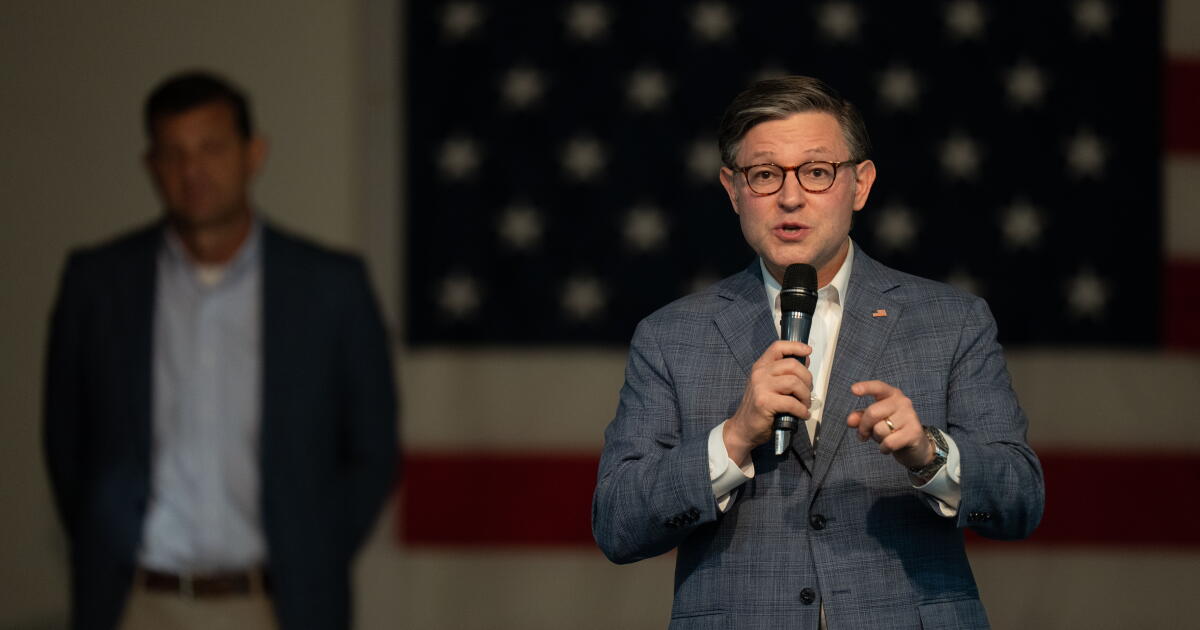
“We’re going to ask every member here to do the right thing,” said House Speaker Mike Johnson, R-La. “We cannot allow that to go dark.”

The House Democratic leadership announced its opposition, saying Pulte has no relevant intelligence background, in defiance of the law’s requirement for “extensive” national security experience.

“The apparent motivation for his elevation is the demonstrated willingness of Bill Pulte to search government databases for alleged dirt on President Trump’s chosen political enemies,” Democratic leader Hakeem Jeffries of New York and the leadership team said in a joint statement. They said there is a path to reauthorizing FISA, “but it will require enacting meaningful reforms.”

GOP leaders lobby the White House, to no avail

Congressional Republicans have lobbied Trump all week to quickly nominate a permanent replacement. But he said he needs more time to do so.

Senate Majority Leader John Thune, R-S.D., said Republican leaders have “made our views known” to the White House.

Trump has said that he is interviewing five candidates for his pick to lead the agency permanently, after the resignation of Tulsi Gabbard.

Johnson said the president has made it very clear that Pulte will serve a “very short term — a sort of renovation role” to help the Office of the Director of National Intelligence be “renovated and downsized.”

But Democrats on the House Intelligence Committee led by Rep. Jim Himes of Connecticut said in a letter to the president that Pulte is a “uniquely poor choice” to serve even in the acting capacity.

Both Republican and Democratic lawmakers skeptical of Pulte have pointed to his lack of intelligence experience and also his record at the Federal Housing Finance Agency. In the position, he has been linked with criminal referrals over allegations of mortgage fraud by public officials Trump sought to punish, including New York Attorney General Letitia James, a Democrat; Sen. Adam Schiff, D-Calif.; and Lisa Cook, a board member of the Federal Reserve.

“He has distinguished himself only as someone who will do or say anything to stay in your good graces,” Himes and the other lawmakers wrote, “qualities that are precisely the opposite of what our nation needs.”

FISA will lapse at midnight Friday

Section 702 of FISA allows agencies such as the CIA, National Security Agency and FBI to collect communications from foreign targets overseas without a warrant.

While members of both parties who cite privacy issues have long wanted to limit the authority, there was broad bipartisan support to renew it, especially after Republicans and Democrats recently worked out a compromise bill.

Virginia Sen. Mark Warner, the top Democrat on the Senate Intelligence Committee, has worked with Republicans on the compromise legislation to renew the authority. But he called Pulte’s appointment to replace Gabbard “a live hand grenade” disrupting the process.

Warner said the only way he’ll support a short-term extension of the surveillance law is if the principal deputy director of national intelligence, Aaron Lukas, is the acting leader during the duration of that extension.

Arkansas Sen. Tom Cotton, the chairman of the Senate Intelligence Committee, and Iowa Sen. Chuck Grassley, chairman of the Senate Judiciary Committee, have warned the administration that the spy tool is likely to lapse.

The administration should prepare “for a potential significant gap in foreign intelligence collection,” they wrote in a letter.

Trump doesn’t back down on Pulte

After bipartisan pushback to Pulte’s temporary appointment, Trump said last week that he would not permanently nominate him to the position. But Democrats, and some Republicans, want his appointment pulled immediately and for Trump to nominate a replacement that can be confirmed by the Senate.

On Tuesday, though, Trump announced that Pulte would not only take over as acting director — he’d also start earlier than expected, on June 19.

One of several possible replacements could be Pete Hoekstra, Trump’s ambassador to Canada and a former chairman of the House Intelligence Committee. The White House has reached out to Hoekstra about the job and conversations are ongoing, according to a person familiar with the outreach who requested anonymity to discuss the private conversations.

Jalonick, Mascaro and Kim write for the Associated Press. AP reporters Joey Cappelletti, Kevin Freking and Eric Tucker contributed to this report.

Source link

Justice Department opens investigation into E. Jean Carroll, who accused Trump of assault: AP source

The Justice Department has opened an investigation into whether E. Jean Carroll, the longtime advice columnist who has said Donald Trump sexually assaulted her in a New York department store 30 years ago, lied during the course of civil litigation against the Republican president, according to a person familiar with the matter.

The person who confirmed the existence of the investigation was not authorized to publicly discuss an ongoing inquiry and spoke on the condition of anonymity. The perjury investigation is being led by the federal prosecutors’ office in Chicago, and acting Atty. Gen. Todd Blanche has had no involvement because of his prior work as Trump’s personal attorney, the person said.

Lawyers for Carroll did not immediately respond to requests for comment from the Associated Press on Thursday.

It’s the latest in a series of investigations the Trump administration Justice Department has opened into perceived adversaries of the president. The actions, including securing an indictment last month against former FBI Director James Comey, have raised alarm from Democrats and former officials that an institution meant to make prosecutorial decisions independent of the White House is being weaponized.

Carroll has said a flirtatious, chance encounter with Trump in 1996 at Bergdorf Goodman’s Fifth Avenue store in Manhattan ended violently. She said Trump slammed her against a dressing room wall, pulled down her tights and forced himself on her. Trump has called the allegations a “made-up scam,” and he has attacked her motivations, saying they were politically driven or arose from a desire to promote her memoir.

A jury in 2023 found Trump liable for sexually abusing Carroll, awarding her $5 million. The following year, another jury awarded Carroll $83.3 million in a defamation case related to Trump’s social media attacks on her.

The Justice Department is scrutinizing a statement Carroll made in the course of the civil litigation that no one else was paying her legal fees. It later became public that a Chicago-based organization backed by Reid Hoffman, the co-founder of LinkedIn, had helped fund Carroll’s case. Trump’s lawyers in the civil case accused Carroll of concealing that information, which they said called into question whether the case was politically motivated.

A court entry earlier this month said Trump won’t have to pay the award until the U.S. Supreme Court gets a chance to review the case or reject an appeal. The 2nd U.S. Circuit Court of Appeals agreed to a request by one of Trump’s lawyers that it let the president delay the payment to Carroll, though it required that he post a $7.4 million bond to cover any additional interest costs, a request Carroll’s attorney had made.

The Carroll investigation was first reported by CNN.

Richer and Tucker write for the Associated Press.

Source link

Blanche doesn’t rule out payments to violent Jan. 6 rioters as he defends $1.8B fund

Acting Atty. Gen. Todd Blanche on Tuesday wouldn’t rule out the possibility that people who carried out violence during the Jan. 6, 2021 riot at the U.S. Capitol will be considered for payouts from a new $1.776 billion fund to pay individuals who believe they were targeted politically.

Pressed during a Congressional hearing over whether those who assaulted police officers would be eligible for compensation from the “Anti-Weaponization Fund,” Blanche responded that all people can apply if “they believe they were a victim of weaponization.” The acting attorney general also refused to say whether he would direct those responsible for deciding who receives payments — a commission whose members he is tasked with appointing — to restrict funds to those convicted of violence.

“What I will commit to is making sure that the commissioners are effectively doing their jobs, and that includes setting guidelines as you’re describing,” Blanche told Sen. Jeff Merkley, an Oregon Democrat. The decisions on payouts will be made a five-member commission appointed by the attorney general.

Appearing before Congress for the first time since taking the reins of the Justice Department last month, Blanche was peppered with questions about the fund announced on Monday to compensate those who believe they were mistreated by prior administrations’ Justice Department. Blanche said the fund was “unusual” but not unprecedented, adding that those who benefit will not be limited to Republicans or to people who were investigated or prosecuted by the Biden administration. At one point, Blanche said President Joe Biden’s son, Hunter — who faced gun and tax prosecutions under his father’s administration — could also apply.

Blanche defends $1.8 billion fund

Tuesday’s hearing was meant to address the Trump administration’s budget request for the Justice Department but quickly delved into other controversies that have escalated concerns about the erosion of the law enforcement agency’s tradition of independence from the White House. Blanche defended the creation of the fund without any acknowledgment that the Trump administration has pursued investigations of Trump’s political opponents, sparking criticism that the department is being weaponized in precisely the same way they allege it was under Biden’s administration to prosecute Trump.

In the weeks since assuming control of the Justice Department after Pam Bondi’s firing, Blanche has moved aggressively to advance the president’s priorities — pushing forward cases against Trump’s political foes, cracking down on leaks to media outlets and establishing the new fund to resolve Trump’s $10 billion lawsuit against the Internal Revenue Service over the leak of his tax returns.

Democrats described it as an illegal abuse of power designed to line the pockets of Trump supporters with taxpayer dollars. Sen. Chris Van Hollen, the top Democrat on the Senate appropriations subcommittee holding the hearing, blasted the move as a “pure theft of public funds.”

“Rewarding individuals who committed crimes is obscene,” the Maryland Democrat said. “Every American can see through this illegal, corrupt, self-dealing scheme.”

The fund is in keeping with Trump’s long-running claims that the Justice Department during the Biden administration was weaponized against him, even though then-President Biden himself was investigated during that time and his son was prosecuted. Merrick Garland, who served as attorney general during the Biden administration, has repeatedly denied allegations of politicization and has said his decisions followed facts, the evidence and the law.

Trump administration has been rewriting the history of Jan. 6

The mere possibility that violent rioters at the Capitol could be considered for payouts is consistent with a Trump administration pattern of rewriting the dark history of Jan. 6, a trend that began when the president pardoned and commuted the prison sentences of the participants in the melee and that continued with the Justice Department firing some prosecutors who put them behind bars.

Under questioning from Merkley, Blanche said that he “will definitely encourage the commission” responsible for deciding on the payouts to “take everything into account.” But when asked whether he believes those convicted of violence should be entitled to compensation, Blanche said: “My feelings don’t matter.”

When Merkley suggested that Trump was using the Justice Department to target his political enemies, Blanche replied that this was precisely the sort of “disgusting” behavior of the Biden administration that the fund was meant to address.

“That is completely inappropriate and wrong,’ Merkley said. “There is no comparison to the absolute fair minded pursuit of justice under the previous administration, and this administration’s pursuit of an enemies list.”

Questions over the meaning of ‘weaponization’

In announcing the fund Monday, the Trump administration did not name specific individuals who might stand to benefit from it. The money itself would come from the federal judgment fund, which pays out court judgments and compromise settlements of lawsuits against the government.

Blanche told lawmakers that the Justice Department is committed to “full transparency” in providing public information about beneficiaries of the new fund.

“It’s not limited to Republicans. It’s not limited to Democrats. It’s not limited to January 6th defendants. It’s limited only by the term weaponization,” Blanche said, though the administration has not said how it will define “weaponization.”

Meanwhile, there were signs of discomfort about the fund even among some Republican members of Congress. Senate Majority Leader John Thune told reporters that he’s “not a big fan,” adding that he isn’t sure how the administration intends to use it, but doesn’t “see a purpose for that.”

Thune’s comments come after Louisiana Sen. Bill Cassidy, who lost reelection in a GOP primary on Saturday, called it a “slush fund.”

“We are a nation of laws,” Cassidy said. “You can’t just make up things.”

Richer and Tucker write for the Associated Press. AP reporter Mary Clare Jalonick in Washington contributed to this report.

Source link