repeats

US judge repeats block on Trump’s bid to limit voting by mail | Elections News

Judge blocks Trump’s mail voting rules for a second time, just days before ballots go out for the midterms.

A United States federal judge has for a second time blocked the Trump administration’s overhaul of election rules aimed at limiting voting by mail.

District Judge Indira Talwani late on Thursday blocked the US Postal Service’s new ballot rules for 14 days, hours after the agency said they had taken effect.

Recommended Stories

list of 3 itemsend of list

The ruling is part of an ongoing battle prompted by President Donald Trump’s bid to limit voting by mail, which is heating up as the US heads towards midterm elections in November that will decide control of Congress and the Senate.

Nearly a third of American voters cast votes by mail. The first ballots for the midterms are due to be sent out in about a week.

The new rules require states to submit approved voter lists and follow new ballot formatting before USPS can deliver voting slips. The restrictions were enacted on Thursday after the Supreme Court cleared the way for them.

Talwani wrote in a statement late on Thursday that states “have neither time nor funds” to redesign ballots, update election systems or train officials on the new USPS portal before the upcoming election.

The fight traces back to March, when Trump ordered the Postal Service to withhold ballots unless states supplied approved voter lists and new formatting rules.

Voting rights groups and democratic officials sued, arguing only states and Congress, not the president, can set election rules. Talwani agreed, blocking the rules over the summer.

On Monday, the Supreme Court’s conservative majority threw out that earlier ruling on a technicality, saying that the legal challenge on which it was based was filed too early.

Democratic officials and voting rights groups quickly refiled their challenge once the rules became official, allowing Talwani to block them once more in a late-night order.

Separately, attorneys general from 24 states filed a new lawsuit this week making the same core argument: that only the Senate and Congress, not the president, can have constitutional authority to set election rules.

A hearing on the refiled case is scheduled for September 3, just as ballots are set to go out. That timeline means whatever Talwani or a higher court decides next could take effect as voting begins, or after it is already under way.
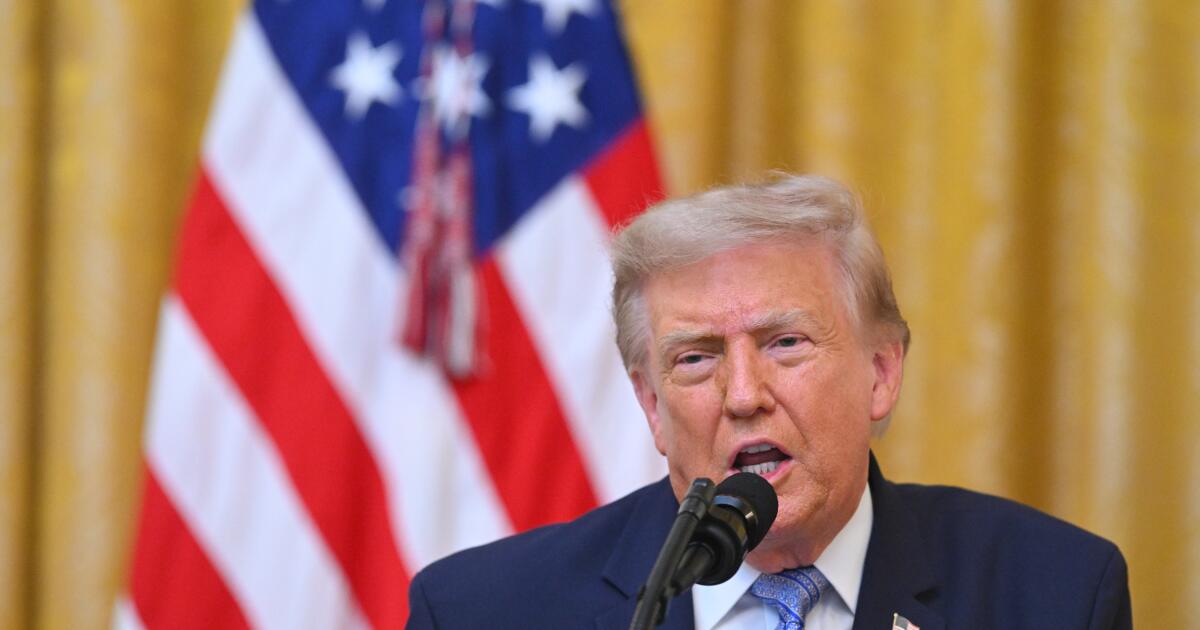
Source link

Trump repeats debunked claims about voting vulnerabilities

President Trump used a rare prime-time address Thursday night to renew his attacks on the security of U.S. elections, telling Americans that the nation’s voting system is “so broken” that “no one can possibly defend it,” an unprecedented effort by a sitting president to undermine public confidence in domestic elections.

Many of the claims he made, which echo those he made after he lost the 2020 election, have been debunked by investigations, audits and court proceedings. Trump did not claim that vote counts were changed or election systems were hacked, and his warnings that the nation’s elections could be vulnerable to foreign influence have long been made by members of both parties.

But the president amplified those claims and others in an effort to cast fresh doubt over what he said was a “stolen” and “rigged” election and renew calls to pass a federal voting law ahead of the November election.

“Addressing this crisis of elections security demands that Congress will pass the SAVE America Act,” Trump said. “How easy is that to do? Unless you want to cheat.”

Trump said he directed the White House to release a tranche of heavily redacted documents that purport to show “vulnerabilities” in the nation’s voting system, with the goal of “correcting them very, very quickly.”

The 26-minute address to the nation — a platform traditionally reserved for rare moments of national importance — was the latest effort by Trump to attempt to assert more federal control over state elections.

Major broadcast networks declined to air Trump’s speech in full, instead reporting on it. Trump complained about NBC and ABC as he spoke, saying they should lose their broadcasting licenses. He falsely claimed that “they and others in the media are part of a plot” to “continue this fraud.”

In his remarks, Trump alleged China carried out what is believed to be the “largest compromise of election data history” starting during the 2020 election cycle and claimed that “members of the deep state” in the American intelligence community covered it up.

He directed the FBI, the director of national intelligence and other agencies led by some of his loyalists to investigate and prosecute the people responsible for the cover up.

Democrats swiftly condemned Trump’s claims as baseless and rehashed ideas that have little to do with actual election administration.

“Donald Trump is releasing unverified, meaningless documents to appease his own delusions about an election he lost resoundingly, all while continuing to withhold 3 million pages of the Epstein files,” Senate Minority Leader Chuck Schumer said on X.

Multiple reviews of the 2020 election have concluded that Democrat Joe Biden won legitimately, and election experts say there is no evidence that widespread fraud affected the outcome of the election.

“It’s been more than half a decade, with numerous audits, recounts, and more than 60 court cases, each finding no evidence of widespread voter fraud,” Sen. Alex Padilla (D-Calif.) said in a statement. “Clearly, this is no longer about an election Donald Trump lost six years ago. It’s about him laying the groundwork to try to ‘take over the voting’ in the upcoming midterm elections.”

Ahead of the speech, elections and democracy experts had cautioned that the president may attempt to sow doubt in the security of the nation’s election system or bolster debunked fraud claims.

Trump has taken a series of steps since retaking office aimed at exerting control over elections. Some experts said Thursday’s address could be interpreted as a sign that Trump is running out of moves in the lead up to the midterm elections, where Republican control of the House is at stake.

“The fact that they’re throwing everything up on the walls at this point demonstrates panic,” said David Becker, executive director of the nonpartisan Center for Election Innovation and Research. “They are not operating from strength right now. They are operating from weakness.”

Trump delivered the address with his approval rating stagnating at 37%, according to a Washington Post-Ipsos poll released Thursday, with weakening enthusiasm among Republicans.

This is a breaking news story and will be updated.

Source link