removes

Libya’s parliament removes Speaker Saleh after 12 years as discontent grows | Conflict News

Eastern-based parliament votes to replace longtime speaker with Al-Salhin Abdelnabi al-Obeidi.

Libya’s eastern-based House of Representatives has elected a new speaker, ending Aguila Saleh’s 12-year tenure amid growing discontent among lawmakers over his leadership.

Legislators in the 170-member House voted on Tuesday to replace Saleh with Al-Salhin Abdelnabi al-Obeidi, the parliament’s spokesperson announced on X.

Recommended Stories

list of 3 itemsend of list

The vote came a day after 98 members of the House approved a new system limiting the speaker and deputy speakers to a single 12-month term.

The change ended an arrangement that had been in place since the chamber’s first leadership was elected in 2014.

“There was significant discontent among MPs with the previous leadership over numerous errors,” lawmaker Jebree Oheida told the Reuters news agency. “We tried to engage with the leadership to address these issues, but to no avail. Among these errors were decisions made without consulting MPs.”

The vote was overseen by Second Deputy Speaker Misbah Douma, according to the Libya Observer.

Saleh has previously rejected the proceedings, saying the initial vote to limit the speaker’s term was “not official and had no legal effect”, according to the outlet.  He had also announced that he had cancelled the session he had called for Tuesday.

The developments come as Libya remains divided politically and militarily between the United Nations-recognised government in Tripoli led by Prime Minister Abdul Hamid Dbeibah, and a rival administration in the east backed by renegade military commander Khalifa Haftar.

Haftar’s camp relies in particular on the parliament, which sits in the eastern city of Benghazi under their control.

Saleh has long been considered a staunch ally of the Haftar clan, but analysts said he appeared to be weakened as Haftar’s sons, in particular Saddam Haftar, consolidated their positions.

“Agila Saleh appears to be the latest casualty of Saddam Haftar’s drive to centralise decision-making in eastern Libya and bulldoze his way into a political role,” said Emadeddin Badi, an analyst at the London-based Chatham House.

Al-Obeidi, who comes from the same tribe as Saleh, represents the eastern city of Tobruk and has chaired parliament’s Libyan-Turkish friendship committee.

The House on Tuesday also elected Tarek al-Ashtar and Mesbah Douma as first and second deputy speakers, respectively.

Their election follows the signing of a landmark agreement by representatives of Libya’s rival political camps in Tripoli in August that could see presidential and legislative elections held within two years.

Mediated by the United Nations Support Mission in Libya (UNSMIL), the “4+4 committee” agreement attempts to resolve recurring legal and institutional disputes that have crippled the nation since the overthrow of Colonel Muammar Gaddafi in 2011.

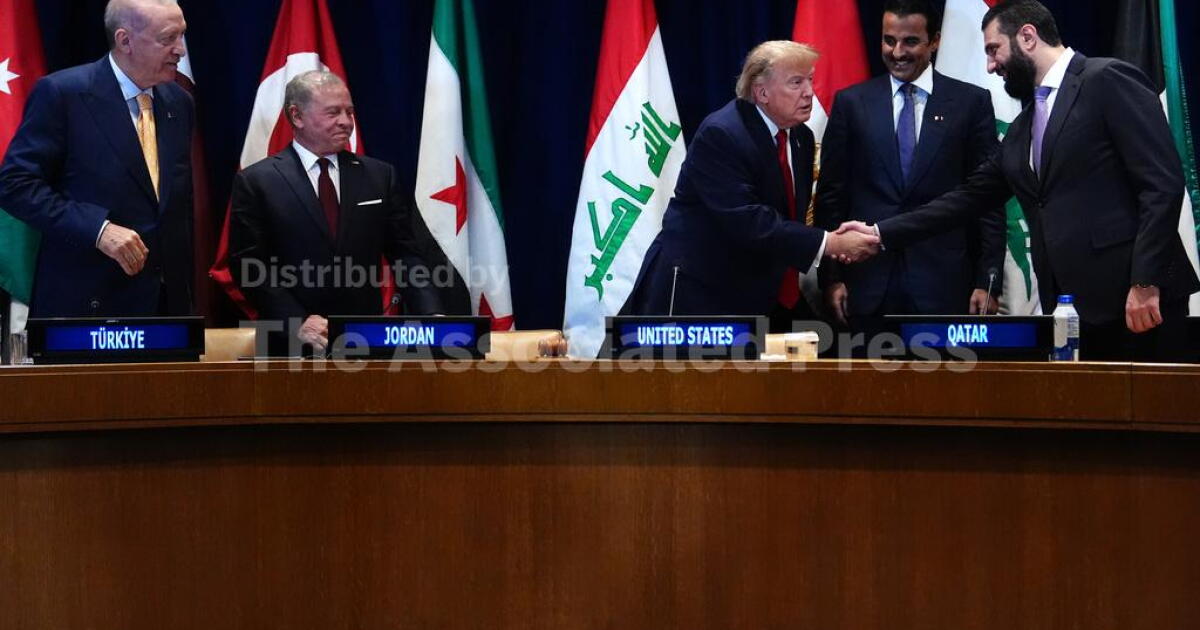
The United States is pursuing a separate reunification plan for the oil and gas-rich North African country, led by Massad Boulos, President Donald Trump’s senior adviser for Arab and African affairs.
Source link

U.S. removes Syria from arms export ban as Trump administration draws closer to new Syrian government

Matthew LeeAP Diplomatic Writer 

The Trump administration is removing Syria from a list of countries that are not allowed to purchase or import U.S. weaponry, a step that is part of a monthslong process of easing sanctions on the new government in Damascus and its leaders.

In a notice published Wednesday in the Federal Register, the State Department said it was amending its International Traffic in Arms Regulations, or ITAR, so that Syria no longer was among the nations subject to a policy of denial for licenses and other approvals needed for the sale of U.S. weapons and munitions.

The change effective Thursday means that arms sales requests from Syria will now be considered on a case-by-case basis.

President Donald Trump acted last year to ease economic sanctions on Syria that had been in place for decades during now-ousted President Bashar Assad’s rule. In August, Secretary of State Marco Rubio rescinded Syria’s designation as a state sponsor of terrorism, helping paving the way for the latest step in drawing closer to the current government.

The State Department has also announced plans to reopen the U.S. Embassy in Damascus. It has been closed for 14 years.

With Syria’s removal from the ITAR blacklist, only seven countries remain subject to the policy of denial for licenses for U.S. arms exports: Belarus, China, Cuba, Iran, Myanmar, North Korea and Venezuela.

Syria’s interim president, former rebel leader Ahmad al-Sharaa, overthrew the Assad government nearly two years ago and has embarked on a policy of change that has impressed the Trump administration. His moves have led to hopes of eventual stability in a country that was wracked by civil war and the Islamic State insurgency that engulfed northeast and western Iraq for years.

Wednesday’s withdrawal of U.S. forces from Iraq may mean that the Syrian government plays a greater role in preventing an IS resurgence.

Lee writes for the Associated Press.

Source link

BBC removes That Mitchell and Webb show scenes that ‘no longer works’

The broadcaster has been accused of ‘classic overkill’ after it removed 11 sketches from the comedy duo’s BAFTA-winning television show amid concerns of racism and racial stereotyping

The BBC has removed several sketches from That Mitchell and Webb Look on iPlayer after deciding some of the comedy show’s material “no longer works today”.

The sketch comedy show, starring comedians David Mitchell and Robert Webb, who wrote and starred in the programme, originally ran for four seasons between 2006 and 2010. It also took home a BAFTA in 2007.

To celebrate the sketch comedy programme’s 20th anniversary, the national broadcaster added four seasons of the smash-hit show onto iPlayer for fans to enjoy – but with a few notable omissions.

A total of 11 sketches have been edited out amid fears of racism and ethnic stereotyping.

“That Mitchell and Webb Look has been made available on BBC iPlayer,” the British broadcaster said in a statement. “This is a 20-year-old sketch show; in consultation with the programme makers, we have included the ones that still work today and not the ones that don’t.”

As per The Times, material removed from the programme included scenes featuring war re-enactors in blackface, a joke about Jimmy Savile, and an indigenous tribe living in a garden centre.

One now-deleted sketch sees Mitchell play a woman in a burka in a scene sending up reality TV programming.

The sketch then cuts to the pair – as themselves – discussing whether or not the sketch itself is actually offensive.

“I’m not sure we quite know what we’re trying to say,” Webb suggests, asking: “Aren’t we just taking the piss out of people’s sincerely held beliefs?”

Mitchell says: “I think you can worry too much about this kind of thing. I mean, what’s offensive to one person is just good, clean fun to another.”

He then pulls off the burqa to reveal he is wearing blackface underneath.

Comedian Dom Joly told The Times: “I totally get it if the BBC is putting out something really racist, which is laughing at and encouraging other people to feel that it’s OK to do that.”

He dubbed the decision to cut the scenes as “classic BBC overkill” and an act of “hysterical censorship”.

“But it’s so clear that Mitchell and Webb are not doing that. Their intent was not to be racist.”

As a possible alternative solution, broadcasters could put trigger warnings on older programmes if they believed they were necessary, he told The Times.

Joly did say such trigger warnings would be “patronising” to the audience, with the move reminiscent of the furore regarding another sketch show that has attarcted criticism years after airing, Little Britain.

A smash-hit in its day, the three-season skit show began in 2003, starring David Walliams and Matt Lucas, who also wrote the gags.

But it was later pulled from the BBC’s Player in 2020 due to its offensive content, such as the use of blackface, homophobic jokes, and ablesit humour. The series did return to iPlayer in late 2022, but in an edited format, complete with removed scenes and a trigger warning for audiences.

Source link

Housekeeper always removes 1 item from hotel room after check in

A hotel housekeeper has shared the one thing she always does when staying in a hotel room and it’s left many people spooked by the idea. So have you done this before?

You check in, drop your bags, and collapse onto what appears to be an immaculate, freshly-made bed. But beneath the perfectly plumped pillows and crisp white sheets, it might not actually be as clean as it looks.

Regardless of how much guests splash out on their hotel room, most will have one non-negotiable expectation – the room has been spotlessly cleaned since the previous guest checked out. From fresh bed sheets to a sparkling bathroom, a housekeeper’s workload can be gruelling. But guests have been left stunned to discover that some everyday hotel room items are virtually never washed – including a common item on the beds.

Taking to TikTok, a housekeeping manager named Margarita left her followers shocked after posting a video demonstrating the very first thing she does upon arriving at a hotel room during her own personal stays.

“POV: You’re a Housekeeping Manager staying at a hotel,” read the on-screen text, as two women were filmed standing inside a hotel room.

Content cannot be displayed without consent

Armed with tissues in each hand, the pair proceeded to remove the bed runner from the foot of the bed, placing it on the luggage rack well away from where they’d be sleeping. One of the women couldn’t disguise her look of revulsion as they carried out the task.

People disgusted to learn some items are ‘never cleaned’

Numerous hotel housekeepers have previously revealed that bed runners are rarely laundered, unlike the rest of the bed linen, which is washed thoroughly after every guest checks out.

Experts have previously voiced their concerns about bed runners, explaining that their purpose is to catch dirt, shoe scuffs, and germs from luggage, bags, and outdoor clothing placed at the foot of the bed.

Because it serves as a dedicated barrier against outside grime, it can accumulate dust and microscopic dirt left behind by previous guests staying in the room.

Margarita was far from alone in her views, as the comments section quickly filled up with others sharing that they always do exactly the same thing, with one person questioning: “I mean, why aren’t they washed after every guest?”

Another argued: “If it’s a hassle to clean or replace they just shouldn’t have them in the rooms. I don’t need decorative pillows or bed runners.”

A third person added: “Should be a law that all decorative décor like pillows or bed runners need to be washed after each guest or just not provided.”

Source link