redistricting

Virginia voters deciding on redistricting plan that could boost Democrats’ seats in Congress

Virginia voters on Tuesday are deciding whether to ratify an unusual mid-decade redrawing of U.S. House districts that could boost Democrats’ chances of flipping control of the closely divided chamber, as the state becomes the latest front in a national redistricting battle.

A proposed constitutional amendment backed by Democratic officials would bypass the state’s bipartisan redistricting commission to allow use of new congressional districts approved by state lawmakers in this year’s midterm elections.

The referendum, which needs a simple majority to pass, tests Democrats’ ability to push back against President Trump, who started the gerrymandering competition between states after successfully urging Texas Republicans to redraw congressional districts in their favor last year. Virginia is the second state, after California last fall, to put the question to voters.

It also tests voters’ willingness to accept districts gerrymandered for political advantage — coming just six years after Virginia voters approved an amendment meant to diminish such partisan gamesmanship by shifting redistricting away from the legislature.

Even if Democrats are successful Tuesday, the public vote may not be the final word. The state Supreme Court is considering whether the redistricting plan is illegal in a case that could make the referendum results meaningless.

Virginia Democrats are following California’s lead

Congressional redistricting typically is done once a decade after each U.S. census. But Trump urged Texas Republicans to redistrict ahead of the November elections in hopes of winning several additional seats and maintaining the GOP’s narrow House majority in the face of political headwinds that typically favor the party that is out of power during midterms.

The Texas gambit led to a burst of redistricting nationwide. So far, Republicans believe they can win up to nine more House seats in newly redrawn districts in Texas, Missouri, North Carolina and Ohio.

Democrats think they can win up to five more seats in California, where voters approved a mid-decade redistricting effort last November, and one more seat under new court-imposed districts in Utah. Democrats hope to offset the rest of that gap in Virginia, where they decisively flipped 13 seats in the state House and won back the governor’s office last year.

Voters focus on fairness, with different perspectives

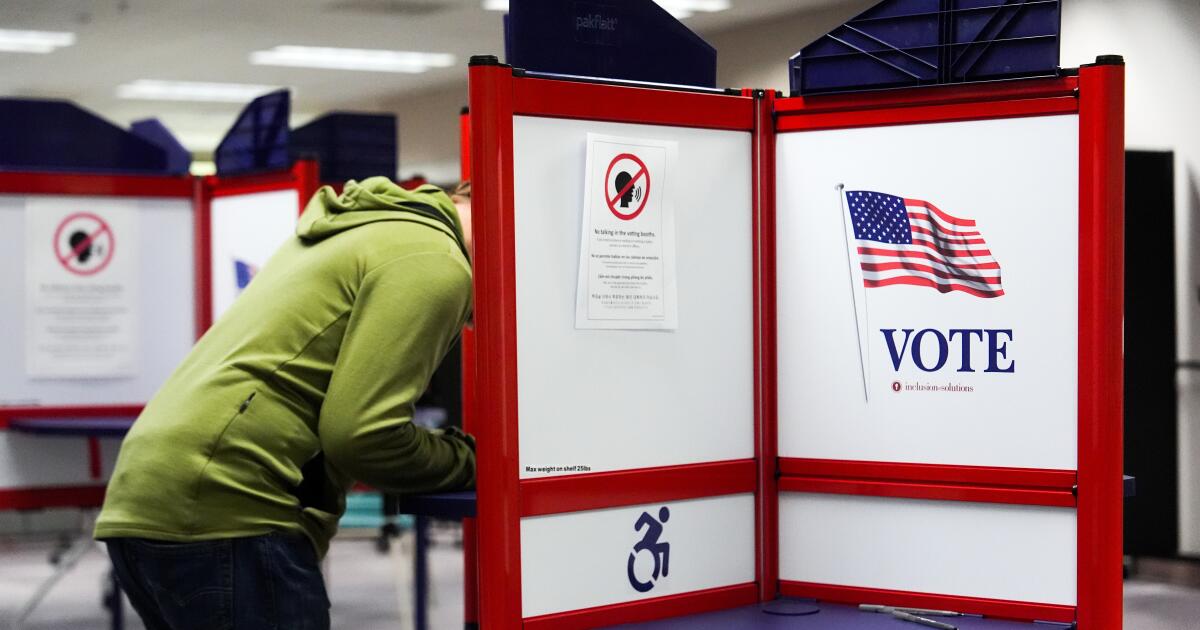
The stream of voters was steady Tuesday at a recreation center in the Old Town area of Alexandria, Virginia.

Matt Wallace, 31, said he votes regularly but this election has additional emphasis.

“I think the redistricting issue across the country is unfortunate, that we’ve had to resort to temporary redistricting in order to sort of alter our elections across the country,” Wallace said. He said he voted for the Democratic redistricting amendment “to help balance the scales a bit until things get back to normal.”

Joanna Miller, 29, said she voted against the redistricting measure, “because I want my vote to count in a fair way.” Miller said she was more concerned about representation in Virginia than trying to offset actions in other states.

“I want my vote and my representation to matter this fall,” she said.

Political parties made a big push in Virginia

Leaders of both major parties see Tuesday’s vote as crucial to their chances to win a House majority in the fall. Trump weighed in via social media Tuesday morning, telling Virginians to “vote ‘no’ to save your country!”

Former Virginia Gov. Glenn Youngkin, a Republican, rallied with opponents of the measure Monday night, calling the redistricting plan “dishonest” and “brazenly deceptive.” House Minority Leader Hakeem Jeffries told reporters at the Capitol earlier in the day that a vote to approve the redraw “will serve as a check and balance on this out-of-control Trump administration.”

A committee supporting the Democratic redistricting effort had raised more than $64 million — three times as much as the roughly $20 million raised by opponents, according to finance reports filed less than two weeks before the election.

The back-and-forth battle over congressional districts is expected to continue in Florida, where the Republican-led legislature is scheduled to convene April 28 for a special session that could result in a more favorable map for Republicans.

A lobster-like district could aid Democratic efforts

In Virginia, Democrats currently hold six of the 11 U.S. House seats under districts that were imposed by the state Supreme Court in 2021 after a bipartisan commission failed to agree on a map based on the latest census data.

The new plan could help Democrats win as many as 10 seats. Five are anchored in Democratic-heavy northern Virginia, including one shaped like a lobster that stretches into Republican-leaning rural areas.

Revisions to four other districts across Richmond, southern Virginia and Hampton Roads dilute the voting power of conservative blocs in those areas. And a reshaped district in parts of western Virginia lumps together three Democratic-leaning college towns to offset other Republican voters.

The Virginia redistricting plan is “pushing back against what other states have done in trying to stack the deck for Donald Trump in those congressional elections,” Democratic Gov. Abigail Spanberger said during an online rally last week.

Ads for the “yes to redistricting” campaign featuring former President Barack Obama have flooded the airwaves.

Opponents have distributed campaign materials citing past statements from Obama and Spanberger criticizing gerrymandering, but those were before Trump pushed Republican states to redraw their congressional maps in advance of this year’s midterms.

Democrats “were all against gerrymandering before they were for it,” Virginia Republican Party Chairman Jeff Ryer said.

Virginia court weighs whether lawmakers acted illegally

Virginia lawmakers endorsed a constitutional amendment allowing their mid-decade redistricting last fall, then passed it again in January as part of a two-step process that requires an intervening election for an amendment to be placed on the ballot. The measure allows lawmakers to redistrict until returning the task to a bipartisan commission after the 2030 census.

In February, they passed a new U.S. House map to take effect pending the outcome of the redistricting referendum. Republicans have filed multiple legal challenges against the effort.

A Tazewell County judge ruled that the redistricting push was illegal for several reasons. Circuit Court Judge Jack Hurley Jr. said lawmakers failed to follow their own rules for adding the redistricting amendment to a special session.

He ruled that their initial vote failed to occur before the public began casting ballots in last year’s general election and thus didn’t count toward the two-step process. He also ruled that the state failed to publish the amendment three months before that election, as required by law.

If the state Supreme Court agrees with the lower court, the results from Tuesday’s vote could be rendered moot.

Lieb writes for the Associated Press. AP writers Gary Fields in Virginia and Lisa Mascaro in Washington contributed to this report.

Source link

Virginia redistricting vote: What polls suggest and what voters will decide | US Midterm Elections 2026 News

Voters in Virginia head to the polls on Tuesday to decide on a measure that could redraw the state’s congressional map and potentially shift the balance of power in Washington.

Major political figures, including former President Barack Obama and House of Representatives Speaker Mike Johnson, have weighed in on the high-stakes vote, with nearly $100m spent on campaigning around it.

Part of a broader redistricting battle that began in Texas and spread nationwide, the vote may be the Democrats’ last chance this year to gain seats by changing district maps. The vote comes about six months before the 2026 midterm elections.

Here is what we know:

What is Virginia voting on?

Virginia currently sends 11 members to the House. At the moment, six of them are Democrats, and five are Republicans, reflecting the state’s balance.

Democrats now want to redraw the map to favour them in a way that could help them win up to 10 of the 11 seats. Under the proposal, most districts would be safely Democratic or lean towards the party, with only one strongly Republican.

A breakdown would be:

  • Eight districts would be safely Democratic
  • Two would be competitive but lean Democratic
  • Only one would be safely Republican

If approved, this could give the Democrats several extra seats in Congress, helping them win back or strengthen control of the House in Washington, where majorities are often decided by just a few seats.

That would be a big political shift for the state, which was once closely contested but has become more Democratic-leaning in recent years.

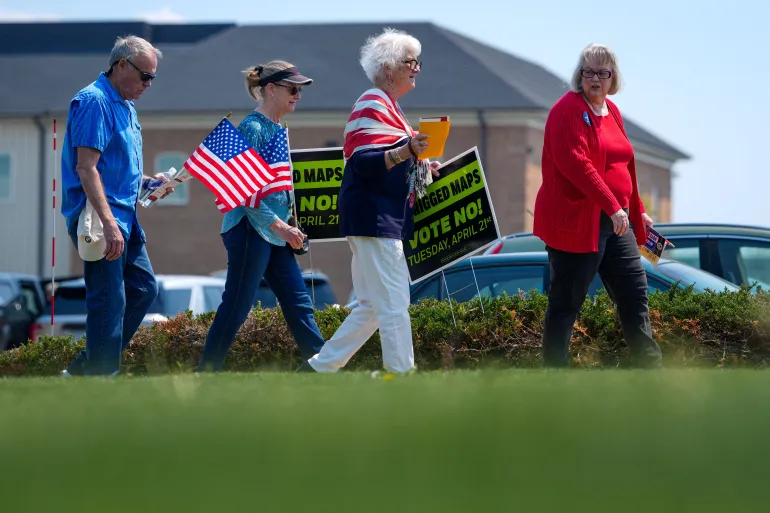
Supporters depart a campaign rally against Virginia Democrats' proposed state redistricting constitutional amendment
Supporters depart a campaign rally against Virginia Democrats’ proposed state redistricting constitutional amendment [FILE: Ken Cedeno/Reuters]

How would the vote work?

Voters in Virginia can cast their ballots either early or on Election Day.

Polling stations will be open across the state on Tuesday:

  • Polls open at 10:00 GMT
  • Polls close at 23:00 GMT

Votes will be counted after polls close, with early results expected later that evening and fuller results overnight or the next day.

What are voters being asked to decide?

The proposed constitutional amendment is the only statewide contest on the ballot.

It reads:

“Should the Constitution of Virginia be amended to allow the General Assembly to temporarily adopt new congressional districts to restore fairness in the upcoming elections, while ensuring Virginia’s standard redistricting process resumes for all future redistricting after the 2030 census?”

A “yes” vote would support allowing the General Assembly to redraw congressional districts before the midterms.

A “no” vote would leave current boundaries unchanged until the next round of regularly scheduled redistricting after the 2030 census.

What do the latest polls suggest?

The result is expected to be close.

A recent poll by State Navigate, a nonpartisan research group, suggests a small lead for supporters, with about 53 percent in favour and 47 percent against.

Why do district lines matter so much?

District lines decide how voters are grouped, which can shape who wins elections.

Moving the lines can make a district more favourable to a Democratic or Republican win, by adding or removing neighbourhoods and communities that lean one way or the other.

It can turn a close race into a safe seat, or the other way around. It affects which communities are kept together and who represents them.

This process, often called gerrymandering, allows parties to draw maps that benefit them.

In a closely divided state like Virginia, even small changes to the map can shift several seats and influence who holds power in Congress.

A 2023 study by Harvard University researchers found that gerrymandering often creates “safe” seats for politicians, meaning their races are less competitive.

In turn, those politicians become less responsive to the needs of their constituents, who become discouraged about voting as a result.

Supporters pray during a campaign rally against Virginia Democrats' proposed state redistricting constitutional amendment
Supporters pray during a campaign rally against Virginia Democrats’ proposed state redistricting constitutional amendment [Ken Cedeno/Reuters]

When could new maps take effect?

If approved, the new map could be used as early as the next election cycle, including the upcoming midterms, depending on legal approval.

However, the plan could face legal challenges. Critics have questioned the ballot wording and the process used by lawmakers.

The Virginia Supreme Court has allowed the vote to go ahead while reviewing those concerns.

If it later finds that rules were broken, the results could be overturned, and the current maps would remain.

Why this vote could shape power in Washington?

A handful of seats could decide control of the US House.

Republicans currently hold a narrow 218–213 majority, but Democrats are seen as competitive heading into the midterms.

Political leaders have underscored the stakes.

Hakeem Jeffries, the Democratic Party’s leader in the House, has pointed to Virginia as a crucial battleground, while Mike Johnson has said the result will be closely watched across the country.

U.S. House Speaker Mike Johnson (R-LA) speaks during a campaign rally
US House Speaker Mike Johnson (R-LA) speaks during a campaign rally [Reuters]

What it means to control the US House

The party with the majority (more seats) in Congress can:

  • Set the agenda, deciding which bills are brought up for debate
  • Control committees, including investigations and hearings
  • Pass legislation more easily (if they stay united)
  • Block bills from the minority party.

The majority party also chooses the speaker of the House, who has major influence over what reaches the floor.

Where else has this happened?

Virginia’s redistricting vote is part of a larger political battle playing out in the US. Republicans in Texas, encouraged by Donald Trump, have redrawn district maps to strengthen their advantage, prompting similar efforts in other states.

In rare cases, voters have been asked to decide directly, including in California last year and now in Virginia.

In California, voters backed the changes despite concerns about fairness. Now it’s Virginia’s turn to decide.

What Democrats are saying, and why?

Democrats argue the plan is a response to Republican actions in other states, not just a power grab.

Leaders like Obama had long opposed gerrymandering in principle, but have now backed the Virginia move, even releasing a video asking voters to go out and vote for the constitutional amendment.

Source link