Jennifer Siebel Newsom sought to redefine the role of first spouse. Now, she faces her biggest test
Jennifer Siebel Newsom was frustrated.
She was standing behind her husband, California Gov. Gavin Newsom, at a February press conference to celebrate a new bill that would give Planned Parenthood emergency funds. A throng of women’s advocates, including herself, had spoken about how the law would help women access healthcare. But now reporters were asking a barrage of off-topic questions, from the California High Speed Rail to the 2028 Olympics.
She paced, she swayed, she laughed with displeasure. Finally, she stepped closer to her husband and gently nudged him aside. She found it “incredulous,” she said, that they had assembled all these allies only for the reporters to ask about other issues.
“This happens over and over and over and over again,” she said as Newsom smiled awkwardly. “You wonder why we have such a horrific war on women in this country and that these guys are getting away with it. Because you don’t seem to care. So I just offer that with love.”
All of a sudden, Siebel Newsom herself was the news. One of Sacramento’s top female journalists, Ashley Zavala, shot back on X that reporters were just doing their jobs and the way they were treated “was not normal.” Right-wing media blasted out headlines from “Gavin Newsom’s wife scolds reporters” to “Gavin Newsom’s wife slams reporters for ‘horrific war on women’ in extraordinary rant.”
The scene underscores Siebel Newsom’s predicament as her husband positions himself as Trump’s chief antagonist and prepares for a possible 2028 White House run.

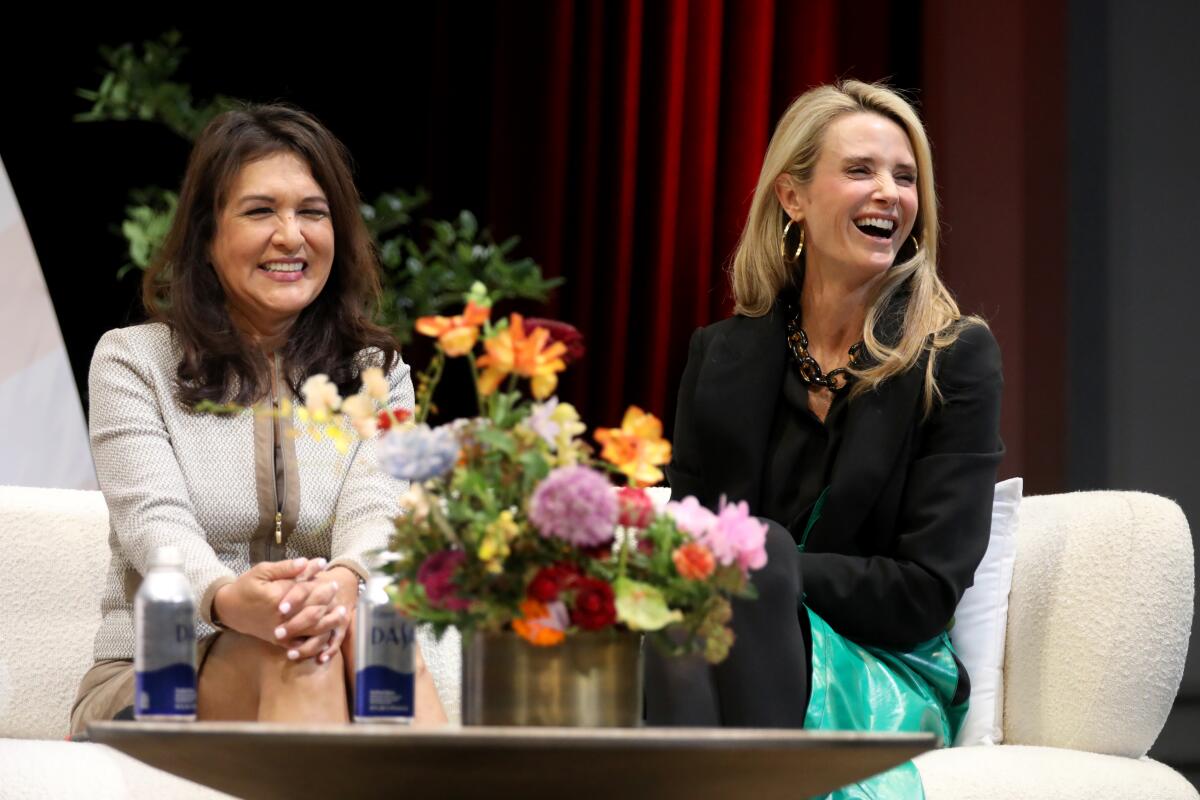
Jennifer Siebel Newsom with California Surgeon General Diana Ramos.
(Gary Coronado / Los Angeles Times)
She came to Sacramento with a mission to speak up for women, calling herself “first partner” to signal she would carry on the theme of her work as a documentary filmmaker and nonprofit leader: dismantling gender norms. But as her husband raises his national profile with a podcast, a memoir and daily trolling of President Trump, she finds herself under mounting scrutiny.
In June, Newsom accused Trump of weaponizing the Department of Justice to launch a politically motivated attack on his spouse after federal agents knocked on the doors of the Newsoms’ friends and former employees, asking about Siebel Newsom’s taxes and nonprofit businesses.
“To get me, he’s coming after my wife,” Newsom said.
A federal source said the investigation began not with Trump, but after federal officials spoke to whistleblowers in Sacramento. Whatever the origin or merits of the probe, Siebel Newsom has long faced questions about her finances — specifically her nonprofits’ partial reliance on donations from companies that lobby the governor, a strategy that does not violate California law but raises concerns about the influence of large corporations in Sacramento.
Her decision to use the title “first partner” and her work “deconstructing” gender are also attracting criticism from the right in the post-#MeToo era as many Americans chafe against what they perceive as radical attempts to undermine traditional values and policing of what they say and do.

California Gov. Gavin Newsom looks on at his wife, Jennifer Siebel Newsom.
(Mario Tama / Getty Images)
To Siebel Newsom, the critiques of her work and the federal probe are part of a broader hounding of women who enter the public sphere. When federal agents targeted her associates, she was promoting “Miss Representation: Rise Up,” her new film examining the role technology plays in fueling what she describes as “the rising backlash against women’s progress.”
“We are seeing young women hold themselves back from wanting to pursue careers … not just political leadership, and it’s extremely disturbing,” Siebel Newsom told CNN in June. “It is a backlash, a backslide, and it is happening at an unprecedented scale, where ultimately we are silencing women’s voices.”
She disagreed with those who say scrutiny is the price of admission for being in public life. “Women and girls deserve to be protected,” she said. “Anyone aspiring to a public service career deserves to be safe. It should be fundamental.”
Untangling legitimate political criticism from deeply ingrained gender bias is not easy. Women in the public eye are frequently held to a different standard than men. But some political experts question whether a woman who refuses to stand on the sidelines — raising her voice on radioactive culture war issues and benefiting in part from her marital status to fund her nonprofits — can reasonably expect to be excluded from the rough and tumble of her husband’s political life.
Jessica Levinson, a Loyola Marymount University law professor and political commentator, said Siebel Newsom had been subjected to heightened public scrutiny for years. “That I think is likely fair,” she said, “in the sense that she has said that she’s very much a partner of the governor, and she has used this platform to advocate for causes that she cares about.”
Still, Levinson said, Siebel Newsom’s availing herself of the public forum did not mean she had violated the law.
“Does the fact that she has created and run nonprofits that receive behested contributions from Gov. Newsom put her and her actions in a different spotlight?” she said. “Absolutely, but that doesn’t mean that she’s doing anything nefarious. It just means that their life and their finances and their jobs are a little bit more complicated than other first families.”
Raised in an affluent suburb in Marin County, Siebel Newsom, 52, grew up in privilege. Her father was an investment manager and prominent GOP donor, her mother a co-founder of the Bay Area Discovery Museum.
After studying Latin American studies at Stanford and volunteering in Ecuador and Africa, she returned to Stanford to earn an MBA. Then she moved to L.A. to try to break into Hollywood. She got small parts in “Mad Men” and “Rent,” but has said she “was typecast as a trophy wife and kind of put into this box.”
That sparked her interest in getting behind the camera.
Around the time she married Newsom in 2008 and got pregnant with her first child, she began work on “Miss Representation,” her debut 2011 film that examines how mainstream culture limits female potential and power by focusing on youth, beauty and sexuality.
When Newsom was elected governor, she announced she would eschew the traditional title of “first lady.”
The “first partner” title, she has said, is not just gender inclusive and gender expansive. “It disrupts some of the male-coded language we associate with leadership, versus a ‘lady’ who sits on the sidelines.”

Jennifer Siebel Newsom.
(Christina House / Los Angeles Times)
Over the last 15 years, Siebel Newsom has worked on a series of documentaries and founded nonprofits focused on gender equity, the Representation Project and California Partners Project.
“She walks the walk,” said Amy Ziering, a documentary filmmaker whose films Siebel Newsom helped produce. She did not take the role lightly, Ziering said, noting she watched cuts and took notes, made introductions and brought people to screenings. The fact that Siebel Newsom kept pressing women’s issues as her husband became governor, Ziering said, reflected her integrity.
“She’s not diminishing her beliefs, her values, her principles or any other kind of long-term goals” Ziering said. “She shows up, ‘This is what I believe,’ and maybe it’s not politically efficacious to believe this right now, or to say ‘I believe it’ … but she does.”
In 2022, Siebel Newsom took on another public role, testifying in Harvey Weinstein’s sexual assault trial.
“She did not have to do that, she could have been Jane Doe,” Ziering said. “That’s about showing up for other women and for all sexual assault survivors.”
Cristina Garcia, a former assemblywoman who represented southeast L.A. and worked with Siebel Newsom on women’s legislation, said she thought Siebel Newsom would be a target no matter what.
“But I think she sees the power that she has, and it’s like, why should she just sit in the background?” Garcia said. “Why shouldn’t she use her power to uplift women and children … these things she’s been really passionate about?”
In Sacramento and across liberal California, Siebel Newsom’s ideas on women and gender are relatively mainstream.
But as the 2028 election looms, conservatives have dredged up old clips, highlighting Siebel Newsom’s comments about parenting and deconstructing gender roles to portray her as “radical” and “woke.”
In one video, Siebel Newsom said that when she reads to her children she changes the protagonist’s gender from “he” to “she” to show women matter and can center a story.
In another, she raised concerns about boys being exposed to “alt-right socialization online that we know is very, very dangerous.” She and her husband, she noted, were alarmed to find their son had encountered misogynist influencer Andrew Tate while watching sports online.
Some conservatives have noted, with glee, that Siebel Newsom could be a liability for her husband as he seeks national office.
“Jennifer Siebel Newsom is the very avatar of Democrat Woman,” a New York Post columnist wrote. “Haughty, hectoring and pleased with herself, she is single-handedly wrecking her hen-pecked husband Gavin’s lofty political ambitions.”
But former state Sen. Hannah-Beth Jackson (D-Oxnard) pushed back on the idea that Siebel Newsom was some kind of strident activist or woke scold. After working with Siebel Newsom on equal pay and bringing more women onto corporate boards, she said Siebel Newsom was adept at working with corporations to find common ground and recognize what businesses need to be successful.
The scrutiny of Siebel Newsom comes as her husband tries to stake out a more centrist stance on some issues.
Last year, Newsom inspired the ire of some Democrats by launching a podcast in which he chatted with right-wing figures, such as Turning Point USA founder Charlie Kirk and Trump’s former chief strategist Steve Bannon. On its debut episode, Newsom distanced himself from his party’s left flank, calling the dismantling of police departments “lunacy.” Allowing transgender athletes to participate in women’s sports, he said, was “deeply unfair.”
Asked why, Newsom told The Times his party had become out of touch with ordinary Americans. “They think we’re elite,” he said. “We talk down to people. We talk past people. They think we just think we’re smarter than other people, that we’re so judgmental and full of ourselves.”
On this point, it’s not clear whether the Newsoms are in sync.
For all her talk of women as allies, Siebel Newsom portrays conservative women who criticize other women as dupes manipulated by MAGA leaders.
“What’s interesting is that the far right really is using women to go after other women,” she said in June on the “Hysteria” podcast. “So I find it very intentional on their part that they have essentially sent the women out to humiliate, demean, ridicule, mock, silence another women. But that’s just the patriarchy, right? … And that’s what we have to fight.”
Still, she has voiced doubt about whether she would continue to go by “first partner” if her husband were elected president.
Asked in 2023, Siebel Newsom said she didn’t know if Americans were ready for a “first partner.”
“Sadly,” she said, “I don’t know if they are.”
But even as conservatives mock Siebel Newsom’s patrician “girl power” message and activist jargon, she shows few signs of backing down.
As she has taken “Miss Representation: Rise Up” to film festivals in New York and Washington, D.C., she has upped her call for more Big Tech regulation.
An advisor from the first partner’s office said Siebel Newsom had been an advocate for women and girls before she met Newsom. That was unlikely to change, they said, as she faced growing right-wing scrutiny or a federal investigation.
“There’s no strategy change here,” they said.