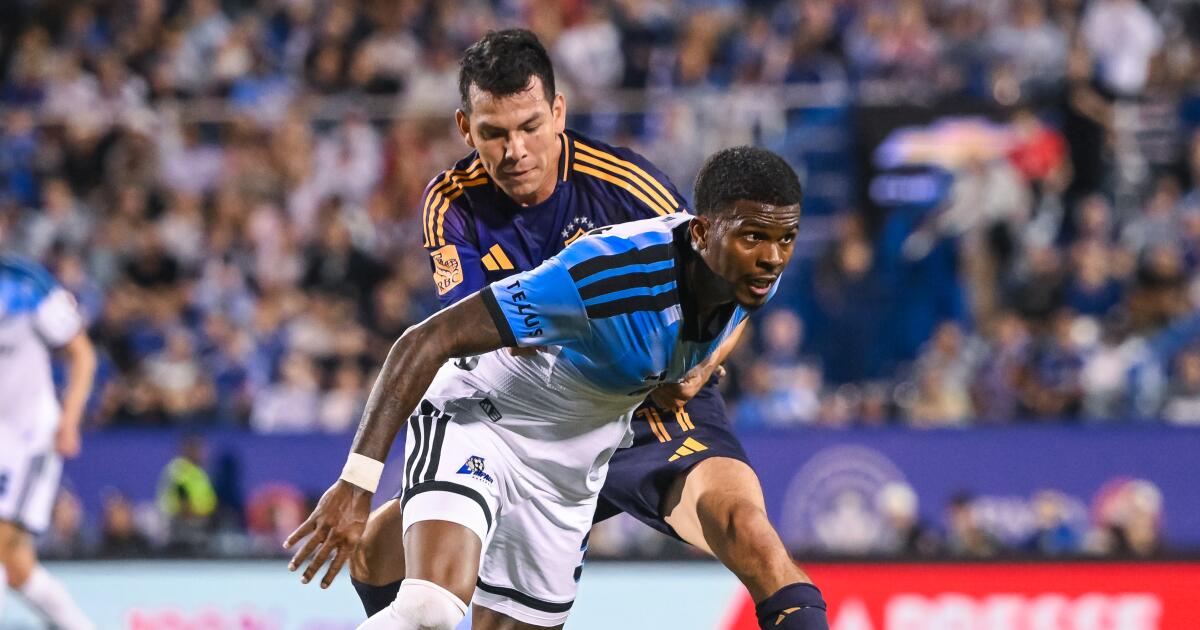
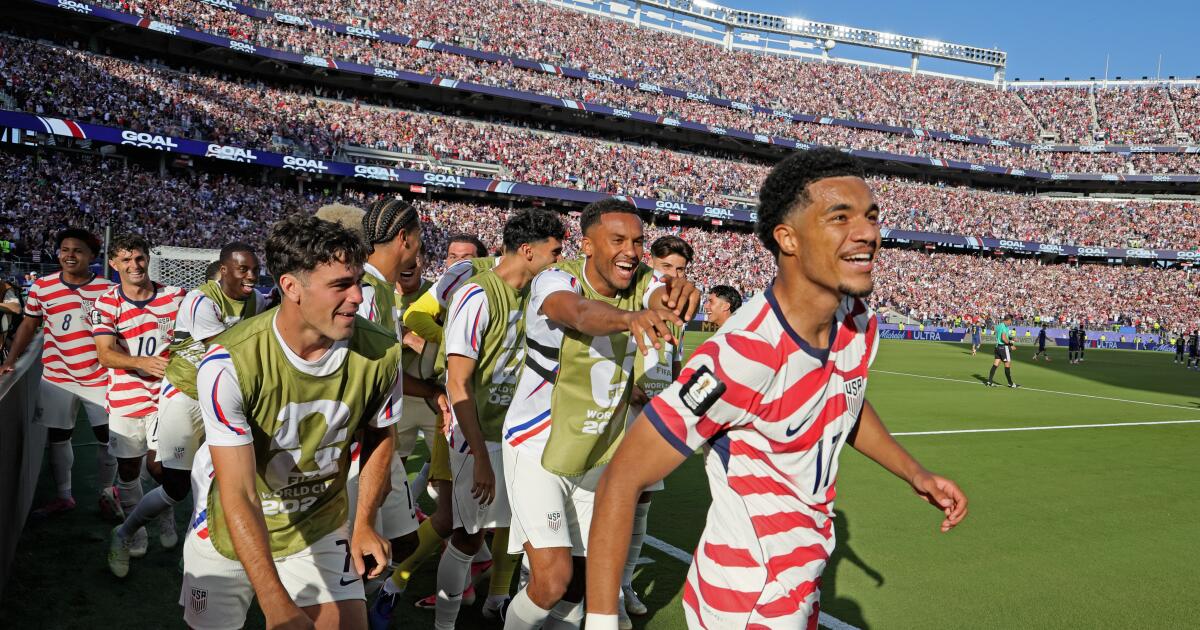
MONTREAL — Daniel Ríos scored his first goal in MLS and Prince Owusu also scored a goal for CF Montreal in a 2-2 tie with the Galaxy on Saturday night.
Goalkeeper JT Marcinkowski, shown a red card in the 68th minute, was replaced by Novak Micovic and the Galaxy played a man down the rest of the way. The Galaxy have drawn red cards in three consecutive games.
Owusu scored his career-high tying 13th goal this season to make it 2-2 in the 79th minute. The 29-year-old forward, who also scored 13 goals for Montreal last season, has a goal in four consecutive games and scored seven goals in the past seven.
Montreal (6-10-5) has a season-long four-game unbeaten streak.
Rubén Ramos Jr. and Maya Yoshida each scored a goal for the Galaxy (6-9-7), who beat San José 1-0 on Wednesday to snap a six-game winless streak.
Ríos made his debut for Montreal and opened the scoring in the 16th minute. Matty Longstaff played a low ball into the area from the right side that was parried by Marcinkowski at the front post before Ríos tapped in the rebound from point-blank range.
Ramos scored his first career MLS goal in the 20th. On the counter-attack, Kyōgo Furuhashi played a first-touch shot off a cross from Robert Taylor that was stopped by goalkeeper Thomas Gillier, but Ramos slammed home the putback to make it 1-1.
Yoshida back-heeled a shot from the center of the area into the net to give the Galaxy a 2-1 lead in the 48th minute.
That’s how Iván Barton described the moment he heard his last name called during the 2026 World Cup referee assignment meeting. It wasn’t to ask a question or to correct some administrative detail.
The next sentence changed his career forever: “Barton, your match is France vs. Spain. … After that, I didn’t hear anything else. I didn’t even know who my assistant referees would be.” The World Cup semifinal — one of the biggest matches a referee can officiate — had just been entrusted to the Salvadoran.
“It’s like going into shock, but a good kind of shock. ‘This is happening — it’s really happening.’ Reaching a semifinal is coming within a hair’s breadth of glory, because after a World Cup final, there’s nothing left,” Barton said.
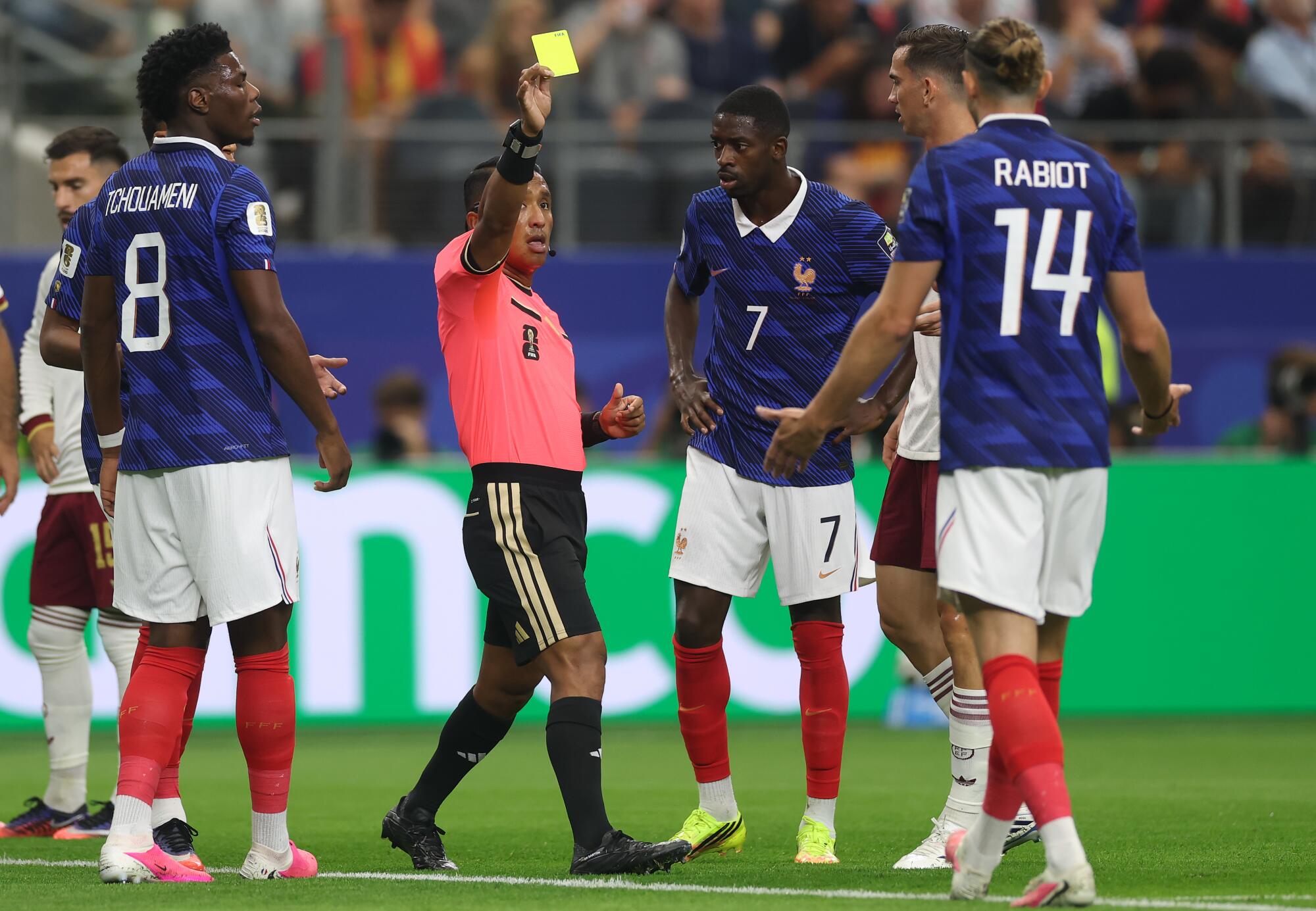
Referee Iván Barton issues a yellow card to France’s Adrien Rabiot during a World Cup semifinal match against Spain on July 14 in Arlington, Texas.
(Lars Baron / Getty Images)
There’s one detail in that scene that captures the magnitude of the moment. While waiting for the meeting to begin, Barton was checking the airline’s app on his phone. His ticket was still scheduled for a return flight to El Salvador the next day. He had already started packing, convinced that his World Cup was over.
“I was already mentally preparing to fly back to El Salvador the next day,” Barton recalled. “When I heard ‘Barton,’ I thought, ‘What happened?’ Then they said, ‘Spain vs. France, semifinal.’ I didn’t even hear the names of my assistants.”
The first thing he did after that was call his wife.
“That’s when the tears of joy came,” he said. “It was also a moment to thank God for what was happening and immediately start preparing for the match.”
For the first time, both World Cup semifinal matches were officiated by CONCACAF referees. Barton officiated the France-Spain match, while American Ismail Elfath refereed the England-Argentina match. The confederation described both appointments as an unprecedented event for the region.
Barton said he fulfilled a dream working during the 2022 World Cup in Qatar, but he and other CONCACAF referees were determined to show their ability to call the most important games.
“Qatar meant making a dream come true. Making it to 2026 was a huge challenge because the bar had been set very high,” Barton said. “There were high expectations. We approached it with a great sense of responsibility and humility.”
When the tournament ended, the feeling was different from that of his first World Cup.
“I feel happy, very proud to have placed our little El Salvador flag practically at the very top of world soccer,” he said. “That’s what fills me with the most pride. We continue to open doors not only for my country, but also for the entire region and for CONCACAF refereeing.”
The red card that made history
Among the four matches Barton officiated, the Turkey-Paraguay game went down in history at the 45+3-minute mark.
During a confrontation between Miguel Almirón and Turkey’s Mert Muldur, the Paraguayan star covered his mouth while speaking aggressively to his opponent.
Barton had to review the play via VAR, and as stipulated by the new amendment to Law 12, the incident resulted in a red card, since the situation had elements of confrontation and the gesture served to conceal provocative, derogatory or inflammatory communication.
The review confirmed his interpretation.
Referee Iván Barton issues a red card to Miguel Almirón for covering his mouth while confronting another player during a World Cup match.
(Dean Mouhtaropoulos / Getty Images)
Almirón became the first player sent off in a World Cup under this new provision.
For Barton, however, the story isn’t simply about a player covering his mouth.
“People get confused. It’s not just the act of doing it; it’s doing it in a confrontational situation against an opponent. That’s what changes the picture,” Barton explained.
Clarity is important.
The amendment aims to prevent players from hiding insults or other abuse — including discriminatory remarks — behind their hand, arm or jersey.
In Almirón’s case, Barton believed the conditions were met.
“In that match, it was clear that it had occurred during a confrontational situation in which the players were facing off,” Barton explained. “Seeing it on the VAR footage was clear. It was evident, and at no point was there any doubt about the decision that had to be made.”
The incident occurred shortly before halftime, when Paraguay was leading 1-0. The red card left Paraguay with 10 players for the entire second half, but the team went on to win the match 1-0.
For Barton, the red card illustrates something he believes the public still misunderstands: VAR does not eliminate the need for the referee to interpret the rules.
“VAR isn’t there to eliminate 100% of errors,” he said. “Errors will always be part of soccer because there are many issues open to interpretation, and that’s what the referee is there for — to interpret them.”
Breaks that changed the pace of the matches
There was another major change fans protested during the World Cup — the hydration breaks.
FIFA decided that during the 2026 World Cup, there would be a three-minute break midway through each half, regardless of the temperature or stadium conditions. The referee was required to stop the match around the 22nd minute of each half.
The decision was motivated by concerns about player welfare in some of the hottest venues and a committee agreed it would be best to use the breaks universally rather than whenever the weather conditions required it to assure no teams were hampered by not getting breaks, but the debate did not go away.
In some cases, the breaks interrupted the flow of the game just as a team was starting to take control.
Barton understands that criticism, but he also doesn’t believe the break necessarily has a favorable or unfavorable effect on a team.
“Team A is attacking, attacking, attacking Team B. Obviously, it won’t be beneficial for Team A because they’re at their peak. For Team B, it will be,” he said.
The scenario can change in the second half.
“And what if, in the second half, the roles are reversed and it’s Team B that’s attacking Team A? For Team A, it’ll be beneficial. It’s very relative. I don’t think you can generalize whether it’s positive or not because it depends on the circumstances of the game.”
There’s also a difference between analyzing the break from the spectator’s perspective and doing so from the field.
As a referee, Barton found an immediate benefit.
“For us as referees, it’s beneficial because having a break to rest a bit, regain our strength and get feedback from our colleagues to see if anything needs adjusting — well, of course that’s positive,” said Barton. “In the United States, summers are extreme and it often becomes very difficult to say, ‘In this game, yes; in this game, no,’ because that undermines the consistency that the application of a rule must have.”
The stars’ last names don’t change the rule
What happens when the player who needs to be disciplined is named Kylian Mbappé, Lionel Messi, Lamine Yamal or James Rodríguez?
In a stadium, those names carry weight. On the lineup sheet, according to Barton, they don’t.
“As a referee — contrary to what many people might think — you detach yourself from many situations, from the noise, from the pressure,” he said.
That doesn’t mean the referee is unaware of who’s on the field. According to him, it means he can’t let a player’s name influence his decision.
“On the field, there are no big names, no big teams. You see 11 players against 11 players,” Barton said.
The Salvadoran had already officiated games featuring Messi during his career in various tournaments and at the 2026 World Cup, he faced some of the most renowned soccer players on the planet.
“At no point do we think, ‘I’m not going to speak to him firmly or show him a card because it’s this player.’ No, absolutely not,” Barton stated.
The rules must apply equally to everyone.
“If you see an incident, a foul or something someone did, you make a decision regardless of who it is,” Barton said.
Barton explains the relationship in a way that makes it clear it’s not about ignoring the players’ status in the sport. It’s about understanding that, for those 90 minutes, roles are clearly defined.
“Obviously, we respect them for what they’ve achieved, for what they represent in soccer, but when it comes to applying the rules of the game, we see 11 players against 11 players — and that’s it,” he said.
Taking El Salvador to the biggest stage
Barton speaks little about himself and a lot about his country. Every assignment, he explains, ceases to be an individual endeavor.
“The higher you climb a mountain, the stronger the wind blows. The harder it is to maintain your balance,” he said.
His philosophy has changed little since he began his career.
“I haven’t achieved these things on my own. There’s a huge team behind me. … My family, CONCACAF, FIFA, the people who have always supported me,” Barton said.
The Salvadoran acknowledges that, during international competitions, he often finds that there are still people who don’t even know where El Salvador is located.
“When you get to competitions at this level, there are people who can’t even locate our country on a map,” Barton noted. “Serving as a means for others to learn about El Salvador and ensuring that representation is dignified is one of my greatest responsibilities.”
There’s a common perception among fans that FIFA assigns the matches each referee will officiate from the very beginning of the tournament.
Instead, each assignment depends on the performance shown during the previous match.
France captain Kylian Mbappe and Spain captain Rodri pose with referee Iván Barton and match officials before a World Cup semifinal.
(Florencia Tan Jun / Getty Images)
“First, you have to earn a spot in the World Cup. Then you have to earn the privilege of officiating a match. And after that, it depends entirely on how you perform in that match,” Barton said. “It’s just like the teams. No one is guaranteed to advance. Game by game, you prove whether you deserve to stay in the competition.”
After each match, there are technical sessions during which every major match decision is analyzed.
“We have debriefing sessions to review what we did well and what we need to improve,” he said. “We also work with a technical staff that conducts tactical analyses of the teams to prepare for the different scenarios a match might present.”
Although the semifinal against France and Spain holds a special place in his heart, Barton recalls other World Cup moments that will likely stay with him forever.
“The four walkouts before the matches were impressive. Hearing the World Cup anthem and walking out of the tunnel was always special,” he said.
“When the final whistle blew in the semifinal, I felt like I’d written my name into soccer history by representing my country. It was one of the most sublime moments of my career.”
Unlike many public figures, Barton decided to stay virtually off social media before and during the World Cup.
“Our minds are what we choose to feed them. If we feed them garbage, we’ll end up thinking that way,” he said.
Barton only opened official accounts after the tournament — and, according to him, not out of personal interest.
“There were too many fake profiles impersonating me,” Barton said. “I’m not swayed by flattery, just as I’m not affected by insults. … I’ve faced the most attacks in my own country, not abroad,” Barton confessed.
Even so, he insists on always responding with the same message.
“Behind the referee is a human being. There’s a father, a husband, a son,” he said. “It’s fine to criticize the work, but don’t cross the line into personal attacks.”
Protesters are inviting soccer fans to join them in issuing referee-style red cards during the World Cup final.
A coalition of artists, community organizers and advocacy groups will be handing out tens of thousands of specially designed commemorative red cards to those headed to Sunday’s championship showdown between Argentina and Spain at MetLife Stadium in East Rutherford, N.J.
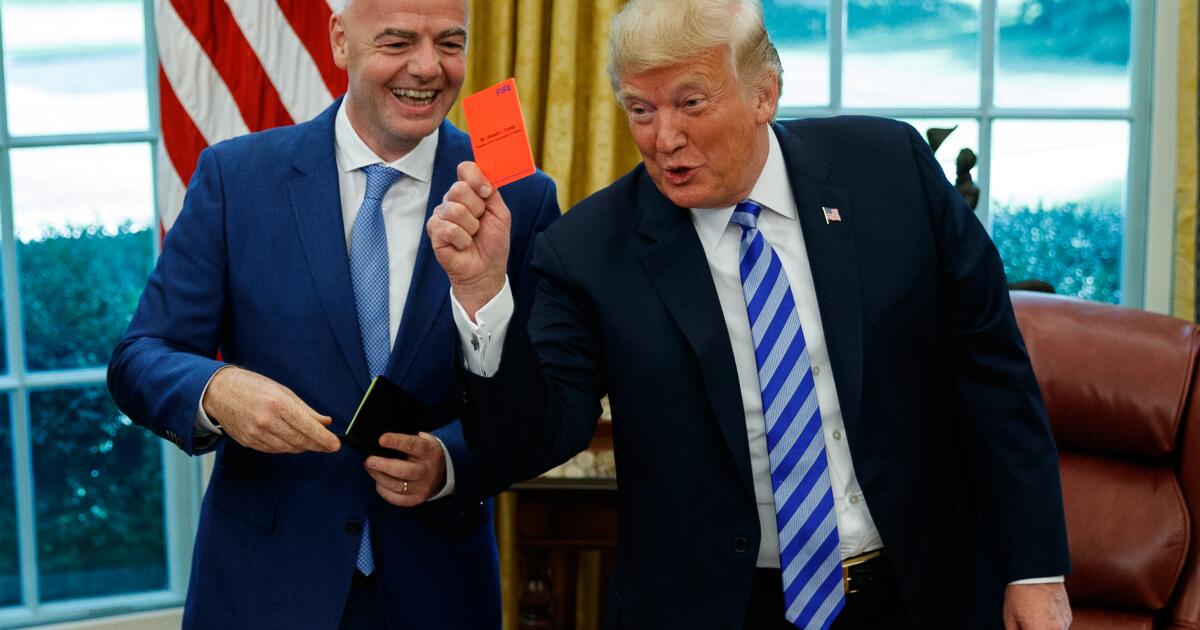
In addition to the slogan “Unitas Mundi” — Latin for “unity of the world” — the mock referee cards direct people to a website explaining the coalition’s campaign and invite them to participate in a collective demonstration inside the stadium to denounce FIFA President Gianni Infantino and President Trump.
The action comes amid increased scrutiny around Infantino and Trump‘s relationship. Infantino has announced that Trump will join him at the final to present the trophy to the winner. He also awarded Trump the first-ever FIFA Peace Prize — created after the U.S. leader was not awarded the Nobel Peace Prize — in December.
And it was after Trump called Infantino to ask for a review of a red card issued to U.S. striker Folarin Balogun that the star forward’s suspension was delayed to allow him to play in the next game. The controversial move prompted an international uproar and accusations that Infantino has violated established rules around political neutrality.
FIFA has strict rules prohibiting political messaging on flags, banners and other items displayed by players and attendees in and around stadiums.
Organizers of the Final Red Card demonstration are also calling out the Trump administration’s immigration and mass deportation policies, which are back in the spotlight after three people were killed within a week during separate encounters with Immigration and Customs Enforcement officers. The fatalities include two people who were shot and killed by ICE officers in Houston and Maine during immigration operations, and another killed in a car crash while fleeing ICE officers in Florida.
At least 10 people have been killed during the Trump administration’s immigration crackdowns.
The coalition behind the campaign includes Contra-ICE, the arts collective that was also a part of the Flags in the Stands Super Bowl action that involved the “ICE OUT” rally towels. Partner organizations also include Make the Road New Jersey, 50501, People vs the Machines and South Asians for America, according to a press release.
The problem is, having our President butt in here was a joke. Unfunny and out of bounds, offsides, an own goal — all of the things.
It put the U.S. team at the center of a geopolitical maelstrom, which is exactly what they did not need in the hours before the biggest match of their lives and the biggest match in the history of the U.S. men’s soccer program.
Some 40 or 50 million viewers were expected to tune in; how many of them watched for the first time? And what sort of impression did Monday’s 4-1 blunder-filled meltdown against Belgium make? That we stink at soccer — still?
If you were one of them, please, believe your soccer-fan friends when they tell you the Americans played much better in previous matches.
But so much for a magical run. On their home turf, the Americans pulled up lame before the finish line (aka, for the U.S. team’s purposes, its first quarterfinals since 2002).
To their credit, after the debacle, members of the U.S. team didn’t complain about anything being rigged. They didn’t use the distraction as an excuse. And they didn’t point fingers at anyone — anyone at all.
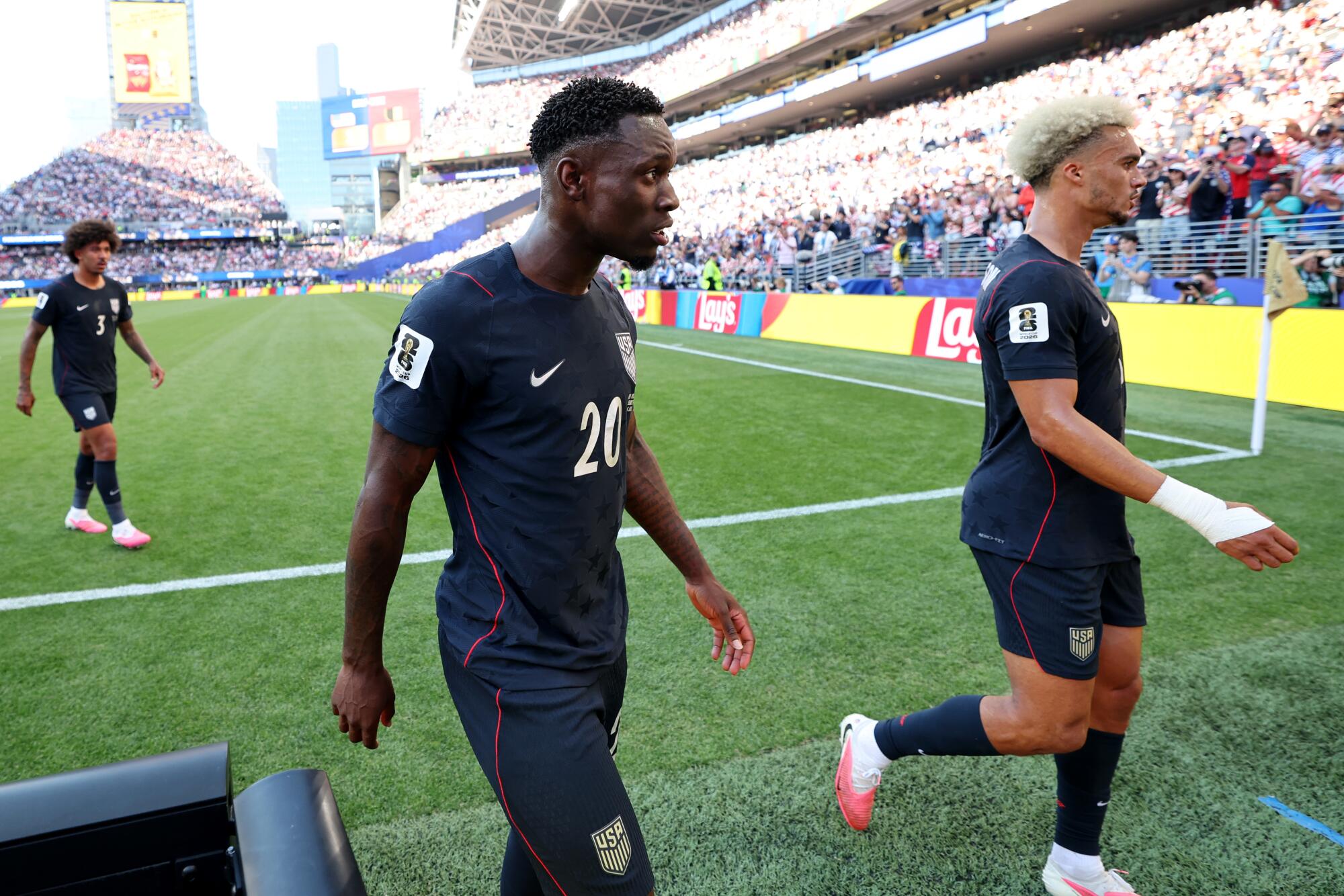
U.S. striker Folarin Balogun (20) walks to the locker room at halftime against Belgium in the World Cup on Monday at Lumen Field in Seattle.
(Allen J. Schaben / Los Angeles Times)
“We’re playing on home soil,” defender Chris Richards said. “So the only pressure we put on ourselves is to perform for our country, and ultimately didn’t feel the way we wanted to today. But I don’t think the antics of the last 24 hours had anything to do with it.”
No, they said the “debate,” or “outside noise” or “political manipulation” — as Tim Ream, Alex Freeman and coach Mauricio Pochettino described what others are calling “Balogate” — were not to blame for the gut-punch that answered the question: Why not us?
Because the U.S. is not yet good enough to beat the world’s great teams. Especially not when their pregame preparation includes having to try to block out an international uproar.
To have any hope against the Belgians in the round of 16 — a matchup between FIFA’s Nos. 9- and 17-ranked sides — the Americans needed to be going full-tilt, to be focused and ferocious and probably also a little bit lucky.
Instead, they looked shook, rattled. And they got rolled.
They were the worst version of themselves at the worst time, which was so weird from a team that had been on its front foot from the first whistle against Paraguay.
Not Monday. Against Belgium, they were on their heels from the outset. Heavy touches, slow afoot, playing like they had the weight of the World Cup on their shoulders.
And all that White House maddening meddling — for what?
Balogun started and played most of the match, but it could just as well have been reserve striker Ricardo Pepi. Or you or me, Balogun was that ineffective.
His play of the day came postmatch, when he approached Belgian coach Rudi Garcia and the two had a respectful exchange. A real diplomat, that Brooklyn-born, Britain-raised American by birthright.
This loss was a real team effort, of course. Christian Pulisic came off in the 59th minute after twisting his right ankle — leaving this World Cup without a goal in the four matches he appeared.
Matt Freese, the Harvard-educated starting goalkeeper, had a brain cramp of epic proportions when he stepped outside of the box and failed to corral a ball. Belgium’s Charles De Ketelaere kicked it loose and set up Hans Vanaken, whose shot traveled behind Ream for an easy score that made it 3-1 in the 57th minute.
There was a lot of poor decision-making with this match, on and off the pitch.
In the end, Trump’s appeal to Infantino did more harm than good. But what if some good could come from it?
Hey, FIFA, what about giving teams a process to appeal cards, like our American athletes in the NBA, NFL and MLB have?
Offering a suggestion box wouldn’t be opening Pandora’s box, not if it were a transparent and regular part of the game that would, hopefully, offer increasingly fair outcomes in a tournament where every match is so monumental — as our President recognized, much too enthusiastically.
U.S. coach Mauricio Pochettino waves to the crown after a 4-1 loss to Belgium at the World Cup on Monday.
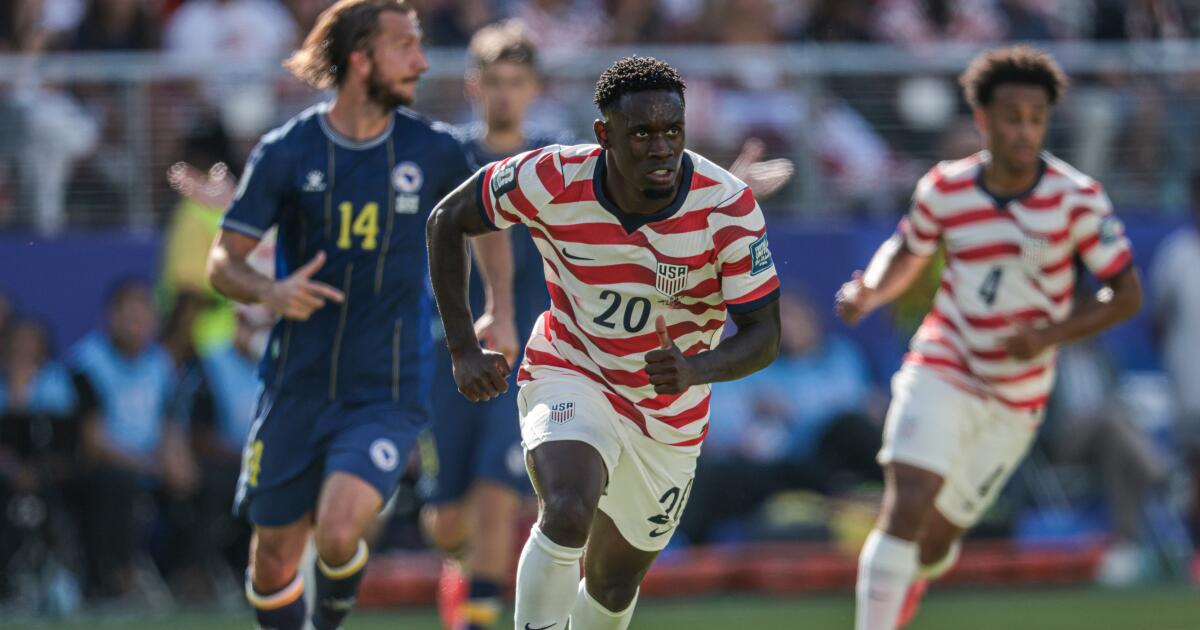
SEATTLE — Folarin Balogun will be able to play for the U.S. in Monday’s World Cup elimination game with Belgium after FIFA rescinded the one-game suspension it handed down when Balogun drew a red card in the second half of the team’s round of 32 match against Bosnia and Herzegovina last week.
In a statement released Sunday morning, FIFA said “In line with article 27 of the FIFA Disciplinary Code, the implementation of the match suspension is suspended for a probationary period of one year. If Folarin Balogun commits another infringement of a similar nature and gravity during the probationary period, the suspension shall be revoked and the sanction enforced without prejudice to any additional sanction imposed for the new infringement.”
Balogun leads the U.S. with three goals in as many games. He is the first American to score three times in a World Cup since 1930.
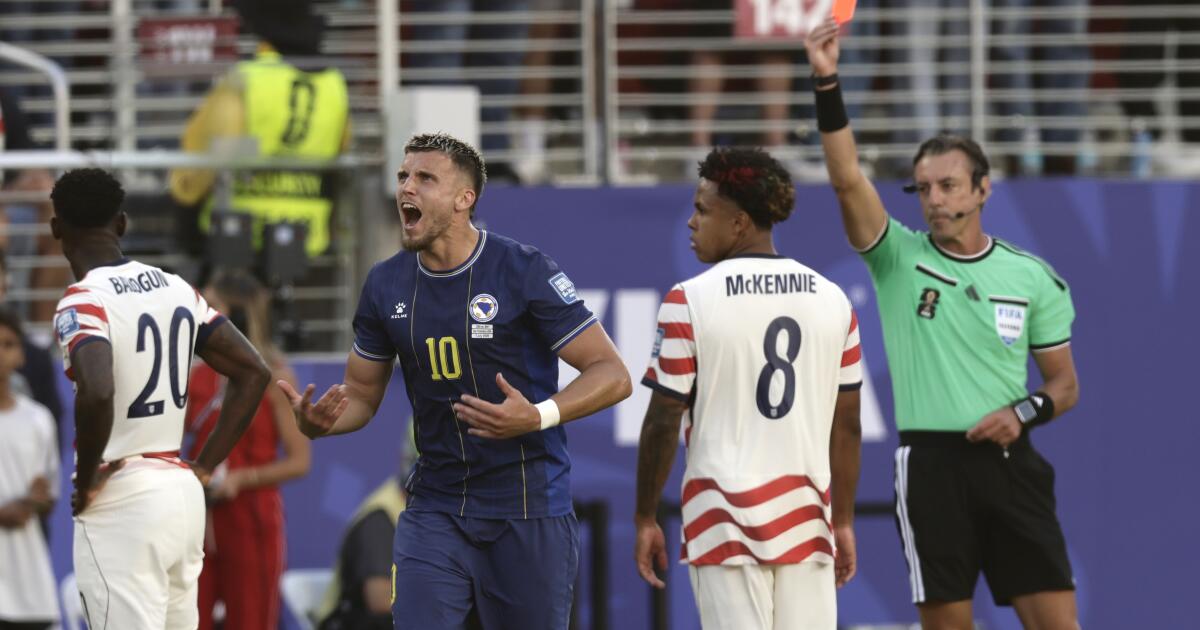
Balogun got the red card after colliding with Bosnia’s Tarik Muharemovic 16 minutes into the second half when the Bosnian defender planted his right leg below Balogun’s right foot, the American inadvertently stomped on his right ankle, twisting it awkwardly.
Both players went down and referee Raphael Claus did not signal a foul or pull a card. But after the video assistant referee urged him to watch a replay, Claus walked away from the monitor and flashed the red card.
After the game Balogun shook Claus’ hand on the pitch. And on Friday, in his first public comments, he spoke respectfully of the decision to give him a red card.
U.S. Soccer also released a statement Sunday.
“We accept the decision of the Disciplinary Committee and are pleased that Folarin Balogun is eligible to compete tomorrow,” the statement said. ”Our full attention is focused on the Round of 16 match against Belgium in Seattle, and we look forward to the continued support of our amazing fans.”
A U.S. Soccer spokesman said the team was informed of FIFA’s decision Sunday morning and Balogun was told the suspension had been lifted during a bus ride to training.
SANTA CLARA, Calif. — Mauricio Pochettino’s team continues to do things in this summer’s World Cup that no U.S. team has ever done before.
Its three wins are the most in a single tournament. So are the 10 goals in four games. It has the best goal differential ever and its two shutouts ties a record.
Yet all that means absolutely nothing to the players.
“They’re great milestones,” captain Tim Ream said. “But I don’t think anybody’s even once mentioned the different things that we’re doing. We’re focused on what we’re doing daily on the training ground, because that puts us in the best possible position to to put these performances.
“So yeah, not aware or even worried about records that we’re breaking.”
Well, except for maybe one.
With Wednesday’s gritty 2-0 over Bosnia and Herzegovina, a game the U.S. finished with just 10 men, the Americans won a game in the World Cup knockout stage for just the second time. That sends them on to a round-of-16 meeting with Belgium on Monday in Seattle where a win would be — you guessed it — historic.
“It’s cool and it’s great and it’s an accomplishment,” midfielder Weston McKennie said of the records. “But at the same time, we have high expectations for ourselves. That’s what we expect of ourselves, what we expect of our team.
“We just want to focus on Belgium now and continue to try to make history.”
That chore got a good deal more difficult because of an unwanted team record that was also set Wednesday. When Folarin Balogun scored a goal late in the first half then drew a red card early in the second, he became the first American — and third player ever — to get one of each in the same World Cup knockout game.
“Cool record,” defender Chris Richards said.
But while the goal, Balogun’s third of the tournament, proved to be all the U.S. needed to beat Bosnia, the red card — which cannot be appealed according to U.S. Soccer — means he’s suspended for the game with Belgium.
“It’s just so unfortunate, honestly,” Christian Pulisic said. “Looking back at it, it seems so harsh. I just told him he’s done so much for us, and now we’ve got his back.”
The red card came in the 64th minute with the U.S. protecting a 1-0 lead built on Balogun’s goal just before the intermission. The American striker was battling hulking Bosnia defender Tarik Muharemovic for a loose ball when he inadvertently raked Muharemovic’s right calf with his studs up, then landed on his ankle, twisting it awkwardly.
Brazilian referee Raphael Claus did not flash either card before stopping play at the behest of the video assistant referee. But after consulting a slow-motion reply, Claus gave Balogun a red card for a dangerous challenge.
“For me, never is this a red card,” said Pochettino, now the winningest U.S. coach in World Cup history. “Watching after on TV, never was [it his] intention to step up on the player. That was a normal action in football.”
Maybe. But Claus sent Balogun off just the same, leaving the U.S. to protect a one-goal advantage for the final 30 minutes while playing a man down. It was probably the sternest test the Americans have faced in the tournament.
“It would be easy to have an excuse if they did score,” McKennie said. “But that’s not the type of team we are.”
For Ream, the challenge was actually no challenge at all.
“Would it be weird if I downplayed this and said [I] wasn’t even fazed by it?” he said. “It didn’t feel like we were down a man. We were still able to carve out chances and we were still able to keep hold of the ball. Everybody knew their roles.
“It felt really calm and felt really, really easy and simple for us in that moment.”
And that allowed another hero to shrug off the pain of his own wounds and step up big.
Early in the second half a Bosnian player stomped on Malik Tillman, shredding his boot and cutting his right foot (but not drawing a red card). During the hydration break, Tillman was able to change shoes and in the 82nd minute, his white sock turning red with blood, he found himself standing over a free kick just outside the Bosnian penalty area.
“I’ve been dreaming about this game. I’ve been dreaming about, yeah, maybe taking a free kick and scoring,” said Tillman, who bent the ball off the gloved right hand of Bosnian keeper Nikola Vasilj and into the net for his first World Cup goal. “I trained for this in our practices and then it actually came true.”
So did the team’s dreams of reaching the round of 16, only now they’re arriving without their leading scorer, who will have to watch the Belgium game from the stands. Balogun’s absence, however, creates opportunity for others, with Haji Wright and Ricardo Pepi the most likely candidates to take his place.
And if this U.S. team has proven anything, it’s proven that it loves nothing more than embracing opportunities to prove people wrong.
“We’re going to miss him for the next game but we know that if it’s Pepi or Haji, whoever, is going to step up next and they’re going to do the job just as well as he did,” Richards said of Balogun. “One thing about this team is we’re really a big family and we’re shown it this whole tournament.
“Coming in, there was a lot of question marks about our whole team in general. Game by game we started to put ourselves right. Because we knew we had it the whole time.”
SANTA CLARA, Calif. — What do you mean U.S. forward Folarin Balogun got red-carded? For that?
As a nation, we’re pretty new to all this. And this VAR abomination we’ve all now been introduced to? Thanks, we hate it.
Soccer’s video assistant referee system is worse than the NBA’s tedious in-game reviews. Worse than the existential NFL question of whether it is or is not a catch. Dumber than not being able to argue obvious balls and strikes in a pre-ABS baseball world.
Worse than all those things put together.
And now that we witnessed it burn the U.S. men’s soccer team in its rousing 2-0 round of 32 World Cup victory over Bosnia and Herzegovina on Wednesday, all of us newly accredited soccer experts in America are ready to declare war on VAR.
In a physical fixture filled with shoving and shouldering, pushing and pummeling, blood and guts, after 60-plus minutes of letting ’em play, Balogun’s off-balance misstep got him kicked off the pitch.
A match of no-calls — including, initially, this gnarly moment of incidental contact between Balogun and Tarik Muharemovic — and the United States found itself down a man for most of the second half at Levi’s Stadium.
The unfortunate accident will rob Americans — both those on the pitch and those glued to screens at home or at a watch party — of their top scorer (Balogun has three goals in three matches) in a round of 16 showdown with Belgium on Monday in Seattle.
The young man was doing LeBron James’ silencer celebration after scoring a goal one moment and being tagged with soccer’s equivalent of a Flagrant 2 the next — because of how one moment was assessed on tape delay.
Delay being the operative phrase. No one loves late calls, but soccer has some late calls. Examined in super-slow motion. And, as the United States’ Tyler Adams pointed out: “When you slow everything down, it’s only going to look worse.”
And Balogun didn’t mean it! That’s a better defense in some situations than others — including this one. Per letter of the law.
ESPN’s resident refereeing expert, Andy Davies, a former Select Group referee with more 12 seasons on the elite list provided this summary judgment: “With both players challenging for ball, the contact from Balogun on Muharemovic, while it looked bad in slow motion, was purely accidental and an unfortunate result from two players challenging for possession of the ball in a normal football movement.”
Also, Davies: “VAR made their recommendation to the referee based on slow-motion and still replays, which is not aligned with VAR protocols, as these should be used for only point-of-contact purposes in a red card tackle situation.”
Let me tell you something you already knew: FIFA is inconsistent.
Malik Tillman’s exquisitely placed, curving free kick for a goal in the 82nd minute might have been Messi-esque, but the call on Balogun? Not Messi-esque.
In a group play match against Algeria, Lionel Messi, the Argentine superstar, seemed to rake his studs along Aïssa Mandi’s right calf and ankle. That time, a foul was called. VAR had a look. And despite the rules stating that a challenge from behind with studs-on-calf contact and a level of force should be a red card — no card was administered. Can’t have Messi missing games.
“For me, never is this red card,” Pochettino said. “Watching after on TV, never was [it] intention[al] to step up on the player. That was a normal action in football that happened by accident.
“That is why for me it’s never a red card.”
But you don’t have to take his word for it.
On Fox, former French footballing legend Thierry Henry said: “You need to adopt some type of common sense. He never went to hurt nobody. He went to get the ball, and where do you land after? You have to land somewhere.”
Commentator Ian Darke weighed in with a post on X: “Reckless and yellow would have covered it.”
Trust your own eyes.
In an attempt to eliminate human error, this great sport has introduced human error. But it feels more egregious than a bad call in the run of play because it’s justice — or injustice — meted out arbitrarily, unevenly and after the fact.
Look, I’m sure the world doesn’t want to hear any of our star-spangled opinions about how to improve the beautiful game — but in this, we’re united.
There’s a universal sentiment: Give VAR the red card.
MEXICO CITY — FIFA president Gianni Infantino described Mexico City Stadium as a venue “blessed by the gods” and a “true cathedral of soccer.”
Azteca Stadium, as most people know it, is steeped in soccer history and is now the only venue to host three World Cup opening ceremonies. But the Mexican national team had never much World Cup success at the venue.
On Thursday, spurred on by most of the 80,824 fans in attendance and forwards Julián Quiñones and Raúl Jiménez, Mexico managed to defeat South Africa 2-0 and securing its first opening match victory.
Mexico opened the scoring in the ninth minute when Quiñones capitalized on a defensive error by South Africa and fired a shot down the middle, between the legs of goalkeeper Ronwen Williams. The striker, a top scorer in the Saudi Pro League, immediately ran off to celebrate with the bench, marking the first goal of the tournament. The crowd responded by throwing beer into the air.
Mexico continued to press with numerous chances in the first half, including another shot by Quiñones that hit the post and another great save by Williams, who was South Africa’s best player.
“We were far superior in the first half; we could have been up 3-0,” Mexico coach Javier Aguirre said.
South Africa was reduced to 10 men just as the second half began when Sphephelo Sithole brought down Brian Gutiérrez, who was heading toward the goal unmarked. Brazilian referee Wilton Sampaio showed a red card.
“We played well; there were moments when Mexico didn’t know what to do and our organization was very good,” said Hugo Broos, South Africa’s coach.
It seemed the match was going to be easier for the Mexicans with South Africa short-handed, but fans began to boo the Mexican players after they stopped attacking and appeared nervous.
Seeing his players’ lackluster performance on the field, Aguirre responded with substitutions: bringing on 17-year-old Gilberto Mora, a fan favorite, as well as Luis Chávez, to reshape the midfield.
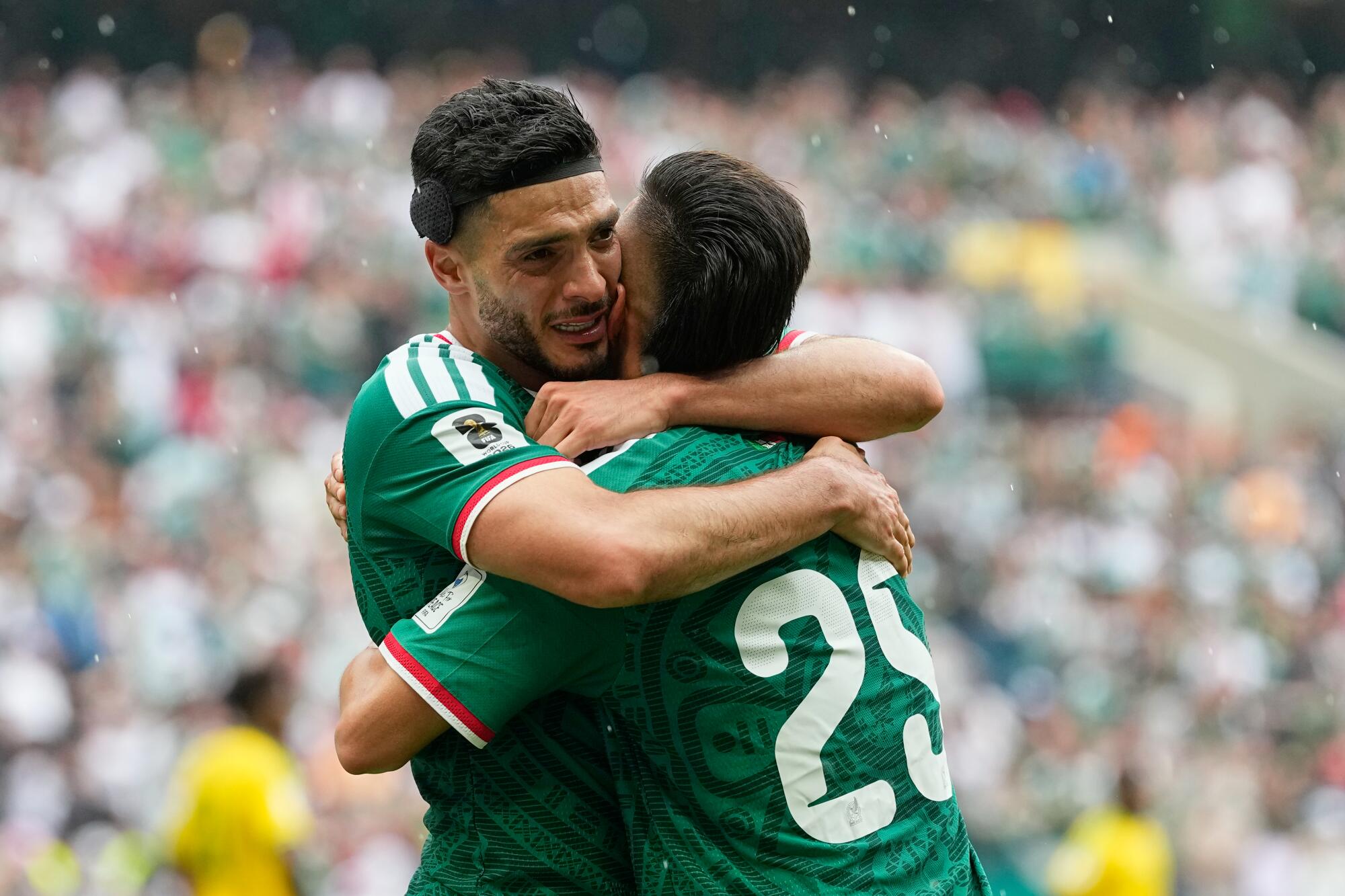
Mexico’s Raúl Jiménez cries while hugging teammate Roberto Alvarado after scoring against South Africa in Mexico City on Thursday to open the World Cup.
(Natacha Pisarenko / Ap Photo/natacha Pisarenko)
“[It was] the start of the World Cup. It’s an intense atmosphere,” Aguirre said.
“In 25 games, we’ve never had players with cramps — today we had three. It was a very intense, emotional state. It shows that the setting weighed on them a little. Not on everyone.”
Shortly after the substitutions, Roberto Álvarado crossed the ball from the right to Raúl Jiménez, who headed it past South Africa’s goalkeeper, Williams, in the 67th minute.
South Africa was reduced to nine men after Themba Zwane struck Álvarado off the ball. After consulting the video assisted referee, the official gave Zwane a red card.
“I think you can accept the first red card,” said Broos. “I think the second one is debatable. It was a bit harsh on the referee’s part. We have two players who won’t be able to play in the next match.”
After the second red card, Mexico took its foot off the gas again and was met with whistles from the crowd, who were hungry for more goals.
Mexico and South Africa faced off in front of 80,824 fans at Mexico City Stadium, more commonly known as Azteca Stadium, on Thursday to open the World Cup.
(David Ramos / Getty Images)
Mexico’s César Montes was sent off in stoppage time for bringing down Khuliso Mudau outside the box as he was heading toward the goal.
With the win, Mexico leads its group with three points and waited to see the result of South Korea versus the Czech Republic in Guadalajara later Thursday. South Africa has zero points. Mexico’s next match is in Guadalajara on June 18 against South Korea, while South Africa faces the Czech Republic in Atlanta.
“We need the next three days to get over the disappointment and fatigue,” Broos said, before addressing his team’s mere two shots on goal. “We have to work on our offense because it wasn’t enough today.”
The match marked the debut of Mora, the youngest player in the World Cup.
“For his first game, he didn’t disappoint,” said Aguirre.