record

New £7 billion tunnel will connect 2 European countries and break world record

The tunnel will become the world’s longest underground railway connection at 64km long when it opens

The Brenner Base Tunnel is presently being built to link Austria and Italy. This remarkable tunnel, destined to become the world’s longest, is due to open in 2032.

The railway tunnel will join the Austrian city of Innsbruck with Franzensfeste/Fortezza in Italy, connecting two nations across different time zones. Construction expenses are projected at 8.54billion euros (£7.4billion). The extraordinary BBT will stretch for 55km (34 miles) as a cutting-edge railway tunnel.

BBT explained: “In May 1994, a railway bypass was opened south of Innsbruck, known as the Inn valley tunnel. This 12.7 km tunnel links to the Brenner Base Tunnel.

“Passenger and freight trains along this stretch will therefore not only travel through the Brenner Base Tunnel, but for a few kilometres, through the Inn valley tunnel as well. This line, totalling 64 kilometres, will become the longest underground railway connection in the world.”

An unusual characteristic of the Brenner Base Tunnel is the “exploratory tunnel running from one end to the other”.

“This tunnel lies between the two main tunnels and about 12m below them and with a diameter of 5m is noticeably smaller than the main tubes.

“The excavations currently underway on the exploratory tunnel should provide information on the rock mass and thereby reduce construction costs and times to a minimum.

“The exploratory tunnel will be essential for drainage when the BBT becomes operational.”

Additional remarkable railway projects include the globe’s lengthiest train route, which links three nations spanning eight time zones.

Source link

Luxury and AI stocks drive European markets to record highs

Published on

European shares extended gains to new highs by early afternoon on Thursday, as strong corporate earnings from luxury and industrial groups fuelled a broad rally across the region’s equity markets.


ADVERTISEMENT


ADVERTISEMENT

The pan-European STOXX 600 was up about 0.5% to 624.67 points by midday, holding near the all-time high level as investors digested a heavy slate of earnings updates.

Major benchmarks also hovered near record levels, with France’s CAC 40 up more than 1.4% on the day and London’s FTSE 100 trading around a record intraday high near 10,535 points.

Luxury stocks were among the biggest drivers of gains, with the sector rising about 1.5%.

Shares in Hermès climbed to a near one-month high after the French fashion house reported stronger-than-expected quarterly sales, backed by robust demand in the United States and Japan.

The results helped lift sentiment across the high-end consumer segment, which has faced concerns over slowing growth in China and more cautious spending among middle-income shoppers.

AI-adjacent industries jump

Industrial companies linked to artificial intelligence and data-centred demand were another key pillar of the rally.

French electrical equipment maker Legrand jumped about 5.8% after reporting strong demand tied to data-centre projects.

German engineering giant Siemens also rose sharply, climbing more than 6% after raising its full-year profit outlook, citing strong orders linked to AI-driven automation and digital infrastructure.

Analysts say the surge in AI-related industrial stocks reflects expectations that global spending on data centres, automation and electrification, will continue to accelerate as companies invest heavily in artificial intelligence capacity.

Stronger-than-expected corporate earnings updates were seen as the main catalyst for the rally.

Broader market sentiment was also supported by a robust US jobs report, which eased concerns about a slowdown in the world’s largest economy and reinforced expectations that growth will remain steady.

Source link

SpaceX IPO Would Set Record As First Trillion‑Dollar Offering As More Giants Line Up

Home News SpaceX IPO Would Set Record As First Trillion‑Dollar Offering As More Giants Line Up

OpenAI, Anthropic, and Databricks lead a new class of super-sized private companies eyeing public markets.

The US IPO market has never seen a trillion-dollar debut. That may soon change as a wave of mega-valued private companies considers tapping public markets, which are eager for fresh stock.

Behind the headlines about the potential Elon Musk IPO from the newly merged SpaceX and xAI is a class of potential mega-sized deals currently valued in the hundreds of billions, supported by a thriving ecosystem for funding big companies in private markets.

SpaceX’s private market valuation is estimated at $1.25 trillion, placing it ninth in the S&P 500. That’s just below Tesla’s $1.5 trillion valuation and ahead of Warren Buffett’s Berkshire Hathaway ($1.1 trillion) and Walmart ($1.05 trillion).

If Musk succeeds in taking SpaceX public this year, it will likely sell about 10% of its equity in the IPO, raising $125 billion. That figure would handily exceed Saudi Aramco’s IPO proceeds of $29.4 billion, the largest global IPO ever, and Alibaba’s IPO proceeds of $21.8 billion, still the largest ever in the US since its 2014 debut.

“There is no precedent for an IPO this large,” Morningstar passive strategies analyst Zachary Evens said in an email to Global Finance. “I am interested to see if index providers make exceptions for mega IPOs since they will instantly reshape the market.”

Nasdaq is considering a special “fast entry” rule that would allow a company to join its flagship index after its first 15 trading days, he said.

Meanwhile, OpenAI is currently valued at about $500 billion. That’s roughly double Alibaba’s $236 billion enterprise value, the current record holder for a US IPO, when it went public in 2014.

Anthropic, the company behind the Claude AI service, is valued at about $374 billion — also bigger than Alibaba — and business software specialist Databricks tips the scales at $134 billion.

These companies also dwarf the $81 billion valuation of Facebook at its 2012 IPO or the $75.5 billion market cap of Uber Technologies at its 2019 IPO.

To be sure, it’s possible that the sky-high valuations of these private companies could take a big hit amid uncertainty on Wall Street about whether unprecedented spending on AI will pay off. The window to take companies public slammed shut in April of last year after the launch of the US’s Liberation Day tariff regime. And it could do so again if the recent tech selloff driven by AI jitters continues.

While the companies are part of an ecosystem that developed and grew in the years following the Financial Crisis, they’ve never experienced a severe recession or a bubble burst, such as the dot-com meltdown of 2000-2001.

Still, after a sluggish IPO market in recent years and the dwindling number of listed companies due to take-private and other merger deals in the marketplace, brokers remain hungry for more public stock, said Mark Lehmann, vice chair of the commercial bank at Citizens Financial Group.

“There’s a whole host of people who will want exposure to these companies,” he said, including institutions, wealthy individuals, and retail investors.

Kaush Amin, managing director and head of private market investing at US Bank, said that valuations of some AI companies assume widespread use of their products within five to ten years. That’s much faster than the 70 years it took for the Industrial Revolution to diffuse across the U.K. and the 25 years it took for the internet to take hold across the economy.

Some pockets of the tech sector are very overvalued because the numbers may not reflect the infrastructure support AI needs and how long it may take to build and be adopted across the economy. There’s a need for capex funding, data centers, chip purchases, and power purchases. This all takes time and money.

Other than Nvidia or other large strategic players – maybe Softbank, for example – there aren’t many players out there that can write big enough checks, Amin said.

While the debate continues over how these and other unicorns will fare after going public, the private capital ecosystem continues to grow.

Morgan Stanley acquired EquityZen, a private markets brokerage, and folded the business into its investment portfolio for its wealthy clients. The deal will also enable the bank to help sell private stock earned as part of a client’s compensation package. Charles Schwab has similar plans with its acquisition of Forge Global.

David Shapiro, co-founder and CEO of OpenVC, which helped create the NYSE OPEN Venture Capital Unicorn Index, said investors are eager to secure stakes in companies before they go public – but they should be aware that fees may be much higher in some cases and that once an IPO debuts, it may fall flat.

“Sometimes, by the time these companies go public, all the juice has already been squeezed for investors,” said Shapiro. This is a reason to invest in companies before they go public — to realize bigger gains. The companies in the index alone add up to an addressable market of about $2 trillion or more, at last check. 

“People are hungry for these assets,” he said.

Source link

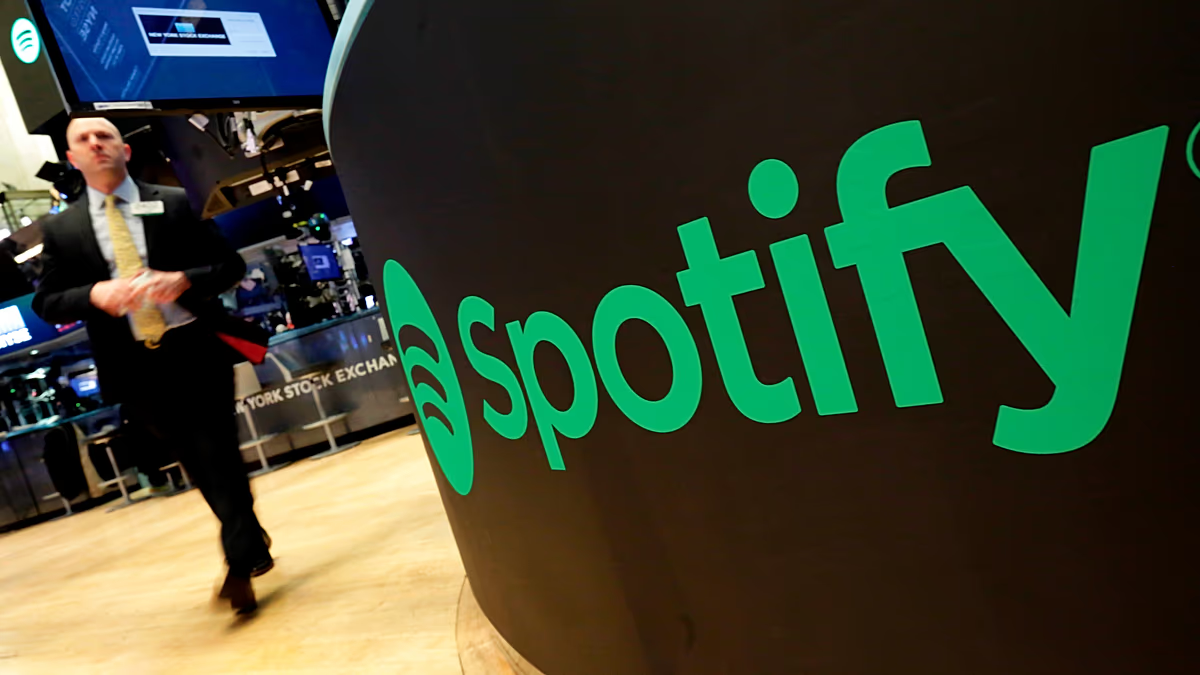
Spotify shares rise after record profits and spike in subscribers

Published on

Spotify stocks spiked 6% higher at market opening this Wednesday, later paring down some of its gains, after the company released its earnings report on Tuesday.

The popular music platform closed 2025 with a little over €2.2bn in net profits which represents a 94% increase, almost double what was achieved the year prior.

The positive result reinforced the historic turnaround the firm accomplished since 2024, when it became profitable on the year for the first time. Before then, Spotify operated at a loss for almost two decades after being founded in 2006.

Last year, the music streaming platform grew in users by 11% and in paying subscribers by 10%. Additionally, Spotify also cut costs and increased prices in several markets achieving a 33.1% profit margin, the highest in its history.

A substantial part of the success in 2025 occurred towards the end of the year, when the company hit a total of 751 million monthly active users (MAUs), after its biggest quarterly increase in activity.

For the first quarter of 2026, Spotify is projecting a continuation of this trajectory. The report points to around €4,5bn in revenue and 759 million MAUs.

The Swedish executive chairman and founder, Daniel Ek, who resigned from the CEO position last month, stated in the earnings call that Spotify has “built a platform for audio but increasingly to all other ways in which creators connect to the public”.

The new CEO, Alex Norström, also declared that “after a year of execution, 2026 will be the year of elevating ambition”.

Music industry and AI

The impact of Spotify’s growth in 2025 was also felt outside the company, in the music industry as a whole.

The firm paid out more than €11bn to artists last year which the earnings report states is “the largest annual payment to music creators by any platform in history”.

Moreover, the Swedish company stated that “we also helped artists generate over one billion dollars in ticket sales, connecting fans to live events”.

Going forward, one of Spotify’s biggest bets is on AI integration, as is the case for most tech companies.

The firm has accelerated the launch of tools such as a playlist generator based on prompts, and a personalised agentic DJ, which have already been used by millions of paying subscribers.

However, artificial intelligence is also presenting new problems for Spotify such as AI-generated music. In the earnings call, the co-CEO, Gustav Söderström, stated that “the issue isn’t new but it has scaled”.

Söderström added that the company is working closely with the music industry to allow artists and record labels to include disclaimers specifying the production methods.

Source link