Recolonization

Claudio Fermín: ‘We Must Forge a Consciousness Against the Recolonization of Venezuela’

Claudio Fermín. (Venezuelanalysis)

Claudio Fermín is a university professor and veteran political leader in Venezuela. Cutting his political teeth with Acción Democrática (AD) party, he became Caracas’s first elected mayor (1990-93). He went on to become a member of the 1999 Constituent Assembly as well as a perennial presidential candidate. Within the Venezuelan opposition, he has been known for his commitment to dialogue and opposing US sanctions.

In this exclusive interview, Fermín reflects on his role in the Venezuelan opposition, the consequences of the blockade against the Caribbean nation, the US “theft” of natural resources following the January 3 attack, and the challenge of recovering sovereignty.

Going back more than two decades, what was your relationship with former President Hugo Chávez like?

Chávez had a sharp tongue that spared no one. Yet whenever he referred to me, he always did so with respect and affection. I am grateful for his generosity.

In the early years, Chavismo was not just a vast popular movement but almost a religion. Since President Chávez spoke of me with such consideration, I think that filtered down to the base as well, and grassroots Chavistas have always been very warm toward me. I have never stopped going anywhere in my life, not even to the Esquina Caliente [a Chavista spot in downtown Caracas’ Plaza Bolívar]. Chavistas or Adecos [AD supporters], I greet them all the same. I have been fortunate in that regard.

My relationship with Chávez was always one of respect and consideration. As a conciliator, what people call a moderate, someone who doesn’t get carried away by extremes, I have always demanded respect for President Chávez and have always acknowledged the positive things his government did. Sometimes journalists are surprised and ask me for an example. I talk about Misión Vivienda [the public housing program], about the people who live much better there than in the shack where they used to live. And that is just one example; I could give you 30 more Chavista achievements that I defend, just as I could give you as many things I object to.

Chavismo knows that my criticisms are honest and sincere. We have had a good relationship. I deeply regret that it is, in my view, a very closed-off movement. Beyond its record in government, from a political standpoint my criticism would be its lack of self-criticism.

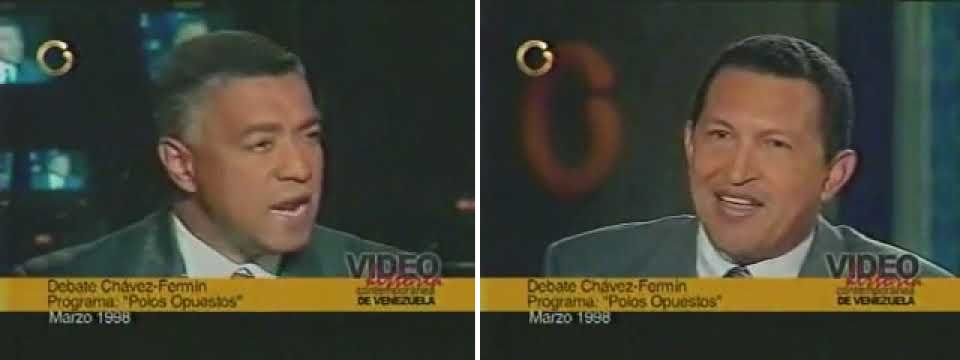
Claudio Fermín and Hugo Chávez took part in a presidential debate in March 1998. (Archive)

What is your assessment of the Maduro government?

President Maduro faced a very difficult period, much more difficult than President Chávez’s, in my opinion. These were years of an infamous [US] blockade and terrible conspiracies. I think he was very brave when he lifted currency and price controls, and when he proposed the special economic zones, which practically amounted to a wholesale critique of the Chavista economic model.

That is very easy to propose when you are in the opposition. But to take those measures from within a Chavista government… It was very hard to survive that storm for 14 straight years. Oil revenues, which had topped $50 billion a year, fell to less than $1 billion.

In recent years you have tried to build spaces for unity within the opposition, for example in Henri Falcón’s 2018 presidential campaign. However, those attempts ended up fractured by extremist figures such as María Corina Machado. Why has it been so hard for the opposition to build a coherent alternative?

To answer that, I think a brief look back at history is useful. Chávez’s early years were a time of endless promises, when everything seemed possible and there was money to back it up. Everything was in crescendo. Chávez, besides his electric, truly mesmerizing charisma, was also a man who carried a heroic narrative.

The initial opposition to the Chávez government was class-based and bent on confrontation. The Carmonazo [the 2002 coup] and the oil lockout failed because the people saw them as alien initiatives, the exclusive project of a political class. And the honeymoon with Chávez was still ongoing. However, that period gave rise to very confrontational behavior on both sides of Venezuelan politics.

There came a point when showing the greatest aversion, the greatest hostility toward Chavismo, meant being against the system and not participating. That is how María Corina Machado and her [US-funded] NGO Súmate got started, directly or indirectly encouraging abstention. The 2018 elections and those that followed cannot be understood without this induced abstention, which ended up benefiting Chavismo. That is not to take away from Chavismo’s own strengths, such as its organizational capacity and grassroots work.

However, in 2015 there was high turnout and the opposition won a majority in the National Assembly…

The 2015 elections were a very particular moment. It was an important election, now facing Chavismo without Chávez, and the opposition, which had been completely fragmented, came together. I think it has certain parallels with Chávez’s election in 1998, when there was a desire to punish, to make someone pay, which made it possible to bring scattered groups together.

If we look back over the years at the speeches of opposition leaders, Julio Borges, Leopoldo López, Henrique Capriles, Henry Ramos Allup and so on, they spent their time insulting one another. But in 2015 they called a sort of truce and were electorally smart in running on a single ticket, avoiding fragmentation.

But it was an exceptional moment. As soon as they reached the National Assembly the squabbling started again, for instance over who would hold the presidency of the parliament. In 2019 a new fight broke out between Guaidó’s faction and the others, whom they called “alacranes” [scorpions]. Guaidó ended up losing the National Assembly in the middle of his “interim presidency,” which was nothing more than a crude coup attempt.

Claudio Fermín presently heads the opposition party Soluciones. (Cronica Uno)

Although you are an opposition politician, you have firmly denounced US sanctions against Venezuela. Can you tell us a bit about the economic reality of recent years?

Starting in 2015, thanks to President Obama – whom I once admired – a defenseless country was attacked, a country where store shelves were empty and pensioners were begging to survive. It was a country terribly battered by the economic situation, mired in an endless internal conflict. And the last thing it needed was sanctions and an economic blockade.

However, we also have to look further back. Thirty to thirty-five years ago, Venezuela exported aluminum, iron, and cattle. There was at least a minimum of economic diversification. But by 2015 it was a poor, single-product economy, and on top of that a blockade fell on us, which led to the country’s total impoverishment. Sanctions are a serious attack on human rights in Venezuela. Every nation has the right to trade freely.

The intention was to starve Venezuela. I remember some despicable statements by former US Ambassador [William] Brownfield, who said it didn’t matter how many people died as long as the government fell. They had not been able to beat Chávez’s charisma, or Maduro, because of the opposition’s mistakes, so they tried to strangle the country. The blockade has been a criminal act that brought about a total collapse in investment. The impact on pensions, wages, hospitals, and the electrical grid has been terrible. And figures like María Corina Machado or Leopoldo López called for sanctions in the morning and demanded wage increases in the afternoon. That is the level of cynicism and demagoguery they reached.

The plan had the desired consequences: investment dried up, discontent grew, and the quality of life collapsed. But that did not bring down the government; the US had to do it with a military intervention on January 3.

Over the last 10 years, Venezuela only had resources thanks to trade with countries that defied the blockade, such as Russia, China, and Iran. But it was done covertly, on the high seas, through parallel channels, and all of that was fertile ground for corruption.

By the same token, we have to point out what I call administrative mistakes. For example, in the midst of that terrible blockade, how can you justify keeping more than 30 ministries and 6 vice presidencies? Those mistakes have to be pointed out and analyzed, but to me they are of a much smaller magnitude than the impact of the blockade. I am not saying this to back Maduro; one simply has to keep a sense of proportion.

Venezuela went from a blockaded economy before January 3 to one controlled by the US. What is your reading of the present context?

Venezuela has been the victim of an outrageous and barefaced theft. On the one hand, the countries that dared to open a door for Venezuela to bring in foreign currency are now off limits. The United States imposes an iron curtain and says we can only have relations with it. The self-proclaimed champion of the free world prohibits free trade, using terrorist threats against those who do not obey.

On top of that, in an act of piracy, the US seized several Venezuelan oil tankers and then took 40 million barrels that we had in storage because a naval blockade was preventing us from selling crude.

January 3 raised enormous expectations. I admit it myself: I welcome much-needed investment, the investment the blockade kept out. But I don’t want it to come at the expense of our sovereignty. Yet in these months, instead of bringing dollars in, they [the US] have taken them out, stolen them. The Financial Times reported $13 billion in the first six months of the year. They have also taken shipments of gold. The money is deposited in US accounts. Absolutely nothing has been returned.

On top of that theft, our resources are still frozen: the IMF special drawing rights, close to $5 billion, as well as the gold held hostage at the Bank of England. These are resources we badly need, in addition to what the US is taking and to its barring us from relations with certain countries.

You have also focused on the foreign debt and the announced restructuring plans. Can you tell us why this issue matters?

Indeed. A narrative had taken hold that Venezuela owed $150 billion. And overnight that became $240 billion. That is absolutely false. Venezuela does not owe that money to anyone.

Of course Venezuela has to meet its obligations. The country has not paid its foreign debt since 2017. But with the blockade, with what resources were we supposed to pay it? That is why I insist that this debt must be audited.

The debt includes bonds, but people who bought them on the cheap now expect to be paid at face value. Then there are the debts to multilateral organizations, arbitration awards, commercial debts, and so on. All of that has to be audited by professional firms, and there has to be a debt restructuring committee made up of Venezuelans.

It seems that in Venezuela we can’t do arithmetic, and it has to be Marco Rubio who appoints the firm in charge of the restructuring: Centerview Partners. This firm charges $50,000 a month plus 0.1% of the debt. In other words, the fox is guarding the henhouse. It is in its interest for the amount to be as high as possible. It is armed robbery in broad daylight.

The opposition politician called for national unity to defend Venezuelan sovereignty. (EFE)

Let’s return to January 3, a turning point in Venezuela’s recent history. How do you assess that attack and everything that followed?

The theft I was describing is a consequence of January 3, when a foreign army bombed our country. It was an unforgivable act of aggression by the United States.

They kidnapped the president after fabricating a campaign claiming he was the head of the Cartel de los Soles. Now the CIA and Southern Command have been here for months, and they haven’t investigated a single military officer for drug trafficking. Where is the Cartel de los Soles? It is a monumental lie, like Iraq’s weapons of mass destruction.

What we are experiencing is a crude recolonization, by force. By force the US is taking millions of barrels of oil; by force they imposed changes to the Hydrocarbons Law and the Mining Law. Under the supposed pretext of making the sector attractive to investors and giving them security, what was actually done was to hollow out the Venezuelan state. They leave it powerless, reducing royalties and taxes to a bare minimum.

Today we have a Venezuelan state that depends on a single product. What revenue will it have if it can’t collect anything from its main industry, or from mining? What’s more, if a restructuring of this abusive debt goes ahead, how is it going to be paid? What is being done with Venezuela’s resources is monstrous.

But there is no shortage of people eager to hand the country over, from “activists” who write letters to the US chargé d’affaires asking for supplies for this or that hospital, to fake trade unionists who ask him for wage increases. I find it undignified and humiliating. Even María Corina Machado gave her Nobel Prize to Trump and still can’t get him to give her the time of day.

January 3, and everything that followed, was not an attack on Chavismo. It was an operation to seize Venezuela’s resources. We have to create consciousness against that. And Trump is not going to be there forever. It pains me to see the naivety of certain voices who think Trump is saving the country. Venezuela is living through an hour of infamy, confusion, uncertainty and shame. If we can’t unite even in the face of an aggression as serious as the one we are suffering…

Venezuela has undoubtedly been the great triumph, perhaps the only one, of Trump’s foreign policy. What is your view of Trump’s stance on Venezuela and of current relations between Caracas and Washington?

First of all, it must be said that this so-called dialogue is a mockery of the country. Trump and Rubio pulled out of their pocket, like someone finding something they had forgotten, this National Assembly whose term expired in 2020. And they forced that [defunct] parliament into talks with the current one. So we have two parliaments of “yes men” following the White House’s directives. And it is Mr. Rubio who announces what is going to happen in the country with his three-phase plan.

Trump mocks us, saying people are dancing in the streets and offering to make us the 51st state. A tremendous disrespect, and nobody raises their voice against it. Venezuela needs a strategy to denounce to the world what is happening, this imperialist colonization based on terrorist threats.

Venezuela has lost its sovereignty, and that is very serious. It is painful, but it is an undeniable fact. Venezuela has every interest in having good relations with the United States, as it has had for almost all of our history, but we cannot accept these conditions. We want investment and to trade with the whole world, but not at the cost of losing our sovereignty as a nation. Giving up sovereignty is not a necessary condition.

Having made that diagnosis, what, from your standpoint, is the way forward?

For the last 28 years I have been called a moderate, ambiguous, a “nini” [neither-nor], for defending my views. But I simply don’t agree with the fanatical positions of the extremes, and I denounce what is happening in my country today.

Ever since I started raising my voice about the seriousness of this situation, from January 3 onward, I have hardly ever been invited for an interview. There is a grave silence, and we are talking about the national interest here. Whether you are a Chavista or an Adeco, a businessperson or a street vendor, the national interest calls on all of us. If a nation cannot agree even to defend its sovereignty, it is finished. This is an existential question, not a matter of who wants to carry out Trump’s orders.

I don’t have a recipe, but we have to react. Let’s sit down and talk, look for common ground. But let’s start by admitting that we have a problem. Of course we have to sit down with the Trump administration. But with a minimum of dignity, not with this tone of capitulation, as if nothing had happened here.

I am not calling on us to confront anyone. We also have to be aware of our weaknesses. But I am calling on us to defend what is ours. Let’s build an agenda, a plan to recover our sovereignty, to explain to the United States that, while we are willing to have good relations and receive investment, we are an independent country and we will fight for that.
Source link

Venezuela: From Revolution to Recolonization

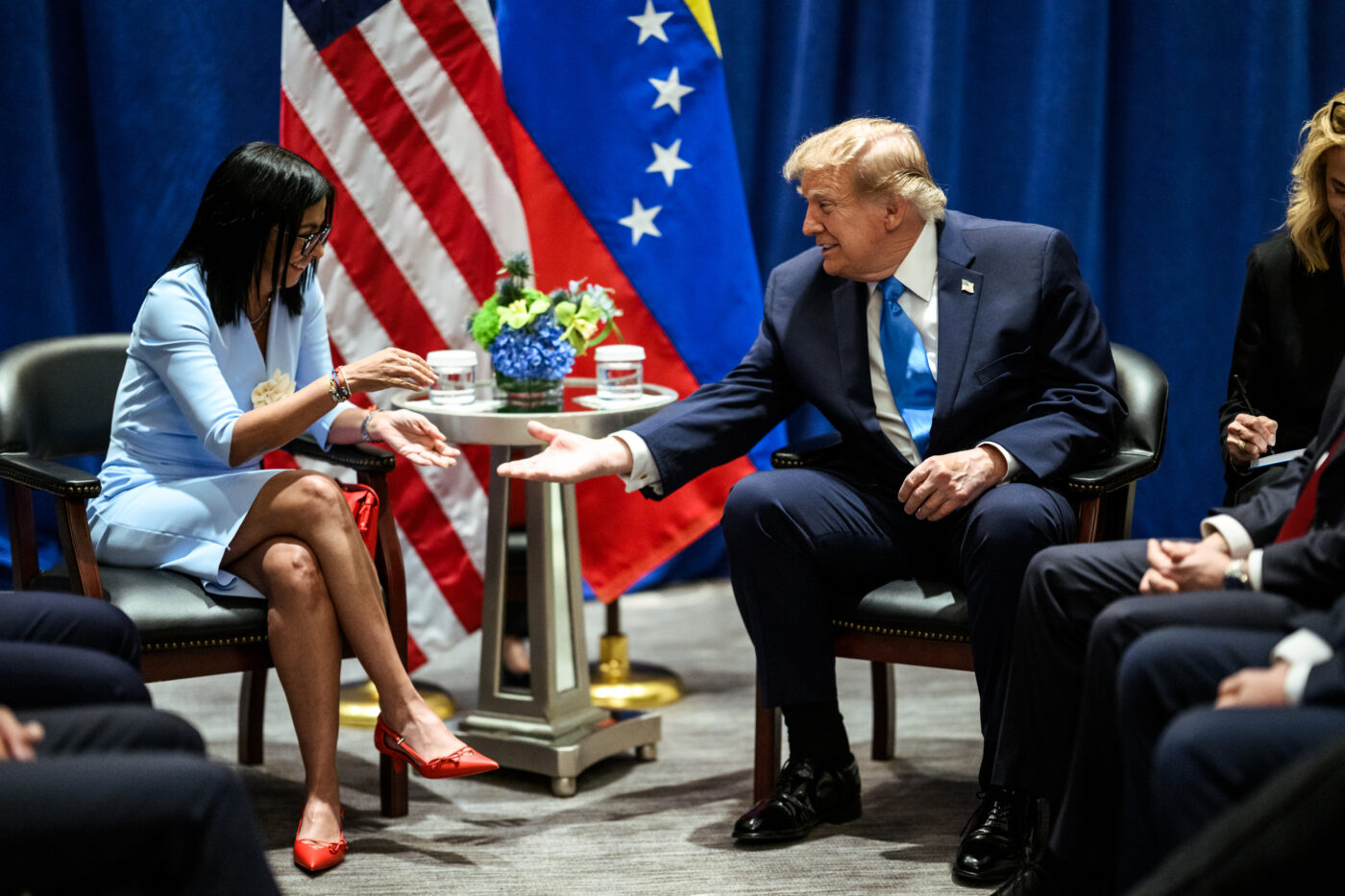
Venezuelan leaders went from threatening a new Vietnam to fawning over Trump. (Presidential Press)

Between smiles and a handshake, Venezuelan Acting President Delcy Rodríguez thanked US President Donald Trump for “supporting the country’s return to multilateral forums,” following a face-to-face meeting on September 22 that she called “historic.”

In her address before the UN General Assembly one day later, Rodríguez reiterated her gratitude to Trump while promising a “democratic transformation” of her country. The acting leader’s trip to New York, a mere nine months after the January 3 US bombings and kidnapping of President Nicolás Maduro and First Lady Cilia Flores, perfectly encapsulated the Venezuelan government’s international and domestic realignment with US imperialism in general and its MAGA faction in particular.

In her speech, she euphemistically called the January 3 military strikes “the outcome of the exhaustion of domestic politics and heightened confrontation with the US,” basically holding Venezuela partially responsible for the imperialist attack it suffered.

The abandonment of Maduro

Rodríguez’s trip was as symbolic for what was said as for what was left unsaid. The acting leader and her entourage heaped praise on Trump and took turns posing for pictures. Rodríguez also maintained an undignified silence when Trump, addressing the UN, gloated about the January 3 military operation and abduction of Maduro, whom he called an “outlaw dictator,” while shamelessly boasting that “to the victor belong the spoils.”

Maduro and Flores – currently detained in Brooklyn just 10 miles from UN headquarters and facing a show trial on ludicrous “narcoterrorism” charges – were not worth a single mention by Rodríguez. This stance has been backed by pro-government pundits who are increasingly dropping the “acting” label when referring to Rodríguez.

Her government has effectively undermined Maduro and Flores’ sovereign immunity argument to get their charges dismissed. US Justice Department prosecutors told the court that Caracas, via its embassy in the US, had advocated to the State Department for Rodríguez to receive head-of-state immunity in an unrelated civil lawsuit in Florida. But, Venezuelan authorities have declined to do the same vis-à-vis Maduro and Flores in what the US Justice Department called “devastating silence.”

The official indifference is even more remarkable given Flores’ documented health issues, heavily aggravated by the brutal kidnapping, which led defense attorneys to request that she be moved to house arrest during the trial. This silence contrasts with the Maduro government’s loud defense of Alex Saab, which repeatedly brought up his health issues under incarceration during the international campaign for his release.

Saab is another prime example of the Rodríguez administration’s pragmatic rapprochement with Washington. He was irregularly handed over to US agencies in May and recently pleaded guilty in a US federal court in Miami, promising to cooperate against unnamed Venezuelan officials.

An imperial satellite

The Venezuelan leadership’s diplomatic activity in New York more broadly showcased a new foreign policy direction that is now unmistakably marching to Washington’s drum.

Rodríguez held talks with International Monetary Fund and World Bank representatives, deepening reengagement with the Washington-based financial institutions that former President Hugo Chávez denounced as instruments of US imperialism and booted them out of the country. The specter of another IMF loan-and-adjustment package returns as the Rodríguez administration begins negotiations to restructure the country’s enormous and illegitimate debt.

In addition, Rodríguez held sideline meetings with US allies only, such as Netherlands PM Rob Jetten, Trinidad and Tobago PM Kamla Persad-Bissessar and Chilean President José Antonio Kast. Rodríguez also hosted Paraguayan President Santiago Peña in Caracas before flying to the US. 

The right-wing Chilean and Paraguayan administrations had firmly backed US regime change efforts in Venezuela, leading the Maduro government to sever ties. Trinidad and Tobago’s case was even more egregious, with Caracas suspending all cooperation, including in key cross-border natural gas projects, after Port of Spain endorsed Washington’s military buildup and extrajudicial boat bombings on Venezuela’s doorstep in late 2025.

Rodríguez and her team also broke with the Chavista tradition of holding meetings with global majority countries similarly under Washington’s gun, especially allies and strategic partners like Cuba, Iran, China and Russia. A customary event in Harlem, alongside Cuban officials and international solidarity movements, was scrapped as well.

The acting president’s UN address exposed how anti-imperialism and the defense of multipolarity have vanished from the official discourse. Absent was the hitherto denunciation of Washington’s criminal wars across the globe, replaced by a vague expression of solidarity with “peoples who suffer war.” Nor was there any condemnation of US economic sanctions, which remain in place against Venezuela and its former allies.

Rodríguez offered no words of support for Cuba as it faces a US blockade that gets more murderous by the day. There was no mention of Palestine either. Before January 3, Venezuelan representatives had never wasted an opportunity to reiterate support for the Palestinian cause and to expose the international community’s failure to rein in the genocidal, Western-sponsored settler colony.

In contrast, Venezuela joined the US, Israel, Ukraine, Western European countries and Latin American right-wing governments in boycotting the UN’s commemoration of the 25th anniversary of the Durban Declaration. The 2001 World Conference Against Racism marked a milestone in the ongoing struggle to end racism and colonialism, provoking the ire of the US and Israel, which have led boycotts of every one of its commemorations.

Fuel for a sputtering empire

Along with the 180-degree foreign policy shift, the Rodríguez administration has moved to restructure the economy to the benefit of a declining US hegemon reeling from its strategic defeat in the war against Iran.

With US officials’ input and supervision, Venezuelan authorities have overhauled energy and mining laws in the interest of multinational corporations, slashing taxes and royalties as well as ceding operational and commercial control. Corporate executives, often shepherded by Trump aides, have paraded through the presidential palace to sign agreements carving up Venezuela’s immense subsoil resources.

A recent oil deal with the Trump administration, which Rodríguez also hailed as “historic,” will turn over 17 prime oilfields holding more than a fifth of Venezuela’s crude reserves to a private petroleum company, NABEP, controlled by the Pentagon. Furthermore, the US State Department will be able to buy 20 percent of NABEP’s output at cost, while having a right of first refusal for the remaining 80 percent, for which a Venezuelan oil official promised a major “sales discount.” In other words, Venezuela is going to supply energy below market price to the imperial war machine.

Whatever revenue is ultimately left for Caracas is still going to be controlled by the US Treasury Department, under what Venezuelan state oil company (PDVSA) chief defended as a “state-to-state agreement.” A recent Financial Times report revealed that the White House is presently barring Venezuela from paying dividends to Russian and Chinese joint venture partners in a flagrant attempt to drive them out.

Washington’s semi-colonial control extends beyond privileged access to natural resources, including strategic minerals. A looming privatization drive and debt restructuring process are likely to further entrench Venezuelan dependence on Western monopoly capital. At the same time, the US is also looking to turn the South American country into a captive market for its heavily subsidized agricultural output. Venezuela’s imports of staples such as rice and corn have skyrocketed this year, seriously threatening national production, especially small and mid-size campesino farms supplying much of the country’s food.

(Ab)uses of history

The speed and scope of Caracas’ realignment with Washington has made it an uphill battle for those still insisting that the acting Rodríguez government is merely conducting a “tactical retreat” without straying from the Bolivarian Revolution’s strategic horizon.

One early line of argument was to invoke historical examples, such as the Brest-Litovsk treaty, to rationalize difficult concessions at gunpoint. However, the analogy grew ever more dubious with the passing months, as the Bolsheviks never renounced their anti-imperialist internationalism nor the nascent socialist state’s sovereignty over the commanding heights of the economy.

The argument that subordinating the economy to US-led capital was akin to China’s post-1978 opening up belies the reality that Venezuela does not even manage its own export revenues and must have its expenses approved by the US State Department, subject to auditing by CIA-linked firms like Deloitte.

Venezuelan government officials and unofficial spokespeople have also abused examples related to Chávez, namely his call for troops to stand down in the failed 1992 insurrection and the fact that he did not martyr himself in the 2002 coup that briefly overthrew his democratically-elected government. However, in both cases, Chávez never surrendered his core principles concerning independence and sovereignty. In 2002, he allowed himself to be taken prisoner by the putschists to avoid a bloodbath, but he did not resign and would not have sat quietly if Venezuela were turned into a US semi-colony overnight. On multiple occasions, Chávez underscored he was prepared to fight and die on the frontlines should Venezuela face an Iraq-style US invasion.

There are other historical analogies that are, unfortunately, more appropriate. Iraq after the US invasion, like Venezuela, to this day does not control its oil revenues, which are deposited in a New York Federal Reserve account. Iraq was until recently under US military occupation, hosting some two dozen bases – a possibility that Trump has recently left open for Venezuela. In past months, the US has carried out extrajudicial executions on Venezuelan soil and deployed military assets in the wake of July’s double earthquake, including temporarily taking over operations at the Simón Bolívar International Airport and La Guaira port.

Egypt under President Anwar Sadat is likewise a very instructive precedent. Sadat never renounced his predecessor Gamal Abdel Nasser, simply presenting his program as a “correction” of past mistakes. Yet he progressively dismantled the achievements of Nasserism, rolling back land reform and industrialization policies in favor of imperialist capital. Sadat also realigned Egypt from the Soviet Union to the US camp, going on to reestablish ties with Israel and abandon the Palestinian cause.

Vietnam: The forgotten analogy

Lacking justifications for the new alliance with the Trump administration, Venezuelan government officials and influencers have resorted to straw man arguments, claiming that the “international left” wanted the Venezuelan people to immolate themselves by confronting a vastly superior military foe.

The official rhetoric eclipses what was until recently Caracas’ preferred historical analogy: Vietnam. In late 2025, as the US ramped up its military buildup, Venezuelan leaders warned that Trump would face a “second Vietnam” if he dared to attack. There were months of military drills and detailed preparations across the country, consistent with Venezuela’s asymmetric doctrine of “prolonged people’s war”. 

Ultimately it is impossible to know how much resistance Venezuela could have mounted against the US onslaught because the leadership opted not to fight. US air superiority and electronic warfare notwithstanding, Venezuelan defense officials have neglected to explain why only one of Venezuela’s 5,000 Russian-made Igla-S manpads – ideal for taking down low-flying helicopters and combat aircraft – was used. Venezuela’s armed forces offered no organized resistance on that fateful morning, leaving Maduro’s Cuban security detail virtually alone to confront the invader in what reportedly still proved a fiercely heroic firefight that left 32 Cubans dead.

Though Venezuela might have been unable to avoid decapitation of its top leadership – either via capture or assassination – it could have raised the costs for the US empire to a politically unacceptable degree, potentially miring it in the sort of Iraq-style quagmire that the Trump administration most feared. 

Instead, almost overnight, the acting government seamlessly pivoted from vowing to combat imperialism by all means necessary to fawning over Trump and his underlings. Promises that not a “single drop” of Venezuelan oil would be shipped to the US in case of an attack were replaced by risible claims that supplying crude at cost to the Pentagon was Chávez’s plan all along.

Unable to present a convincing case for the domestic and foreign policy U-turns, official and unofficial government spokespeople have also lashed out at criticism from the Latin American left. Most recently, former Colombian President Gustavo Petro slammed the Rodríguez administration for giving away the nation’s oil to Trump. Caracas responded with ad hominem invectives.

At Washington’s behest, Venezuela has also halted all subsidized oil shipments to Cuba, which has added to the island’s gravest energy crisis in its history. Cuba’s Deputy Foreign Minister Carlos Fernández de Cossío recently said that Venezuela remained a “friendly” country, but added that “ally is too strong a word.”

The cost of capitulation 

The human toll of resistance, whether in sanctions-besieged Venezuela or on the battlefields of West Asia, is always immense. However, as national liberation movements have long understood, the price of capitulation is inevitably higher, especially in the medium and long term. Chávez and Maduro clearly grasped this reality, rallying the masses to withstand decades of US hybrid warfare and forging close alliances with anti-imperialist states from Cuba to Iran. 

The cost of submission, meanwhile, is being borne by the Venezuelan laboring classes, from small farmers hard hit by US agricultural dumping to the urban semi-proletariat devastated by spiraling inflation resulting from Washington’s pilfering of the nation’s export earnings. 

For its part, Venezuela’s comprador bourgeoisie, in both its traditional and emergent fractions, stands to reap fabulous rewards from the demolition of the legislative pillars of the Bolivarian Revolution – viz., hydrocarbons, mining, housing and real estate, or forthcoming axing of labor and land laws – reasserting itself as a servile intermediary for US imperialism. 

There is no better example than NABEP owner Alejandro Betancourt, an oil mogul who amassed a fortune from often-unfulfilled state contracts dating back to 2009 and was hand-picked by the Trump administration as a middleman in the 25-year agreement backstopped by the Pentagon. The White House went as far as pressuring domestic and foreign courts to drop money laundering accusations against Betancourt.

Rodríguez and her leadership faction likewise benefit from what analyst William Serafino has called the new regime of “co-government” with the Trump White House, tying their fortunes to the latter to outflank rivals and solidify the strategic alliance with local and imperialist capital. 

The current acting president is one of the architects of the post-2018 neoliberal economic package that was the fulcrum of a new governability pact with the local bourgeoisie, freezing wages and social spending in exchange for social “peace”. Indeed, as then vice president, Rodríguez reportedly brought Betancourt back to Venezuela in 2023, shuttering an investigation into his alleged corruption and key role in financing the self-proclaimed Juan Guaidó “interim presidency” during the first Trump administration. The episode is symptomatic of the Venezuelan government’s Faustian gambit to appease business sectors and maintain a modest economic recovery under crushing sanctions, but at the cost of slowly eroding its popular support base.

The Maduro administration’s concessions hollowed out the Bolivarian Revolution’s sovereign edifice but its institutional foundations remained formally intact alongside the internationalist geopolitical scaffolding binding Venezuela to the broader Axis of Resistance. The post-January 3 semi-colonial offensive has set about demolishing this structure of political-military and economic independence. While the destruction can be repaired through sustained bottom-up mobilization advancing a national popular alternative to capitulation, it will likely be the outcome of a medium- and long-term process. Nevertheless, there are growing signs of revolutionary movements and intellectuals organizing to confront the US empire and its local agents and reconquer sovereignty as the cornerstone of any future socialist construction.

What should be clear without a sliver of a doubt is that the “Rodrigato” – and the lumpen bourgeoisie it represents – has opted to pact with the Trump administration. Any revolutionary strategy to resist re-colonization must begin from concrete analysis of concrete conditions. Ignoring the acting Venezuelan leadership’s discourse and policies, pretending that there is a cunning secret plan being devised or trying to frame everything as a masterful 3D chess move, will ultimately hamper the most important task: fighting US imperialism.

Source: Sovereign Media

Source link