reclaim

Alexandre Pantoja eager to reclaim belt he lost to Joshua Van

Alexandre Pantoja and Joshua Van hope their fight Saturday at Crypto.com Arena will last longer than 26 seconds.

It has been nine months since their first bout, which ended in less than a minute because of a Pantoja injury and made Van the UFC flyweight champion. Pantoja aims to reclaim the belt he lost at UFC 331, with the main event beginning at 6 p.m. and streaming on Paramount+.

Pantoja dislocated his elbow when he fell while trying to defend against one of Van’s moves on Dec. 6 at UFC 323 in Las Vegas. The fight ended immediately.

Van celebrated winning the 125-pound title, but both fighters walked away from that night feeling everyone deserved more than the premature result.

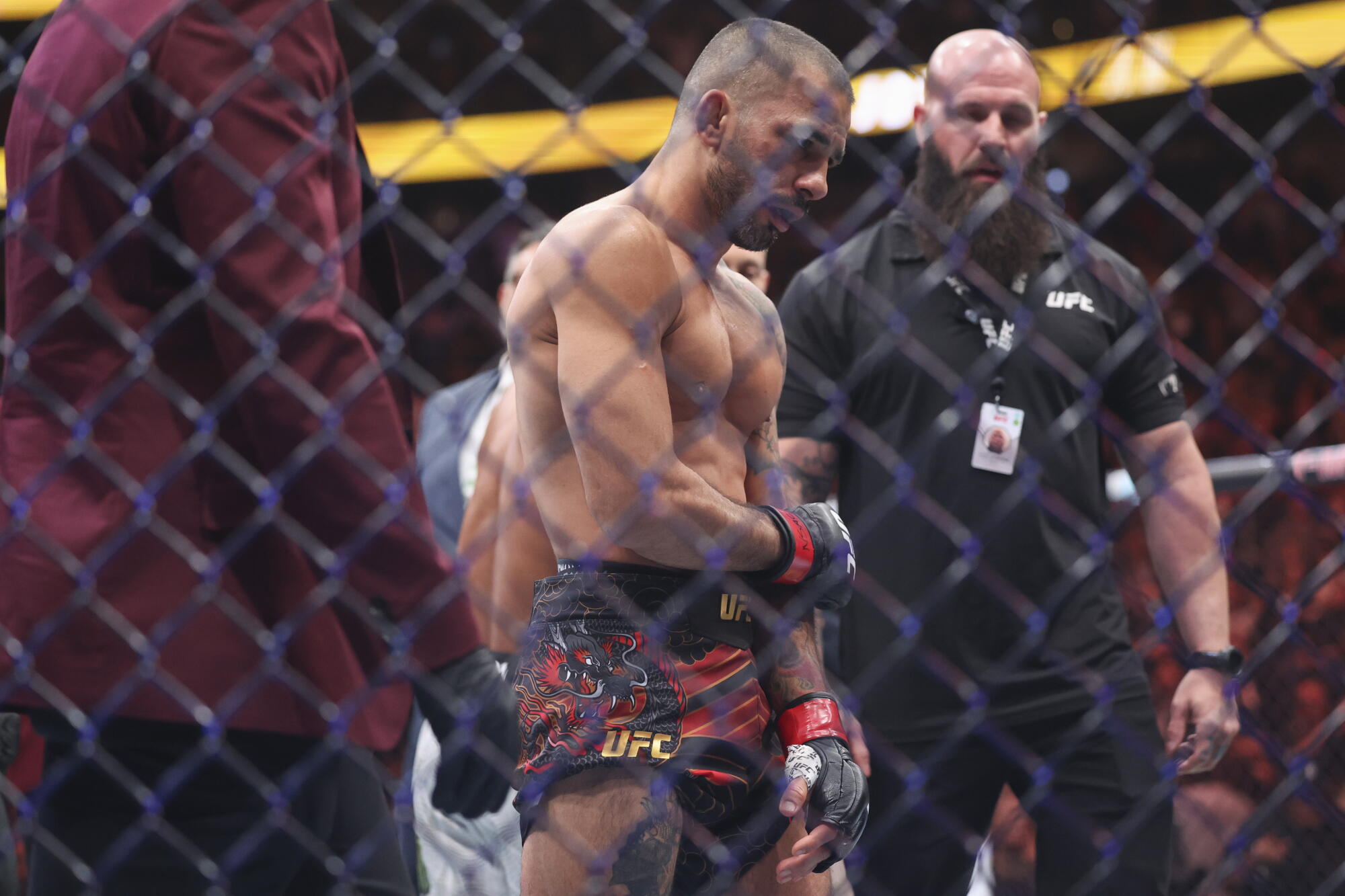
Alexandre Pantoja holds his arm after losing his flyweight title fight on Dec. 6 in Las Vegas.

Alexandre Pantoja holds his arm after losing his flyweight title fight on Dec. 6 in Las Vegas.

(Ian Maule / Getty Images)

Pantoja, of Brazil, has not competed since that night. He has spent most of the past nine months recovering from the injury, while Van successfully defended his title once against Tatsuro Taira in May, winning by stoppage in the final round.

“It’s been [nine] long months,” Pantoja said. “I’ve been working hard. And at a certain point, I think that after two years as champion, five title fights — almost six title fights — at a certain point it’s good to take some time off, enjoy my family, enjoy myself. But at the same time, I’m really hungry to win again.”

Pantoja said he returned to the gym two days after that first fight. Although the injury kept him out of the octagon, he didn’t want to stay away from training for too long because he said that would have made it harder to get back to fighting at the championship level.

During his time out of the octagon, he observed how the division changed.

“I see a lot of good fights. We’re seeing the top 10 change almost completely,” Pantoja said Wednesday. “I see incredible fights in the flyweight division. And I think this Saturday, with my fight against Joshua Van in the main event here in Los Angeles, is very special.”

Van, meanwhile, enters the rematch coming off a five-round championship bout.

“I’ve been working on my ground game, and you’ll see it,” said Van, who holds dual American and Myanmar citizenship. “I tried it in the fight against Taira, but I didn’t quite pull it off. But this time, you’ll see a different level from Joshua Van.”

The champion’s confidence remains undiminished, as he sees the rematch as an opportunity to put any debate surrounding that first fight in 2025 to rest and prove his place in the division.

“When I beat him, I’ll be one of the greats in this division, and then the next challenger will come and try to take the belt from me,” Van said.

Pantoja said Van has changed since December, highlighting the fight against Taira and noting the champion has refined aspects of his fighting style.

Joshua Van celebrates after defeating Alexandre Pantoja in a flyweight title bout during UFC 323 on Dec. 6 in Las Vegas.

Joshua Van celebrates after defeating Alexandre Pantoja in a flyweight title bout during UFC 323 on Dec. 6 in Las Vegas.

(Ian Maule / Getty Images)

“I think Van definitely evolved a lot after our fight,” Pantoja said. “He had the fight against Tatsuro Taira; I think he evolved and corrected some mistakes he made in that fight. So I think it’s going to be completely different.”

Pantoja doesn’t consider himself the same fighter who will face Van.

“The drive is always the same,” Pantoja said. “I’ve had the same drive since I was a kid — I’ve always wanted to fight the best fighters in the world. The drive is the same; it’s just that I think I’m much more mature now.”

Pantoja said Van is a top-tier fighter, but he believes the injury prevented both of them from showing everything they were capable of.

“He’s an incredible fighter,” said Pantoja, 36. “When you watch Joshua Van fight, his expression never changes — he always tries to stay in control. And that proves just how good you are.”

Although Pantoja officially lost that night, the injury changed the course of the fight before it could truly get underway.

“I injured my arm. I know that, as an athlete, I lost that fight, and now I have the opportunity to fight world champion Joshua Van — and that’s what I want. I want him at his best because I’m at my best too,” Pantoja said.

Tensions have escalated since their first encounter.

At a news conference in August in Los Angeles, the fighters got into an exchange that forced UFC president Dana White to intervene. Pantoja stood up from his seat after Van interrupted him, but the situation did not escalate into a physical confrontation.

“As far as I’m concerned, I’m his dad,” Van said. “He was being respectful before the fight, and I don’t know what he’s doing in interviews and stuff like that to make me look like the bad guy.”

Pantoja offered a different explanation.

“He does a very good job,” Pantoja said. “He needed a lesson. When I stood up, I tried to teach him a lesson. I’m from the ‘90s. Back then, if you didn’t respect your mother or father, you’d get a slap.”

Despite the disagreement, both have shown respect for their opponent’s skills. Van described Pantoja as a “very, very dangerous” fighter.

“He’s going to be motivated, he’s going to be hungrier, and I think this will be the best Pantoja we’ll see,” Van said. “So I’m very well prepared for this fight.”

Pantoja, for his part, knows he’s facing a champion who’s already had the chance to prove he can go the distance for five rounds. The Brazilian also viewed Van’s fight against Taira as a source of insight for his preparation.

“An incredible fight, very good,” Pantoja said of his 24-year-old opponent. “I think it’s a good fight for all the fans. It showed me something, but I know Joshua Van is very young and can fix a lot of things from that fight.”

For the Brazilian, the goal this weekend is clear.

“At the end of the day, what matters is the victory,” said Pantoja. “However it plays out — whether it’s by decision, split decision, KO or submission — I think the closer we get to the fight, the less those things matter. The closer we get to the fight, the championship doesn’t matter anymore, the money doesn’t matter — all that really matters is the win.”

Van doesn’t expect to let the fight go to the scorecards.

“I don’t think it’ll go five rounds; I’ll finish it within the first three rounds,” he said confidently. “It’ll be by knockout or submission, but I’m leaning more toward a knockout.”

If Pantoja regains the championship, he would become only the third flyweight champion in UFC history to reclaim the belt after losing it, joining Deiveson Figueiredo and Brandon Moreno.

For the Brazilian, returning to Los Angeles also holds personal significance. He recalled that it was the first city he visited when he arrived in the United States in 2014 and that, back then, he slept in a gym.

Now he’ll return as a title challenger in the main event of UFC 331.

“It’s so nice that people see where I started here and see how far I’ve come,” Pantoja recalled. “For me, the best part is being the same guy I was when I arrived here in 2014; I’m the same guy right now, and I’m very happy and proud of myself.”

Source link

The Battle to Reclaim Our History

Anti-imperialism was a non-negotiable pillar for Hugo Chávez. (Archive)

Tatuy TV is celebrating its 19th anniversary at a very difficult time in our history as an independent nation. With a people engulfed in daily hardship and our sovereignty compromised on several fronts, the outlook is clearly bleak.

In this editorial, we take a close look at the situation in Venezuela, not to sink us further into despair, but to reject the normalization of the current course.

We refuse to accept this neocolonialism as inevitable or even desirable. Gaining clarity on the current context is essential for us to regroup and rebuild our future.

The Pessimism of the Intellect

Although this story did not begin on January 3 (and we must analyze how we reached that point), recent months have been marked by a dizzying political shift in favor of the bourgeoisie – both domestic and foreign – and US imperialism. Our current condition as a country is one of completely compromised sovereignty.

If oil revenues go into an account at the US Treasury Department, and the national government has to submit a budget in order to have its own resources (partially) released, if judicial and electoral bodies are appointed under US tutelage, if the most important laws are drafted in consultation with the White House and Chevron executives, if the imperial army can come and go as it pleases and bomb whatever it wants on national soil, what is truly left of an independent nation?

In what world can a country that maintains criminal sanctions against our people, that bombed Venezuela and kidnapped its president, be an “ally”? The US ambassador struts around “inspecting” infrastructure and hospitals as if he were the overseer on a plantation, escorted by the adeco [anti-Chavista opposition] deputy foreign minister [Oliver Blanco], who smiles like a good little Yankee lapdog.

We could dwell on the battle of numbers surrounding the recent “historic” oil agreement with the Trump administration. However, the analysis is quite clear. The Rodríguez government has already rolled back national control and participation in the oil industry to disastrous levels, and this deal will offer even less favorable terms for the country.

Plain and simple, Venezuela’s oil reserves, even if they formally remain its property, have been placed at the service of an empire seeking to halt its decline. That gringo monster that sows death and destruction throughout the world now runs on Venezuelan fuel.

Selling Snakeoil and Hoping it Trickles Down

If in recent years there was any gap between a policy of class reconciliation in the face of economic blockade and a discourse that retained certain key elements of the Bolivarian project, that gap has now closed completely.

Gone are any notions that PDVSA can produce oil, that housing is a right and not a commodity, that land should belong to those who work it, and so on, not to mention terms like “socialism” or “anti-imperialism,” which have disappeared entirely.

Instead, today the goal is exclusively to create the best possible conditions for capital. Laws must be reformed, assets denationalized and privatized, evictions carried out in both rural and urban areas, foreign currency handed out to the bourgeoisie without restraint, and labor regulations made more flexible – whatever it takes so that the wealthy can feel confident they will earn even more money.

And then the trickle-down effect will follow. All the key tenets of the neoliberal discourse of the past 40 years are now commonplace in the national government’s rhetoric: that we must attract investment because that is the only way to create jobs, and that the only way to have schools and hospitals is by subordinating the energy industry to the United States and its corporations.

There is no better example of this surrender to foreign capitalist interests than the fact that half the country is permanently in the dark so that corporations can continue to extract their profits from our subsoil.

Nor is the avalanche of reversals anywhere near over. Still to come are the government’s plan to privatize state assets, the labor reform tailored to [business lobby] FEDECÁMARAS’ interests, the downsizing of the state in the name of “efficiency,” and the restructuring of a debt as massive as it is illegitimate, all aimed at deepening Venezuela’s dependence even further.

Tragedy and Farce at the Same Time

For years, internal debate was suppressed and repressed because we were under siege by imperialism and the fascist international. It did not matter that the discussion was about the best way to resist without sacrificing the project. We had to remain silent in the face of all kinds of abuses, since if the right-wing opposition came to power, it would dismantle all the gains of the revolution and hand over the oil on a silver platter to the United States.

And now the official propagandists want to prove that you can square the circle, that what has all the hallmarks of colonial surrender and submission is in fact a “win-win” strategic advance.

There is no mistake more serious and outrageous than taking the people for fools. For months we heard that we had to prepare for people’s war, that the U.S. would face its own “Vietnam 2.0” and would not receive a single drop of oil if it were to attack Venezuela. No one wanted a bloodbath, but it was asserted that we had to asymmetrically resist against imperialist aggression. Then after January 3 we were told that we didn’t have enough weapons and that being a vassal of the empire is not so bad.

Another central argument was internationalism. We were told that despite all the setbacks and internal contradictions, Venezuela was still on the “good side,” the side of multipolarity. And that was not a lie. Venezuela maintained relations with Cuba and sent oil there – albeit less than in the past –, supported Iran, fiercely defended the Palestinian cause, and denounced imperialism in multilateral forums.

Today, Venezuela’s foreign policy is no different from that of any other country subordinate to Washington. Not a drop of oil for Cuba, zero support for Iran, an alliance with the Gulf monarchies, silence on Palestine, and restored ties with Israel. Strategic relations with Russia and China are being sidelined, and their companies are gradually being displaced to make way for those authorized by Trump.

Those who adapt and justify any scenario are opportunists who lack principles. The sole objective is to remain in power, even if it means implementing the exact opposite of what was previously proclaimed. The current leadership simply concluded that the best bet for staying in power was to be as useful as possible to imperialism.

History Is Not Over

In the not-so-distant past, the Venezuelan people reclaimed their dignity, which had been stripped away by one group or another for centuries, and emerged as the protagonists of their own history. They did so under the leadership of Comandante Chávez. Grassroots struggles propelled Chávez to Miraflores presidential palace, and he, as an “outsider,” changed the rules of a game that had until then been reserved exclusively for the elites.

This phenomenon was no historical accident. It was not the result of oil at $120 a barrel. It was a heroic creation, born of struggle, critical thinking, and a clear vision: socialism. Along the way, mistakes were made; old vices were ignored, and new ones were created. We must be willing to debate all of this with humility and honesty.

However, we will not renounce Chávez simply because his legacy was trampled upon by those who represent the very opposite of the Bolivarian project, yet cling to the image of the Comandante to inherit a legitimacy they never deserved.

Revolution does not happen through shortcuts. The struggle is also for historical memory. And here, those who want to be the Titanic’s orchestra just to hold onto their positions or small fiefdoms are free to do so. But they should at least have the dignity not to pretend that this course has anything to do with Chávez and Bolívar.

The empire is making plans for Venezuela’s future while different factions fight to become the lackey government of the moment. The challenge, both in our nation and across the continent, is to reorganize our equals, the working people who have nothing to lose but their chains. Starting over does not mean starting from scratch.

From our media front, as well as in the political spaces where we participate, we will do our part to bring these struggles to light and sharpen our collective consciousness. Imperialism and its lackeys will not have the final say. The Venezuelan people will once again become protagonists and set the wheels of their history in motion.

The views expressed in this article are the author’s own and do not necessarily reflect those of the Venezuelanalysis editorial staff.

Translated by Venezuelanalysis.

Source: Tatuy Tv

Source link