Rebuilding the Arsenal 2026

Wildfire Is General Atomics’ Successor To The MQ-9 Reaper

General Atomics (GA) has unveiled plans for what it calls the Wildfire Unmanned Aerial System, a next generation medium-altitude, long-endurance (MALE) drone. The move comes as the Pentagon is seeking an updated, modular, cheaper successor for the MQ-9 Reaper – one that is easier to produce and can be more freely sent into higher-risk environments where losses are likely to occur. 

The Reaper, a workhorse for U.S. uncrewed strike and ISR missions for decades, suffered heavy losses during the war with Iran and against the Houthis in Yemen. This has added a new level to already existing concerns about how they would perform against a peer threat like China. It also has decreased the MQ-9 fleet so dramatically that there are real concerns above operational impacts and the force size going forward overall. The MQ-9 is now out of production and cannot be directly replaced.

Aviation Week was the first to report about the Wildfire.

The MQ-9A (General Atomics) (General Atomics)

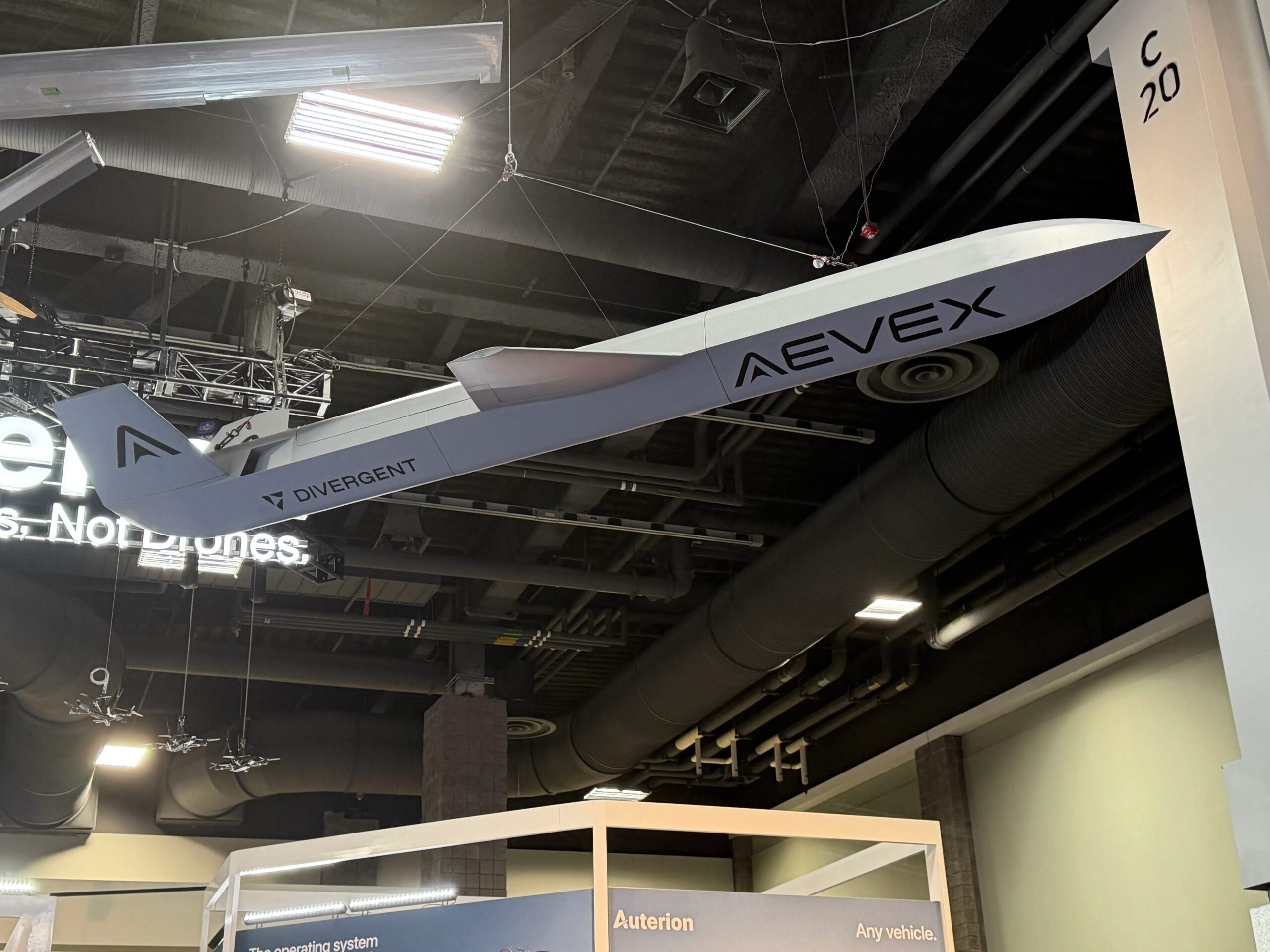
GA spokesman C. Mark Brinkley offered limited details about the Wildfire system, which he claimed is a leap beyond what the Pentagon is currently seeking in a new MALE combat drone. The company, he added, is not yet providing any images.

“General Atomics is looking at it and asking ourselves, ‘What can we really do? No kidding, no BS, actually do,’” Brinkley told us. “Let’s be honest with ourselves first. How do we come out of the box, day one, with a 10,000-nautical-mile ferry range? Can we carry four LRASMs [AGM-158C Long Range Anti-Ship Missiles]? Can we swarm 100 aircraft under semi-autonomous control? Can we fuse all of that data into a highly effective common operating picture? Can we do that at scalable, affordable mass?”

“So that was the assignment, and our engineers sharpened their pencils and got to work,” he added. “What came out the other side was our new Wildfire UAS. That thing is a beast, and no one who actually does this for a living and is honestly concerned about America’s warfighting edge can look at it and not want 100 of them as fast as we can make them.”

A line of MQ-9B SeaGuardian fuselages at the General Atomics facility. (General Atomics)

Last month, the Pentagon’s Defense Innovation Unit (DIU) announced its plans for what it has dubbed the Massed Modular Aircraft (MMA) program to replace the Reaper. The objective is to bring several companies together to help determine the way forward.

“The math of modern warfare is changing, and our force design must change with it,” DIU stated. “For decades, the Joint Force has relied on low-density, high-value, ‘exquisite’ (>$30M) manned and unmanned aircraft. In a high-end fight, this model is simply unsustainable. To win, we must design for, and accept, inevitable attrition while retaining the advantage.”

MQ-9 (USAF)

“The Joint Force seeks a cost-effective, theater-range, massed, and modular Unmanned Aerial System (UAS) to provide a flexible, operationally-responsive, risk-tolerant option in the air domain,” the DIU explained. “The ability to employ many aircraft at once ensures a persistent overwhelming credible threat despite inevitable attrition.”

Massed Modular Aircraft “are envisioned as in-theater reconfigurable platforms capable of long-range payload delivery,” DIU added. “Crucially, MMA must retain the ability to be outfitted with a variety of payloads, including Full Motion Video (FMV) sensors, to execute missions that the MQ-9A performs today.”

Primarily, DIU wants an aircraft with a munition and sensor payload capacity of at least 2,800 pounds, an unrefueled combat radius of at least 2,300 nautical miles with payload, and able to self-deploy one-way at least 8,000 nautical miles. It must also have a Modular Open Systems Approach (MOSA) to rapidly swap in different payloads and system upgrades.

As for secondary attributes, DIU wants autonomy for control, allowing one pilot to operate several aircraft. In addition, it is seeking “resilient and integrated communications – hybrid SATCOM/mesh network connection” and to be able to conduct “local airfield operations under highly degraded or denied primary C2/SATCOM conditions.”

In addition, the aircraft would have “at least 200 knots true airspeed” and operate from runways with a maximum length of 6,000 feet.

DIU

The MQ-9A Reaper has a 3,850-pound payload capacity and can fly for more than 20 hours unarmed, or more than 12 hours with weapons. In the case of the latest MQ-9B version, with an extended wingspan, flight endurance can be increased to more than 40 hours.”

The deadline for submissions on this program ended July 23, but it is unclear when contracts will be awarded. However, proposed solutions “must be capable of full-scale prototype flight testing within 21 months of award, with a targeted Initial Operating Capability in FY2031 (20 mission-ready aircraft delivered to an operational unit, able to be deployed),” DIU noted.

To put the DIU goal into perspective, official budget documents say the Air Force had 165 Reapers in inventory as of the start of Fiscal Year 2026, which began on October 1 of last year. This had already marked a significant year-over-year decrease, down from 231 MQ-9As at the beginning of Fiscal Year 2025. These figures don’t include the Marine Corps and Central Intelligence Agency, which also fly Reapers.

General Atomics is turning the MQ-9 Reaper family of drones into cruise missile 'trucks' thumbnail

General Atomics is turning the MQ-9 Reaper family of drones into cruise missile ‘trucks’


As noted earlier in this story, the DIU announcement of the MMA program came as Reaper losses in the war against Iran were mounting.

By May, the Air Force’s total MQ-9A fleet had shrunk to 135 aircraft, Air Force Lt. Gen. David Tabor, Deputy Chief of Staff for Plans and Programs, told members of Congress at a hearing.

There was enough concern that the service has scrambled to replace some of those airframes.

“So there’s a bit of a short-term effort to buy back things immediately, in this fiscal year,” Tabor testified.

The picture has only grown bleaker since then.

“The U.S. military has lost at least 45 MQ-9 Reaper drones during the war with Iran, or roughly 25 percent of its fleet,” The Washington Post reported last week, citing three U.S. officials familiar with the matter. The newspaper, citing the Air Force, stated that Reapers can cost between $30 million and $50 million each, depending on the type of sensors and weapons they carry.

“The potential taxpayer cost of recent losses is over $1.3 billion for that weapon system alone,” the publication added.

TWZ cannot independently verify those figures.

The MQ-9 Reaper Keeps Getting Shot Down - And Still Gets Used thumbnail

The MQ-9 Reaper Keeps Getting Shot Down – And Still Gets Used


The MMA program is not the first effort to replace the MQ-9. The Air Force has tried multiple times to develop a Reaper replacement without success. While GA had long held essentially had a monopoly on the MALE combat drone market in the U.S., the DIU competition has a host of other companies competing

As we highlighted in a past report on this subject:

“…the U.S. drone landscape has changed considerably in terms of manufacturers. A few years ago, Northrop Grumman, Lockheed Martin, and General Atomics would have been seen as the front-runners for the MQ-9 replacement. Now, there are more contenders, often with a founding focus on rapidly scaling up production at low cost. Still, these firms have much to prove, especially considering the risk in replacing an aircraft as important as the MQ-9. At the same time, in the more advanced drone space, the legacy defense “prime” contractors are also making major progress in leveraging new technologies to reduce production costs and migrating away from exquisite, very expensive drones as their default offerings.”

A MQ-9 Reaper assigned to the 174th Attack Wing flies over Hancock Field Air National Guard Base, Syracuse, NY, following a routine training flight, Oct. 31, 2024. The 108th Attack Squadron conducts these flights to instruct pilots and sensor operators on proper flight operations of the aircraft. (U.S. Air National Guard photo by Senior Airman Dylan McCrink)
An MQ-9 Reaper assigned to the 174th Attack Wing flies over Hancock Field Air National Guard Base, Syracuse, NY, following a routine training flight, Oct. 31, 2024. (U.S. Air National Guard photo by Senior Airman Dylan McCrink) Staff Sgt. Dylan McCrink

As for General Atomics, Brinkley pushed back against the notion that the MMA program is actually a Reaper replacement.

“I think it’s really unfortunate that MMA has been branded as a ‘Reaper replacement’ because it misrepresents what America needs now and what we need later,” he suggested. “We need an immediate backfill solution to a critical shortage of unmanned MALE ISR/Strike. We need to get going on that now. MMA isn’t a backfill solution, or even a bridge to a backfill solution. This isn’t that.”

“Some say we need cheaper, disposable aircraft, so that we can use them and throw them away, or lose them and not feel bad about it. No one is talking about actual capability, ready today,” Brinkley told us previously. “No one is talking about all of the hard lessons, already learned, about icing and weather and weapons integration. No one is talking about the multiple survivability upgrades available for the existing platforms and the lack of investment in those.”

“These make-believe weapons that don’t exist have the luxury of being anything you imagine them to be,” Brinkely added. “Unscratched lottery tickets, promising all of the win and none of the lose [sic].

Still, the company did submit a proposal for MMA, Brinkley told us on Wednesday, “but the aircraft [Wildfire] is not dependent on that program.”

“We can deliver Wildfires years earlier than the current schedule, and absolutely no one on Earth wants to see them coming over their horizon,” he stated.

Contact the author: howard@twz.com

Howard is a Senior Staff Writer for TWZ. He writes frequently about conflict, focusing heavily on the Middle East and Ukraine, and interviews with military and intelligence officials and industry leaders from around the globe. He lives near Tampa, Florida, home of U.S. Central Command, U.S. Special Operations Command.


Source link

Hunt For New Mobile Missile Defense Radar Reinforced By Lessons From Iran War

The U.S. Missile Defense Agency (MDA) has plans for a new radar to succeed the AN/TPY-2. The AN/TPY-2 is most commonly associated with the Terminal High Altitude Area Defense (THAAD) ballistic missile defense system, but it can also be used as a stand-alone sensor in a larger integrated air defense network. MDA’s main desire now is to find a more mobile radar system to make them less susceptible to enemy missile and drone attacks. Iran’s successful targeting of largely static missile defense radars this year, including the reported destruction of at least one AN/TPY-2, has been a wake-up call to just how vulnerable these prized assets have become already. TWZ explored this reality and its implications in a detailed feature earlier this year.

MDA put out a call yesterday for “innovative prototype concepts” for what it is currently calling the Forward-Based Mode (FBM) Radar Next. This notably came just ahead of the annual Space & Missile Defense (SMD) Symposium in Huntsville, Alabama, that opened today and at which TWZ is in attendance.

The contracting notice stresses that the agency is currently in the pre-solication phase of this effort, but that it does have plans to eventually pursue these prototypes through an Other Transaction Authority (OTA) agreement. OTA is a mechanism typically used to support rapid prototyping and other research and development work outside of a typical and often drawn-out contracting process. In its budget request for the 2027 Fiscal Year, which was released earlier this year, MDA also explicitly asked for funding for a pair of “next generation radar prototypes to prove out and mature emerging technologies for the future FBM Radar fleet.”

The AN/TPY-2 radar, one of which is seen here, is what the U.S. military primarily uses today to meet its forward-based mode requirements. RTX

For some additional context, MDA uses the term FBM here to refer to a radar used to detect threats, traditionally ballistic missiles, after launch. Deployable radars like the AN/TPY-2 employed in this role are typically emplaced at semi-permanent sites. The U.S. military also has higher-end static strategic radar sites around the globe, along with space-based assets, to help provide additional layers of early warning detection.

FBM is one of two typical modes of operation for the X-band AN/TPY-2. The other is a terminal mode where the radar is used to cue interceptors to incoming threats. As mentioned, AN/TPY-2 is most commonly used in the terminal mode as part of the THAAD system, but it also has a demonstrated ability to feed data to Patriot surface-to-air missile systems.

At the time of writing, the U.S. military is publicly known to have two AN/TPY-2s deployed in the FBM mode in Japan, as well as three more at sites in Israel, Qatar, and Turkey. Additional AN/TPY-2 are also currently forward-deployed elsewhere globally as a component of the THAAD system.

AN/TYP-2s, as well as the generators needed to power them, are trailer-mounted and technically road mobile. However, they are not designed to be very rapidly relocated from one site to another. This brings us back to the FBM Radar Next.

An AN/TPY-2 together with its trailer-mounted generators in position at Kwajalein Atoll in the South Pacific for a test. MDA

“As adversarial missile capabilities become increasingly sophisticated, the need for agile, survivable, and highly precise forward-based sensors has never been greater. Current static or semi-mobile radars are vulnerable to counterattacks and lack the rapid relocation capabilities necessary for modern distributed operations,” the pre-solication notice explains. “FBM Radar Next will close this gap by providing a system that can be quickly transported, set up, and operated in austere forward locations while maintaining interoperability with existing Command and Control, Battle Management, and Communications (C2BMC) networks.”

In terms of transportability and deployability requirements, “the system must be capable of rapid deployment and transport via C-17 military airlift and tactical ground vehicles,” the notice says. “The radar must demonstrate rapid setup and teardown times (e.g., operational within specified hours of arrival, and tear down within minutes to maximize survivability).”

A trailer-mounted generator for the AN/TPY-2 radar seen being unloaded from a C-17 cargo plane, giving a sense of the size of the entire system. ENERCON

The next-generation radar must also be capable of “high-sensitivity detection, persistent tracking, and precise discrimination of advanced threats in high-clutter and contested electromagnetic environments,” the notice continues. MDA also wants “engineered physical, thermal, and electromagnetic signatures to
ensure platform survivability in contested environments.”

Furthermore, “the design must support remote operations, command and control integration, and automated system health monitoring,” the notice adds. Minimizing the onsite operator footprint is critical to improving personnel safety and increasing overall tactical flexibility.”

MDA wants the FBM Radar Next to be able to slot into more “versatile deployment architectures, with the capability to operate either as a highly integrated single aperture or as multiple distributed arrays to optimize geographical coverage, sensitivity, survivability, or electronic protection.” In line with this demand, there are additional requirements for a modular design with open architecture systems, as well as seamless integration with the existing Command and Control, Battle Management, and Communications (C2BMC) architecture.

The MDA video below highlights the general capabilities of the C2BMC architecture in the context of a notional engagement of a hypersonic threat utilizing the still-in-development Glide Phase Interceptor (GPI).

GPI Scenario Animation thumbnail

GPI Scenario Animation


A highly networked and distributed concept of operations could open the door to more novel radar configurations, including ones involving larger groups of smaller types, to succeed the AN/TPY-2. Smaller individual radars could also have reduced signatures, be easier to conceal, and be more readily relocatable, all helping to reduce vulnerability. This could also make the entire system more resilient in the event that nodes are lost or otherwise rendered inoperable for any reason.

There could be benefits in terms of unit cost and scalability of production from such an approach, too. Prime contractor Raytheon is understood to have only produced 16 AN/TPY-2s to date, in total, for all customers, not just the U.S. military. The unit cost of a single one of those radars is generally pegged at around $250 to $300 million, and these are long-lead-time items that take years to deliver.

“The system design must prioritize manufacturing ease, design-for-manufacturing-and-assembly (DFMA) principles, and cost-efficiency. It is critical that the prototype demonstrates a viable pathway to rapid, high-volume production at an affordable unit cost,” MDA’s FBM Radar Next notice makes clear. “This ensures the capability to quickly scale production and cost-effectively replace radar units in highly active forward-deployed environments.”

Regardless of the approach MDA ultimately decides to pursue, the threat ecosystem that is driving the FBM Radar Next plans is real now, and is not just limited to enemy missile attacks. Weaponized drones, especially long-range one-way attack types, present real dangers to high-value targets. This fact had already been driven firmly into the public consciousness by the ongoing war in Ukraine. It has now been further demonstrated by Iran’s aforementioned targeting of prized air and missile defense radars around the Middle East during fighting earlier this year. The ramifications of all of this go well beyond these particular conflict zones, too.

As we wrote back in March after Iran’s very deliberate targeting of U.S. and allied radars became clear:

“Strategic air and missile architectures, in general, exist in a world now where the threats they face are not limited to very-long-range standoff capabilities possessed only by peer or near-peer adversaries.

“It used to be, generally, that you had to fire a ballistic missile or high-end cruise missile in an attempt to strike one of these systems. Now, long-range one-way-attack drones, as well as increasingly capable cruise and ballistic missiles, continue to proliferate steadily, including to smaller nation-state armed forces and even non-state actors. An attack could even come from a small drone with a C4 charge launched from a fishing trawler 10 miles away from one of these critical radar installations. The threat of these kinds of near-field attacks has largely been overlooked for years, even as the low-end drone threat has exploded and ‘democratized’ precision-guided weaponry, as they did not fit the established aerial threat matrix and the countermeasures used to repel those threats.”

The scale and scope of Iran’s retaliatory attacks so far, while clearly threatening, pale in comparison to what one would expect to see in a major high-end fight between the United States and China in the Pacific. The overall ramifications would also be more severe.

“Beyond the more immediate impacts of losing this kind of strategic radar coverage, there are far larger implications. In some cases, these radars are designed to provide critical early warning and verification of incoming nuclear strikes, or other large-scale attacks by a major adversary, targeting a nation’s home soil. They are critical parts of the nuclear deterrent. As such, losing these sensors can have major downstream impacts on strategic decision-making cycles based on concerns about what suddenly is not being seen. Fewer radars also means fewer ways to double-check that a track is not a false positive in a scenario where the total available decision-making time could be seriously truncated, to begin with. These are concerns TWZ explicitly highlighted after Ukraine’s attack on the Armavir Radar Station in Russia in 2024.”

A satellite image of the Armavir Radar Station taken on May 23, 2024. Significant damage to the southwest-facing Voronezh-DM early warning radar at the site and associated debris are clearly visible. PHOTO © 2024 PLANET LABS INC. ALL RIGHTS RESERVED. REPRINTED BY PERMISSION

During a panel discussion at the SMD Symposium today, U.S. Army Lt. Gen. Richard Zellmann, Deputy Commander of U.S Space Command, further underscored the reality of the current threat ecosystem, including one-way attack drones layered in with traditional missile barrages. The general also highlighted the impact of more readily available space-enabled targeting and navigation capabilities.

“We see, I think, the low end on Epic Fury [the official nickname for U.S. operations against Iran earlier this year]. Sure, the missiles are more high-end, but we’ve seen our adversary employ a number of one-way attack systems that are coupled with these ballistic missile volleys,” Zellman explained. “We are really at this point in the history of warfare because of the democratization of space. Space isn’t a sanctuary. It’s no longer just the playground of nations with a lot of money.”

“The commercialization of space has created what many call essentially a transparent battlefield. And because I can see everything all the time with commercial ISR [intelligence, surveillance, and reconnaissance; in this case primarily satellite imagery], it’s given our adversaries capabilities that they haven’t had in the past,” he continued. “That ISR, if you couple it with a platform that has access to GPS or some other PNT [Position, Navigation, and Timing] system, and then you add in another layer of over-the-horizon comms, like say from an Iridium or a Starlink [satellite communications terminal], and you have a pretty lethal asymmetric weapon system that our adversaries can get a hold of.”

Munitions that use GPS, or a similar form of navigation, alone for guidance are only employable against static targets. This, in turn, only drives home even more the importance of the transportability and deployability requirements that are at the heart of the FBM Radar Next plan.

It’s also important to note that, like AN/TPY-2 now, FBM Radar Next will still be just one part of a larger air and missile defense architecture. In our analysis earlier this year, we noted that Iranian attacks on radars in the Middle East had reinforced arguments for new layered defenses to protect those and other prized assets and for migrating more early warning and missile tracking capabilities into space. There is still a question of how much of that functionality will be shared and eventually ported over into orbital sensing capabilities. As Lt. Gen. Zellmann pointed out today, threats to space-based capabilities continue to grow, and that domain can no longer be considered a sanctuary, either. Having a layered, redundant, and flexible mix of terrestrial and orbital sensing for ballistic missile tracking will remain highly important for the foreseeable future.

What exactly a successor to the AN/TPY-2 looks like in the end remains to be seen. What is clear now is that very real missile and drone threats have prompted a major rethinking on the part of MDA about how future missile defense radars will need to be employed to ensure they can survive going forward.

Contact the author: joe@twz.com

Joseph is TWZ’s Deputy Editor, helping to oversee the site’s highly experienced and dedicated team, while also writing informative and impactful defense and national security content. He lives right in the thick of it in the Washington, D.C. area.


Source link

Army Downed More Than 1,400 Iranian Missiles And Drones During Epic Fury And 12-Day War

During the two most recent major Middle East conflicts it has been involved in, the U.S. Army swatted down more than 1,400 Iranian missiles and drones, according to the officer in charge of the Army’s air and missile defense. The figures provided by Lt. Gen. John Rafferty, commander of the U.S. Army Space and Missile Defense Command, Joint Functional Component Command for Integrated Missile Defense, and Joint Task Force-Gold, offer new context about the number of Army interceptions during these fights. His comments also come amid concerns about the tremendous expenditure of U.S. interceptors that has exacerbated the stress on America’s magazine depth of these high-end defensive weapons, an issue that TWZ has raised frequently for years. 

“For the last 14 months,” the 32nd Army Air and Missile Defense Command (AAMDC), based at Fort Bliss, Texas, “has been in the largest air and missile defense fight in U.S. history,” Rafferty said during a panel at the Space and Missile Defense Symposium (SMD) in Huntsville, Alabama, attended by TWZ. “Over the 12-day war [between Iran and Israel], they successfully engaged 125 ballistic missiles, and during Operation Epic Fury, over 1,200 ballistic, cruise and UAS threats have been neutralized.”

The commander of U.S. Central Command dismissed reports Iran retains most of its missiles and launchers.
Iranian missiles stored in an underground location. (Iranian media) (Iranian media)

The 32nd AAMDC, which is responsible for all U.S. Army air and missile defense in the region, “adapted and innovated to overcome advanced threats,” Rafferty added. “The THAAD [Terminal High Altitude Area Defense], the Patriot, and our counter-UAS systems are the envy of the world, and that’s due in no small part to some of the efforts of the organizations that are represented by the leaders in the front row here, but also by the contributions of many of our industry partners and industry teammates here.”

Ukraine, short on Patriot interceptors, can't down Russian ballistic missiles.
Patriot interceptor launching. (U.S. Army) (Official Army photo)

Though he didn’t mention how many interceptions were performed by the U.S. Navy’s ship-launched SM-3 and SM-6 missiles, or Air Force air-to-air missiles and rockets, Rafferty’s comments added insight into the extent of the U.S. military’s defense of the region during numerous Iranian missile and drone barrages. It represented just a part of a much larger regional effort involving several nations that came under Iranian attack.

In May, Adm. Brad Cooper, commander of U.S. Central Command (CENTCOM), testified before Congress that Epic Fury “validated, at full scale and in actual combat, a combined Middle East Air Defense (MEAD) network – a concept the region had exercised for years but never fully operationalized.”

“During OEF, for the first time in history, U.S. air defenders stood shoulder to shoulder with partner air defenders across national systems… Over the course of the operation, this integrated architecture intercepted over 6,000 one-way attack drones and more than 1,500 ballistic missiles aimed at U.S. forces, Israel, and our Arab partners.”

Cooper did not break down how many interceptions were carried out by each country, but the figures provided by Rafferty suggest that the Army was responsible for about 16% of all of them. CENTCOM declined our request for the numbers of interceptions carried out by the Navy and Air Force.

As a result of this intense air and missile defense activity, partner nations, minus Israel which uses its own systems, have had their missile stocks backfilled by the U.S. due to the massive consumption of interceptors. It’s also worth noting that it is common to use multiple interceptors against each target to increase kill probability, so one target often doesn’t mean one missile was used to shoot it down.

LIVE: Head of Central Command testifies before Senate committee on Iran war thumbnail

LIVE: Head of Central Command testifies before Senate committee on Iran war


As for the 12-Day War, Iran fired about 550 ballistic missiles and around 1,000 drones at Israel, according to the IDF. About 90% were intercepted by the U.S. and Israel, the Jerusalem Post reported at the time. While the Army engaged 125 Iranian missiles, the U.S. Navy played a large role in swatting down these threats as well. It is unclear just how many interceptions the Navy performed during that conflict, but former acting Chief of Naval Operations Adm. James Kilby told the Senate Appropriations Committee in June 2025 that the service fired interceptors at incoming Iranian threats “at an alarming rate.”

An SM-3 interceptor being launched. (DOD)

As we noted earlier in this story, we have been sounding the alarm about magazine depth for years, especially in regard to America’s air and missile defenses. In fact, we laid out in detail these exact concerns and how they would be a major issue in war with Iran just prior to the conflict starting in a feature you can read in full here.

The U.S. has burned through hundreds of THAAD and Patriot interceptors since a shaky ceasefire went into effect on April 8, according to the Center for Strategic and International Studies’ (CSIS) latest assessment. CSIS was updating a previous analysis of munitions expenditures during Epic Fury that you can read more about here.

According to CSIS, the U.S. had about 2,300 Patriot interceptors in its inventories before Epic Fury, 1,030 by the time the ceasefire was agreed to, and between 759 and 827 as of July 27.

As for THAADs, there were 452 interceptors in the U.S. inventory before Epic Fury, between 232 and 262 on the date of the ceasefire, and between 234 and 278 as of July 27.

The test launch of a THAAD interceptor.
Terminal High Altitude Area Defense (THAAD) interceptor launch. (DoD) (U.S. Army)

During the SMD panel, Rafferty addressed magazine depth concerns but did not provide any granularity about the number of interceptors used. The bottom line, he said, is that THAAD and Patriot munitions are just one part of an overall defense.

“I cannot add anything to the emphasis on magazine depth… or for the need for cheaper and wide-ranging mix of interceptors,” he explained. “I mean that couldn’t be made more loud and clear from the highest levels of our government. But I do want to highlight the need that interceptors alone won’t do it, right? We need more of a comprehensive missile defeat strategy that focuses on interceptors, equally so on non-kinetic effects, both electronic warfare and directed energy.”

“And the type of targeting C2 enabled by a data strategy, and a cross-domain solution that works that helps us take data from TS [top secret], move it down to secret, and even down to CUI [controlled unclassified information], that’ll enable us to use that data to make decisions to engage targets faster,” he continued. “That’s the kind of comprehensive missile defeat strategy that isn’t just about more interceptors. It’s about integrating other capabilities, non-kinetics, and also decision-making into that.”

For the moment, things have calmed between the U.S. and Iran, with no major attacks against each other for several weeks. Media reports have suggested that President Trump has shifted to economic, rather than military pressure against Iran in large measure over concerns about the ability to sustain a conflict with greatly diminished magazine depth.

Still, Trump has been unable to compel Iran to give up its nuclear ambitions, reopen the Strait of Hormuz, pare its ballistic missile stocks or stop supporting proxies like the Houthis and Hezbollah. Given that, it remains possible the notoriously impatient president could resume hostilities at any time. So too could the Iranians, who have done it before.

Meanwhile, the heavy use of these expensive, hard-to-build, long-lead-time weapons raises additional questions about how the U.S. can defend itself from another major threat, and especially should a war break out with China. 

Rafferty didn’t bring up concerns about whether the supply of air defense munitions and general capacity was sufficient for a China fight, nor was he asked about it in the ensuing question and answer session. Still, he did imply that the U.S. Army’s air defenders were under significant stress battling Iran.

Contact the author: howard@twz.com

Howard is a Senior Staff Writer for TWZ. He writes frequently about conflict, focusing heavily on the Middle East and Ukraine, and interviews with military and intelligence officials and industry leaders from around the globe. He lives near Tampa, Florida, home of U.S. Central Command, U.S. Special Operations Command.


Source link

Hunt For New Lower-Cost Strike Missile With 1,000-Kilometer Range Underway By U.S. Army

The U.S. Army is on the hunt for a new lower-cost strike missile capable of hitting targets more than 621 miles (1,000 kilometers) away. The Affordable High Speed Strike (AHSS) missile could be more of a traditional ballistic missile-like weapon or feature an air-breathing propulsion system. AHSSs could be fired from new uncrewed launcher vehicles that the Army is pursuing separately, as well as certain existing crewed types like the M142 High Mobility Artillery Rocket System (HIMARS). The service sees these future weapons as offering a particularly important new way to strike enemy air bases, air defense nodes, missile launchers, and other high-value targets within a particular theater of operations.

AHSS was among the many programs the Army’s Combat Capabilities Development Command’s Aviation & Missile Center (DEVCOM AvMC) highlighted at its booth at the annual Space & Missile Defense (SMD) Symposium in Huntsville, Alabama. TWZ was in attendance at this conference, which wrapped up yesterday. Aviation Week was first to report on AHSS from this event.

A US Army M142 HIMARS launcher vehicle fires a 227mm guided artillery rocket. The service says this is one launcher that could be used to fire AHSS missiles in the future. US Army

“AHSS is an entirely new missile,” a DEVCOM spokesperson said, according to Aviation Week. At the same time, the Army is also clearly in the very early stages of defining what it wants from this new weapon beyond general affordability and reach.

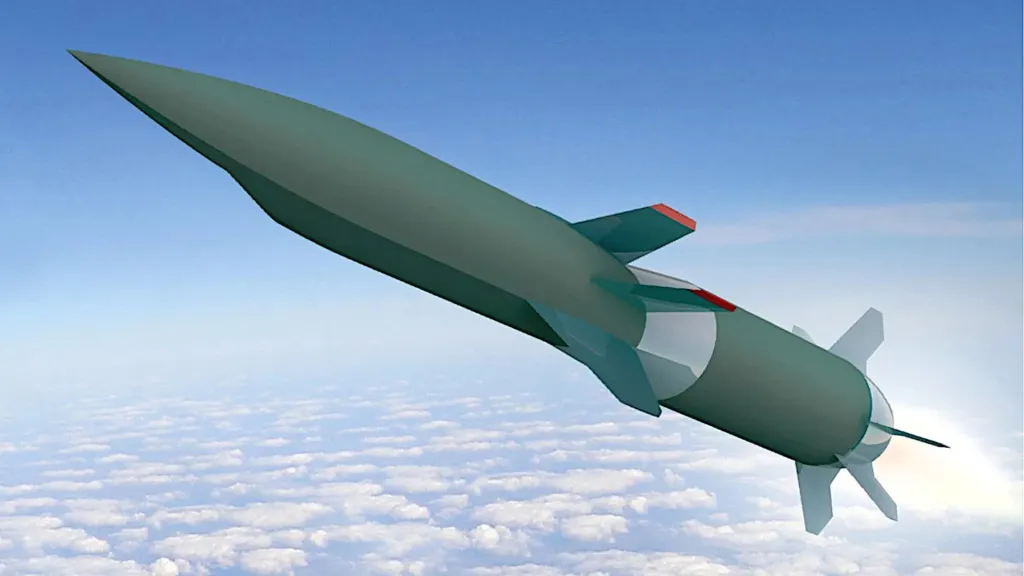
A graphic on display at DEVCOM’s booth at the SMD symposium showed renderings of two distinctly different notional missiles under the AHSS heading, as seen at the top of this story and below. One has a traditional ballistic missile-type design with a cruciform fin arrangement at the tail end. The other notional missile has a more novel design with an air-breathing propulsion system feeding from an intake in the nose. In broad terms, the intake has a style commonly associated with high-speed jet engines such as ramjets and scramjets. It also has a completely different tail configuration, as well as what appears to be a long, slender stabilizing strake visible along the right side of the body.

Jamie Hunter

Aviation Week‘s story also highlights the Army’s current separate development of an entire new family of Common Autonomous Multi-Domain Launcher (CAML) vehicles. However, the current AHSS concept also includes “an option to be launched from a crewed HIMARS,” the DEVCOM spokesperson said, according to that outlet.

The prototype uncrewed version of HIMARS seen here, called the Autonomous Multi-Domain Launcher (AML), was an important stepping stone to the CAML program. US Army The Autonomous Multi-domain Launcher (AML) prototype. US Army

HIMARS, which uses a 6×6 tactical truck as its base, fires munitions via standardized ammunition ‘pods.’ As such, it seems likely that any other launcher that makes use of these same pods, such as the tracked M270 Multiple Launch Rocket System (MLRS), would also be able to fire the future AHSS missile.

US Marines load an ammunition pod into an M142 HIMARS launcher during an exercise. USMC

“This project directly supports Precision Fires capabilities by developing, maturing, and demonstrating affordable high speed strike missile technologies for responsive, mobile, deployable, survivable, and sustainable Army conventional theater strike weapons,” the Army said about AHSS in its 2027 Fiscal year budget proposal, which was released earlier this year. The program will “provide hardware and software technologies demonstrated, including affordable advanced propulsion, complementary warhead, guidance, navigation and control technologies, and integration onto Army mobile launch platforms.”

“The Army needs affordable, responsive high speed strike capability to attack theater level targets, provide offensive counter-air capability, and be launched from Army mobile, deployable, and survivable platforms,” the Army budget documents add.

The specific mention of the offensive counter-air (OCA) mission set is interesting as it is far more commonly associated with air assets. However, it is simply defined as “offensive operations to destroy or neutralize enemy aircraft, missiles, launch platforms, and their supporting structures and systems both before and after launch, and as close to their source as possible,” according to the January 2020 edition of the U.S. military’s official Dictionary of Military and Associated Terms. Long-range surface-to-surface missiles are very applicable for pursuing these objectives, something we will come back to later on.

It is also worth noting that DEVCOM’s graphic at the SMD Symposium used the exact same air-breathing missile render to represent the planned Increment 4 version of the Precision Strike Missile (PrSM). The baseline version of PrSM, or Increment 1, is a traditional short-range ballistic missile with ability to hit targets at least around 310 miles (500 kilometers) away, if not further. The Army’s current stated plan for Increment 4 is to acquire a new variant or derivative of PrSM with a range of at least 621 miles/1,000 kilometers. For further context, the Increment 2 PrSM, which is in active development now, is an anti-ship-focused variant with a new seeker system, allowing it to engage moving targets. The Increment 3 plan is centered on new unspecified “enhanced” payloads, which could include swarms of loitering munitions.

A look at the full DEVCOM graphic on display at the annual SMD Symposium this week. Jamie Hunter
A Lockheed Martin rendering of an air-breathing missile design tied to its work on an Increment 4 PrSM concept. Lockheed Martin

The Army has also talked in the past about an Increment 5 variation of PrSM with even greater range. This would put it in the same general category, at least in terms of reach, as AHSS. As noted, DEVCOM has stressed that AHSS is distinct from other existing efforts.

Furthermore, AHSS and PrSM are just two parts of a larger array of new longer-range strike capabilities the Army is working to acquire. The service has already fielded a small number of Typhon systems, which are currently capable of firing Tomahawk land attack cruise missiles and Standard Missile-6 (SM-6) multi-purpose missiles. Tomahawks can hit targets roughly 1,000 miles away. The Army is now pushing to field the Long Range Hypersonic Weapon (LRHW), also known as Dark Eagle, as well. Last year, new details emerged that put the maximum range of this weapon at around 2,175 miles.

On top of this, defense startup Castelion is developing a ground-launched version of its Blackbeard missile for the Army. Blackbeard is a lower-cost design said to be capable of traveling at hypersonic speeds. The exact maximum range of this missile is unclear, but the Army has said in the past that it is targeting “80% of the Precision Strike Missile (PrSM) Increment 4 capability.”

A key underlying factor in all of this was the collapse of the Intermediate-Range Nuclear Forces (INF) Treaty in 2019. Under the INF, the United States and Russia were both prohibited from developing and fielding nuclear or conventionally-armed ground-based ballistic and cruise missiles with maximum ranges between 310 and 3,420 miles (500 and 5,500 kilometers). The AHSS section in the Army’s 2027 Fiscal Year budget request specifically mentions that such developments are now “unconstrained by previous treaties.”

Depending on what kind of capability is ultimately pursued under AHSS, as well as PrSM Increment 5, the Army could be on track to field its first new medium-range ballistic missile (MRBM) since the INF went into force in 1988. MRBMs are categorized as ballistic missiles with maximum ranges between 620 and 1,860 miles (1,000 and 3,000 kilometers). Members of Congress have notably been openly supportive of the Army acquiring exactly this kind of long-range capability in the past.

Pairing this capability with new and improved crewed and uncrewed launchers could offer more flexibility for employing these weapons, while also helping to reduce vulnerability to enemy attacks. TWZ has highlighted now on several occasions how uncrewed mobile launch systems would offer even greater advantages for future expeditionary and distributed operations. Uncrewed platforms could be pushed further forward without necessarily exposing human operators to greater risks. This would also allow a smaller force of human personnel to operate a larger number of total launchers, in general.

The broader value of Army ground-based long-range strike capabilities has been demonstrated this year in the course of operations against Iran. PrSM, as well as older Army Tactical Missile System (ATACMS) short-range ballistic missiles, have been so heavily employed against Iranian targets that there are now serious concerns about the adequacy of the remaining stockpiles of those weapons. There are reports that stocks of PrSMs, which the Army only received in quantity in 2023 and that made their combat debut in strikes on Iran, have run especially low.

As such, AHSS also underscores the importance of acquiring new, lower-cost munitions that are also more readily procurable, something that has become a focal point for the entire U.S. military in recent years. As a point of comparison, the unit cost of an Increment 1 PrSM is around $1.5 million. It is also a long-lead item where the time between when orders are placed and deliveries occur is measured in years.

What the timeline might be for AHSS developments to evolve into an actual operational capability is unclear. The Army has asked for just over $94.2 million to support AHSS work in the 2027 Fiscal Year. In its report, Aviation Week also noted that the service has previously disclosed that Australia is an international partner in the AHSS effort. This is a capability that could be of interest to other branches of the U.S. military and other foreign allies and partners. The U.S. Marine Corps, in particular, has an interest in longer-range strike capabilities to support its new expeditionary and distributed concepts of operations, and axed its plans to field Tomahawks fired from uncrewed 4×4 launcher vehicles last year,

With the Army exploring initial concepts for AHSS now, more about its vision for these missiles may begin to emerge.

Contact the author: joe@twz.com

Joseph is TWZ’s Deputy Editor, helping to oversee the site’s highly experienced and dedicated team, while also writing informative and impactful defense and national security content. He lives right in the thick of it in the Washington, D.C. area.


Source link

Lockheed Martin’s Master Plan For Accelerating Munitions Production

The Department of War is challenging the U.S. defense industrial base to transform the way it builds and supplies weapons for the military – stimulating manufacturers to find new ways to enable faster and more efficient procurement. It’s a necessary move, particularly when it comes to weapons stockpiles, as some have been placed on red alert due to high consumption in crisis abroad. Efforts to create a so-called “Arsenal of Freedom” involve shoring-up critical supply chains, injecting predictable long-lead funding, lowering costs, and increasing competition.

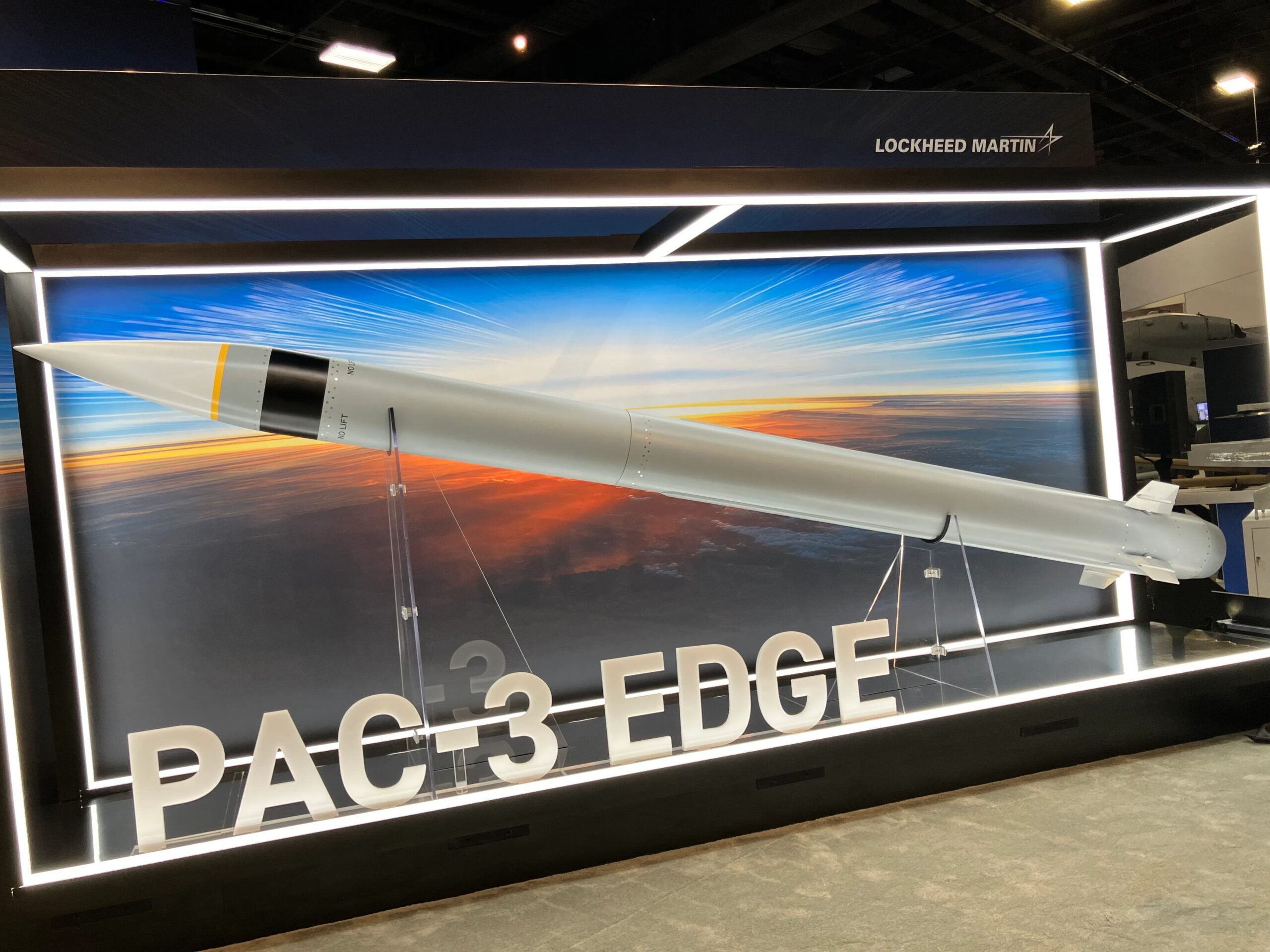
Lockheed Martin’s Missiles and Fire Control (MFC) division is reacting by investing in production capacity to accelerate some of its most important munitions facilities – a reflection of how many of its missiles are in high demand. Speaking at a groundbreaking event at the company’s Troy, Alabama, site in May 2026, at which TWZ was present, Lockheed Martin chairman, president and CEO Jim Taiclet addressed employees about a “first landmark framework agreement” that will dramatically accelerate production of PAC-3 MSE (Missile Segment Enhancement) air defense interceptors, which are designed to destroy adversary tactical ballistic missiles, cruise missiles, drones and aircraft.

THAAD interceptors on the production line. Lockheed Martin

Taiclet said the “agreement represented a new model for how government and industry could work together with greater speed, accountability and shared commitment to the mission’s execution.” In addition to PAC-3 MSE, Lockheed Martin is also boosting production of its Terminal High-Altitude Area Defense (THAAD) and Precision Strike Missile (PrSM) lines to meet the urgent demand for more missiles. 

Both PAC-3 and THAAD have been integrated together in Joint All-Domain Operations, including with the U.S. Army’s Integrated Air and Missile Defense Battle Command System (IBCS) and during exercises with the F-35 stealth fighter.

The company says it’s planning an $8-9-billion investment through 2030 to expand this munitions footprint across the U.S.. Lockheed Martin has invested more than $7 billion since President Donald Trump’s first term to expand capacity for priority systems, including approximately $2 billion dedicated to accelerating munitions

production. Investment is being channeled into MFC facilities, tooling, suppliers, as well as its workforce. “This effort reflects the power of a commercially-inspired partnership between government and industry,” Taiclet said, endorsing this approach as an obvious method to expand capacity for priority systems.

Paving the way for acceleration

The Department of War’s Acquisition Transformation Strategy is designed to create long-term stability that gives industry the confidence to make necessary investments to change the way it produces equipment. Lockheed Martin was the first in the defense industry to announce a framework agreement like this for munitions acceleration under the new government initiative – initially committing to the tripling of production capacity of the PAC-3 MSE interceptor and then quadrupling the production capacity of THAAD interceptors.

A PAC-3 MSE being test fired. U.S. Army Photo

The U.S. government awarded Lockheed Martin a $4.7-billion undefinitized contract action (UCA) in April 2026 for the accelerated production of PAC-3 Missile Segment Enhancement (MSE), which built on a framework agreement signed in January 2026 to ramp up production of the missiles. Production of the PrSM short-range ballistic missile will also quadruple. PrSM, which succeeds the Army Tactical Missile System (ATACMS), received Milestone C approval from the U.S. Army in July 2025, which led to a $4.94 billion contract award. PrSM then made its operational debut earlier this year in operations against Iran. 

“We’re rapidly ramping up a number of munitions. It’ll probably [expand to] include all the munitions that we build here at Lockheed Martin Missiles and Fire Control,” explained Tim Cahill, president of the company division. “We are working in partnership with the Department of War to identify go-quick contract actions that we can put in place, the suppliers we need and what investment is needed, and then determine what we call the enablers to make that happen.”

“It’s not just a case of let’s just go faster, it’s about what we fundamentally have to change across the entire business and in the technical process to go quickly to replenish stocks at a higher level than we ever have before,” Cahill added. “Ultimately, I would expect that we’re going to see all the munitions that we build in some sort of heads of agreement, some sort of a contract to increase the level of production.”

Lockheed Martin’s Master Plan For Accelerating Munitions Production thumbnail

Lockheed Martin’s Master Plan For Accelerating Munitions Production


In addition to PAC-3 MSE, THAAD, and PrSM, the AGM-158 Joint Air-to-Surface Standoff Missile (JASSM) and AGM-158C Long-Range Anti-Ship Missile (LRASM) programs are also ramping up, and Cahill added that the AGM-179 Joint Air-to-Ground Missile JAGM and Javelin shoulder-launched anti-armor weapon are expected to follow suit. “We have been ramping some of these munitions for several years already. Javelin production has increased, as has GMLRS [Guided Multiple Launch Rocket System] and GMLRS Extended-Range, but I would expect they’re going to ramp up beyond those numbers in the next few years.”

The manufacturing process for these advanced weapons is a complex business. It has typically taken as long as three years from contract signature to the delivery of a PAC-3 MSE. Lockheed Martin aims to dramatically cut timelines like this. “Lockheed Martin is not waiting – we have been taking proactive steps to ramp up production and secure materials well in advance,” explained Jason Reynolds, vice president and general manager for integrated air and missile defense. “It takes time for each of those suppliers to actually create those individual subcomponents and ship them to places like our plants in Troy, Alabama, or Camden, Arkansas. Then we do the final assembly. Once we’ve completed that, we have to go through testing and qualification, packaging and signing off, then delivering them to the U.S. government or to our partners and allies that have placed that order. It’s a time consuming process, but we’re doing everything possible to shorten that in the near term.”

A PrSM being launched during exercise Valiant Shield 24. U.S. Marine Corps photo by Cpl Kyle Chan

One of the critical keys to the change lies in contracting. Cahill says companies have become used to annual contracts, with incremental follow-on options. He says this drove industry to commit to a year’s worth of production at a time, with no real certainty over what the ensuing years would bring. The new government approach presents a commitment of between five and seven years, which provides far greater confidence and predictability for manufacturers to invest in long-lead items to help prevent bottlenecks in the complex production cycle, and ultimately streamlines and expedites the production process.

The long-term approach to procurement has an additional benefit of being able to secure lower prices for components and materials, enabling the prime contractor to invest in a supplier’s capacity with greater confidence. Keeping a production line moving and not having to pause to wait for components to arrive is a significant factor. Securing larger quantities of parts with plenty of lead time enables cost savings and production acceleration.

PAC-3 MSE in production. Lockheed Martin

“For all of us, there’s also economic value there,” explains Cahill. “There is real money in being able to drive efficiencies, knowing what the next seven years will be like. We can take those efficiencies and effectively apply them into self-investment up front, so the U.S. government gets better value in the price of the munitions. They’re ordering more and business gets the opportunity for increased revenue and increased capability.”

“We have thousands of suppliers, particularly underneath our key suppliers all across this nation and in many cases across the world. It’s about what they need all the way down to raw materials. For example, one thing that’s held us up over the years is titanium. Titanium goes into a lot of things, including golf club shafts! So you’re out there competing on the commercial market for materials. Being able to get ahead of that curve and aggregate demand, first of all, increases our priority and allows us to deal with the lead times and plan for that so those don’t become bottlenecks. What we are doing with our suppliers is in effect addressing all those elements.”

It’s not just the contracting that is being overhauled, changing the way these complex systems are actually built is equally important. Lockheed Martin is now increasing both its workforce and the use of robotics, plus it’s bringing in additive manufacturing techniques such as 3D printing to reduce reliance on costly and time-consuming traditional tooling.

A THAAD interceptor is fired from its mobile launcher. Lockheed Martin

“Building missiles faster is a key priority for us, and we can do that a couple of different ways,” added Jason Reynolds. “You can shorten the span time and the lead times of all the different components, and you can actually increase the factory floor [footprint] to increase throughput. We’re doing all of that. We’re working with suppliers to reduce the individual span times, whether it be a rocket motor, a seeker, or a section that we make internally like the guidance section, so that we can build these things faster using automation and advanced manufacturing technologies at the same time. We’re increasing the actual capacity. We’re making additional tooling and test equipment, hiring additional people both here at Lockheed Martin and at our suppliers around the world.”

License production is another means to share the load and unlock expanded production capacity. Lockheed Martin has already licensed PAC-3 MSE production to Japan, which operates a final assembly and checkout facility. “That’s something we’re going to be looking at, because if we can expand our supply base in Europe, for example, where we have potential co-production in Europe, there are some great possibilities there,” says Tim Cahill. “We’re looking at all the elements, everything that might be a methodology to bring those numbers up and make sure that our nation and our allies have the capacity they need. Licensed production could very well be part of that.”

Rapid prototyping and speed to field

New start-up companies and industry “disruptors” are playing a fundamental role in changing the government’s expectations when it comes to driving down costs and rapidly developing and then producing new capabilities. Tim Cahill pulls no punches when acknowledging this and emphasizing how Lockheed Martin is similarly evolving its approach. 

MFC has set-up a Rapid Fielding Center at its Grand Prairie facility in Dallas, Texas, designed to promote the use of latest in production and prototyping technologies. “We are looking at how we can apply some of the emerging technologies to do things quickly, like using Artificial Intelligence and Machine Learning to make our production more adaptive and able to build in mass quantities that we couldn’t build before. We are competing in that space.”

THAAD interceptors in production. Lockheed Martin

The use of commercial off the shelf products is a recognized means to accelerate, but Cahill cautions that it’s not always a suitable solution. “You’re looking for the most capable parts to meet the requirements and get you there fast. That’s always been part of the dynamic for Lockheed Martin. We always look at commercial parts. Some systems are more conducive to it than others. If you’re building a low-cost drone or a counter-drone system, you’re looking for something that’s treatable – it’s great for those kinds of systems. But as these become more complex – when they have to operate in environments that range from the Arctic to the high desert in the Middle East in the middle of summer – or if they have to go through extreme launch environments or whether they have to survive in the presence of our adversaries trying to counter them. As the requirements get harder and harder, commercial off-the-shelf parts just don’t meet those requirements. They fail because they’re not designed for that.”

“You can’t take an automotive guidance system and run it at Mach 5, run it through the atmosphere at high temperature and have somebody try and disrupt it. In most cases we have to make them more robust and capable, or build parts that are unique to those particular products. We always start with the questions of how we accomplish the mission? How do we give our warfighters what they need to prevail, and we will use commercial off-the-shelf if that fits what is necessary for that mission – sometimes it does and sometimes it doesn’t. Any technology that you can imagine, we are looking for, how might we apply that just like all the new entrants and frankly all the traditional companies are doing much the same. We get the sense of urgency and that’s what we intend to do.”

Lockheed Martin is also involved in deep research around low cost weapons. “There’s a lot of people competing in that space,” Cahill acknowledges. “Sometimes for us when we’re applying our investment, our expertise, it’s more effective to focus on some of the other capability areas. For example, we have introduced a counter-UAS [unmanned aircraft system] called MORFIUS™ X-Rotor, a newly-released airborne high power microwave system that can neutralize more than 50 enemy drones in a single flight.”

MORFIUS is designed for field recovery and reuse and Lockheed Martin says it offers a very low cost-per-kill ratio.

Lockheed Martin has released this image of MORFIUS in action. Lockheed Martin

Lockheed Martin is also ready to move ahead with a lower-cost Patriot missile interceptor. “Our PAC-3 Adapted Capability Effector, or PAC-3 ACE, answers the call,” Cahill told TWZ, adding that it will probably be less than half as expensive as the current PAC-3 MSE, but that it would still retain a lot of the capability. “They’re never going to have that full capability because you’ve got to fundamentally remove parts, some of the things that are most expensive.” 

An artist’s rendition of PAC-3 ACE. Lockheed Martin

Cahill says that PAC-3 ACE is built on the PAC-3 fire-control system and will be fully linked to the Patriot weapon system and the Integrated Battle Command System. “There isn’t magic here and when you take some of those things off, they become less capable, but that’s absolutely part of the dynamic. This rapidly fielded, complementary PAC-3, will be deployed quickly and enhance the resilience of the U.S. defense industrial base worldwide.”

Jamie is TWZ’s Branded Content and YouTube Editor, overseeing the content side of the site’s industry partner programs and our expanding video programs. He lives in London, U.K. but is regularly on the road particularly with our international trade show presence.


Source link