rebound

Sparks hold off late Toronto Tempo rally, earn first win of season

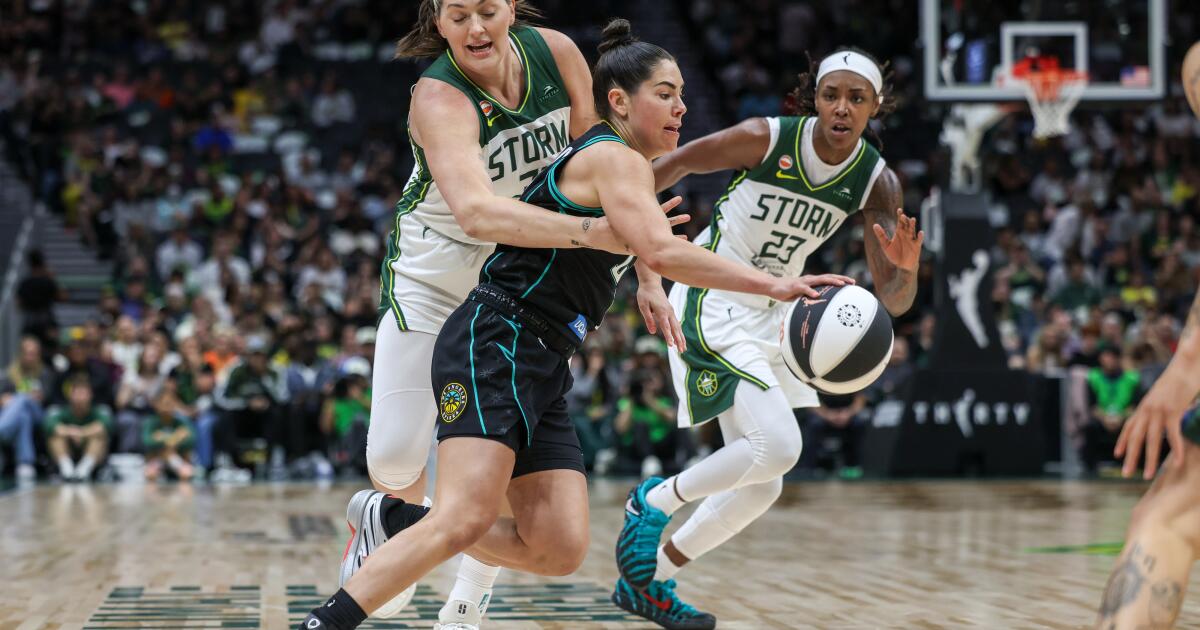
The Sparks are finally in the win column, but the outcome was in doubt late Friday night.

Behind double-digit scoring from all five starters, the Sparks had by far their best offensive showing of the season, shooting 63.8% during a 99-95 win over the expansion Toronto Tempo.

The Tempo didn’t make things easy, cutting the deficit to two points late and later trailing by just three with 31 seconds remaining and possession of the ball. Marina Mabrey missed a three-point attempt before late Tempo fouls gave the Sparks enough of a cushion to win.

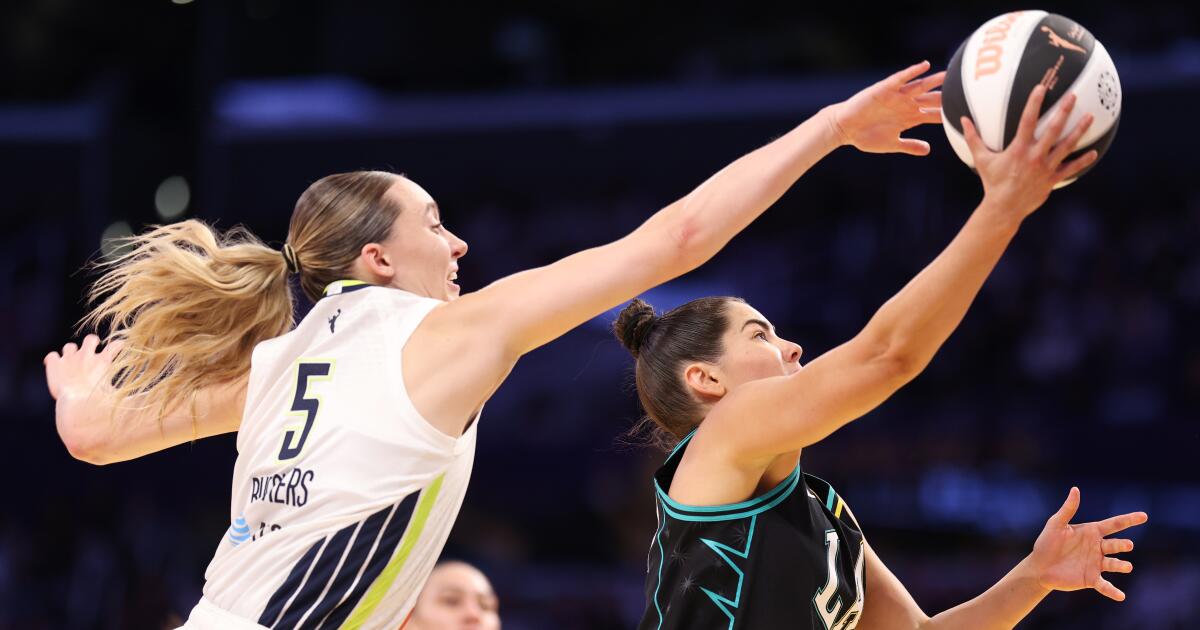
Kelsey Plum nearly claimed a double-double with 27 points and nine assists, while Dearica Hamby had 19 points with seven rebounds and Nneka Ogwumike scored 20 points.

Erica Wheeler, who started in place of Ariel Atkins (concussion), scored 10 points with seven assists and was a plus-16 as the primary ball handler after starting the season two for 16 from the field. That freed up Plum to be in position to score, setting up a much more efficient Sparks offense.

Toronto was shorthanded in the frontcourt without starting center Temi Fagbenle (right shoulder), and the Sparks trio of bigs had a field day with 54 points in the paint.

The Sparks came out firing on Friday, opening with a 17-2 run.

The Tempo went on a 10-0 burst heading into the second quarter but the Sparks countered to maintain momentum and led 46-38 at halftime.

A Wheeler three-pointer early in the third quarter gave the Sparks a 20-point lead. The Tempo cut it to three midway through the fourth while Brittany Sykes (27 points, seven assists) sparked Toronto’s rally. The Tempo put up more shots than the Sparks, 70-58, largely because of a 10-2 offensive-rebounding gap.

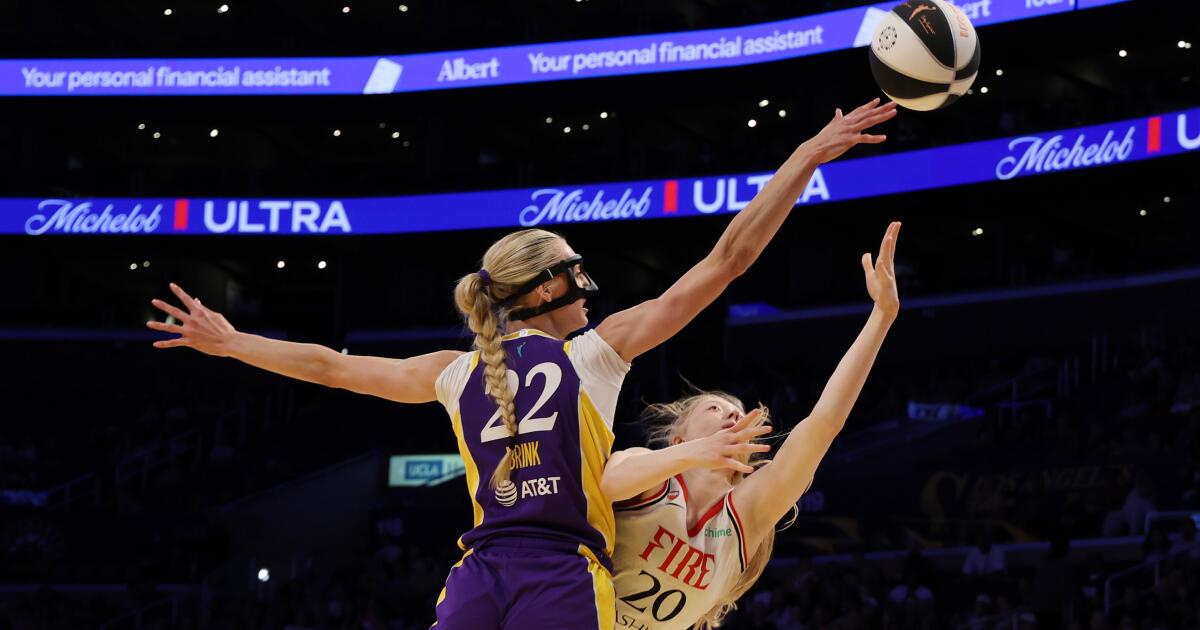
Cameron Brink’s 10 points were the only ones provided by the Sparks’ bench, while the Tempo got 42 points from reserves.

Toronto was coming off its first win in franchise history on Wednesday when it defeated Seattle but struggled against a more complete offensive team in the Sparks.

In her return to Los Angeles after winning a national championship with UCLA this spring, Tempo rookie Kiki Rice netted 11 points.

Kate Martin made her Sparks debut as a developmental player with Atkins and Sania Feagin (lower left leg) unavailable and picked up one rebound in six minutes.

The Sparks will face Toronto again on Sunday at Crypto.com Arena.

Source link

Lisa Leslie moved she will get a statue outside Crytpo.com Arena

Hall of Famer Lisa Leslie didn’t expect to ever get a statue outside Crypto.com Arena. After all, it had been 15 years since her jersey retirement and no other Sparks player was featured among the Lakers and Kings heroes outside the area.

After years of hearing from fans that she deserve to be immortalized, Leslie learned she would join Sue Bird in Seattle as the second WNBA player to be honored with a statue at a franchise’s home arena.

“One thing I never had on my bucket list was a statue,” Leslie told The Times on Thursday. “I grew up seeing the statues of some of the amazing Lakers, so I’m just really grateful to be alive and to be one of the first, especially in the WNBA for L.A. Sparks. It means a lot to me, and I’m really hoping that our community will really rally around it.”

The Sparks announced Thursday morning that Leslie will receive a statue to be unveiled during a ceremony on Sept. 20 before a game against the Portland Fire.

During her 12-year career with the Sparks, Leslie won three WNBA titles and league MVP honors. She also won four Olympic gold medals. She was the first player in WNBA history to dunk in a game and her No. 9 jersey was retired in 2010.

She was one of the Sparks’ original players in 1997 and is the franchise’s career leader in points, rebounds, blocks, field goals, free throws, offensive rebounds, defensive rebounds, minutes and games played, and is third in the WNBA in blocks and double-doubles.

“I’ve known Lisa for nearly three decades and believe that she is beyond deserving of this incredible honor,” fellow statue honoree and Lakers great Magic Johnson said in a news release. “She was the driving force behind bringing back-to-back championships to the Los Angeles Sparks franchise in 2000 and 2001, and Lisa’s hard work and commitment has made her one of the best to ever play the game.”

Johnson, who is part the Sparks ownership group, accepted responsibility for the team’s skid two years ago and promised to do more. The Sparks owners, who also own the Dodgers and Lakers, have responded to losing at a boom time in the WNBA by executing a coaching change, breaking ground on a new practice facility and installing the first Sparks statue outside Crypto.com Arena.

“Lisa’s legacy isn’t just measured by championships and accolades, though; it’s defined by the doors she opened and the standard she set for generations to come,” Johnson said in the news release. “More than an athlete, she is a pioneer, a cultural icon and a force who elevated women’s basketball to new heights. This statue celebrates her excellence, her leadership and the future she helped create, and it ensures her impact will forever be part of the fabric of this city.”

Leslie said that she noticed fans lobbying for her to get a statue beginning in 2019, and the timing for her and the Sparks felt right during the 30th anniversary season.

“It couldn’t be better with the new [practice] facility coming, the new CBA, everything is aligning so properly,” she said. “It’s more perfect than it would have been a few years before.”

The statue was created by sculptors Julie Rotblatt Amrany and Omri Amrany and will join 15 others outside of Crypto.com Arena, including Johnson, Wayne Gretzky, Oscar De La Hoya, Chick Hearn, Jerry West, Kareem Abdul-Jabbar, Luc Robitaille, Shaquille O’Neal, Bob Miller, Elgin Baylor, Dustin Brown, Kobe Bryant (2), Gigi Bryant and Pat Riley.

“I hope she looks good,” Leslie said of the statue. “People don’t realize how hard it is to make a statue look good. … They helped me to be super specific about every little thing down to my earlobe and fingernail tip. So I’m excited about all the little details that have been added that people can kind of find on their own as well.”

Source link

Jason Collins, NBA’s first out gay player, dies at 47

Jason Collins, the NBA’s first openly gay player who went on to become a pioneer for inclusion and an ambassador for the league, has died after an eight-month battle with an aggressive form of a brain tumor, his family announced Tuesday.

Collins, who starred at Stanford and Harvard-Westlake High, where he helped the Wolverins win to back-to-back Division III state titles along with twin brother Jarron, spent 13 years as a player in the league for six different franchises. He revealed in 2013 that he was gay, an announcement that came toward the end of his playing career.

Collins had been diagnosed with Stage 4 glioblastoma, which has an extremely low survival rate. He was 47.

“Jason changed lives in unexpected ways and was an inspiration to all who knew him and to those who admired him from afar,” Collins’ family said in a statement released through the NBA. “We are grateful for the outpouring of love and prayers over the past eight months and for the exceptional medical care Jason received from his doctors and nurses. Our family will miss him dearly.”

Just last week, Collins received the inaugural Bill Walton Global Champion Award at the Green Sports Alliance Summit. He was too ill to attend so Jarron Collins accepted for him.

“I told my brother this before I came here: He’s the bravest, strongest man I’ve ever known,” Jarron Collins said while accepting that award.

Jason Collins averaged 3.6 points and 3.7 rebounds in his career. He helped the New Jersey Nets reach two NBA Finals and in his best season averaged 6.4 points and 6.1 rebounds for them in 2004-05.

“Jason Collins’ impact and influence extended far beyond basketball as he helped make the NBA, WNBA and larger sports community more inclusive and welcoming for future generations,” NBA commissioner Adam Silver said. “He exemplified outstanding leadership and professionalism throughout his 13-year NBA career and in his dedicated work as an NBA Cares Ambassador. Jason will be remembered not only for breaking barriers, but also for the kindness and humanity that defined his life and touched so many others.

“On behalf of the NBA, I send my heartfelt condolences to Jason’s husband, Brunson, and his family, friends and colleagues across our leagues.”

Jason Collins revealed his sexuality in a first-person account for Sports Illustrated in April 2013. He was a free agent at the time, said he wanted to keep playing, and went on to play in 22 games with Brooklyn the following season.

“If I had my way, someone else would have already done this,” he wrote at that time. “Nobody has, which is why I’m raising my hand.”

His decision was widely lauded, with star players such as Kobe Bryant quickly speaking out in support of Collins. There was even support from the White House and then-former President Bill Clinton — whose daughter, Chelsea, went to Stanford with Collins. At Stanford, Collins was roommates with someone who was part of another American political dynasty, that being Joe Kennedy III, who spent eight years in Congress representing Massachusetts.

Collins, in the piece for Sports Illustrated, wrote that he realized he needed to go public about his sexuality when Kennedy walked in Boston’s gay pride parade in 2012 — but Collins couldn’t do the same.

Until then, Collins kept his feelings about gay rights close to the vest. He wore jersey No. 98 for the majority of his final three playing stints with Boston, Washington and Brooklyn — a nod to the year that Matthew Shepard, a gay college student in Wyoming, was killed. He also wore 46 in one game for the Nets, since it was the only jersey the team had available when he signed.

Collins made nearly 61% of his shots in his career at Stanford, which remains a school record. He was an honorable mention selection for the Associated Press’ All-America team in 2001, a few months before the Houston Rockets took him with the 18th pick in that year’s NBA draft.

“It’s a sad day for all of us associated with Stanford basketball when we lose one of the program’s greats,” former Stanford coach Mike Montgomery said. “We all have great memories of Jason and the kind of person he was. It’s hard to separate Jarron and Jason because they thought so alike, but even though he was an identical twin, Jason was unique in his own way. The impact he had on Stanford was immense, as he could match up against anyone in the country because he was big, smart, strong and skilled, all while being a very bright and nice person.”

Source link