It is just one of the many upcoming projects the reality star has in the works
Kim Kardashian is working on the ‘new Dance Moms’(Image: Stephane Cardinale – Corbis/Corbis via Getty Images)
The makers behind hit dating show Love Island have teamed up with Kim Kardashian for their next reality series project which aims to be the ‘next Dance Moms’.
Having received a green light, the new show is expected to be streaming on Paramount Plus at some point later this year. Reality star Kim Kardashian will serve as executive producer for the new show
The title is a joint production between companies ITV America, which also produces Love Island USA, along with Kim Kardashian Productions and Paramount Sports Entertainment. Executive producers for ITV America are Mioshi Hill, Jordana Hochman, Jeremiah Smith and Tom Ciaccio. Natalie Ento also serves as an executive producer.
Named Team Moms, the series will launch viewers into the world of nationally competition youth baseball in the US. To do this, they will be granted exclusive access to the Legendary Prep Academy in Scottsdale.
Viewers will be immersed in what is Arizona’s first and only baseball prep school. The series follows the coaches, founders and a group of dynamic families.
Their respective teen sons who comprise the starting line-up for one of the most competitive youth baseball programs in the world. It is a feeder to Division 1 college scholarships, NIL deals and ultimately, fame and fortune in the MLB.
Willing to do whatever it takes for their children to excel at America’s favourite pastime, the intensity of the program is only paralleled by the fervour of its athlete’s parents, who will stop at nothing to ensure their kids make it to the big leagues.
It’s clear from the premise that the show hopes to be recreate the magic of Dance Moms which created such stars like Maddie Ziegler and JoJo Siwa.
This isn’t the only television project being produced by All’s Fair star Kim Kardashian. According to her IMDB page, she is also set to produce and star in the series Group Chat.
That is an upcoming drama about five glamorous LA women in their 40s who appear to live flawless lives, but their private group chat reveals the raw, messy reality beneath their polished facades..
She will also star in the series as well as Netflix comedy film The Fifth Wheel. She also has a Kardashians spin-off in the works called Calabasas Behind the Gates, which will focus on the exclusive, gated lives of the extended Kardashian-Jenner circle, including friends and neighbours.
Paramount hope that Team Moms will become another hit in its list of ongoing reality shows which also include Survivor, Big Brother, The Challenge and Making Love.
The L.A. man who was filmed punching and kicking the Mercedes-Benz of “Gown and Out in Beverly Hills” stars Patrik Simpson and Pol’ Atteu in Hollywood was arrested this week and booked on felony vandalism.
The reality stars shared the dramatic video of the incident on social media with the caption, “Emergency! We need your help! We were just attacked at an intersection.”
“This man just blocked the intersection of our car at Melrose and Vine and then kicked our door in attacking us. Police were called and the license plate is on the video. If you know who this is, call the police immediately and send me a DM. He is dangerous and the police are looking for him!”
In the video, a man wearing a Cheech & Chong tee that reads “Don’t Panic, It’s Organic” blocked the Melrose Avenue and Vine Street intersection Sunday around 9:20 a.m. and hopped out of his Toyota 4Runner.
Contrary to instructions on the man’s shirt, the married co-stars of the Amazon Prime reality series did begin to panic as the man, who has been identified as Los Angeles resident Kevin Antonio Hernandez, approached their vehicle and punched the driver’s side window and kicked the driver’s side door. “Lock the door!” Simpson is heard saying in the video. “Call the police!”
Hernandez continued to yell at the fashionistas as he returned to his vehicle, but it’s unclear what he was saying because the techno music playing on the radio in Simpson and Atteu’s Benz drowned out any outside noise. Hernandez climbed into the driver’s side of his Toyota and pointed at the couple, yelling one last time, before speeding off.
“Go get him!” Simpson is heard yelling as they continue to film, while chasing the Toyota through the streets of Hollywood and calling 911. The reality stars’ exchange with the emergency dispatcher played out in the video, with the dispatcher urging the couple to stop following the car.
According to Simpson and Atteu, Hernandez had a baby in the car during the heated exchange and ran stop signs and ignored traffic lights as he sped away.
“This is it, I’m going to die here,” Atteu told KTLA of his headspace during the ordeal. “I’ve never been faced with that kind of fear in my life on the streets of L.A.”
The Los Angeles Police Department told The Times that Hernandez was arrested Wednesday. He has since been released.
HE IS the working class boy from Wales who conquered Hollywood as Sir Elton John in Rocketman.
She’s the Louisiana-born Baywatch actress whose reality TV family want to be the nextKardashians.
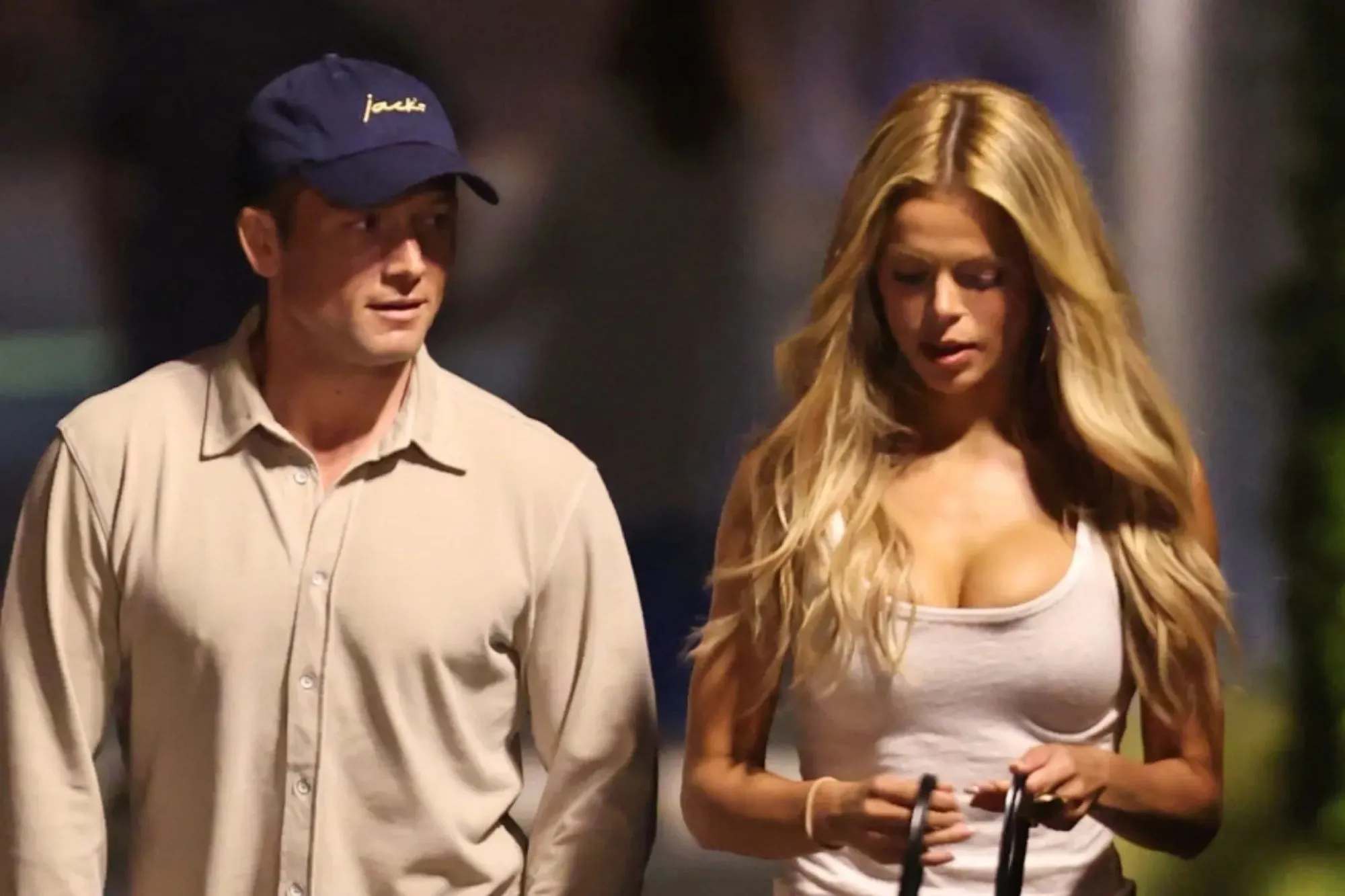
Taron Egerton and Brooks Nader have become showbusiness’s hottest coupleCredit: BackGridBut Taron’s inner circle is sounding the alarm on the pair’s relatonshipCredit: SplashThe chaotic circus of Brooks’s life could derail Taron’s acting career, it is fearedCredit: Getty
But behind the steamy snogs, Taron’s inner circle is sounding the alarm.
For I can reveal, that the 36-year-old Kingsman heartthrob’s prestige acting career could be spectacularly derailed by the chaotic circus of Brooks’s life, and her ferociously protective, camera-hungry family.
As my insider warned: “This could all end in disaster. He doesn’t know what he has gotten himself into. She will eat him alive.”
But it is not just one Nader Taron has to contend with.
She also has a brood of high-flying sisters who all live together in Manhattan and keep a watchful eye on their big sis.
Dubbed the “Wannabe Kardashians”, Brooks and her photogenic sisters – Sarah Jane, Grace Ann, and Mary Holland – became smash hit reality stars when their show launched last year on Disney+.
If his relationship with Brooks hits a speedbump, Taron won’t just be dealing with a private heartbreak – he’ll be dealing with the wrath of the sisters and a Hulu camera crew capturing every excruciating detail.
As one insider summarised the situation: “Who knows if this is happily ever after. But it could spectacularly backfire for Taron if things get messy. The Nader sisters are brutal and unafraid to play dirty to protect their own.”
The Louisiana-raised siblings swapped the country for the bright lights of New York and Los Angeles, and they absolutely do not take prisoners.
In the first season of their show, which quickly became a guilty pleasure for millions of viewers, the sisters famously tore shreds into Brooks’s exes.
This could all end in disaster. He doesn’t know what he has gotten himself into. She will eat him alive
Insider
They had choice, cutting words for her former husband, advertising executive Billy Haire, whom she divorced in 2024, with Brook herself saying she married him “for rent purposes”.
When she was asked on a chat show what she thought about her ex remarrying, Brooks remarked: “Which ex?”
But the sisters saved their unfiltered venom for her Dancing With the Stars partner and ex-boyfriend, Gleb Savchenko.
The pair met when they were partnered on the dance show, and sister Grace Ann revealed they hit it right from the off.
Brooks and her protective, camera-hungry sisters have been dubbed the ‘Wannabe Kardashians’Credit: Instagram/BrooksNaderThe Kingsman heartthrob could be dealing with the wrath of her sisters and a camera crew capturing every detail if his relationship to Brooks hits a speedbumpCredit: Alamy
‘Highly dangerous tightrope’
She explained in eye-watering detail: “I can tell you firsthand, every time I visited Brooks’ trailer, the trailer was shaking — every single time.”
But Brooks’s whirlwind fling with the Russian dancer imploded months later, but made great reality television.
The sisters discovered he had left his phone in their flat and quickly went about searching the device while being filmed for the series.
Brooks said they were “shocked” by what they found. She said on the episode: “All these screenshots of my boobs. What the f— is this? There’s like a million girls in here. This is a week ago.”
She then found a contact labeled “Threesome girl, Joshua Tree,” and broke down in tears.
Gleb vehemently denied the allegations, but the truth hardly mattered once the Nader sisters went to war.
They cornered him both on-screen and off, acting as Brooks’s personal attack dogs.
Brooks later admitted that watching herself “crying on the bathroom floor” over the split was the hardest part of filming the show,
But she also issued a chilling warning to anyone who might doubt her family’s investigative skills, proudly claiming: “My sisters are my sources.”
With these glamorous private investigators, any misstep Taron makes is guaranteed to end up in the next season.
Reality television thrives on conflict, and the Nader sisters know exactly how to deliver it
Insider
This is exactly why Hollywood insiders are so nervous for the Welsh actor. A-list directors and prestige studios often shy away from actors embroiled in reality TV circus acts.
My insider added: “By aligning himself with a star whose life, heartbreak, and family drama are filmed for public consumption, Taron is stepping onto a highly dangerous tightrope. Reality television thrives on conflict, and the Nader sisters know exactly how to deliver it.”
But he does not seem deterred. The pair have been painting California red over the last week, looking thoroughly besotted with one another.
Since The Sun revealed earlier this week that they were dating, they’ve been spotted holding hands outside luxury steakhouses and grabbing intimate drinks at Shutters on the Beach.
Yet, as the romance heats up, there are dark whispers in Hollywood, with some questioning the authenticity of the sudden pairing.
A more cynical insider even suggested that the highly photographed romance might be a well-orchestrated PR stunt designed to mutually boost their profiles.
‘Extremely ambitious’
Taron, despite his undeniable talent, has slipped off the radar slightly since his meteoric run with Rocketman and the Apple TV+ prison drama Black Bird.
Meanwhile, Brooks is “extremely ambitious” and “desperate” to cement her burgeoning reality TV empire.
Still a source told The Sun, Taron is “very keen” on the swimwear model, but this highly public romance is a stark departure from his roots.
Born in Birkenhead but raised in the quiet seaside town of Aberystwyth, small-town boy Taron has until now kept his private life discreet.
Taron, above with Elton John, had his meteoric run with Rocketman and is said to be ‘very keen’ on the swimwear modelCredit: Instagram
When he burst onto the scene as a council estate rebel turned superspy in Kingsman: The Secret Service, he was praised for his grounded nature.
He dated assistant director Emily Thomas for six years, keeping the romance strictly low-key and away from red carpets before they quietly parted ways.
However, the famously cheeky star hasn’t been entirely mute about his romantic preferences or his prowess as a boyfriend in past interviews.
Speaking to Andy Cohen, Taron confessed he wasn’t looking for a specific body type, laughing as he admitted his actual preference.
He joked “I’m probably more of an a** man… I’ve got a big butt. Quite a big round butt. When we’re walking away hand-in-hand as a couple, it’s not going to look right [if she doesn’t]. It won’t work.”
He even doubled down while reading thirsty fan tweets online during a promotional tour, cheekily declaring to the camera, “I’m quite proud of my a**, actually.”
And when he does fall for someone, he falls incredibly hard.
Recalling a romantic gesture for his ex, Emily, he once revealed, “When my girlfriend and I first got together, I took her to Claridge’s hotel in London, and I had them deliver a necklace to the room.”
He has confidently described himself in the past as an “attentive, thorough, enthusiastic” lover.
But all the attentive enthusiasm in the world might not be enough to shield him from the Nader family.
Brooks is ‘desperate’ to cement her burgeoning reality TV empireCredit: Getty
Watch this discussion between Ross Harrison and Hassan Ahmadian on US strategy regarding Iran. They conclude the US is still negotiating with old talking points, while Iran has moved on.
When you think of your earliest memory of reality television, what comes to mind? Is it “The Real World,” “Survivor” or “The Bachelor”? Perhaps it’s other fare like “Project Runway” or one of the “Real Housewives” franchises.
Growing up in the ‘90s and early aughts, my first exposure to reality programming was MTV’s slate of shows like “Real World” and “Road Rules” — thanks to being the youngest of four siblings, I was exposed to shows that were, in hindsight, too risque for me at too young an age. But they left an indelible mark. I saw Irene McGee of “Real World: Seattle” get slapped by her roommate Stephen Williams, a moment that at the time sent shock waves. Genesis Moss, of the Boston cast, was one of my earliest exposures to a gay person on TV. And Melissa Howard of the New Orleans season showed me how you can be 5-foot-2 and unapologetically feisty — as someone with a similar build and demeanor, I took that to heart.
Over the years, I’ve sometimes dismissed reality TV because it felt a little too personal or a little too competitive. I often wonder about the psychological effect on participants as their lives are laid bare for all to see. However, I can’t deny their appeal and why fans have continued to gravitate toward these shows season after season. They make for excellent watercooler talk; in recent weeks, my co-workers and I have spoken endlessly about “The Bachelorette” and Taylor Frankie Paul, and who did or didn’t stay married from Season 10 of “Love Is Blind.”
Few of us knew in the early days what effect reality television would have on the culture or how it would create a new type of star. Reality TV personalities have become influencers, pop culture icons and even political figures. One is the president.
And many shows have not only endured, they’ve spawned universes, international adaptations and spinoffs. Bravo, a TV channel that used to focus on the performing arts, is now an unscripted powerhouse that even has its own convention, BravoCon, where its various universes come together in service of fans.
What does that say about us as viewers? There’s always been a fascination with peering into the lives of others, seeing how they react to everyday problems under the glare of a camera. Perhaps it is a way to deflect from the reality of our own lives, which under the guise of normalcy is straining with the weight of political upheaval and economic turmoil, not to mention personal strife. Seeing someone else onscreen deal with their reality is sometimes the best escape.
So like it or not, reality television is here to stay.
Perhaps it was predictable that reality TV would become a pipeline into American politics. After all, political theater was the ultimate unscripted spectacle before reality TV became a genre unto itself.
Consider the raw drama of the first televised presidential debate, where a sweaty Richard Nixon and confident John F. Kennedy traded barbs. Or Anita Hill’s should-have-been-damning testimony against then-Supreme Court justice candidate Clarence Thomas during Senate Judiciary Committee hearings in 1991. Or President George W. Bush’s 2003 “mission accomplished” speech from a carrier off the coast of California, mere weeks into a war in Iraq that lasted years.
Modern programmed reality TV isn’t political theater, but it has become a springboard into modern politics for some stars of the genre. From President Trump to Dr. Oz, Caitlyn Jenner to Sean Duffy, campaigns and political offices are littered with the names of former cast members from reality series. Here’s a list of the most memorable jumps from trash TV to the smoldering dumpster of 21st century politics.
Donald Trump, president of the United States, ’The Apprentice’
Before he was a two-time president of the United States, Trump was one of America’s most recognizable make-believe bosses thanks to his 14-season run on NBC’s reality competition “The Apprentice,” created by reality TV kingmaker Mark Burnett. With his practiced executive scowl and scripted boardroom catchphrase, “You’re fired!,” the show burnished his image as a decisive billionaire dealmaker, even as his real-life business results were far less impressive. Off camera, Trump’s businesses filed for Chapter 11 bankruptcy protection six times between 1991 and 2014. Never mind. It was his knack for showmanship, and his undying need for attention, that proved the perfect entry into post-decorum politics. How does pretending to be in charge on a middling reality competition qualify anyone to safely and successfully run the most powerful nation on Earth? It doesn’t. Sleep tight.
Sean Duffy, Transportation secretary, ’The Real World’ and ‘Road Rules: All Stars’
Sean Duffy first appeared on MTV’s “The Real World: Boston,” where he was introduced as a flirtatious, conservative lumberjack/student hybrid. In short, he was a casting director’s dream. He later joined “Road Rules: All Stars,” where he met his future wife Rachel Campos-Duffy. Trading hot tub confessionals for courtrooms, Duffy became a Wisconsin district attorney and then a congressman. By 2025, he’d risen to secretary of Transportation under Trump, completing a career arc from staged arguments with pretend roommates to heated exchanges with the press about the effects of a government shutdown on airport safety. Dude.
After a fiery confirmation hearing, Mullin is now Trump’s second secretary of Homeland Security in the 2.0 administration, following the disastrous tenure of wannabe reality show star Kristi Noem. Mullin was not a reality star per se, but in his role as a professional mixed martial arts (MMA) fighter he performed in cages for live, streaming and pay-per-view cable audiences. As an early 2000s champ in the sport, Mullin boasted an undefeated 5-0 record and the Oklahoma chapter of the National Wrestling Hall of Fame inducted him in 2016. How do these MMA skills, or his former life running the family plumbing business qualify him to protect the national security of this great nation? It’s unclear, but his fighting instincts have already resulted in a viral moment out of a 2023 Senate hearing, when he challenged Teamsters President Sean O’Brien to a physical fight, offering to “finish it here.” Now he’ll be running the DHS. What could go wrong?
Omarosa Manigault Newman, former assistant to Trump and director of communications for the office of public liaison, ‘The Apprentice’
Newman became one of reality television’s more memorable villains thanks to her run on “The Apprentice,” where her Machiavellian ways and unapologetic ambition revolted viewers and impressed her fake boss. She would eventually parlay that dubious notoriety into more than one role in the first Trump White House. Her tenure was brief, ending in a high-profile departure and her accusation that Trump is a “racist, a bigot and a misogynist.” She then wrote a book, “Unhinged: An Insider‘s Account of the Trump White House.” Perhaps she’ll adapt her written account into a reality show, only to reignite her fame and win the White House. From there? She’d hire Trump, of course, then swiftly end his run on the show with two simple words: “You’re Fired!”
Spencer Pratt, Los Angeles mayoral candidate, ‘The Hills’
Best known as one-half of reality TV’s most polarizing couple on “The Hills,” Pratt built a reputation as a needling instigator, often leaning into the role of villain with annoying enthusiasm. After stints on other reality shows such as “Big Brother U.K.,” he began speaking out about local California issues, including wildfire recovery and environmental policy. Earlier this year Pratt, a Republican, announced that he would be running for mayor of Los Angeles in the upcoming mayoral election, challenging incumbent Karen Bass. Does he really want to govern the Left Coast, or is his candidacy a ploy for a new reality show? Let’s hope it’s the latter.
Caitlyn Jenner, California gubernatorial candidate, ‘Keeping Up With the Kardashians’
An Olympic gold medalist long before reality TV fame, Jenner reentered public consciousness through a show about nothing. The hit series relaunched her into the spotlight as a member of one of America’s most visible families. Using that fame, she ran as a Republican in 2021 in California’s gubernatorial recall election, positioning herself as a political outsider. Her campaign leaned heavily on her life story — from her athletic achievement to her personal reinvention — but she failed to keep up with the competition.
Clay Aiken, U.S. congressional candidate, ‘American Idol’
Aiken rose to fame as the earnest, vocally gifted runner-up on “American Idol” circa 2003. His polite demeanor, impressive vocal range and dramatic rendition of “Bridge Over Troubled Water” earned him a devoted fanbase known as the “Claymates.” Aiken went on to have a semi-successful music career before running for Congress in North Carolina as a Democrat in 2014. Aiken made the mistake of leaning into his strengths as a thoughtful, policy-oriented candidate rather than relying on his past achievement as a vapid reality show contestant. He lost, of course.
Jim Bob Duggar, Arkansas state House representative and state Senate candidate, ’19 Kids and Counting’
As the patriarch of TLC’s “19 Kids and Counting,” Jim Bob Duggar became synonymous with a conservative Christian lifestyle when the show aired in 2008; it garnered high ratings and ran for 10 seasons. He espoused many of the same ideals as an elected official in the Arkansas House of Representatives from 1999 to 2003, before leaving the political stage for reality TV. But the show was canceled in 2015 when the Duggars’ eldest son, Josh, admitted to molesting several girls, some of whom were his sisters. A conviction on child pornography charges followed. (More recently, his brother Joseph was charged with child sex abuse.) Jim Bob Duggar attempted a political comeback in 2021 when he ran for a vacated seat in the Arkansas state Senate, leaning on what he believed was his reputation as an upstanding family man. Reality bit back, and he lost.
Mehmet Oz, U.S. Senate candidate and administrator of Centers for Medicare & Medicaid Services, ‘The Dr. Oz Show’
Like so many questionable figures Americans came to trust in the 2000s, Dr. Oz got his start as a frequent guest on “The Oprah Winfrey Show.” He went on to launch “The Dr. Oz Show,” where he dispensed health advice to millions of viewers. His blend of seemingly measured medical guidance and on-camera charisma appealed to viewers who were tired of looking at egg-headed doctors, like the kind who practice real medicine off screen. He announced his candidacy for the U.S. Senate in Pennsylvania as a Republican in 2021, focusing on an anti-establishment platform. He lost the general election to Democrat John Fetterman, but the doctor is still in. Trump appointed him administrator of the Centers for Medicare & Medicaid Services.
Sarah Palin, former Alaska governor and vice presidential nominee, ‘Sarah Palin’s Alaska’
File this under “Folks who tried to reinvent themselves on reality TV after tanking in politics.” Sarah Palin served as the ninth governor of Alaska before being selected as Sen. John McCain‘s running mate ahead of the 2008 presidential election. After losing to Barack Obama and Joe Biden, she veered away from politics, a decision that probably had nothing to do with an ethics scandal dubbed Troopergate that involved Palin. Burnett saw an opportunity, producing the 2010 TLC reality series “Sarah Palin’s Alaska.” It followed the Palin family engaging in activities such as fishing, prospecting for gold and camping in the region. In short, it looked like a tourism ad for Alaska and was canceled after one season. It also failed to kickstart her political career. She lost her 2022 bid for Alaska’s U.S. House seat, failing in both a special election and her general election comeback attempt. Apparently it isn’t Sarah Palin’s Alaska, after all.
ITV viewers were left saying the same thing as a new reality show debuted on Saturday night.
21:21, 21 Mar 2026Updated 21:22, 21 Mar 2026
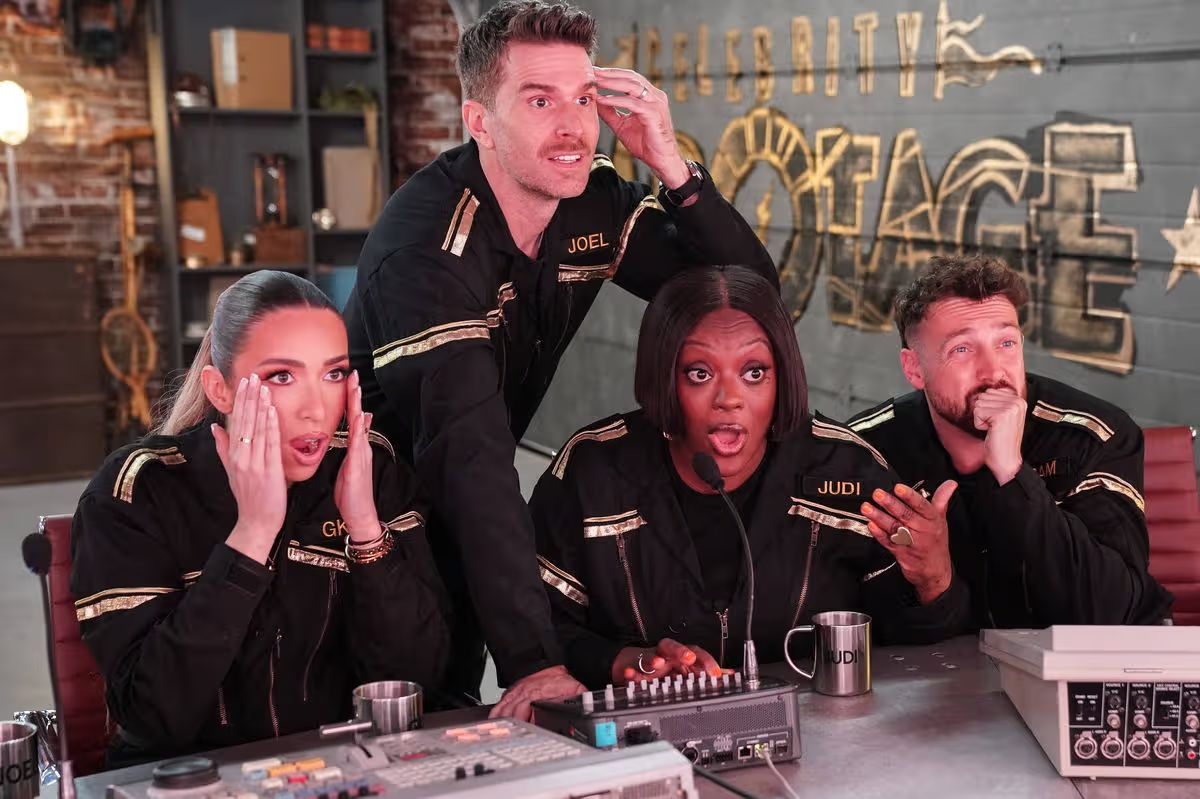
ITV viewers issue same complaint minutes into new reality show Celebrity Sabotage (Image: ITV)
ITV viewers were not impressed as new reality show, Celebrity Sabotage, premiered.
The new series sees Joel Dommett, Judi Love, Sam Thompson and GK Barry sabotage ordinary people who think they are taking part in various reality shows, with the aim of winning them money.
In each episode, a fresh set of unsuspecting contestants will arrive, believing they’re participating in a brand-new ITV show. But what they don’t know is that hidden away in their very own high-tech Mission HQ are celebrity saboteurs, who are secretly watching the contestants’ every move and are being set their own sabotage missions.
Hosting the fake shows are a string of stars, including Emma and Matt Willis, Sara Davies and Clare Balding, while celebrities will also join Joel, Judi, Sam and GK to help with the sabotaging.
The first episode aired on Saturday (March 21), with a group of business enthusiasts embarking on a set of challenges under the watchful eye of entrepreneur and Dragons’ Den star Sara Davies.
The celebrity saboteurs were joined by comedian Jo Brand as they set about disrupting wedding video filming, deleting the contestant’s filmed footage, and sabotaging a wellness away-day face mask activity by using lashings of green food colouring.
After watching the first episode, several ITV viewers shared their complaints about the show’s premise.
“#CelebritySabotage This is as much fun as having a toothache, @ITV churns out some rubbish & this one is right up there. It’s a waste of our time, it makes you look forward to seeing the adverts! I’m going to sit outside & watch the car electric battery top up, a lot more fun!” one person wrote on X (formerly Twitter).
Another added: “How do programmes like these ever get commissioned. Utter rubbish,” while a third said: “What a s*** show.”
A fourth fan echoed the sentiment, saying: “This is a kids TV show that got mixed up in the schedule surely. Utterly dreadful hate watch,” with another similarly sharing: “This is appallingly bad even for ITV. How long before it’s shunted to 4.30 Sunday afternoon?”
Meanwhile, other viewers enjoyed the silliness of the show, with one person writing: “Honestly I knew I was going to like #CelebritySabotage, it’s a great show with a great cast and I really like how the fake shows are rip offs of others. Definitely will be watching next week.”
Another added: “I know it’s all very childish but I absolutely love it. This is what Saturday night telly should be,” while a third said: “This is incredible. I could listen to @1Judilove laugh all day long, absolutely howling.”
Someone else commented: “Cackled with laughter for this whole show. What a vibe.”
After two days of sabotaging, the contestants eventually found out about the celebrities’ antics, before learning that they’d won a shared prize of £29,000.
A channel spokesperson said: “We have made the decision to not move forward with the new season.”
22:46, 19 Mar 2026Updated 23:31, 19 Mar 2026
Taylor Frankie Paul was due to star in the new series of The Bachelorette(Image: Disney via Getty Images)
The new series of reality TV dating show The Bachelorette has been cancelled following domestic violence allegations against one of its stars. A video of Taylor Frankie Paul appearing to assault her ex-boyfriend Dakota Mortensen had been published by TMZ.
Taylor was announced as the star of the latest series of the show, which is a spin-off from The Bachelor and sees a woman choosing a husband from a large pool of romantic interests. It had been a huge success for US network ABC and Paul was due to be central to its 22nd series.
However, a spokesperson for ABC owner Disney said today it would be pulling the show, which has already been filmed and was due to air on TV in a matter of days.
It said: “In light of the newly released video just surfaced today, we have made the decision to not move forward with the new season of ‘The Bachelorette’ at this time, and our focus is on supporting the family.”
TMZ obtained a video of a 2023 incident with Taylor and her ex, Dakota, where she was arrested for and charged with assault, criminal mischief, and domestic violence in the presence of a child. In the video Dakota can be heard saying: “This is called physical abuse.”
Police bodycam footage of Taylor’s arrest in the 2023 incident was played on the first episode of Hulu’s Secret Lives of Mormon Wives.
A spokesperson for Paul issued a statement to People in response to the video. It said: “It’s sad to see the latest installment of his never-ending, desperate, attention-seeking, destructive campaign to harm Taylor without any regard for the consequences for their child.
Ensure our latest headlines always appear at the top of your Google Search by making us a Preferred Source. Click here to activate or add us as your Preferred Source in your Google search settings.
“Releasing an old video, which conveniently omits context, on their son’s birthday is a reprehensible attempt to distract from his own behavior. Thankfully, the public has seen this act before and knows who he is and sadly, many will recognize this pattern of manipulation, both in his actions on the show, and from their own experiences.”
Paul also confirmed that the next series of The Secret Lives of Mormon Wives, which first aired in 2024, has paused production for its fifth season. Her co-star, Mikayla Matthews said: “It was a decision that all of us girls came up with. We didn’t feel comfortable filming with everything that was happening.”
Paul rose to fame on social media as part of a group of young mothers from the Church of Jesus Christ of Latter-day Saints who made dance videos and parenting content in Utah.
It has been reported that Salt Lake County District Court records show Mortensen today filed for a protective order against Paul via his attorney, but that the filing was sent back for a correction and an amended petition.
Former L.A. mayor and current candidate for governor Antonio Villaraigosa wants voters to know that he navigated billion-dollar budgets, cracked down on violent crime and championed the expansion of bus and rail lines.
The onetime state Assembly speaker argues he’s the only Democratic candidate with the experience to do the complicated job of running California.
But Villaraigosa left City Hall in 2013 — eons ago in the world of politics. President Obama was still in office, singer Robin Thicke’s “Blurred Lines” was atop the charts and Apple Watches weren’t yet a thing.
Because of his distance from elected office, combined with a decent but overshadowed fundraising effort, Villaraigosa lacks a high-profile platform to attract attention in today’s fractured media universe, an essential ingredient he needs to remind voters about his experience and accomplishments as mayor and a state lawmaker.
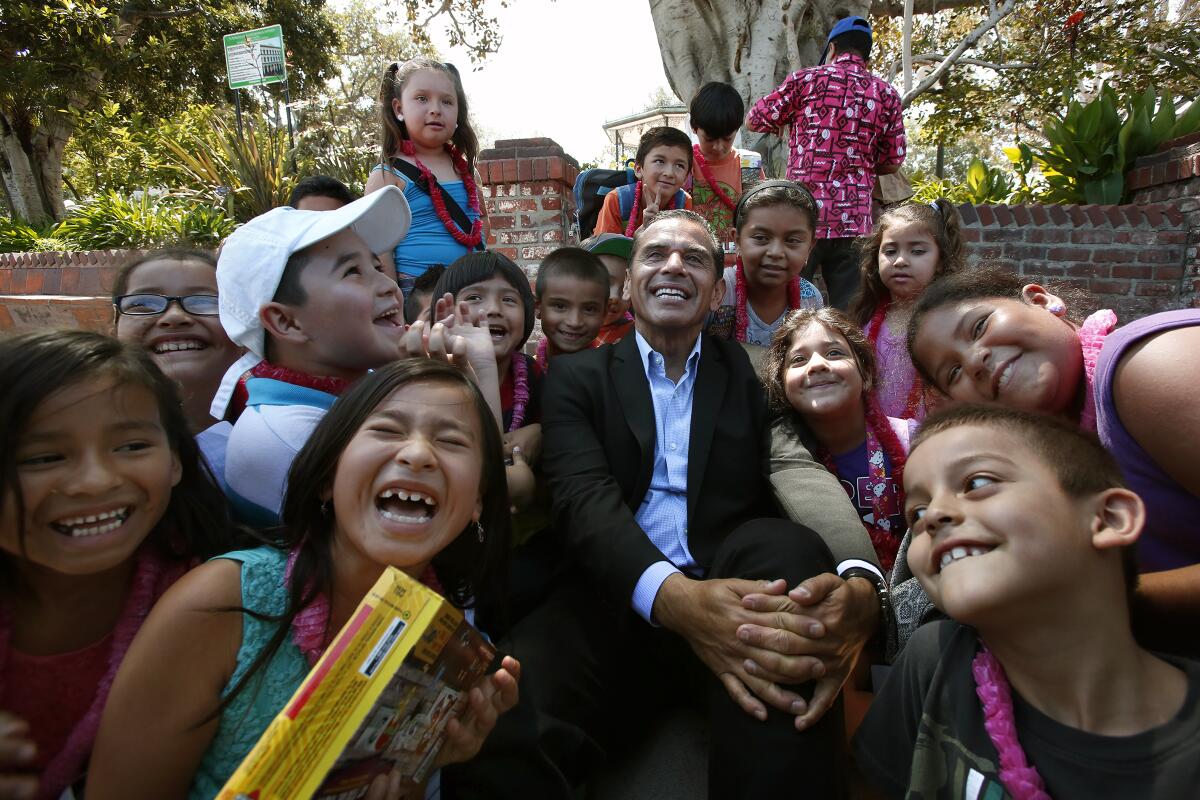
Antonio Villaraigosa gets his photo taken with students from Hazeltine Avenue Elementary School while visiting Placita Olvera in 2013.
(Irfan Khan / Los Angeles Times)
Recent polls show Villaraigosa, 73, wallowing at the bottom of the field, though none of the major Democratic candidates have an overwhelming edge.
Villaraigosa also ran for governor in 2018, coming in third in the primary election behind Democratic rival Gavin Newsom, who went on to win and is now serving his second term, and little-known Republican businessman John Cox.
Political strategist Mike Madrid, who worked for Villaraigosa on that campaign, said the former mayor’s absence from politics in recent years is a major liability in this race.
“He’s a dogged, determined candidate,” Madrid said. “But there are pretty stiff headwinds.”
Villaraigosa got a boost last week when the State Building and Construction Trades Council of California pledged $1 million to an outside committee supporting him.
His allies argue voters aren’t paying attention to the governor’s race because eyes are on President Trump, immigration raids and the Iran war.
But the new funding is a pittance compared to some of his rivals. Billionaire Tom Steyer is tapping tens of millions of his own money to pump out ads. Tech companies and billionaire Rick Caruso are supporting Matt Mahan, the mayor of San José, with millions.
Another contender, Rep. Eric Swalwell (D-Dublin), has the power of incumbency. Swalwell launched his campaign on “Jimmy Kimmel Live!” and is a regular on cable news shows, while former Orange County Rep. Katie Porter, who is also running, recently served in Congress and campaigned for the U.S. Senate two years ago.
With the June primary looming, Villaraigosa’s campaign risks sputtering out.
Angeleno Celine Mares holds a copy of Newsweek featuring newly elected Los Angeles Mayor Antonio Villaraigosa as he is sworn into office on the steps of City Hall July 1, 2005.
(David McNew / Getty Images)
Leaving a Compton church earlier this month, he reacted to Mahan’s support from technology companies, and the billionaire money in the race.
“When you have overwhelming sums of money influencing elections, there’s a great deal of concern for those of us who care about our democracy,” said Villaraigosa. “As much as they say it’s about free speech, it actually drowns out speech.”
(During his 2018 bid for governor, though, Villaraigosa was a major beneficiary of Californians using their wealth to wield political influence. Charter school backers, including Netflix co-founder Reed Hastings and philanthropist Eli Broad, spent around $23 million on efforts to boost his campaign. )
Earlier in the morning, he rallied runners at a 10K road race in L.A.’s Chinatown, lighting firecrackers, posing for photos and looking as energetic as when he was mayor and would dart into the street to personally fill potholes.
Villaraigosa flitted around the racers’ VIP tent, spotted a bowl of fortune cookies and made a beeline. “You have an active mind and a keen imagination,” he read aloud.
“Antonio V.!” a middle-aged man called out as the former mayor passed.
Minutes later, Villaraigosa swapped his black and white Veja sneakers and jeans for dress shoes and a suit for the church service in Compton, at which an overwhelmingly Black audience gave him a warm reception.
Building a coalition of Black and Latino voters helped him win the 2005 L.A. mayor’s race in a dramatic upset of then-Mayor Jim Hahn, and brought wide attention to the one-time high school dropout, who was raised by a single mother on Los Angeles’ eastside.
Newsweek magazine featured Villaraigosa on its cover with the headline, “Latino Power: L.A.’s New Mayor and How Hispanics will change American Politics.”
But national acclaim can be fleeting. Today, voters aren’t as interested in identity-based politics, said Fernando Guerra, a professor of political science at Loyola Marymount University who has known Villaraigosa for decades.
Guerra said Villaraigosa is struggling to differentiate himself in the race because his pitch to voters is not unlike the moderate path taken by Mahan. Another contender, former Health and Human Services Secretary Xavier Becerra, overlaps with Villaraigosa when it comes to biographical details: Both are from the L.A. area, Latino and relatively close in age.
“What’s made it so difficult is that [Villaraigosa said], ‘Here’s my path,’” said Guerra. “Well, guess what, there are one to two more candidates who are also on that path.”
Strategist Madrid questioned whether voters even want to hear about a candidate’s experience at a time when anti-Trump messages rally Californians. “They want a fighter,” he said.
Since leaving the mayor’s office, Villaraigosa has enjoyed success in the lucrative private sector. He purchased a $3.3 million home in the L.A. neighborhood of Beverly Hills Post Office in 2020. . A recent campaign filing shows he’s spent the last few years advising companies including the health company AltaMed, financial lender Change Company and crypto currency exchange Coinbase Global.
Then mayor Antonio Villaraigosa holds a news conference at the Department of Water and Power on Hope Street July 22, 2005, urging all of Los Angeles to conserve energy in an effort to ensure Southern California avoids blackouts.
(Ken Hively / Los Angeles Times)
He also worked for a few years for consulting firm Actum and briefly advised the Newsom administration on infrastructure projects.
“It’s not that I didn’t like the public sector,” said Villaraigosa, explaining his decision to run again. As he talked about his desire to serve, he cast a gauzy image of the aughts in Los Angeles, taking credit for the downtown resurgence, skyline full of construction cranes and fewer homeless people on the streets during that period.
“Most people look back on those years and say they were some of the best years we’ve had in the last 25 — at least,” said Villaraigosa.
Stuart Waldman, president of the business group Valley Industry and Commerce Assn., argues Villaraigosa’s experience in the private sector and distance from elected office is a good thing.
“Look at what the economy was like, look at what the city was like” under Villaraigosa, said Waldman. “That’s what he’s going to be judged on.”
Villaraigosa started his career working for labor and civil rights groups before entering politics. Elected to the state Assembly in 1994, he pushed legislation that banned assault weapons and created healthcare coverage for children. His outgoing personality established him as a coveted fundraiser for Democrats in Sacramento and paved the way for him to be chosen as Assembly speaker.
As L.A. mayor, he brought down gang crime through a program that used former gang members to broker truces. Voters backed his ballot measure to expand L.A.’s transit system through new sales tax money in the middle of the Great Recession. He drove down pension costs after a bruising battle with city unions. At the same time, he established himself as a national leader on climate issues and education.
His reputation took a hit after an affair with a television reporter led to the breakup of his marriage.
The media scene that covered Villaraigosa back then is vastly diminished, with young people now getting news from TikTok videos, message boards or Instagram posts.
Weighing in on recent TV news layoffs in Los Angeles, Villaraigosa called himself “lucky” that there were plenty of newspaper and television reporters covering him as mayor, recalling that he’d get a dozen cameras to his press conferences.
Asked to compare his 2018 campaign for governor with this one, he said, “I didn’t have to reintroduce myself last time in quite the way I’ve had to this time.”
Villaraigosa spent a significant time in Mexico in recent years to see his now ex-wife Patricia Govea, a clothing designer. “She was in Mexico 80% of the time, the last six years. So I` went to Mexico a lot.” The pair’s divorce was finalized last year.
During a debate in front of Jewish voters on L.A.’s westside last month, Villaraigosa appeared to seize on the fact that he was the sole Angeleno on the stage, introducing himself by saying, “It’s good to be home.”
He told the crowd about his work as president of the American Civil Liberties Union of Southern California and criticized UCLA — his alma matter — for its handling of incidents targeting Jewish students on its campus.
It remains to be seen if he’ll have a hometown advantage. In the 2018 race for governor, Newsom won more votes than Villaraigosa in Los Angeles County. While Villaraigosa did well in Latino communities in central L.A. and on the Eastside, Newsom captured more votes in wealthier, whiter areas.
But at the Compton church, a security guard approached Villaraigosa and told him she’d worked on his 2005 campaign, while others promised to vote for him.
“I know he has a track record,” said Valerie Bland, a 63-year-old former port worker from Long Beach, as she watched Villaraigosa work the pews. “I haven’t even looked at anyone else.”
Former Assembly speaker Fabian Núñez, a longtime friend of Villaraigosa and managing partner at Actum, hopes voters dig into Villaraigosa’s record.
“We have short-term memories in this country,” said Núñez.
BROOKS Nader has stripped off into a daring bubble outfit with her reality show star sisters after landing a part in the Baywatch reboot.
The family show, Love Thy Nader, follows the four Louisiana sisters as they trade their small-town roots for high fashion, high drama, and the hustle of New York City.
Sign up for the Showbiz newsletter
Thank you!
Brooks Nader was seen in an incredibly sexy bubble outfitCredit: GettyBrooks and her sister’s Mary, Grace and Sarah looked stunning in the barely-there ensemblesCredit: GettyThe stunning model posed for the camera as she was spotted in New YorkCredit: Getty
Brooks, Mary Holland, Grace Ann and Sarah Jane have now been snapped wearing incredibly sexy bubble ensembles.
Holding hands, they walked the streets of New York flashing their sensational abs.
The barely-there bubbles left little to the imagination as the telly stars smiled for the camera.
Blonde bombshell Brooks put on a leggy display as she twirled around nearly flashing her bum.
This comes as the star has been announced as the latest actress to join the cast of Fox’s Baywatch reboot.
The Sport Illustrated model has already been compared to the original show’s standout Pamela Anderson.
Hulu star Brooks is joining the cast alongside Suits LA star Stephen Amell.
Brooks and her sisters flashed their sensational figures in the tiny bubble outfitsCredit: Getty
Stunning Brooks will play Selene, captain of the Zuma Beach lifeguards, who regularly butts heads with Stephen’s character, Hobie Buchannon, the son of Mitch, played byDavid Hasselhoffin the original series.
Selene and Mitch are set to clash over their drastically different approaches to the job.
Fans have gone crazy over Brooks casting as she becomes one of the latest stars destined to put on the famous red swimsuit.
They have likened the Love Thy Nader star to blonde beauty Pamela Anderson, given their similar career paths.
“So, they want Brooks to be the next Pamela Anderson but there’s only one Pam,” one Instagram user said about the casting.
Brooks, who has just been announced as the latest actress to join the Baywatch reboot, gave the camera a sultry lookCredit: Getty
For years, Magaluf has been a go-to party resort for Brits seeking fun in the sun. But a darker side to the tourist spot has emerged, with reports of spiked drinks, sexual assaults, and rape
09:03, 11 Mar 2026Updated 09:09, 11 Mar 2026
Magaluf has long been a party destination for Brits(Image: AFP via Getty Images)
With the promise of sun, sand, booze, and parties, Magaluf is a major party resort – but beneath it hides a dark underbelly. Popular amongst a younger demographic, it’s been seen to epitomise a typical ‘lads holiday’ or girls’ trip abroad, with tens of thousands of British 18 to 30-year-olds flocking there each summer.
Dubbed ‘Shagaluf’, alcohol-sodden tourists descend on the ‘strip’ in their droves, lured through the promise of cheap accommodation, cheap booze, and no-strings sex. However, it hides a seedier scene where vulnerable young girls are being exploited – duped into drinking too much and pressured into sex acts.
In 2014, viral mobile phone footage showed a British 18-year-old giving oral sex to 24 men on a Carnage Magaluf pub crawl, egged on by a DJ who called her a ‘slag’. The ‘prize’ was a free drink. In the horrifying video obtained by our newspaper, the vile music host is seen shouting: “This is Carnage and this is what we do” as a no-holds-barred sex act takes place in the middle of a bar. When the girl appears to stop, the DJ – who has a Geordie accent – bellows: “You little sl*g, stop f****** about. This is Carnage and this is what we do. We need to see someone get b*nged here don’t we? Who wants to see someone get sh**ged?”
And this week, eight men were jailed after a British teenager was filmed being gang-raped at a hotel in Magaluf. The accused, seven French nationals and one man from Sweden, subjected the 18-year-old to a sickening attack in at the BH Mallorca Resort on August 14, 2023.
The men agreed to plead guilty in exchange for reduced sentences. The five rapists accepted jail terms of nine to 11 years for sexual assault, with three receiving higher prison sentences because they repeated their crimes. The three men who didn’t take part in the sex attack but filmed it were handed prison sentences of two years and three months.
Reports at the time said three of the suspects had met the girl hours earlier while partying in Magaluf. After sexually attacking her, one went out into the hotel corridor to encourage strangers returning from their own night out to have ‘free sex’ with her.
“There, the accused men, during approximately half an hour, aware of the semi-conscious state the young woman was in and at one point seeing she had fallen in a state of unconsciousness, and taking advantage of the closed room she had been taken into, stripped her naked leaving her with only her bra on,” a 14-page indictment laying out the public prosecution case read.
“They then carried out different sexual acts on her, acting by common consent and without her consent.” The indictment further detailed how the woman had been raped, spat on, and “hit and smacked”.
“The accused men, each one with a mobile phone, throughout the actions previously described, recorded several videos focusing on the young woman’s private parts in which they appeared forcing her to to carry out sexual acts,” it added. One of the suspects was accused of filming 14 videos lasting 170 seconds, and another of filming five videos lasting 142 seconds.
Sadly, it’s not an unusual story. The dark underbelly of Magaluf was explored in the 2024 Channel 4 documentary Magaluf Undercover: Predators and Parties. It followed journalists Ellie Flynn and Emily Birtley as they went undercover for three nights, posing as drunk or vulnerable tourists to expose the predatory behaviour on the strip, in clubs, and on the beach.
In one instance, footage saw Ellie pretend to be drunk and slump on a sun lounger before being approached by two men. One asks: “Are you good? Do you want to talk for a little bit?” When she replies, “I’m good”, he continues to bombard her, saying: “You are my last chance, do you want to kiss a little bit?”
Ellie tells him “No”, and secret cameras, hidden around the lounger, show the man walking away. But instead of leaving, he goes to recruit another man. “She’s completely wasted,” he tells him in Spanish, before calling out “Let’s go for it.” A third man then moves in beside Ellie on the sun lounger saying: “If you want, I can keep you company.”
Reflecting on the encounter, Ellie said: “The arrival of the third male startled and genuinely scared me. I had seen the first two together, but the sudden appearance of another – and having no idea at the time if they were together – was enough for me to signal security to get me out.
“I leave the beach upset and frightened, feeling like I’ve experienced an orchestrated attempt to target drunk women alone on a night out in Magaluf. Shockingly, this was not an isolated incident, but a pattern that emerged across my three nights in the resort town.”
Another young woman, meanwhile, said she ended up alone on the beach after her drink was spiked. “I just started to feel worse and worse. I could barely speak, I could barely walk,” she said.
We spoke to Ellie about the latest arrest of the eight men – and the dangers that women can face abroad. She told the Mirror: “It’s just so horrifying, isn’t it? I guess first impressions are just, I’m so, so sorry for that girl, what she’s been through.
“I think having been on these holidays when I was younger myself – I went to Magaluf when I was younger – and similar places, I think I really understand some of the problematic culture there.
“I think that these holidays, unfortunately, can create a breeding ground for this kind of behaviour, because you have young people who are particularly vulnerable, perhaps away from home for the first time, with their friends, trying to have a good time, drinking, trying to party.
“And unfortunately, there are predatory people there who are looking to take advantage of those vulnerabilities. I think what’s so shocking about this case [is that] it’s not even the first or the only one of these kind of horrific group rapes. It says so much, I think, about this toxic culture that eight people got involved with that.”
Dr Charlotte Proudman, a barrister and academic who specialises in women’s rights, echoes these concerns, and believes the problem has been fuelled by the so-called ‘manosphere’ – an online space that often champions masculinity to the extreme. The online space includes content creators with huge followings, such as HS Tikky Tokky, who promote the ideals of masculinity – and even misogyny – via YouTube videos and podcasts.
“What we are seeing in places like Magaluf is the collision of toxic online misogyny with a holiday culture of excess, where alcohol, group dynamics and anonymity embolden some men to act with shocking entitlement towards women’s bodies,” she tells The Mirror.
“The influence of the ‘manosphere’ has normalised the dehumanisation of women and the idea that sexual aggression is a form of male bonding or status,” Dr Proudman explains. “The fact that some perpetrators even film these attacks is profoundly disturbing; it shows that for some men, sexual violence is not only committed but performed for an audience for entertainment.
“This is not about lowered inhibitions on holiday, it is about a culture that still allows misogyny and sexual violence to be trivialised, excused and, in some cases, celebrated.”
Indeed, an independent survey undertaken as part of the documentary exposed disturbing levels of predatory behaviour and sexual abuse – primarily toward women – on party holidays. The survey, which asked over 500 men and women aged 18 to 35 about their experience on party holidays, revealed:
Almost of quarter of those surveyed said they’d experienced sexual assault with almost 1 in 10 women reporting experience of a sex act – including rape – without consent
Nearly 35 percent of women reported unwanted sexual touching whilst on a party holiday
1 in 5 of the men surveyed admitting to touching a stranger in an intimate area without their consent
More than 30 percent of the men surveyed admitted they had kissed someone without their consent during a night out on holiday
Nearly a quarter of men believed that someone dancing or standing alone indicated they were looking for a sexual partner
33 percent of the women reported they had been followed whilst on holiday
Nearly 40 percent of women surveyed felt that they had been taken advantage of whilst being alone on a party holiday
More than 1 in 4 of the men believed that someone chatting to them on a night out meant that person wanted to be sexually intimate with them
In an effort to take control back on the streets of Magaluf, the government passed a new law in January 2020 to target “tourism of excesses and for the improvement of quality in tourist zones”.
At the time of the approval of the decree, Balearic tourism minister Iago Negueruela stated that it represented “one more commitment to a sustainable tourism of quality” and that it was part of “the fight against anti-social behaviour caused by excessive consumption of alcohol”.
Key rules include a six-drink limit per day for all-inclusive guests, a ban on shop alcohol sales between 9:30 PM and 8 AM, and prohibitions on pub crawls. There are also fines for being topless and naked in public, and the police presence has increased.
Ellie added that “it’s really hard to imagine and it’s horrifying” that one of the men went into the corridor and offered ‘free sex’ with the teenager, saying: “It’s almost difficult to um comprehend that anybody would respond to that in any way other than calling the police.
“I think it’s really symptomatic of how dangerous these holidays or these kind of environments can be, not just for women but you know mostly for young women.
“What I find the most shocking about it is the fact that they were, it’s such a bleak fact that this group of men who did not know each other, thought that this was something they would get involved in and I think that it shows how pervasive this kind of this culture of abuse of women is because you know in that environment people were willing to get involved in the most horrific crime.
“There’s something about these holidays, I think, where hedonism and abuse, the lines become so blurred and I think that people kind of go in with these attitudes of wanting to have sex, wanting to meet people, and unfortunately what we see in a society where, like, women are systematically abused and often used for kind of male gratification is this blurring of lines between sort of hedonism and trying to have fun and then really really serious abuse.”
When making her own documentary and surveying holidaymakers, Ellie noted, “a huge percentage of the men that we surveyed thought that someone standing near you was an indication that they might be interested in sex”. She added, “it was so shocking and I think there is this assumption that if you are on these holidays, if you’re out with your friends having a good time, having a drink that somehow that that makes you you know constantly available for sex – you know even if you’re unconscious”. Een if someone is “showing no signs at all that is what you want, there are people out there who will take advantage of the fact that you that you were just there”.
She added, “That was what really shocked me about the documentary,” pointing out that some people responded to the documentary in bizarre ways, “there were people who were replying to me on Instagram who were like, ‘Well you know, why would you go somewhere like Magaluf if you weren’t prepared to experience something like that?’ And I think it shows that we have such a long way to go in terms of actually stopping Violence against women and girls.”
Discussing the algorithmic silos that see totally different conversations about gender, sexual violence, and abuse taking place at once, Ellie said: “We’ve never seen a further divide between young men and young women and their views and their experiences.
“And there was a period in time where I think it felt like things were moving in the right direction. You know, we were taking women seriously, and we were listening to their stories and we were, saying all the right things to try and combat violence against women and girls and stop this kind of insidious abuse, but you know at the same time you have the rise of, you know, certain influencers and the manosphere and this kind of narrative that young boys are isolated and don’t know how to treat girls and are scared of kind of making any approaches, and and we have these kind of two conversations happening simultaneously and taking people down in completely different directions and I think that is where things are now particularly concerning.”
She added that “on one side you have young men,” hearing one message and “almost being justified in some cases in the abuse of women and in this mistreatment of women and in degrading women, because there are people, there are high profile figures, who have made them feel like it’s okay to do that.”
Ellie continued, “It’s clear that we need to be having conversations that include both sides of this argument.” She adds, “I have two sons and I don’t want them to grow up feeling like they are inherently bad because they are male, that’s not true, and I think that somewhere along the way that’s a narrative that some young boys have learned to believe, and so things have gone wrong in a sense that things have gone that way, but also ignoring the very real epidemic of violence against women and girls and highlighting those issues isn’t the answer. We should be able to do both at the same time.”
Saudi Arabia’s fixation with megaprojects may be giving way to more pragmatic initiatives better aligned with investor appetite.
The urgent need for foreign investment crystallized last month when a royal decree replaced veteran cabinet member and investment minister Khalid Al-Falih amid broader funding concerns over the kingdom’s signature Vision 2030 development framework.
Foreign investment amounted to just 2.1% of GDP last year, according to Capital Economics. That’s well below the government’s Vision 2030 target. The research firm also forecasts government debt will balloon to 40% of GDP next year. That’s up from just over 30% last year and above consensus.
Vision 2030, which now appears to be under review, represents Crown Prince Mohammed bin Salman’s blueprint for diversifying an economy still heavily reliant on hydrocarbon revenues.
Replacing Al-Falih is Fahad Al-Saif, sometimes also referred to as Fahad bin Abduljalil Al-Saif, a former HSBC banker.
Until his appointment, Al-Saif held various positions at the Public Investment Fund (PIF), Saudi Arabia’s $1.15 trillion flagship sovereign wealth fund. He was also instrumental in overhauling the kingdom’s capital-raising capabilities. Earlier, he played a role in roadshows aimed at mustering investor support for Saudi bond sales.
But the government’s recent signaling suggests Al-Saif will preside over a period of relative austerity while attempting to maintain investor support for a rolling set of reforms. His stewardship is likely to face an early test as policymakers’ attention is focusing on future foreign investment initiatives.
Recent reports imply that the government will soon announce a streamlined set of priorities and a pivot away from nosebleed-inducing megaprojects such as The Line, a 170-kilometer, multibillion-dollar planned smart city that makes up a segment of the ambitious Neom development.
Posts on social media have broadly welcomed Al-Saif’s appointment, variously describing him as a safe pair of hands fit to carry out a shift towards more mundane revenue-generating projects.
REALITY TV star Paul Preece Jr who won the Netflix survival show Outlast has been charged with raping a child.
The 51-year-old was arrested in Tennessee on Friday and booked into Knox County Jail.
Sign up for the Showbiz newsletter
Thank you!
Paul Preece Jr, winner of Netflix show Outlast, has been charged with child rapeCredit: NetflixJail records show Preece is being held on a $150,000 bondCredit: JIMS
Jail records show Preece has also been charged with aggravated sexual battery and attempted rape of a child, The Daily Mail reports.
The age of the victim has not yet been released.
Preece is currently being held on a $150,000 bond and will be required to wear a GPS tracker upon release.
His arrest comes after a capias warrant was issued, according to TMZ.
The court-ordered warrant is typically used when a person fails to appear in court, violates bond conditions, or neglects to pay court-ordered fines or child support.
Preece rose to prominence after competing on the first season of Outlast in 2023.
The gruelling reality show sees a group of contestants trying to survive remote Alaskan terrain in punishing conditions for a chance at a $1 million prize.
Sixteen participants are dropped by parachute into the wilderness before being divided into teams.
Most read in Entertainment
Season one was filmed on the Neka River on Chichagof Island, while series two moved south of Petersburg to Little Duncan Bay.
Unlike many competition shows, contestants cannot compete alone.
Participants are allowed to switch teams throughout the competition.
The only way to leave the game is to quit.
Preece won the inaugural season alongside teammates Seth Lueker and Nick Radner.
Season two landed in the Global Top 10 in 22 countries.
Two Texas men, Drake Vliem II and Drew Haas, won the million-dollar pay-out in the second series.
The series was renewed for a third season in February 2025.
Preece won the first series of Outlast – bagging $1 million with his teammatesCredit: Netflix