Ramans

Raman’s victory was a resounding rebuke to L.A.’s Latino political establishment

When Angelenos chose Nithya Raman as their next mayor, Karen Bass wasn’t the only establishment pillar that was resoundingly rebuked.

Here in the country’s Latino capital, the metropolis that delivered California its first Latino U.S. senator and pioneered the type of winning political machine that Latinos across the country replicated for decades, almost all the city’s Latino power brokers — politicians, nonprofit leaders, union activists, celebrities — bet big on longtime ally Bass, only to now find themselves on the outside looking in.

All that might and hype delivered worse than nada for Bass, who finished first in the June primary thanks in part to Latino support, winning 35 Latino-majority neighborhoods compared with just seven for Raman. The reverse happened in last week’s general election, with Raman winning many of the city’s key Latino neighborhoods — South L.A. to the Eastside, Pico-Union to Wilmington — according to a Times analysis of precinct data.

It was a fitting dénouement to Mayor Bass’ one term in office, and the capstone of a terrible four-year run for L.A.’s Latino political establishment, beginning with the leak of a profane, racist conversation that disgraced four top politicos.

Bass should have run as far away as possible from our caudillos y caudillas. But she just couldn’t quit them. Take an Oct. 24 lunchtime rally at Plaza Del Valle in Panorama City, the nexus for the fabled San Fernando Valley Latino political machine.

Volunteers handed out “Latinos Con Bass” signs to customers and store owners. An all-star roster of elected officials — City Councilmembers Monica Rodriguez and Imelda Padilla, Assemblymember Celeste Rodriguez (no relation to Monica) and Rep. Luz Rivas — gathered in a community room to make the case that Bass was the best choice.

“You have tías and cousins and primos that call you, ‘Who should I vote for? What do I do? How do I fill out the ballot?’” Rivas told a crowd of about 60, most of whom were not Latino. “You need to remind them Mayor Karen Bass is the right leader.”

“This is where we win elections,” Rodriguez asserted, describing the mayor — whom she bitterly opposed until fellow Councilmember Raman entered the race — as a “Valley girl” and the election as “our moment.”

The enthusiasm level struggled to exceed that of a line at the DMV. Half an hour later and a few miles east in Sylmar, a very different scene was unfolding.

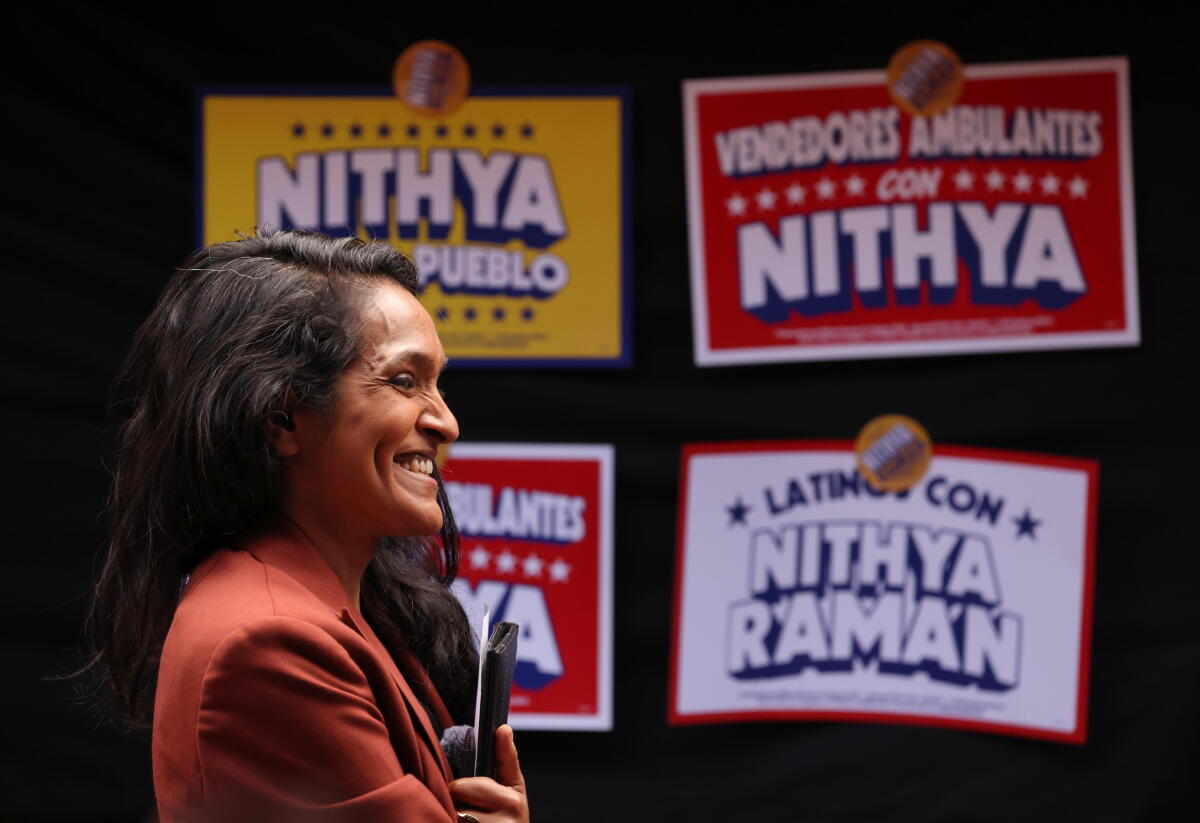
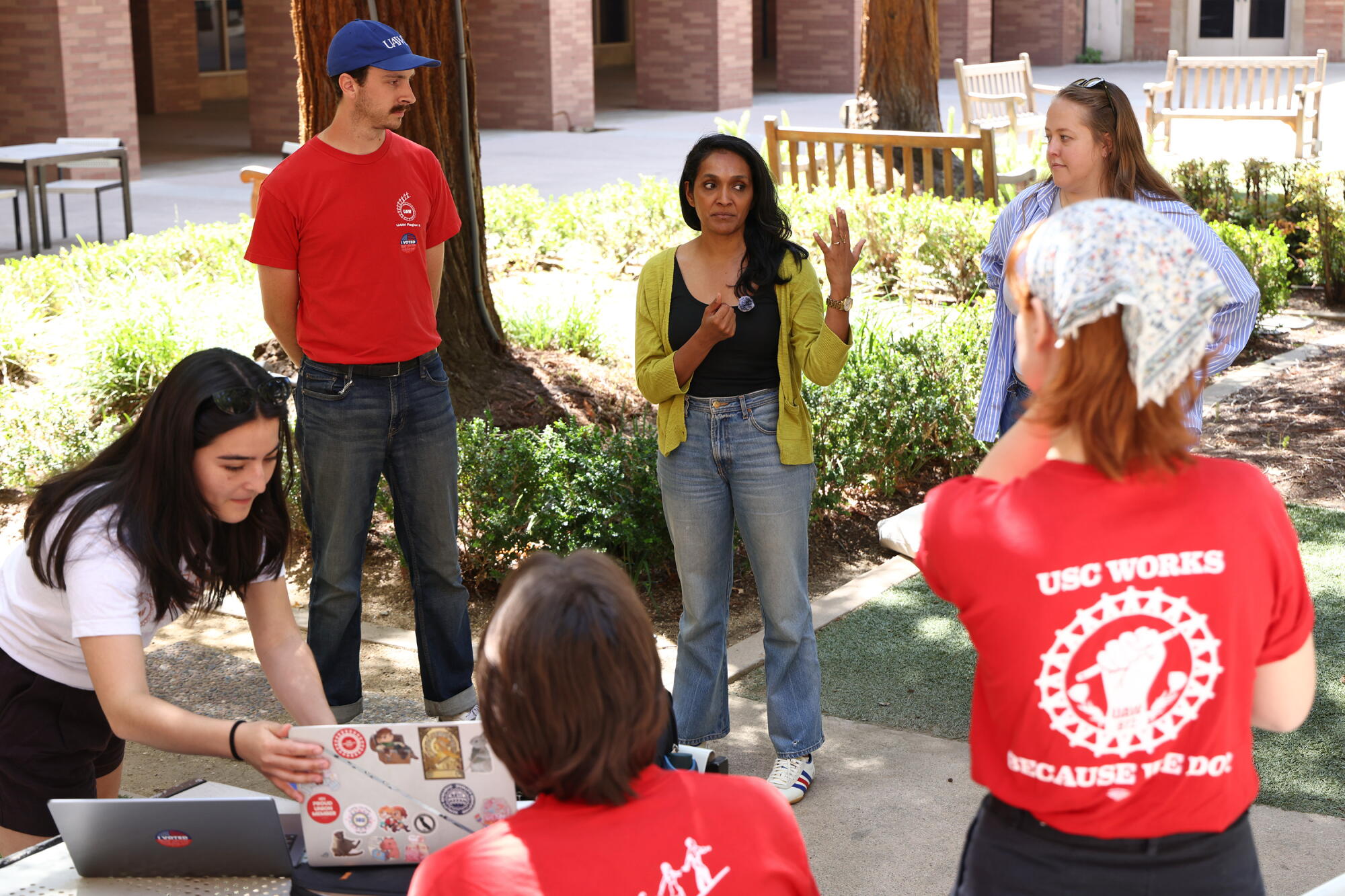
DJ Danny Guerrero blasted quinceañera classics like “Vivir mi Vida” and “Come On Let’s Go” by Pacoima native Ritchie Valens as Raman’s team hosted a canvasada — free tacos for everyone to fuel an afternoon of canvassing. L.A. Unified school board member Kelly Gonez was the only elected official at the Carpenters Local 818 training center. The others were union members, Latino hipsters or kids too young to vote.

“Her passion to protect our community — that compassion resonated with me,” said Guerrero, a 21-year-old Cal State Northridge political science major who helps undocumented college students at his school’s Dream Center. “I advocate for that in my life, and I see Nithya doing that. She meets us where we’re at.”

Guerrero cheered as Raman kicked off her remarks with an “¡Hola, Sylmar!,” pronouncing the “y” like an “i” the way a Spanish speaker would. The candidate shouted out Latino Valley icons like Lenchita’s, Tia Chucha’s Centro Cultural and even Plaza Del Valle. But she received the biggest cheers when she said, “La communidad latina merece más.”

Latinos deserve more.

In the end, Raman captured most of the precincts in Padilla’s and Rodriguez’s districts even after the two council members whacked away at her through the election like brats hogging the piñata stick at a birthday party.

Without institutional support, Raman focused on a new generation of Latino leaders who are not part of the traditional political machines.

“Maybe they [Latino establishment leaders] felt obligated to back her,” Rocío Rivas said of Bass. The L.A. Unified school board member and democratic socialist endorsed Raman and attended her election night party at the Greek Theatre, where a crowd of hundreds chanted, “Sí se puede.”

“Or maybe they’re not as connected to the community as they once were,” Rivas added.

The trouble for the establishment started in 2022 when three City Council members and a powerful union leader became pariahs after starring in the audio leak scandal. That same year, democratic socialist upstarts Hugo Soto-Martínez and Eunisses Hernandez won City Council seats, despite a lack of support from Chicanosauruses who mocked their chances.

In January 2024, former City Councilmember Jose Huizar — once a rising star with aspirations for higher office — was sentenced to 13 years in prison after pleading guilty to corruption charges. In the fall of that year, Eastside Assembly and City Council seats held by Latinos for decades went to Filipina Americans Jessica Caloza and Ysabel Jurado. Meanwhile, former Mayor Antonio Villaraigosa’s campaign for governor sputtered out with just 1% of the vote.

In the race to succeed Nury Martinez, who resigned from the City Council after the audio leak, Padilla won with backing from the Valley Latino political machine.

Marco Santana lost to Padilla in the primary. despite an endorsement from Raman, and supported Raman’s mayoral campaign.

“The mayor ran on a very institutional playbook of getting a bunch of Latino politicians together so they could tell Latinos how to vote,” said Santana, 36. “That doesn’t work anymore. Latinos want deeds.”

Instead, outdated ideas were all Bass had.

It started with her choice of chief campaign strategist: Julie Chavez Rodriguez, who was campaign manager for President Biden’s disastrous 2024 reelection bid and then Kamala Harris’ failed attempt to pick up the pieces. I quickly tuned out the one time Chavez Rodriguez described her vision for Latino outreach, which would have been revolutionary in L.A. two generations ago.

While Bass’ campaign mounted a vigorous media outreach effort in English and Spanish, her own attempts to court Latino voters kept backfiring. The crowd at the annual City Hall Mexican Independence Day celebration booed when Padilla, in a green outfit that matched Bass’, hailed the mayor as “good.”

At Homegirl Cafe in Chinatown the morning before the election, customers largely ignored Bass while swarming gubernatorial candidate Xavier Becerra. She stood next to Becerra at the restaurant, only to have him later clarify to reporters that he wasn’t endorsing anyone in the mayor’s race.

Michael Trujillo is a longtime political consultant who served as an unpaid advisor to a pro-Bass independent expenditure committee and has participated in the rise and struggles of the Eastside and San Fernando Valley machines.

“It’s going to take a long time” for L.A.’s Latino political establishment “to be reconstructed, and that’s ironic when you have Latinos in charge in Sacramento now,” he said. But he predicted that Raman would bear her former opponents no ill will, because “they’re going to give her a fair shot” — because what else can they do?

The Raman era will undoubtedly boost a new generation of Latino leaders. But establishments don’t fade away so easily — and insurgents don’t automatically shun them.

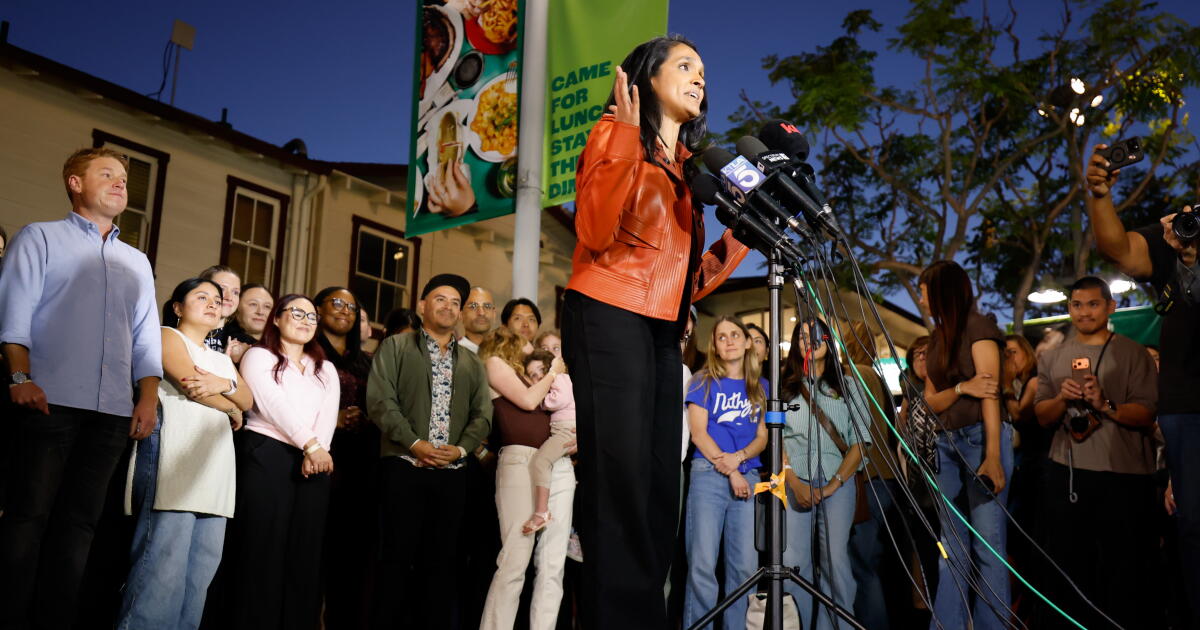
On Saturday, Raman attended a news conference to condemn the arrests of two people by federal immigration agents during an anti-ICE protest outside Adventist Health White Memorial Center. The mayor-elect shook the hands of state Sen. Maria Elena Durazo, SEIU California President David Huerta and Angelica Salas, executive director of the Coalition for Humane Immigrant Rights of Los Angeles, all of whom endorsed Bass and recorded social media videos in support of the incumbent.

When it was Raman’s turn to speak, she led the crowd in chants of “ICE out of Boyle Heights” and praised Huerta, Durazo and Salas. Raman concluded by promising Angelenos in Spanish that she would “defend” immigrants.

And then L.A.’s Latino political establishment did the only thing they could: They applauded.
Source link

Inside Nithya Raman’s improbable campaign for L.A. mayor

The first volunteers gathered in the back house of Nithya Raman’s Silver Lake home with little besides a whiteboard counting down the number of days until the June 2 primary election.

Raman had jumped into the Los Angeles mayor’s race the day before, right at the Feb. 7 filing deadline. Her campaign didn’t have an office, a bank account, a campaign treasurer, or even a proper website.

It lacked, put simply, “the most basic things,” said Ian Manheimer, Raman’s campaign manager, who joined the team after a 10 p.m. call from Raman the night before the filing deadline. There would be a meeting the next day in Raman’s backyard accessory dwelling unit to get things rolling.

“For anyone who suspected Nithya had designs on this for a long time, you could just come to the ADU and that would dispel those notions,” Manheimer said.

Those unassuming beginnings in Raman’s backyard, with her parents and her husband’s parents taking turns cooking vegetarian Indian lunches for the small staff, evolved into a disciplined campaign that overcame initial struggles to unseat incumbent Mayor Karen Bass, a veteran politician who had racked up endorsements from most of L.A.’s traditional power brokers.

Nithya Raman at a phone bank event at UCLA.

Nithya Raman speaks at a campaign phone bank event at UCLA on May 31.

(Jonathan Alcorn/For The Times)

Raman did it on a hyper-abbreviated timeline by turning out and expanding her base of younger renters, pitching herself successfully to Latino voters, securing late but key endorsements from groups and officials that gave massive support to her campaign’s ground game and by running on a hopeful message about restoring city services against a deeply unpopular mayor.

From the moment she got into the race, there was an evident, yet narrow lane for the progressive, second-term council member to rise to the city’s highest office, but it was far from clear that she would be able to make it through.

For much of the primary, Raman and her campaign were all alone. She had few endorsements, and almost none from elected officials.

Because of her late entry into the race and some past disagreements, she failed to secure the backing of the Los Angeles chapter of the Democratic Socialists of America for the June 2 primary, even though the left-wing organization endorsed her in both of her council campaigns. Raman got almost no supportive outside spending in the primary, while millions of dollars were spent opposing her.

But Raman had made a name for herself on the City Council as an advocate for tenant rights, and her campaign focused on turning out L.A.’s legions of renters to secure enough of the vote to make the runoff.

She was still a largely unknown entity early on in the race, with 51% of likely voters in a March poll saying they didn’t know enough about Raman to form an opinion of her.

On top of that, Raman was quickly upstaged by Spencer Pratt, the Republican former reality television personality, whose slash-and-burn campaign on social media attacking L.A.’s liberal political establishment dominated news coverage.

While Raman’s camp hadn’t initially worried too much about Pratt, thinking he and entrepreneur Adam Miller would split the more conservative vote in the city, it became clear as the primary went on that Pratt could emerge over Raman as the second candidate in the runoff.

Spencer Pratt, Karen Bass and Nithya Raman debate during the primary.

Spencer Pratt, from left, Karen Bass and Nithya Raman take part in a televised debate at the Skirball Cultural Center May 6 during the primary race.

(Jason Armond/Los Angeles Times)

To dent Pratt’s appeal, the Raman campaign worked to brand him as the MAGA Republican in the nonpartisan race, knowing it would hurt his chances in a deep-blue city like Los Angeles. They chose to try out the line at the only televised mayoral debate.

Raman didn’t miss her chance.

“This is a MAGA Republican’s idea of what Los Angeles looks like,” she said during the NBC4 debate on May 6, referring to Pratt’s sometimes dystopian depiction of L.A. “This is really not the city that I love so much.”

Though Raman’s debate performance was widely panned — and Pratt’s was praised — her team felt she had gotten the point across to Angelenos: With the unpopular Bass almost certain not to win the primary outright, the runoff could either be a contest between two progressive Democrats, or Bass versus a candidate whose views echoed those of President Trump.

That debate was a learning moment for Raman and her campaign.

“She’s up against an extremely seasoned politician and a television star. She’s just a normal person who hasn’t been on stage like that,” Manheimer said.

But defining Pratt as MAGA, the campaign believed, would pull some voters to Raman from lower-performing candidates on the left and in the middle with the hopes of keeping Pratt out of the runoff.

Raman was able to eke out a win against Pratt in the primary, getting 29% of the vote compared to his 26%, with Bass taking first place at 34%.

The sole goal of the primary for Raman’s campaign was, self-evidently, to make it out of the primary.

If her team could move on to the runoff, it would be able to reset — fundraising would restart, it could build a bigger team and it would have a longer runway to increase Raman’s name recognition and build out her base.

While Bass dominated labor and elected official endorsements throughout the race, Raman began to pick up key supporters in the runoff.

In August, the Western States Regional Council of Carpenters endorsed her, sponsoring an independent expenditure group for her called Estamos con Nithya for Mayor 2026.

That was followed by the endorsement from the union Unite Here Local 11, a major player in city politics, which represents hospitality workers at airports and in hotels.

Raman also got major endorsements in the runoff from City Controller Kenneth Mejia and L.A. County Supervisor Lindsey Horvath.

Mejia especially became a pit bull for Raman at events and on social media.

“Kenneth would call every day and say, ‘Let me know what myths I can bust today,’ ” said Tessa Wick, the communications director for Raman’s campaign.

“We didn’t have time to feel particularly lonely in the primary, but once we saw what it felt like to have all these groups and people behind us, each press conference we would do was injecting more force into this movement we were building,” Wick said.

Raman’s bid also got a serious infusion of cash from Aaron Sosnick, a hedge fund manager and bike lane advocate who poured $8 million into two independent expenditure groups to support Raman, making him the single biggest spender in the mayoral campaign.

“He is a cyclist. He just wants to not die riding the streets in L.A.,” said Michael Schneider, who runs Streets for All, a transportation advocacy group that ran one of the independent expenditure groups that Sosnick funded.

Raman also capitalized on a difficult summer for Bass, during which the mayor faced turnover on both her campaign and administration teams, unsheltered homelessness rose citywide (but crucially, went down sharply in Raman’s city council district) and a massive fire burned at a cold-storage food warehouse in Boyle Heights, sending noxious fumes into the heavily Latino, working-class neighborhood.

Mayoral candidate Nithya Raman, right, reviews notes in Spanish with Lauren Perez-Rangel.

Nithya Raman, right, reviews notes in Spanish with Lauren Perez-Rangel before an interview at Univision on Oct. 22.

(Myung J. Chun/Los Angeles Times)

“Many Latinos saw themselves in the Boyle Heights residents,” said Lauren Perez-Rangel, senior director of Latino outreach for the Raman campaign.

Bass had prevailed in more Latino neighborhoods than any other candidate in the primary. The Raman campaign worked to change that in the runoff, Perez-Rangel said, focusing especially on Latino voters. Raman brushed up on her Spanish and used it frequently at events.

The campaign also teamed up with Latino and Spanish-language content creators to spread Raman’s message of affordability, building more housing and solving the homeless crisis. The result: Raman led Bass among Latino likely voters throughout the runoff campaign, according to polls by UC Berkeley IGS and the L.A. Times.

Despite that growing support, Bass and her allies’ negative portrayal of Raman in attack ads had an effect, as Raman’s unfavorable ratings rose month by month. They framed the council member as too far left, allowing homeless encampments in front of schools and failing to show up for thousands of City Council votes.

“It was a race to define Nithya,” said Jeff Millman, an advisor and spokesperson for Raman’s campaign. “Their strategy was to tear down Nithya. Our job was to make sure that people knew Nithya’s strengths and record of success as a council member.”

As the campaign drew to a climax, Raman improved as a candidate and came off as more confident during the two runoff debates. Her team said she spent many hours improving her debate skills.

“There was no secret weapon, just a person really committed to practicing,” said Wick.

Still, she opened herself up to attacks from Bass’ side during the final debate Oct. 13, after she said the city used to be the “gold standard” of noncooperation with immigration authorities under controversial former LAPD Chief Daryl Gates. Bass hammered Raman over the remark, accusing the council member of romanticizing Gates’ tenure.

Despite that and other missteps during the closing days of the campaign, her team said it was Raman’s insistence on running a largely positive campaign about an optimistic vision of L.A.’s future that pushed her over the finish line.

“She was really dogged that it was a campaign that was hopeful, not nasty and cynical. She wanted the campaign to be a love letter to L.A.,” said Wick.

LA mayoral candidate Nithya Raman embraces her husband, Vali Chandrasekaran.

Nithya Raman embraces her husband, TV writer Vali Chandrasekaran, left, on election night at the Greek Theatre plaza.

(Robert Gauthier/Los Angeles Times)

In her election night speech, still trailing Bass by a few percentage points that she would quickly make up, Raman spoke to that vision.

She called it a vision where the people who made L.A. extraordinary could afford to live in the city and where government is responsive and takes responsibility.

“We believed that Angelenos were hungry for that city,” she said. “And it turns out that we were right.”

Source link

Could Raman’s win be a turning point for transit in Los Angeles?

Public transit is expected to be a top priority for Los Angeles Mayor-elect Nithya Raman, an advocate for expanding bus lanes and making the city friendlier for bicycles — and who campaigned on getting the Los Angeles International Airport people mover back on track after years of squabbles, delays and cost overruns.

As mayor, Raman will oversee the city’s transportation department and will have the power to appoint new members to the city’s Airport Commission. What’s more, she will have regional clout through L.A. Metro, the transportation agency that runs the county’s light-rail and subway lines.

Raman will take over as chair of Metro’s board of 13 voting members, a job now held by Mayor Karen Bass, whom Raman defeated for reelection this week. She will also get three appointees on the board, and can replace the current mayoral appointees — Councilmembers Katy Yaraslovsky and Imelda Padilla and community advocate Jaqueline Dupont-Walker — who all backed Bass in this week’s election.

Metro is currently in need of millions of dollars to fund a massive bus network for the 2028 Summer Olympics in Los Angeles. Raman said that she would push Los Angeles’ congressional delegation to make this a key priority. In a statement to The Times ahead of the election, she said she will also prioritize Metro projects that “give the most benefits to the most riders and help make our network more useful” and plans to reinstate a project team in the mayor’s office to eliminate city delays on major capital projects.

Transportation analysts believe Raman, who has a graduate degree in urban planning from MIT, will be more aggressive in addressing transit issues than Bass, whose background was in healthcare and community organizing.

“I do think we’ll see a considerable amount of action on transit and multimodal transportation in the short run on a timeline that puts this work in the context of preparation for the summer of 2028,” said Juan Matute, deputy director of UCLA’s Institute of Transportation Studies.

Los Angeles voters also approved a charter amendment that will allow the City Council to disband the Public Works Board, a move that Matute believes will allow the city to streamline infrastructure projects. The charter change, combined with Raman’s election, will lead to “a shift in the foundation of transportation decision-making,” Matute said.

Among the transportation plans Raman has cited as priorities are the Sepulveda Transit Corridor project, which was approved earlier this year to connect the Westside to the San Fernando Valley; the East San Fernando Transit Corridor project to extend service along the E Line from East Los Angeles to Whittier; expansions of the K Line, to connect multiple communities from South Bay, Inglewood, Mid-City and Hollywood, and the D Line beneath Wilshire Boulevard; a new light rail connection in southeast L.A. County; and the Vermont Transit Corridor project.

That last project to add dedicated bike lanes along Vermont Avenue between 120th Street and Sunset Boulevard recently broke ground. It is also the subject of a lawsuit under Measure HLA that claims it requires a designated bike lane. Raman said she supports compliance with the measure, while supporting shared bike and bus lanes along narrower portions of the route.

Ahead of the election, Raman told The Times via written statements that her transit priorities as mayor would focus on safety, affordability and reliability so that people did not have to be as reliant on cars. She advocated for protected bike lanes and expansion of bus lanes during her campaign.

Raman also criticized Bass and the Los Angeles World Airports board of commissioners for not staying on top of the $3.3-billion Skylink people mover at LAX, a 2.25-mile train that is supposed to whisk passengers between the terminal and ground transportation. The project is years behind schedule and more than $1 billion over budget.

The contractor, LAX Integrated Express Solutions, or LINXS, has blamed the repeated delays on unsigned agreements between the city’s Los Angeles World Airports and the Los Angeles Department of Water and Power as one cause, along with nagging technical issues.

At a news conference near the airport last week, Raman told reporters that if elected, her first-week priority in office would be to convene airport and DWP officials and the contractor to determine who is responsible for each unresolved issue in an effort to break the logjam.

“Taxpayers deserve an advocate at the negotiating table, not another bill for someone else’s failure,” Raman said.

Michael Schneider of Streets for All, an advocacy nonprofit, said he expects Raman to convene a task force to address issues around the people mover project during her first 100 days in office.

He also foresees her consolidating some departments, such as the Street Services repaving division under the city’s transportation department, and directing city departments to implement Measure HLA. It’s also likely, he said, that she will initiate a bond or a tax hike to raise money for sidewalks repairs, curb updates and other street improvements.

“I think it’s the first election where safe streets has become a campaign issue, and real money has gone behind it to try to change the status quo,” Schneider said.

Streets for All’s political action committee took out ads to elect Raman and defeat Bass, powered largely by contributions from hedge fund manager and bike lane advocate Aaron Sosnick.

Over the summer, Raman slammed Bass for pausing a bike lane and street safety improvement project near two cemeteries along Forest Lawn Drive that had come under fire by some in Raman’s district. The debate became so heated that the state Legislature ultimately intervened and set a law that would require a public hearing and approval from the City Council and the mayor’s office before moving forward.

Raman has told The Times that she supported multiple bike lane and multimodal projects including the 710 North Mobility Improvement Program along Valley Boulevard, Huntington Drive and Eastern Avenue, plans to set priority bike lanes during peak hours along Sunset Boulevard and add bike lanes and reconfigure the intersection of Virgil Avenue and Sunset and Hollywood boulevards.

It’s unclear how she will balance the push toward these types of endeavors when faced with community pushback.

Nadine Levyfield has advocated for more transparency and answers from Metro over a bus lane project through the center of Eagle Rock. The agency recently agreed to more community meetings to address ongoing concerns over how a reduction in lanes on a bottlenecked portion of Colorado Boulevard will affect traffic and parking through the area’s business district and surrounding neighborhoods. Levyfield believes the community’s asks align with Raman’s campaign.

“Running on a platform of accountability, transparency, improving efficiency, and making sure government agencies are accountable, we really hope she can help us ensure that Metro is prioritizing public safety,” Levyfield said.

Raman has said she is also committed to the city’s goal to eliminate traffic deaths and said she will treat an initiative that began under Mayor Eric Garcetti’s administration and faced significant scrutiny under Bass as a mandate.

“Angelenos look around and see faded crosswalks, busted pavement and darkened streetlights and wonder why the City can’t even take care of our basic transportation infrastructure,” Raman said in a statement to The Times before her election. “Traffic deaths are preventable and I’ll make sure we’re enforcing laws against dangerous driving, providing actual protection for people who walk and bike, and get our street lights back on and our streets fixed.”

“My priority is to make transit safe, affordable, fast, and reliable, so more Angelenos can avoid the high cost of car payments, insurance, and gas,” she said in the statement.

Source link

What Nithya Raman’s effort to learn Spanish says about her vision for L.A.

Nithya Raman slowly recited the start of her handwritten message to Angelenos.

Llegué de la India con mi madre a los seis años. Sé lo que cuesta empezar de nuevo.

I came from India with my mother when I was 6. I know what it takes to start over.

The mayoral hopeful was in the green room of Univision’s Westchester studios on Thursday, waiting for an interview with anchor Guad Venegas. He would ask each question in both English and Spanish, and Raman could respond in English.

But she hoped to do better than that.

Since the start of her campaign, Raman has sprinkled Spanglish into her speeches and sometimes offered whole sentences in softly accented, lightly stilted Spanish. It’s part of an effort to win over Latinos, nearly half the city’s population and a crucial swing vote , with less than a week to go before election day.

“Can you say the whole thing for me?” Raman asked Lauren Perez-Rangel, her Latino outreach senior director, who read the full message in effortless Spanish. Raman repeated it word for word, accent for accent, with no flubs or pauses.

“You got it!” Perez-Rangel told her boss.

“I hope,” Raman replied.

It was showtime.

Raman, who serves on the L.A. City Council, grinned when someone said “me vale madre” — I don’t give a damn — on the walk to the studio. She cracked in English, “I doubt that’s true!” when I told an Univision producer in Spanish that no one likes my work.

A cameraman proclaimed “¡Muy bien!” when Raman rattled off an “uno, dos, tres” mic check. Venegas responded in English, “It’s always like that” to Raman’s comment in Spanish that her pronunciation is better than her comprehension.

During the interview, Raman raised her eyebrows when Venegas talked about streets filled with “basura,” the word for “trash” that became an insulting pun on Bass’ name hurled by then-candidate Spencer Pratt during the primary. Raman answered questions in English even when Venegas only asked them in Spanish, fully understanding what he said. And she kept saying “sí” to acknowledge Venegas’ points, as a native speaker would.

She never got a chance to read her Spanish-language statement, but that was OK. I saw enough to know that while she isn’t going to write the next “Don Quixote,” she isn’t limited to ordering at Casa Vega.

Supporters have praised her efforts en español. Critics dismiss them as pandering. I see something more interesting at work.

Raman spoke Tamil and Malayalam in India before moving to the U.S. as a child. If she wins, she would be the first immigrant mayor since Canadian-born Frank Shaw in the 1930s. She’d also be the first mayor whose native tongue wasn’t English since Bernard Cohn, who grew up speaking German in Prussia and served as mayor for two weeks in 1878.

Having a non-native English speaker in charge of a world capital such as L.A. — and one who wants to express herself in the city’s second tongue — wouldn’t just be symbolic. A person who’s earnest about learning a language is forever trying to decipher something new, failing far more often than succeeding in the early going — yet always working to master the task.

Isn’t that what we want from any politician, especially in a city where 56% of residents live in a household that speaks a language other than English?

Los Angeles mayoral candidate and city council member Nithya Raman

Los Angeles mayoral candidate and city councilmember Nithya Raman prepares to speak at a “Latinos Con Raman” rally at La Cita Bar in downtown Los Angeles on Sept. 18.

(Genaro Molina/Los Angeles Times)

Familiarity with Spanish has become a prerequisite for L.A. mayors. Antonio Villaraigosa famously took classes to improve his assimilated Spanish. Eric Garcetti described his fluency as “good community meeting Spanish” and often delivered remarks in Spanish. Bass, who was married to a Chicano and treats her ex-husband’s children as her own, isn’t fluent but has a robust Spanish-language outreach for her campaign, complete with ads, mailers and websites.

For Raman, though, learning Spanish isn’t just a way to reach out to constituents. It’s a reminder of “what it means to grapple with a bureaucracy that wasn’t intended for you.”

We spoke outside Univision’s studios after her interview. I asked to speak about her experience with Spanish as a way to show a private side of her to Angelenos. (I had asked Bass to sit down with me and talk about food. The interview was initially scheduled, then campaign spokesperson Alex Stack said it was canceled so Bass could attend a news conference assailing Raman for saying that former LAPD Police Chief Daryl Gates was a “gold standard” in protecting immigrants. Bass’ campaign didn’t reschedule the interview and didn’t provide comment on her Spanish skills in time for publication.)

In 2022, Raman co-authored a motion that introduced live Spanish translation services at city council committee meetings. She wants the city to research whether it can provide the information that’s being lost as the Trump administration increasingly deletes Spanish-language versions of federal websites.

“You have to show them that you’re trying,” Raman told me. “And even if you go out there, and you speak broken Spanish, and you mess it up, and you don’t conjugate it properly, and you get all the endings wrong — ‘a’ versus ‘o’ — the fact that you show up and you say it, and you try it in Spanish, means something to the people that I’ve been talking to.”

Her Spanish journey began with four years of classes at a suburban Boston high school. She chose Spanish instead of French because she felt it “would be more useful for me in the world.”

Raman forgot most of it while attending Harvard and MIT but started practicing with her brother, a Spanish major at UCLA, when she moved to L.A. 13 years ago. She read bilingual books for beginners and streamed shows such asNetflix’s dark comedy “La Casa de las Flores” (“The House of Flowers”) and podcasts such as “Chill Spanish.”

Those lessons have happened “pretty regularly” since she joined the city council in 2020, Raman said, although she scaled back once the mayoral campaign intensified.

I wondered what languages are spoken in her household. Her husband, whose Tamil-speaking parents are immigrants from India, only speaks English. Her twin 10-year-olds “can kind of follow along” when she speaks to her parents in Tamil, but she is no longer fluent in Malayalam.

“I have friends like who speak a different language, and they’re, like, religious about speaking it to their children,” Raman said. While she would love for her children to learn other languages, “life is too stressful trying to make every moment of your time with your family into almost a chore.”

I asked about the pandering charge. Throwing out Spanish phrases in an effort to appeal to Latinos is a political cliché as weak salsa as eating tacos in East L.A. or cruising in a lowrider.

Raman shook her head.

“To try and communicate to people in the language that they speak doesn’t feel like pandering. It feels like what the city should do,” she said. “Why shouldn’t elected representatives here also speak Spanish, or do their best to communicate to people in their language?

“If there was a lot of Tamil speakers here,” Raman continued, “I would appreciate that for me and for my family and for my grandparents.”

Los Angeles Mayor Karen Bass

Mayor Karen Bass speaks during the “Latinos Con Bass” campaign at Ernest E. Debs Regional Park on Sunday, Sept. 20, 2026 in Los Angeles.

(Kayla Bartkowski/Los Angeles Times)

Then I tested her Spanish.

Had she heard of one of my favorite words: convenenciero? Someone who goes with what will help them and doesn’t stand for anything but themselves. Haters have never outright called Raman a convenenciera, I said, but that’s what they’re insinuating in almost every other sentence.

In fairness, most politicians have a bit of convenenciero in them.

“People say, ‘She doesn’t stand for anything,’ but people also criticize me for being ideological, so which is it?” Raman calmly responded. “I try and learn. And I don’t come and say, ‘I know what you want.’ I say, ‘I’m trying to learn what you want, and I want to make the city work for you. How can I make it work?’”

So you’re not a convenenciera?

“I don’t feel that,” Raman said, repeating the phrase two more times.

I told her I’d ask three questions in Spanish. First: how was she doing?

“Bien. Un poco nervioso.”

“Poca nerviosa,” I corrected. A bit nervous. She thanked me for correcting her and said, “Sí, sí, nerviosa.”

What was she doing to try and relax during this campaign?

“Yo quiero estar con mi familia. Mis hijos …” I want to be with my family. My children …

She thought about the right phrase.

“… son mi vida.” Are my life.

What’s a word she loves in Spanish?

Perez-Rangel suggested chisme — gossip.

“I do like chisme!” Raman said with a laugh. But that wasn’t it.

“I like the word tomar [to take] and how many different meanings it has,” she said in English, then rattled off definitions and tenses in Spanish. Tomar bebidas. Tomar su tiempo.

“Tomar City Hall?” I asked.

She laughed again and said something that needs no translation: “Yes.”

Source link

DSA’s national leaders postpone decision on rescinding Raman’s endorsement for mayor

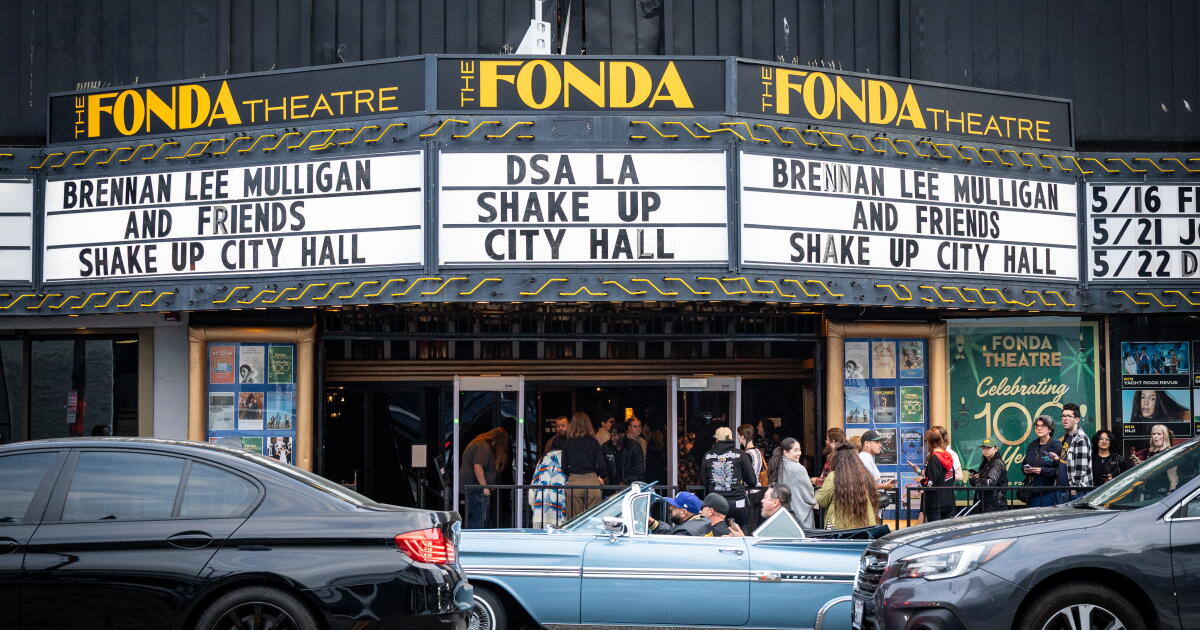
A national panel of the Democratic Socialists of America decided Monday to once again delay voting on whether to uphold or rescind the Los Angeles chapter’s endorsement of Nithya Raman in the L.A. mayor’s race over concerns that Raman hadn’t taken a sufficiently tough stance against Israel.

The left-wing group’s National Political Committee had begun a review of the DSA-L.A.’s endorsement of Raman after some members pointed out that Raman hadn’t been asked for her position on “R22,” a DSA resolution that requires local chapters to inquire about a candidate’s support for the Boycott, Divestment and Sanctions movement against Israel before they are endorsed.

The committee met last week and again Monday, when it voted to work with DSA-LA to organize an Oct. 31 meeting with Raman to assess her position on BDS and other issues related to the Gaza conflict.

If she fails to “provide clear and unequivocal commitments” to their questions, the national committee will vote on whether to rescind DSA-LA’s endorsement, a spokesperson confirmed.

If Raman wins the Nov. 3 election, the group also wants a commitment by her to oppose weapons being shipped to Israel out of Los Angeles International Airport.

If Raman has not “expressed support for BDS and condemned weapon shipments out of LAX” by Jan.1, the National Political Committee will “compile the documentation of fair and ample opportunity for education about the Palestinian struggle for liberation necessary to begin a disciplinary process under R22 and thereafter schedule a vote on expelling Nithya Raman on those grounds,” according to a resolution approved by the committee.

The Raman campaign sent a statement to DSA on Monday during the national committee meeting that outlined her stance on BDS.

“I believe the best way for working Angelenos to stand in solidarity with Gaza is through non-violent protest, legislative action, and diplomatic pressure, including BDS,” Raman said in the statement.

The Raman campaign declined to say whether the council member personally supports BDS, and pointed The Times back to the statement she sent to the DSA and other statements she has made in the past. Raman has said she does not plan to make BDS part of her mayoral platform.

Some Angelenos in DSA were frustrated with the move to rescind the endorsement.

“I feel that this is unnecessary, but that I am encouraged that Nithya has actually expressed support for Palestine and our priorities and that she is compliant with R22,” said Clayton Ryles, a member of DSA-LA who also serves on the 27-person national committee, after the meeting. “Not everybody agrees on that.”

Ryles — one of a few DSA-LA members on the committee — plans to vote against rescinding the endorsement. He also supported Raman’s endorsement as a member of DSA-LA.

Revoking DSA-LA’s endorsement of Raman would have represented a major incursion by the national organization into the local chapter’s politics, invalidating a democratic vote to endorse Raman that passed 937 to 484 in September.

The co-chairs of DSA-LA acknowledged that they had failed to include a question about BDS on their candidate questionnaire, though they said they had inquired about Palestine both on the questionnaire and during a candidate interview.

“This was an oversight,” Leslie Chang and Sean Wakasa, the co-chairs of DSA-LA, wrote in an email to members.

“Nithya had strong answers on Palestine in her DSA-LA questionnaire, in public forums … and in her response to the NPC today,” Chang said in a statement to The Times on Monday. “We are disappointed that the members of the NPC passed their resolutions without reading the materials we sent them, which clearly answer the many questions that are posed to us in the two resolutions.”

“In these last few days of the election, we would like to focus on electing our entire slate and continuing to fight for working Angelenos,” Chang said.

Source link