Mendocino County’s Skunk Train introduces a luxe, adults-only railcar
A hike among redwoods is fine if you go in for that sort of thing.
But to gaze upon those towering trees from a slow train with a stiff drink in your hand — that’s something else entirely.
And with the latest added offerings from Mendocino County’s historic Skunk Train, slow-rolling drink-sipping is possible on short excursions from the railway’s stations in both Fort Bragg along Highway 1 and Willits along U.S. 101.

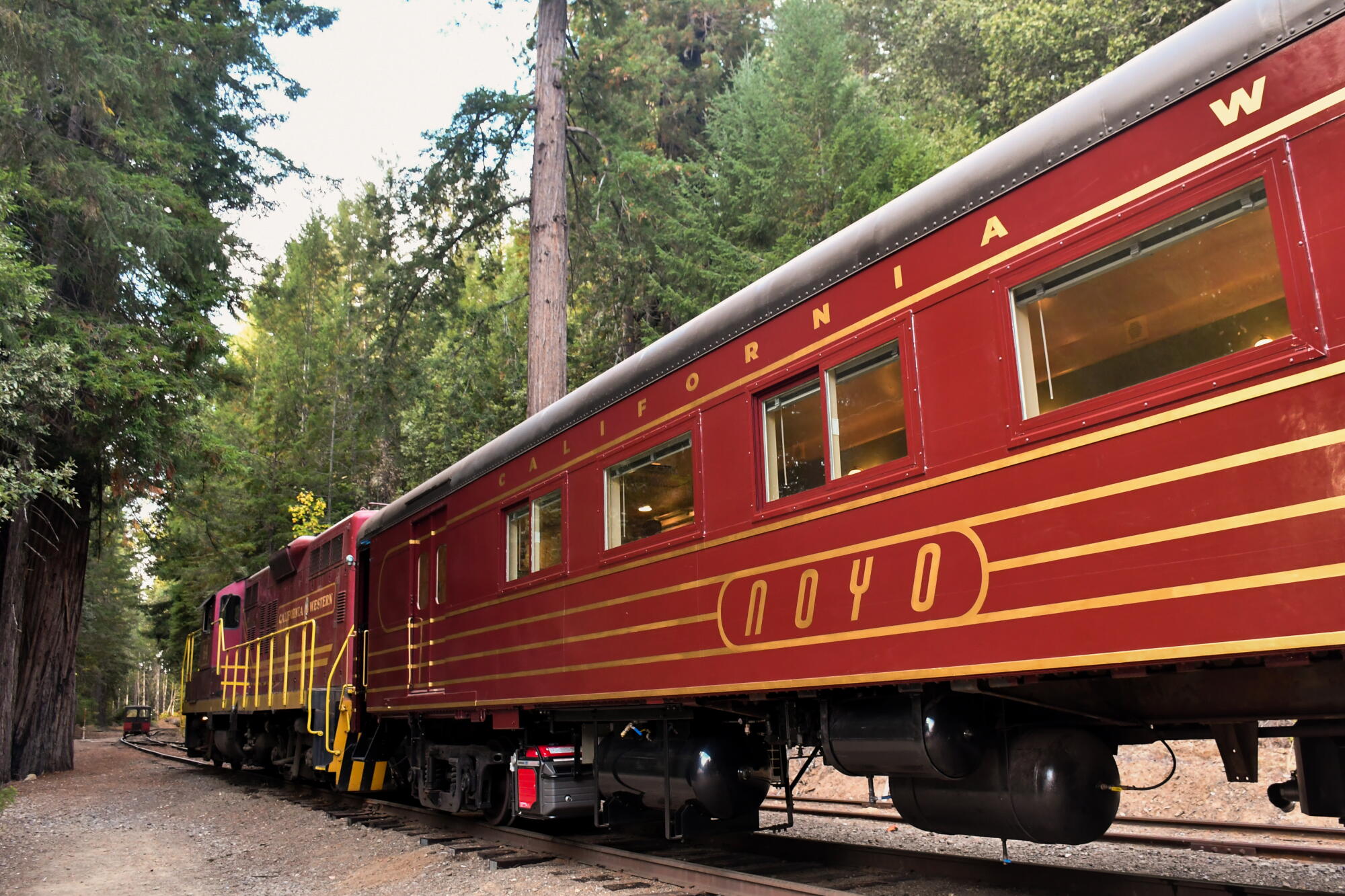
Known as the Noyo, this car is a new cocktail car that’s part of the Skunk Train, rolling from Willits, Calif.
(Christopher Reynolds / Los Angeles Times)
The first part of this expansion happened last year when the Mendocino Railway, better known as the Skunk Train, unveiled the Redwood, a fancy railcar offering cocktails as part of a seven-mile round trip from Fort Bragg. The Willits end of this expansion followed in September, when the railroad introduced another reconditioned traincar, this one known as the Noyo. Formerly a U.S. Army railcar, it’s now been reborn as a rolling cocktail lounge for up to 22 guests, featuring leather chairs, plush couches, a carpeted floor and ‘50s overtones.
On the journey I joined recently, passengers mingled in a spacious, adults-only railcar with vintage jazz on the sound system and servers outfitted in spiffy white jackets. For about $200 each, Willits-based passengers get a 16-mile round trip, charcuterie snacks and two cocktails (or mocktails).
Most popular cocktail so far: the Redwood Martini, made with dry gin, dry vermouth and orange bitters, served with a sprig of redwood.
The journey takes about two hours, passing through an 812-foot-long tunnel (a.k.a. Tunnel No. 2), then pausing to turn around in a clearing known as Crowley.

Passengers relax in the Skunk Train’s “presidential class” railcar, the Noyo, from Willits.
(Mendocino Railway)
Crowley, once a logging camp, can’t be reached by road, but train passengers can wander among picnic tables, fire pits, cornhole games and a massive, gnarled old redwood known as the Wolf Tree. (In September, when the performers of the Flynn Creek Circus were in town, the troupe hauled a big tent out to the clearing and staged two weeks of live performances there.)
Through October and November, the Skunk Train offers “presidential class” cocktail-car trips four to five days per week from Fort Bragg, two to three days per week from Willits. In December, trips from Willits are also offered on most weekdays and service from Fort Bragg drops to two days per week. (Willits-based service shuts down in January and February before resuming in March.)


1. Passengers in the Skunk Train’s “presidential class” railcar, the Noyo, from Willits get two cocktails (or mocktails) with the price of admission for a two-hour round-trip journey. 2. Besides cocktails or mocktails, service aboard the Skunk Train’s “presidential class” cars from Willits and Fort Bragg includes charcuterie plates. (Mendocino Railway)
These cocktail cars are the latest additions in a decade of Skunk Train team improvisations in the wake of long history and, more recently, trouble on the tracks.
The Fort Bragg Railroad started up in 1885 to haul redwood and fir logs to the coast for shipping south to San Francisco. By 1911 there was steam-driven passenger service between Fort Bragg and Willits, and by 1925, locals had nicknamed it the “skunk train” because of the odor that billowed from the railcars’ recently introduced gasoline-burning engines and oil-burning stoves.
That moniker might have faded, but in May 1959, National Geographic magazine devoted a spread to the train under the headline “The Friendly Train Called Skunk.” In its 40 miles, that article noted, the train climbed more than 1,600 feet, crossed 34 bridges and trestles and rounded some 381 turns, occasionally pausing to deliver groceries to rural neighbors.

A passenger soaks up atmosphere on the two-hour, round-trip Skunk Train journey from Willits in Mendocino County.
(Christopher Reynolds / Los Angeles Times)
Alas, the timber industry faded, a mail delivery contract was lost and railroad ownership changed hands. On the way, the Skunk Train began to depend mostly on tourists. Then in 2013, the railroad’s Tunnel No. 1 collapsed, blocking the tracks about four miles east of Fort Bragg. Repairs followed, but the same tunnel collapsed again in 2015. There were no injuries in either accident, but it remains impossible for any railcar to make the full 40-mile journey between Fort Bragg and Willits.
“We are committed to reopening the tunnel,” Mendocino Railway president and CEO Robert J. Pinoli has said. But the reopening won’t be quick. Besides the challenge of rebuilding the tunnel, the railroad has been tangled for several years in legal disputes with the city of Fort Bragg and the California Coastal Commission. For now, every trip on the Skunk Train, including traditional railcars and increasingly popular pedal-assisted railbikes, is an out-and-back journey designed to avoid the blocked tunnel.
From Fort Bragg, most train and railbike trips go 3.5 miles east and 3.5 miles back again. From Willits, most trips go eight miles west and turn around, including the fall Pumpkin Express and Christmas Train. The great exception is “Railbikes on the Noyo,” a 25-mile journey that begins near Fort Bragg with a hike to the east end of Tunnel No. 1. From there, guests pedal an eastbound railbike for 12.5 miles through the forest, including a dozen wooden trestle bridges and recurring views of the Noyo River. After a picnic lunch, guests double back to where they started. That adventure usually takes about six hours and starts at $564 (combined) for two people sharing a two-seat railbike.
The new cocktail car excursion, meanwhile, requires less time, less money and less perspiration.

A view of the Skunk Train’s Noyo railcar.
(Mendocino Railway)
After our train reversed direction at its midway stop in Crowley, I could have stayed in my comfortable cocktail-car seat. But I had been tipped to check out the back end of the train. That’s the open observation car (no ceiling) in the back of the train. Skunk Train employees say it was first built for the U.S. Marines to transport Sherman tanks. It works just fine carrying us gawking civilians.
“Ahhh,” said 2-year-old Elle Davis, looking up to the sky and standing by her mother, Kaitlyn Davis of Willits. The observation car is open to all aboard — that is, the Noyo Car passengers and to those Skunk Train passengers who pay standard fares ($81.47 per adult) for less luxe railcars (open to all ages).
As you stand there with the wind in your face and the rails rattling below, the evergreen boughs whoosh past. Depending on the hour and humidity, the sky might be dimming or masked by fog. These days you don’t get that skunky scent of years gone by, but a ride is still a full sensory experience. And even if you have an adult beverage in your hand, you might find yourself with the same sense of rejuvenation that engineer Johnny Galliani described to National Geographic back in 1959.
“Young or old, they’re all kids when they ride with us,” Galliani said. “Nothing like a ride on this train to take the years off your back and make you young again.”

Passengers board the Skunk Train on an excursion from Willits to a forest clearing (once a lumber camp) called Crowley.
(Christopher Reynolds / Los Angeles Times)