L.A.’s mayoral ad blitz: Hollywood, ICE raids and homeless encampments
The advertising blitzkrieg of L.A.’s mayoral campaign is here.
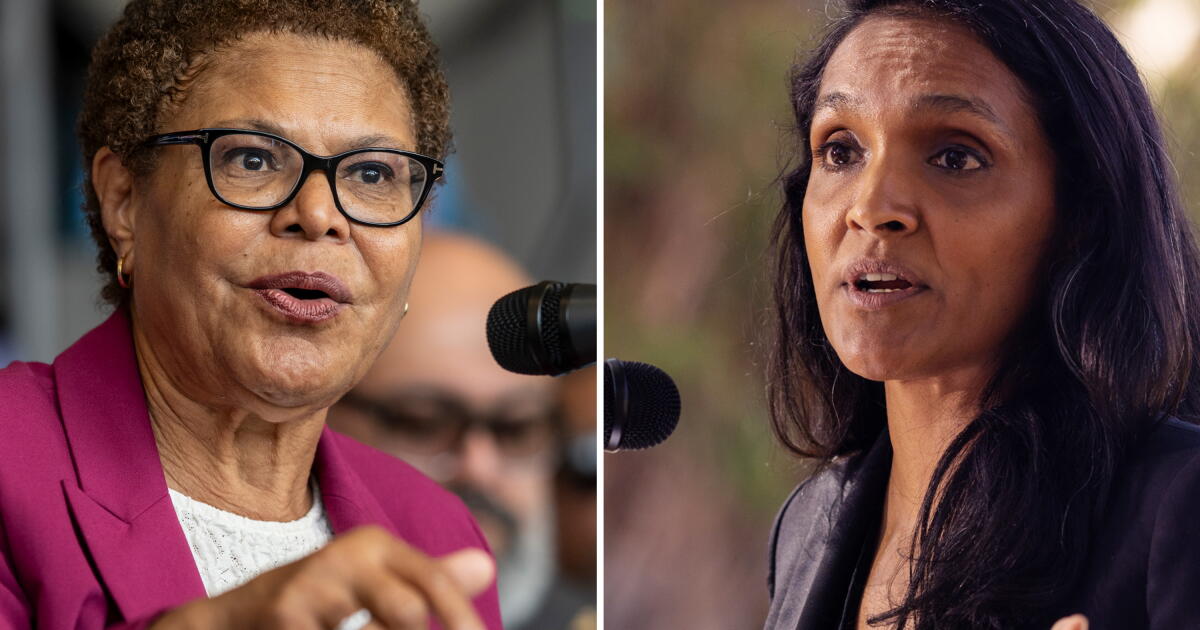
Mayor Karen Bass and her opponent, City Councilmember Nithya Raman, dropped new campaign commercials over the last week, buying time on television, streaming channels and other platforms. Supporters of both candidates released ads as well.
The two candidates relied heavily on free media for most of the summer, putting videos on Instagram and inviting the news media to cover their appearances.
The dam effectively burst on Monday, with Raman touting her new Hollywood-themed ad “For Your Consideration,” timed to coincide with the Emmy Awards.
The 30-second spot starts with Raman stepping out on the town, then shifts to some standard L.A. imagery: freeways, palm trees, Echo Park Lake and, of course, the Hollywood sign.
“L.A. shows the world what it means to be a star,” declares the ad’s narrator, actor and screenwriter Bob Odenkirk. “And every Angeleno deserves the chance to reach for their own.”
After Raman has stopped off at a taco stand and hugged a dog, Odenkirk delivers the ad’s final message: “Change. Affordability. An L.A. that loves you back.”
That ad ran on television a few times before being cycled onto social media, per the Raman campaign.
Three days later, Bass went up with a 30-second spot — on digital platforms for now — centered on President Trump’s immigration raids.
The ad offers footage from the day in July 2025 when Bass confronted federal immigration agents in MacArthur Park. The video features images of gun-toting federal agents in military uniforms and Bass hopping out of a car in an aquamarine pant suit to face them.
“When someone comes after your family, you don’t hesitate,” Bass says. “You stand up. You fight.”
One of Bass’ most formidable allies — the Los Angeles Police Protective League — went hard negative with its first ad of the runoff campaign, offering the message that Raman “Doesn’t Get It.”
The commercial, released Friday, follows a young girl as she walks past a homeless encampment, juxtaposed against video of Raman talking about her opposition to a law that prohibits encampments near schools.
“I don’t think a kid’s gonna be safer because a tent is 500 feet away from a school,” Raman said in the clip, which was taken from a 2024 candidate forum in Sherman Oaks.
The backpack-wearing child speaks to the camera and says: “Walking to school shouldn’t be scary.”
“I’m just a kid,” she says. “But even I know I’d be safer if this was 500 feet away.”
The police union says the ad will start running on television this weekend and already is on social media platforms.
Meanwhile, Raman’s backers have an assortment of attack ads running on Facebook and Instagram.
Streets For All, a group that wants to expand the city’s bus and bike lane network, pulled video footage from a different Sherman Oaks candidate forum — this one featuring Bass and Raman last month.
At that event, Bass told the audience that Raman is unresponsive to her constituents, forcing many in Sherman Oaks to contact the mayor’s office directly.
“Many of you have my cellphone, you have called me,” Bass says in the ad. “You called on me specifically for help.”
Streets For All contends those remarks show that Bass gives wealthy homeowners her number while “regular Angelenos get ignored.”
“L.A. deserves a mayor who doesn’t just listen to the rich and powerful,” the ad says.
By Friday, Streets For All had nearly two dozen different video spots opposing Bass over such issues as homelessness, transparency and the Palisades fire, according to Ethics Commission filings.
The biggest backer of the group’s political action committee is hedge fund manager Aaron Sosnick. Of the $1.2 million that the group plans to spend in the mayor’s race, Sosnick has provided $1 million, said Michael Schneider, who heads the group.
Schneider said the committee also has financial support from retired real estate developer Yuval Bar-Zemer — known for his work in the Arts District — and Todd Wexman, chief principal of 4SITE Real Estate, a real estate development company.
Raman pollster says she’s in the lead
The Raman campaign shared the results of a new internal poll that showed their candidate with a five-point lead over Bass.
Of the 600 likely voters who were surveyed, 44% supported Raman and 39% backed Bass, with 17% undecided, according to a memo provided to the campaign and viewed by The Times. The survey, conducted by Hart Research Associates in early September, had a margin of error of 4 percentage points.
“In the initial trial heat for Los Angeles mayor, Councilmember Nithya Raman is in the rare position for a challenger of already LEADING the incumbent,” the polling firm wrote.
Another poll, commissioned by an independent expenditure group supporting Raman, portrayed the race as a statistical tie, at least initially. Estamos con Nithya for Mayor of LA 2026, sponsored by the Western States Regional Council of Carpenters, said its poll showed Bass with 38% and Raman at 37%.
However, when voters received more information on the candidates, Raman took a 7-percentage-point lead, with 41% supporting her and 34% supporting Bass, according to a memo prepared by the group’s pollster.
The margin of error was 3.7 percentage points.
The Bass campaign declined to share its internal polling when contacted by The Times.
However, Neighborhoods for a Better L.A., an independent expenditure group supporting the mayor, said a survey it commissioned in early August showed the mayor with an edge over Raman of 41% to 35%, with 24% of the electorate undecided.
That poll, conducted by Tulchin Research, surveyed 1,200 likely Los Angeles voters and has a 2.8-percentage-point margin of error, the group said.
The poll also found that when given “balanced biographies” about both candidates, Bass’ support grew to 45% while Raman went down to 33%.
“Communications focused on Raman’s record can both reduce her support and consolidate voters behind Bass,” the pollsters wrote.
Giving back El Grito cash
Los Angeles City Councilmember Imelda Padilla locked down sponsorships for the city’s celebration of El Grito, which marks Mexico’s independence.
Tuesday’s event, which featured an evening of musical performances, was sponsored by an assortment of city contractors and government agencies, including waste hauler Athens Services and the Department of Water and Power.
Still, Padilla decided she didn’t want to partner with one particular business, announcing at the last minute that organizers no longer would accept a $5,000 sponsorship from Home Depot.
On the day of the celebration, Padilla issued an apology on Instagram, saying she had heard from community members upset over the event’s affiliation with Home Depot, whose parking lots have been the site of many federal immigration raids.
“We have rescinded their partnership for this event,” Padilla said in her post. “The spirit of El Grito is rooted in celebrating our Latino heritage and creating a space where our families feel welcomed, safe, and celebrated.”
In an email, a Home Depot spokesperson said the company is not involved in immigration enforcement activities and doesn’t coordinate with Immigration and Customs Enforcement or U.S. Border Patrol. The company also doesn’t receive advance warning about enforcement actions, the representative said.
“We cannot legally interfere with federal enforcement agencies, including preventing them from coming into our stores and parking lots,” Home Depot spokesperson Evelyn Fornes said.
State of play
— COZY WITH CARUSO: Billionaire developer Rick Caruso, who was defeated by Bass in 2022, appeared alongside the mayor at a groundbreaking for the Palisades Recreation Center. Caruso praised her for her work on the project but stopped short of endorsing, saying he intends to meet with Raman in the coming weeks.
— LIFE AFTER PRATT: The voters who picked reality TV personality Spencer Pratt in the June 2 primary election are now up for grabs. But will they stay home instead of picking a mayoral candidate?
— BASS BAILS: The mayor skipped a congressional hearing on waste and fraud in homeless spending this week, calling the session politically motivated. Rep. Tim Burchett, the Republican who chaired the subcommittee meeting, accused her of dodging accountability.
— FINDING FRAUD: Federal authorities arrested three people who were working in Los Angeles-area homeless nonprofits this week, accusing one of them of misappropriating more than $7.5 million in taxpayer funds. Scott Turner, secretary of the Department of Housing and Urban Development, said the Los Angeles Homeless Services Authority, which provided the funding, had allowed fraud to “run rampant.”
— WE’RE IN THE MONEY: The 2028 Summer Olympic Games in Los Angeles will generate up to $40.6 billion in increased economic output and add as many as 224,000 jobs, according to an upbeat economic forecast released this week. Another, more tempered estimate put the increase at $20.5 billion to $25.4 billion.
— SEETHING OVER SKID ROW: Some activists want dogs taken away from homeless residents living in Skid Row, saying those animals are living in an unsafe environment. A Bass aide responded by cautioning that it is “neither humane nor legal to remove animals from their human companions without appropriate cause.”
QUICK HITS
- Where is Inside Safe? The mayor’s signature program to combat homelessness went to Avalon Boulevard and 64th Street in South L.A., an area represented by Councilmember Curren Price.
- On the docket next week: The council’s Public Works Committee meets Tuesday to discuss ways of cleaning, safeguarding or demolishing nuisance properties.
Stay in touch
That’s it for this week! Send your questions, comments and gossip to LAontheRecord@latimes.com. Did a friend forward you this email? Sign up here to get it in your inbox every Saturday morning.