raiders

We Finally Know The B-21 Raider’s True Wingspan

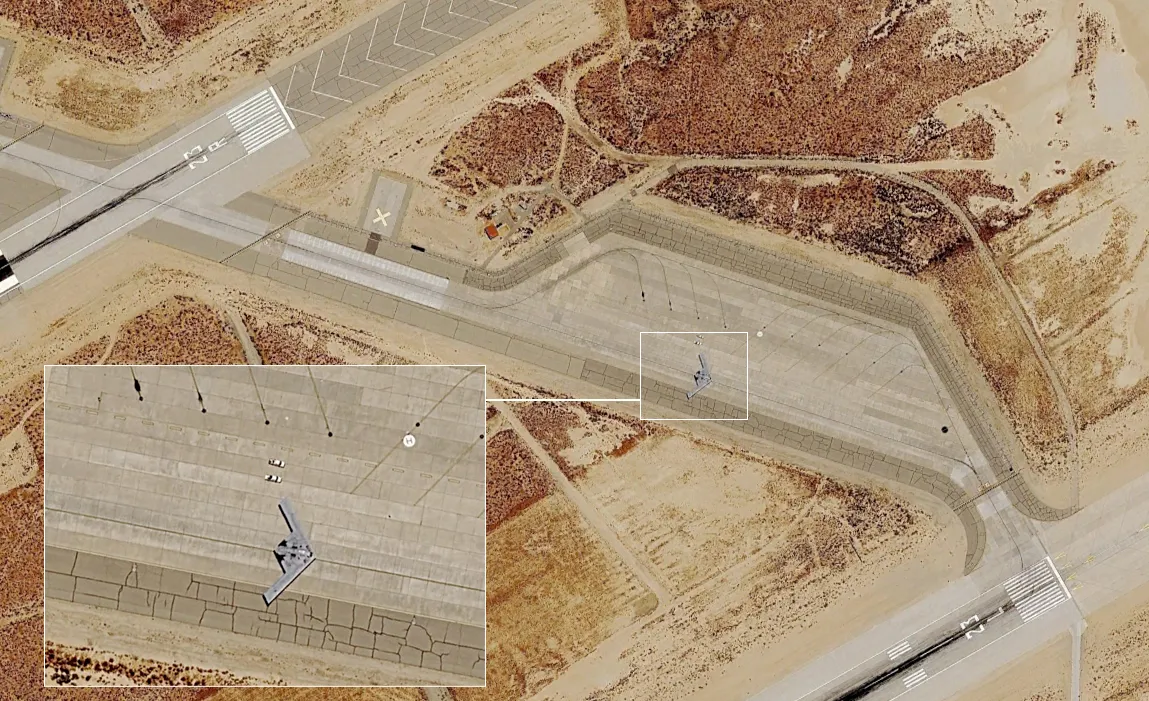
Thanks to Google Earth, we can finally put this one to bed. Since the B-21’s unveiling, people have made wild claims about its wingspan, specifically how tiny it is. This was never the case, as we have reported continuously since we first set eyes on it. Many AI-generated and enthusiast-made B-21 fact sheets have gone viral on social media showing wingspans under 130 feet, which only helped propel the nonsense. Now we can definitively say, give or take a few feet, the B-21 spans 152 feet and is 61 feet long. This puts it at about 12% smaller in terms of wingspan than the B-2, and about the same — 12% smaller — when it comes to length.

The image in question, taken of Edwards AFB and dated June 20, 2026, was recently uploaded to Google Earth. While we have seen satellite images of the B-21 going about its business before, this one was published in the public domain and had enough resolution, when paired with Google Earth’s excellent measurement tools, to get conclusive measurements.

B-21 taxiing between Edwards AFB’s parallel runways. (Google Earth)

Since we first saw the B-21 at Plant 42 in Palmdale, California, during its unveiling, which TWZ attended, we put the top-end size at 155 feet wingspan-wise. That analysis has only narrowed over the years. I have had many emails, social media threads, and other engagements with folks claiming the aircraft was in the sub-130-foot wingspan range. Now we can finally put those battles behind us.

B-21 span nowhere that number. Bizarre people think this. Around 150-155 best estimate

— Tyler Rogoway (@Aviation_Intel) September 19, 2025

I smile every time I see these graphics showing like 130 foot wingspan on the B-21. People think it’s way smaller than it is.

— Tyler Rogoway (@Aviation_Intel) August 25, 2025

So what does the size tell us? Nothing we don’t already know. The B-21 was always going to be smaller than the B-2. Our analysis from many years ago has stayed the same — the aircraft would be designed with a premium on range and affordability, as well as very low observability, over massive payload. This resulted in the aircraft you see today. It is smaller, but with design priorities that have shifted from its predecessor’s, and 12% smaller in pure dimensions makes total sense considering what Northrop Grumman was trying to achieve. Above all else, it points to the B-21 having an extreme unrefueled range, with improved aerodynamics for high-altitude cruise, more gas for its size, and two efficient engines instead of four.

Official photo of the B-21 in close pre-contact position behind Edwards AFB’s ‘Ghost’ test tanker. (USAF)

As for its length, the B-21 is nearly the same length as an F-15 fighter, which sounds bizarre for a large bomber. However, flying wings are visual transformers, looking like compact UFOs side-on and massive head-on or from the planform view.

What’s even more fascinating is that this thing is probably about the same length as an F-15 or close to it. Flying wings are transformers. From flying saucers side-on to massive flying wedges in the bank to huge boomerangs head on. pic.twitter.com/0UXOK0uVVN

— Tyler Rogoway (@Aviation_Intel) May 22, 2024

As far as what else we can discern from the Google Earth image? Not much. We get a bit of a better view of the B-21’s exhaust configuration, but nothing is really revelatory there. The exhausts are deeply buried with large planar exhaust exit ‘ramps’ and have a large chevron trailing edge over the exhaust aperture itself. We have seen some pretty detailed images of this general arrangement from the rear that have been posted on social media. We do see the exhaust pathway as black in color, a feature that was edited out in the official top-down photo of the B-21 seen above, which was released in April, and this is something we mentioned at the time.

Regardless, at least we can say with total confidence that the B-21 is smaller than its progenitor, but not by all that much — about 12% to be more exact.

Contact the author: Tyler@twz.com

Tyler’s passion is the study of military technology, strategy, as well as foreign policy, and he has fostered a dominant voice on those topics in the defense and national security space. Tyler was the creator of the hugely popular defense site Foxtrot Alpha before developing TWZ, which he continues to lead as the Editor-In-Chief to this day.


Source link

Mike McDaniel is turning Chargers’ offense into a disaster

Be careful what you wish for when you’re wishing for a new offensive coordinator.

Chargers fans were so over Greg Roman. Anything would be better than his run-heavy scheme stunting quarterback Justin Herbert’s anticipated ascension. Anyone would be preferable to the man holding the reins while the Chargers scored just three points in last season’s wild-card loss to the New England Patriots, after which Roman was fired.

Anyone such as, say, former Miami Dolphins coach and purported offensive guru Mike McDaniel?

Yeah?

About that.

Somehow, after just two games, the Chargers’ offense under McDaniel has Bolts fans wishing anyone else was running the show. Roman included.

Because Roman wouldn’t have overcomplicated a third-and-inches play-call. He wouldn’t have had the 6-foot-6, 240-pound Herbert line up in shotgun and call for motion.

The Chargers lost to the Las Vegas Raiders 26-14 on Sunday, and the schedule doesn’t get any easier for them moving forward.

And the subsequent snap wouldn’t have hit receiver Tre’ Harris before it got to Herbert. And instead of losing five yards and having Herbert, in a rare show of emotion, slapping the turf in frustration, the Chargers probably would have gotten a fresh set of downs.

So far, McDaniel’s brief Chargers’ tenure hasn’t just been a disappointment. It has, through two games, been a disaster. Because the Chargers really needed these first two wins against opponents who both won only three games last season.

Instead, the Chargers’ offense looked as disjointed and discombobulated in Sunday’s 26-14 loss to the Las Vegas Raiders as it did the previous week in their 26-14 loss to the Arizona Cardinals.

It was an unwanted second helping of “humble pie,” as McDaniel described the Chargers’ Week 1 defeat. And it was nasty.

Now the Chargers’ schedule is about to come at them fast, with their next games against the Buffalo Bills, the Super Bowl champion Seattle Seahawks, Denver Broncos, Kansas City Chiefs and then the Rams, the preseason Super Bowl favorites.

After consecutive 11-win seasons under Jim Harbaugh — who’d never lost to the Raiders and never previously lost two consecutive games to start a season — the Chargers might blink and find themselves 0-7.

What’s worse than frustratingly quick postseason exits? Not making the playoffs at all.

And the Chargers are going to need to engineer a quick turnaround if they’re going to be among the 15% of teams that start a season 0-2 and still reach postseason play.

Chargers offensive coordinator Mike McDaniel walks on the sideline before a preseason game.

Chargers offensive coordinator Mike McDaniel walks on the sideline before a preseason game against the San Francisco 49ers at SoFi Stadium on Aug. 20.

(Robert Gauthier / Los Angeles Times)

To do that, they’ll need to score more points. They’ll need to stop shooting themselves in the proverbial feet and take some better shots downfield. Stop dropping the ball — figuratively, literally. They fumbled six times Sunday!

And stop thinking so much. Sundays are for reacting, and any amount of thinking is overthinking.

Maybe it’s personnel? The fact that, outside of Ladd McConkey, the Chargers are short on receivers who can reliably create separation.

Maybe it’s just a matter of time that the Chargers don’t have much of, cramming to learn McDaniel’s methods, to dial in the timing and coordination.

Or maybe, for McDaniel, it’s as simple as simplifying what he’s trying to do with this Chargers offense.

When he was hired in January, the prevailing thought was that the cerebral partnership between McDaniel and Herbert would prove a perfect match.

Even though McDaniel was dismissed after the Dolphins missed the playoffs two consecutive seasons, the coach — who’d developed a reputation as a talented offensive mind under Kyle Shanahan with the San Francisco 49ers — was a hot commodity on the coaching market.

McDaniel reportedly drew interest from the Baltimore Ravens, Cleveland Browns, Tampa Bay Buccaneers, Bills and Raiders. But he opted to come to L.A. to work with Herbert as the All-Pro QB’s fifth offensive coordinator in seven seasons (following three offensive coordinators in his four years at Oregon).

Starting over again, in these two games with McDaniel, Herbert has thrown for a modest 401 yards, just two touchdowns and three interceptions — though one of them bounced off David Njoku’s hands Sunday.

Chargers quarterback Justin Herbert watches a pass attempt fall incomplete after he is hit.

Chargers quarterback Justin Herbert watches a pass attempt fall incomplete after he is hit by Raiders defensive end Malcolm Koonce during the fourth quarter Sunday.

(Allen J. Schaben / Los Angeles Times)

There have also been protection problems, fumbles, a missed field goal, and lots of penalties — including four on star left tackle Joe Alt, who was called for a hold that resulted in a safety on an anything-that-can-go-wrong-will-go-wrong Sunday.

“I’m not looking in any one direction,” Harbaugh said Sunday. “I’m looking at it all.”

On TV, Herbert appeared to be looking off into space on the sideline as McDaniel sat chattering beside him, the game mercifully winding down.

Asked what McDaniel’s message was to the offense, Herbert said: “I haven’t been able to speak with him after.”

There’s a lot to talk about, but be careful what you ask.

Source link