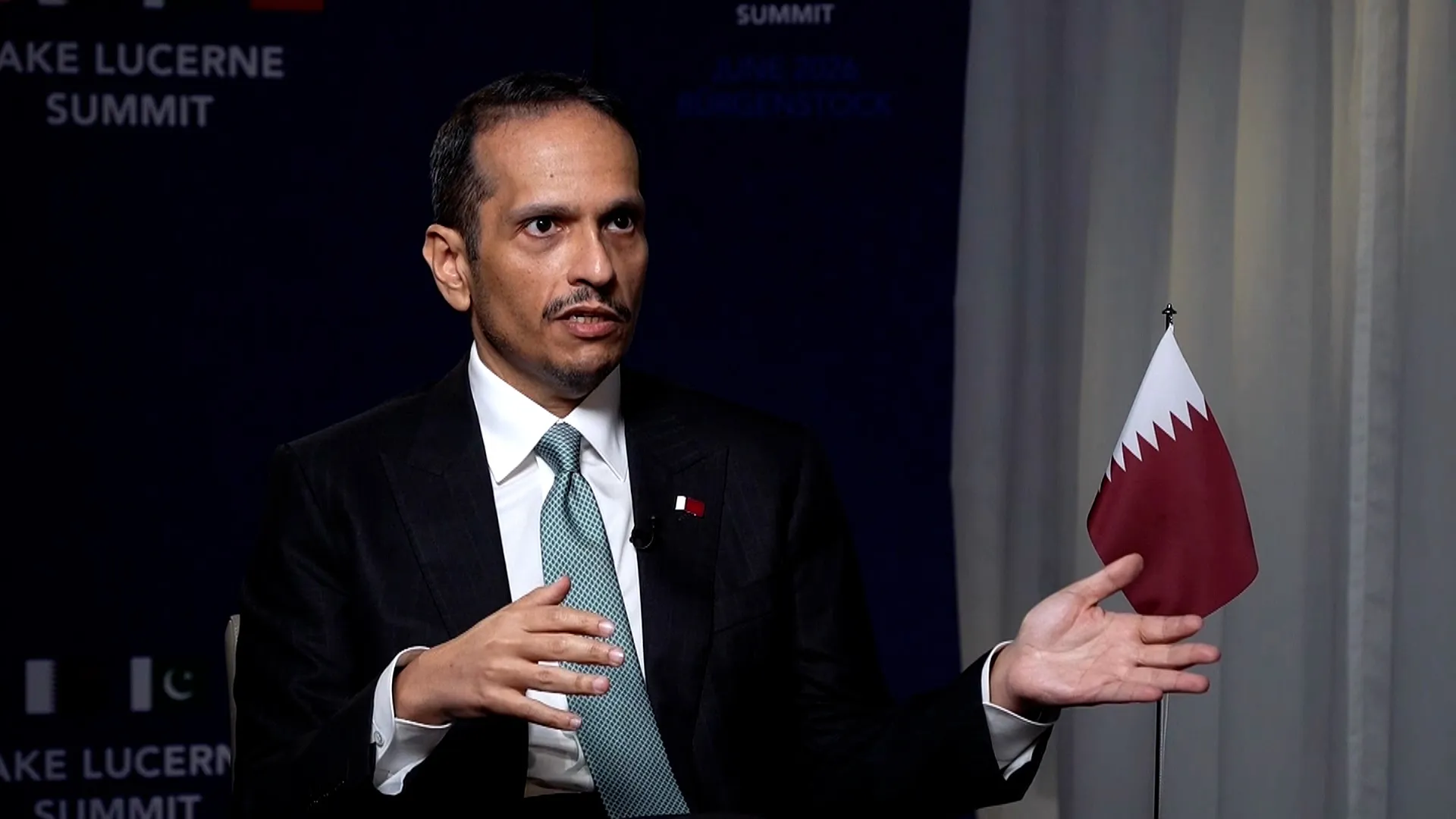
Qatar’s PM Sheikh Mohammed bin Abdulrahman Al Thani told Al Jazeera that safeguards have been put in place to prevent US-Iran negotiations from regional escalation, including tensions in Lebanon and the Strait of Hormuz, stressing diplomacy and respect for agreements.
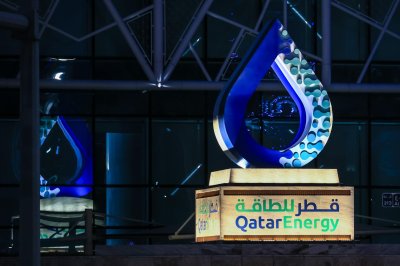
The logo of state-owned petroleum company QatarEnergy is shown in front of its headquarters in Doha, Qatar. An explosion at a liquefied natural gas plant in Qatar killed 13 and injured dozens Sunday. Photo by Hannibal Hanschke/EPA
June 22 (UPI) — An explosion at Qatar’s largest natural gas plant killed 13 people and injured about 66, authorities said.
The blast, caused by a technical malfunction, took place Sunday as the facility restarted its natural gas production after a shutdown caused by the Iran-U.S. war, authorities from the interior ministry said. It took place in the Ras Laffan industrial zone. The nearby Ras Laffan Port is the largest artificial harbor in the world and was targeted by Iranian strikes earlier this year, BBC News reported.
Saad Sherida al-Kaabi, Qatar’s energy minister, said that the explosion would not affect the country’s exports and that it was an accident and “not sabotage or hostile in nature.”
“We convey our deepest condolences to the families of those who have unfortunately passed away in the sad incident at Ras Laffan Industrial City last night,” the Embassy of India in Doha said in a social media post.
Liquified natural gas is important to Qatar’s economy, and the country is one of the world’s largest exporters of it. Ras Laffan is the largest site in the country for producing LNG. Qatar had ceased production earlier in the Iran-U.S. war and has said damage from attacks during the conflict could take years to repair.
The blast turned the city’s skyline orange and was felt by residents more than 43 miles away, BBC News said.
Blast at Ras Laffan Industrial City caused by ‘technical malfunction’, Ministry of Interior says.
Published On 22 Jun 202622 Jun 2026
An explosion at Qatar’s main liquefied natural gas processing facility has injured 54 people and left 18 others missing, authorities have said.
The Qatari International Search and Rescue Group were deployed to conduct search operations for those missing following the “internal explosion” at Ras Laffan Industrial City, Qatar’s Ministry of Interior said on Monday.
Recommended Stories
list of 4 itemsend of list
The ministry did not provide information on the conditions of those injured in the incident, which it blamed on a “technical malfunction”.
Officials had said earlier that civil defence teams responding to the scene had not recorded any injuries.
The ministry said there was no leakage from the facility that would pose a danger to public safety.
QatarEnergy, which administers the industrial hub, said emergency response teams were immediately deployed after the explosion at the Barzan factory and brought a fire at the facility under control.
Ras Laffan Industrial City, located about 80km (50 miles) north of Doha, is home to the world’s largest LNG export facility, producing about one-fifth of global supply.
In March, the Qatari government announced that the industrial hub had sustained “significant damage” after being targeted by Iranian missile and drone attacks.
QatarEnergy invoked the force majeure clause in some of its contracts to free itself from its supply obligations following the attacks, affecting customers in Italy, Belgium, South Korea and China.
The first round of US-Iran talks has ended with both sides agreeing on a roadmap towards a final deal to be reached ‘within 60 days’. Iran said the negotiations resulted in waivers for oil exports and the release of some frozen assets. The parties have also agreed to a ‘de-confliction cell’ to monitor the ceasefire in Lebanon.
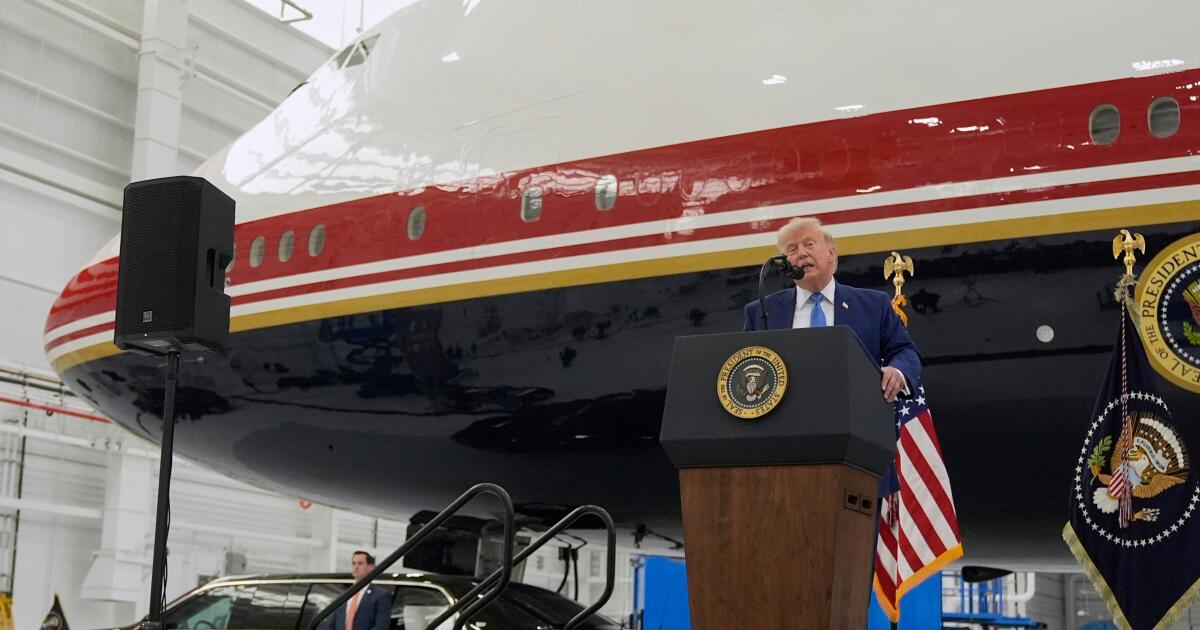
JOINT BASE ANDREWS, Md. — President Trump on Friday showed off the new Air Force One, a formerly Qatari-owned — and much debated — jumbo jet that has been converted into the official U.S. presidential aircraft.
The new plane — gifted from the Qatari government, raising a host of legal, ethical and security questions — will take on a new look, eschewing the Kennedy-era robin’s egg blue exterior in favor of white on the top half, its underbelly navy blue with a red stripe above it.
“This plane was transformed into a flying White House at a level of luxury that nobody has ever seen before,” Trump said from inside the massive Joint Base Andrews hangar, as a couple of hundred assembled Air Force personnel looked on. He spoke after stepping off the new plane in a dramatic flourish, as his signature tune “God Bless the USA” played.
He confirmed that he would be taking the new jet to the North Atlantic Treaty Organization summit in Ankara, Turkey, next month and indicated that he would be returning to China “at some point,” presumably a reference to the Asia-Pacific Economic Cooperation summit that China is hosting in November. His return from the Group of 7 summit in France this week was the last planned trip aboard the old Air Force One, he said.
“Now, when we land at airports in London and in Germany and different places, nobody tops this one, and that’s the way we have to have it for our country,” Trump said, noting that the colors and the design were to “my taste, I will say.”
He added that the new Air Force One will do a flyover during the July 4 celebrations next month.
The gift from Qatar is serving as a so-called bridge aircraft to carry the president until new planes ordered directly from Boeing arrive. That is currently slated for 2028.
The administration formally accepted a luxury Boeing 747 jet from Qatar last year to be used as the presidential airplane, despite questions about security and the ethics and legality of accepting such an expensive gift from a foreign government. Trump has claimed in the past that he would not fly around in the Qatari jet once he leaves office and said it would instead be donated to a future presidential library.
Trump on Friday said the U.S. was in a “little bit of a logjam” as it awaited the delivery of the new jets directly from Boeing, which had originally been scheduled for 2024 but have been delayed. He recalled asking the emir of Qatar for the use of one of their planes.
“See, a normal president wouldn’t do this. A normal president wants to stay away from aircraft,” Trump said Friday. “But our country has to be represented properly.”
Members of Congress and others have questioned the cost and effort that would be needed to make security modifications to an aircraft from a foreign government.
The Air Force said in a news release Friday that any plane deemed Air Force One “must meet rigorous security requirements” and that the Qatari plane “was modified under a disciplined engineering approach that prioritized these exact core capabilities above all else.” The Air Force also said “much of the previous head of state interior layout” of the plane was kept intact.
The Air Force has said in the past that security modifications to the jet would cost less than $400 million.
Trump’s efforts to reimagine the presidential airplane date back to his first administration, when he directed that an incoming fleet of new jets would adopt a color scheme that was nearly identical to that of his personal airplane. Then-President Biden reversed the decision in March 2023 as an Air Force review suggested that the darker colors could increase costs and delay delivery of the new jets, but once Trump returned to office, he returned to his desired colors for the plane.
Other government jets that carry other top administration officials will use a similar red, white and navy color scheme, the Air Force said earlier this year.
An Air Force spokesperson, who spoke on condition of anonymity to discuss sensitive plans, told the Associated Press that the two current planes, known as VC-25As, will not be retiring. Instead, they will remain in the fleet until the new Boeing planes, referred to as VC-25Bs, come into service, the spokesperson said.
It is unclear how the older jets will be used but the spokesperson said that both the Qatari jet as well as the VC-25As will be available for use and “the Presidential Airlift Group will select the appropriate aircraft for each mission based on operational requirements.”
Kim and Ceneta write for the Associated Press. Kim reported from Washington. AP writer Konstantin Toropin contributed to this report from Washington.
VANCOUVER, Canada — When the first men’s World Cup game played in Canada kicked off last week, Anthony Totera sat in the stands and wept.
“It was a dream come true,” said Totera, who has spent most of his 57 years on earth promoting Canadian soccer. “I can’t describe the emotions. It was something surreal.”
If the 1994 World Cup, the first held in the U.S., forever altered the direction of American soccer, this summer’s tournament, which Canada is sharing with the U.S. and Mexico, has the potential to do the same for that country.
“This is going to be something monumental,” Totera said. “We’re going to get to another level, another point, where we’re going to say this was when it all turned.”
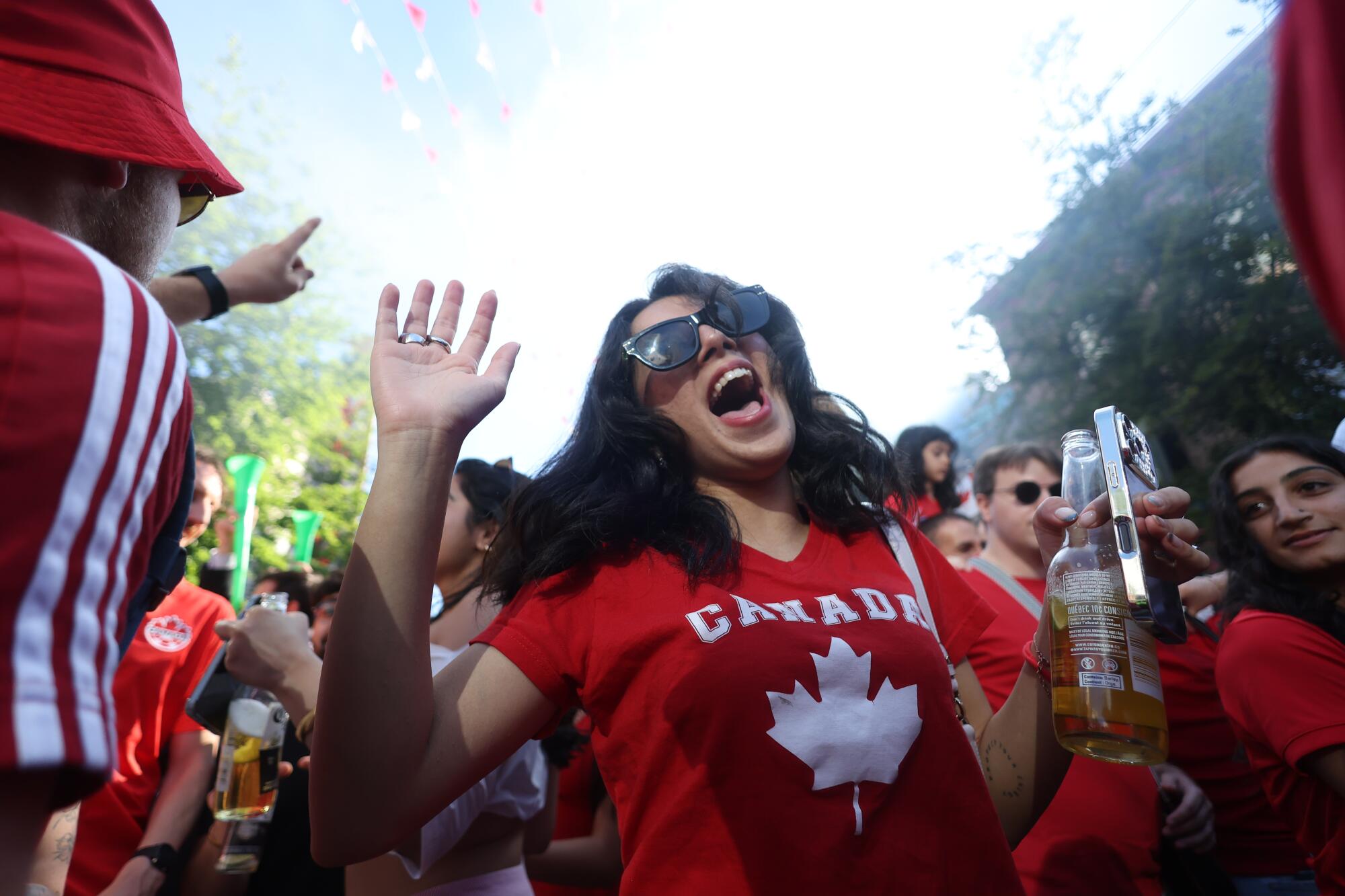
With an opening draw against Bosnia and Herzegovina last week in Toronto and Thursday’s 6-0 blowout victory over Qatar in Vancouver, this tournament is already the most successful on the field for Canada, which had lost all six previous World Cup games it had played. Now it’s poised to advance to the knockout rounds for the first time ever.
Jonathan David’s three goals were more than Canada had scored in its previous World Cup seven games combined. And former LAFC goalkeeper Maxime Crepeau, who lost his chance to play in the last World Cup when he broke his leg in the MLS Cup final, had no trouble making them stand up, recording Canada’s first-ever World Cup clean sheet.
The hosts outshoot Qatar 32-2 and had 97 touches in the box in one of the most dominant performances in recent World Cup history.
“I really think that we’re a soccer country,” LAFC midfielder Stephen Eustaquio said. “It’s a very special group.”
But the win was a costly one since Canada, which entered the tournament missing three starters to injury, lost another early in the second half when midfielder Ismael Kone was carted off on a stretcher with an apparent broken leg after Qatar’s Assim Madibo clipped him from behind.
And while that success on the field — costly or not — is significant, Steve Reed, the former Canadian Soccer Assn. president who was instrumental in bringing the World Cup to Canada, said the real goal wasn’t to win games as much as it was to win over the public.
“Each time we have hosted major tournaments, we have seen a significant increase in participation and general public interest,” said Reed, who was part of the group that organized the 2015 women’s World Cup in Canada. That tournament produced nearly a half-billion dollars in economic activity, double the original projections. It also boosted investment of soccer infrastructure, including the construction or upgrading of 21 “FIFA-quality” pitches, and surged youth participation numbers. The quarterfinal game between the host country and England drew a record TV audience of 20.8 million Canadians.
“I would say that we have proved that we excel at hosting major events. This will just be reinforced in 2026,” Reed said.
“In terms of expectations,” he continued, “one would be the continued growth of the game, particularly on the men’s side. We have always been great at the grassroots level. But we need to be better at the top end of the game, creating more professional opportunities for players in our domestic leagues and creating a pipeline to bigger clubs in major leagues.”
Canada fans celebrate after a 6-0 win over Qatar at the World Cup on Thursday.
(Kaleb Tatum / Associated Press)
That’s exactly the kind of legacy the 1994 World Cup created in the U.S., where it gave birth to Major League Soccer, a deep lower-tier professional infrastructure and an academy system that has sent players to major teams all over the world. Canada has also benefited from that, with MLS placing teams in Vancouver, Montreal and Toronto. Nine players from the league — including three from LAFC — are on Canada’s World Cup team.
In the last decade, Canada has begun building its own youth development system. It also launched the Canadian Premier League, an eight-team professional league that has already sent 15 players to the national team. Those initiatives had a good foundation to build on since soccer is Canada’s most popular sport in terms of registration and participation and ranks behind only hockey as a spectator sport.
Still, when Victor Montagliani, a former Canadian Soccer Assn. president, first publicly floated the idea of bidding to host the men’s World Cup in 2013, he was lampooned.
“People absolutely laughed at him, all across this country,” said Totera, who is now the grassroots ambassador for the Premier League. “But his closest friends and people that knew him knew he didn’t lie when he said, ‘I want to bring the World Cup to Canada.’ And he brought it.”
Canada had to pair with the U.S. and Mexico to make that happen, with the so-called United Bid beating back a proposal from Morocco thanks in part to some steady diplomacy from Reed, who took over as president when Montagliani was chosen to lead CONCACAF, the governing body that oversees soccer in North America, Central America and the Caribbean.
Canada’s reward was 13 World Cup games — seven in Vancouver and six in Toronto. Mexico gets the same number, while 78 of the record 104 matches will be played in the U.S.
That same year, 2018, Reed and Canada Soccer put the final piece of its World Cup preparations in place when it hired John Herdman to rebuild its men’s team.
In seven years with the country’s women, Herdman had taken a team that finished last in the 2011 World Cup to the quarterfinals of the next tournament, sandwiched between two bronze-medal performances in the Olympic Games. His impact on the men’s team was equally as stunning.
When Herdman took over, it had been 32 years since Canada played in its only World Cup. The country not only returned in its first cycle under the new coach, but it won the CONCACAF qualifying tournament to earn its place in the 2022 tournament.
“Being a Canadian football supporter, the roller-coaster ride has been downward for most of the years,” said Totera, who pulled on his first Canada soccer shirt the year he entered first grade. “But for the last few years, it’s been on on the upswing.”
Herdman found success in part by making the recruitment of dual nationals a priority, starting four of them — including Alphonso Davies, who immigrated to Canada from a refugee camp in Ghana — in Qatar.
Nearly a quarter of Canada’s population was born somewhere else and Herdman leaned into that diversity.
Jesse Marsch, the U.S.-born coach who took over the national team in 2024, followed Herdman’s lead, recruiting six dual nationals to his World Cup team. As a result the 26 players on Canada’s roster, or their parents, come from more than 17 countries — from Iran, Croatia, Jamaica and Barbados to Haiti, Lebanon, Nigeria and the Philippines.
“We’re a melting pot. We embrace it,” said Totera, whose family moved to Canada from Italy. “I look at that team, our team, and they’re from all parts of the world. Not one from one section of the world or the other section. No, all over.
“Amazing.”
Now, with a win and draw in two games, that diverse Canadian team is almost certain to advance out of a World Cup group stage for the first time — just as the U.S. did when it first hosted a men’s World Cup in 1994.
“After ‘94, after the World Cup was there, they took off to bigger and better things,” Totera said. “I believe once we get into the knockout route, we won’t look back.
“We’re on the cusp of something really special in this country right now. And we need to grab it and run with it.”
BC Place Vancouver was a battlefield as Kone was stretchered off, Qatar got 2 red cards, and both teams brawled after full time.
Published On 19 Jun 202619 Jun 2026
Canada thrashed nine-man Qatar 6-0 to clinch their first-ever World Cup victory in a Group B match, marred by a horrific injury to the home team’s midfielder Ismael Kone, and disciplinary issues both during and after the match.
A Jonathan David hat-trick, one goal apiece from Cyle Larin and Nathan Saliba, as well as a Qatar own goal, sealed a momentous victory for the Canadians at the BC Place Vancouver stadium on Thursday.
Recommended Stories
list of 4 itemsend of list
Canada now need only a draw against Switzerland in their final match to finish top of the group, while Qatar and Bosnia and Herzegovina will aim to finish third when they meet on Wednesday.
But the celebratory atmosphere in Vancouver, with Canadian Prime Minister Mark Carney cheering on Les Rouges, was soured by a serious injury to Kone in the 51st minute.
Qatar’s Assim Madibo upended Kone with a clumsy challenge from behind, leaving the Italy-based midfielder writhing in agony and clutching his left leg.
The seriousness of the injury was immediately apparent as teammates frantically called for help from the Canadian medical staff on the sidelines.
Kone was eventually stretchered off the pitch, waving to the crowd as he inhaled from an oxygen pipe.
Kone waves to the crowd as he receives oxygen while being stretchered off after sustaining an injury [Agustin Marcarian/Reuters]
Madibo, who had initially been given a yellow card for the tackle, was sent off after it was upgraded to red following a VAR review, the second Qatari dismissal after Homam Ahmed was given his marching orders in the first half.
With Qatar down to nine men, Canada took full advantage to score three more goals.
Saliba, who had replaced the injured Kone, curled in a free kick to make it 4-0 in the 64th minute.
The substitute celebrated his goal by racing to the sideline to hold up a replica of the stricken Kone’s Canadian jersey and pointing to his jersey number, eight.
Another substitute, Jacob Shaffelburg, then helped make it 5-0, his fierce shot turned into the Qatar goal by defender Mohamed Manai.
David, who had scored twice in the first half after Cyle Larin’s 16th-minute opener, then completed his hat-trick in the second minute of stoppage time to end the rout.
Jonathan David celebrates scoring his second goal [Fran Santiago/Getty Images via AFP]
‘Tough to focus’
David’s was the 56th hat-trick scored at a men’s World Cup and the second of the 2026 edition.
Argentinian superstar Lionel Messi earned his first of the tournament when he led his side to a 3-0 victory over Algeria and steamrolled several records in the process.
David is also the first Confederation of North, Central America and Caribbean Association Football (CONCACAF) men’s player to score a hat-trick since 1930 and the first Canadian man to record a multi-goal game at the World Cup.
Embers of carnage during the match were reignited after full-time when both sides brawled on the halfway line and had to be pushed apart by FIFA volunteers and team personnel.
“It was a great game even before [Kone] got hurt, but I think after he got hurt, it was tough to focus on the game, even finishing the game… We just wanted the game to end so we could all be together,” David said after the match.
“It will take a few days to sink in, but obviously we know that what we’ve done today is historical for the country, our first win in the World Cup, and to do it in that fashion is really amazing.”
Qatar had a forgettable day in the field [Lee Smith/Reuters]
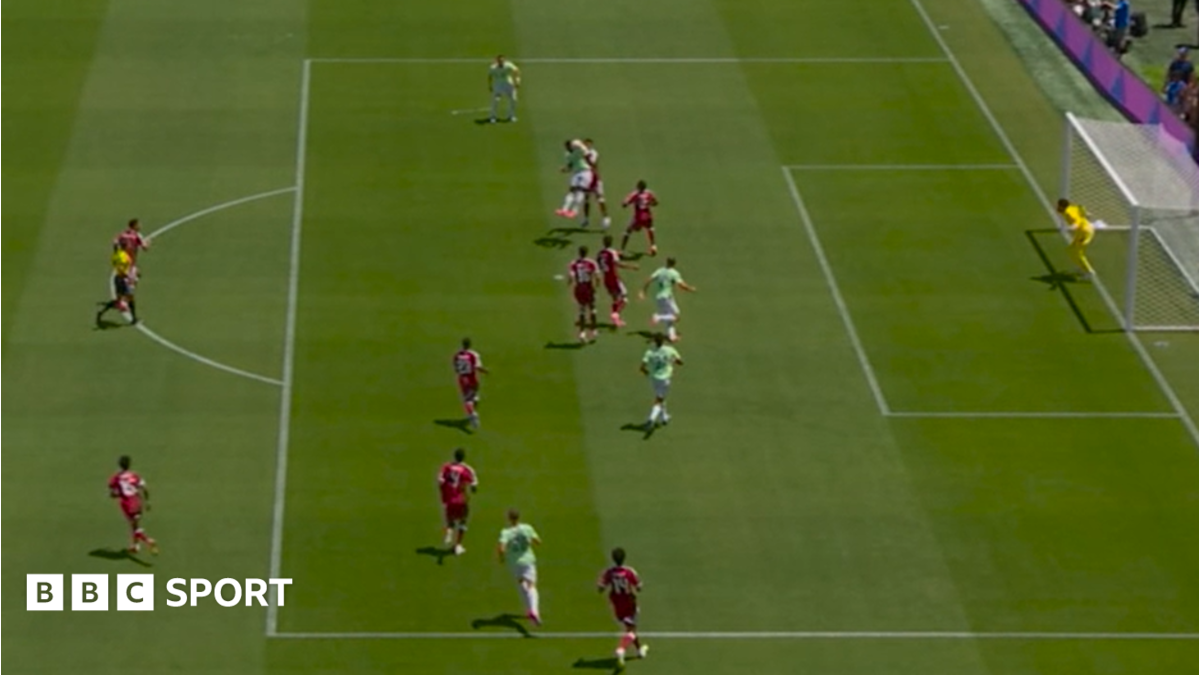
Was Switzerland’s Remo Freuler offside before he was brought down by Qatar goalkeeper Mahmoud Abunada?
It is the question that, for many, remains unanswered despite Fifa finally releasing images four and a half hours after the incident happened.
The move led to a penalty, converted by Breel Embolo, as the teams drew 1-1 in Saturday’s World Cup Group B match in Santa Clara.
Before the tournament Fifa put a lot of stock in its new, enhanced semi-automated offside system.
World football’s governing body scanned every player at the World Cup to create unique, lifelike avatars.
It was supposed to provide the most accurate illustration of offside decisions we have ever seen.
But it did not work and Fifa had to revert to drawing lines to the players and on the pitch.
Fifa released a statement saying “a brief technical outage prevented the onside animation graphic from being generated”.
It went on to say the lines drawn by the video assistant referee (VAR) showed no offside and released two images – which remain unconvincing – but not the usual avatar graphics.
Within the move, two Switzerland players could potentially have been offside.
Fifa released an image for both as evidence they were onside. The first was for Embolo in the build-up, the second for Freuler before he was fouled by Abunada.
Fifa’s statement read: “The workflow of the VAR was not affected by this issue and followed the normal procedure in checking the on-field decision.
“The lines used by the VAR to check the position of the relevant players did not show the attacking player to be in an offside position in either of the two situations immediately before the penalty decision.”
The semi-automated technology is not flawless. It can be impacted by many things, such as players being close together or even something as random as ticker tape on the pitch.
When the technology fails in the Premier League there is the option to fall back to the old technology where the VAR draws the lines.
But the offside image is produced straight away, not several hours later.
“We all think [it was offside],” Gary Neville said on ITV before the statement was released.
“Everybody at home thinks it. Fifa are the host broadcaster and they have the semi-automatic decision that they can show us.
“There is a massive question over that because it is offside in my eyes until they prove to me different.”
If there is one thing that is guaranteed to create doubt it is delay. It creates a vacuum that feeds conspiracy theories. It might give the impression Fifa is hiding something.
Qatar has earned its first-ever FIFA World Cup point in dramatic fashion against Switzerland. An injury time own goal put Qatar level with the Swiss in San Francisco. Al Jazeera’s Paul Rhys was there.
Asian Cup holders Qatar level in injury time to draw 1-1 with Switzerland in World Cup 2026 opening game.
Published On 13 Jun 202613 Jun 2026
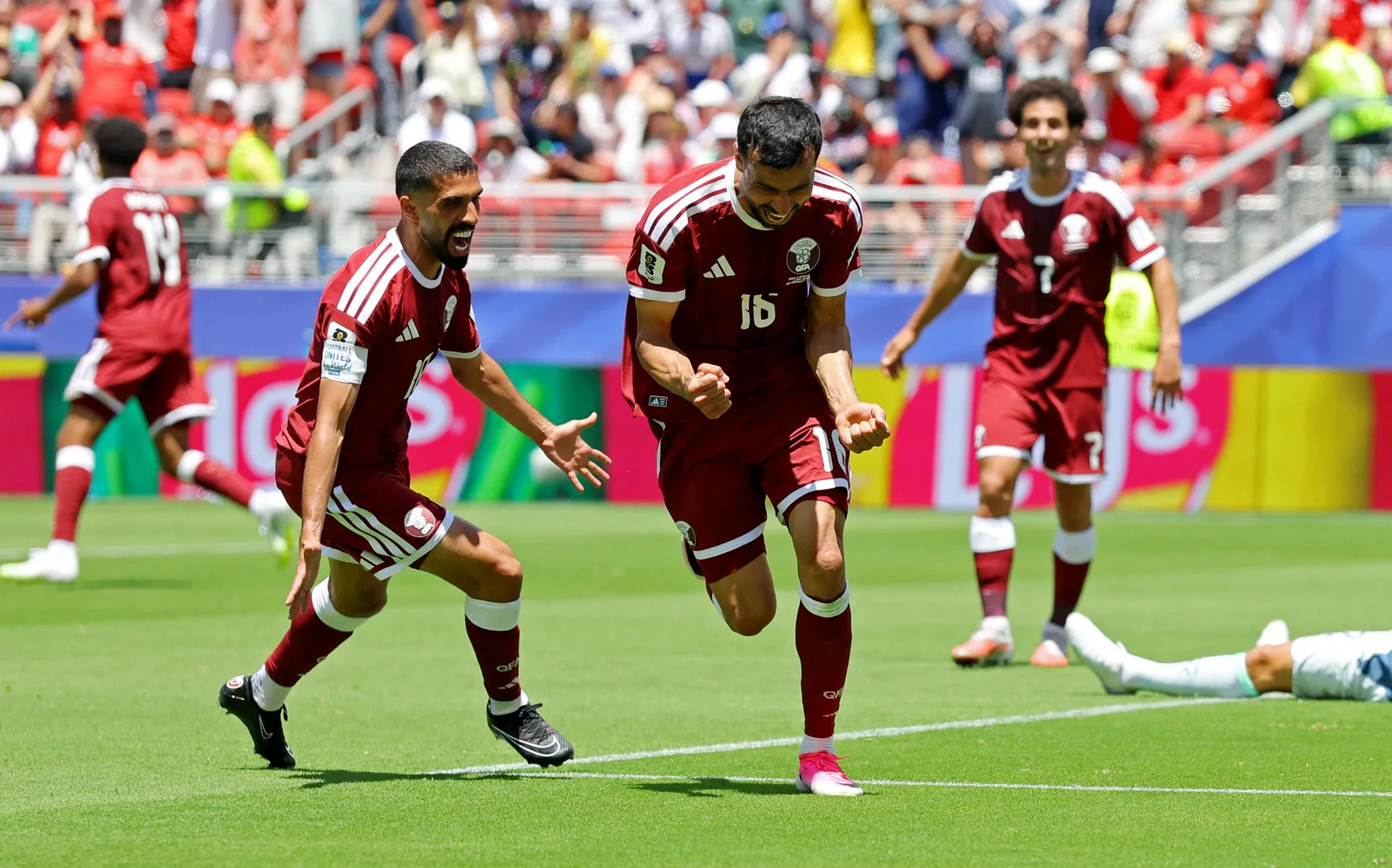
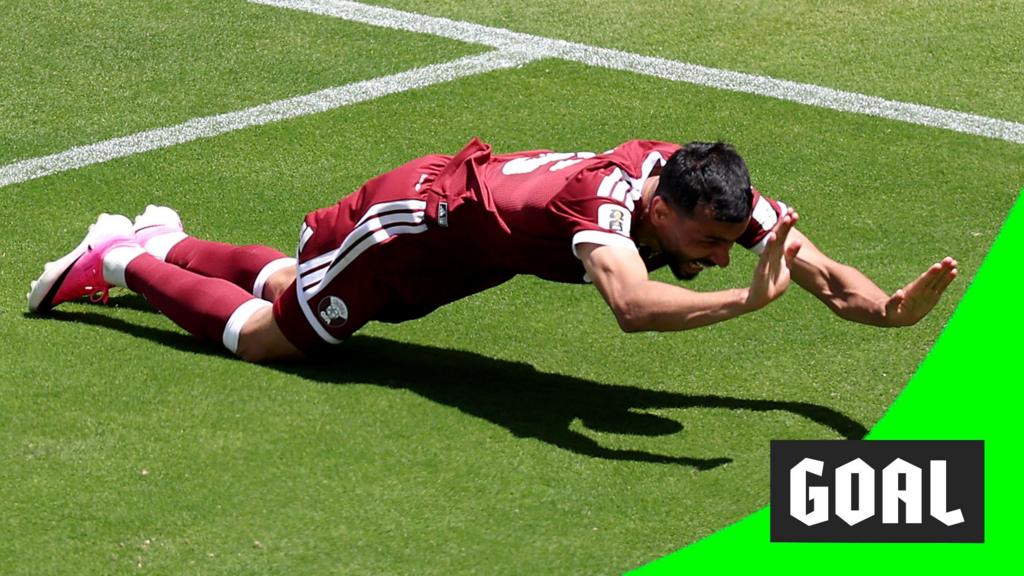
Boualem Khoukhi scored an equalising goal on a header in the fourth minute of stoppage time, and Qatar spoiled a dominant day by Switzerland in a 1-1 draw in Group B of the World Cup.
Several of the Qatari players fell to the ground on Saturday in celebration of the late goal, as others ran to each other to embrace.
Recommended Stories
list of 4 itemsend of list
Breel Embolo scored for Switzerland from the penalty spot in the first half just over a week after being cleared to enter the US following a visa delay, but the Swiss failed to capitalise on multiple other scoring chances.
In the 13th minute, Embolo was fouled by Qatar goalkeeper Mahmoud Abunada, who received a yellow card on the play. Abunada lay face down and appeared motionless for a couple of minutes before he began to move his legs and was able to stand up again.
When Embolo calmly sent his penalty into the upper left corner in the 17th minute, it sent the red-clad Swiss fans into a dancing frenzy in the stands of San Francisco Bay Area Stadium.
The 29-year-old forward applied for an urgent visa at the United States embassy in Bern on June 3, one day after he was denied boarding the team’s flight to travel for his third World Cup because of a 2018 criminal conviction that was only finalised in April.
Switzerland dominated the possession game on an unseasonably warm June afternoon — with sprinklers running during a first-half break.
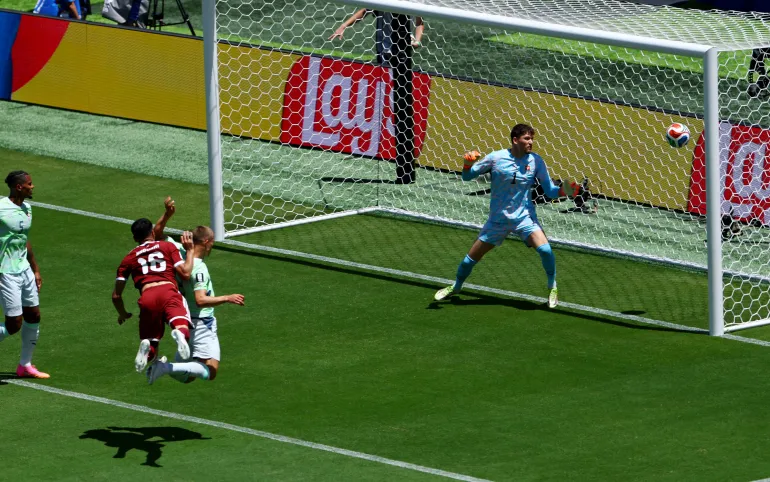
Qatar’s Boualem Khoukhi scores their first goal past Switzerland’s Gregor Kobel [Eloisa Lopez/Reuters]
There were thousands of empty seats scattered throughout Levi’s Stadium, home of the NFL’s San Francisco 49ers. Brazil and Colombia drew 70,971 two years ago in a group match at the Copa America. The stadium in Santa Clara staged the Super Bowl only four months ago.
Switzerland goalkeeper Gregor Kobel made a save in the second minute after Edmilson Junior got through the defence for a one-on-one. Kobel corralled the ball again in the 90th on a close-range attempt by Ahmed Alaaeldin.
Switzerland is hoping to advance further than its round-of-16 showing four years ago before losing 6-1 to Portugal — when Goncalo Ramos delivered an improbable hat-trick playing in place of benched star Cristiano Ronaldo. The loss prompted Switzerland midfielder Xherdan Shaqiri to apologize the the fans.
The Swiss used consistency and experience to go unbeaten through qualifying against Sweden, Kosovo and Slovenia. Coach Murat Yakin’s team produced four wins and two draws to secure its sixth straight World Cup appearance and hasn’t missed one since 2002, but the team has never gotten beyond the quarterfinals.
Qatar, led by Spanish coach Julen Lopetegui, had to qualify through a playoff in November — beating the United Arab Emirates and Oman — after missing an opportunity from its group stage of Asian qualifying.
The Gulf state country became the first host nation to lose all of its group matches four years ago. It lost to Senegal, Ecuador and the Netherlands in the 2022 tournament, scoring its lone goal in a 3-1 loss to Senegal.
Qatar’s Boualem Khoukhi heads home an equaliser in added on time as his side earn their first ever World Cup point against Switzerland in San Francisco.
The World Cup continues on Saturday, with Brazil beginning their campaign and three more group-stage matches taking place across North America.
Brazil take on Morocco in the day’s biggest match, while Qatar face Switzerland, Haiti meet Scotland and Australia play Turkiye as more teams get their tournaments under way.
Recommended Stories
list of 4 itemsend of list
Away from the football, there has been plenty to talk about. Donald Trump skipped the United States’ opener, former Canadian Prime Minister Justin Trudeau was at the US game instead of Canada’s, and Ghana midfielder Thomas Partey will miss his team’s first match after Canada denied his visa application.
In Peru, police made headlines after carrying out a drug raid dressed as World Cup mascots.
Here is what to know:
What’s the World Cup schedule on June 13?
Qatar take on Switzerland at BC Place in Vancouver, with kickoff scheduled for 12pm local time (19:00 GMT).
The day’s action concludes with Haiti meeting Scotland at AT&T Stadium in Arlington, Texas. Kickoff is set for 8pm local time (01:00 GMT on June 14).
Australia and Turkiye then get Group D under way at Lumen Field in Seattle, with kickoff at 9pm local time (04:00 GMT on June 14).
What do the predictions say for Brazil vs Morocco?
Brazil and Morocco have only faced each other once before at a World Cup, with Brazil winning their 1998 group-stage meeting. Morocco got their revenge in a 2-1 friendly win in 2023.
Brazil have won seven of their eight World Cup matches against African opponents, with their only defeat coming against Cameroon in 2022.
The five-time champions have not lifted the trophy since 2002. Since then, they have usually exited in the quarterfinals, apart from their run to the 2014 semifinals.
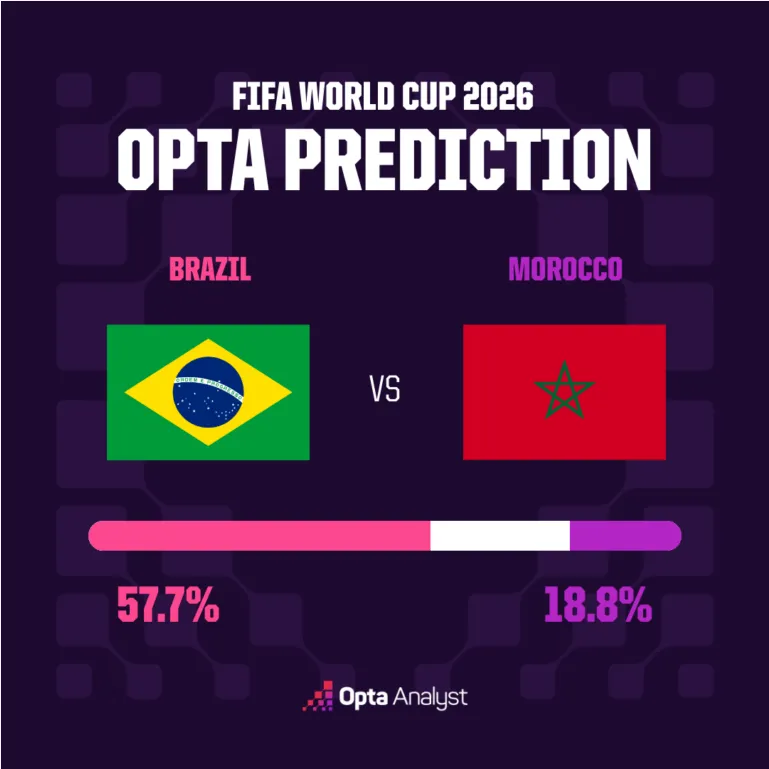
Opta’s 25,000 simulations give Brazil a 57.7 percent chance of winning. A draw happened in 23.5 percent of the projections, while Morocco won in 18.8 percent.
The winner could put themselves in a strong position to top Group C.
What do the predictions say for Qatar vs Switzerland?
Qatar and Switzerland have met only once before, with Qatar claiming a 1-0 friendly win in 2018 thanks to a late goal from Akram Afif. Afif is among nine players from that squad still in Qatar’s 2026 World Cup team, while Switzerland have seven survivors from that defeat, including Granit Xhaka and Remo Freuler.
Opta’s 25,000 simulations make Switzerland the clear favourites in this Group B clash, giving them a 76.0 percent chance of victory. Qatar won just 9.1 percent of the projections, while 14.9 percent ended in a draw.
A point would likely be considered a positive result for the Gulf side.
What do the predictions say for Australia vs Turkiye?
Australia and Turkiye have met only twice before, with Turkiye winning both friendlies in 2004. Turkiye have also won all four of their previous World Cup matches against Asian opponents.
Opta’s 10,000 simulations give Turkiye a 55.3 percent chance of victory, compared with 20.5 percent for Australia and 24.1 percent for a draw.
Neither side has a strong record in World Cup openers, however. Turkiye have lost both of their previous first matches, while Australia have lost five of their six opening games.
What do the predictions say for Haiti vs Scotland?
Haiti and Scotland have never faced each other before, making this one of several first-time matchups at the expanded 48-team World Cup. It will also be Haiti’s first-ever game against a team from the British Isles.
Opta’s 25,000 simulations make Scotland clear favourites, giving them a 59.0 percent chance of victory. Haiti won 19.2 percent of the projections, while 21.8 percent ended in a draw.
Haiti vs Scotland
What else is shaping the World Cup?
The football has only just started, but the World Cup is already making headlines away from the pitch, too.
Trump did not attend the US World Cup opener
The US president did not attend the US men’s national team’s World Cup opener against Paraguay in Los Angeles.
His absence drew attention because Trump has recently attended several high-profile sporting events, including Game 3 of the NBA Finals earlier this week. He is also expected to host a UFC event at the White House on Sunday.
A White House official said Trump instead plans to attend the World Cup final on July 19 at MetLife Stadium in East Rutherford, New Jersey.
The US president called into a USMNT team meeting with some words of support via Andrew Giuliani, the White House’s World Cup task force CEO.
Partey denied entry into Canada
Ghana midfielder Thomas Partey will miss his country’s World Cup opener against Panama after Canada denied his visa application while he awaits trial in the United Kingdom on multiple rape charges, which he denies.
FIFA confirmed on Friday that the 32-year-old would not be permitted to travel from Ghana’s base camp in Smithfield, Rhode Island, to Toronto for Wednesday’s match.
“His visa application has been refused by the Canadian government,” FIFA said in a statement.
“FIFA is not involved in the immigration processes of host countries, including the adjudication of visas. As with previous FIFA events, the host government ultimately determines who receives a visa and is admitted into the country.”
Trudeau attends the US’s World Cup
As Canada and the US kicked off their World Cup campaigns on the same day, former Canadian Prime Minister Justin Trudeau was in California rather than Toronto.
The 54-year-old did not attend Canada’s 1-1 draw with Bosnia and Herzegovina at BMO Field. Instead, he was at SoFi Stadium in Inglewood alongside pop singer Katy Perry, who performed during the pre-match opening ceremony before the US faced Paraguay.
Peruvian officers use World Cup mascot costumes in Lima drug bust
Peruvian police have gone viral after carrying out a drug raid in Lima dressed as World Cup mascots.
Video shared by police showed officers dressed as World Cup mascots breaking through a metal gate with a battering ram before entering the property.
Once inside, they arrested a suspected drug dealer and recovered weapons and bags of what authorities believe were narcotics.
The World Cup may be decided on the pitch, but another competition is already under way off it: Which host city has the best food?
In a report for Al Jazeera, Lou Browne travelled across North America to find out what fans can expect beyond the stadiums.
In Mexico City, taco vendors are hoping the tournament brings more customers. “Well, now the World Cup is coming, and we hope we’ll get customers,” a tortilla cook at El Califa de Leon told Al Jazeera. “I imagine there will be a lot of people, foreigners or locals.”
Philadelphia is proudly backing its famous Philly cheesesteak. Locals say visitors should learn how to order properly. “You want to tell them what kind of cheese you want,” Anthony Rossi, a cook at Geno’s Steaks, explained. “And you say if you want onions, which is ‘wit’ or ‘wit-out’ … Keep it simple.”
Across the border, Toronto is making the case for poutine, the Canadian dish of fries topped with gravy and cheese curds. “Poutine is the … not the best … dish, but poutine is from Canada,” said Lisa Deni, a French tourist.
In Kansas City, barbecue is a point of pride. “This is really good,” diner Camilla Thomas said. “We’ve been enjoying coming here. and bringing people from out of town here and giving them a little taste of Kansas City.”
And in Miami, locals insist the Cuban sandwich is a must-try. “The Cuban sandwich, croquetas, and cafecito are really the way to go,” said Daniel Figueredo, cofounder of Sanguich. “The Cuban sandwich really is the thing you have to have when you come to Miami.”
For fans travelling across North America this summer, the hardest choice may not be picking the World Cup winner, but deciding which host city serves the best food.
As Washington and Tehran move towards a long-term ceasefire agreement, Gulf states will likely look for new long-term security solutions when a war in their region – which they did not start – finally ends.
It comes as United States President Donald Trump cancelled new strikes on Iran saying that a deal with Tehran was imminent, and that a “time” and “place” for signing would soon be announced.
Recommended Stories
list of 4 itemsend of list
In Tehran, officials appeared more cautious with one senior Iranian official telling Al Jazeera that the government was still reviewing a proposed Memorandum of Understanding with Washington.
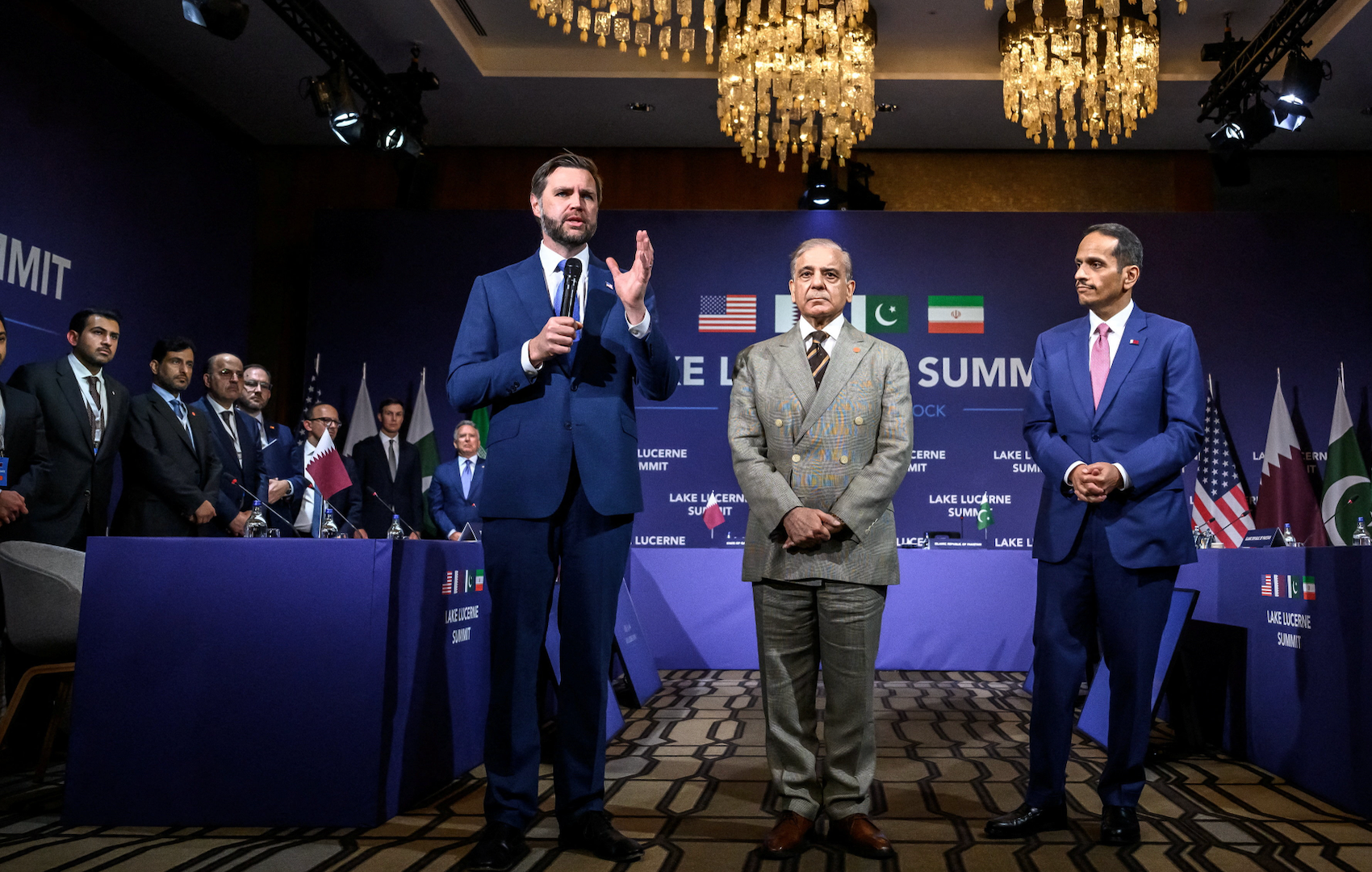
Subsequent comments by Pakistan Prime Minister Shehbaz Sharif point to a deal being made, and what follows in the coming days could have important implications for collective regional security.
Attacks on the Gulf
The United States operates military facilities in at least 19 locations across the MENA region, including permanent bases in Bahrain, Egypt, Iraq, Jordan, Kuwait, Qatar, Saudi Arabia and the United Arab Emirates, according to the Council on Foreign Relations. Between 40,000 and 50,000 US troops were stationed across the region before the war on Iran started.
This US-Gulf nexus appeared to insulate states from conflicts engulfing other parts of the region, but over the past four months, Gulf states hosting US military facilities have been targeted by Iran.
“If there is a way to describe the prevailing security model in the region since the 1980s, the concept of security partnerships best encapsulates it,” said Mahjoub Al-Zuwairi, an academic and expert on Middle East politics.
“The countries of the region have chosen to align their security with broad international alliances. For decades, this model has provided a reasonable deterrent and logistical and intelligence depth that is difficult to replace.”
Iranians in Tehran at the funerals of Iran’s Revolutionary Guards Corps (IRGC) commanders, army officers and others killed in the early days of the United States and Israeli strikes on Iran, March 11, 2026 [AFP]
A security umbrella with holes
The war on Iran has exposed a paradox – while Iranian officials have repeatedly referred to their Gulf neighbours as “brothers”, they have also repeatedly targeted them during the war.
Despite the protestations of Gulf states that no attacks on Iran were launched from their soil, they have been repeatedly targeted.
“Just the war itself has pierced that sense of security, the US security umbrella is moribund at worst, or ineffective at best,” Simon Mabon, professor of international relations at Lancaster University, told Al Jazeera.
“They’ve long relied on it for their own security. Yet the presence of US forces on their territory directly meant they became targets. They can’t escape their geography [and] despite the tensions, despite the hostilities, despite the attacks, Iran isn’t going away. They have to find a way of dealing with this reality.”
The economic cost of war
The closure of the Strait of Hormuz has proven be a setback for some Gulf states working to diversify their energy-reliant economies towards tourism, services and finance, but not all have been affected equally.
Saudi Arabia was able to redirect some oil exports through its East-West pipeline to the Red Sea, while Oman – whose main ports are outside the Strait of Hormuz – has also benefited from rising energy prices.
The UAE, Bahrain, Kuwait and Qatar have been more heavily affected due to their dependence on the waterway for their energy exports, but the war has encouraged new thinking on long-standing security and economic arrangements.
“There are new pipelines being set up, but the capacity of these alternatives is infinitely smaller than the Strait itself,” said Mabon. “It will take enormous investment and years of development before they can come close to replacing it.”
Moving closer to Iran?
One possible lesson from the conflict is that Gulf states may seek engagement with Iran rather than confrontation, something that Gulf states had already made some groundwork on before the US-Israel war began.
Al-Zuwairi says that the conflict could revive plans for MENA-led regional security arrangements, as envisioned in the 2019 Hormuz Peace Initiative, which proposed a Gulf security framework involving Iran, Iraq and the six GCC states.
But the distrust fostered since then – notably Tehran’s strikes on its Gulf neighbours – would make such a formation unlikely in the near future.
“The recent war has opened the door wide to reconsidering the Gulf security system with its neighbours,” Al-Zuwairi said.
“How can Tehran propose a non-aggression pact while raining missiles on neighbouring cities? The initiative appears theoretically sound but practically bankrupt unless Iranian behaviour changes.”
Looking beyond Washington?
The solution for the Gulf could be a hybrid arrangement where ties with Washington are maintained, but other regional and domestic options are explored, including greater investment in local defence industries.
A possible blueprint for this could be the mutual defence agreement between Saudi Arabia and Pakistan last September, stating that an attack on one country would be considered an attack on both.
Yet previous instances when Gulf states felt abandoned by the US have led to divergent responses, with the UAE and Bahrain deepening ties with Israel, but a new paradigm means that a more collective action to the issue of security might be considered.
“The war has demonstrated that every guarantor, no matter how many banners it flies, primarily protects its own interests,” said Al-Zuwairi.
“The region ends up paying the price for a war it did not choose … The security of the Gulf will not be created in Washington … It will be created when Gulf countries recognise that they must build it themselves, because when fires start, it is always those closest to the flames who pay the price.”
The Washington institution cut its global growth forecast by 0.4 percentage points to 2.5 percent, citing surging energy prices, inflation and borrowing costs.
Published On 11 Jun 202611 Jun 2026
The conflict in the Middle East is set to bring global economic growth to its slowest since the COVID-19 pandemic, the World Bank has warned.
In its latest Global Economic Prospects report, published on Thursday, the Washington-based institution cut its global growth forecast for 2026 to 2.5 percent from the 2.9 percent it had predicted in January, citing surging energy prices, rising inflation and higher borrowing costs.
Recommended Stories
list of 3 itemsend of list
The report highlights the significant economic costs of the conflict, which is at risk of flaring up again, as the fragile ceasefire between the United States and Iran is tested on both sides.
The analysis warns that the outlook could decline further if supply disruptions worsen. Iran’s closure of the Strait of Hormuz – a vital passageway for oil and gas transit – in response to the hostilities launched by the US and Israel has put huge stress upon global energy and other supply chains.
The World Bank estimates that Brent crude prices — the international oil benchmark — will average $94 a barrel this year, 36 percent above last year’s average. Fertiliser prices are forecast to increase significantly this year, with knock-on effects for food prices.
Overall, the closure of the strategic waterway will help to push global inflation to 4 percent this year, a substantial increase from last year’s rate of 3.3 percent.
However, the World Bank cautions that global growth could plummet to as low as 1.3 percent this year, should energy supply disruptions worsen, with inflation pushing to 4.4 percent.
The World Bank report also cautions that developing countries are on the front line of the potential impact.
In its report, the institution has downgraded its growth forecasts for two-thirds of countries since January. Global growth is expected to improve to 2.8 percent in 2027, but will remain 0.4 percentage points below the average during the 2010s, during which the world economy was recovering from the global financial crisis.
Excluding China and India, the report worries that developing countries have made little progress towards narrowing their per capita income gap with wealthy nations over the past decade.
“Developing countries have faced a series of challenges over the last decade,” said Ajay Banga, president of the World Bank Group. “The impact differs by country, but the basic test is the same: protect people and preserve stability today, without giving up on growth and jobs tomorrow.”
The World Bank is pledging to assist any developing country experiencing the economic fallout of the Middle East conflict. The organisation says it has set aside up to $60bn to help. It added that if the conflict persists, it can increase its support to $100bn.
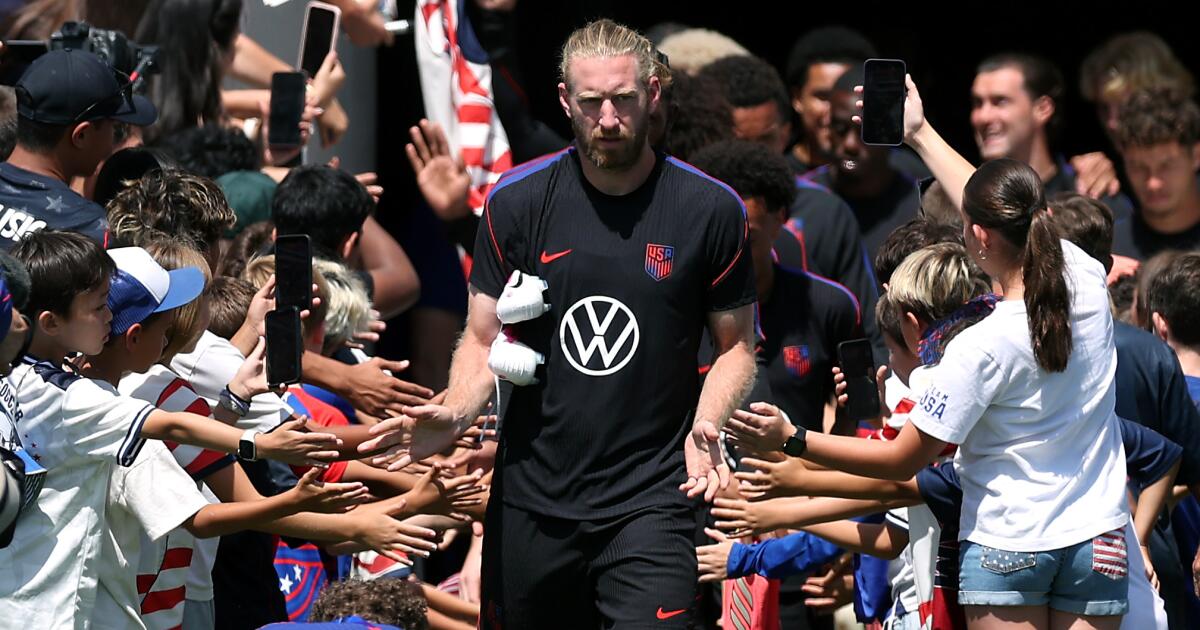
Tim Ream is the only player on the American World Cup team who was alive the last time the tournament was played in the U.S. But he was only 5, so the memories are kind of sketchy.
“I remember bits and pieces of 1994,” he said.
Still, it’s fallen on Ream, as both the captain and the oldest man on the roster, to prepare the team for what they’re about to experience when the U.S. opens play Friday at SoFi Stadium.
“I’ve tried to tell guys and tried to convey the message that this is a once-in-a-career [opportunity] and with that comes more expectation, more pressure,” he said. “But at the same time we have to enjoy it.
“It’s about just opening your eyes and taking everything in because this is unique, this is completely different from anything that any of us as players has experienced.”
Only 22 men in history have suited up for a home World Cup game on U.S. soil. Players including Alexi Lalas, Eric Wynalda, Cobi Jones and Marcelo Balboa parlayed that fame into broadcasting careers. Others have become coaches. Fifteen of them were inducted into the National Soccer Hall of Fame.
Ream, who played in the last World Cup in Qatar, said it’s difficult to compare the experience of that tournament with this one — especially since this one hasn’t started yet.
“It’s not our first rodeo, but it’s our first one on U.S. soil,” he said. “So it’s kind of our first rodeo in a way. It’s exciting.
“So take it in, enjoy it, embrace everything that it is. Because it’s so unique, it’s so special. And it’s not something that we will ever get to do again.”
Midfielder Cristian Roldan was also at the last World Cup, although he didn’t appear in a game. He says the energy is different this time around.
“You feel it when you’re there. You’re kind of isolated, you’re alone,” said Roldan, one of 13 players on this team who were also on the team in Qatar, half a world away. “But it’s different here. You see how many media members are here. You see how many people we’ve seen in training over the last few weeks. You feel that energy, you feel that support.
“Now it’s about translating that energy, that support, that pressure into something good.”
Goalkeeper Matt Turner agreed.
“This one, obviously, it’s a lot more tangible,” he told reporters Tuesday. “You guys are all here, right, real close to us. We have 5,000 fans for training yesterday. It’s very different. In Qatar, you’re in a lot more of a bubble.
“But us players, the ones that had the [World Cup] experiences, I think we’ve done a really good job of keeping that boundary.”
What’s lacking this time, Turner said, was the pressure of a qualifying campaign to bring the team together. Because the U.S. is one of the three host countries — alongside Mexico and Canada — it was assured a spot in 48-team field when it won the right to stage the tournament eight years ago. As a result it hasn’t played a competitive game in more than 11 months.
“The intensity of those games, the environments that you have to dip into and get results, you find out a lot about the players and find out a lot about the team,” he said. “This time around, it’s been different. We’ve had a lot of different looks, a lot of different players getting a chance to prove themselves and show themselves.
“It’s not anything bad or good. I just think it was a little bit different.”
Striker Folarin Balogun, one of 13 World Cup newbies on the U.S. team, said he doesn’t expect the gravity of the experience to hit him until he lines up for Friday’s opening game with Paraguay.
“It’s probably going to start to go more real to me when I’m preparing to go on to the pitch,” he said, sitting behind a table next to Ream. “I’m hearing the fans shouting and screaming, so I definitely think it’ll be real to me the closer I get.
“But you know, this is the first opportunity for me to play in the World Cup so I don’t really have any expectations.”
Balogun then looked over at a frowning Ream, who had just finished urging his teammates to be sure to stop and smell the flowers along this World Cup journey.
“Just trying to stay present, stay in the moment,” Balogun hastened to add. “You know, enjoying the experience. I think it can be a really memorable World Cup.”
Guillermo “Memo” Ochoa has experienced nearly everything a Mexican soccer player could imagine. World Cups, titles, criticism, adulation, impossible saves and nights when he practically carried the weight of an entire national team on his own. But at 40, the legendary Guadalajara-born goalkeeper seems to be looking toward the end of his career with a different kind of calm. No drama. No exaggerated nostalgia. Like someone who knows exactly what he has achieved and what he still wants to give to Mexican soccer before saying goodbye.
The Mexican goalkeeper recently confirmed that the 2026 World Cup will be the last of his career with the Mexican national team and likely also as a professional soccer player, thus closing a career that will place him on a list reserved for few names in soccer history.
If he manages to play at least one minute in this summer’s tournament hosted by Mexico, the United States and Canada, Ochoa will have appeared in six World Cups — a feat he would share only with figures like Lionel Messi and Cristiano Ronaldo. Though the goalkeeper himself makes it clear that he never puts himself on the same level as those legends.
“Being on that exclusive list would of course be fantastic on a personal level, but it would be even nicer and more interesting if people remember in the future that a Mexican shares that list with them,” Ochoa said.
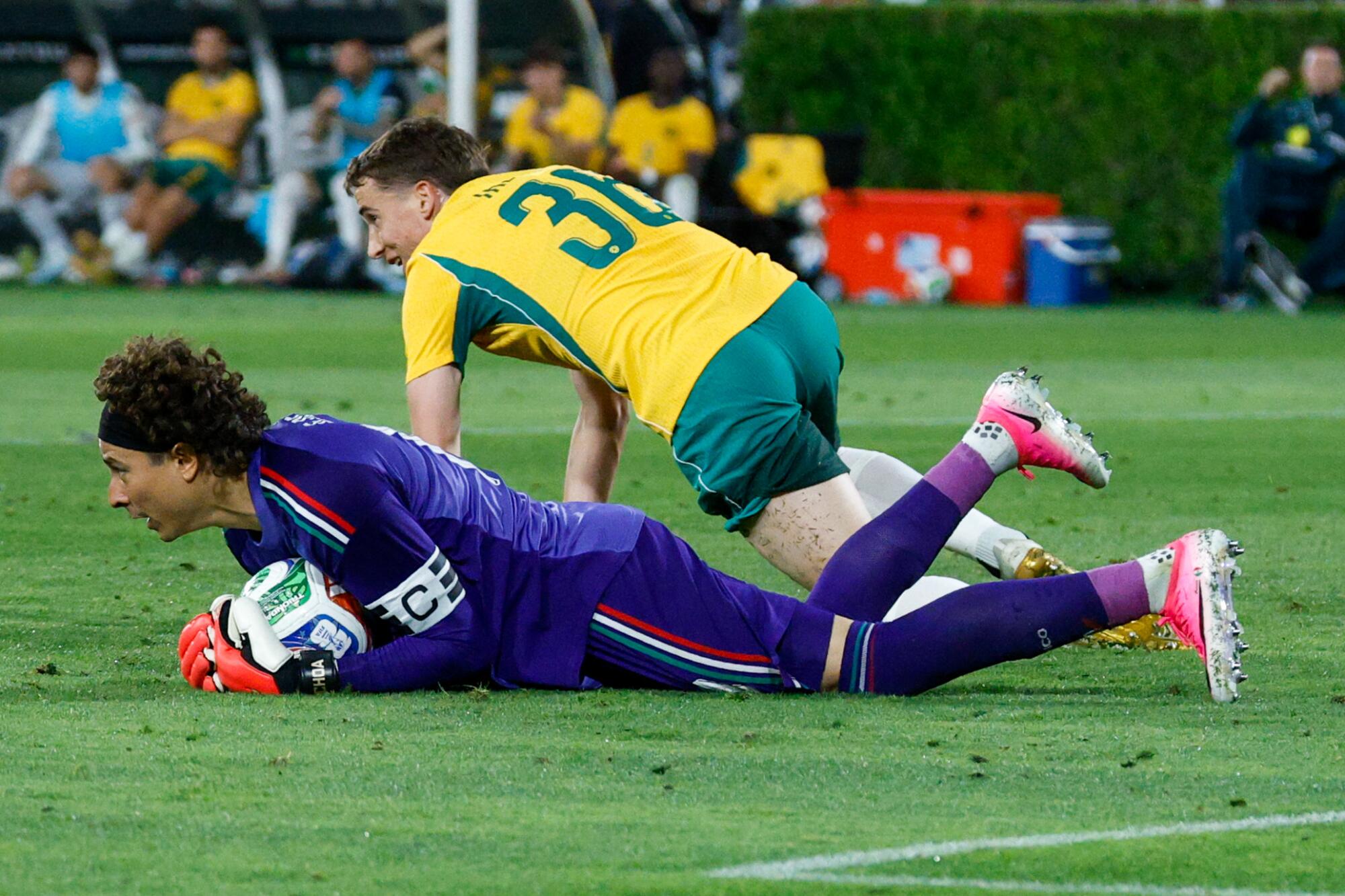
Mexican goalkeeper Guillermo Ochoa lays down and collects the ball during a friendly against Australia at the Rose Bowl on May 30.
(Ronaldo Bolanos/Los Angeles Times)
“They’re light years ahead of me in terms of what they’ve done in their careers, the goals they’ve scored, the titles they’ve won. I don’t compare myself to them at all. But the best thing would be if, one day, we could see a Mexican on that list.”
After being left out of some recent call-ups with the Mexican national team and facing doubts about his future beyond the 2022 World Cup in Qatar, the veteran goalkeeper found a second soccer life in Europe.
First came the opportunity to play in Italy’s Serie A with US Salernitana 1919 and later he continued his career in Cyprus with AEL Limassol, staying physically sharp and keeping alive the possibility of reaching another World Cup.
“After the World Cup in Qatar, I thought to myself, ‘Let’s see what happens.’ Then the chance to play in Italy’s Serie A came up and I thought, ‘I’m not that far off anymore; I’m very close to the next World Cup,’” said Ochoa, who previously played for Club América.
“That’s when my mind said, ‘I can make it, I feel good, I’m in good shape, let’s go for it.’ But this is going to be my last one. Now there’s no turning back.”
Mexican goalkeeper Guillermo Ochoa directs his teammates during a corner kick against Australia at the Rose Bowl on May 30.
(Ronaldo Bolanos/Los Angeles Times)
Ochoa spoke about the announcement without a solemn tone. His history with Mexico spans practically an entire generation of fans. He made his professional debut with Club América in 2004 and appeared in his first World Cup two years later in Germany. Since then, he has gone from a young backup to an absolute icon for El Tri on the World Cup stage.
During the 2014 World Cup in Brazil, he delivered perhaps the most iconic performance of his career, becoming a hero against the host nation and stopping everything Neymar and company threw at him in Fortaleza. Four years later, in Russia, he delivered another memorable night in Mexico’s victory over Germany, stopping the reigning world champions. And in Qatar, he added another iconic moment by stopping Polish star Robert Lewandowski’s penalty kick.
Now, as Ochoa prepares for what could be his final World Cup on home soil, he insists that the goal is to maintain that level of excellence.
“That’s the standard, that’s the bar,” he said of his historic performances. “The intention is to be at that level. If I’m on the field, I have to do it. I have to be ready to perform at that level. And if I’m not called upon to do so, I’ll help and support.”
Because although his name remains one of the most important in the recent history of Mexican soccer, the starting spot no longer belongs to him. Mexican coach Javier Aguirre has publicly insisted that Ochoa will have to compete for minutes like any other player.
“I have to earn it,” Ochoa recently told reporters.
Meanwhile, the veteran goalkeeper also enjoys the chance to look back and laugh at all the stories from his nearly two decades of World Cup training camps.
Because behind the serious figure who stands between the posts lies a player who has experienced practically everything at the World Cups.
“We’ve been through it all,” he recalled with a laugh.
He spoke of animals climbing through the windows at training camps and impromptu matches on Brazilian beaches.
“In South Africa, we had to use golf carts. You have no idea the races we had in those carts that people didn’t see. We ended up with the carts overturned all over the training camp,” he recalled. “In Brazil, we’d have friendly matches on the beach after some games. It’s been so many years that it’s not hard to remember so many things — good, bad, silly — but it’s been a lot of fun.”
The combination of longevity, outgoing personality and historic performances made Ochoa one of the most recognizable Mexican soccer players of the last two decades. For many fans outside Mexico, the surname Ochoa is synonymous with the World Cup.
Mexican goalkeeper Guillermo Ochoa plays a ball during a training session on March 26.
(Marco Ugarte / Associated Press)
Even among international fans, there is special recognition of the Mexican goalkeeper due to his ability to rise to the occasion on the biggest stages.
But far from getting caught up in nostalgia, Ochoa is beginning to envision what comes after retirement.
While he admits it will be practically impossible to completely detach himself from soccer, he said there are important things to accomplish off the field.
“Stepping away from soccer is difficult. My name and my image are associated with soccer,” he acknowledged.
“There are many projects ahead. I’m someone who likes to make long-term agreements and plans. When you share values and goals, it’s easier to work together.”
For now, however, he said his full focus is solely on the World Cup.
“We can’t get distracted by other things,” he said. “The least the national team and the upcoming tournament deserve is for us to be 100% focused on that.”
Mexico arrives at the World Cup with enormous expectations and a lot of pressure as one of the tournament’s hosts. And although the spotlight will naturally fall on a new generation of players, Ochoa represents a bridge between different eras of Mexican soccer.
From the young, long-haired goalkeeper who appeared in Germany 2006 to the veteran leader who now seeks to cap his career at home, Ochoa has built a career that would be difficult for any Mexican soccer player to replicate.
An imperfect career, yes, but also one of profound resilience.
It is fitting that his farewell comes with one more World Cup — the stage where he became a legend.
Hamas says it will not hand over its weapons right now, resisting ongoing disarmament demands and stating that the ultimate fate of its military arsenal will be decided following comprehensive discussions with other Palestinian factions.
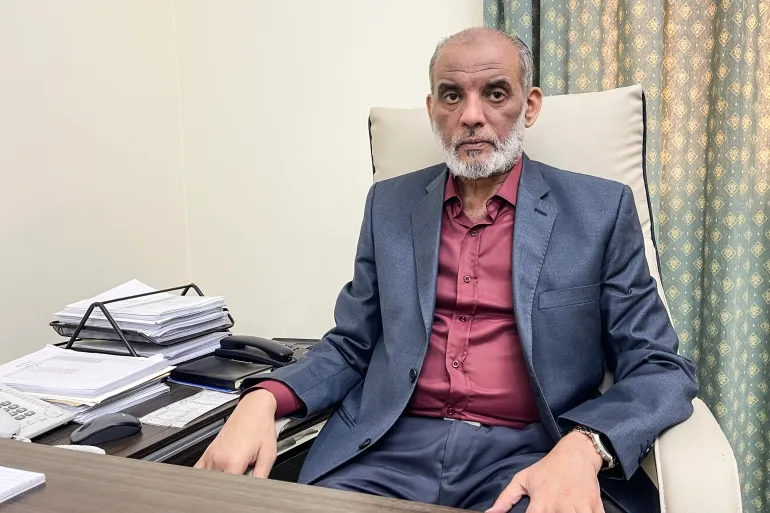
Husam Badran, a member of the Hamas political bureau, spoke exclusively to Al Jazeera about the group’s vision for a long-term ceasefire in Gaza [Mohammad Mansour/Al Jazeera]
In an exclusive interview with Al Jazeera, Husam Badran, a member of the Hamas political bureau, offered an inside look into the group’s proposed solutions to the stalled negotiations, introducing the concept of a long-term hudna (truce).
“When this Palestinian committee [the National Committee for the Administration of Gaza (NCAG)] comes to take over the Gaza Strip, there will be no visible weapons in the streets and alleys of Gaza except the official weapons belonging to this committee, which is the official Palestinian police, ” Badran told Al Jazeera. “There will be no armed manifestations like the ones we were accustomed to in the Gaza Strip.”
But he clarified that this did not mean a formal surrender of arms.
“We are not talking about handing them over; we are talking about, at least, weapons not being visible except for the official weapons of the Palestinian police,” he said. “The details of this matter will be discussed within a national framework.”
The Hamas stance comes as an informed source told Al Jazeera that the group is preparing to send its delegation to Cairo for renewed talks, which are set to begin this weekend. Hamas had briefly delayed its participation to demand a halt to ongoing Israeli assassinations—such as the recent killings of military commanders Izz al-Din al-Haddad and Mohammed Odeh—to ensure a more favourable negotiating environment.
The disarmament of Hamas and the withdrawal of Israeli troops from Gaza remain the biggest sticking points in the United States-brokered October 2025 ceasefire plan.
Factional consensus in Cairo
The upcoming Cairo meetings will gather eight key Palestinian factions to form a unified national stance. Badran confirmed the attendance of representatives from Hamas, Palestinian Islamic Jihad (PIJ), the Popular Front for the Liberation of Palestine (PFLP), the Democratic Front for the Liberation of Palestine (DFLP), the PFLP-GC, the National Initiative, the Popular Resistance Committees (PRC), and the Democratic Reform Current affiliated with the Fatah movement.
These talks aim to salvage the ceasefire originally proposed by United States President Donald Trump. However, Badran noted that Israel has failed to implement even 30 percent of its phase one obligations, making any transition to subsequent phases impossible.
“We are talking about humanitarian aid … the Rafah crossing mechanism, the infrastructure, and the assassinations,” Badran explained. “The idea was a comprehensive ceasefire, but around 1,000 people have been killed. Saying Israel implemented even 30 percent is an overstatement.”
Only 150 to 250 aid trucks are entering the Gaza Strip daily instead of the agreed-upon 600, while the critical infrastructure for electricity, hospitals and fuel remains completely decimated.
The ‘disarmament’ deadlock
While Palestinian factions demand the fulfilment of these phase one survival metrics, Israeli officials and Nickolay Mladenov, the high representative for Gaza on Trump’s “Board of Peace”, are conditioning the transition to phase two on the disarmament of armed groups.
To break the deadlock, Mladenov recently presented a 15-point “roadmap” built by the ceasefire guarantors. In a May 2026 briefing to the United Nations Security Council, Mladenov defended the plan, emphasising that its architecture rests on a strict principle of reciprocity and verification. Addressing Palestinian concerns, Mladenov clarified that the roadmap explicitly dictates that “no Palestinian armed group will be required to transfer its weapons to Israel”. Instead, the decommissioning of weapons would be gradual, sequenced, and Palestinian-led, with all arms transferred to the NCAG.
Mladenov outlined that this disarmament process is tied directly to an Israeli military pullback. The plan commits Israel to a phased withdrawal of its forces to Gaza’s perimeter on an agreed timetable, conditional upon verified progress on decommissioning and the deployment of an International Stabilization Force (ISF) to act as a buffer.
Mladenov warned the UNSC of the severe consequences of rejecting the roadmap. With 85 percent of Gaza’s buildings damaged or destroyed, he stressed that “reconstruction financing will not follow where weapons have not been laid down”. Without an agreement, he cautioned, Gaza will remain divided, with Hamas holding administrative control over less than half the territory.
‘Negotiation time’ and Israeli expansion
However, Palestinians view this 15-point framework as a stalling tactic designed to extract concessions while Israel deepens its occupation. Palestinian political analyst Wissam Afifa told Al Jazeera that Israel is exploiting “negotiation time” to exhaust the population through continuous escalation.
“They shifted from Trump’s 20 points to a new square, the 15-point square, which revolves entirely around one single clause: disarmament,” Afifa explained. He noted that the Palestinian resistance has been cornered and asked to make major concessions without real guarantees, while the Israeli government uses the talks to advance its territorial goals.
According to Afifa, Prime Minister Benjamin Netanyahu is weaponising the negotiations for domestic electoral gains, expanding Israel’s control from 60 percent of Gaza to 70 percent or more. This expansion is happening while oversight mechanisms, such as the Civil-Military Coordination Center (CMCC), have completely failed and paralysed the monitoring process.
“We are facing a scenario where the occupation has reshaped the ceasefire on its own terms,” Afifa said, adding that Mladenov has in effect adopted the Israeli and American vision by demanding disarmament without offering a clear political horizon for “the day after”.
The National Committee hurdle
This ongoing expansion complicates the transition of power. Amid accusations that Hamas is clinging to power, the group’s spokesperson, Hazem Qassem, reiterated that Hamas is fully prepared to hand over all governance and security responsibilities to the Cairo-based National Committee. Badran confirmed that Hamas has prepared all necessary administrative and security files for the transfer.
However, the NCAG itself faces massive operational barriers and has become, as Afifa described, a “hostage” to Israeli pressure.
A member of the committee, speaking to Al Jazeera on condition of anonymity, firmly denied reports that the body would enter Gaza soon, outlining strict conditions for assuming power. The committee categorically refuses to operate behind the Israeli-controlled “Yellow Line” or to cooperate with Israeli-backed armed militias currently operating in the Strip, the source said.
Furthermore, the source stressed that the committee will not enter Gaza until the International Stabilization Force is deployed in the buffer zones separating Israeli forces from Palestinian areas.
While the political deadlock continues, the human toll mounts. Mladenov acknowledged in his UN briefing that ceasefire violations continue to kill civilians and obstruct humanitarian access.
Since the ceasefire took effect, ongoing Israeli military actions have killed 933 Palestinians and injured 2,868, raising the total death toll since October 2023 to 72,942, with 172,967 people injured.













![Hossam Badran, a member of the Hamas Political Bureau, spoke exclusively to Al Jazeera about the group's vision for a long-term Hudna in Gaza. [Mohammad Mansour/Al Jazeera]](https://i0.wp.com/www.aljazeera.com/wp-content/uploads/2026/06/IMG_7408-1780572254.jpg?w=640&ssl=1)