Qatar

U.S. weighs plan to send Afghans who helped with war effort from Qatar to a third country

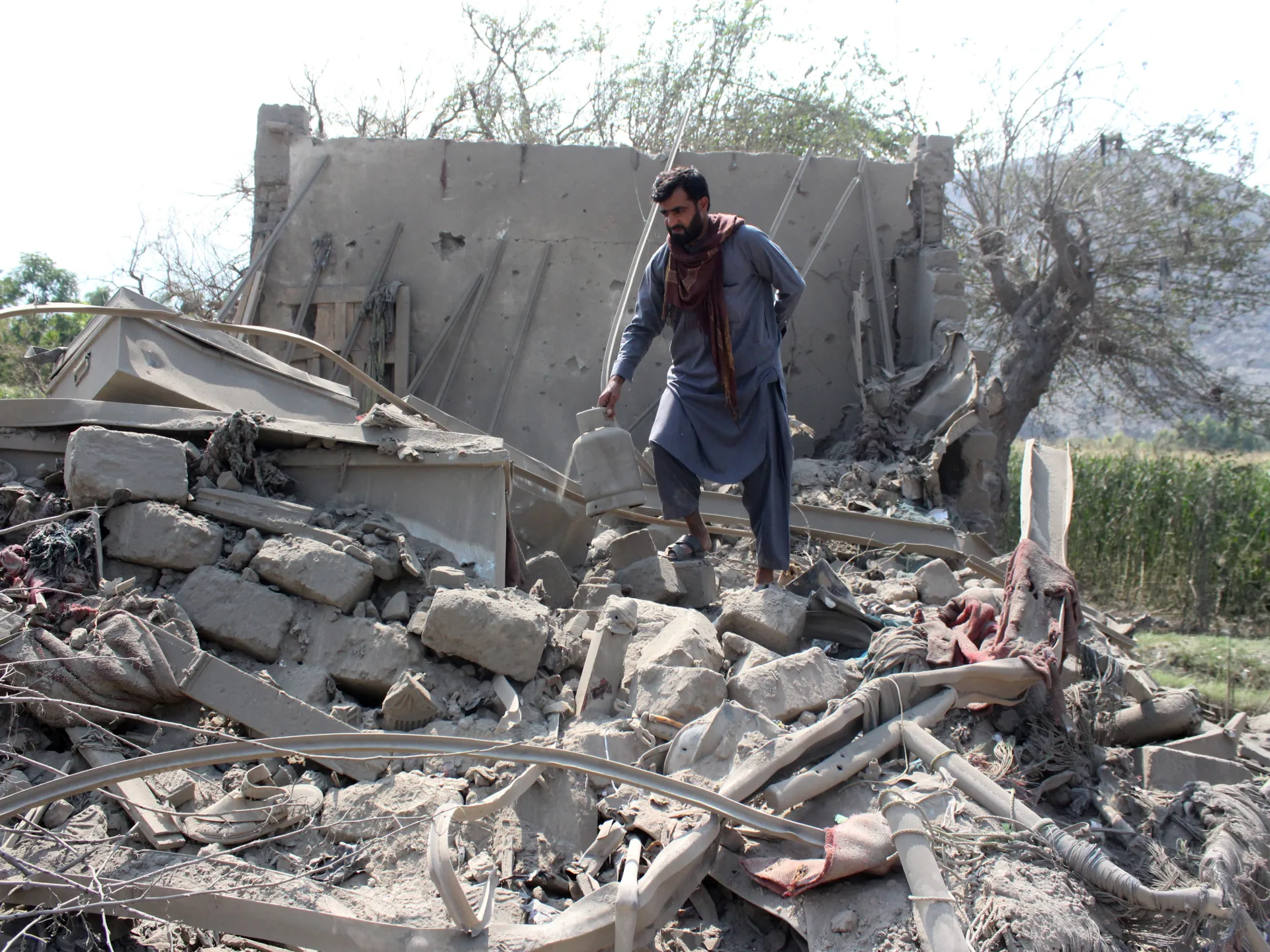
The Trump administration is in discussions to potentially send more than 1,000 Afghans who assisted America’s war effort and relatives of U.S. service members stuck in Qatar to a third country, the U.S. government and some advocates said. Congo is an option, the advocates said.

Shawn VanDiver, a Navy veteran who heads a coalition that supports Afghan resettlement efforts called #AfghanEvac, said Wednesday that U.S. officials informed him and other groups of discussions between the United States and Congo about taking the Afghan refugees who have been in limbo at a U.S. base in Doha for the last year.

The 1,100 refugees at Camp As-Sayliyah include Afghans who served as interpreters and with Special Operations Forces as well as the immediate families of more than 150 active-duty U.S. military members.

The State Department said Wednesday that it is working to identify options to “voluntarily” resettle the refugees in a third country, but it did not confirm which nations were being discussed.

An alternative provided to the refugees, VanDiver said, is to return to Afghanistan, where they face likely reprisal or even death at the hands of the Taliban for working alongside the U.S. during the two-decade war.

“You cannot call a choice voluntary when the two options are Congo and the Taliban, civil war or an oppressor who wants to kill you,” VanDiver said at a virtual news conference. “That is not a choice. That is a confession extracted under duress.”

The discussions — which were reported earlier by the New York Times — come more than a year after President Trump paused his predecessor’s Afghan resettlement program as part of a series of executive orders cracking down on immigration.

That policy left thousands of refugees who fled war and persecution, and had gone through a sometimes years-long vetting process to start new lives in America, stranded at places worldwide, including the base in Qatar.

From one war-torn country to another

Negotiations between the U.S. and several other countries, including Botswana and Malaysia, started months ago, according to an executive at a refugee resettlement agency who was briefed by U.S. officials. The executive, who spoke on condition of anonymity to share private negotiations, said that Botswana was seen by many refugee advocates as the most promising option but that talks between senior U.S. officials and the country’s leadership fell through. In early April, the executive was briefed that Congo was now the main option being discussed.

A person familiar with the matter who was not authorized to comment publicly and spoke on condition of anonymity said they had heard from State Department personnel that the U.S. was looking at sending the Afghans at the base in Qatar to countries in sub-Saharan Africa. The person said the Afghans were told Wednesday that there was no final deal on where to send them.

The base in Doha “was always intended as a transit platform. It was never designed to hold families for months or years, which is the situation that people are currently in,” said Jon Finer, who was deputy national security advisor to then-President Biden. “What I want to emphasize is that this was intended to honor a wartime commitment.”

Finer and other former U.S. officials and refugee advocates warned of the risk of resettling Afghans in Congo, a country that U.N. officials say is facing “one of the most acute humanitarian emergencies in the world.”

The African country has been battered by decades-long fighting between government forces and Rwanda-backed rebels in its eastern region.

Congolese authorities did not immediately respond to AP’s request for comment on the discussions, which did not come as a surprise to some there. Congo is one of at least eight African nations that were paid millions in controversial deals with the Trump administration to receive migrants deported from the U.S. to countries other than their own.

Like most other African nations involved in the deportation program, Congo is also among the worst-hit by the Trump administration’s policies on aid and trade. At least 70% of the country’s humanitarian aid came from the U.S. before Trump’s second term, and aid workers say American aid cuts have led to avoidable deaths in the conflict-hit region.

Sean Jamshidi — an Afghan American who served in the U.S. military, including a stint in Congo — said he was deeply concerned about his brother possibly being sent from the Doha base to the war-torn country.

“I saw the security situation and what it looked like there. I saw the displacement camps. … I stood in places where the United Nations has counted the dead,” Jamshidi said. “I’m telling you, as someone who has been in uniform, the Democratic Republic of the Congo is not a place you send vetted Afghan allies and their children to live.”

Refugees are in the dark as they await their fate

Negina Khalili, a former prosecutor in Afghanistan who fled during the 2021 U.S. withdrawal, has been waiting to hear about the resettlement status of her father, brother and stepmother since they arrived at the Doha base in January 2025. That was just days before Trump suspended the refugee program soon after he returned to the White House.

Khalili told the Associated Press on Wednesday that she spoke to her family about reports that they could be sent to Congo.

“They are not giving them any information or updates regarding which countries they will go to,” she said. “They were so stressed and worried about it and said that Congo is not a safe place either. They don’t know if it’s a temporary location for them there or a permanent location. They are worried.”

She said U.S. officials at the camp have been suggesting to refugees that they go back to Afghanistan and offering them money to do so.

Amiri, Santana and Asadu write for the Associated Press. Amiri reported from New York and Asadu from Abuja, Nigeria. AP writer Matthew Lee contributed to this report.

Source link

Pakistan PM, army chief wrap up key trips in push for more US-Iran talks | US-Israel war on Iran News

Field Marshal Asim Munir leaves Tehran while premier Shehbaz Sharif heads home from Turkiye amid hopes of another round of US-Iran talks.

Pakistan’s army chief and the prime minister have wrapped up separate diplomatic visits aimed at advancing efforts to end the United States-Iran conflict, with Field Marshal Asim Munir leaving Tehran and Prime Minister Shehbaz Sharif returning from Turkiye.

Munir met Iran’s leadership and peace negotiators during a three-day visit to Tehran, a Pakistani military statement said on Saturday.

Recommended Stories

list of 4 itemsend of list

The visit demonstrated Pakistan’s “unwavering resolve to facilitate a negotiated settlement… and to promote peace, stability and prosperity,” the military said ahead of expected US-Iran talks in Islamabad in the coming days.

Munir held talks with the country’s president, foreign minister, parliament speaker and head of Iran’s military central command centre.

Parliament Speaker, Mohammad Bagher Ghalibaf, and Foreign Minister, Abbas Araghchi, led the Iranian delegation to Islamabad for peace talks with the US last week, the highest level face-to-face contact between Washington and Tehran in decades.

Those talks ended without agreement, and a ceasefire is due to expire on April 22.

But diplomacy has continued, with Pakistan’s Prime Minister, Shehbaz Sharif, visiting Saudi Arabia, Qatar and Turkiye to push the peace process.

His three-country trip concluded on Saturday, with Sharif and Foreign Minister Ishaq Dar departing a diplomacy forum in Antalya, according to statements from both officials.

“I leave Antalya [Turkish city] with fond memories and a renewed commitment to further strengthening the enduring fraternal bonds between our two nations, and to continuing our close cooperation to advance dialogue and diplomacy for lasting peace and stability in the region,” Sharif posted on X.

The flurry of diplomacy comes as further negotiations are expected in Pakistan in the coming days as Islamabad intensifies contacts with regional and global leaders in an effort to sustain momentum towards a US-Iran deal.

Pressure for a deal between the two countries has grown after Iran reimposed restrictions on the Strait of Hormuz, hours after its reopening following the start of a ceasefire in Lebanon. Tehran accused the US of violating a deal to reopen the strategically important waterway.

Donald Trump has said a second round of talks with Iran could be held in Pakistan in the coming days. The New York Post reported that Trump praised Munir, saying he was “doing a great job”.

Reporting from Islamabad, Al Jazeera’s Kamal Hyder said Munir landed back home on Saturday as Pakistan prepared for another round of US-Iran talks expected “within the next few days”.

“We have also seen a lot of praise from the Trump administration on social media, praising the Pakistani leadership. So all eyes are on Islamabad. Serious differences remain, but there is a flurry of diplomatic activity and a hope and expectation that some sort of breakthrough may happen,” he said.

Source link

Turkiye’s Roketsan eyes top 10 exporter rank amid Middle East conflict | Business and Economy News

Modern warfare has dramatically changed as we have seen from the Russia-Ukraine war, conflicts involving Gaza, India and Pakistan, and the recent US-Israeli strikes on Iran. At the centre of this shift is a surging global reliance on drone and missile technology as well as advanced air defence systems.

Turkiye, one of the largest military powers in the Middle East, is increasingly positioning itself as a major supplier in the global defence sector. Central to this effort is Roketsan, a company founded in 1988 to supply the Turkish Armed Forces, which has since evolved into the country’s primary manufacturer of missile and rocket systems.

Recommended Stories

list of 3 itemsend of list

Currently exporting to approximately 50 countries, the firm is one of the fastest-growing defence companies globally.

So how did Roketsan secure a large share of the global arms trade?

Bypassing Western embargoes

Turkiye’s defence expansion was largely accelerated by restrictions placed upon it. Western embargoes aimed at halting its military advancement meant Ankara could not acquire the necessary technical systems or components.

In 2020, the United States imposed Countering America’s Adversaries Through Sanctions Act (CAATSA) restrictions on Turkiye – a key member of the transatlantic military alliance NATO. These sanctions targeted Turkiye’s military procurement agency, its chief Ismail Demir, and three other senior officials. Washington also ejected Ankara from the F-35 stealth jet programme in July 2019.

The measures came after Ankara purchased Russia’s S-400 missile defence system, which was seen as a potential threat to NATO security. The European Union also prepared limited sanctions and discussed restricting arms exports following energy exploration disputes in the Eastern Mediterranean.

To circumvent this, the country built an integrated, domestic defence ecosystem. Today, Turkiye relies on a vast supply chain of nearly 4,000 small and medium-sized enterprises (SMEs) scattered across the country. As a result, the Turkish defence industry now operates with a local production rate exceeding 90 percent.

Türkiye's defense industry now operates with a local production rate exceeding 90 percent, bypassing long-standing Western embargoes. [Al Jazeera]
Türkiye’s defence industry now operates with a local production rate exceeding 90 percent, bypassing long-standing Western embargoes [Al Jazeera]

This shift has yielded significant financial returns for Ankara. In 2025, Turkiye’s defence industry reported $10bn in exports. Roketsan’s General Manager Murat Ikinci told Al Jazeera that the company currently ranks 71st among global defence firms, with ambitions to break into the top 50, then the top 20, and ultimately the top 10.

To support this expansion, Turkish President Recep Tayyip Erdogan inaugurated several large-scale facilities last week, including:

  • Europe’s largest warhead facility.
  • new research and development (R&D) centre housing 1,000 engineers.
  • the “Kirikkale” facility dedicated to rocket fuel technology.
  • new infrastructure for the mass production of ballistic and cruise missiles.

These projects represent a $1bn investment, with the company planning to inject an additional $2bn to expand mass production capabilities.

The ‘Tayfun’ and modern warfare

Roketsan’s R&D strategy – which employs 3,200 engineers and makes the company the third-largest R&D institution in Turkiye – is heavily influenced by data gathered from ongoing global conflicts.

According to Ikinci, the war in Ukraine highlighted the impact of cheap, first-person view (FPV) and kamikaze drones supported by artificial intelligence. In response, Roketsan developed air defence systems like “ALKA” and “BURC,” alongside the “CIRIT” laser-guided missile.

The regional landscape was further complicated during the US-Israel war on Iran, as cheap Iranian-designed Shahed drones – recently upgraded by Russia with “Kometa-B” anti-jamming modules – overwhelmed defences and even struck a British base in Cyprus in March 2026. During the same month, NATO air defences were forced to intercept three Iranian ballistic missiles that entered Turkish airspace.

Meanwhile, the recent conflict between Israel and Iran showcased the use of complex attacks combining ballistic missiles with “swarms” of kamikaze drones designed to overwhelm air defences. This environment makes hypersonic technology a critical asset.

This brings the Tayfun (Typhoon) project into focus. Tayfun is a developing family of long-range ballistic missiles. Its most advanced iteration, the Tayfun Block 4, is a hypersonic missile engineered to penetrate advanced air defence systems by travelling at extreme speeds.

When Al Jazeera asked for specific details regarding the Tayfun’s exact operational range, Ikinci was elusive. “We avoid mentioning its range; we just say its range is sufficient,” he noted.

Similarly, historical Western sanctions have pushed Turkiye to form new cooperation initiatives, effectively accelerating an “Eastern shift” away from Western defence dependence. Turkish drones are now being used by a growing number of countries, including by Pakistan during its war against India last May.

Based on these threat assessments, Roketsan has prioritised five key areas of production:

  1. long-range ballistic and cruise missiles.
  2. air defence systems, including the “Steel Dome”, Hisar-A, Hisar-O, and Siper.
  3. submarine-launched cruise missiles, utilising the AKYA system to leverage Turkiye’s large submarine fleet.
  4. smart micro-munitions designed specifically for armed drones.
  5. long-range air-to-air missiles, a need highlighted by the brief India-Pakistan skirmish.

A strategic export model

Unlike traditional arms procurement, Turkiye is marketing its defence industry to international buyers as a strategic partnership.

“Our offer to our partners… is as follows: Let’s produce together, let’s develop technology together,” Ikinci stated.

İkinci emphasizes that Roketsan's international strategy is based on "partnership models" rather than simple sales. [Al Jazeera]
Rokestan’s General Manager Murat İkinci, right, emphasises that Roketsan’s international strategy is based on ‘partnership models’ rather than simple sales [Al Jazeera]


By establishing joint facilities and R&D centres in allied nations across the Middle East, the Far East, and Europe, Turkiye is attempting to secure long-term geopolitical alliances rather than purely transactional sales. Ikinci highlighted Qatar as a prime example of this model, describing it as a benchmark for technological, military, and security cooperation in the region.

Filling the global stockpile gap

This rapid expansion comes at a critical time for the global arms trade. Ongoing wars have severely depleted the stockpiles of advanced weapon systems worldwide.

During the recent US-Israel war on Iran, Washington relied heavily on multimillion-dollar Patriot and Terminal High Altitude Area Defense (THAAD) systems to intercept cheap Iranian drones targeting US assets across Qatar, Kuwait, Bahrain, Saudi Arabia, and the United Arab Emirates. With growing concerns that US interceptor supplies could run low, Gulf states – which have collectively detected over 1,000 drones in their airspace – are actively seeking alternative defence technologies, creating a highly lucrative opening for Turkiye’s missile industry.

Defence analyses indicate that even military superpowers like the US will require significant time to replenish their current air defence inventories due to the complexity and massive infrastructure required to build them.

Turkish defence officials view this shortage as a strategic opening. Having localised its supply chain, Turkiye claims it can manufacture and export these highly sought-after complex systems independently.

As global demand for air defence and ballistic technologies rises, Roketsan is aggressively reinvesting its revenues into production infrastructure to expand its footprint in the international arms market.

Source link

Saudi Arabia-hosted Asian Cup draw rescheduled due to US-Israel war on Iran | Football News

Draw for the 24-team 2027 AFC Asian Cup, originally set for Saturday, moved to May 9.

The draw for the 2027 ⁠Asian Cup ⁠in Saudi Arabia has been rescheduled for May 9 in Riyadh as the ⁠United States-Israel war on Iran disrupts regional sporting events.

The draw, originally scheduled for last Saturday, will be held at the historic At-Turaif District in Diriyah. The Asian Football Confederation (AFC) said ⁠on Wednesday that the postponement was ‌made to ensure the full participation of all key stakeholders and member associations.

Recommended Stories

list of 4 itemsend of list

A number of sporting events across the region have been postponed or cancelled due to the war, which began on February 28.

Saudi Arabia is set to ⁠host the 24-team, quadrennial continental championship for the first time from January 7 to February 5. With 23 of the ⁠24 teams already confirmed, the draw will divide the qualified ⁠nations into six groups of ⁠four.

The final qualification place will be decided on June 4 when Lebanon face Yemen in a playoff.

Defending champions ‌Qatar have already secured their place at the finals along with four-time winners Japan and fellow ‌World ‌Cup qualifiers South Korea, Iran, Jordan, Australia and Uzbekistan.

Source link

UK PM Keir Starmer visits Gulf to shore up ‘fragile’ US-Iran ceasefire | US-Israel war on Iran

NewsFeed

As UK Prime Minister Keir Starmer arrived in Doha as part of a Gulf tour spanning Saudi Arabia, the UAE, Bahrain and Qatar, he discussed efforts to secure the US-Iran ceasefire and reopen the Strait of Hormuz. Starmer warned there’s more ‘work to do’, stressing the need for regional partners to restore global energy flows.

Source link

World Athletics postpones Doha Diamond League amid US-Israel war on Iran | Athletics News

The multi-discipline event scheduled for May 8 will now be held on June 19 should conditions allow, organisers say.

World Athletics has postponed its season-opening event in Qatar’s capital, Doha, due to concerns for “player and spectator safety” as the  US-Israel war on Iran continues to affect the Middle East.

The Doha Diamond League has been rescheduled from May 8 to June 19, conditional on the safety and security situation in the region, World Athletics said in a statement on Wednesday.

Recommended Stories

list of 4 itemsend of list

“In the interests of athlete and spectator safety, a decision has been taken to postpone the meeting,” the global governing body for athletics said, adding that the event will go ahead on the new date “should conditions allow”.

The Diamond League said it had been “monitoring the situation in Doha” in recent weeks and was “working in close coordination with meeting organisers, Qatari authorities and other stakeholders”.

While Iran and the United States accepted a two-week ceasefire deal – mediated by Pakistan – Gulf states continued to intercept missile and drone attacks on their territories.

Qatar’s Ministry of Defence said on Wednesday that it intercepted a missile attack in the hours leading up to the ceasefire announcement, and the UAE, Kuwait and Bahrain reported strikes after news of the ceasefire was confirmed.

The organisers said they would continue to monitor developments in the Middle East in the coming weeks to deliver “the highest level of safe and secure competition for athletes, media and spectators”.

The Doha meeting was originally scheduled to take place at the Qatar Sports Club as the opening event of the 2026 Wanda Diamond League season, but will now be held at the Khalifa International Stadium, a temperature-regulated venue with air cooling vents.

The stadium hosted the World Athletics Championships in 2019 and was one of the FIFA World Cup 2022 venues in Qatar.

Olympic gold medallist from Botswana, Letsile Tebogo, headlined the 2025 event, winning the 200m race, while Jamaica’s Tia Clayton won the women’s 100m event.

Indian javelin star Neeraj Chopra was the crowd favourite for the field event but finished behind Julian Weber of Germany.

Chopra, Olympic gold medallist in 2021 and silver winner in 2024, has finished on the Doha Diamond League podium on five occasions.

The new date of the Doha Diamond League will fall between the Bislett Games in Oslo on June 10 and the Meeting de Paris on June 28, making it the eighth leg of the 2026 season.

The series will begin in Shanghai on May 16 and end at the Diamond League final in Brussels on September 5.

Source link

U.S. soccer’s World Cup ambitions are wildly off from reality

Mauricio Pochettino said last month that he plans to take the U.S. national team to the semifinals of this summer’s World Cup. If that’s the case, he’d better buy tickets because there’s no way the Americans are getting to that game on the field.

In its two March friendlies, the U.S. was blitzed by Belgium 5-2 and Portugal 2-0. By way of comparison, Mexico played the same two teams, in reverse order, to draws.

But wait, it gets worse. Because from the smoldering ruins of that mess, Pochettino has less than two months to choose a roster for the World Cup, a tournament U.S. Soccer has been pointing to for eight years.

Yet the March friendlies raised more questions than they answered — and it’s too late to start over.

“Right now, it’s just not enough,” DaMarcus Beasley, a four-time World Cup player, told TNT Sports. “We want to see these players compet[ing] and creating chances and being hard to play against every single match. Right now, it’s not happening.”

Pochettino ran the March training camp like an audition rather than settling on a starting 11 and trying to win games. He experimented with Tim Weah at outside back, where he has played for his club teams, and tried unsuccessfully to shake Christian Pulisic out of a career-long scoreless streak by playing him as a striker.

But he seems unable to solve some of the core issues plaguing the team. The U.S., which hasn’t posted a clean sheet since September, has become an error-prone mess on defense, with Pochettino’s wide, attack-minded approach revealing a structural fragility that has left the Americans’ thin back line exposed.

Consider the two goals in the Portugal loss. The first came after a turnover at midfield that led to a lightning-quick counterattack and the second on a poorly defended corner in which the Americans kept seven players in the six-yard box, leaving João Félix all alone at the top of the penalty area.

Behind the defense, no one has stepped up to seize the starting job in goal. Matt Turner, so spectacular four years ago in Qatar, gave up as many goals as he made saves against Belgium. And while Matt Freese was markedly better against Portugal, that was just his 14th international start.

Those are just the lowlights of the myriad issues facing Pochettino’s team.

Pulisic, the talisman who was supposed to carry the U.S., has gone cold. He hasn’t scored for the U.S. since November 2024 and hasn’t scored for his club team, AC Milan, this year. So Pochettino used him as a No. 9 against Portugal, a role Pulisic has made clear he does not like.

Christian Pulisic, left, controls the ball during an international friendly against Portugal on March 31.

Christian Pulisic, left, controls the ball during an international friendly against Portugal on March 31.

(Jared C. Tilton / Getty Images)

It didn’t work, with Pulisic extending his goal-less streak to 15 games for club and country.

Tyler Adams, the captain in Qatar, has been saddled by injury and hasn’t played for the national team since September; right back Sergiño Dest, who started all four games in Qatar, is also hurt; center back Tim Ream, at 38, suddenly looks his age; and Gio Reyna, who has been unable to win a starting job on three teams in two countries since Qatar, nonetheless keeps getting called to the national team with little affect.

In the middle of it all is Pochettino, the highest-paid coach in U.S. Soccer history, who, despite a stellar resume as a club coach, has failed to find a consistent winning formula on the international level. In its 18 months under Pochettino, the national team has gone 11-2-1 against teams outside the FIFA top 25 and just 2-7-1 against teams ranked 25th or higher, according to ESPN. It has also lost eight consecutive games to European rivals.

Guess which kinds of teams the U.S. will have to beat to get to the semifinals of the World Cup?

It wasn’t supposed to be this way, of course. After failing to qualify for the 2018 World Cup, the U.S. team was ripped down to its foundation and built anew. Interim manager Dave Sarachan was tasked with reconstructing a roster that had grown old and stagnant, and in his 12 months in charge he gave a record 23 players — including nine who made the team for the last World Cup — their international debuts. With an average age of 25, the squad in Qatar was the second-youngest World Cup team in U.S. history.

But Qatar was just a trial run. The real goal was to have a mature, experienced team ready for this summer when the World Cup would be played at home. A deep run could fuel the kind of transformation the 1994 tournament in the U.S. achieved.

Instead, the U.S. team has regressed.

“It feels like four years have gone down the drain,” said ESPN’s Herculez Gomez, another former World Cup player.

Fortunately, the U.S. was drawn into a soft group for the World Cup. And because the tournament’s expansion to 48 teams means just 16 countries will be eliminated in the first round, even a poorly built American team should advance.

But the semifinals? Not this team and not in this tournament. To do that the U.S. would have to be better than at least four teams on a list that includes England, France, Spain, Argentina, Germany, Morocco, Brazil and the Netherlands. We already know it’s not better than Belgium or Portugal.

It might not even win its group now that Turkey, a top 25 team which beat the U.S. 2-1 last June, has qualified. And a stumble early in the tournament would make the kind of deep run Pochettino promised that much more difficult.

“We are so close to the World Cup,” Pochettino said after the Portugal loss. “But I think we are intelligent enough to know what we need to do.”

Buy tickets was not supposed to be the answer.

You have read the latest installment of On Soccer with Kevin Baxter. The weekly column takes you behind the scenes and shines a spotlight on unique stories. Listen to Baxter on this week’s episode of the “Corner of the Galaxy” podcast.

Source link

Iran’s ex-FM Zarif proposes peace roadmap; Gulf points at erosion of trust | US-Israel war on Iran News

Former Iranian Foreign Minister Mohammad Javad Zarif has proposed a roadmap for ending the United States-Israeli war on Iran as tensions escalate across the Middle East.

Zarif’s plan was published by Foreign Affairs magazine on Friday and goes “beyond a temporary ceasefire”.

Recommended Stories

list of 4 itemsend of list

The war, which erupted on February 28 with US-Israeli strikes on Iran, has spread across the Middle East and convulsed the global economy as Tehran attacked its neighbours, claiming to be targeting US assets there and restricting movement of vessels in the Strait of Hormuz.

Regional hostilities showed no signs of abating on Sunday, a day after US President Donald Trump said Iran had 48 hours to cut a deal or face “all hell”.

Against this backdrop, Zarif’s roadmap said that although Iran viewed itself as successful in the war, prolonging the conflict – while potentially “psychologically satisfying” for Tehran – would only result in further loss of civilian lives and destruction of infrastructure.

Iran should, therefore, offer to “place limits on its nuclear program” under international monitoring as well as “reopen the Strait of Hormuz in exchange for an end to all sanctions”, Zarif wrote.

Since the war began, Iran has virtually blocked the key waterway, through which one-fifth of the world’s crude oil and natural gas supplies normally pass.

Nuclear limits on Iran would include a commitment to never seek nuclear weapons and to blend its entire stockpile of enriched uranium so its enrichment levels fall below 3.67 percent, Zarif said.

According to the International Atomic Energy Agency (IAEA) estimates, Iran is believed to have about 440kg (970lb) of uranium enriched to 60 percent, a level at which uranium can be quickly enriched to the 90 percent threshold needed to produce a nuclear weapon.

Zarif called Trump’s demand for zero enrichment “fanciful” thinking.

Iran should also “accept a mutual nonaggression pact with the United States” in which both countries pledge to not strike each other in the future, the former minister said.

The US should also end all sanctions and United Nations Security Council resolutions against Iran, he added.

Regional consortium

Zarif also outlined potential roles for regional and international actors.

He suggested that China and Russia along with the US could help create a regional fuel-enrichment consortium with Iran and its Gulf neighbours at West Asia’s sole enrichment facility with Iran transferring all enriched material and equipment there.

Zarif additionally proposed that Gulf states, UN Security Council powers and possibly Egypt, Pakistan and Turkiye should form a regional security framework to “ensure nonaggression, cooperation and freedom of navigation”, including arrangements to guarantee safe passage through the Strait of Hormuz.

“To further consolidate peace, Iran and the United States should initiate mutually beneficial trade, economic and technological cooperation,” Zarif added.

The Iranian politician said this roadmap would benefit Trump, offering him a “well-timed off-ramp” and an opportunity to claim peace.

“Emotions may be high, and each side is boasting about its war-front victories. But history best remembers those who make peace,” he said.

The US has presented Iran with a 15-point plan for a ceasefire as Pakistan, Turkiye and Egypt have been trying to achieve direct talks, but there has been no signs of progress on the diplomatic front.

What about the Gulf?

Officials from Gulf states have responded to Zarif’s proposal, criticising it for overlooking Tehran’s attacks against its neighbours.

“Reading M. Javad Zarif’s article in Foreign Affairs ignores one of the core flaws in Iran’s strategy: aggression against its Gulf Arab neighbors,” Anwar Gargash, the diplomatic adviser to the president of the United Arab Emirates, said on X on Saturday.

“Thousands of missiles & drones targeting infrastructure, civilians, even mediators, is not strength; it is hubris & strategic failure. The Arab world has seen this before: destruction peddled as victory,” he added.

Former Qatari Prime Minister Hamad bin Jassim Al Thani also responded to Zarif’s plan, writing on X on Sunday that he “agreed with much of it” and it took a “clever” approach.

Still, he pushed back, stating that the war has “led us all into a path that is more complicated and dangerous” and chiding Iran for its attacks on the Gulf.

“You may believe that you have achieved progress in some aspects, and perhaps temporary tactical gains, but the cost was clear: the loss of an important part of your friends in the region, and the erosion of the trust that was built over years,” he wrote.

“Today, we need a voice like yours [Zarif’s] merging from within Iran to propose solutions to this war,” he added.

Source link

Italy’s Meloni meets Qatar emir to discuss energy issues amid Iran war | Energy News

Prime Minister Meloni is the first EU and NATO country leader to visit the region since the war began.

Italian Prime Minister Giorgia Meloni has met Qatar’s Emir Sheikh Tamim bin Hamad Al Thani in Doha to discuss the energy crisis due to the ongoing United States and Israeli war on Iran.

Meloni met the Qatari leader on Saturday in Doha, the second stop on a regional tour that began in Saudi Arabia the previous day and continues with a visit to the United Arab Emirates.

Recommended Stories

list of 4 itemsend of list

The leaders “tackled energy issues … and discussed possible measures to mitigate the shocks suffered”, according to a statement from her office.

Meloni told the Qatari leader that Rome was ready to “contribute to the rehabilitation of Qatari energy infrastructure, which is essential to energy security on a global scale”, the statement added.

Italy is highly dependent on energy imports and is concerned about rising energy prices that have resulted from Iran’s effective blocking of the Strait of Hormuz, a key waterway through which some 20 percent of global oil and liquified natural gas transits.

The Qatari emir’s office said in a statement that both sides had “stressed the need to work towards de-escalation”.

“And prioritise political dialogue and diplomacy as the best way to contain the current crisis in the Middle East and its repercussions on energy and supply chains, and to safeguard energy security in the region,” the statement said.

“They also reviewed bilateral cooperation between the two countries and ways to support and develop it in various fields, particularly in the economy and energy,” it added.

Since the beginning of the war at the end of February, Iran has targeted US and Israeli targets in the region, in addition to targeting Gulf countries, including Qatar.

INTERACTIVE - DEATH TOLL - tracker - war - US Israel and Iran attacks - APRIL 3, 2026 - 10gmt-1775210232
[Al Jazeera]

Iran has targeted Qatar’s energy installations, including a missile strike on Ras Laffan Industrial City, the country’s main gas facility, that caused “significant damage”. Doha says the attacks will affect its natural gas export capacity.

An Italian government source told the AFP news agency that Meloni’s trip to the Gulf aimed to “strengthen relations with these countries and repeat Italy’s support against Iranian attacks”.

The source added that the region was a “crucial source of oil and gas for Italy” and that Meloni is the first leader of a European Union or NATO country to travel to the region since the war broke out.

After meeting the Qatari emir, Meloni travelled to the United Arab Emirates, where she was received by President Mohamed bin Zayed Al Nahyan.

Source link

How war on Iran turned Pakistan’s LNG surplus into a looming shortage | US-Israel war on Iran News

Islamabad, Pakistan – At the start of this year, Pakistan had more imported liquefied natural gas (LNG) than it could use. Demand had been falling for three straight years, from a peak of 8.2 million tonnes in 2021 to 6.1 million tonnes by late 2025, as cheap solar panels flooded the market and factories cut back.

The government quietly sold excess gas shipments to other countries and shut down domestic gas wells to prevent pipelines from bursting under the pressure of oversupply. Gas that could not be diverted would be pushed into household networks at a financial loss, adding billions to an already crippling debt pile in the energy sector.

Recommended Stories

list of 4 itemsend of list

Then the war came. On February 28, the United States and Israel launched hundreds of strikes against Iran in an operation named Epic Fury. The strikes targeted Iranian missiles, air defences, military infrastructure and leadership. Supreme Leader Ali Khamenei was killed in the opening assault.

Iran retaliated by firing hundreds of missiles and drones across the region, and as a result, traffic passing the Strait of Hormuz, the narrow waterway through which roughly a fifth of the world’s oil and gas passes, almost came to a halt.

The energy consequences were immediate. As a part of its retaliation against US-Israeli attacks, on March 2, Iranian drones hit Qatar’s gas facilities at Ras Laffan Industrial City, the world’s largest LNG export complex.

Qatar, the world’s second-largest LNG exporter after the United States, halted all production and declared force majeure, a legal term meaning it was released from delivery obligations due to circumstances beyond its control.

The conflict escalated further on March 18, when Israel struck Iran’s South Pars gas field, the largest in the world, off Iran’s southern coast.

Gasfield

South Pars and Qatar’s North Field sit above the same underground reservoir, meaning the attack threatened both countries’ gas production simultaneously. Iran struck Ras Laffan again in retaliation.

QatarEnergy said that the hit had forced it to cut LNG production by 17 percent, with repairs expected to take up to five years.

Brent crude, the industry benchmark, was priced at more than $109 a barrel on Thursday,

Oil prices on Thursday climbed to $109 a barrel, while European gas prices jumped 6 percent in a single trading session.

For Pakistan, which secures nearly all its imported gas from Qatar and the United Arab Emirates, and holds no emergency reserves, the shift from surplus to shortage happened almost overnight.

A system built on imports

Pakistan meets its daily gas needs from three main sources. The bulk, about 2,700 million cubic feet per day, comes from domestic gas fields that have been in slow decline for years.

The rest comes from imported LNG, supplied by Qatar under long-term contracts, adding roughly 600 million cubic feet per day when shipments flow normally.

The third source is bottled LPG, used mainly by households in rural areas not connected to the pipeline network. Pakistan gets more than 60 percent of its LPG from Iran, a supply also disrupted by the conflict.

Pakistan began importing LNG in 2015 when domestic production could no longer meet demand. Today, imported LNG powers roughly a quarter of the country’s electricity, with the power sector its largest consumer.

Qatar and the UAE together account for 99 percent of Pakistan’s LNG imports, according to energy analytics firm Kpler.

Of that, Pakistan’s LNG supply is dominated by two long-term government-to-government agreements with Qatar, one spanning 15 years and the other 10. Together, they cover nine shipments a month.

QatarEnergy's liquefied natural gas (LNG) production facilities, amid the U.S.-Israeli conflict with Iran, in Ras Laffan Industrial City, Qatar March 2, 2026. REUTERS/Stringer TPX IMAGES OF THE DAY
QatarEnergy’s liquefied natural gas (LNG) production facilities, amid the US-Israeli conflict with Iran, in Ras Laffan Industrial City, Qatar March 2, 2026. [Stringer/Rueters]

From glut to scarcity

Monthly cargo data from Pakistan’s energy regulator, OGRA, reflects the impact of the war. The country received between eight and 12 LNG shipments a month through 2025 and into early 2026, with 12 arriving in January alone. In March, the month the war began, only two shipments arrived.

Prices have been affected too. According to data compiled by researcher Manzoor Ahmed of the Policy Research Institute for Equitable Development (PRIED), on February 13, state-owned entities Pakistan State Oil and Pakistan LNG Limited procured eight combined cargoes at an average cost of $10.47 per MMBtu, totalling $257.1m.

MMBtu is the standard international unit used to measure and price natural gas and LNG.

By March 12, the two cargoes that did arrive cost $12.49 per MMBtu, a 19 percent increase in a month, reflecting tightening global conditions even before the war’s full impact.

Pakistan had already been consuming less gas. Its share of Asian LNG markets fell from roughly 30 percent in 2020 to about 18 percent in 2025, driven largely by the rapid expansion of solar power. Millions of Pakistanis, frustrated by high electricity costs and frequent blackouts, have installed rooftop panels in recent years.

By 2025, the country had 34 gigawatts of solar capacity, with an estimated 25 gigawatts feeding into the national grid. Overall electricity demand from the grid fell nearly 11 percent between 2022 and 2025.

Gas-fired power plants built to run on imported LNG were left underutilised, especially during daylight hours.

“Of course, solarisation helps manage daytime demand, reducing the need for running thermal power plants,” said Haneea Isaad, an energy analyst at the Institute for Energy Economics and Financial Analysis (IEEFA), who has tracked Pakistan’s gas sector for years.

But the contracts with overseas gas suppliers still needed to be adhered to — so Pakistan kept buying and paying, she told Al Jazeera.

Ahmed of PRIED pointed to two compounding challenges. First, the nature of Pakistan’s gas supply contracts were such that the government had to “buy LNG even when demand collapsed,” he told Al Jazeera.

Second, “rapid solar growth and suppressed grid demand were underestimated, and their effect on overall planning was not accounted for,” the Islamabad-based analyst added.

LNG consumption dropped by 1.21 million tonnes in 2025 alone. With no large storage capacity, surplus gas was pushed into domestic pipelines at a loss.

The resulting circular debt in the gas sector now stands at 3.3 trillion rupees, approximately $11bn. By January, Islamabad was negotiating to offload 177 unwanted gas shipments projected through 2031, a liability of $5.6bn.

Isaad of IEEFA said the surplus was predictable.

“Pakistan’s energy planning has mostly been bound by long-term contracts with very little flexibility,” she said. Once considered necessary for energy security, these rigid contracts, she added, have become a financial albatross in a market increasingly prioritising flexibility and low-cost generation.

She described the government’s pre-war response, diverting excess cargoes, as “reactive crisis management” that prioritised short-term fixes over better forecasting and procurement flexibility.

Supply shock

Qatar’s LNG shipments to Pakistan have stopped almost completely since March 2. Of the eight shipments scheduled that month, only two arrived. The six expected in April are unlikely to reach the country.

At a public hearing of the National Electric Power Regulatory Authority, Central Power Purchasing Agency chief executive Rehan Akhtar said LNG supplies were under force majeure, though coal imports from South Africa and Indonesia remained unaffected.

Officials have warned of near-zero LNG availability in the coming months, even if the war ends quickly. LNG accounts for more than 21 percent of Pakistan’s power generation.

“With Pakistan’s LNG supply completely halted after Qatar’s declaration of force majeure, LNG plants are effectively out of the running order,” Isaad said.

The government has responded by restoring domestic gas production that had been deliberately curtailed during the surplus period.

Isaad said Pakistan had been holding back roughly 350 to 400 million cubic feet per day of domestic gas to accommodate LNG imports.

“There will also be the option to rely on other power generation sources such as imported coal and hydropower,” she added. But, she warned, “even with hydropower, imported coal and restored domestic gas production covering some of the gaps left by LNG, there might still be an energy shortage.”

For now, mild weather and increased solar output have provided temporary relief.

“So far, Pakistan has somehow miraculously survived any prolonged energy shortages in the power sector through a combination of mild weather and a pre-existing reduced reliance on imported LNG,” Isaad said. “But peak summer months may be a different story.”

Men load solar panels on a rickshaw (tuk tuk) at a market, in Karachi, Pakistan March 26, 2025. REUTERS/Akhtar Soomro
Men load solar panels on a rickshaw (tuk tuk) at a market, in Karachi, Pakistan March 26, 2025. [File photo: Akhtar Soomro/Reuters]

Summer pressure

With an energy crisis looming, Pakistan is bracing for a few hours of daily planned power cuts this summer, alongside other energy conservation measures and higher electricity costs.

According to the National Electric Power Regulatory Authority’s State of Industry Report 2025, peak electricity demand last summer exceeded 33,000 megawatts.

Winter demand currently stands at about 15,000 megawatts, partly because solar panels now generate between 9,000 and 10,000 megawatts daily, reducing reliance on the grid.

Furnace oil, the main backup fuel, now costs 35 rupees per unit, about $0.12, and its price has more than doubled since the Strait of Hormuz disruption.

Analysts say the burden will fall unevenly. Consumers reliant on grid electricity will face both higher bills and outages, while industries dependent on gas will see production disruptions. Those with rooftop solar and battery storage will be best insulated.

Isaad is blunt about the options before Pakistan. “Returning to the spot market might not be feasible, given the dire financial consequences,” she said. “Even if it does, competition with wealthier nations may once again price Pakistan out. Furnace oil could be another option, but that will be prohibitively expensive to run.

“The only option the government may be left with is load-shedding [planned power blackouts], probably around two to three hours daily.”

Source link

GCC chief urges UN to halt Iranian attacks, protect Gulf waterways | US-Israel war on Iran News

Jassim al-Budaiwi calls on UN Security Council to guarantee ‘uninterrupted navigation through all strategic waterways’.

The head of the Gulf Cooperation Council (GCC) has called on the United Nations to act to immediately halt Iranian attacks across the region, condemning the strikes as a “flagrant violation” of international law and the United Nations Charter.

Speaking at the UN Security Council (UNSC) on Thursday, GCC Secretary-General Jassim al-Budaiwi urged the council to “take all necessary measures” to bring an end to Iran’s attacks on Gulf countries.

Recommended Stories

list of 3 itemsend of list

The UNSC must “take all necessary means” to “protect maritime corridors and guarantee the uninterrupted maritime navigation through all strategic waterways” in the region, al-Budaiwi said.

He also stressed that the six GCC states – Saudi Arabia, Qatar, Bahrain, Oman, Kuwait and the United Arab Emirates – must be included in any talks or deals with Iran “to enhance regional security and prevent further escalation or the repetition of such attacks in the future”.

“The GCC reaffirms the urgent need to immediately halt these attacks; restore security, stability and calm in the region, and ensure the safety of air and maritime navigation, the safety of international supply chains, and the protection of global energy markets,” al-Budaiwi said.

Iran has carried out daily missile and drone attacks across the Middle East, including in Arab Gulf nations, since the United States and Israel launched a war against the country on February 28.

While Iranian officials have said they are acting in self-defence and striking US and Israeli-linked targets, the attacks have struck civilian sites across the Gulf, including several of the region’s critical energy facilities.

Iran also has effectively closed the Strait of Hormuz, a key Gulf waterway through which about one-fifth of the world’s oil and liquified natural gas supplies transit, sending global energy prices skyrocketing.

Reporting from the Emirati city of Dubai on Thursday evening, Al Jazeera’s Zein Basravi said frustrations are growing across the Gulf as the US-Israeli war on Iran drags on.

“The GCC countries were from day one – months before this war even began – trying to keep it from happening. But it was like trying to stop a slow-moving car crash. And effectively, that crash has happened in their front yard,” Basravi said.

He noted that 85 percent of the projectiles fired by Iran have targeted Gulf countries, with the UAE the hardest hit.

“Their primary threats are the retaliatory attacks by Iran,” Basravi said of the GCC. “And their primary focus is bringing that to an immediate close – and that means ending the conflict as soon as possible.”

Source link

Iran attacks cause fire in Kuwait, Bahrain; kill man in UAE | US-Israel war on Iran News

Shrapnel from an Iranian drone interception kills a Bangladeshi national in the UAE’s Fujairah city.

Iran’s drones have hit fuel tanks at Kuwait’s international airport, causing a large blaze, and authorities in Bahrain have reported a fire at an undisclosed company facility, as the United States-Israel war on Iran continues for a fifth ⁠week.

Abdullah al-Rajhi, a spokesman for the General Directorate of Civil Aviation in Kuwait, on Wednesday said the airport had been subjected to “brazen attacks by drones from Iran and the armed factions it supports”.

Recommended Stories

list of 3 itemsend of list

The raids targeted fuel tanks at the airport, “leading to a large fire breaking out at the site”, al-Rajhi was quoted as saying by the official Kuwait News Agency (KUNA).

Emergency teams were on site, and “the damage is material with no human injuries,” he said.

Bahrain’s Ministry of Interior said civil defence crews were “extinguishing a fire in a facility of a company as a result of the Iranian aggression”.

“Relevant authorities are taking their measures at the site,” it added, without naming the company.

Vessel hit

A tanker was ‌hit by an unknown projectile near the Qatari capital Doha, causing damage to the hull at the waterline, the United Kingdom Maritime Trade Operations said, adding the crew were safe.

The vessel was struck about 17 nautical miles (equivalent to about 32km) north of Qatar’s Ras Laffan industrial hub, the country’s main gas production facility, which was hit by Iranian missiles last month, causing significant damage.

Confirming the incident, Qatar’s Ministry of Defence said the country was targeted by three cruise missiles launched from Iran, one of which struck an oil tanker.

In a post on X, the ministry said it intercepted two of the missiles, while the third hit a tanker leased to QatarEnergy. The tanker’s 21-person crew was evacuated, the ministry said. No injuries were reported.

In the United Arab Emirates (UAE), the official WAM news agency said shrapnel from a drone interception fell on a farm in the al-Rifaa area of Fujairah city and killed a Bangladeshi national. It said authorities were dealing with the incident.

Saudi Arabia’s Ministry of Defense said several drones were “intercepted and destroyed”, without reporting any injuries.

The oil-rich Gulf has borne the brunt of Iran’s attacks in response to the US-Israeli air strikes on the country.

Iran has claimed to be attacking US assets in the region, but Gulf nations say Tehran has targeted civilian infrastructure.

On Tuesday, a United Nations Development Programme (UNDP) report said gross domestic product (GDP) in the Arab world was estimated to decline by approximately 3.7 to 6 percent after a month of war, equivalent to a contraction of $120bn to $194bn.

Meanwhile, US President Donald Trump and his administration have sent contradictory statements about how and when the war might end.

“We’ll be leaving very soon,” Trump told reporters at the White House on Tuesday, saying the exit could take place “within two weeks, maybe two weeks, maybe three”.

Washington had previously threatened to intensify operations if Tehran did not accept a 15-point US ceasefire ⁠framework that had, among its core demands, commitments by Iran not to pursue nuclear weapons, halt all uranium enrichment and fully reopen the Strait of Hormuz.

Tehran dismissed the proposal as “maximalist” and “unreasonable”, stressing it is not seeking war and wants a permanent end to the conflict. It also demanded compensation for the destruction caused by US-Israeli attacks against the country.

Source link

Ukraine’s Zelenskyy signs air defence deals with UAE, Qatar on Gulf tour | News

Kyiv has sought to leverage its expertise in downing Russian drones to help Gulf nations.

Qatar and Ukraine have signed a defence agreement seeking joint expertise on countering threats from missiles and drones, according to Qatar’s Ministry of Defence, as Iran continues attacking its Gulf neighbours.

The agreement was made on Saturday during Ukrainian President Volodymyr Zelenskyy’s visit to Doha, following his stop in the UAE earlier in the day.

Recommended Stories

list of 4 itemsend of list

Earlier on Saturday, Zelenskyy said Ukraine and the United Arab Emirates had also agreed to cooperate on defence, a day after signing a deal with Saudi Arabia during his visit to the kingdom on Thursday.

Kyiv has sought to leverage its expertise in downing Russian drones to help Gulf nations and has deployed anti-drone experts to the three countries Zelenskyy visited during his diplomatic tour.

Tehran insists it is targeting only US assets in the Gulf in retaliation for the US-Israeli war on Iran, but the assaults have upset relations as Gulf nations say civilians are being put at risk.

During the Ukrainian leader’s visit to Doha on Saturday, Deputy Prime Minister and Minister of State for Defence Affairs Sheikh Saoud bin Abdulrahman bin Hassan Al Thani met Ukraine’s Secretary of the National Security and Defence Council (NSDC) Rustem Umerov, and Chief of Staff of the Armed Forces of Ukraine Andrii Hnatov.

“The agreement includes collaboration in technological fields, development of joint investments and the exchange of expertise in countering missiles and unmanned aerial systems,” Qatar’s Defence Ministry said in a statement during Zelenskyy’s visit.

The officials discussed the latest security developments. The defence agreement was signed by Qatari Armed Forces Lieutenant General Jassim bin Mohammed Al Mannai, and on the Ukrainian side by Hnatov, in the presence of the other officials.

“Ukraine is offering a cheap way of countering Iranian drones. Ukraine has been doing that for the past three and a half years because Russia has been firing Shahed drones since September 2023 at least, and it’s been downing them nearly every day,” said Al Jazeera’s Dmitry Medvedenko, reporting from Doha.

“The Gulf has been using Patriot and THAAD missiles primarily so far to down Iranian missiles and drones. Each Patriot missile costs almost $4m, while Ukraine is offering its expertise in downing drones for about $2,000 each.”

Decade-long cooperation

Ukraine has become one of the world’s leading producers of sophisticated, battlefield-proven drone interceptors as Russia has been attacking Kyiv with hundreds of thousands of Iranian drones since the start of its full-scale invasion of the neighbouring country in 2022.

On March 18, Zelenskyy said 201 anti-drone experts had been deployed to the Middle East.

Kyiv has proposed swapping its interceptors for the vastly more expensive air-defence missiles that Gulf countries are using to down Iranian drones. Kyiv says it needs more of them to fend off near-daily Russian missile attacks.

“What we can assume is that Ukraine is primarily interested in funding,” said Medvedenko.

He said that the US-Israeli war on Iran is “costing so many Patriot missiles”, which concerns Ukraine as its stocks will decline.

The Patriots are “a much better solution” for countering Russia’s ballistic missiles, he said.

Source link

How important are the Gulf economies to the world? | US-Israel war on Iran News

Impact of US-Israeli war on Iran poses serious risks beyond energy sector.

The US-Israeli war on Iran is hitting Gulf Arab nations hard – but with a wider impact in today’s interlinked world.

As well as global oil and gas supplies, Gulf states play a critical role in many economies.

So how are they connected – and what could be at risk?

Presenter: James Bays

Guests:

Nikolay Kozjharnov – Research associate professor in energy security at the Gulf Studies Center at Qatar University

Cornelia Meyer – Macroeconomist and oil and gas specialist

Torbjorn Soltvedt – Associate director at global risk intelligence company Verisk Maplecroft

Source link

Qatari PM and US officials discuss strategic ties amid Iran war | US-Israel war on Iran News

The meeting held in Washington, DC reviewed the ‘close strategic cooperation’ between Doha and Washington, Qatar’s foreign ministry said.

Qatar’s prime minister has held talks with senior US officials in Washington, DC, amid the ongoing US-Israeli war on Iran and fallout across the Gulf.

Sheikh Mohammed bin Abdulrahman bin Jassim Al Thani, who also serves as Qatar’s foreign minister, met US Vice President JD Vance and US Secretary Scott Bessent, Qatar’s Ministry of Foreign Affairs said on Friday.

Recommended Stories

list of 4 itemsend of list

They reviewed ways to strengthen the “close strategic cooperation” between Doha and Washington, “especially the defence partnership in light of the conditions the region is experiencing”, the ministry said.

Both sides stressed “ensuring the sustainability of energy supplies and maintaining the continued flow of liquefied natural gas from the State of Qatar to global markets”, in a way that “supports global energy security”, it added.

Vance hailed the “robust strategic partnership”, praising Qatar’s “active role in promoting regional stability and enhancing global energy security”.

The Gulf has been in a state of heightened tension since February 28, when the US-Israeli war on Iran began, which has killed more than 3,000 people across the region, a vast majority of them in Iran and Lebanon.

Tehran has since launched drone and missile attacks aimed at Israel, as well as Jordan, Iraq, and Gulf states. Iran insists it is targeting US assets in the Gulf, but the region’s leaders have urged Iran to cease attacks as they endanger civilians.

Qatar, earlier this month, said Iranian missile attacks on the Ras Laffan Industrial City, the country’s main gas facility, caused “significant damage”.

The war has created an unprecedented global energy crisis as Iran has effectively closed off the Strait of Hormuz, through which one-fifth of the world’s oil passes.

Meeting with Hegseth

On Thursday, Sheikh Mohammed also held a meeting in Washington with US Secretary of Defense Pete Hegseth, the Foreign Ministry said.

“The meeting took place in Washington on Thursday and focused on ways to support and develop defence and security collaboration amid regional challenges,” it added.

“Both sides stressed the importance of continued coordination and consultation on regional issues to promote security and stability locally and internationally.”

On Wednesday, the Qatari Cabinet renewed its condemnation of Iranian attacks on Qatar and its neighbours, calling for an immediate halt.

Source link

What is LNG and what is it used for? | US-Israel war on Iran News

The United States-Israeli war on Iran has hit critical liquified natural gas (LNG) supplies in the Gulf, triggering the most severe disruptions in recent years to the global energy market.

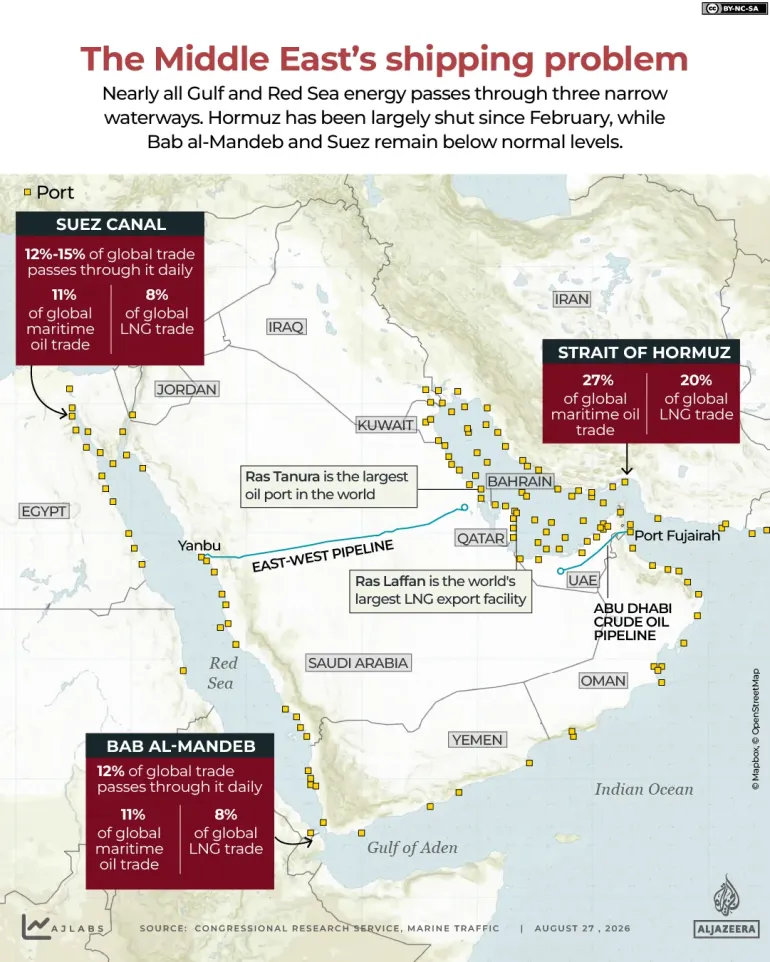
Shipping through the critical Strait of Hormuz, which accounts for 27 percent of the world’s maritime oil trade and 20 percent of LNG, has been brought to a near standstill, with oil-producing nations such as Saudi Arabia rerouting oil through alternative pipelines and Qatar halting LNG production.

Recommended Stories

list of 4 itemsend of list

Natural gas makes up about a quarter of global energy consumption, raising concerns about how much the disruption to LNG will affect those most reliant on gas.

INTERACTIVE - REGIONAL GAS FACILTIES-MARCH27, 2026

What is LNG?

Natural gas is formed over millions of years from decomposed organic matter subjected to intense heat and pressure beneath the Earth’s surface.

LNG is natural gas cooled to -162 degrees Celsius, known as cryogenic processing, shrinking it to a 600th of its gaseous volume.

In its liquid state, LNG is colourless, odourless and non-flammable, making it safe and efficient to transport across vast distances.

WHAT IS LNG

Composition and purification

Before liquefaction, the gas is purified through water-based solvents and molecular sieve beds to remove impurities including carbon dioxide, hydrogen sulphide, water and mercury.

Heavier hydrocarbons are then separated from methane and ethane through fractionation, and stored, used or sold as byproducts. The result is a fuel typically composed of 85 to 95 percent methane, with small amounts of ethane, propane, butane and nitrogen.

Storage and transport

LNG is stored in large insulated tanks without the need for high-pressure infrastructure. It is then pumped onto double-hulled carriers and shipped to terminals around the world.

Regasification

At its destination, LNG is heated using seawater or a warm water bath until it vaporises, a process known as regasification, before being moved through pipelines for consumption. It is sometimes blended with nitrogen or propane to ensure compatibility with local gas networks.

What is it used for?

Once LNG is returned to a gaseous state at import terminals, it is dispersed through pipelines for use in homes, businesses and industries around the world.

Residential uses include cooking, heating and generating electricity. In many parts of the world, LNG also supports hot water systems in homes and heating for commercial buildings.

It is used for power generation broadly, offering a comparatively low-carbon alternative to coal and oil.

In industry, it is used for fertilisers, plastics, paints and medicines. It is also used in transport to fuel heavy-duty vehicles and ships.

A man walks through a mustard field during the spring season on the outskirts of Srinagar, the summer capital of Indian Kashmir, India, 24 March 2026. EPA/FAROOQ KHAN
A man walks through a mustard field during the spring season on the outskirts of Srinagar, the summer capital of Indian-administered Kashmir, on March 24, 2026 [Farooq Khan/EPA]

Gulf nations export close to half the world’s traded urea – commonly used in fertilisers globally, leaving international agriculture deeply vulnerable to any interruption in the LNG shipping lane through the Strait of Hormuz.

The disruption has already forced fertiliser producers across the region to suspend or reduce operations, since natural gas is both the primary feedstock and the fuel that powers the manufacturing process.

RAS LAFFAN INDUSTRIAL CITY, QATAR - MARCH 3: A picture of Qatar Energy's operating facilities on March 3, 2026 in Ras Laffan Industrial City, Qatar. Qatar Energy announced a complete halt to liquefied natural gas (LNG) production at its Ras Laffan and Mesaieed facilities on March 2, 2026, after Iranian attacks targeted energy facilities. (Photo by Getty Images)
A picture of QatarEnergy’s operating facilities on March 3, 2026, in Ras Laffan Industrial City, Qatar. QatarEnergy announced a complete halt to liquefied natural gas (LNG) production at its Ras Laffan and Mesaieed facilities on March 2, 2026, after Iranian attacks targeted energy facilities [Getty Images]

QatarEnergy’s decision to halt gas production following attacks on its LNG infrastructure brought the world’s single largest urea plant to a standstill. In addition, the Omani port of Salalah on the Arabian Sea has been closed, which holds an ammonia storage terminal. The port was hit in a drone attack on March 11.

INTERACTIVE - LNG BY PRODUCTS - MARCH 27, 2026

What are the by-products?

While LNG is primarily valued as an energy source, the processing and liquefaction of natural gas yield a range of by-products with industrial and medical applications.

The most notable by-product is helium, which is extracted during cryogenic processing at LNG facilities using distillation to separate the concentrations of helium from the gas.

Global helium production is estimated to be about 180 million cubic metres annually. The disruption to LNG facilities in Qatar means some 5.2 million cubic metres of helium is taken out of the market each month, accounting for about a third of global monthly production.

Helium is used primarily as a cooling agent for superconducting magnets in MRI and CT scanners, with the average MRI machine needing about 1,700 litres of liquid helium, and some older MRIs needing replenishment every two to three years.

FILE - A brain-scanning MRI machine is seen in Pittsburgh, Nov. 26, 2014. (AP Photo/Keith Srakocic, File)
A brain-scanning MRI machine is seen in Pittsburgh, United States, on November 26, 2014 [File: Keith Srakocic/AP]

Helium is also critical to the data centre industry, where it is used to conduct heat away from silicon, preventing parts of semiconductors from being damaged.

The natural gas value chain generates petrochemical derivatives that also form feedstock for manufactured goods.

For example, ethane and propane are cracked to produce ethylene and propylene, which are materials used in plastics such as IV bags, syringes and other medical-grade plastics.

Which countries supply LNG?

According to the International Gas Union (IGU) 2025 World LNG Report, some 411.24 million tonnes (mt) of LNG were traded in 2024.

The largest exporter of LNG is the United States, which in 2024 exported a total of 88.4mt, followed by Australia (81mt), Qatar (77.2mt), Russia (33.5mt) and Malaysia (27.7mt).

Together, the top five countries account for more than three-quarters of global supply.

Which countries import it?

China was the largest importer of LNG with 78.6mt imported in 2024, followed by Japan (67.7mt), South Korea (47.1mt), India (26.1mt) and Taiwan (21.8mt). The top five importers accounted for nearly 59 percent of all global LNG imports in 2024.

South Asian nations such as Pakistan and Bangladesh are also at high risk from the current conflict.

FILE PHOTO: Motorists queue to refuel their motorcycles at a fuel station amid concerns over fuel supply amid the U.S.-Israel conflict with Iran, in Dhaka, Bangladesh, March 15, 2026. REUTERS/Mohammad Ponir Hossain/File Photo
Motorists queue to refuel their motorcycles at a petrol station amid concerns over supplies amid the United States-Israeli conflict with Iran, in Dhaka, Bangladesh, on March 15, 2026 [Mohammad Ponir Hossain/Reuters]

Pakistan’s primary energy source is natural gas, which accounts for 28 percent of electricity generation for the country of more than 250 million people.

In Bangladesh, with a population of about 176 million, gas accounts for half of all electricity generation.

Qatar and the United Arab Emirates supply about 99 percent of Pakistan’s LNG imports and 72 percent of Bangladesh’s, according to trade intelligence firm Kpler.

Earlier in the month, Pakistan introduced emergency measures to tackle the energy shock, including moving to a four-day workweek for government employees and announcing spring holidays for schools from March 16 to the end of the month.

As a precautionary measure, the Bangladeshi government has also reduced gas supplies. Bangladesh is seeking nearly $2bn in loans from international lenders in a bid to fund energy inputs and keep prices stable.

Some petroleum gas tankers heading to India have managed to pass through the Strait of Hormuz despite the conflict — at least one Pakistani tanker has crossed the strait, too. In India, where 5 percent of electricity generation comes from gas, they are now relying more on coal as LNG disruptions continue. India gets about half of its LNG from the Gulf.

COUNTRIES THAT IMPORT LNG-1774601653


On March 9, an Indian government order redirected natural gas and regasified LNG to priority sectors, with curtailments affecting consumers and the petrochemical industry, according to S&P Global.

Source link

US-Israel war on Iran: What’s happening on day 27 of attacks? | US-Israel war on Iran News

The US and Israel’s war on Iran is intensifying, as Trump again claims Iranian leaders want to ‘make a deal’.

The United States and Israel’s war on Iran continues, with an Al Jazeera correspondent in Tehran reporting strikes are “increasing in number and in intensity” amid conflicting claims about whether negotiations are taking place.

US President Donald Trump says talks are happening, but Iran rejects the talks, saying it will continue to “resist” US aggression.

On Thursday, Iran carried out retaliatory strikes against Israel and several Gulf countries, as the Middle East conflict sees no signs of ending, and global energy and food prices continue to rise.

In Iran

  • Intensifying attacks: US-Israeli attacks on Iran are “increasing in number and in intensity”, according to Al Jazeera correspondent, with Israel announcing extensive strikes on central Isfahan. Alongside US forces, Israel has launched a “wave of extensive strikes” across Iran.
  • Civilian casualties reported: Iranian media reported that two teenage boys were killed in a recent US-Israeli strike on a residential area in a village in the county of Shiraz.
  • Iran talks: US President Donald Trump insisted that Iran was taking part in peace talks.
  • Iran chooses ‘resistance’: Foreign Minister Abbas Araghchi said Tehran will continue its “resistance” and does not intend to negotiate.
  • US targets missile capacities: The US has hit two-thirds of Iran’s production facilities for missiles and drones, a top officer said.
  • Threat to Iranian island: Tehran warned enemies may try to occupy one of its islands with support from an unnamed regional country.
  • Iran’s leverage: Jane Foley, an analyst from Rabobank, noted that Tehran’s position on negotiations leaves the ball firmly in their court. Because the critical Strait of Hormuz remains effectively closed, she suggests Iran could have the power to dictate the terms of any resolution.
  • New toll legislation: The Iranian parliament is preparing a draft law that would mandate the collection of tolls and duties from ships and tankers transiting the Strait of Hormuz, treating the waterway like a standard transit corridor.

In the Gulf

  • Hezbollah plot uncovered in Kuwait: Authorities arrested six people allegedly linked to Hezbollah, accused of planning assassinations in the Gulf state, the Interior Ministry said.
  • Saudi Arabia: Saudi Arabia’s Defence Ministry on Thursday morning announced the interception and destruction of a drone in the Eastern Province. Its air defence systems intercepted and destroyed at least two dozen drones targeting the Eastern Province, home to the majority of the kingdom’s oil facilities, on Wednesday.
  • Bahrain: A fire broke out at a facility in the Muharraq Governorate due to what the Interior Ministry described as “Iranian aggression”.
  • United Arab Emirates: The UAE’s Defence Ministry said on Thursday that its air defence systems have been actively responding to and intercepting incoming missiles and drones from Iran.

In the US

  • Trump says Iran wants a deal: Trump again claims Iranian leaders want to “make a deal so badly” but are afraid to say so “because they figure they’ll be killed by their own people”.
  • Trump threatens ‘hell’ if no deal: Trump is ready to “unleash hell” on Iran if Tehran does not accept a deal to end the war, the White House warned on Wednesday.
  • Strategic posturing: Jason Campbell, a former Pentagon official, said US threats to “hit Iran harder” are more about signalling than intensifying attacks.
  • Intentional vagueness: Campbell told Al Jazeera that Trump is deliberately omitting specific details because he wants the Iranian regime to believe the US is fully capable and willing to execute these harsher attacks.

In Israel

  • Missile salvoes: Israel’s army on Thursday morning said it had detected a wave of missiles from Iran heading towards the country, the second salvo in less than 30 minutes.
  • Rockets and missiles targeting Israel: Iranian missiles continue to target central and northern Israel. Additionally, Hezbollah has fired volleys of rockets into the Western Galilee region.

In Iraq, Lebanon

  • Gulf issues Iraq demand: Gulf states and Jordan have urged Iraq to stop attacks by pro-Iran armed groups from its territory.
  • Ground clashes with Hezbollah: Israeli troops have crossed the border into Lebanese territory and are actively engaging in ground combat. Hezbollah says its fighters are continuing to clash with invading Israeli troops in south Lebanon.
  • Defending Lebanese soil: Hezbollah’s Secretary-General Naim Qassem stated that the group is now in a war against both the US and Israel and will do everything it can to defend Lebanese territory.

Oil markets and food

  • Oil prices climb: Oil prices have climbed higher amid fading hopes of de-escalation in the Iran war following Tehran’s rejection that talks with the US are under way.
  • Food supply shocks: Antony Currie, a columnist for Breakingviews, warned that the Iran war will likely have a more severe impact on global food security than Russia’s 2022 invasion of Ukraine.

Source link

Deaths and debts: Missiles in Gulf shake millions of South Asian families | US-Israel war on Iran

A week into the United States-Israeli war on Iran, and Iran’s attacks on its Gulf neighbours, Jaya Khuntia spoke – as he often did – to his Doha-based son Kuna on the phone.

It was March 6, about 10pm, and Khuntia and the family were worried. “He told me, ‘I am safe here, don’t worry,’” the father recalled from the conversation with Kuna.

It was the last time they spoke.

The next day, the family in Naikanipalli village of India’s eastern Odisha state received a phone call from Kuna’s roommate telling them that the son had suffered a heart attack after hearing the sound of missiles and debris from interceptions falling near their residence. He collapsed and was later declared dead. Kuna’s body reached home days later.

Al Jazeera cannot independently confirm the cause of Kuna’s death, but the family of the 25-year-old, who worked as a pipe fitter in Qatar’s capital, is among millions across South Asia directly affected by the war in the Middle East.

Of the eight people killed in the United Arab Emirates in Iranian attacks, two were Emirati military personnel, a third a Palestinian civilian, and the remaining five were from South Asia: Three from Pakistan, and one each from Bangladesh and Nepal. All three people killed in Oman were from India. An Indian national and a Bangladeshi national are the only deaths in Saudi Arabia.

Migrant workers from South Asia total nearly 21 million people in the Gulf nations, a third of the total population of the region. At stake, for their families back home, is the safety of their loved ones and the future of their dreams.

The Khuntia family had taken on a 300,000-rupee ($3200) debt in 2025 for the marriages of their two daughters. Kuna’s income in Doha – where he had moved only in late 2025 – of 35,000 rupees ($372) was helping them collect what they needed to pay back the loan. Kuna had been sending back about 15,000 rupees ($164) every month.

“We thought our suffering was finally ending,” Jaya said, his voice trembling. “My only son would say, ‘Baba, don’t worry, I am here.’ He was our only hope… our everything.”

That hope is now extinguished. “That one call finished us,” Jaya cried. “He promised to return after clearing our debts … but he came back in a coffin. We have nothing left now. Losing our only son is the biggest debt we have to live with.”

Kuna Khuntia, a 25-year-old pipe fitter from India's Odisha, who died of a heart attack in Doha Qatar [Photo courtesy the Khuntia family]
Kuna Khuntia, a 25-year-old pipe fitter from India’s Odisha, who died of a heart attack in Doha, Qatar [Photo courtesy the Khuntia family]

‘I thought we would be next’

In all, Bahrain, Kuwait, Oman, Qatar, Saudi Arabia and the UAE – the six Arab countries in the Gulf – host 35 million foreign nationals, who form a majority of their total population, 62 million.

They include 9 million people from India, 5 million each from Pakistan and Bangladesh, 1.2 million from Nepal, and 650,000 from Sri Lanka. Most of them are engaged in blue-collar work, building or supporting the industries and services that are at the heart of the Gulf’s success and prosperity.

But since the US and Israel launched their war on Iran, these migrant workers have often been among the most vulnerable. That vulnerability extends beyond deaths and injuries to the very nature of their work: Oil refineries, construction areas, airports and docks, where many work, have been targeted in Iranian attacks.

The suspension of work at many of these facilities, coupled with fears of a major economic downturn in the region, has also left many workers and their families worried about the future of their jobs.

Hamza*, a Pakistani migrant labourer working at an oil storage facility in the UAE, recalled a recent attack that he witnessed. “A drone struck a storage unit right in front of us. We were completely shaken. Most of us there are from India, Pakistan and Bangladesh.

“We couldn’t sleep for nights after that. The drone was so close that it could have killed us, too,” Hamza added. “For a moment, I thought we would be next.”

Despite these dangers, he said, leaving is not an option.

“We want to go back, but we can’t,” Hamza said. “Our families depend on us. It’s dangerous here, but if we stop working, they will have nothing to eat. We have no choice.”

Experts say Hamza’s sentiment is common across South Asian blue-collar workers in the Gulf, because of poverty and limited employment opportunities back home.

Imran Khan, a faculty member at the New Delhi Institute of Management working on migration economics, said migrant labourers from South Asia are often driven by desperation to take up jobs in the Middle East. He said Western countries have, in recent years, dramatically raised entry barriers for less-educated blue-collar foreign workers.

“These workers are the worst affected during crises – whether war or natural disasters,” he says. “I have been speaking to several migrant labourers, particularly Indians in the Middle East, and many are living in distress since the conflict began.”

But, like Hamza, most cannot afford to leave, Khan said.

“They cannot simply quit. Their income would stop immediately, and there are very limited opportunities back home,” he explained. “They have families to support, and without these jobs, survival becomes difficult.”

Indian labourers work at the construction site of a building in Riyadh November 16, 2014. India is pressing rich countries in the Gulf to raise the wages of millions of Indians working there, in a drive that could secure it billions of dollars in fresh income but risks pricing some of its citizens out of the market. Picture taken November 16. To match story INDIA-MIDEAST/WORKERS REUTERS/Faisal Al Nasser (SAUDI ARABIA - Tags: BUSINESS CONSTRUCTION EMPLOYMENT)
Indian labourers work at the construction site of a building in Riyadh, November 16, 2014 [Faisal Al Nasser/Reuters]

Families – and societies – that depend on remittances

Middle Eastern countries remain a key source of remittances for South Asian nations such as India, Pakistan, Bangladesh, Sri Lanka and Nepal. The remittances these five countries receive from the region, $103bn, are comparable to Oman’s total gross domestic product (GDP).

Just the remittances that India receives from the Gulf, $50bn, are more than Bahrain’s entire GDP. Pakistan receives $38.3bn in remittances, Bangladesh $13.5bn, Sri Lanka $8bn, and Nepal $5bn.

With the recent escalation of conflict in the Middle East, experts warn these flows could be significantly affected, especially if Gulf economies contract and layoffs follow.

Faisal Abbas, an expert in international economics and director at the Centre of Excellence on Population and Wellbeing Studies, a Pakistan-based research institute, said remittances from the Middle East form a crucial economic backbone for South Asian nations, not just families.

“Remittances are a critical pillar for Pakistan and other South Asian economies, and a large share comes from Middle Eastern countries,” he explained. “If the situation worsens, it will not be a positive development for the region.”

Pakistan’s remittances from the Gulf constitute nearly 10 percent of its GDP, about $400bn.

Abbas added that the effect may extend beyond remittance flows. “Migration patterns could also be disrupted. Many workers may return home, while those planning to migrate might reconsider,” he said. “This could further increase unemployment in a region already facing job shortages.”

Unlike Hamza, a number of South Asian workers are planning to return home.

Noor*, a migrant worker from Bangladesh employed at an oil facility in Saudi Arabia, said he no longer feels safe and plans to return home once his contract ends.

“I will never come back here again,” he said. “It’s too dangerous. We can’t even sleep at night. The fear never leaves us.”

Noor said drone attacks had occurred close to his workplace. “We saw it happen in front of us,” he said. “That fear stays with you… It doesn’t go away.”

His family, too, is deeply affected. “My children cry every time they call me. They are scared for my life,” he added.

He said he knows that returning to Bangladesh would mean more economic hardship for his family. But Noor said he had made up his mind.

“I would rather go back and struggle to survive with my family than live here in constant fear,” he said. “At least there, I will be with them.”

*Some names have been changed at the request of workers who fear retribution from contractors for speaking to the media.

Source link

Are Middle East attacks pushing Asia towards an energy crisis? | US-Israel war on Iran

Energy facilities in the Middle East are under attack, including Qatar’s LNG, pushing prices higher.

In a sharp escalation in the Middle East conflict, energy production itself is now in the firing line.

Iran targeted facilities across the Gulf – including the world’s largest liquefied natural gas hub in Qatar.

It was retaliation for an Israeli strike on an Iranian gasfield hours earlier.

Energy prices are soaring, and countries from Asia to Europe are scrambling for alternative supplies.

But, for Asia – the world’s largest LNG buyer – this is a severe energy shock.

The region depends on Gulf supplies to keep its lights on, its factories running, and its people fed.

Source link