Qatar

Gas prices soar as QatarEnergy halts LNG production after Iran attacks | Energy News

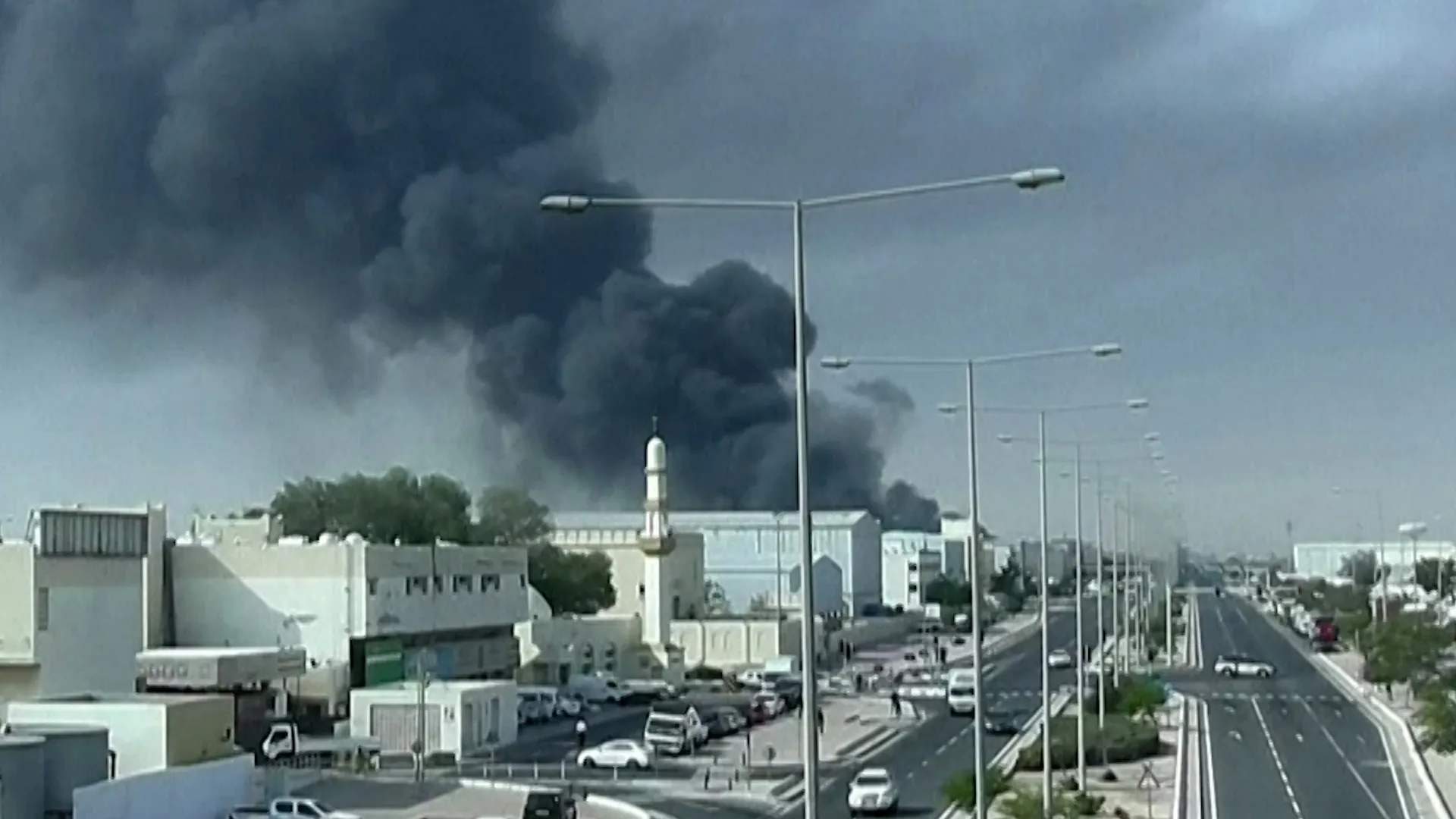
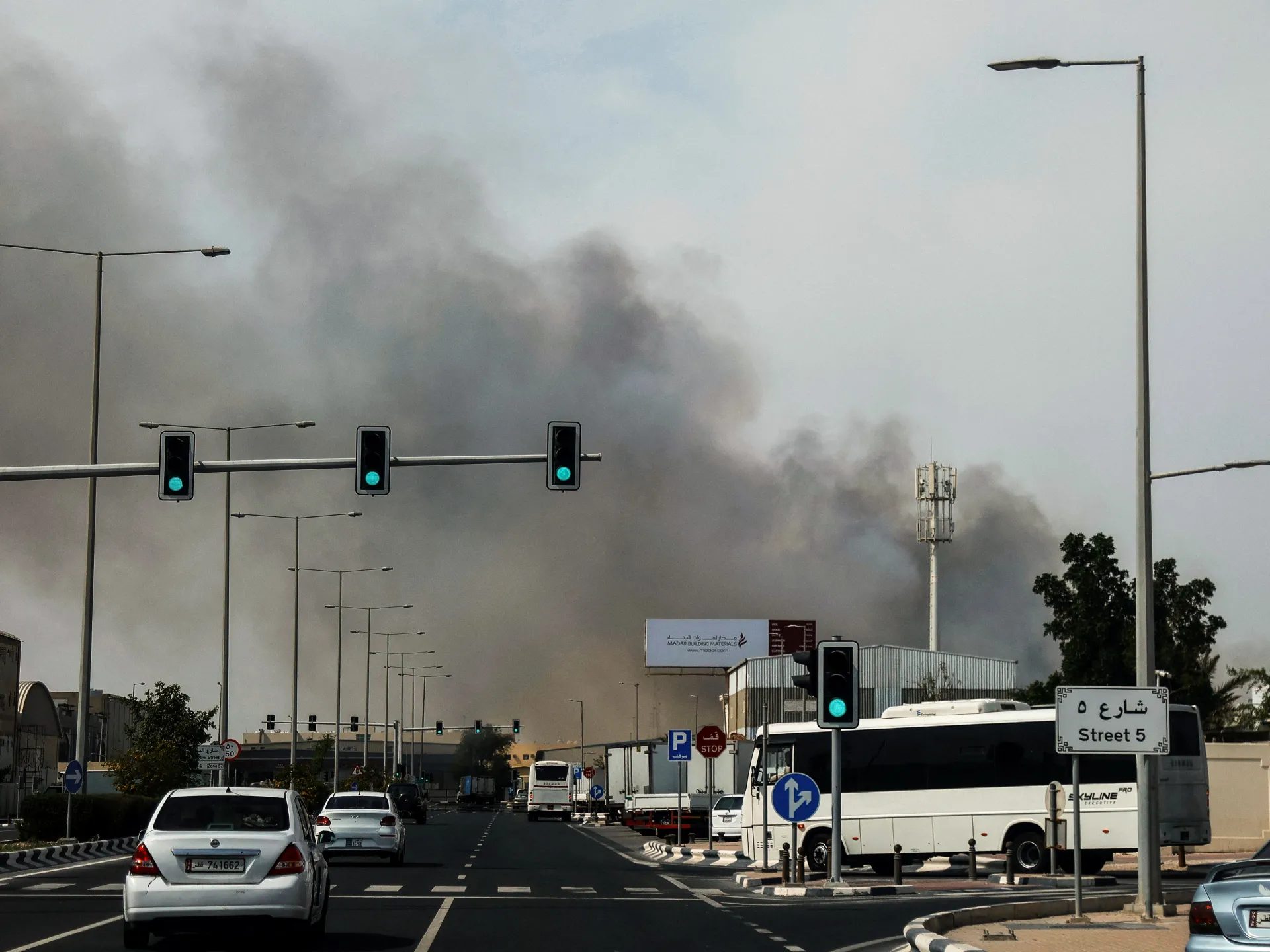
Qatar’s state-run energy firm says it has halted liquefied natural gas production after Iranian attacks, sending gas prices soaring in Europe, as Saudi Arabia announced it was temporarily shutting down some units of the Ras Tanura oil refinery located near the country’s eastern region after a fire broke out following a drone attack.

“Due to military attacks on QatarEnergy’s operating facilities in Ras Laffan Industrial City and Mesaieed Industrial City in the State of Qatar, QatarEnergy has ceased production of liquefied natural gas (LNG) and associated products,” the world’s largest LNG producer said in a statement on Monday.

Recommended Stories

list of 3 itemsend of list

Shortly after the announcement, natural gas prices in Europe soared by almost 50 percent.

Earlier, Qatar’s Defence Ministry said the country was attacked by two drones launched from Iran. “One drone targeted a water tank belonging to a power plant in Mesaieed, and the other targeted an energy facility in Ras Laffan Industrial City, belonging to QatarEnergy, without reporting any human casualties,” it said in a statement.

“All damages and losses resulting from the attack will be assessed by the relevant authorities, and an official statement will be issued later,” it added.

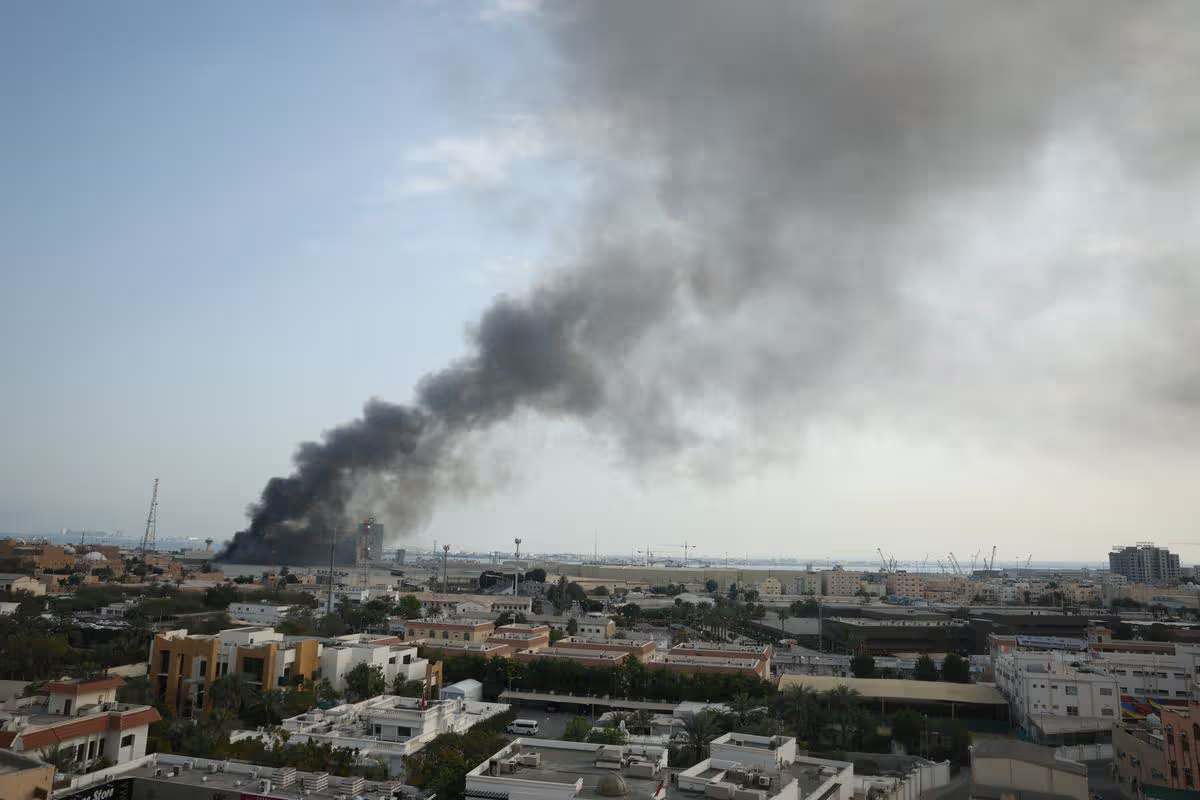
The Saudi Ministry of Defence, in reports carried by the state-run Saudi Press Agency (SPA), said two drones had “attempted to attack” the Ras Tanura refinery on Monday morning, and that a “small” fire had broken out after they were intercepted.

Footage verified by Al Jazeera showed plumes of smoke rising from the oil facility, located on Saudi Arabia’s Gulf coast. The ministry said the refinery “sustained limited damage”, but there were no casualties.

Ras Tanura oil refinery, one of the world’s largest oil processing facilities located near the eastern city of Dammam, has a capacity of 550,000 barrels per day. The facility is home to one of the largest refineries in the Middle East and is considered a cornerstone of the kingdom’s energy sector.

The attacks come as oil tankers have been piling up on either side of the Strait of Hormuz, through which about a fifth of the world’s seaborne oil and the bulk of Qatari gas flows.

The maritime disruptions and fears of a prolonged conflict have led to a sharp rise in global oil prices, which will have a significant impact on the global economy.

Iran has been launching retaliatory strikes, mainly targeting Israel and military facilities of the United States across the Middle East, after the US and Israel launched massive air strikes on the country.

In a statement published by SPA, the Saudi Ministry of Energy said some operations had been halted as a “precautionary measure” and that it did not foresee “any impact on the supply of petroleum products to local markets”.

Saudi Arabia had earlier said it would “take all necessary measures to defend its security and protect its territory, citizens, and residents, including the option of responding to the aggression” after Iran targeted the capital Riyadh and the country’s eastern region with strikes over the weekend.

The US, Bahrain, Jordan, Kuwait, Qatar, Saudi Arabia and the United Arab Emirates issued a joint statement on Sunday condemning Iranian attacks across the region and affirming their right to self-defence.

Rob Geist Pinfold, lecturer in defence studies at King’s College London, told Al Jazeera that Iran “knows exactly what it’s doing” by attacking the Gulf countries.

“These countries have less of an appetite for a fight because, at the end of the day, this is not their war. So, Iran is banking that they will want a ceasefire as soon as possible, that they will be pressuring the Trump administration. But we have no signs of that whatsoever so far,” he said.

Pinfold added that there seems to be a “show of force” and “of unity” coming from the Gulf states, at least rhetorically.

“They’re trying to get the message across that they are one and that they are united and that they are resilient,” Pinfold said. “But under the surface, there are profound disagreements here about how to engage with Iran and whether to engage with Iran at all.”

Source link

Blasts shake Qatar, UAE, Kuwait as Iran’s retaliatory strikes continue | News

Tehran’s retaliatory attacks on US assets in the Gulf region continue for a third day as fears of a prolonged conflict rise.

Loud explosions were heard in Dubai in the United Arab Emirates and the Qatari capital ‌of Doha for a third consecutive day of ⁠Iranian retaliatory strikes on neighbouring Gulf states in response to ongoing attacks by the United States and ⁠Israel on Iran.

Loud bangs and sirens were also heard in Kuwait early on Monday morning, with a witness quoted by Reuters news agency saying smoke was seen rising from near the US embassy.

Recommended Stories

list of 4 itemsend of list

Kuwaiti air defences intercepted the majority of the ⁠drones near Rumaithiya and ⁠Salwa neighbourhoods, the state-run Kuwait News Agency reported, quoting the director general of civil defence.

Tehran said it ⁠would target US military assets in the region after the ⁠US-Israeli ⁠strikes on Iran continued for the third day on Monday.

Iran has hit a range of civilian and commercial areas across ‌Gulf cities, widening the conflict’s impact on key regional aviation and trade hubs.

Meanwhile, Bahrain’s Ministry of Interior said it activated air raid alerts and urged residents to head to the nearest safe place.

It said the Shaikh Khalifa bin Salman Bridge linking the capital, Manama, to nearby towns was closed and urged “residents to use main roads only when necessary”.

At least one person has been killed in Kuwait, three have been killed in the UAE, and 16 people have been injured in Qatar.

Meanwhile, at least 201 people have been killed in Iran in US-Israeli attacks, with 747 wounded, while at least nine have been killed and 121 wounded in Israel.

Iran ‘attacking American targets’

The US, Bahrain, Jordan, Kuwait, Qatar, Saudi Arabia and the UAE issued a joint statement on Sunday condemning Iranian attacks across the region and affirming their right to self-defence.

Gulf countries “will take all necessary measures to defend their security and stability and to protect their territories, citizens, and residents, including the option of responding to the aggression”, the statement released after a meeting said.

However, Iranian Foreign Minister Abbas Araghchi on Sunday stressed that Tehran is not seeking confrontation with its Gulf neighbours, telling Al Jazeera that Tehran has “no problem with the countries on the other side of the Persian Gulf”, referring to the Gulf, which is also known as the Arabian Gulf.

Iran maintains “friendly and good neighbourly relations with all of them”, which it is determined to continue, he added.

“What we are doing is in fact an act of self-defence and retaliation to the American aggression against us,” Araghchi said.

“We are not attacking our brothers in the Persian Gulf, we are not attacking our neighbours, but we are attacking American targets,” he added.

Source link

Travel expert Simon Calder explains when Dubai, Emirates and Qatar flights could resume

Simon Calder warned that, even if the major airports reopen, it will take some time for normal service to resume

A travel expert claims international airports currently shut due to military action in Iran could reopen earlier than many anticipate. Journalist Simon Calder shared his forecast whilst boarding a flight from Istanbul, Turkey.

One individual has died and 11 others have been wounded at airports in Dubai and Abu Dhabi. Over 3,400 flights have been scrapped and airports in Dubai and Abu Dhabi in the United Arab Emirates (UAE), along with Qatar’s capital, Doha, and Manama in Bahrain were among those shuttered.

The Foreign Office is advising British nationals against all but essential travel to Bahrain, Kuwait, Qatar and the UAE. This means hundreds of thousands of travellers are stranded in the region, many of whom are believed to be either British or those attempting to fly to the UK.

In an Instagram video, Mr Calder stated: “The main question is when is the disruption going to stop?”.

“Dubai indefinitely closed; Emirates is kind of saying that sometime on Monday it might start up again. Doha, they’re going to give an update at 6 o’clock British time tomorrow. And Etihad and Abu Dhabi airport, they’re saying, well actually, yeah, we might be opening before that.

Content cannot be displayed without consent

“And I hope that the flight ban and also the travel advice from the Foreign Office saying do not go to these places will be lifted as soon as possible so that people can come back.

“I’m going to say, if you twisted my arm, we will probably see flights start up in the next couple of days but in a small way because, of course, planes and pilots and cabin crew and passengers are all out of position. So it’s going to take some time to get this back to normal and I simply hope that it is done with the maximum energy and indeed money just to try to make sure that people are back when they need to be as soon as possible.”

Mr Calder explained that – aside from the Covid-19 pandemic – disruption on the scale witnessed over the weekend hadn’t been seen since the 2010 Eyjafjallajökull volcano eruption and resulting ash cloud in Iceland.

READ MORE: Travel expert Simon Calder issues three-word advice for Brits caught up in Iran attacksREAD MORE: Travel expert Simon Calder predicts when BA, Etihad and Emirates flights will resume after Iran attack

During that week-long episode, approximately 20 countries shut their airspace to commercial aircraft, affecting roughly 10 million passengers. Mr Calder suggested things weren’t quite that severe ‘yet’ but described these as extraordinary circumstances and warned matters were ‘definitely heading in that direction’.

He also noted that, given the sheer scale of the airports affected and the extent of the chaos, it would require a substantial amount of time for the situation to resolve itself even once flights restarted.

He added: “Just bear in mind that every day that there are no flights going in and out of the world’s busiest international airport, Dubai, and Doha, and Abu Dhabi, that is two and a half thousand flights and about half a million people. The numbers are really staggering.

“Every hour generally, on average, 20,000 people land and depart from those airports, and so you have a massive problem building up. And certainly the numbers haven’t been added to because, of course, people are there, but what’s happening is that people’s holidays are ending and so they are being added to the back of the queue at the airport. It’s a desperate position for them to be in.

“It is going to be quite interesting to see how it is done, because you’ve got to remember that the numbers in Dubai rather exceed the current capacity of them.

“So let’s take a case of an expat who’s booked on the 5th of March, and let’s hope very much that flights are back on the 5th of March. That expat is expected to take her or his seat, and the fact that somebody’s been there for five days and really wants to get home isn’t relevant; it’s whoever’s got the booking in.

“And so I think there may well be shuttle services operated. They might even go to somewhere like Cyprus; they might just take people back and forth to a relatively short-haul destination from where people can board relatively short-haul flights. That would seem to cause the least amount of problem. I

” don’t know if this is going to happen, but I do know that there’s an awful lot of people out there who really want to be somewhere else and heavens, just imagine the stress and upset if you know that there’s somebody across the Gulf who is sending drones and missiles in your direction. A horrible situation for everybody.”
Source link

US-Israel attacks on Iran: Death toll and injuries live tracker | Conflict News

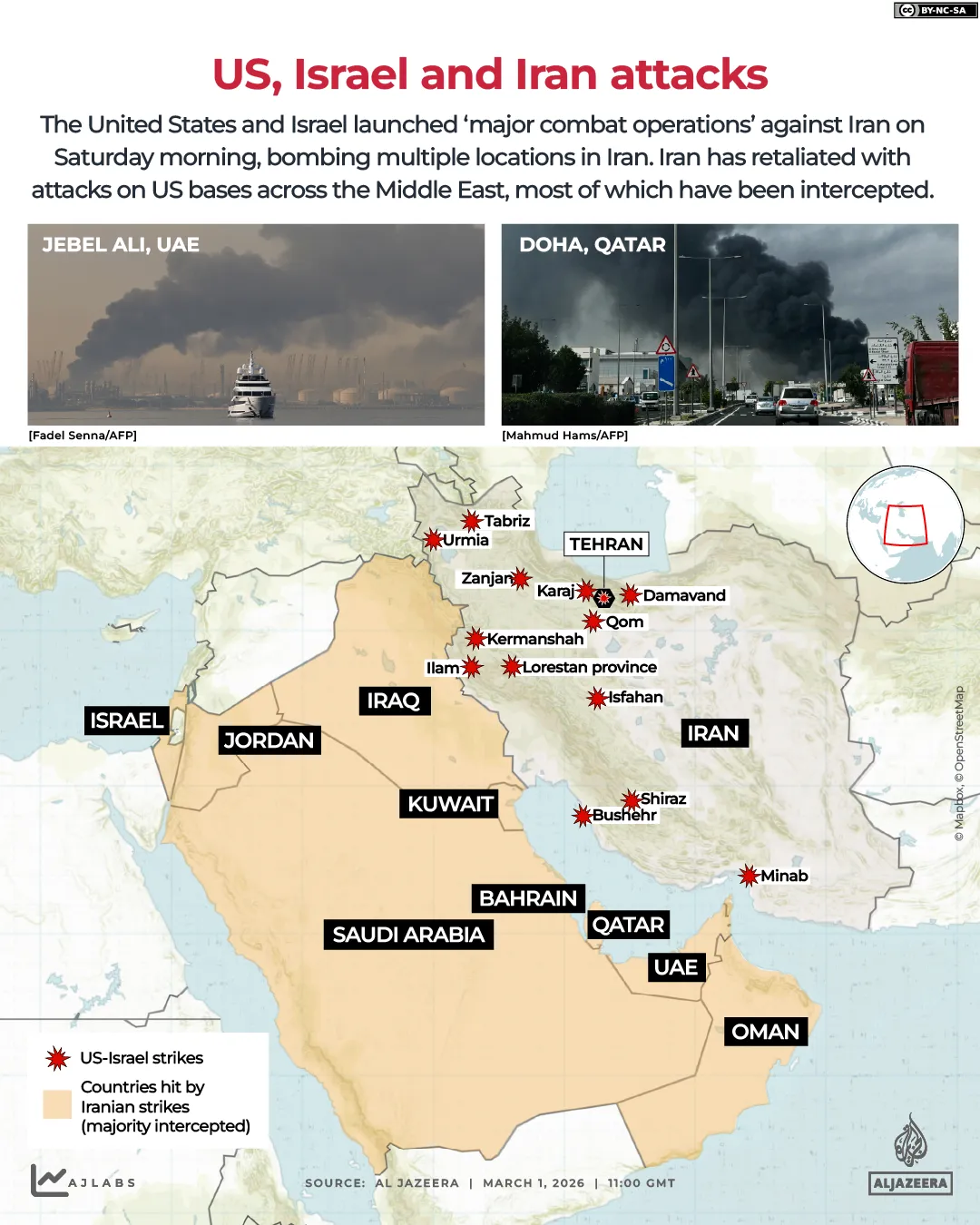
Explosions are being heard in Iran, Israel and across several Middle Eastern states after the United States and Israel began attacking Iran on Saturday.

Tehran has responded by launching waves of missiles and drones at Israel and towards several military bases in the Middle East where US forces operate.

Iran had previously warned that if it were attacked, it would respond by targeting US military facilities across the region, which it considers legitimate targets.

Which countries have been attacked?

Israel’s air force says it dropped more than 1,200 munitions across 24 of Iran’s 31 provinces over the past day in its joint attack with the US.

Iran’s Islamic Revolutionary Guard Corps (IRGC) says it has launched attacks on 27 bases in the Middle East where US troops are deployed as well as Israeli military facilities in Tel Aviv and other parts of Israel.

So far, Iran has launched strikes across eight countries in the region: Bahrain, Iraq, Jordan, Kuwait, Oman, Qatar, Saudi Arabia and the United Arab Emirates.

Most of these attacks have been intercepted.

Interactive_Iran_US_Israel_March1_2026-01-1772368294
(Al Jazeera)

US military presence in the Middle East

The US has operated military bases in the Middle East for decades.

According to the Council on Foreign Relations, the US operates a broad network of military sites, both permanent and temporary, across at least 19 locations in the region.

Of these, eight are permanent bases in Bahrain, Egypt, Iraq, Jordan, Kuwait, Qatar, Saudi Arabia and the UAE.

As of mid-2025, there are about 40,000 to 50,000 US soldiers in the Middle East stationed in both large, permanent bases and smaller forward sites.

The countries with the most US soldiers are Qatar, Bahrain, Kuwait, the UAE and Saudi Arabia. These installations serve as critical hubs for US air and naval operations, regional logistics, intelligence gathering and force projection.

INTERACTIVE - US Military presence in the Middle East June 2026 - FEB24, 2026-1772272732
(Al Jazeera)

How many people have been killed or injured?

Below are the confirmed casualties across the 10 countries that have been subject to attacks as of Sunday at 13:40 GMT.

Due to the rapidly evolving situation, all figures may change as more information becomes available.

Iran – killed: 201, injured: 747

As of Sunday morning, the Iranian Red Crescent Society and official state-linked media have reported preliminary casualty figures of 201 people killed and at least 747 injured as rescue operations continue.

Since then, explosions continue to be heard across Iran with Israel saying it has carried out a large aerial attack on the “heart of the capital”.

The deadliest single incident occurred in the city of Minab in southeastern Iran, where a strike on an elementary girls school reportedly killed at least 148 people and injured 95. The attack occurred on Saturday, and the death toll has been climbing since.

Israel – killed: 9, injured: 121

On Sunday afternoon, an Iranian ballistic missile strike on central Israel’s Beit Shemesh killed eight people and injured about 20. Rescue workers are still combing through the rubble.

Late on Saturday, one woman in the Tel Aviv area was confirmed killed after being struck by falling shrapnel.

At least 121 others have been reported injured, at least one seriously.

At least 40 buildings in Tel Aviv were damaged in Iranian strikes on Saturday, the Israeli newspaper Haaretz reported, citing the city government.

An explosion caused by a projectile impact after Iran launched missiles into Israel following Israel and the U.S. launched strikes on Iran, in Tel Aviv, Israel, February 28, 2026. REUTERS/Gideon Markowicz ISRAEL OUT. NO COMMERCIAL OR EDITORIAL SALES IN ISRAEL
An explosion occurs in Tel Aviv on February 28, 2026, after Iran launched missiles into Israel [Gideon Markowicz/Reuters]

Bahrain – killed: 0, injured: 4

Iranian missiles targeted the headquarters of the US Navy’s 5th Fleet in Bahrain’s Juffair area.

Bahrain’s Ministry of Interior also confirmed that the country’s international airport was targeted with a drone, “resulting in material damage without loss of life”.

On Saturday night, several residential buildings in the capital, Manama, were struck by Iranian drones.

Government hospitals said four people were receiving treatment for shrapnel-related injuries.

A building that was damaged by an Iranian drone attack, after Israel and the U.S. launched strikes on Iran, in Seef, Manama, Bahrain, March 1, 2026. REUTERS/Hamad I Mohammed
A building was damaged in the Seef commercial district of Manama, Bahrain, on March 1, 2026, in an Iranian drone attack [Hamad Mohammed/Reuters]

Iraq – killed: 2, injured: 5

The US and Israel also targeted the Jurf al-Sakher base, also known as Jurf al-Nasr, in southern Iraq, which houses the Popular Mobilisation Forces, made up of mostly Shia fighters, and the Iran-supported Iraqi paramilitary group Kataib Hezbollah.

Iraqi state media and sources within Kataib Hezbollah confirmed that two fighters were killed in the strikes and five were wounded.

In northern Iraq‘s semiautonomous Kurdish region, where the US is reported to still have troops, several powerful explosions were reported near the US consulate and international airport in Erbil.

Air defences intercepted the drone attacks on Saturday, according to reports.

A plume of smoke rises near Erbil International Airport in Erbil on March 1, 2026. Loud explosions were heard early on March 1 near Erbil airport, which hosts US-led coalition troops in Iraq's autonomous Kurdistan region, an AFP journalist said. (Photo by Shvan HARKI / AFP)
A plume of smoke rises near Erbil International Airport in Erbil, Iraq, on March 1, 2026 [Shvan Harki/AFP]

Jordan – killed: 0, injured: 0

The Jordanian armed forces reported intercepting 49 drones and ballistic missiles that entered Jordanian airspace. While their fragments caused localised property damage, there have been no deaths or injuries within the kingdom.

Kuwait – killed: 1, injured: 32

Kuwait’s Ministry of Defence says Ali al-Salem Air Base came under attack by a number of ballistic missiles, all of which were intercepted by Kuwaiti air defence systems.

A drone targeted Kuwait International Airport on Saturday, resulting in minor injuries to a number of employees and limited damage to the passenger building.

On Sunday, Kuwait’s Ministry of Health said one person had been killed and 32 wounded.

Kuwait City, in the aftermath of strikes
Kuwait City in the aftermath of strikes by Israel and the US on Iran [Stephanie McGehee /Reuters]

Oman – killed: 0, injured: 5

On Sunday morning, the Oman News Agency, quoting a security source, said two drones had targeted the Duqm port, injuring one foreign worker.

Later, Oman’s Maritime Security Centre said a Palau-flagged oil tanker was ‌attacked about 5 nautical miles (9km) off Oman’s Musandam governorate, injuring four people.

Qatar – killed: 0, injured: 16

As of Sunday morning, the Qatari Ministry of Interior confirmed that the number of injured was at 16 people. Most injuries were reported to be from falling shrapnel and debris with one person seriously hurt.

The Qatari Ministry of Defence confirmed that two ballistic missiles struck the Al Udeid military base, where US forces are stationed, while a drone targeted an early warning radar installation.

Qatari air defence systems, in coordination with regional partners, successfully intercepted about 65 missiles and 12 drones over Qatari airspace, it said.

The Qatar Civil Aviation Authority suspended all air navigation indefinitely. Qatar Airways grounded all flights and advised passengers that updates will be provided on Monday by 9am (06:00 GMT).

All schools have moved to remote learning, and public gatherings for Ramadan have been suspended until further notice to ensure public safety.

Saudi Arabia – killed: 0, injured: 0

The Saudi Ministry of Foreign Affairs confirmed that Iranian attacks targeted both the capital, Riyadh, and Eastern Province, home to major oil infrastructure and the King Abdulaziz Air Base.

The kingdom has officially reported no casualties as of Sunday afternoon.

United Arab Emirates – killed: 3, injured: 58

As of Sunday afternoon, at least three people in the UAE were confirmed killed and 58 others wounded.

A Pakistani national was killed and seven people were injured when debris from intercepted missiles and drones fell on a residential area near Zayed International Airport in Abu Dhabi.

The Ministry of Defence confirmed that another individual, identified as an Asian national, was killed by falling shrapnel in a residential district of the capital.

Additionally, four airport staff at Dubai International Airport sustained injuries, and four people were injured at Palm Jumeirah after a fire in a building caused by falling debris.

As of Sunday afternoon, The UAE’s Defence Ministry says it detected 165 ballistic missiles, destroying 152, and intercepted two cruise missiles.


Source link

Smoke rises above Qatar capital Doha after Iranian missiles shot down | Infrastructure

NewsFeed

Loud explosions have been heard in Doha, the capital of Qatar, as defence systems shot down incoming Iranian missiles. Falling debris ignited large fire that sent plumes of black smoke rising above the city. Iran has hit multiple Gulf states as it responds to US-Israeli attacks.

Source link

Missile debris injures eight in Qatar after Iran launches barrage | Israel-Iran conflict News

Interior Ministry official says 66 missiles were fired at Qatar, and there were 114 reports of falling shrapnel. 

Doha, Qatar – Eight people have been injured in Qatar after missile shrapnel landed in multiple locations across the country, authorities said, following a barrage of Iranian missiles that Qatar said were intercepted by its air defences.

Brigadier Abdullah Khalifa Al-Muftah, the head of public relations at Qatar’s Ministry of Interior, said in a televised address on Saturday that 66 missiles were fired at Qatar and that authorities received 114 reports of shrapnel falling nationwide. He said one of the injured people was in serious condition.

Recommended Stories

list of 3 itemsend of list

The Interior Ministry issued an emergency alert urging the public to stay away from military sites and remain indoors, warning people not to approach or handle any unidentified debris and to report any to authorities.

Qatar’s Ministry of Defence said it had “successfully intercepted” a second wave of attacks targeting several areas. It said all missiles were intercepted before reaching the country’s territory, and urged residents to remain calm and follow official instructions.

Qatar’s Ministry of Foreign Affairs condemned what it said was the targeting of Qatari territory with Iranian ballistic missiles, calling it “reckless and irresponsible”, as well as a “flagrant violation” of sovereignty and an escalation threatening regional stability.

Ibrahim Sultan Al-Hashemi, the head of public relations at the Foreign Ministry, said the attack was inconsistent with the principles of “good neighbourliness”, and that Qatar reserved the right to respond “in accordance with international law”.

The ministry also called for an immediate halt to escalation and a return to negotiations.

The missile barrage came as Iran launched strikes across the Gulf after the US-Israeli attacks on Iran, an escalation that prompted air-defence interceptions over several countries. The news agency Reuters reported that Kuwait, Qatar, the United Arab Emirates and Bahrain said they intercepted Iranian missiles, while Jordan also intercepted missiles.

This is not the first Iranian attack on Qatar. In June 2025, during the 12-day war between Iran and Israel, Iran launched missiles at the Al Udeid airbase, a key facility hosting US forces near Doha.

Saturday’s barrage came after the United States and Israel carried out strikes on Iran, raising fears of a wider conflict and increasing pressure on Gulf states that host US forces and critical energy infrastructure.

The developments heightened anxiety across the Gulf, where Ramadan routines were disrupted by air raid alerts, interceptions and warnings about unexploded fragments, as leaders urged restraint amid fears of a widening confrontation.

Source link