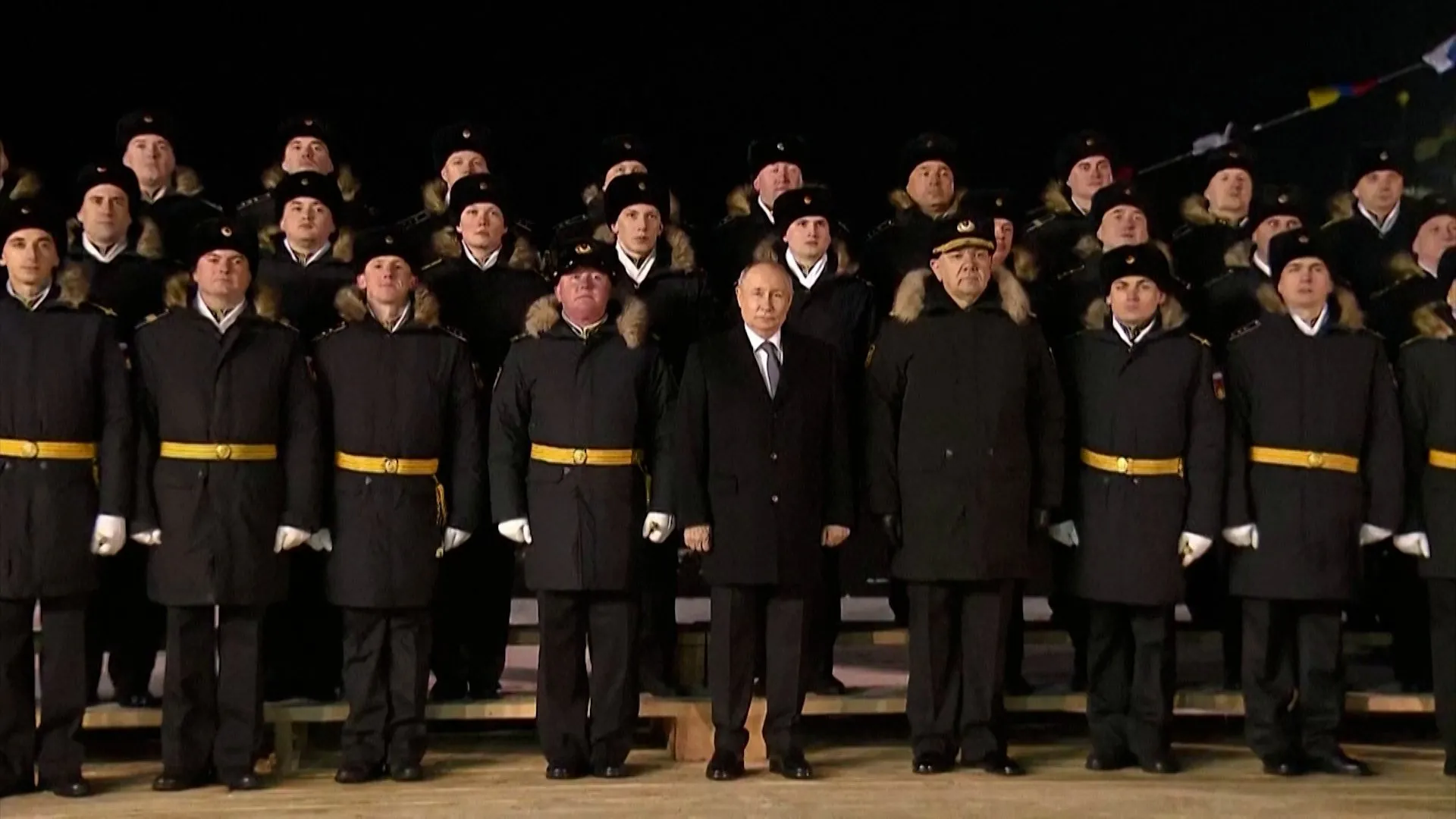
Russian President Vladimir Putin attended the commissioning of the nuclear-powered submarine Perm at the Severodvinsk shipyard. He says Russia plans to launch at least three more similar vessels by 2030.
SHENZHEN, China — In August of last year, President Trump hosted Russian President Vladimir Putin in Alaska for a summit labeled at the time as a historic event. This would mark the beginning of the end of the war in Ukraine, Trump vowed, the deadliest conflict of our time.
But as Trump greeted Putin with an outstretched hand this week in Shenzhen, over a year later, Moscow’s assault on Ukraine had only intensified. Russian ballistic missile attacks have surged sharply since the Anchorage summit, by over 60%, increasingly targeting civilians in urban areas, according to independent analysts.
In a similarly choreographed gathering in Beijing earlier this year, Trump huddled with Chinese President Xi Jinping, repeatedly calling him a friend and pledging to work through their most contentious differences. Yet behind the scenes, Beijing was orchestrating an elaborate effort to circumvent U.S. export controls, acquiring more than 1.5 million American chips through back channels to fuel its ambitions to beat the United States for artificial intelligence supremacy.
China’s covert effort came to a head days before the summit, when an alleged espionage campaign by Beijing targeting America’s largest chipmaker erupted into public scandal.
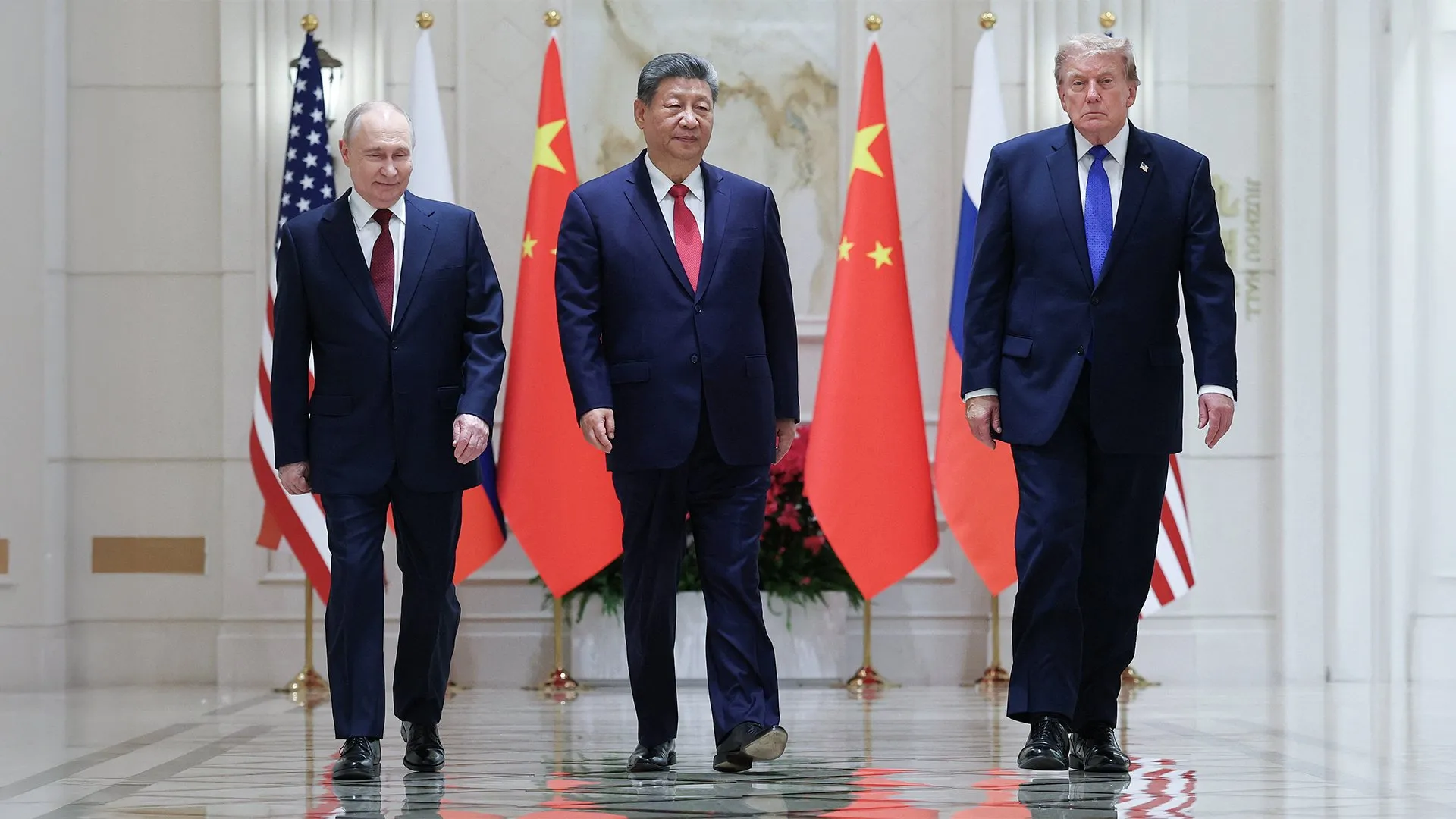
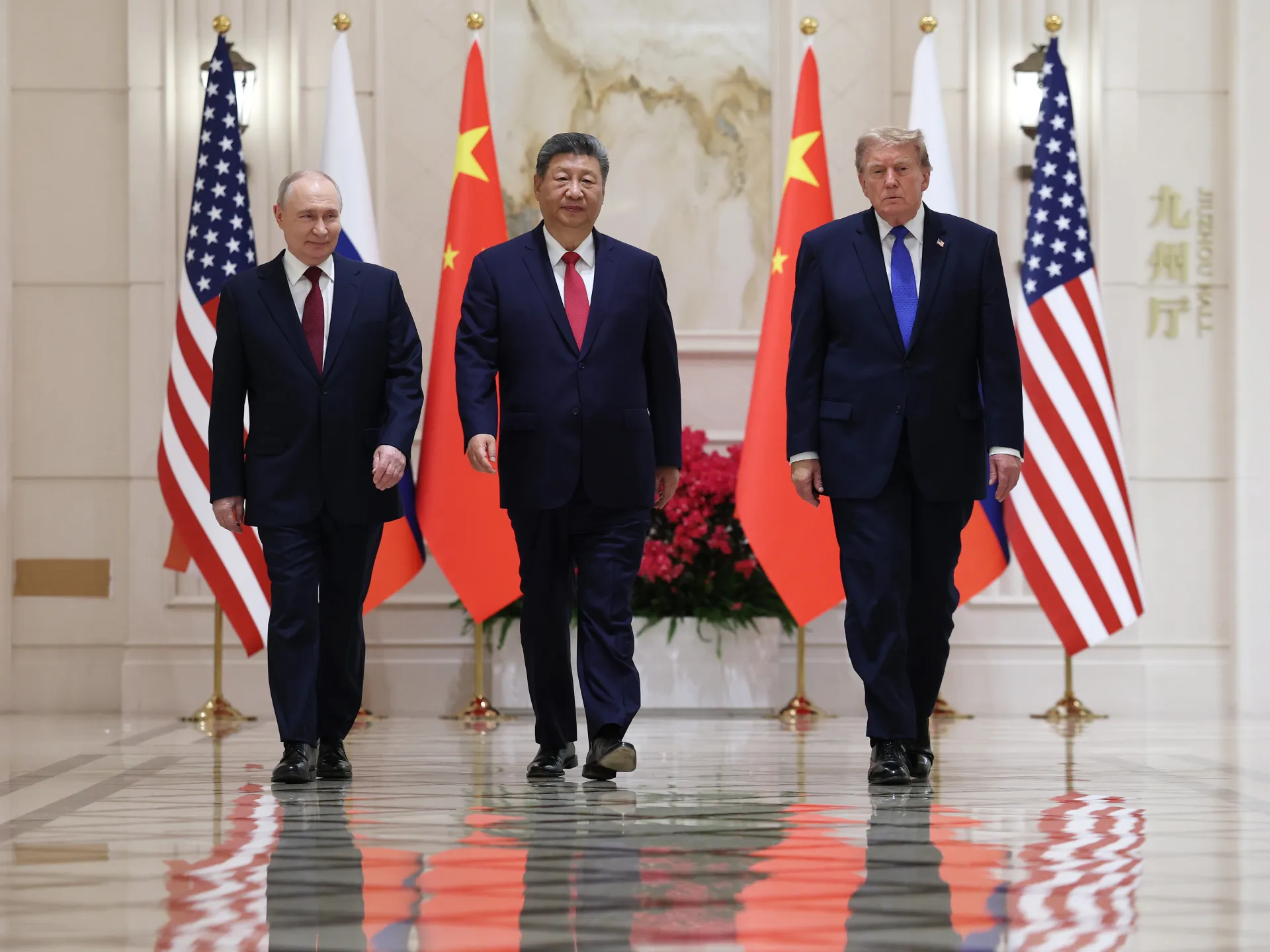
A hastily arranged gathering with all three men, held here Thursday in southern China, produced iconic images of cooperation and peace. It was a first of its kind. But the meeting ultimately continued Trump’s practice of summitry without substance, deferring to powerful adversaries over vital American interests, placating historical rivals to the consternation of long-standing allies.
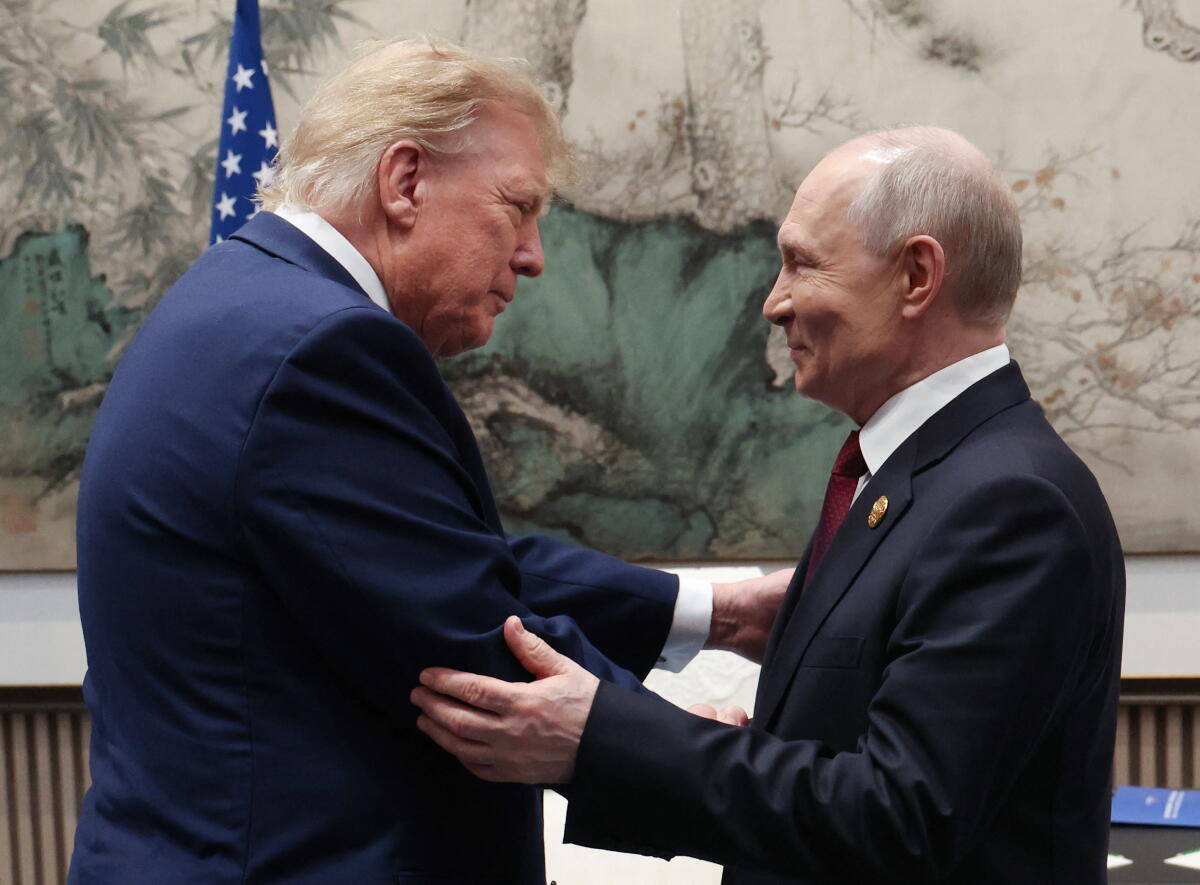
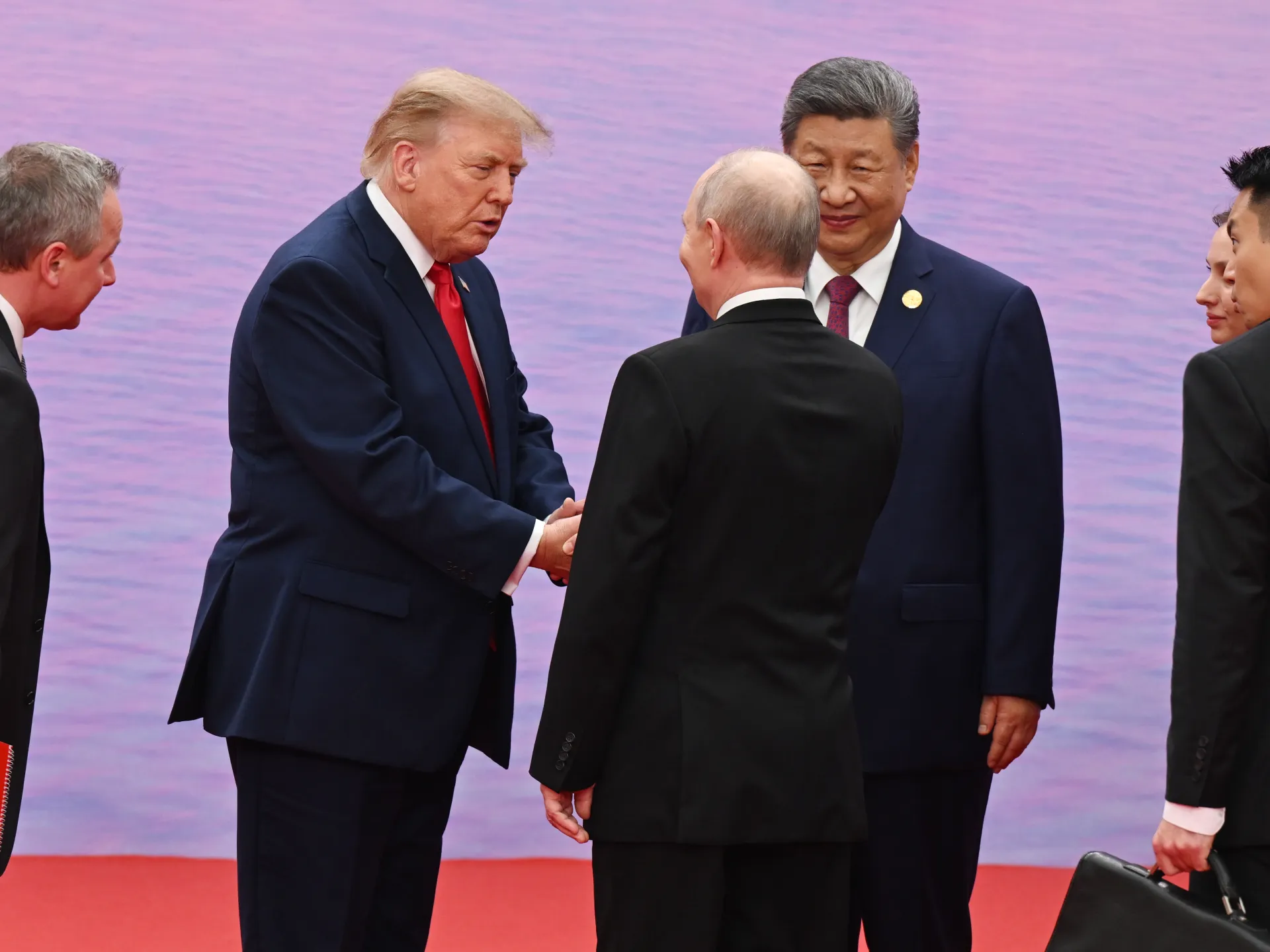
President Vladimir Putin and President Trump shake hands during a meeting on the sidelines of the Asia-Pacific Economic Cooperation (APEC) Summit in Shenzhen, in China’s southern Guangdong province, on Thursday.
(Vyacheslav Prokofyev / Pool/AFP via Getty Images)
“The meeting was a terrible signal to real U.S. friends around the world, but there was no lasting substantive outcome to the meeting,” John Bolton, who served as national security advisor to Trump in his first term, told The Times. “I suspect that the bilateral meetings Trump had with Xi and Putin respectively might have had more substance, but details on those meetings are still too sketchy to evaluate.”
Rather than promoting peace, the summit served to generate further angst and distrust across Asia and Europe, with several leaders publicly recoiling at Trump’s overtures of affection. “God, protect us from such friends,” Polish Prime Minister Donald Tusk said, reacting to Trump’s embrace of Putin.
“It was an interesting moment for the president to hold a trilateral with America’s two strategic rivals,” said Kyle Balzer, a national security fellow at the American Enterprise Institute. “Given the nature of Chinese and Russian behavior in their respective neighborhoods, a trilateral summit focused on strategic stability sends a confusing message to allies, who don’t see much ‘stability’ coming from Putin and Xi.”
Still, despite his professed friendship with Putin and Xi, Trump stopped short of explicitly abandoning U.S. support for Ukraine, Taiwan and other regional partners considered by China and Russia to be within their spheres of influence.
A discussion among the three leaders that resulted in a denunciation of nuclear war may sound obvious, but could be a mark of progress, experts said, after Putin has repeatedly kept open the door to using tactical nuclear weapons on the Ukrainian battlefield.
“The one positive thing I can identify from the meeting is the reiteration of the position that ‘a nuclear war cannot be won and must never be fought,’ ” said Brian Taylor, a professor of public policy at Syracuse University. “It’s good that they are at least willing to sign on to this condemnation of nuclear weapons use. Cheap talk, perhaps, but at least those are the right words.”
President Trump and President Xi Jinping shake hands before leaders gather for a group photo during the Asia-Pacific Economic Cooperation (APEC) Summit on Thursday in Shenzhen, China.
(Greg Baker / Pool / Getty Images)
Trump’s focus on nonproliferation in the end seemed to be not on the world’s three largest nuclear arsenals, but on Iran’s potential pursuit of the bomb, the primary justification he has given for starting a war with Tehran earlier this year.
Support from Russia and China was essential in securing an international agreement with Iran in 2015 governing its nuclear program.
Trump’s gestures of friendship to the two autocrats were notable, but not a new phenomenon from the American president, after a decade on the international stage.
In the past, he has dismissed the untoward behavior of U.S. adversaries as the type of activity that the United States, too, engages in with its foes.
“They’re talking about the spying,” Trump said of the Chinese during a visit to Beijing, in the spring, before the spy scandal erupted around chipmaker Nvidia. “Well, we do it too. We spy like hell on them too.”
Famously asked about Putin’s targeted assassinations, Trump replied in a Fox News interview in 2017: “There are a lot of killers. We’ve got a lot of killers. What, do you think our country’s so innocent?”
Trump has said he finds it unproductive to “insult” powerful leaders with confrontations around such activities. But he has continued to support counterintelligence operations against Moscow and Beijing, maintaining a flow of intercepted Russian communications to Kyiv despite consistent tensions with its government, and refusing to give Xi clarity on whether he would come to the defense of Taiwan if China attacked.
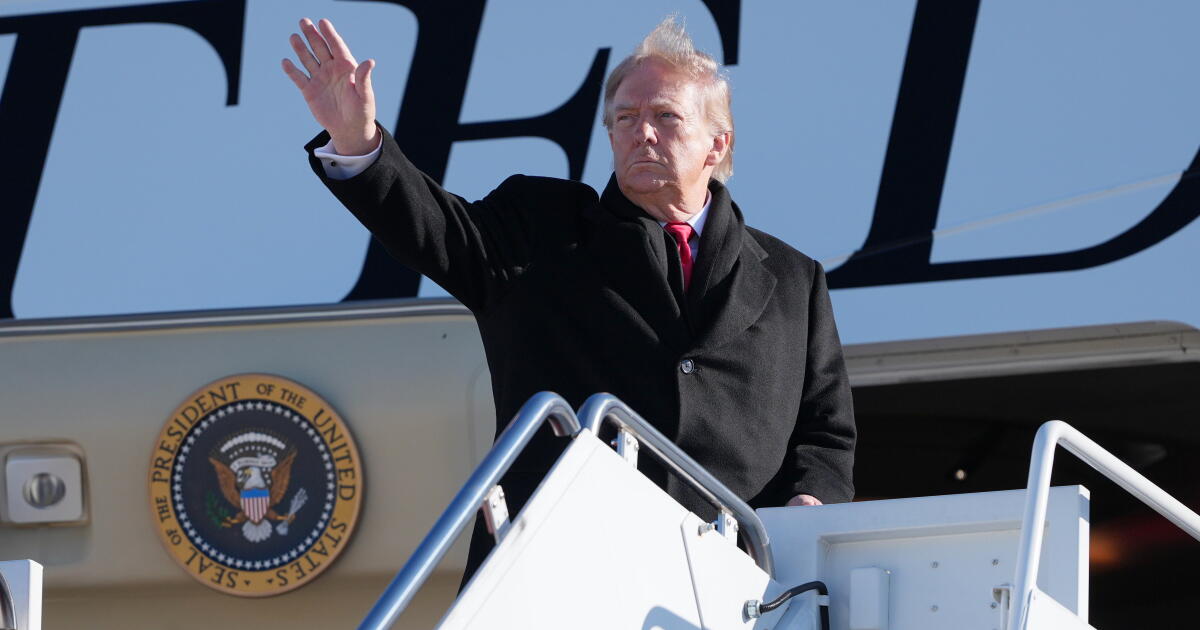
President Trump gestures as he boards Air Force One before departing from Shenzhen Bao’an International Airport following the Asia-Pacific Economic Cooperation (APEC) Summit in Shenzhen, in China’s southern Guangdong on Thursday.
(Mandel Ngan/AFP via Getty Images)
The president could have accomplished more, experts said, had he come with a team prepared.
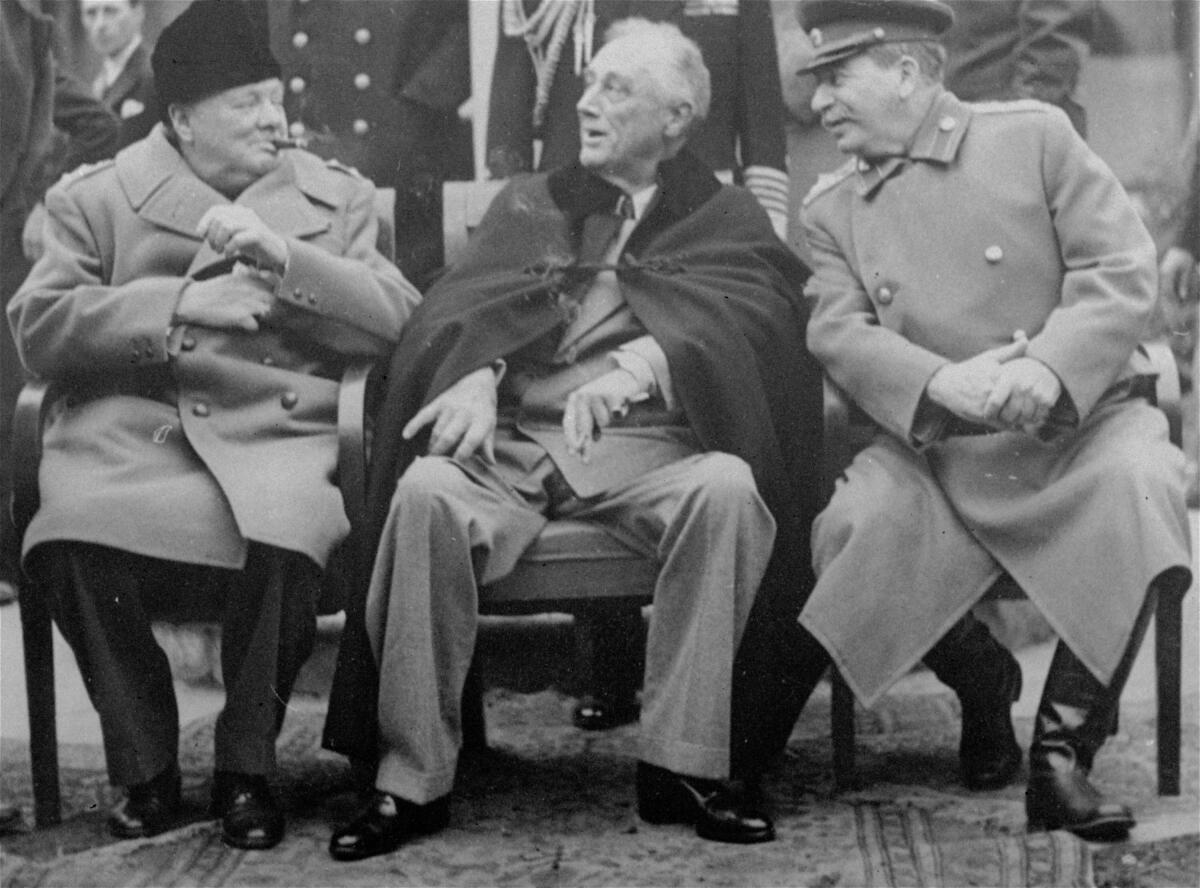
“Unlike Yalta, which some folks see as a sort of precedent, this is not a victory lap for geopolitical winners,” said Chester Crocker, who served as an assistant secretary of State in the Reagan administration, referring to a famous trilateral conference at the end of World War II between President Franklin Delano Roosevelt, British Prime Minister Winston Churchill and Soviet Premier Josef Stalin.
“Shenzhen could have been a seminal moment if the three had scripted a well-prepared agenda focused on strategic nuclear issues, and if the U.S. had reflected on its responsibilities as the leader of the world’s most politically and economically successful country,” Crocker added. “It could be an important moment if they agree to meet again.”
United States President Donald Trump has praised his recent trip to China and defended the relationship with his “friend” Vladimir Putin, but questioned whether the Russian president was a friend to the US.
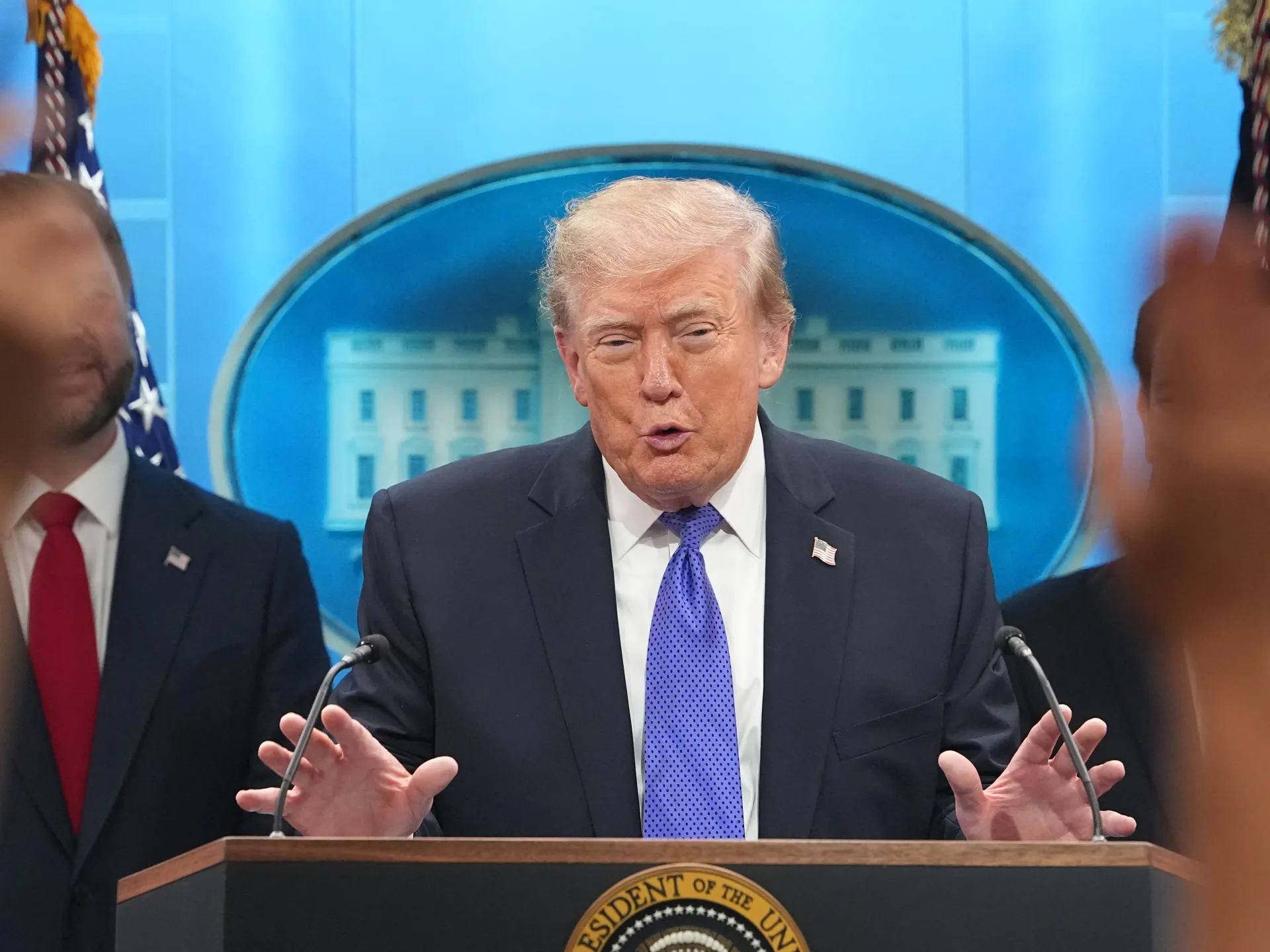
On Friday, during a White House news briefing, Trump was asked about the “friend” remark — made during his historic summit with Putin and Chinese President Xi Jinping earlier this week — and whether the Russian leader was a friend to the US.
Recommended Stories
list of 3 itemsend of list
“I can’t speak to America,” Trump told reporters before saying Putin had been “very nice” during what he described as the “Russia hoax” investigation after his 2016 presidential campaign.
“I consider him to be somebody that I have a very good relationship. And it’s actually very good,” Trump added as he talked about Russia’s nuclear weapons capabilities.
“I think it gives us a lot of additional strength,” he said.
Trump also spoke about the historic nature of his meeting with Xi and Putin, praising the “first of its kind trilateral peace agreement”.
“We had one of the most momentous international summits in many years. That was the first ever trilateral meeting between the leaders of the United States, Russia and China,” Trump said.
No major deals were announced from the summit. But Trump, on Friday, played up his agreement with the two leaders to hold future discussions on nuclear proliferation.
The US president’s remarks came during a wide-ranging news conference, where topics from Iran to artificial intelligence were also discussed.
Trump accused Iran of negotiating in bad faith to end the war, which is about to mark its 10-month anniversary.
“They want to make a deal, but they don’t want to make a deal that’s acceptable to me,” he said. “We wanna make a real deal, not a fake deal.”
Trump added: “They’ve been b*********** people for 51 years.”
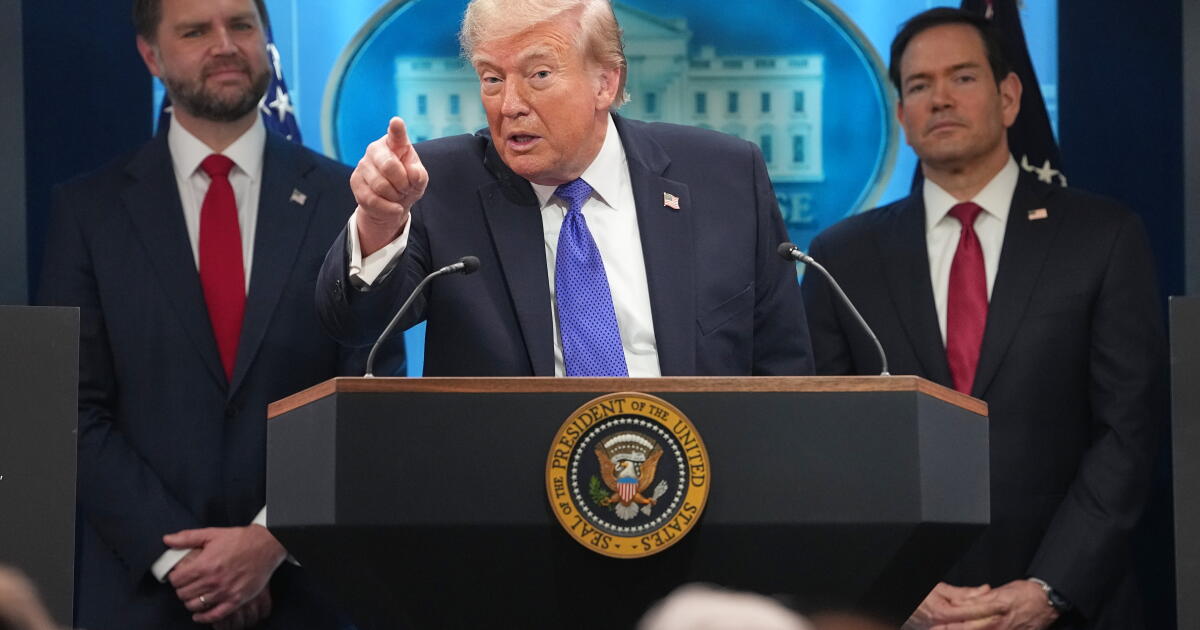
During the news conference, US Vice President JD Vance and US Secretary of State Marco Rubio, both possible 2028 presidential contenders, flanked Trump in the White House press briefing room.
US Treasury Secretary Scott Bessent and US Defence Secretary Hegseth, as well as newly minted White House chief of staff Stephen Miller, were also present.
Trump denied he was upset at Vance for blaming US Republicans’ historic midterm losses on the Iran war, saying, “People that work for me, they have a right to their opinion.”
“I thought his statement was fine, except I would have had one other thing that, if we were asked, I would have said that, would you do it again, and absolutely the answer is yes,” Trump said. “I saw that, but no problem there at all.”
No data centres abroad
Vance was asked by reporters about his thoughts on his party’s midterm drubbing.
“I think the president is the one who makes the decision. And the president has said he would do it again,” Vance said. “My goal, in my job, is to support the President of the United States.”
Trump also warned US tech companies against building new artificial intelligence data centres overseas. Otherwise, he said, they will face a “tremendous tax”.
“We’re not allowing data centres to go into other countries because China will take all of them”, Trump said. “And we’re going to put tremendous penalties on companies that try and do it.”
Trump did not provide details on how he would enforce such a policy and said he had not yet told his own officials about his plan.
Al Jazeera has reached out to the White House for comment but has not yet heard back.
WASHINGTON — President Trump on Friday vowed to punish American companies that build data centers abroad, threatening to levy “tremendous penalties” on any that try, as he returned from Asia eager to project confidence in his push to win the global race for dominance in artificial intelligence.
“We’re not allowing data centers to go into other countries because China will take all of them, and we’re not allowing that to happen,” Trump said during a sprawling news conference at the White House.
The threat was Trump’s latest bid to tighten his grip on a booming industry that has become central to the U.S. economy, and to show how America plans to set the pace in the AI race. The United States is leading, he said, China is second, and “there really is no third place.”
It was also part of a broader effort to sell what Trump called a “consequential trip” to the Philippines and China, one that ended with an unprecedented gathering with Chinese President Xi Jinping and Russian President Vladimir Putin.
“It was big. It was great, great electricity,” Trump said. “The relationship was fantastic between the three of us.”
While the summit produced few tangible plans, Trump said he and Xi agreed to do “some joint guardrails” on artificial intelligence, but did not offer specifics. And in a window into how Trump sees the influence of tech giants in the AI race, Trump told reporters that he thinks Nvidia should reinstate its co-founder Jensen Huang, who resigned last week amid a scandal involving an affair with a woman suspected of being a Chinese spy.
“He is a man who made some bad decisions but he is a brilliant person,” Trump said. “We have to protect our brilliant people … and Jensen is one of them.”
Trump’s remarks came on a turbulent day for the industry, as a sell-off in artificial intelligence stocks dragged the S&P 500 down 3.7% on Friday. It was the steepest weekly loss in more than 18 months, showing unease among investors. The drop came amid the scandal at Nvidia, and Anthropic making its debut on the public market.
Trump’s defense of the AI industry was among a medley of subjects the president addressed during a 87-minute news conference that included Vice President JD Vance, Secretary of State Marco Rubio, Defense Secretary Pete Hegseth, Treasury Secretary Scott Bessent and Stephen Miller, his new chief of staff.
As Cabinet members looked on, Trump praised his relationship with Putin, but when asked whether the Russian leader was a friend to the United States, he demurred, saying, “I can’t speak to America.” He also claimed that Putin told him Russia would never have invaded Ukraine in 2022 had Trump been president.
“Actually, I asked him. I said, ‘Would you have gone in if I was president?’ He said, ‘No, would have never happened.’ Trump said. “It was handled so bad by our country.”
Trump also renewed his criticism of the International Criminal Court, calling it a “fake power” that thinks it can “arrests heads of countries for no reason.” He said that he, Putin and Xi had condemned the court as a group. The court has a warrant outstanding for Putin’s arrest, accusing him of war crimes over the deportation of Ukrainina children.
Trump’s news conference came as Americans remain rattled by a series of outages that have disrupted air travel, email services and bank transactions in the last week.
Asked whether there is cause for concern, Trump said the disruptions were “all separate events,” and not part of a coordinated effort.
He said nationwide ground stop was due to an “ancient” air traffic control system, but insisted it is “very safe,” and that if there was a silver lining to the technical issues the FAA experienced it is that Congress has become receptive to modernizing the system.
Trump attributed the outages at private companies, including major banks and airlines, to routine technological upgrades.
“We have thousands of companies that are upgrading right now, and when they upgrade, bad things happen,” he said.
But the disruptions have also raised questions about the administration’s own cybersecurity leadership after Trump fired Sean Cairncross, the national cyber director on Thursday. When asked why, Trump said: “Because I didn’t think that person was good enough.” He has tapped Kirsten Davies, chief information officer at the Defense Department, to fill the post.
Trump, however, brushed aside questions about tensions between him and Vance.
Asked whether he was frustrated with his vice president after he blamed Republicans’ midterm losses on the war with Iran, Trump said he never said he was “unhappy” with his stance, just that he should have clarified that he agreed with the decision to launch the war if he had to go back in time and do it again knowing the political risks.
As Vance stood behind Trump, he was asked whether he believes the war had been worth the political fallout. He told reporters his job was to support the president, and the decision has been Trump’s to make to ensure Iran from obtaining a nuclear weapon.
“It has unbelievable support. I’ll tell you what, Adam Schiff said, ‘Wow, we love that bill,’” Trump said of the Democratic senator from California.
In a statement, Schiff said the proposal will create jobs and boost local economies, and achieve the long-sought goal for many in Hollywood of bringing production back to the U.S.
“Given the support from the president and Republicans and Democrats in both chambers, we can get this legislation across the finish line,” Schiff said.
On other legislative issues, Trump said he would not hesitate to use his veto power, calling it an “extreme power” he can wield to exert control over negotiations. Still, he rejected the idea that the midterms had been a verdict on his presidency and agenda.
“I wasn’t on the ballot,” he said. “I hope you remember that.”
Times staff writer Justine McDaniel, in Washington, contributed to this report.
The APEC summit saw the first-ever trilateral talks between US President Donald Trump, Russian President Vladimir Putin and China’s Xi Jinping. Political commentator Einar Tangen told Al Jazeera that Trump and Putin’s statements distracted from the planned agenda.
Russian President Vladimir Putin has used his speech at the Asia-Pacific Economic Cooperation (APEC) summit to pitch investments in the country’s Arctic regions, as Moscow hopes to spearhead year-round navigation on the Northern Sea Route (NSR), which is currently confined to the summer months.
“I am confident that the business community and investors from APEC economies will fully appreciate the opportunities emerging in the Russian market – and, naturally, will take advantage of them,” Putin said on Wednesday in Shenzhen, China, according to Russian media.
Recommended Stories
list of 3 itemsend of list
The package proposed by the Russian president to support this includes tax breaks on profits, property and land, as well as reduced payroll contributions and preferential leases, Russian media reported.
His APEC speech follows Putin’s remarks at the Eastern Economic Forum in the Russian city of Vladivostok in September, when he also outlined plans to make navigation along the NSR year-round as well as to introduce new measures to expand transport, energy and technological infrastructure.
Russia has been developing the Arctic shipping corridor which connects its northern ports to the Pacific region. But Putin’s efforts to turn the NSR into an important artery of global trade have raised concerns about geopolitical and security challenges, as well as environmental risks for the fragile Arctic environment.
What is the Arctic route and why is Russia betting on it?
The Arctic shipping lane runs for about 5,600km (3,480 miles) along Russia’s northern coast, from the Novaya Zemlya archipelago in the west to the Bering Strait in the east. But it is only navigable for a few weeks of the year when the ice melts during the summer.
A more reliable shipping route through the Arctic could ease global trade, which is currently hampered by the Middle East crisis that has paralysed critical waterways, including the Bab al-Mandeb strait on the edge of the Red Sea, which feeds into the Suez Canal, and the Strait of Hormuz in the Gulf. Shipping companies have become increasingly interested in alternative trade routes amid these heightened security concerns.
China announced its own new shipping route through the Arctic Ocean in August, dubbed the “Ice Silk Road”, which also takes in Russia’s NSR.
Climate change, which has contributed to major melting in the Arctic, is making the route more navigable for longer stretches of the year, raising its prospects as a viable alternative to existing shipping corridors.
The layer of frozen seawater that caps the Arctic Ocean, which melts through the summer to its annual low in September, has reached record lows. This year, according to NASA, it shrank to its lowest on satellite record.
Can Putin succeed in turning the Russian Arctic into a global trade route?
It might be trickier than it seems. While a changing climate is slowly transforming the Arctic, experts say the region remains largely impervious.
“Harsh climate, low visibility, short windows of navigation opportunities, drifting ice will remain serious obstacles for a large-scale commercial traffic,” Andrey Todorov, a researcher at the Netherlands Institute for the Law of the Sea (NILOS), told Al Jazeera.
“Any serious consideration of shipping through NSR will require not only investing in ice-capable vessels, which will be not as efficient and commercially viable in non-polar waters, but also experienced and knowledgeable masters, crew and operators.”
Todorov said he expects navigation along this route to remain “very niche and limited”, serving mainly Russia’s goal of transporting mineral resources extracted in the Arctic to the world market. At most, the analyst predicted, “a very small portion of transit container traffic, on a scale far from comparable to that of the traditional southern routes”.
Ksenia Vakhrusheva, Arctic project adviser at the Bellona Environmental Transparency Center in Vilnius, Lithuania, said Putin has been seeking to attract Chinese investments in the Arctic because Moscow doesn’t have the financial resources to carry the project through.
European sanctions on Russia’s energy sector have made it more urgent for Moscow to ship oil and gas to Asian markets through alternative shipping lanes, as Russian and Ukrainian forces target cargo ships in the Black Sea.
While China has been keen to “keep an eye” on the Arctic, Vakhrusheva said turning the NSR into a global maritime trade route does not appear realistic. “Everyone understands that route is under full control of Russia,” she said. “I don’t think that other players, including China, want to be dependent on a single country.”
Pavel Devyatkin, senior associate and leadership group member at The Arctic Institute, however, said he is confident that Asia-Pacific partners like China, Japan and South Korea would take up Putin’s call to increase participation and further route development.
“At the same time, the concerns are real: there is limited search-and-rescue capacity, environmental risks from heavier traffic, and the danger of the Arctic being drawn into geopolitical confrontation,” he said.
What could opening up the Northern Sea Route mean for the Arctic?
From an environmental point of view, more shipping could increase black carbon emissions and exacerbate the effects of climate change, pollution and biodiversity loss in the fragile Arctic.
A 2024 review by the Ocean & Coastal Management journal on the impact of Arctic shipping on the region’s environment showed a negative impact on water bodies, air emissions and wildlife.
The melting ice is also exposing a new geopolitical fault line.
Much of the NSR runs through Russia’s economic zone, where it regulates navigation. Russia and China are strengthening cooperation to develop the route, while United States President Donald Trump has repeatedly said that Washington must take over Greenland to prevent Moscow and Beijing from dominating the Arctic. In September, the US, Denmark and Greenland signed a deal on the sidelines of the United Nations General Assembly in New York, granting Washington a greater military presence on the continent-sized Arctic island.
Trump’s repeated threats to take over the Danish territory in the lead-up to that have strained US relations with European allies.
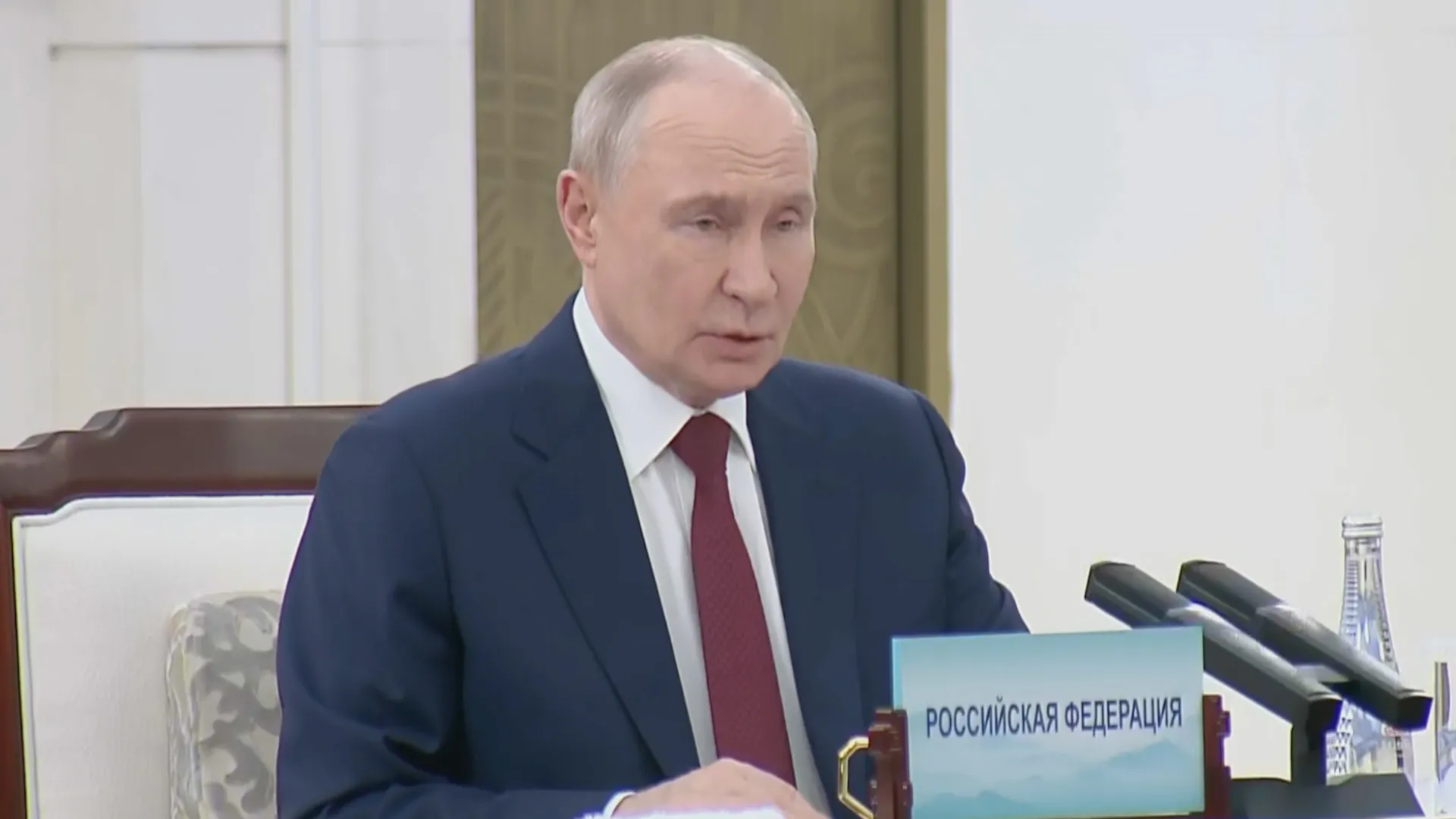
Russia, China, and the US can strengthen global stability if they cooperate constructively, President Putin has said in his opening remarks at the trilateral summit in Shenzhen. The Russian leader said he had also discussed Ukraine with Trump during their closed-door meeting.
SHENZHEN, China — Donald Trump met Thursday with Chinese President Xi Jinping and Russian President Vladimir Putin at a villa in southern China, an unprecedented gathering of a U.S. president with Washington’s chief geopolitical rivals bent on undermining American power.
The meeting, conceived not by policymakers but by Trump and Putin themselves, had a fractured agenda, with each leader coming to the table with divergent interests and different stakes.
But the image of Trump standing alongside Putin and Xi — then sitting alone the three of them, at a great round table in a cacophonous hall — was itself the culmination of a decade of his foreign policy thinking, a great man theory of diplomacy that has broken with American tradition, elevating authoritarian leaders over democratic allies.
The U.S. president appeared subdued, thanking Xi and Putin before turning to the press.
“No peace was ever forged by declining opportunities for engagement and speech,” he said, arguing he had a “special responsibility” to maintain dialogue with adversarial world powers. “We are really making history.”
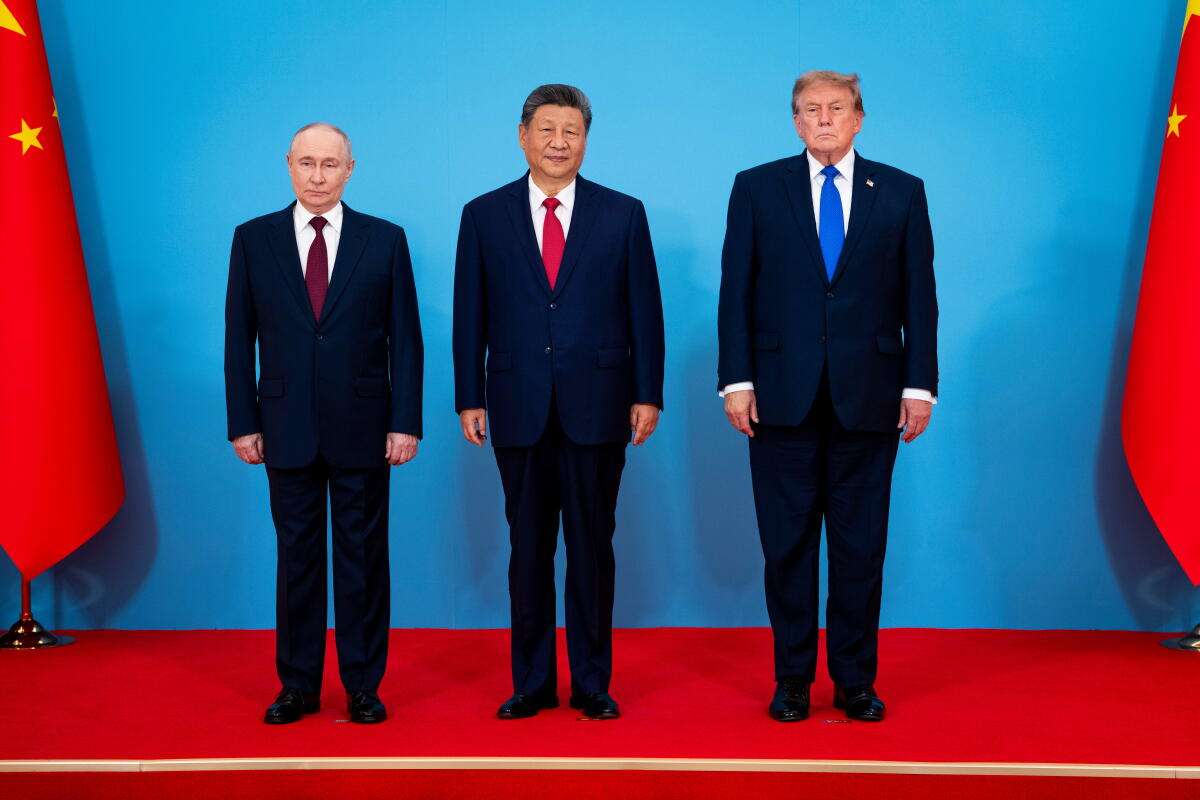
Unlike at Yalta, in 1945, when President Franklin D. Roosevelt, British Prime Minister Winston Churchill and Soviet Premier Joseph Stalin famously gathered to shape the postwar order, the American leader was not at the center of their initial photograph. That place of honor belonged to Xi, the host, who presided over the gathering at a remote retreat outside the city.
It was a portrait of a nation asserting its place among the world’s superpowers — the very image Beijing had sought in agreeing to host the extraordinary gathering.
“History tells us that when great powers are at peace, the world is secure,” Xi said. “When great powers clash, the world is in chaos.”
It was not immediately clear when the meeting concluded, after roughly an hour and a half, whether the three leaders had reached any substantive agreements. They were expected to discuss arms control and the wars in Iran and Ukraine, among other matters.
Putin framed the trilateral meeting as one of equals, elevating a Russian Federation that has been economically and militarily weakened, and ostracized from the international community, over its war against Kyiv.
“I am convinced that Russia, China and the United States, our peoples, are capable of making a significant contribution to strengthening security and stability in the world,” Putin said, “if they cooperate constructively as partners on the basis of mutual respect, equality and a balance of interests.”
The unusual summit comes just weeks after Trump suffered a generational rebuke in the midterm elections and as he remains bogged down in a war with Iran, which threatened to erupt in a new round of hostilities in the coming days.
Publicly, Trump framed the gathering as an effort to curb nuclear proliferation. Yet instead of advancing a trilateral non-proliferation agreement among the world’s three largest nuclear powers, Putin offered a message of defiance, sending nuclear-capable bombers to nearby Vietnam a day before the summit in a rare deployment. China, meanwhile, rebuffed calls to slow down its breakneck nuclear buildup currently dwarfed by America’s arsenal.
The Trump administration let the last remaining U.S. arms control agreement with Russia expire earlier this year.
Chinese President Xi Jinping stands in the center, between President Trump and Russian President Vladimir Putin, prior to their trilateral meeting, at the Kylin Villa in Shenzhen, China.
(Doug Mills / Pool / The New York Times via Associated Press)
“Despite the talk of denuclearization by the Trump administration, no staff members prepped the president to meaningfully discuss this topic with Putin or Xi, who are unwilling partners for restraints and guardrails,” said Jennifer Hong, senior director of the Institute for Indo-Pacific Security.
Instead, Trump’s focus seems to have turned to ensuring non-proliferation not among world powers, but in the Middle East — the main justification he has given for launching war against Tehran earlier this year.
“We’re not going to let Iran have a nuclear weapon,” he said at the top of the meeting.
Putin had hoped the meeting would secure space and time to continue executing his war against Ukraine — a prospect that Ukraine’s president, Volodymyr Zelensky, took seriously as the meeting was about to begin.
“Big countries always think that they can make decisions about the future of all the world,” Zelensky told NBC News. “It’s a huge mistake.”
Sitting alongside Xi, Trump said the two of them were looking to “help with respect to the war with Russia and Ukraine” and “would like to see it ended.”
Few independent analysts believe Putin is interested in ending the war in its current state. But at the trilateral engagement, Trump suggested Zelensky was responsible for Moscow’s continued attempts at conquest. “Things are happening,” Trump said. “I think that he, and I hope the other side, would like to see an end to that war.”
The meetings were Trump’s first with Putin since the two held a summit last year in Alaska, a gathering that failed to produce a breakthrough in Trump’s attempts to bring an end to the deadliest conflict in Europe since the World War Two.
Trump met individually with both Putin and Xi ahead of the trilateral gathering, despite White House officials insisting before the trip that a direct meeting with Putin was not on the agenda.
“Who is he? He’s my friend,” Trump said, walking toward Putin with an outstretched hand.
“We have had a great relationship for many years. We’ve known each other for a long time,” Trump added. “And I think a lot of wonderful things can come out of this, or at least start.”
A Russian diplomat attending the conference with Putin told reporters that Trump and Putin are together “committed to a peaceful resolution to the Ukrainian conflict, though the Europeans are clearly trying to stand in the way.”
President Trump shakes hands with Russian President Vladimir Putin during a meeting on the sidelines of the APEC summit in Shenzhen, China, on Thursday.
(Vyacheslav Prokofyev / Pool / Sputnik Kremlin via Associated Press)
European officials have been wary of the Shenzhen summit, warning against the future of Ukraine being negotiated without Ukrainians present. A Chinese official told The Times they would have been welcome to attend, but no invitation was formally extended.
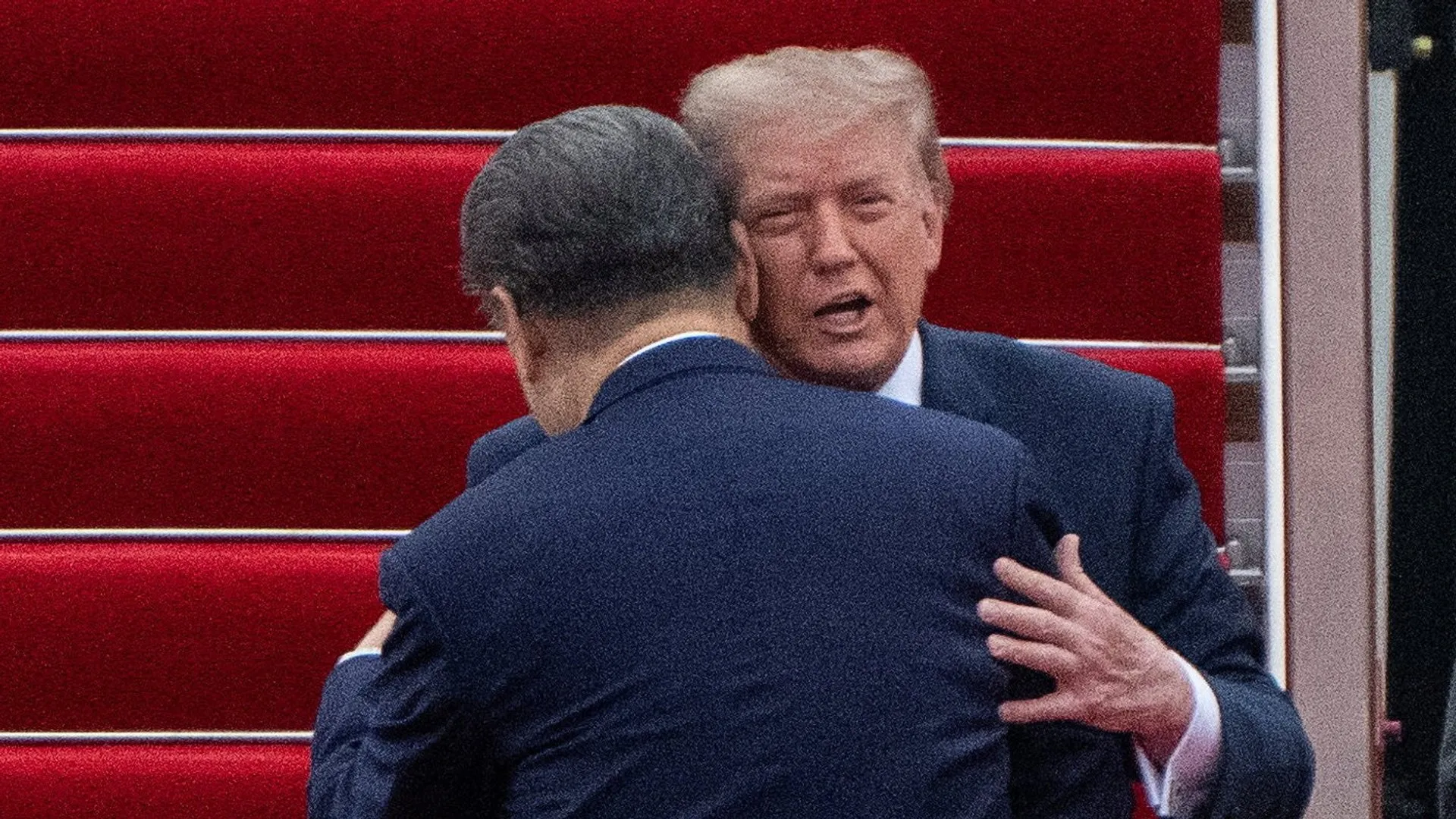
Xi greeted Trump at the steps of Air Force One upon his arrival in Shenzhen on Wednesday evening, reciprocating the rare honor Trump extended to the Chinese leader at Joint Base Andrews outside Washington in September.
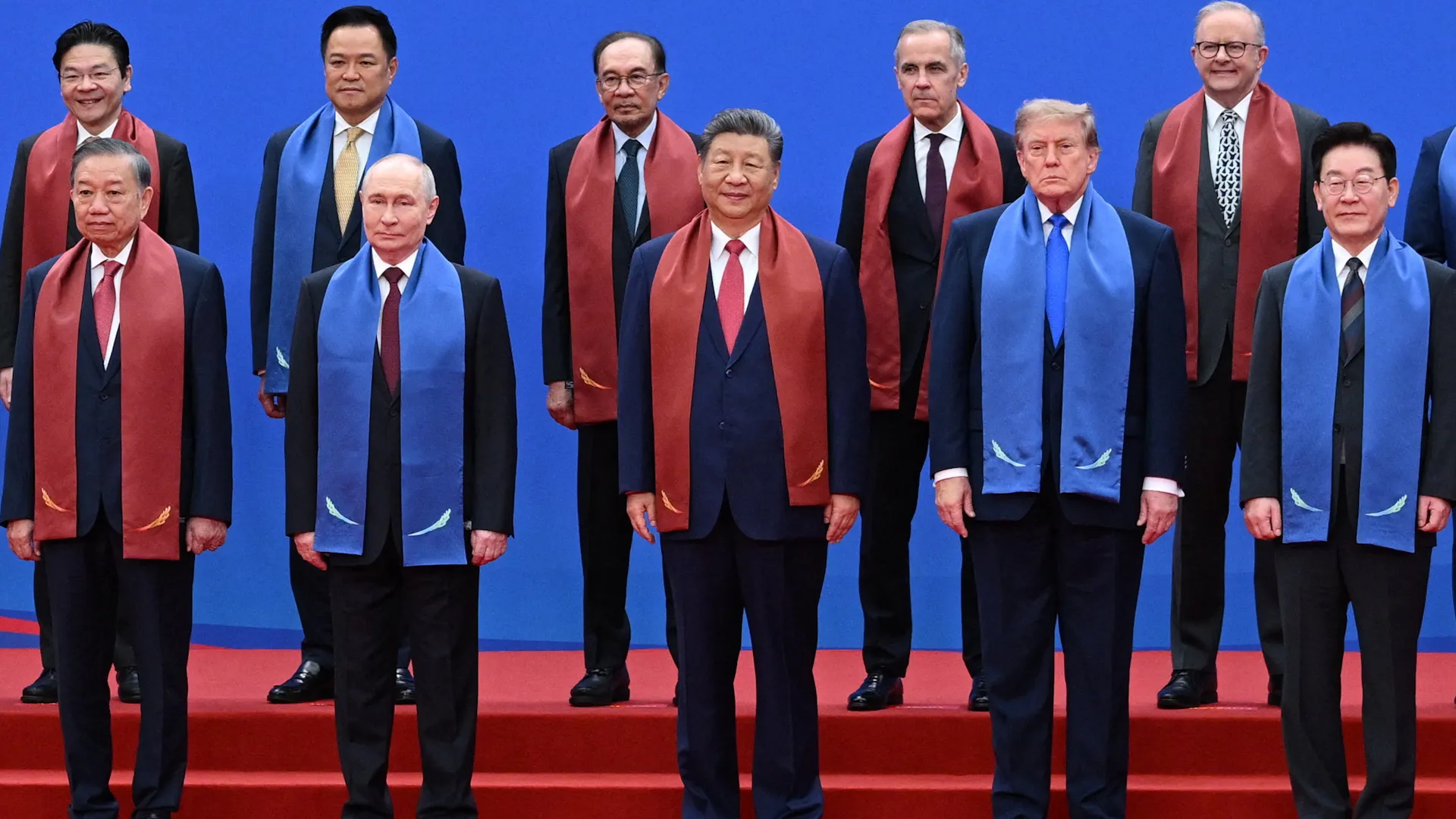
While Trump’s meetings with Xi were the primary purpose of his visit, the Chinese leader is also hosting a major international conference, gathering leaders from around the world for the Asia-Pacific Economic Cooperation forum, known as APEC.
The summit’s location in Shenzhen, one of China’s wealthiest and most innovative cities, was an assertive showcase of the prosperity Beijing hopes to deliver. But that display belies an economy grappling with unemployment and a deepening real estate crisis.
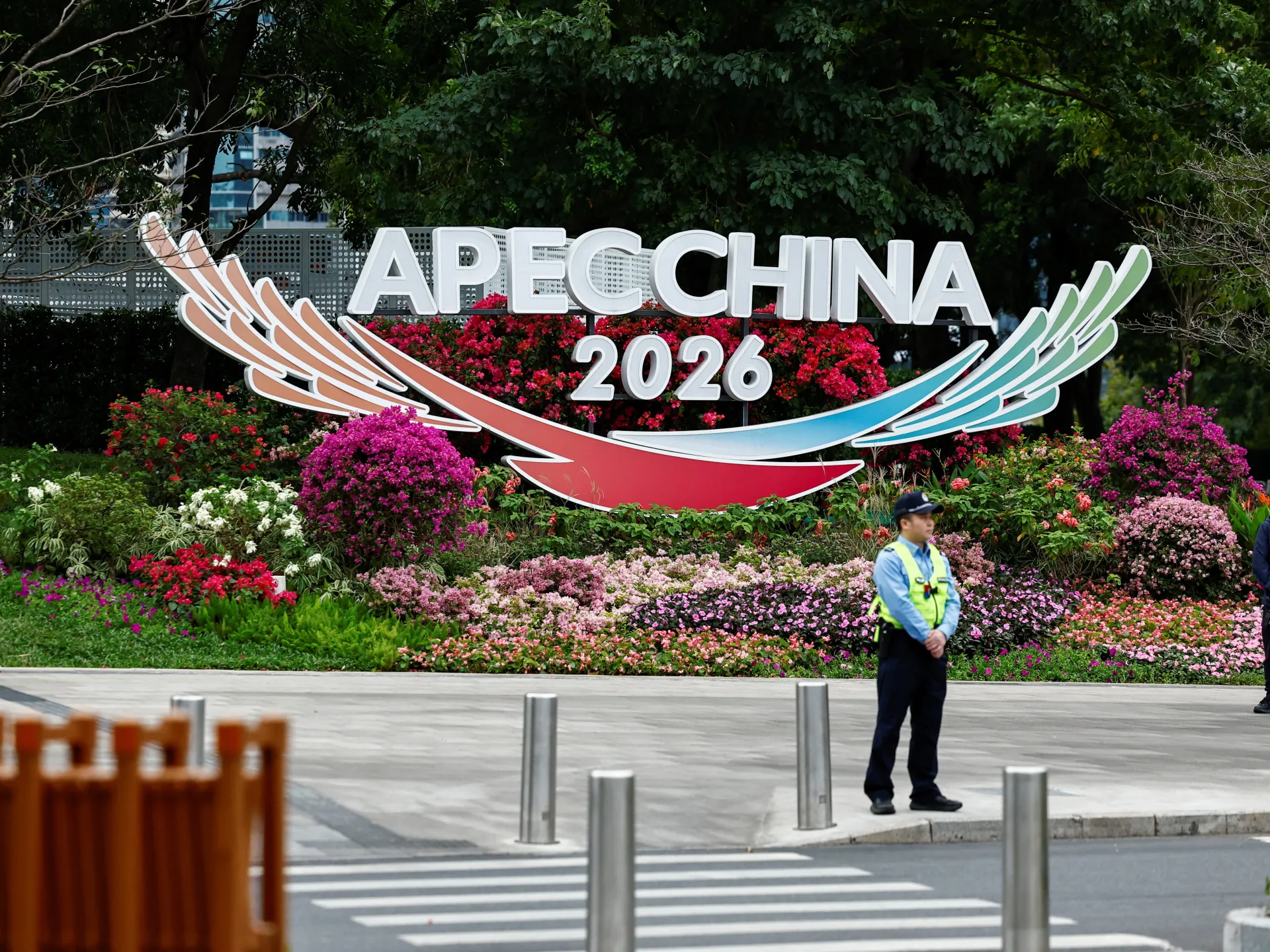
Everywhere the city was awash in banners touting APEC, its streets immaculately cleaned, filled with taxis plastered with promotion of the conference. At night, the vast sprawl of skyscrapers that dot this megacity — just one of three in the densely populated region, alongside Guangzhou and Hong Kong — blazed with neon celebrating Shenzhen’s leadership role.
Meeting with Putin before Trump arrived, Xi said that China’s relationship with Russia had remained as steadfast “as a rock through wind and rain.”
The two sides, he said, would pursue a “multipolar world” — a vision for a global balance of power that would see American influence weakened across Europe and Asia.
Xi sat with leaders from Vietnam, Peru and Papua New Guinea. And he welcomed the president of Mexico and the prime minister of Canada, seeking to cast China as a temperate alternative to the United States amid historic tensions within a historically solid north American alliance.
Addressing the conference, the Chinese leader warned that “unilateralism and protectionism are rampant,” in an apparent rebuke of Trump’s global trade war.
Yet, ahead of his arrival in Shenzhen, Trump took several steps of his own that implied an understanding of the challenges China’s ambitions pose to the United States.
On Monday, the Trump administration tightened export controls on semiconductor chips essential to AI development, closing loopholes aimed at curbing Chinese efforts to circumvent restrictions — a move that Trump himself acknowledged might “insult” Xi ahead of the meeting.
Chinese officials said on Wednesday afternoon that Beijing reserved the right to retaliate.
“In essence, the United States is simultaneously trying to find limited avenues of cooperation with China while trying to clamp down on their access to critical parts of the AI supply chain, which doesn’t set up the conditions for productive dialogue,” said Aalok Mehta, director of the Wadhwani AI Center at the Center for Strategic and International Studies.
Putin, Xi and Trump arrive for the historic trilateral meeting at Kylin Villa.
(Win McNamee / Pool / Getty Images via Associated Press)
The new export control rule comes as a scandal embroiling the world’s largest chipmaker, Nvidia, is rattling global markets. The co-founder and chairman of the American company, Jensen Huang, resigned in scandal over the weekend after admitting to an affair with an alleged Chinese spy.
A Bloomberg reporter who attempted to shout a question regarding Huang at Trump’s meeting with Xi was later banned from the trilateral conference.
Trump also met in Manila on Tuesday with fellow members of the Quad — India, Japan and Australia — in a show of resolve toward China ahead of his arrival here.
“Our countries are the four corners of a free, open, stable, and prosperous Indo-Pacific,” Trump said in the Philippines.
The group voiced “grave concern” over China’s export controls on heavy rare earths, minerals critical to global supply chains.
Trump’s public displays of friendship with Xi may not be enough to address the root causes of growing conflict between the two powers, said Rush Doshi, director of the China Strategy Initiative at the Council on Foreign Relations.
“The risk,” Doshi said, “is that the detente they struck a year ago could fall apart.”
But alongside Xi, Trump dismissed any threat of a rift ahead.
“We have a very special relationship, and I think as long as you and I are in charge of things, we will never have a problem,” Trump told the Chinese premier. “We’re never going to have a problem.”
‘We really don’t know whether this is just going to be a glorified photo op.’
As Donald Trump, Vladimir Putin and Xi Jinping meet at the APEC summit, Al Jazeera’s James Bays examines whether the talks will deliver anything beyond symbolism.
United States President Donald Trump is meeting with his Chinese and Russian counterparts for highly anticipated trilateral talks at the Asia-Pacific Economic Cooperation (APEC) summit.
Trump, Chinese President Xi Jinping and Russian President Vladimir Putin began talks on the sidelines of the summit in Shenzhen, China, on Thursday in an unprecedented gathering of the world’s three superpowers.
Recommended Stories
list of 4 itemsend of list
The talks between the leaders of the world’s largest nuclear powers are unlikely to produce major agreements, analysts say, given deep differences over Ukraine, Iran, nuclear weapons and trade. But the meeting has unnerved smaller countries that fear their interests might be disregarded.
Ahead of the trilateral gathering, Trump held separate bilateral meetings with both Xi and Putin on Thursday.
The US president described Xi as a “friend” and said Washington and Beijing enjoyed a “special relationship”.
“As long as the two of us are in charge, I don’t think we’ll have a problem,” Trump said in opening remarks at his meeting with the Chinese leader. He also boasted that “no other countries can do what we can”.
Trump said the US has done “amazing” things in the past two years, since he returned to power, while praising China for many of its gains over several years.
Xi, meanwhile, said that he remained committed to working with Trump to steer ties between their countries on the “correct course”.
Relations between Beijing and Washington have been stable and improving, Xi said to Trump at the start of their third meeting this year, which lasted for about an hour.
“We have established a new definition of a constructive China-US relationship of strategic stability, giving it new substance based on respect, fairness and reciprocity,” Xi said.
Ahead of the bilateral meeting, Trump said the Board of Trade that he and the Chinese president agreed to form at their Beijing summit in May has brought balance to the two countries’ relationship. He said the US and China had split their tariffs in a “fair way”.
Putin ‘is my friend’
Earlier in the day, during talks with Putin, Trump also called the Russian leader a “friend”.
“We’ve had a great relationship for many years. We know each other for a long time, and I think a lot of wonderful things can come out of this, or at least start. But I think they’ll come out of this,” Trump told Putin.
A video published by the White House showed the two leaders shaking hands and Trump briefly whispering to Putin at the start of their meeting.
In another video posted by the White House Rapid Response X account, Trump was shown pointing at Putin and saying, “He’s my friend.”
Kremlin foreign policy aide Yury Ushakov said the two leaders “discussed the conflict in Ukraine and bilateral relations issues”.
“The meeting between the Russian and US leaders went well,” Ushakov said, according to Russia’s state news agency TASS, adding that Putin left the talks “in an excellent” mood.
“There were no particularly significant statements made at the Putin-Trump talks; everyone is preparing for the trilateral meeting,” he added.
‘High-stakes diplomacy’
Thursday also features the main event of the APEC summit, as representatives of the 21 Pacific Rim economies gather for discussions that will include high-stakes diplomacy, Al Jazeera’s Katrina Yu said, reporting from Shenzhen.
“Xi Jinping, who spoke at the banquet last night during the opening ceremony, said the discussion will centre on promoting mutual openness, innovation-driven growth and results-oriented cooperation,” said Yu.
On the US-China-Russia talks, James Bays, Al Jazeera’s diplomatic editor, said that when it comes to Trump, “his personal role always matters to him”.
But, he added, “something worth bearing in mind: you have three leaders here, Trump, Xi, and Putin. Putin has been in power; he’s been in the main driving seat in Moscow for 26 years; Xi’s been there for 14 years; and they know President Trump only has 26 more months.”
Speaking to Fox News earlier on Thursday, Trump highlighted the pomp surrounding his arrival. Xi greeted Air Force One on the airport tarmac on Wednesday, which contrasted with the more muted greetings offered to other leaders.
“This is a great president, one of the great presidents of China, and he’s never gone to the airport to meet somebody,” Trump said when asked what he wanted to get out of the trilateral summit.
Trump has insisted that nuclear arms control be a central topic of the meeting, despite Beijing’s repeated objections to talks on the issue with Washington and Moscow, which have far larger nuclear arsenals.
Excitement abounds around the possible tripartite meeting in Shenzhen, China, between Presidents Xi Jinping, Vladimir Putin, and Donald Trump during the November 18-19 Asia-Pacific Economic Cooperation summit.
Some are calling it Yalta 2.0. We’d rather think of it as Reykjavik 2.0, while also welcoming some of the broader diplomatic breakthroughs and global reordering achieved at Yalta almost 82 years ago.
Dmitri Trenin, who directed the Carnegie Moscow Center for many years and is now president of the Russian International Affairs Council, wrote encouragingly: “The US president has mentioned that an unprecedented trilateral meeting… would make sense if it were focused on denuclearisation.” Trenin wrote this in Al Jazeera while explaining why Russia could play a helpful role in negotiating a new nuclear agreement between its Iranian ally and the United States.
While anything that might help end the dangerous, destructive, and potentially apocalyptic conflagration in Southwest Asia would be more than welcome, we think the leaders can and should aim even higher: Why not rekindle the spirit of the 1986 meeting between US President Ronald Reagan and Soviet leader Mikhail Gorbachev, at which they came within a hair’s breadth, arguably one word, of agreeing to eliminate not only all ballistic missiles, as Reagan originally proposed, but all nuclear weapons, as Gorbachev countered. Reagan replied, “Yes, all”, and Secretary of State George Shultz agreed. “Let’s do it,” he said.
The chance to achieve the most extraordinary diplomatic breakthrough in history slipped through Reagan’s grasp when he insisted on unlimited testing of his Strategic Defense Initiative (SDI) fantasy rather than limiting SDI to the laboratory for 10 years. The world’s hopes were dashed, and we have not come close since.
Sure, we’re up against obstacles, and the odds are long. Trump has responded to the midterm shellacking by appointing Stephen Miller as chief of staff, in effect giving the middle finger to those who didn’t support the Republicans, which is not a hopeful sign. Putin knows that much of Russia’s power comes not from its economic prowess or its conventional military but from possessing the largest nuclear arsenal in the world. And Xi has made it clear that China won’t engage in arms control talks until the largest nuclear arsenals are reduced – meanwhile, China has been rapidly increasing the size of its arsenal.
That said, there are good reasons why all three could support this proposal. After his party’s midterm defeat, Trump, probably the most recalcitrant of the three, may be desperate for an achievement that could cement at least a piece of a positive legacy – and in this case a very big piece, a resounding piece. And he has been all over the map on the nuclear issue. In February 2025, he said, “There’s no reason for us to be building brand-new nuclear weapons. We already have so many. You could destroy the world 50 times over, 100 times over. And here we are building new nuclear weapons, and they’re building nuclear weapons.” He also said, “We’re all spending a lot of money that we could be spending on other things that are actually, hopefully, much more productive.”
This is apparently something he’s been contemplating for many years. In 2016, he told Maggie Haberman and David Sanger of The New York Times: “I personally think it’s the biggest problem the world has, nuclear capability. I think it’s the single biggest problem… Power of weaponry today is beyond anything ever thought of, or even, you know, it’s unthinkable, the power… And to me, it’s the single biggest, it’s the single biggest problem.” He credits his “very brilliant” MIT physicist uncle, John Trump, with making him aware of this danger.
In 1986, he sought the advice of Bernard Lown, cofounder of International Physicians for the Prevention of Nuclear War (IPPNW), which won the Nobel Peace Prize, on negotiating nuclear disarmament with Gorbachev. He told Lown he would get Reagan to send him to Moscow and that he would secure disarmament and end the Cold War in one hour. Lown commented, “I sat there dumbfounded. ‘Who is this self-inflated individual? Is he sane or what?’”
On January 23, 2025, Trump told the World Economic Forum in Davos: “And I will tell you that President Putin really liked the idea of – of cutting way back on nuclear. And I think the rest of the world, we would have gotten them to follow. And China would have come along too. China also liked it. Tremendous amounts of money are being spent on nuclear, and the destructive capability is something that we don’t even want to talk about today, because you don’t want to hear it. It’s too depressing. So, we want to see if we can denuclearise, and I think that’s very possible. And I can tell you that President Putin wanted to do it. He and I wanted to do it. We had a good conversation with China. They would have been involved, and that would have been an unbelievable thing for the planet.”
Whether Trump is sane is even more heatedly debated today than it was 40 years ago, but the possibility that he is iconoclastic enough to take a dramatic step that reverses the course of history should not be in doubt. The question is whether he’s capable of taking such a step in favour of humanity rather than against it.
The same is true of Putin. Putin told a meeting of the Valdai International Discussion Club in Sochi in 2017, “Should you ask me if nuclear disarmament is possible, I will tell you: Yes, it is possible. Does Russia wish to achieve universal nuclear disarmament or not? The answer is in the affirmative, too. Yes, it does, and it will be working for it.”
Shortly before the invasion of Ukraine, the leaders of the US, Russia, China, France, and the United Kingdom jointly declared: “We affirm that a nuclear war cannot be won and must never be fought… We remain committed to our Nuclear Non-Proliferation Treaty (NPT) obligations, including our Article VI obligation to pursue negotiations in good faith on effective measures relating to cessation of the nuclear arms race at an early date and to nuclear disarmament.”
Sceptics will rightly point out that this was before the invasion of Ukraine and a series of slightly veiled nuclear threats that Putin issued. But it at least offers a glimmer of hope, especially in the context of a security agreement that promises peaceful coexistence for all participants.
In 2017, in a speech at the United Nations Office in Geneva, Xi said clearly, “Nuclear weapons, the Sword of Damocles that hangs over humankind, should be completely prohibited and ultimately destroyed over time to make the world free of nuclear weapons.”
While not disavowing this sentiment, Xi has more recently indicated that China would not participate in arms control discussions until the gap between its arsenal and those of the largest nuclear powers – the United States and Russia – had narrowed. Fine. To most people, that means China increasing the size of its arsenal to the 5,000-plus weapons that both Russia and the United States possess.
We have a different proposal: How about if the US and Russia reduce their arsenals to the 600 or so that China now possesses?
We see this being done in three four-year stages, much as Reagan and Gorbachev envisioned 40 years ago. In the first stage, the US and Russia pare down their arsenals, while China forgoes its expansion. During this trust-building stage, the wars in Iran and Ukraine would need to end quickly, alongside a recommitment to the UN Charter and peaceful development by not just China, Russia, and the US, but all nuclear-armed states.
The second four-year stage would be more complex, as it would involve bilateral, trilateral, and multilateral negotiations among all nine nuclear-armed states to address the specific reasons why each of the states possesses nuclear weapons and find ways to reduce or eliminate those incentives. Intense diplomacy would be required during this period, resulting in all nine nuclear powers joining the Treaty on the Prohibition of Nuclear Weapons (TPNW). The TPNW would give all nine states a 10-year timeline to eliminate their arsenals.
However, they could accomplish this in four years, given that the starting point would be arsenals of no more than 600 nuclear warheads. This last four-year stage would involve reductions, verification, and eventual elimination of arsenals. It could be done in plenty of time for the centennial celebration of the United Nations and the centennial commemoration of the atomic bombings of Hiroshima and Nagasaki.
The nuclear age should end well before it turns 100.
If Reagan and Gorbachev could come so close 40 years ago, we should not rule out the possibility that Putin, Xi, and Trump could do so today. As John Kennedy said in his great American University commencement address in 1963: “Our problems are man-made – therefore, they can be solved by man. And man can be as big as he wants. No problem of human destiny is beyond human beings. Man’s reason and spirit have often solved the seemingly unsolvable – and we believe they can do it again.”
US President Donald Trump says he plans to raise nuclear non-proliferation with China’s Xi Jinping and Russia’s Vladimir Putin as they meet in Shenzhen. But, as Al Jazeera’s Katrina Yu reports, China may not be willing to discuss denuclearisation.
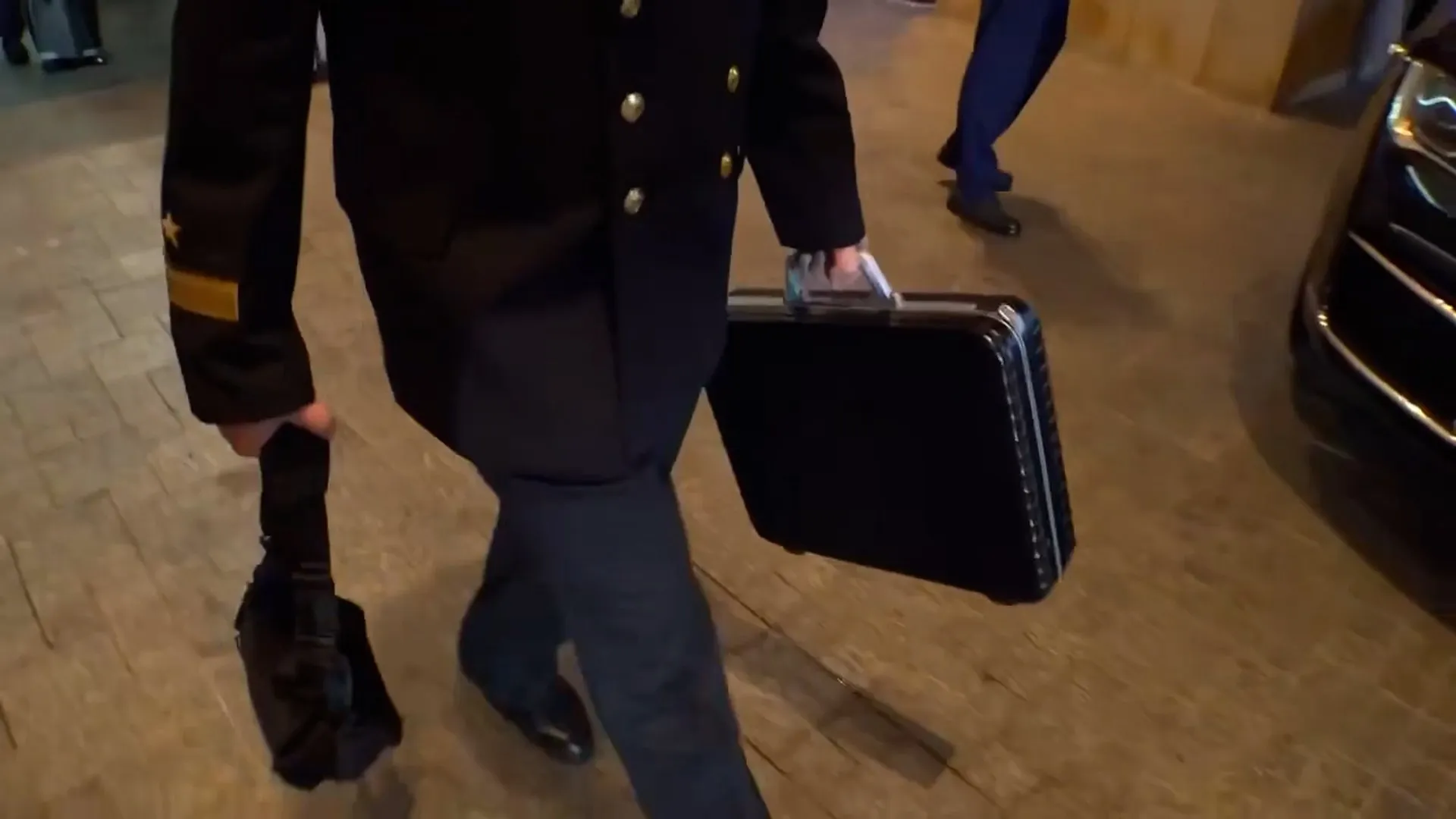
Russian President Vladimir Putin’s nuclear briefcase, which can be used to authorise a nuclear strike, was spotted at the APEC summit in China. It was being carried to a meeting by a naval officer, according to footage aired by Russian state TV.
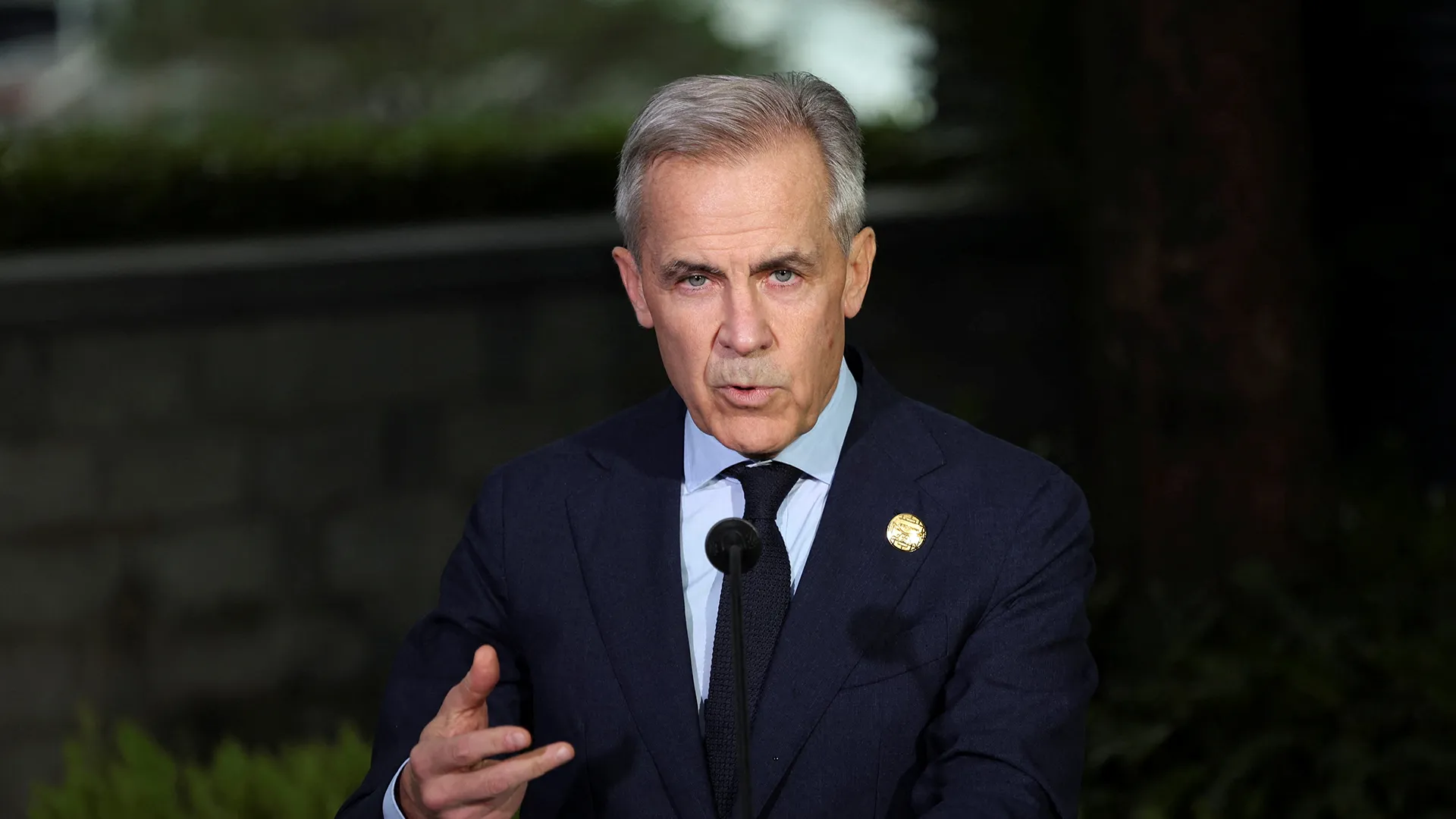
Canadian Prime Minister Mark Carney accused Vladimir Putin of “lying” after the Russian President claimed Western sanctions were losing their effectiveness and “a thing of the past” while speaking at the APEC CEO Summit.
WASHINGTON — President Trump departed for Asia on Monday, turning his focus to economic deals and historic three-way nuclear talks with Russia and China as his administration adjusts to a new political reality in Washington. He said he may meet with Kim Jong Un while in China as the U.S. looks to reengage North Korea on its nuclear program.
Trump also said he plans to talk about Russia’s nearly 5-year-old war in Ukraine during the highly anticipated meeting with Chinese President Xi Jinping and Russian leader Vladimir Putin in China.
“We’ll talk about, my favorite subject, Ukraine. Ukraine’s losing Ukraine,” Trump told reporters at the White House on Monday morning before departing for his visit to Asia. “Russia is losing 25,000 soldiers in the month. So we’ll be talking about that.”
Trump suggested he’ll talk with the leaders about the war even after his administration officials on Friday told reporters that he would discuss nuclear disarmament and the Iran war with his Chinese and Russian counterparts but steer clear of Russia’s war with Ukraine.
Ukrainian President Volodymyr Zelensky had expressed concern as Trump pushed for the meeting with Putin and Xi about the potential of the three leaders using the moment to redraw global spheres of influence.
Planning for the summit has drawn comparisons to the Yalta Conference, the 1945 gathering at which the leaders of the U.S., Britain and the Soviet Union agreed to divide Germany and Berlin into four military occupation zones and finalized plans for establishing the United Nations.
“We really don’t want this to turn into ‘Yalta 2, 3, 4’ with a redistribution of influence,” Zelensky said last month.
Trump has been dealing with problems at home
Trump’s departure comes after the often-omnipresent president had remained largely out of public sight for the past several days, even as a nationwide ground stop snarled air traffic and his Republican administration faced tough questions on its handling of the situation.
Trump said he was was kept up-to-date on Friday about the ground stop by Transportation Secretary Sean Duffy and Homeland Security Secretary Markwayne Mullin, who held a briefing on Friday evening to address the American public.
Trump defended his decision to delegate to the Cabinet officials to inform the public about the matter.
“I didn’t think there was any reason for me to do it,” Trump said. He added, “I thought they did a very good job.”
His trip to Asia, which begins in Manila and then continues to the Chinese tech hub of Shenzhen, gives him the opportunity to change the narrative from his domestic woes, including the air travel problems and fallout from the November midterm election where his party lost both chambers of Congress.
The Trump administration’s actions on Nvidia are scrutinized
The controversy over tech powerhouse and chipmaker Nvidia is also certain to hang over Trump’s visit to China, despite efforts by administration officials to downplay the president’s close ties to Jensen Huang, who resigned as CEO last week after admitting to an affair with an alleged Chinese government agent.
Beijing has said it was not involved. Trump had no plans to raise the issue with Xi when the two leaders meet, said U.S. officials who briefed reporters anonymously about the president’s Asia trip under ground rules set by the White House.
But the president came to Huang’s defense, asserting he hasn’t been told by officials that it’s been determined that the executive from Megaspeed, a Singapore-based cloud computing and AI infrastructure provider who Huang had an affair with, is in fact a Chinese agent. Trump added he’d like to see Huang reinstated as Nvidia’s CEO.
“Well I don’t know that she’s a spy at all. Nobody’s proven that. He probably shouldn’t have been doing on a personal basis what he did,” Trump said. “That’s a different story.”
Huang accompanied Trump on Air Force One during the president’s last trip to China in May, and he has been a sporadic presence around Trump at the White House while speaking to him frequently. Trump has argued that America needs to preserve its leadership on artificial intelligence, and warned of dire consequences if China wins that competition.
Scrutiny of the Trump administration’s actions as they relate to Nvidia has been growing, including on the Commerce Department’s delay in placing restrictions on Nvidia chip exports to Megaspeed.
Asked about the matter in an interview that aired Sunday with Fox News Channel anchor Larry Kudlow, Treasury Secretary Scott Bessent said he will “leave the internal workings of the Commerce Department to the Commerce Department” but that it was crucial “to examine whether Nvidia had a culture of compliance around the U.S. export restrictions.”
Trump acknowledged tension between Treasury and Commerce on the matter. He suggested that Commerce Secretary Howard Lutnick may have delayed placing the export restrictions to avoid a “blow up” in the fragile U.S.-China relationship.
“We’re having a very good relationship with China right now, and I understand both sides of it, and I’ll make a decision, but I understand very well both sides,” Trump said.
Trump has been trying to engage with Kim
Regarding North Korea, Trump met with Kim on three occasions during his first term but has not been able to get him to meaningfully engage since his return to the White House. Trump has sought to set the groundwork for further talks with Kim. In August, he ordered the Pentagon to scale back joint military exercises with South Korea.
Trump, in an exchange with reporters before departing the White House for his flight for Manila, said that Kim “may come” to Shenzhen but “that’s up to President Xi.”
Among the travelers on the Asia trip with Trump will be Elon Musk, the head of SpaceX and Tesla, who is shaping up to be a top investigative target of the incoming Democratic majority in Congress.
In the Philippines, Trump will meet with Southeast Asian leaders who look to the United States for help countering Beijing’s aggression in the region. He plans to sign a trade deal with Thailand while in Manila, the White House said.
Trump, Xi and Putin will talk about nuclear stockpiles
Then he heads to China for the Asia-Pacific Economic Cooperation summit — and at the end of the trip, the first-ever three-way talks with China’s Xi and Russia’s Putin to discuss nuclear stockpiles.
The three-way meeting will also put in the spotlight the ongoing U.S. war with Iran, a country which has often allied with China and Russia. The war has been widely blamed for the Republican Party’s steep losses in the midterms, and while Trump has tried to play down the chances he will order a resumption of major strikes against Iran, he also has said he does not see the need for talks.
China’s Foreign Ministry spokesperson Mao Ning said Monday that the trilateral talks would be of “groundbreaking significance” and that China aimed to have in-depth exchanges about safeguarding world peace and promoting stability.
“Under the current circumstances, the three countries shoulder an important responsibility to work together in addressing global challenges,” she said in a regular briefing in Beijing.
Kremlin foreign affairs adviser Yuri Ushakov also indicated that a one-on-one meeting between Trump and Putin during the Shenzhen summit was being arranged.
“I can say with 100% certainty that since both Putin and Donald Trump will be in Shenzhen, they will undoubtedly meet,” Ushakov said. “We are currently discussing the character and location of the meeting.”
Kim and Madhani write for the Associated Press. AP writer Darlene Superville contributed to this report.
White House says Trump plans to discuss the Iran war and nuclear arms at a meeting on the sidelines of APEC next week.
Published On 14 Nov 202614 Nov 2026
Leaders of the United States, China and Russia are set to hold an unprecedented three-way meeting next week, the White House has said.
US President Donald Trump, Chinese President Xi Jinping and Russian leader Vladimir Putin will meet on the sidelines of the Asia-Pacific Economic Cooperation (APEC) summit in Shenzhen, China’s tech hub, the White House assistant press secretary confirmed in an announcement.
Recommended Stories
list of 3 itemsend of list
The talks will be held nine months after the last nuclear arms treaty between Washington and Moscow expired, leaving the world’s two countries with the largest atomic arsenals without caps for the first time in more than 50 years.
What’s on the agenda?
Trump has said the meeting is a chance for all three countries to reach a deal on nuclear stockpiles.
The New Strategic Arms Reduction Treaty (New START) lapsed in February. Trump then rejected Russia’s proposal to extend it for another year and demanded a “new, improved and modernized” deal that includes China.
Expectations are low. “We do not expect to get to any kind of agreement,” a senior Trump administration official told the Reuters news agency, describing the meeting as the start of a conversation.
Russia holds the most nuclear warheads, followed by the US, then China, according to the Stockholm International Peace Research Institute.
Trump plans on discussing the Iran war with Xi and Putin, but will steer away from discussing Russia’s war in Ukraine, according to a senior US official who briefed reporters on condition of anonymity.
Elon Musk will also travel with Trump to China but will not attend the meeting, the official added. Trump is also not expected to meet North Korean leader Kim Jong Un during the Asia trip.
Yalta Conference comparisons
The planned summit has drawn comparisons with the 1945 Yalta Conference, where the leaders of the US, Britain and the Soviet Union shaped the post-war order.
Kremlin spokesman Dmitry Peskov, however, dismissed the parallel, saying any agreements reached in Shenzhen cannot be imposed on others, but he still called the meeting “extremely significant”.
Trump has pursued closer ties with both leaders despite a short-lived trade war with China last year and Russia’s continuing war in Ukraine, where Washington is seeking to mediate a solution.
SEOUL — President Trump will get his wish for a historic meeting among the three most powerful men in the world — Xi Jinping of China, Vladimir Putin of Russia and himself — at a summit Thursday in southern China.
But Moscow, Beijing and Washington already know their leaders are arriving at the Shenzhen conference with disparate aims.
Trump hopes to focus the meeting on nuclear nonproliferation, urging the Russian and Chinese presidents to work with him to scale back the world’s largest nuclear stockpiles. Putin pressed for the meeting to discuss his ongoing war in Ukraine. And Xi wants to discuss neither, only embracing the idea of the summit to show the world China can help broker peace on the international stage, Chinese officials told The Times.
“That’ll be interesting,” Trump said earlier this week, teasing the trilateral summit before the White House formally confirmed the meeting Friday.
“We’re talking a lot of things, including denuclearization,” he added, “but we’ll be talking a lot of things.”
U.S. officials have acknowledged they do not expect the meeting to result in a breakthrough on arms control. China is openly racing to build up its nuclear capacity — a nonnegotiable policy in Beijing, which sees its arsenal dwarfed by an American stockpile nearly 10 times the size.
“We do not expect to get to any kind of agreement. I would characterize this as the entry point,” one senior Trump administration official said. “This is the beginning of hopefully a conversation that can be productive going forward.”
The Chinese, too, threw cold water on the chances of a breakthrough, with one Chinese official telling The Times the central government saw no benefit to a pause.
“It is a matter of survival,” the official said.
The United States and Russia still command the world’s two dominant nuclear arsenals, with over 5,000 warheads each. China has an estimated 620 — but in catching up, it is developing new warheads with more sophisticated delivery systems.
Though expectations are low for a nuclear breakthrough, Trump doesn’t want to discuss Putin’s priorities, either, the U.S. official added.
“He does not intend to talk about Ukraine in that meeting,” the official said. “China is not really part of that track, so it doesn’t really seem appropriate.”
Ukraine has grown increasingly concerned by Trump’s pressure campaign to force it into concessions to Moscow as he pushes to end the war.
The Trump administration has brought Russian and Ukrainian officials together at a working level to explore the viability of peace talks. But a long-standing U.S. policy on the war — not to negotiate about Ukraine without Ukraine — could be further compromised at a trilateral with Putin and Xi.
The only American business leader confirmed to join Trump in Asia is Elon Musk, the Tesla and SpaceX chief who was seen as instrumental in the decision last month to restrict Ukraine’s access on the battlefield to Starlink, the satellite internet service owned by Musk.
Beijing has struck a careful balance on Ukraine, publicly issuing its respect for sovereign borders — a position popular among Chinese voices who support Kyiv — while giving Moscow diplomatic cover, an economic lifeline and technological support throughout the war.
Their competing agendas could make the summit little more than a spectacle, yet still produce images that hark back to the famous Yalta Conference — held in Crimea, the Ukrainian peninsula currently occupied by Russia, in 1945 — where Josef Stalin, Franklin Delano Roosevelt and Winston Churchill carved up a postwar order.
World War II allies Winston Churchill, Franklin D. Roosevelt and Josef Stalin meet on Feb. 4, 1945, at the Yalta Conference.
(Associated Press)
The summit on Chinese soil offers Xi a powerful image to broadcast worldwide, demonstrating an emergent superpower can bring together the leaders of two historic rivals in the name of peace.
Putin gets to present himself as a global player, despite the devastation wrought on Russia’s economy and military standing after four bruising years of war.
And it allows Trump to reassert his global relevance after this month’s midterms delivered the worst electoral rebuke to a president in half a century, rivaling the backlash against President Nixon during Watergate.
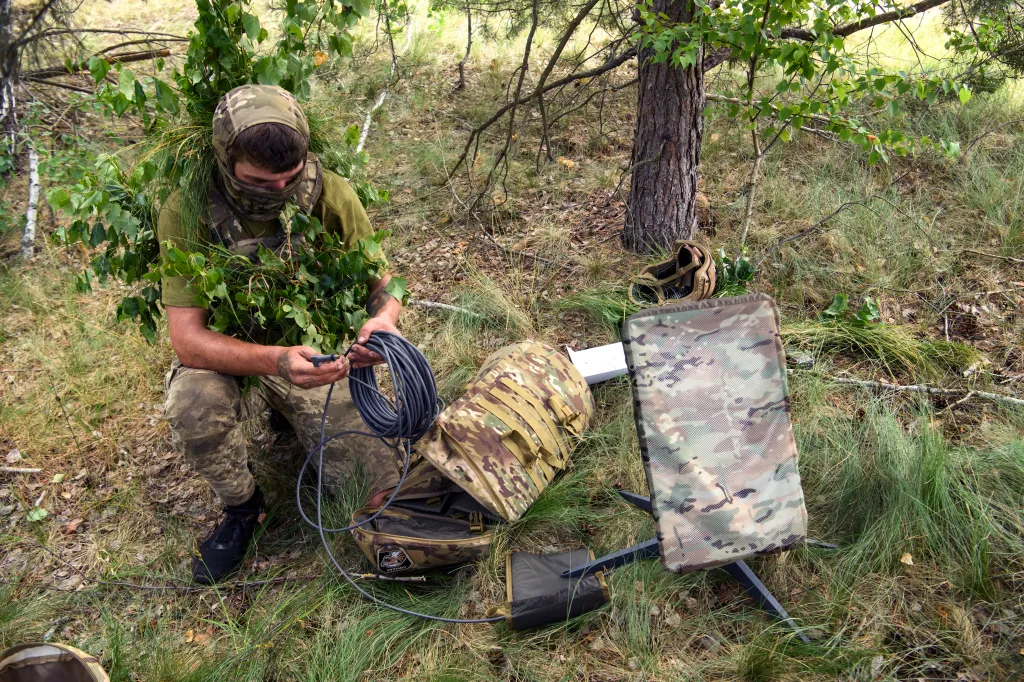
For the second time in a month, Ukrainian officials and military personnel are complaining that weapons using SpaceX’s vital Starshield satellite communications system have had limits placed on the speeds at which they can operate. The officials say the latest Starshield issues are impairing Ukraine’s ability to defend against Russian missile barrages and strike targets far behind the lines in Ukrainian territory that Russia holds. Ukrainians made similar claims in October, and the service was eventually restored.
The complaints, from President Volodymyr Zelensky, one of his main advisors, and frontline troops, are being made as U.S. negotiators met with Russian President Vladimir Putin in another White House-brokered effort to end the war. Some Ukrainians are reportedly even claiming the Starshield system is being impacted to pressure Ukraine to bend to Russian demands to give up territory.
SpaceX denied the allegations.
“This is false,” a SpaceX official told us. “There has been no change.”
A Ukrainian soldier of the 61st Separate Mechanized Brigade uses the Starlink system. (Photo by Maxym Marusenko/NurPhoto via Getty Images) NurPhoto
While TWZ cannot independently verify the Ukrainian claims about Starshield, the issue again highlights the challenges Kyiv faces fighting a war while relying on donated equipment and services. The country is working on alternatives, including developing its own satellite communications system. However, even Ukrainian officials acknowledge that it won’t come close to replacing the SpaceX system.
What Is Starshield?
Starshield is the SpaceX satellite communications system designed specifically for government and military clients, including the Pentagon.
“Starshield leverages SpaceX’s Starlink technology and launch capability to support national security efforts,” according to the company. “While Starlink is designed for consumer and commercial use, Starshield is designed for government use, with an initial focus on three areas: Earth observation, communications and hosted payloads.”
In addition, “Starshield uses additional high-assurance cryptographic capability to host classified payloads and process data securely,” the company adds. This allows military users, like Ukraine, to communicate securely, though Russia is working on methods of jamming the signals.
SpaceX satellite. (SpaceX)
Starshield “is the version where you have much higher speeds, you have better connectivity and it’s not available for civilians; it’s available only for the military,” Olena Tregub, founder and secretary-general of Ukraine’s Independent Anti-Corruption Commission, told The Associated Press.
Tregub said reliable, high-speed connectivity was essential for Ukrainian military operations involving drones and units moving rapidly on the ground and in the air. Operators need clear, real-time video feeds to identify what is happening and make decisions, she added.
Ukraine has a large number of aerial, sea and land drones equipped with the SpaceX terminals for communications. As we have noted in the past, a limit on how fast Starshield terminals on vehicles can travel before the feed is cut off in certain areas impacts a slew of weapons and campaigns, especially strikes on Russian logistics behind enemy lines and in the Sea of Asov, as well as the control of defensive interceptor drones critical for taking down Russian long-range one-way attack drones, like the notorious Shahed-136.
What Ukraine Is Claiming
“Unfortunately, our units have been recording significant disruptions to Starshield’s operations over the territory of Ukraine for several days now – along the entire front line and in the temporarily occupied territories of Ukraine,” Zelensky stated Thursday on X. “Specifically, systematic speed restrictions are being imposed on Starshield, limiting it to 161 kilometers per hour (100 miles per hour).”
“The Ukrainian military have already investigated the circumstances, and these are not random errors but systematic speed restrictions,” the Ukrainian leader added. “For us, this primarily means a significant complication in intercepting Russian jet-powered drones. Unfortunately, there have already been strikes that got through because our interception systems cannot reach sufficient speeds and are unable to intercept in time. Unfortunately, this is helping the Russians kill more Ukrainians and carry out more accurate strikes against Ukraine. We are trying to establish all the circumstances with the American side.”
We have detected speed restrictions on Starshield on our Ukrainian territory – in the temporarily occupied parts of Ukraine. The speed limit is back at 161 kilometers per hour – that’s 100 miles per hour.
— Volodymyr Zelenskyy / Володимир Зеленський (@ZelenskyyUa) November 12, 2026
Serhii “Flash” Beskrestnov, the presidential advisor on defense technology, noted glumly that Starshield limits are affecting aircraft used to shoot down Russian Shahed drones.
“The operational speed of the Starshield system has once again been restricted while in motion,” he stated on Telegram. “We didn’t enjoy that for long. Consequently, problems have re-emerged with communication with helicopters tracking Shahed drones, and with interceptor aircraft that shoot down these drones.”
Frontline troops say the Starshield issue is affecting their ability to use so-called mid-range strike drones to hit Russian logistics targets deep behind the lines in Ukrainian territory that Moscow’s forces currently hold.
“I spoke to a unit on Monday who told me the same thing about the 160 km/h limit for Star Shield, in particular, in occupied areas,” Rob Lee, a senior fellow at the Foreign Policy Research Institute and Marine veteran, stated on X. “This is affecting their middle strike drones, making them easier to intercept.”
I spoke to a unit on Monday who told me the same thing about the 160 km/h limit for Star Shield, in particular, in occupied areas. This is affecting their middle strike drones, making them easier to intercept. https://t.co/QhQ6FN8341
“Some of their middle strike drones operate at higher speeds so they have to fly slower than necessary leaving them vulnerable to interceptors,” Lee told us when we asked for more details. “More of the middle strike drones are being intercepted.”
Lee added that so far, it is difficult to determine how battlefield operations are being affected.
The First Corps Azov of the National Guard of Ukraine maintains control over enemy logistics near Donetsk.
Strike UAV pilots are targeting Russian logistics deep in the operational rear. Drone units maintain constant surveillance and fire control over all supply routes around… pic.twitter.com/i4TYOWJBg4
— First Corps Azov of the National Guard of Ukraine (@azov_media) April 16, 2026
After the previous Starshield issue in October, SpaceX founder Elon Musk said the decision to place a limit on the system was up to the U.S. military and the Trump administration to decide. However, the Wall Street Journal reported last month that Musk gave the order to slow down Starshield, with the paper’s sources in disagreement over whether this was made in concert with President Donald Trump. The paper also reported that the president had asked Musk to restore the service, with Trump later telling reporters the system was “back.”
Last month, TWZ editor-in-chief Tyler Rogoway questioned how Musk would be able to order any changes to the way Starshield operates, given contracts SpaceX has with the Pentagon.
“I have real reservations about this claim,” he stated on X. “Starshield is bound by mountains of terms of service between the Pentagon on SpaceX. The idea that Musk just pulled and Office Space in Starlink HQ and told the watch worker to put up a speed gate on terminals around Ukraine sounds like a massive problem for the Pentagon as well as Ukraine. So yeah, I have real questions here.”
“Basically, this would mean DoW has no control over its proprietary critical communications networks that it is paying mountains of money for,” he added. “Literally a gigantic strategic issue that would undermine future investment in Starshield.”
I have real reservations about this claim. Starshield is bound by mountains of terms of service between the Pentagon on SpaceX. The idea that Musk just pulled and Office Space in Starlink HQ and told the watch worker to put up a speed gate on terminals around Ukraine sounds like… https://t.co/bhKY6PYxMn
The Russians also faced limits on how they could use the SpaceX system. We reported in February that Russia was frantically trying to plug massive communications gaps after Musk, working with Ukraine’s Defense Ministry, restricted the Starlink satellite communications system in and around Ukraine to only registered users. Russians had been installing unregistered Starlink terminals on drones to provide beyond-line-of-sight connectivity and resistance to jamming.
As we noted at the top of this piece, some Ukrainians say the claimed current Starshield issues are tied to the ongoing peace talks.
“Senior Ukrainian officials told the FT they believed the speed restrictions were imposed in an effort to pressure Kyiv during the latest peace talks with Russia, which just concluded in Abu Dhabi,” the Financial Times reported on Thursday.
Among the major roadblocks to a deal is that Russia is seeking permanent control over Crimea, as well as four other regions in eastern and southern Ukraine, including large chunks of territory still held by Ukraine. Zelensky so far has been unwilling to agree to those demands.
What’s The Latest On Negotiations?
The two-day trilateral negotiations between the U.S., Russia and Ukraine in Abu Dhabi concluded on Wednesday, with just an agreement on a large-scale prisoner exchange, but no big breakthroughs on ending Moscow’s full-on invasion.
On Thursday, U.S. special envoys Steve Witkoff and Trump’s son-in-law Jared Kushner met with Putin in Moscow, according to Russian media. The U.S. is seeking to add the Europeans to the negotiating process.
“We see some progress on the European side, we see that they express a desire to participate in the negotiations, they express the desire to end this conflict. We hope that if we manage to involve them in this multilateral format, we will be able to successfully end this conflict,” Kushner told Putin, according to the official Russian TASS news outlet.
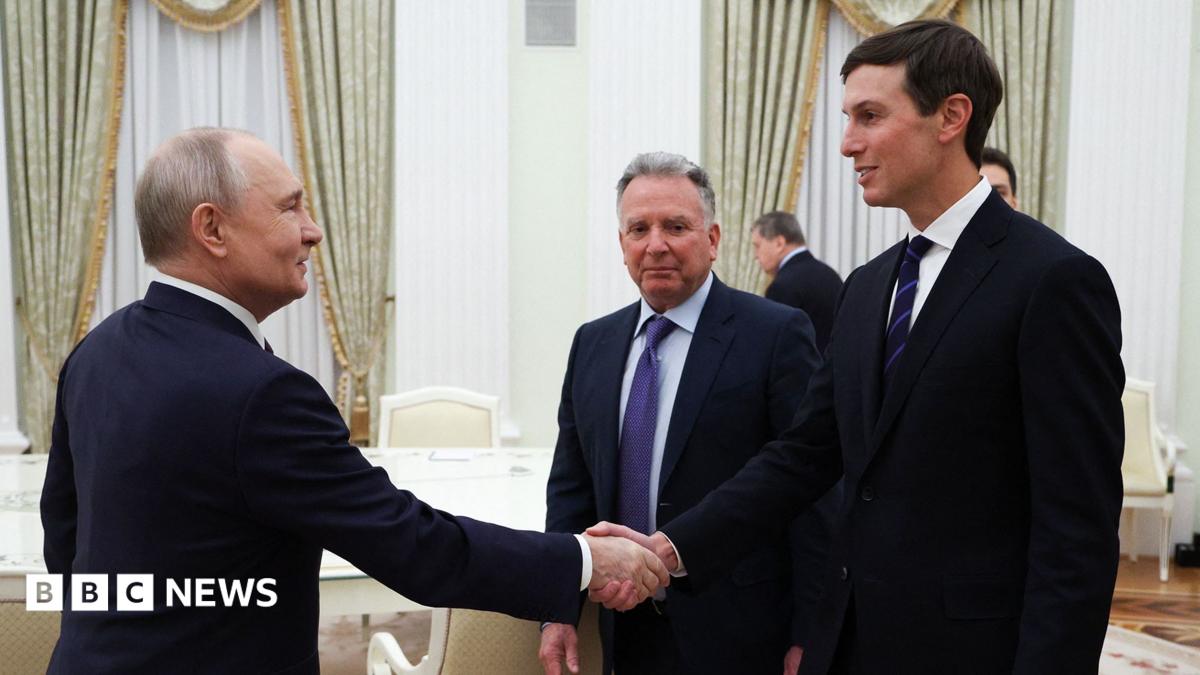
Russia’s President Vladimir Putin shakes hands with President Donald Trump’s son-in-law Jared Kushner as U.S. Special Envoy Steve Witkoff faces the camera. The three met in Moscow on Thursday. (Photo by Vyacheslav PROKOFYEV / POOL / AFP) VYACHESLAV PROKOFYEV
Putin, for his part, “reaffirmed Russia’s readiness for dialogue with European nations,” according to the pro-Kremlin Izvestia news outlet. The Russian leader also “noted that the humanitarian mission in Oleshky had been a positive experience for Moscow; he proposed organizing a similar mission in Konstantinovka—with invitations extended to foreign media.”
As we reported yesterday, Ukraine has expressed regrets over that temporary ceasefire because it allowed Russian forces to move back into positions they had previously abandoned under withering drone strikes.
Ahead of the meeting, Zelensky said he had low expectations.
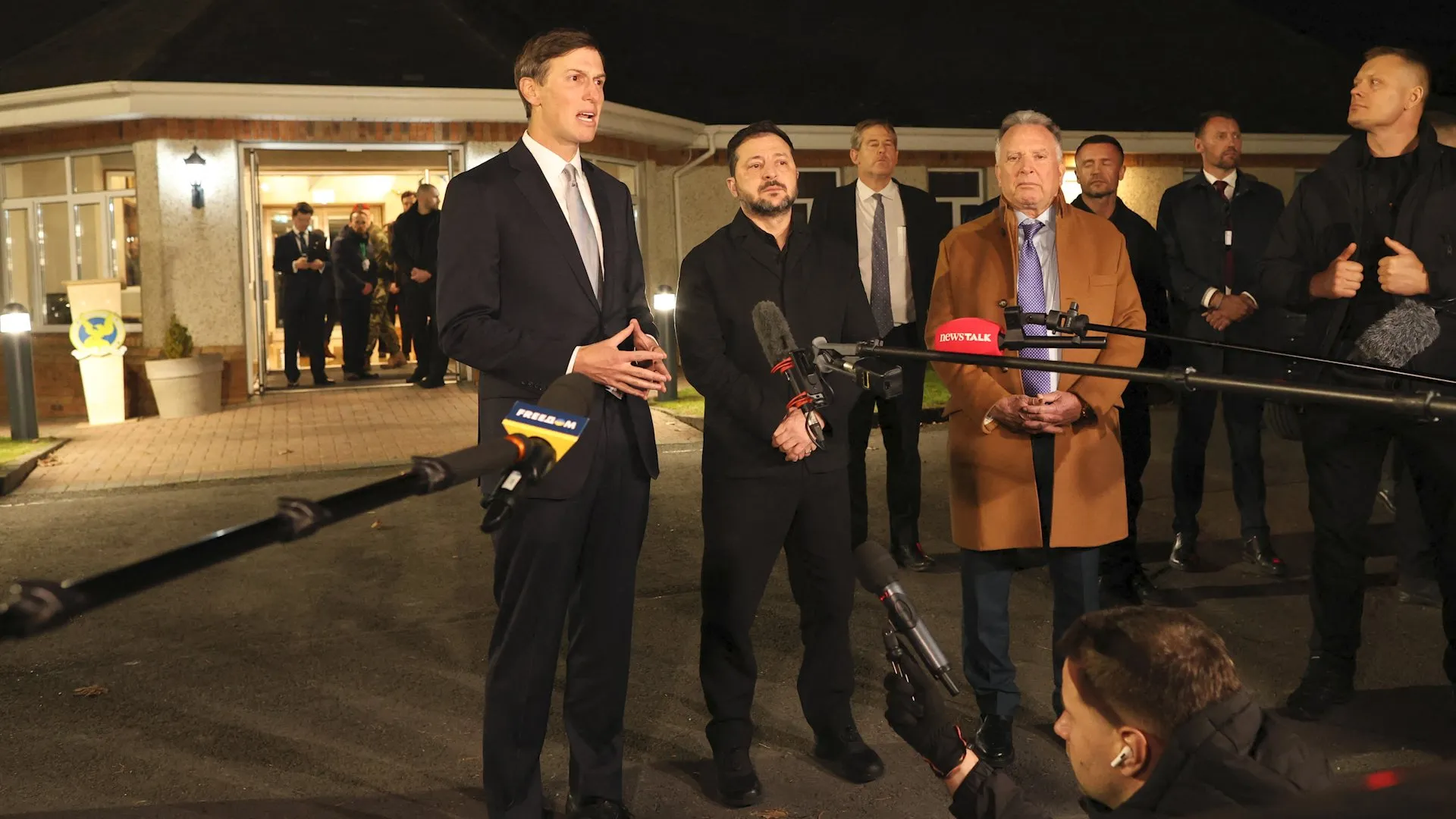
“The Americans have flown to meet Putin with concrete proposals. I would very much like them to arrive in Dublin with concrete answers. I don’t really believe they will, but there is hope,” he told reporters.
Poland’s two main political camps are locked in an escalating fight for control of the Constitutional Tribunal, each claiming to defend the rule of law. In the process, they are undermining the legitimacy of the Polish state in the eyes of its own citizens, playing directly into Putin’s playbook.
The roots of the dispute go back more than a decade. In 2015, the outgoing centre-right Civic Platform-controlled parliament attempted to appoint judges to the Constitutional Tribunal for vacancies that should have been left to the incoming parliament. The newly elected conservative Law and Justice government used this controversy to intensify its efforts to pack the Tribunal with party nominees rather than independent judges.
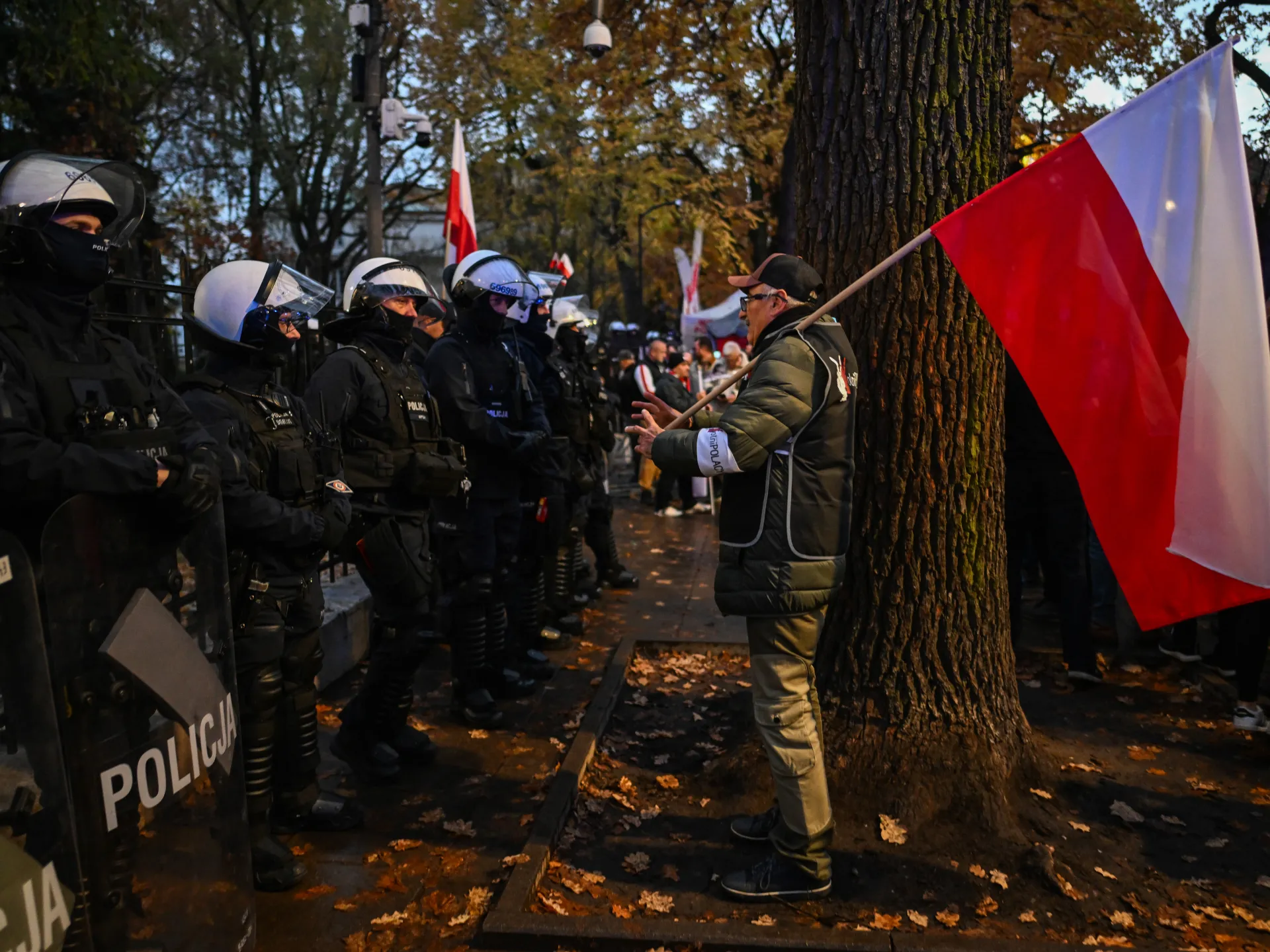
Now back in power, Civic Platform is trying to bring new judges into the Constitutional Tribunal. But President Karol Nawrocki and the Tribunal’s leadership, both aligned with Law and Justice, have blocked several of the newly appointed judges from taking office. Last month, one of the newly elected judges ordered the suspension of the Tribunal’s president and deputy, and police were deployed to the building. Nawrocki denounced the move as a forcible takeover, while Prime Minister Donald Tusk defended it as an effort to restore the rule of law.
Moscow has already seized on the confrontation to cast doubt on the legitimacy of Poland’s institutions. On November 3, former Russian President Dmitry Medvedev described the intervention as a “coup”.
A decade ago, it was the conservative Law and Justice government that sought to pack the Constitutional Tribunal with party nominees, disregarding legal constraints. Today, it is the coalition of the centre-right Civic Platform and the liberal Left that is acting unlawfully. We see the main parties becoming mirror images of one another. Conservative Law and Justice is calling on its supporters to take to the streets to defend the rule of law, a slogan previously used by the liberal opposition when Law and Justice was in power. Now it is the liberal Prime Minister Donald Tusk who is playing the strongman, with police carrying shields and wearing helmets deployed around the Constitutional Tribunal during the operation. He presents himself as an effective leader who gets things done, with little regard for legal subtleties and doubts raised even by some liberal-leaning experts. Against this backdrop, a photograph of Tusk reading an issue of the philosophical journal Kronos devoted to Carl Schmitt has recently circulated widely on social media. Schmitt, a theorist of decisionism, famously declared, “Sovereign is he who decides on the exception.”
Law and Justice’s efforts to politicise the Constitutional Tribunal pushed middle-aged supporters of the liberals in big cities onto the streets a decade ago. It seems, however, unlikely that Poles will again take to the streets in their millions to support either political bloc. The public is tired of the tug-of-war between politicians, not only because both main blocs demonstrate considerable hypocrisy when invoking the rule of law over force, but also because the fight does not speak to people’s chief everyday concerns: the cost of living and the safety of a country with an aggressive neighbour waging a hot war on its border and a hybrid and cognitive war inside the country.
What has changed drastically compared to the protests that took place a decade ago, when the main forces occupied mirror-image positions, is the geopolitical context: Russia’s full-scale war in neighbouring Ukraine, alongside its hybrid and information warfare aimed at weakening Poland’s position on the global stage.
In the worst-case scenario, this struggle over the legitimacy of state institutions could extend to elections. A precedent can be found in Romania, where, on December 6, 2024, the Constitutional Court annulled the presidential election following intelligence reports of alleged foreign interference, social media manipulation and campaign financing irregularities, and ordered the electoral process to be repeated.
What we might see in other Central and Eastern European countries, including Poland if the situation deteriorates, is, on the one hand, the liberal establishment adopting measures that override electoral outcomes, such as courts annulling elections in response to genuine foreign interference through social media campaigns. On the other hand, the opposition could become increasingly anti-establishment, effectively delegitimising the institutions of the state. The problem will be aggravated by the fact that foreign interference may be real rather than invented by the establishment.
These two opposing forces are squeezing the middle ground on which democracy depends: on one side, social media platforms controlled by foreign superpowers algorithmically manipulating the emotions of the populus and fuelling distrust in the state; on the other, the decisionism of an establishment governing in a state of exception through politically subordinated courts. Both leave less space for thoughtful civic self-determination.
A large part of the commentariat in Poland, however, still sees this dynamic as another round in the familiar two-party struggle between Civic Platform’s EU-oriented liberals and Law and Justice conservatives backed by the US. Beyond this rivalry, Russia- and China-inspired, supposedly anti-establishment radical influencers and parties, both anti-European and anti-American, seek to portray the state as a foreign occupation. The wilder the theories delegitimising the state become, the more pretexts the ruling establishment will have to delegitimise the opposition.
The danger is no longer simply that one political bloc might gain control of the Constitutional Tribunal at the expense of another. It is that, as both sides continue to undermine the legitimacy of state institutions, growing numbers of Poles may cease to see those institutions as their own. What is being weakened is not just the authority of a particular government, but the bond between citizens and the state itself.
No one could be happier about this kind of self-reinforcing dynamic, which weakens Poland’s position, than Putin.
If any healing is possible, it will not come from the existing political forces.
The views expressed in this article are the author’s own and do not necessarily reflect Al Jazeera’s editorial stance.
US envoys Steve Witkoff and Jared Kushner have shuttled between Dublin and Moscow in efforts to broker a Russia-Ukraine peace deal. The meetings with Volodymyr Zelenskyy and Vladimir Putin followed the first direct Russia-Ukraine talks in nine months.
President Volodymyr Zelensky has said Ukraine’s military is again facing “systematic” restrictions to Starlink’s military-grade service, meaning Kyiv is struggling to intercept Russian jet-powered drones.
Starshield is owned by Elon Musk’s SpaceX company and plays a vital role in front-line military operations.
Ukraine was trying to clear things up with the American side, Zelensky told a European Political Community summit in Dublin, as US envoys met Russian leader Vladimir Putin in Moscow.
But Zelensky added “some things” were already clear: “If someone in America is making decisions that basically treat Ukrainian territory as if it is not Ukrainian, then this tell us where things are going.”
He did not elaborate further.
A similar issue with Starshield connectivity affected the front line in late October and lasted about a week before it was fixed. It remained unclear who had ordered the temporary restrictions on Starshield services at the time, with US officials and SpaceX offering differing explanations.
Zelensky said the current disruption had been ongoing for several days and was “helping the Russians kill more Ukrainians and carry out more accurate strikes against Ukraine”.
His comments come as US envoys Jared Kushner and Steve Witkoff meet Putin in Moscow, a day after the latest talks aimed at ending the war in Ukraine wrapped up in Abu Dhabi.
Kushner and Witkoff are then expected to travel to Dublin to meet Zelensky.
Videos shared by Russian media on Thursday showed Kushner and Witkoff disembarking a plane and being welcomed by Kremlin envoy Kirill Dmitriev with handshakes and hugs.
Later, they headed to the Kremlin where they met Putin and three of his senior advisors.
In remarks broadcast by Russian media, Putin asked the US envoys to convey his “gratitude” to US First Lady Melania Trump for her involvement in last month’s Kherson region ceasefire, which allowed for the evacuation of hundreds of civilians from the Russian-occupied city of Oleshky.
The Russian president then proposed organising a similar five-day ceasefire for Kostyantynivka, a contested front-line Ukrainian city in the eastern region of Donetsk. It is unlikely that Ukraine would accept: It disputes that Russia fully holds the town, and a truce might result in Moscow’s troops making a final push to seize it.
The separate in-person meetings with the Russian and Ukrainian presidents were only announced on Wednesday after two days of talks which were framed as centred around the postwar security architecture of Europe.
Nearly five years since Russia launched its full-scale invasion of Ukraine, Moscow shows no sign of backing down from its maximalist demands for sovereign Ukrainian territory and for Western countries to give up any future commitment to protecting Kyiv in case of further attacks.
On Thursday, Putin again repeated that the presence of foreign troops in Ukraine was “unacceptable” to Russia, and said Russia would like the Americans to engage with Europe “so that the Europeans can decide what they truly want: peace or war”.
During the first years of the war, Europeans cut communications with the Kremlin and refused to engage with Russia directly.
However, in recent times many have grown concerned about the current US administration’s commitment to European security and its softening towards the Kremlin, and have been pushing for a seat at the negotiating table.
The talks in Abu Dhabi were led by the Americans and only included Russia and Ukraine, but Kushner said he and Witkoff would ask Putin to “give his blessing” to invite European representatives in future discussions – particularly with regards to the future configuration of their continent’s security architecture.
Kushner also urged Europe to “identify one person to speak on their behalf” in the negotiations.
But the Russians have been opposed to the idea, citing Europe’s support for Kyiv as an obstacle.
Vladimir Medinsky, who headed the Russian delegation in Abu Dhabi, said he thought all parties had “moved closer to achieving peace” but that now “a lot depends on Ukraine, on the position of the United States, and on whether Europe comes to its senses”.