pushes

Trump says California is full of fraud. Bonta pushes back

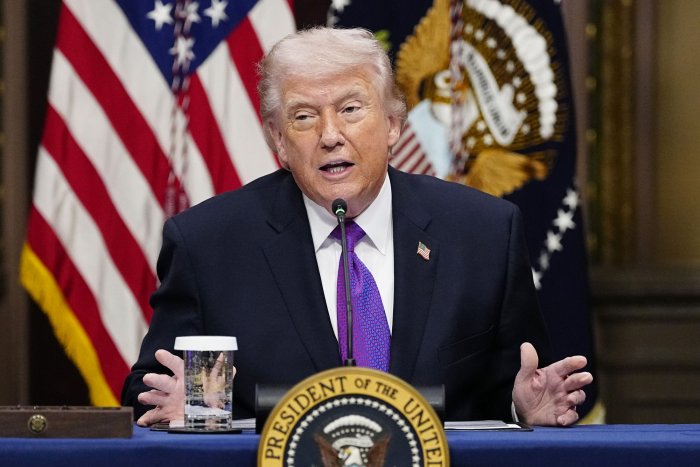
With the Trump administration reportedly in talks to create an anti-fraud task force for California, state Atty. Gen. Rob Bonta on Thursday vehemently denounced what he described as the administration’s “reckless” and “false” rhetoric about fraud plaguing the state.

At a news conference at the Ronald Reagan State Building in downtown Los Angeles, Bonta said the Trump administration’s claims that state programs are overrun by fraud and that its government was itself perpetrating or facilitating this fraud was “outrageous and ridiculous and without basis.”

Bonta said most states struggle with some fraud from outside actors, saying that “anywhere there’s money flowing there’s a risk” and that the state’s Department of Justice has thrown immense resources into cracking down on illicit activities and recovering funds for taxpayers.

As a politicized national fight over waste, fraud and abuse led by Republicans have targeted California and its Democratic leadership, Bonta and other state officials have moved swiftly to combat the claims.

In California, Bonta said, authorities have recovered nearly $2.7 billion through criminal and civil prosecutions since 2016, including some $740 million through Medi-Cal fraud related prosecutions, about $2 billion under the state’s False Claims Act, and an additional $108 million from a task force focused on rooting out tax fraud in the underground economy.

State authorities have frequently partnered with the federal government in the past on such investigations and welcome a good-faith partnership in the future, Bonta said.

CBS News reported on the creation of a California-focused fraud task force earlier this week, citing multiple unnamed sources familiar with the plans. The outlet, whose new editor in chief, Bari Weiss, has been aligned with Trump and spearheaded a major overhaul of the news organization, reported that the president plans to soon sign an executive order naming Vice President JD Vance as head of a group that would also include the head of the Federal Trade Commission as vice chairman.

Trump’s rhetoric fueled doubts about California programs and Gov. Gavin Newsom’s leadership at the start of the year, when he declared that “the fraud investigation of California [had] begun.”

On the president’s social media platform, in formal letters and in recent news conferences, officials in the Trump administration have alleged fraud in child care, hospice funding and unemployment benefits.

Last week, the topic took center stage again when Mehmet Oz, the administrator for the Centers for Medicare and Medicaid Services, posted a video accusing Armenian crime groups of carrying out widespread hospice fraud in Los Angeles.

That viral video received more than 4.5 million views on X.

Oz’s video received fierce backlash from California politicians and the local Armenian community, who collectively alleged that it contained baseless and racially charged attacks on Armenians.

The video shows Oz being driven around a section of Van Nuys where he says that about $3.5-billion worth of medicare fraud has been perpetrated by hospice and home-care businesses, claiming that “it’s run, quite a bit of it, by the Russian Armenian mafia.”

He also points to Armenian language signs, incorrectly referring to them as written in a cerulean script, and saying “you notice that the lettering and language behind me is of that dialect and it also highlights the fact that this is an organized crime mafia deal.”

Newsom filed a civil rights complaint against Oz on Jan. 29, asking the Department of Health and Human Services to investigate the “racially charged and false public statements” made in the video.

On Monday, California Sen. Adam Schiff followed suit, demanding an independent review of Oz’s alleged targeting of Armenian American communities.

“To suggest markers of Armenian culture, language, and identity are indicative of criminality underscores a discriminatory motive that could taint any investigation into fraud and incite the further demonization of the community,” Schiff said in a statement.

Glendale City Councilmember Ardy Kassakhian said in an interview that Oz’s statements feed into the Trump administration’s playbook of using allegations of fraud to sow racial divisions.

“This time the focus just happens to be the Armenians,” he said. “In places like Minnesota, it’s the Somali community.”

California has been investigating healthcare fraud since a 2020 Los Angeles Times investigation uncovered widespread Medicare fraud in the state’s booming but loosely regulated hospice industry.

From 2010 to 2020, the county’s hospices multiplied sixfold, accounting for more than half of the state’s roughly 1,200 Medicare-certified providers, according to a Times analysis of federal healthcare data.

Scores of providers sprang up along a corridor stretching west from the San Gabriel Valley through the San Fernando Valley, which now has the highest concentration of hospices in the nation.

The state Department of Justice has charged more than 100 people with hospice-related fraud since 2021 and shuttered around 280 hospices in the last two years, according to data from the California Department of Public Health.

But those shuttered hospices barely represent a dent in the massive hospice home healthcare industry. There are 468 hospice facilities in the Van Nuys area alone, according to the state database of medical facilities.

There are 197 licensed medical practices, including 89 licensed hospices, in a single two-story building located at 14545 Friar St. in Van Nuys — suggesting a concentration of fraudulent businesses.

When asked why the number of licensed medical practices in Van Nuys and at that address are so high, a spokesperson for the California Department of Public Health said that the department is committed to fighting fraud and unable to comment on pending investigation.

Recent turmoil in Minnesota has demonstrated the potential ripple effects of allegations levied by the Trump administration.

Ahead of sending in thousands of immigration enforcement agents into the Midwest state, Trump had repeatedly cited a fraud case involving funds for a child nutrition program involving COVID-19 pandemic relief funds.

He used the case, which involved a nonprofit where several Somali Americans worked, to vilify the immigrant community, even though the organization was run by a white woman. After the state became a lightning rod, Gov. Tim Walz dropped his reelection plans.

At Thursday’s news conference, Bonta described major cases in other states, such as $11.4 million healthcare fraud and wire fraud conspiracy involving a nursing assistant in Florida and a $88.3 million Medicaid fraud case in in Ohio involving over billing by a pharmacy benefit manager — to show abuse of state programs is not unique to California — or to blue states.

“We know Vance hails from Ohio, so maybe he should take a look in his own backyard before leading an unnecessary political stunt focused on California,” Bonta said. “We thought we should set the record straight.”

Times staff writers Melody Gutierrez and Dakota Smith contributed to this report.

Source link

Bari Weiss pushes a digital plan in attempt to move past her rocky start at CBS News

Before arriving at CBS News in October to become editor in chief, Bari Weiss had never been inside a television control room.

But on Tuesday, she presented her plan for taking the storied news division forward after a series of moves that has damaged its standing among viewers, failed to improve ratings, lowered internal morale and generated highly negative press coverage.

Weiss, addressing the staff gathered at the CBS Broadcast Center in Manhattan, reached out to those who have not been impressed with what they have seen so far. “I’m not going to stand up here today and ask for your trust,” she said, according to a transcript provided by CBS News. “I’m going to earn it, just like we have to do with our viewers.”

The statement was an acknowledgment that the early days of Weiss’ tenure have not been smooth. Weiss has dealt with her own lack of familiarity with TV news procedures, the entrenched culture of a legacy media institution and suspicion that partisan politics are driving changes. The town hall-style meeting was an attempt at a reset.

Weiss fought the claims that her mandate at CBS News is to provide friendlier coverage to the Trump administration as parent company Paramount pursues an acquisition of Warner Bros. Discovery. She said she has never discussed CBS News coverage of the White House with Paramount Chief Executive David Ellison, to whom she reports.

Paramount Chief Executive David Ellison attends the premiere of "Ghosted" at AMC Lincoln Square in New York in April 2023.

Paramount Chief Executive David Ellison attends the premiere of “Ghosted” at AMC Lincoln Square in New York in April 2023.

(Evan Agostini/Evan Agostini/Invision/AP)

“I’m here to do one thing,” Weiss said. “It’s not to be a mouthpiece for anybody. It’s simply to be a mouthpiece for fairness and the pursuit of truth.”

She told employees her business goal for CBS News is to expand its reach on digital platforms.

“We are not doing enough to meet audiences where they are, so they are leaving us,” she said, adding that the network’s strategy until now has been “to cling to the audience that remains on broadcast television. If we stick to that strategy, we’re toast.”

Weiss said she wants to focus on expanding the most successful CBS News programs — “60 Minutes,” “CBS Sunday Morning” and true crime magazine “48 Hours” to other platforms, including podcasts, newsletters and live events. “We need to shift to a streaming mentality immediately,” she said, adding that “our competitors are not just the other broadcast networks.

The pronouncement — which could have been made five to 10 years ago — was welcomed by some CBS News employees who believe the operation has lagged in using its resources to expand beyond traditional TV. Overall, they were encouraged by Weiss’ remarks.

“She went a good way to bring people together,” said one attendee. “That was a good start.”

One question posed to Weiss, which is likely to loom over her tenure, is how much time does CBS News have to replace the substantial revenue still generated by traditional TV with digital enterprises. Ad rates for digital platforms are substantially lower than those for TV, which means greater dependence on subscriptions and other revenue sources.

Weiss did not provide any specifics on the level of investment for the new initiatives. “The emphasis going forward is going to be building things that people are ultimately willing to pay for,” she said.

Weiss said the network is recruiting “fresh young talent” that will focus on reporting first through social media, “but will appear everywhere else too.” She showed three recent hires based in London, Kyiv and New York who deliver their stories across different platforms using their iPhones.

Weiss also announced the hiring of 19 new contributors, several of whom have already appeared on the Free Press, the digital news site that CBS News parent Paramount acquired as part of the deal to bring her into the company.

The dependence on contributors, who are not employees but paid for their TV appearances, is commonly used on cable news networks that need to fill hours of programming.

Weiss has acknowledged to colleagues that she’s not familiar with the process of moving the assembly line of stories from the assignment stage, through the reporting and editing process and onto a schedule of programs, some of which run 365 days a year.

Her lack of experience was glaring in her handling of “60 Minutes,” the network’s most prestigious and profitable program. CBS News staffers were stunned when she decided to pull a segment on the abuses at an El Salvador prison used by the U.S. government to detain undocumented immigrants from Venezuela.

"CBS Evening News" anchor Tony Dokoupil and the network's chief national correspondent Matt Gutman.

“CBS Evening News” anchor Tony Dokoupil and the network’s chief national correspondent Matt Gutman.

(CBS News)

The story had been researched and reported for months by correspondent Sharyn Alfonsi and fully vetted by the standards department when Weiss yanked it one day before its originally scheduled Dec. 21 air date. Alfonsi called the move political and the conflict added to the narrative that Weiss is trying to placate the White House.

Weiss insisted Alfonsi’s story needed more reporting including an interview with an administration official, even though the White House had already declined requests to participate. The segment ran a month later with only minor additions to the reporting which executives inside the news division say was not worth the public drama created by Weiss’ editorial decision.

At the meeting, Weiss acknowledged she would have approached the matter differently but defended her intent.

“It’s always gonna be my prerogative as editor of this newsroom to say that I want more information, and to push to get more information,” she said. “Now, am I ever going to hold something again after it has been put out there with promos? I don’t want to make that exact same decision again, no I do not.”

Weiss added that Paramount management had no influence on her decision to hold Alfonsi’s story. “I wanna just say this as plainly and clearly as possible,” she said. “I was not pressured by David Ellison or anyone else.”

She said the journalism standards at the network have not changed since she arrived, but believed the division has been more welcoming to a wider range of viewpoints.

“I don’t think a year ago CBS News would’ve had [former National Rifle Assn. spokesperson] Dana Loesch, let’s say, on the morning show,” Weiss said. “I think that’s something to be proud of.”

Weiss praised the revamped “CBS Evening News with Tony Dokoupil” — with a new anchor she handpicked, even though critics have been harsh and the ratings have slipped. All three of the major network evening newscasts are down in January compared to a year ago, but CBS is off the most at around 20%.

Segments on the program, such as Dokoupil’s frothy tribute to Secretary of State Marco Rubio and a brief item on the fifth anniversary of the Jan. 6 insurrection in Washington that had President Trump calling it the fault of the Capitol police, were widely panned. But the attention has died down as the program has settled into being a straight-ahead newscast.

While the fiascoes involving “60 Minutes” or the first week of the “CBS Evening News” have been demoralizing, some journalists in the division are still hopeful Weiss can be a catalyst for change and want her to succeed.

But her rocky start will be tough to turn around according to Tom Bettag, a former network news producer who is now a lecturer at the University of Maryland’s Philip Merrill College of Journalism.

“Weiss started off so miserably with ’60 Minutes’ and the Dokoupil launch, that you wonder if she can redeem herself,” Bettag said. “You only get one chance to make a first impression.”

Weiss isn’t the first executive to be put in charge of a TV news operation without any hands-on experience. It was not easy for the others, either.

Michael Gartner, a Pulitzer Prize-winning newspaper editor was appointed to oversee NBC News in the mid-1980s. During his turbulent five-year tenure, he struggled with talent egos as he tried to get costs under control. Walter Isaacson came from Time magazine to run CNN in 2001. He was gone after 18 months, expressing bewilderment over the public scrutiny of every network move.

Weiss’ previous management experience was running the Free Press, which has a staff of 60 compared to the sprawling CBS News operation with more than 1,200 employees around the world.

Weiss is also an anomaly as she comes to the job with an established point of view. Her journalism career was as an opinion writer before she launched the Free Press. The site gained a following for its criticism of the progressive left and purveyors of so-called “woke” policies.

Weiss has been vocal in telling CBS News employees that the public has less trust in legacy media, an assertion that is often pushed by Trump and his supporters. (She told the meeting that the network needs to target “independents … those who want to equip themselves with all the facts, who are curious to hear what’s going on, even if it offends their sensibilities.”)

Weiss carries that agenda while she tries to overcome the whispers of “she’s not one of us” at CBS News, which even loyal insiders believe leans too heavily on its storied history defined by 20th century journalism icons such as Walter Cronkite and Edward R. Murrow.

“I think this place has allowed the ghosts of the past to walk these halls a little too much,” one CBS News journalist said. “They need to be acknowledged, but not obsessed over every day. The New York Yankees don’t sit around dwelling on Babe Ruth every day. They focus on winning.”

While “60 Minutes” and “CBS Evening News” are the editorial backbone of the division and are getting the bulk of Weiss’ attention, the division also has to chart a future course for “CBS Mornings,” a major revenue generator. Co-host Gayle King’s contract is up in May and last year there were leaks to an industry trade suggesting that Paramount wants her to return in another role and presumably a lower salary.

“CBS Mornings” is in third place behind ABC’s “Good Morning America” and NBC’s “Today,” but still has a following and King is the most recognizable star in the news division. Morning show viewing is habitual and a change in the host chair could lead King’s fans to abandon the program. Once viewers leave, it’s hard to get them back, especially in today’s fragmented media environment where consumers have a seemingly endless array of alternatives.

At the town hall, Weiss gave a positive shout-out to King, who is angry over the press reports. “I’ve had people come and pet me like a puppy and say, ‘I’m sorry that you’re leaving CBS, I won’t watch those guys anymore,’” King said.

“I just want everyone here to know that she’s absolutely beloved,” Weiss said. “And we see her long into the future here at CBS.”

People close to the morning program who were not authorized to comment publicly believe King would return for another contract. But the network is already preparing for the future if King does depart.

Adriana Diaz and Kelly O’Grady were named co-hosts of “CBS Saturday Morning” and will be the principal fill-ins for King on the weekday program, clearly an attempt to get them familiar with the audience. “It’s a very explicit attempt to start building a bench,” said one insider.

Before the town hall meeting on Tuesday, many CBS News veterans were frustrated that Weiss had not addressed the entire division during the first three months of her tenure. King, who told colleagues she was impressed overall with the presentation, told Weiss they needed to meet sooner.

“For many people — they’ve never even heard your freakin’ voice,” King said. “So it’s good to hear, to see you’re a real person and this is what you want.”

Source link

Trump’s use of AI images pushes new boundaries, further eroding public trust, experts say

The Trump administration has not shied away from sharing AI-generated imagery online, embracing cartoonlike visuals and memes and promoting them on official White House channels.

But an edited — and realistic — image of civil rights attorney Nekima Levy Armstrong in tears after being arrested is raising new alarms about how the administration is blurring the lines between what is real and what is fake.

Department of Homeland Security Secretary Kristi Noem’s account posted the original image from Levy Armstrong’s arrest before the official White House account posted an altered image that showed her crying. The doctored picture is part of a deluge of AI-edited imagery that has been shared across the political spectrum since the fatal shootings of U.S. citizens Renee Good and Alex Pretti by U.S. Border Patrol officers in Minneapolis

However, the White House’s use of artificial intelligence has troubled misinformation experts who fear the spreading of AI-generated or AI-edited images erodes public perception of the truth and sows distrust.

In response to criticism of the edited image of Levy Armstrong, White House officials doubled down on the post, with Deputy Communications Director Kaelan Dorr writing on X that the “memes will continue.” White House Deputy Press Secretary Abigail Jackson also shared a post mocking the criticism.

David Rand, a professor of information science at Cornell University, says calling the altered image a meme “certainly seems like an attempt to cast it as a joke or humorous post, like their prior cartoons. This presumably aims to shield them from criticism for posting manipulated media.” He said the purpose of sharing the altered arrest image seems “much more ambiguous” than the cartoonish images the administration has shared in the past.

Memes have always carried layered messages that are funny or informative to people who understand them, but indecipherable to outsiders. AI-enhanced or AI-edited imagery is just the latest tool the White House uses to engage the segment of Trump’s base that spends a lot of time online, said Zach Henry, a Republican communications consultant who founded Total Virality, an influencer marketing firm.

“People who are terminally online will see it and instantly recognize it as a meme,” he said. “Your grandparents may see it and not understand the meme, but because it looks real, it leads them to ask their kids or grandkids about it.”

All the better if it prompts a fierce reaction, which helps it go viral, said Henry, who generally praised the work of the White House’s social media team.

The creation and dissemination of altered images, especially when they are shared by credible sources, “crystallizes an idea of what’s happening, instead of showing what is actually happening,” said Michael A. Spikes, a professor at Northwestern University and news media literacy researcher.

“The government should be a place where you can trust the information, where you can say it’s accurate, because they have a responsibility to do so,” he said. “By sharing this kind of content, and creating this kind of content … it is eroding the trust — even though I’m always kind of skeptical of the term trust — but the trust we should have in our federal government to give us accurate, verified information. It’s a real loss, and it really worries me a lot.”

Spikes said he already sees the “institutional crises” around distrust in news organizations and higher education, and feels this behavior from official channels inflames those issues.

Ramesh Srinivasan, a professor at UCLA and the host of the “Utopias” podcast, said many people are now questioning where they can turn to for “trustable information.” “AI systems are only going to exacerbate, amplify and accelerate these problems of an absence of trust, an absence of even understanding what might be considered reality or truth or evidence,” he said.

Srinivasan said he feels the White House and other officials sharing AI-generated content not only invites everyday people to continue to post similar content but also grants permission to others who are in positions of credibility and power, such as policymakers, to share unlabeled synthetic content. He added that given that social media platforms tend to “algorithmically privilege” extreme and conspiratorial content — which AI generation tools can create with ease — “we’ve got a big, big set of challenges on our hands.”

An influx of AI-generated videos related to Immigration and Customs Enforcement action, protests and interactions with citizens has already been proliferating on social media. After Good was shot by an ICE officer while she was in her car, several AI-generated videos began circulating of women driving away from ICE officers who told them to stop. There are also many fabricated videos circulating of immigration raids and of people confronting ICE officers, often yelling at them or throwing food in their faces.

Jeremy Carrasco, a content creator who specializes in media literacy and debunking viral AI videos, said the bulk of these videos are likely coming from accounts that are “engagement farming,” or looking to capitalize on clicks by generating content with popular keywords and search terms such as ICE. But he also said the videos are getting views from people who oppose ICE and DHS and could be watching them as “fan fiction,” or engaging in “wishful thinking,” hoping that they’re seeing real pushback against the organizations and their officers.

Still, Carrasco also believes that most viewers can’t tell if what they’re watching is fake, and questions whether they would know “what’s real or not when it actually matters, like when the stakes are a lot higher.”

Even when there are blatant signs of AI generation, like street signs with gibberish on them or other obvious errors, only in the “best-case scenario” would a viewer be savvy enough or be paying enough attention to register the use of AI.

This issue is, of course, not limited to news surrounding immigration enforcement and protests. Fabricated and misrepresented images following the capture of deposed Venezuelan leader Nicolás Maduro exploded online earlier this month. Experts, including Carrasco, think the spread of AI-generated political content will only become more commonplace.

Carrasco believes that the widespread implementation of a watermarking system that embeds information about the origin of a piece of media into its metadata layer could be a step toward a solution. The Coalition for Content Provenance and Authenticity has developed such a system, but Carrasco doesn’t think that will become extensively adopted for at least another year.

“It’s going to be an issue forever now,” he said. I don’t think people understand how bad this is.”

Huamani writes for the Associated Press. AP writers Jonathan J. Cooper in Phoenix and Barbara Ortutay in San Francisco contributed to this report.


Source link