The measure aims to tackle the cost of what it takes to run a campaign and to broaden the pool of people who could run for office without being tethered to any individual, group or special interest.
“The increasing costs of political campaigns can force candidates to rely on large contributions from wealthy donors and special interests, which can give those wealthy donors and special interests disproportionate influence over governmental decisions,” the measure states.
There have been several attempts to allow for public campaign financing in California. Five charter cities, including Los Angeles, and at least 14 other states already allow some version of it.
“This bill will restore control to local governments and the state by giving counties, districts, general law cities, and the state the same option that charter cities currently have to enact public financing of campaigns,” a Senate rules committee analysis states.
While Republican Steve Hilton has spent months jackrabbiting around California during his long-shot bid for governor, Democratic front runner Xavier Becerra just recently emerged from quasi hibernation and stepped into political daylight.
Hilton has blasted Becerra as taking the state’s voters for granted, failing to hold public campaign events to explain his detailed plans to address California’s many ills. Despite pledging to participate in multiple debates, Becerra brushed aside several invitations, agreeing to just a solitary one-hour face-off against Hilton on CNN in late September.
That month, Hilton held 14 public events, a dozen more than Becerra, but the Democrat’s spokesperson said he appeared at multiple functions sponsored by other groups. Hilton wasn’t buying it.
“He is a useless nothing, a totally unaccomplished pipsqueak who is so smug, so arrogant, so entitled, that he somehow thinks he’s owed this job just because he was picked as a useful puppet by the Sacramento machine,” Hilton, a former Fox News commentator and British political strategist, said last week in West Sacramento.
“Uh, hello?” Becerra said sarcastically to reporters in Sacramento after being asked about his absence from the campaign trail.
“That Steve Hilton doesn’t see me on Fox News is his problem, not mine. I am gonna talk to voters,” Becerra said, rattling off a list of his recent campaign events. “I will talk to them until November the 3rd, and then I’ll be ready to talk to voters and taxpayers and the people of California when I’m the next governor.”
On Thursday, Becerra held a news conference in downtown Los Angeles with Latino leaders and famed Mexican actor Eugenio Derbez urging voters to turn out despite alleged intimidation efforts by the Trump administration.
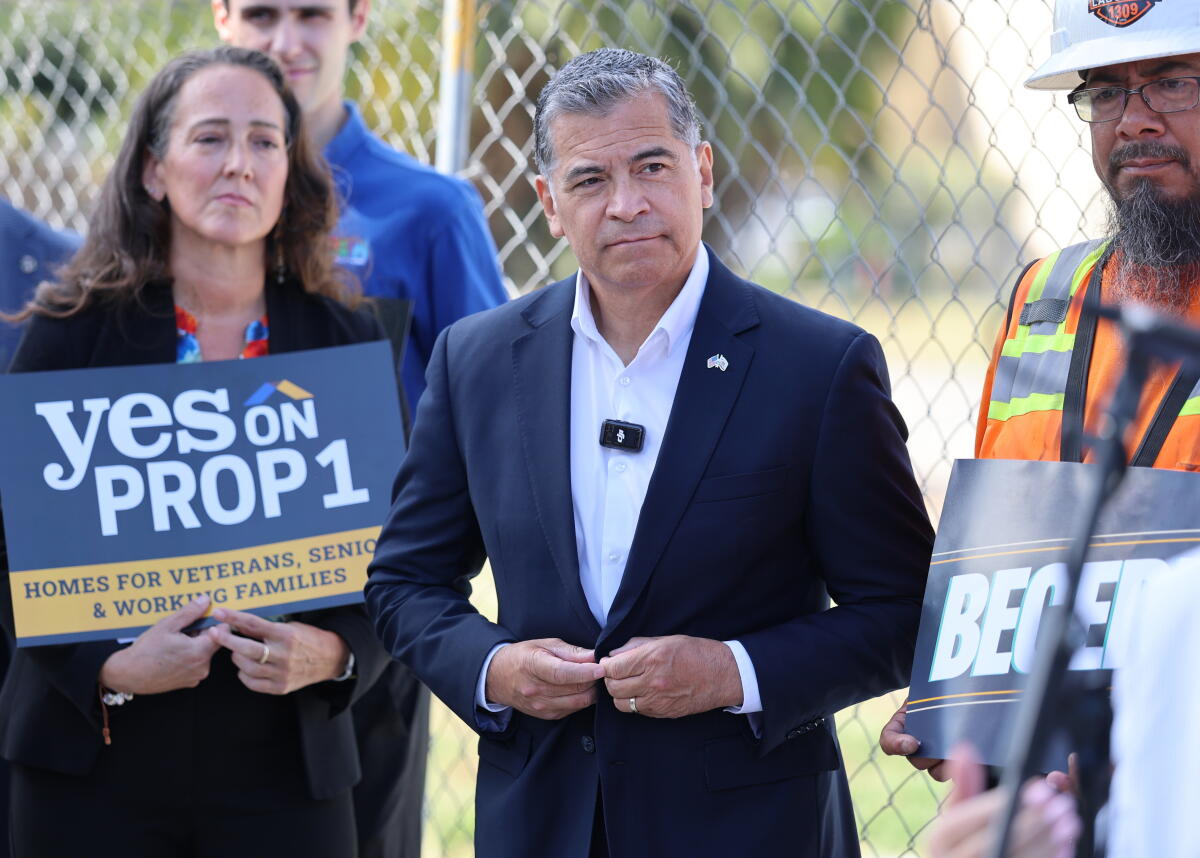
On Monday, he held get-out-the-vote events in Santa Clarita and Glendale, shortly after he campaigned for former state Sen. Richard Pan, a congressional candidate, in Sacramento, and urged voters to cast their ballots early at an event in Santa Rosa. In September, Becerra promoted Proposition 1, a proposal on the November ballot that would allow the state to sell nearly $11.3 billion in bonds to fund affordable housing.
“We know we can get these men and women who are wearing these orange vests to work and keep them working, so they can afford to buy a house if we pass Proposition 1,” Becerra said, standing alongside union members in front of a chain-link fence encircling a vacant lot in North Long Beach.
Gubernatorial candidate Xavier Becerra held a news conference in Long Beach on Sept. 4 to highlight his housing agenda.
(Allen J. Schaben / Los Angeles Times)
Long Beach Mayor Rex Richardson, who endorsed Becerra in April and appeared at the housing event, pushed back on the notion that Becerra is taking the election for granted after winning a top spot in the primary, positioning him to be the first Mexican American elected governor of California.
“I’ve seen firsthand the work that has taken place under the radar that may not be explicitly, openly political or openly be seen as campaigning, but it is the kind of thing you want to see,” Richardson said in an interview on Thursday, adding that he saw Becerra meeting with elected officials of both parties, the mayors of the state’s largest cities and labor leaders. “I’ve seen a very active candidate that has been making sure that real time was put into building relationships that will ultimately translate to a successful governorship, because that’s the goal. I mean, ultimately, what we want is a leader who has the relationships to lead our state.”
Becerra’s campaign said that the candidate has frequently met with voters since the primary without press coverage to hear from Californians, and that he would be a frequent public presence in the weeks before the election, when “voters really get engaged, when ballots land in their mailbox,” said spokesman Jonathan Underland.
“People have incredibly busy lives. They are worried about affording their healthcare, putting food on the table, paying for gas to fill their tank,” Underland said. “What is at the forefront of Secretary Becerra’s mind is the very real problems that Californians are facing every day.”
In contrast, Hilton has been publicly barnstorming California since the June primary.
Becerra’s schedule is not surprising given Democratic dominance in California, where the party’s registered voters outnumber Republicans nearly 2 to 1. While appearing at parades, pancake breakfasts and in voters’ living rooms can be effective for candidates running in local campaigns, the most effective way for candidates to reach voters in a state as vast as California is through sustained advertising buys, which can cost tens of millions of dollars.
“If you’re the Democrat running in California, the operating theme of your campaign is do no harm and measure the drapes and figure out how you’re going to put an administration together and what is the tone that you’re going to set for that administration,” said Tim Rosales, a veteran GOP consultant who led businessman John Cox’s unsuccessful 2018 gubernatorial campaign and previously worked on Arnold Schwarzenegger’s successful effort to replace Gov. Gray Davis in the 2003 recall campaign.
Newsom was more active in the 2018 general election campaign against Cox than Becerra has been this year, but Rosales argued that could be because Becerra views it as the final chapter of his political career, which also may have been the case with former Gov. Jerry Brown in his 2014 reelection campaign. Newsom, however, is pondering a 2028 run for the White House.
“This is potentially more of a swan song for Xavier Becerra, the icing on the cake for a long and distinguished political career, and for Gavin Newsom, it was a stepping stone,” Rosales said.
Becerra has raised $40.5 million, as of Friday, while Hilton has raised $29 million, according to the fundraising disclosure reports filed with the state. Those figures do not include the exponential advantage that Becerra had in independent expenditure committees’ spending over Hilton in the primary.
Veteran Republican strategist Rob Stutzman, an advisor to Schwarzenegger, said that while Becerra will almost certainly be the state’s next governor, he should be cautious about his approach weeks before the November election.
“What he needs to be careful of is a big Democratic night across the United States that looks muted in California, and if that happens, the analysis will be that it’s his fault,” Stutzman said. “He should want to optimize his political capital as the clear leader of his party now in California. So he has to be a little careful of leaving some political capital on the table by not creating a stronger brand over the next three weeks.”
The last gubernatorial race that was viewed as competitive took place in 2010 between Brown and former eBay chief Meg Whitman, then a Republican who spent $144 million of her personal wealth on her campaign.
That contest drew national attention, but Brown beat Whitman by nearly 13 percentage points. Every gubernatorial election since that race has been sleepy and ignored in national politics, with Democratic candidates coasting to victory. The state has seen contentious gubernatorial primaries, notably in 2018, and this year, when the Democratic field was so crowded that party leaders urged low-polling candidates, including Becerra, to drop out.
He won the top spot in the primary after then-Rep. Eric Swalwell (D-Dublin) dropped out amid rape and sexual assault allegations.
Mason Harrison, who worked for Republicans Carly Fiorina in a 2010 Senate bid and Neel Kashkari in a 2014 gubernatorial campaign, and worked with Hilton on business ventures but is not affiliated with his campaign, noted that while Brown was well-known by Californians because of decades in the public eye, Becerra is not. However, given Democrats’ edge in the state’s voter registration, as well as current headwinds against the GOP in California and across the nation, it’s unsurprising that Becerra has been less visible than Hilton. Harrison compared Becerra’s campaign to Biden’s in 2024 before the then-president bowed out of the race.
“The calculus seems to be, the more he gets out on the campaign trail, the greater the potential of him having a misstep in an interview or getting some tough question that he’s going to have to answer, and what’s the advantage of that in a year when you’re running against a party that, by historical standards, stands to lose significantly,” Harrison said. “Why make it more competitive by making yourself more vulnerable?”
Indeed, Becerra previously committed to multiple debates, but has participated in one so far and appears unlikely to agree to another. Still, he has repeatedly disputed the notion that he is taking the race for granted.
“If I were trying to coast, I’d be out on the coast right now instead of here with you all,” he told reporters one sweltering August afternoon in Little Tokyo in downtown Los Angeles, an area he represented in Congress.
Xavier Becerra, center, walks with Helen Ota, left, president of the 2026 Nisei Week Foundation, while touring businesses and meeting with business community leaders at Japanese Village Plaza in Little Tokyo in Los Angeles on Aug. 18.
(Genaro Molina / Los Angeles Times)
While there, he met with local business and community leaders. And he bought merchandise and delicacies, including a sweet mango mochi wrapped in a thin, fluffy pancake at a 123-year-old Japanese confectionery.
Times staff writer Nicole Nixon contributed to this report from Sacramento.
Anthropic (ANTHRO) plans to allocate 5% of its equity to a new fund designed to address the societal consequences of artificial intelligence, including potential job losses as businesses increasingly deploy AI-powered automation. The initiative, announced Sunday, comes as the developer of the Claude AI
GRANTCHESTER hunk Tom Brittney has split from his fiancée and moved on with tattooed model Clo Gascoigne.
It comes two years after Tom’s engagement to his long-term girlfriend, whose name he never revealed.
Tom Brittney has split from his fiancée and moved on with tattooed model Clo Gascoigne, aboveCredit: SuppliedTom recently starred in thriller movie Fall 2: DeadpointCredit: Alamy
The new couple have now gone Instagram-official as Clo shared a loved-up snap of them on the red carpet at Prime Video’s Carrie launch last week.
Tom, who recently starred in thriller movie Fall 2: Deadpoint, featured in Clo’s TikTok (which she has now deleted) where she filmed him watching himself on telly with the caption: “POV your boyfriend is an actor.” Congrats.
Sign up for the Showbiz newsletter
Thank you!
HOLLY AND FELTZ CLICK
Holly Willoughby has been exchanging tips with Vanessa Feltz on kickstarting their YouTube careersCredit: Instagram/Holly Willoughby
The presenters, who worked together regularly on This Morning, shared a snap on Instagram on Friday after watching a performance at the English National Opera in central London.
Speaking earlier in the week at Best magazine’s Heroes Awards, Vanessa said: “I’ve had a really great voicenote from Holly.
“She is incredibly encouraging and she says she’s thoroughly enjoying it and she can see that I am.
“We’re having dinner this week. We really like each other and support each other and I think she’s doing an absolute bang-up job. I think that women supporting women is always attractive and great.”
She added: “It’s quite a big deal to do it. Terrestrial TV seems to feel narrower, smaller, and fewer and fewer opportunities.
“On terrestrial TV, they all seem to be reining themselves in, there seem to be lots of cuts being made, and closures, things are shorter and smaller and less often and all this kind of thing.
“So I think the idea of just waiting for an opportunity there might be a very long wait.
“It’s a question of feeling like you want to try to see if you can make an opportunity for yourself.”
Nicole Scherzinger had a wild night stepping out in a skintight leopard-print catsuitCredit: Splash
NICOLE SCHERZINGER had a wild night stepping out in a skintight leopard-print catsuit.
The singer was joined by her Pussycat Dolls bandmates Ashley Roberts and Kimberley Wyatt at Nammos Greek restaurant in London’s Mayfair on Friday night, to celebrate their successful reunion tour.
The trio dined on signature dishes and enjoyed cocktails.
An onlooker said: “They were in high spirits. They had an amazing tour and got rave reviews, they deserve to let their hair down.”
TYLA’S HOT FLUFF
Tyla showed her softer side as she donned a fluffy lingerie set for a show on Friday nightCredit: Getty
TYLA showed her softer side as she donned a fluffy lingerie set for a show on Friday night.
Excited to be performing in the capital, the South African singer painted “London” across her thigh for the O2 Brixton Academy leg of her A*Pop World Tour.
The Water hitmaker, full name Tyla Laura Seethal, revealed that she loves the UK but still sees Johannesburg as her home.
The Grammy Award-winning singer said: “We don’t have paparazzi and you see our superstars at the mall, like every weekend. It’s kind of chill.
“It feels like a movie [in the UK] – the fact that people care about every little thing I do and say.”
Tyla continues her tour tonight in Glasgow then Manchester tomorrow.
ZARA’S GOT SOMETHING ‘SPECIAL’
Zara Larsson has confirmed a new album is coming next year and has already recorded the first trackCredit: Getty
ZARA LARSSON has confirmed a new album is coming next year and has already recorded the first track.
The star said the “special” song came by accident while she was working on this year’s remix album Girls Trips and she knows it’s going to be a hit.
She explained on Popcast: “I think it’s going to be a really fun journey to write the next album.
“I already have new lyrics, actually I have one song we did just because we couldn’t help ourselves when we weremaking Girls Trips and it sort of gave me the same feeling to when I did (previous album) Midnight Sun.
“When I left that session you just know when something is special and that’s one, and also what it was; for the four of us being fully present.”
EMMERDALE OLIVIA IS NED OVER HEELS
Emmerdale’s Olivia Bromley and Ned PorteousCredit: ITV
The ITV soap pair have been secretly dating for months.
Gorgeous Olivia and hunky Ned grew close after their characters, Dawn Taylor and Joe Tate, were involved in one of the show’s biggest-ever love triangles.
But the couple initially kept their romance quiet.
An Emmerdale source said: “Olivia and Ned were a couple off-screen while acting out those sex scenes.
“It was easy for them to get away with it because they were working so closely together.
“A few people clocked what was going on and they both admitted that they were seeing where things go. But it’s been a good few months now and they couldn’t be happier.”
Olivia left the soap over the summer, but now she has a great excuse to keep visiting the set.
MARTIN Freeman looked happier than ever as he made a rare red carpet appearance alongside his girlfriend Rachel Benaissa.
The Sherlock actor, 55, was joined by the French actress, 31, at the premiere of his new film A Long Winter during the BFI London Film Festival on Wednesday evening.
Martin Freeman looked happier than ever as he made a rare red carpet appearance alongside his girlfriend Rachel Benaissa.Credit: GettyThe Sherlock actor, 55, was joined by the French actress, 31, at the premiere of his new film A Long Winter during the BFI London Film Festival on Wednesday evening.Credit: Getty
The couple, who have been dating since 2020, shared a giggle as they posed together for photographers at the glamorous event.
Martin looked dapper in a dark suit with a patterned shirt and white T-shirt underneath, while Rachel opted for a blue striped shirt tucked into high-waisted black trousers and chunky heels.
Sign up for the Showbiz newsletter
Thank you!
The pair stood close together on the red carpet, with Rachel showing off her voluminous curly hair as they smiled for the cameras.
Martin stars alongside Outlander actress Caitríona Balfe and Fred Hechinger in A Long Winter, which follows a family preparing for the harsh winter months in the American mountains.
The pair stood close together on the red carpet, with Rachel showing off her voluminous curly hair as they smiled for the cameras.Credit: GettyMartin poses with Caitriona Balfe and Fred Hechinger at the glam red carpet eventCredit: Getty
The actor previously spent 16 years with his former partner Amanda Abbington, with whom he shares two children, Grace, 21, and Joe, 18, before their split in 2016.
Rachel, who has appeared in Normal People, This Way Up and Netflix film Irish Wish, has since become a familiar presence in Martin’s family life.
The actress previously appeared in a TikTok video shared by his daughter Grace, dancing alongside the family to a song from Martin’s festive film Nativity.
Martin has also offered a rare insight into their relationship, revealing on Jessie and Lennie Ware’s Table Manners podcast that the couple enjoy cooking together.
Speaking about Rachel’s love of food, he said: “She’s not a Cordon Bleu… she’s a massive cheese and wine w****,” before adding: “That’s what she would say about herself.”
He continued: “She says that about herself, ‘I’m a cheese and wine w****’. It’s not all she is, but no, she loves all that stuff. We like cooking.”
Iran. Afghanistan. North Korea. Somalia. And now, the United States.
If Secretary of Defense Pete Hegseth is to be believed, America will soon gain the dubious distinction of joining the only four countries on the globe that carry out executions in public.
Hegseth said Thursday that he wanted the execution of convicted F.t Hood shooter, Army Maj. Nidal Malik Hasan, to be available for public viewing.
“It was a radical Islamist attack … so he’s going to get a firing squad of soldiers, as it should be,” Hegseth said in an interview with far-right political activist Jack Posobiec. “We’ll make sure that people are able to watch it. That it’s public. Because people need to understand that there’s serious consequences for these types of things.”
The execution is scheduled to be live streamed Dec. 3 from the same military base where Hasan opened fire in 2009, killing 13 and wounding 32.
The planned public display is, in a word, barbaric. It’s the archaic act of tyrannical monarchies, staged in the shadow of a looming tower or in the town square. The Taliban and ISIS were big on public executions. So was Nazi Germany. They were either fighting a war on their own soil or had just come out of one. It’s a poor excuse, but the U.S. military can’t even point to that as justification for the animalistic intention of broadcasting a state-sanctioned murder.
Should plans for the livestream of Hasan’s killing become a reality, our peers will be countries that the U.S. has long held up as the worst of the worst. Oppressive “shithole” countries, to use a Trump term, that wield intimidation and the threat of death to keep their people in line.
Iran carries out its hangings in public squares, typically using truck-mounted cranes as makeshift gallows. The Taliban exacts its death penalty in sports arenas. Amnesty International reports that North Korea forced local residents, students and workers to watch the 2008 execution of 13 women and two men as a deterrent. Their crime? Attempting to flee to China.
Hasan, an Army psychiatrist and a Muslim, opened fire on dozens of his fellow soldiers as they were preparing to deploy to Afghanistan. He was reportedly angry about the U.S. involvement in the region and in Iraq. In court, prosecutors argued that he was radicalized online and motivated by an ideology that called for “jihad duty.”
His crimes were horrific, and he should be punished. Whether you believe in the death penalty or not (I do not), turning his execution into a morbid form of entertainment — or a warning to never do what he did — would mark a new low for this country.
And we are pretty low as it is. On Thursday, ICE agents in civilian clothing fired at least seven rounds, at 4 p.m. on a busy Manhattan street, into a car with a 5-year-old boy inside. They hit the driver, who survived, and by some act of god missed the child.
Federal immigration agents have shot at least 21 people, killing seven, since President Trump returned to office less than two years ago with the promise of cracking down on crime and making the country safer via mass deportations. The public execution of Hasan, who is a U.S. citizen, is being sold as part of that tough-on-crime initiative. Hegseth himself said the public killing is meant as a deterrent.
The idea that keeping a population safe requires removing the guardrails of civilized society is absurd, though despots throughout history would have us believe otherwise.
If Hasan’s death is televised, it will be the nation’s first government-sanctioned execution carried out in public since 1939. It will be the first U.S. military execution since 1961 and the first military death by firing squad, or “musketry,” since 1945, according to the Death Penalty Information Center.
The Army had planned a very different type of execution for Hasan. ABC News reported that officials were preparing to use lethal injection if Trump authorized the execution of one of the four prisoners on the service’s death row.
Trump’s approval of Hasan’s execution last Friday came days after a botched lethal-injection execution in Tennessee. Christa Pike, who was sentenced to death for a 1995 murder she committed as a teenager, survived despite being injected with two supposedly lethal doses. She is now said to be lucid and even walking.
Hasan, who is partially paralyzed and uses a wheelchair after being shot by officers who were responding to the Ft. Hood attack, will be put to death in a more dramatic fashion — and for everyone to see.
“The public execution even of one who has done grave harm will only further undermine the moral fabric of our nation and be a blight on the conscience of its people,” Oklahoma City Archbishop Paul Coakley said in a statement Friday. “The word of God exhorts us: ‘do not repay anyone evil for evil’ (Romans 12:17).”
A few congressional Republicans even broke ranks with their party and criticized Hegseth’s plans for the livestream. Sen. John Curtis of Utah posted on X that “a civilization erodes when it cultivates an appetite for executions as a form of entertainment. Secretary Hegseth’s plan to livestream the Fort Hood execution risks feeding that appetite.”
There is no reason the U.S. should stoop to the barbarism of public executions. It’s ghoulish, inhumane and a marker of tyrannical rule. Do we really want to join Iran, Afghanistan, North Korea and Somalia in the global hall of shame?
The hum of the kidney dialysis machine that Onasis Munoz is connected to suddenly stops. The fluorescent lights overhead flicker out, and his room at a clinic in Valencia, Venezuela, is plunged into darkness.
It is not the first time a power cut has interrupted one of the three weekly sessions Munoz needs to do the work his failing kidneys can no longer do, filtering waste and excess fluid from his blood.
For years, electricity would go out every couple of days across parts of Venezuela’s Carabobo state.
But in recent months, Munoz said, the outages have grown to be daily, lasting around seven hours. The clinic’s emergency batteries have since been depleted, and its backup generator no longer works.
He explained that the frequent power failures have disrupted his treatment. His health has slumped as a result.
“I arrive home, exhausted, as if I had run a marathon,” the 34-year-old said.
But often there is no electricity there either, and recent weeks have been sweltering. “I can’t switch on the air conditioning. I cannot rest because of the heat and the mosquitoes. There’s no relief,” Munoz said.
Onasis Munoz of Valencia, Venezuela, has seen his dialysis treatment interrupted by power outages [Courtesy of Onasis Munoz]
Across Venezuela, the prolonged outages are riling locals, as the electricity supply to homes, businesses and essential services becomes unstable.
Some of the cuts are deliberate, as the government of interim President Delcy Rodriguez rations electricity.
The resulting frustration has spilled onto the streets, where demonstrators hold “cacerolazos” – a traditional form of protest that involves banging pots and pans.
Some have gone as far as blocking roadways and setting tyres on fire. The electricity crisis has also raised concerns about how the government is managing the country’s vast oil supply, a key source of income for the country.
“We are desperate. We cannot understand how a country so rich in resources can be practically left in the dark,” said Patricia Cueva, a lawyer from Maracaibo, the capital of oil-rich Zulia state.
“We cannot rest. We cannot work. Our children cry.”
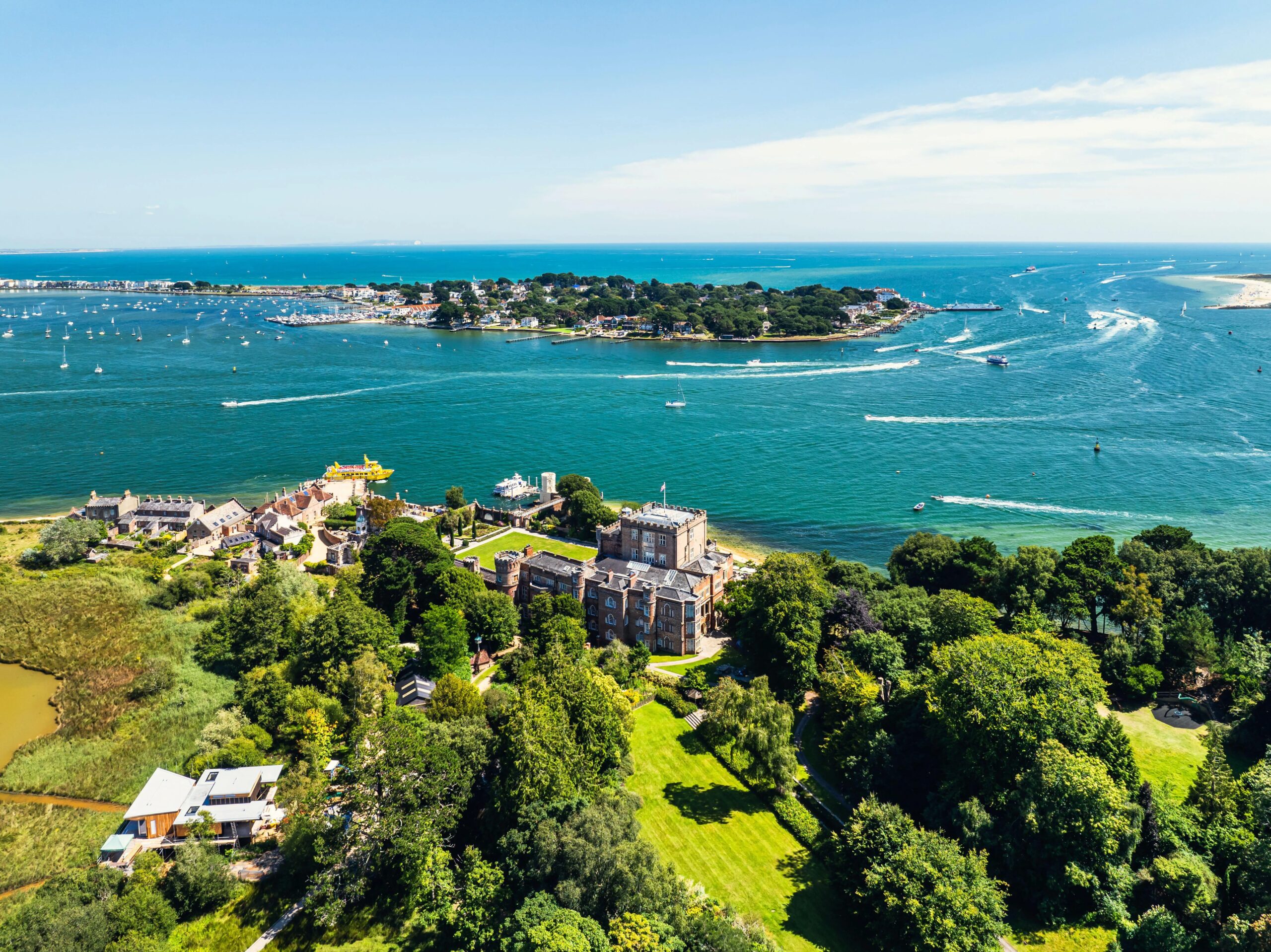
But the island is popular with wildlife lovers, with exotic birds, deer and free roaming peacocks.
It has a huge red squirrel population too, with around 250, best spotted in the morning.
The 16th century Brownsea Castle, built by Henry VIII, is the main building on the island, but you won’t be able to stay there as it is sadly privately owned.
Instead there is the Brownsea Island Campsite, with 40 pitches in the summer, or a number of lodges sleeping from 2 to 12 people.
It will reopen again in March 2027Credit: Alamy
There is an adventure playground for kids, with everything from den building to obstacles.
You’ll have to leave the dogs at home sadly, as only assistance pets are allowed.
Daily guided tours take place too twice a day.
Otherwise you can fill your stomach at the Vilano Cafe which has snacks, drinks and a snack van in the summer.
Proponents of the measure say Los Angeles is falling short in providing basic services, including street and sidewalk maintenance, upkeep of streetlights and trees and other services administered by the Department of Public Works.
The measure is intended to streamline public works decision-making to improve city services and add new sources of revenue by leveraging existing resources such as underutilized city land.
Measure LA’s perhaps most controversial element is the proposal to increase the power of the director of public works while reducing the sway of the Board of Public Works or potentially eliminating it.
The director would be able to manage public works projects, including construction, buying or leasing property, exercising eminent domain with City Council approval, granting street permits, regulating parking and recommending budgets for the department.
An opponent of the measure, Rodriguez said the Board of Public Works was established to provide independent review of city contracting, with commissioners’ decisions made in public meetings.
“Removing this important check and balance would reduce public scrutiny and weaken accountability over billions of taxpayer dollars for public projects,” Rodriguez said in her ballot argument against the measure.
Commissioners are appointed by the mayor. They work full-time on the board for five-year terms administering the Public Works Department while assisted by several bureau heads and the director of public works.
Proponents of the measure say the current system of overseeing public works is ineffective because responsibility is spread among multiple officials, commissions, agencies and bureaus.
“Angelenos see the results in crumbling streets, buckled sidewalks and streetlights that stay dark,” proponents said in their ballot argument.
Another key element of the measure is establishing a two-year budget cycle for the city, which currently adopts its budget annually. Under Measure LA, the mayor would be required to submit a proposed two-year budget to the City Council by April 1. A two-year budget would enhance planning for infrastructure improvements under another new requirement that the city adopt a Capital Infrastructure Plan.
Most major U.S. cities rely on multiyear capital improvement plans to schedule spending on roads, bridges, parks and buildings.
A long-term infrastructure plan administered with two-year budgeting “sets clear priorities, identifies the projects that need to get done, and plans how to fund them over time,” proponents said.
Currently, the charter prohibits the city from mortgaging city-owned property and prevents it from operating purely commercial or industrial businesses. The measure would remove these restrictions to raise new revenue.
Easing restrictions on operating a business also would allow the city to use its intellectual property to sell merchandise with city logos, as is done in other cities including New York, Yaroslavsky said.
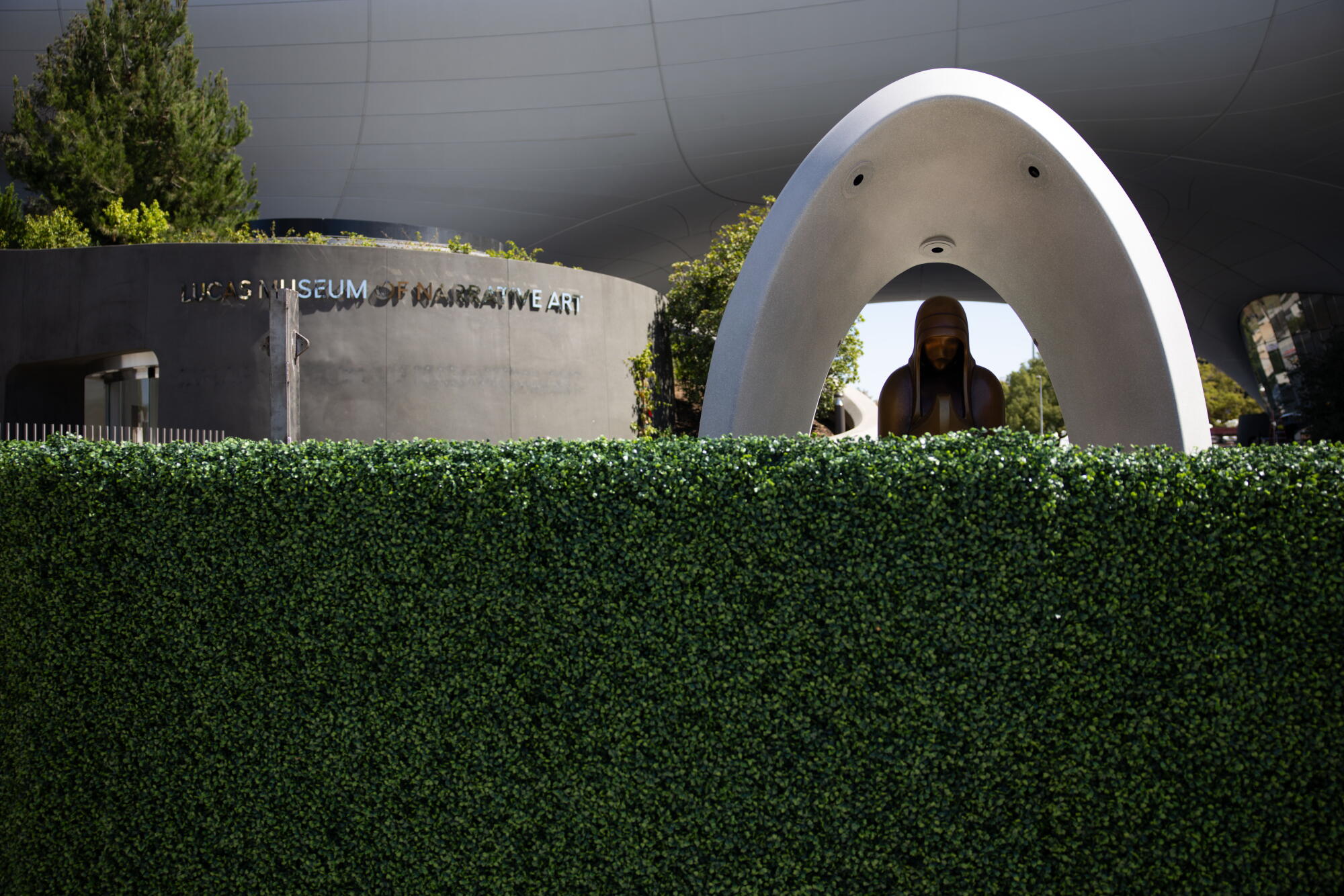
The Lucas Museum of Narrative Art’s central plaza, which spreads out beneath the building’s curved, hovering form, was always meant to be a generous civic space. Ma Yansong, the museum’s architect, has called it the “Gateway” between the museum and Los Angeles, opening to both Expo Park and the surrounding South L.A. neighborhood.
But that gateway, it turns out, is more like a gate.
This weekend — the first that the museum was open to the public — fences covered in plastic greenery blocked entry to the plaza from both sides. Standing sentry, bizarrely, were tall, cartoonish statues — half storm troopers, half USC Trojans. Visitors were directed to enter through the museum’s two enclosed security booths off the plaza.
In the coming weeks, permanent plaza fences will be erected here — curvy stainless-steel structures that MAD Architects principal Dixon Junliang Lu compared to the lacy filigree of Art Nouveau architecture. Lu added that they would eventually be draped in real greenery, not the plastic version.
While certainly an improvement on the current barriers (which are a shockingly makeshift solution for a museum that cost over $1 billion), the plaza’s main entryways will remain gated off, confirmed both Lu and Lucas Museum spokesperson Seth Fowler.
Gates have been erected around the main courtyard of the Lucas Museum of Narrative Art.
(Kayla Bartkowski / Los Angeles Times)
“It’s about creating the best possible visitor experience when you’re there, with an eye on safety,” said Fowler, who cited a need to protect the plaza from car traffic on both sides and the ability to control visitor flow among the reasons for the enclosure.
Visitors without tickets, Fowler added, are still able to enter the plaza, as well as the museum’s cafe and gift shop, after passing through security, “pending capacity limits.” They can enter the museum’s adjacent park without security screening.
Museums of course have legitimate security concerns, especially in and around such a high-traffic location. A growing list of threats, from violence to vandalism, has changed the calculus for what’s acceptable in public life. But surely the building’s talented design team could have developed a security plan that better preserved the plaza’s open arms? Lu acknowledged that the fence design had “evolved as the project developed and the operational and security requirements became more defined.”
The plaza is one of the museum’s most powerful gestures, creating much-needed civic room for Expo Park, and the city. The gates blocking it, and the security checkpoints along its flanks, will dramatically limit the public’s desire to enter, and change the tenor and experience of a space that should feel porous and inclusive. What could have been a grand welcome has become a gated off, highly controlled space that now feels separate from the park and the neighborhood. Sure, anyone can come, but they are no longer invited.
Art Nouveau style fencing will eventually replace the temporary green fencing, but guests will still be directed through security in order to enter the museum’s main courtyard.
(Kayla Bartkowski / Los Angeles Times)
Just a few miles away at LACMA’s new David Geffen Galleries, visitors can enter the plazas beneath that building without first passing through security. In fact, I don’t know of a single civic plaza (and there are not enough!) in Los Angeles that requires passing through security checkpoints to enter. Think about this scenario in other cities. In New York, can you imagine having to go through metal detectors to sit at the Met steps? Or to enter Central Park?
Speaking of parks, it’s inconsistent and puzzling that the museum’s beautiful park, which edges right up to the building, can be entered without having to also pass through security. I, for one, am thankful. Access to this area is already being limited to some degree. Its long fences, with relatively small openings, are not exactly screaming “come in.” The green space, as it was this Saturday, will be closed to nonticket holders on USC game days. And if locals who live to the west of the museum want to reach Expo Park outside of the Lucas park’s hours — 8 a.m. to sunset — they need to make their way around the entire complex; which a few are already grumbling about.
It’s hard not to wonder whether these barriers represent something more than security: the extension into public space of the gated, closely guarded world inhabited by co-founders George Lucas, Mellody Hobson and those in their orbit. Is this truly what museum security requires, or has the logic of a private compound shaped an institution that was supposed to welcome the city? That is the uneasy promise of privately controlled public space: It looks open to everyone, but access ultimately depends on the owner’s discretion.
It is an especially peculiar contradiction for a museum whose site is being leased from the state at just $30 a year and was founded to celebrate the “people’s art” — comics, illustrations, movie imagery — and to bring that art to the broadest possible public. Renderings introducing the project never showed the walls and fences that now cover the plaza’s perimeter. (A model produced later, now in the museum, does.)
Temporary fencing around the Lucas Museum, alongside the Art Nouveau style fencing that will eventually replace it.
(Kayla Bartkowski / Los Angeles Times)
I last encountered this type of scenario when visiting the Eiffel Tower, whose base has been closed since Paris’s 2015 terrorist attacks. (The attacks did not occur at the tower itself.) Its sealed perimeter, only accessible via lines and screening, now makes one of the world’s wonders feel less like a wondrous part of the city than an attraction held behind glass.
I’m not suggesting we leave major public spaces vulnerable. But security can be built into buildings’ plazas in myriad ways without sealing them off: reinforced planters and seating can stop vehicles; grade changes, landscapes and water features can establish protective distance; clear sight lines, lighting, cameras and visible staff can improve oversight; and retractable barriers can be deployed during large events or credible threats. Screening can remain at the museum doors, leaving outdoor space free.
At the end of the day, civic space depends on a willingness to share some level of uncertainty. A public plaza brings all kinds of people together, including those we don’t know and can’t entirely predict. If every risk leads us to add another checkpoint, fence or barrier, we may gain a sense of control but lose the ability to create the kind of public togetherness that forms a bonded city.
If this plaza, and this museum, are truly meant to serve the public it should be clear that all are welcome once they arrive. Openness is more than an architectural effect: It depends on having the freedom to enter without having to justify our presence.
UK Prime Minister Andy Burnham is promising a major improvement to public services including social care, housing and energy. Al Jazeera’s Milena Veselinovic reports on what he’s proposing and what it could mean for the people of the UK.
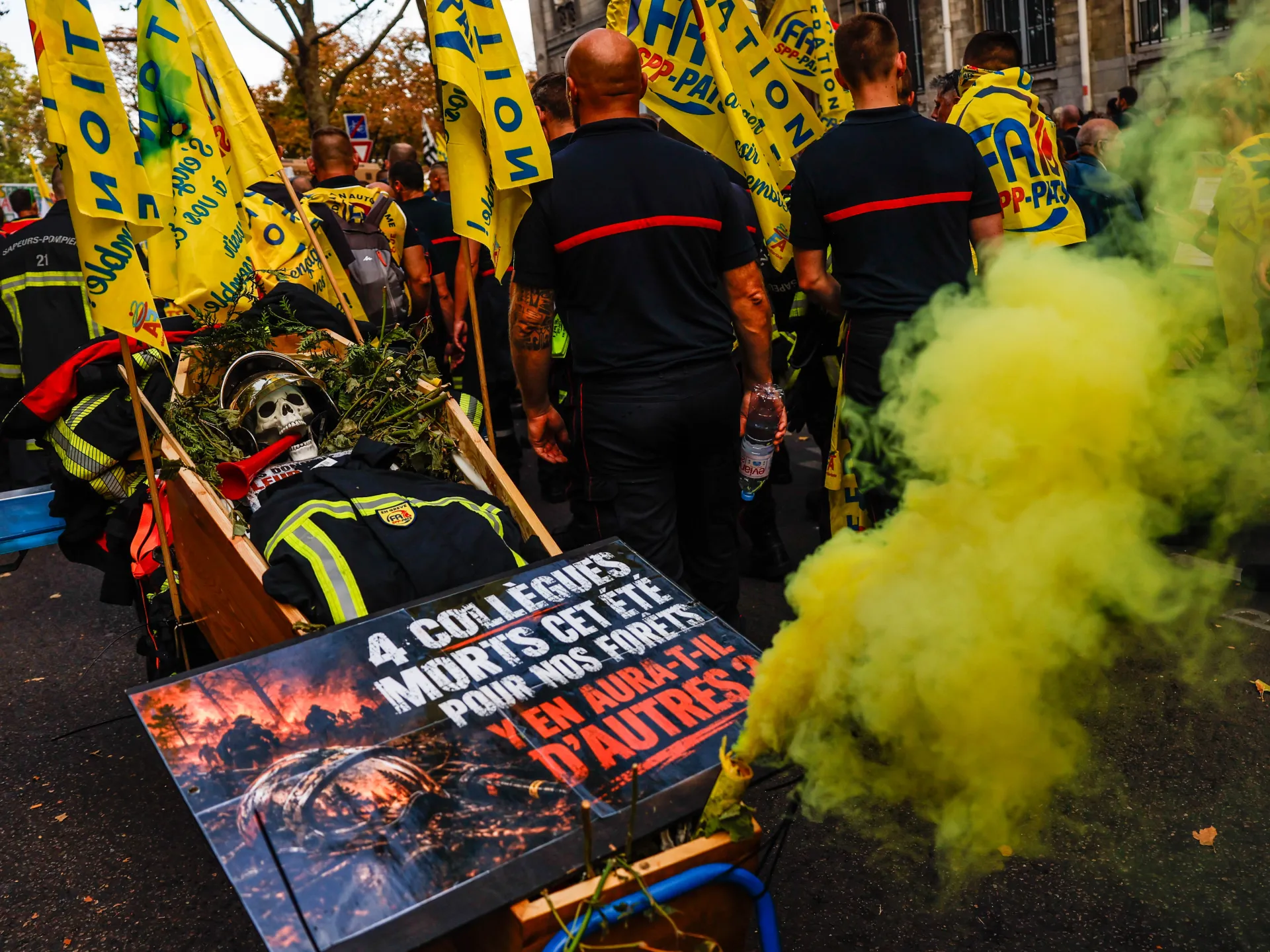
Tens of thousands of civil servants, including teachers, firefighters and healthcare workers, have marched in cities across France to demand higher pay, as students clashed with the police in separate protests over conditions at their schools.
Unions said some 300,000 people took part in the one-day strike action nationwide, while police on Tuesday estimated a turnout of 30,000 in the capital, Paris. The workers also demanded better working conditions and expressed anger at the government’s planned budget cuts.
Recommended Stories
list of 3 itemsend of list
Protests also took place at more than 400 schools, about 40 of which were blockaded and 44 of which faced attempted blockades.
Ten people, both students and staff members, were wounded, and at least 440 were detained, officials said.
The strikes and the student unrest came two days before the government is to unveil its draft budget and seven months before the presidential election. According to unions, the government proposes freezing base salaries for state employees in 2027 to save 2 billion euros ($2.3bn).
It would be the fourth consecutive annual freeze and the eighth during President Emmanuel Macron’s tenure. Unions say the freezes have cost workers a double-digit share of their purchasing power, and they are demanding a 6 percent raise.
‘Red alert’
Sophie Binet, general secretary of the General Confederation of Labor, called the protests “a red alert”.
“This anger is not going away. The government must look again at the budget,” she told Al Jazeera. She gave the government 48 hours to reverse the planned cuts before her union decides on further strike action.
The Education Ministry said just more than 11 percent of teachers and other school staff went on strike. French teachers are paid less on average than their counterparts in other European countries.
Fewer than 1 in 10 other civil servants took part, and fewer still in hospitals, with the loss of a day’s pay a likely factor in the turnout. France’s civil aviation regulator had warned of flight disruptions at some airports.
Professional firefighters, who say this summer’s huge wildfires exposed a lack of resources, were among those marching.
The government has already unveiled measures to help households cope with a spike in energy prices driven by the United States and Israel’s war on Iran, but it has failed to quell the discontent with Macron and his administration.
Student unrest
Students, meanwhile, have been protesting outside hundreds of schools over timetables, class sizes, teacher shortages and overheated classrooms during this year’s heatwaves. The demonstrations began in the Ile-de-France region around Paris and spread to other cities.
In addition to the 10 students and staff members who were hurt, 48 law enforcement officials were injured, authorities said, as students in some places set fire to rubbish bins and hurled projectiles, and officers responded with batons and tear gas.
Interior Minister Laurent Nunez told BFMTV that 440 people had been detained.
“We don’t have the final tally yet, but I’m told two thirds led to police custody,” he said. “Violence is never legitimate. There is nothing that justifies violence.”
Education Minister Edouard Geffray condemned the clashes on social media.
“This violence is unspeakable,” he wrote, adding that legal proceedings had begun. “To legitimize it or… call for an expansion of the blockades is to endanger both our students and public officials. It is irresponsible.”
‘Fewer cops, more money’
In Seine-Saint-Denis, a low-income suburb of Paris, Bally Bagayoko, the district’s mayor and a member of the hard-left France Unbowed party, joined hundreds of students protesting at the Lycee Paul-Eluard.
He led them in singing the national anthem and called the protests “completely legitimate”, saying poorer areas received fewer resources than wealthier ones.
Outside the Arago school in Paris, students, some with their faces covered, sat on dumpsters to block the entrance beneath a placard reading “Macron explosion”. A banner at the Helene-Boucher school read “Fewer cops, more money”.
“We want fewer police because we think there is a huge amount of police repression, both against high school student movements and social movements more generally,” said Mael Breton, a final-year student there. “This is a real problem, especially when there is such a lack of funding… here at our school and in the national education system more broadly.”
Prime Minister Sebastien Lecornu on Monday condemned the high school protests as irresponsible but acknowledged that the “difficulties of high schools must be heard and addressed”.
Jean-Luc Melenchon, a hard-left presidential contender, accused the government of steadily dismantling public services as he addressed protesters in Paris and urged his supporters to mobilise against the draft budget.
A Toluna Harris poll on Monday suggested that Melenchon and Marine Le Pen, the leader of the far-right National Rally, would advance to next year’s presidential run-off, with Le Pen best placed to win.
NewGenIvf Group (NIVF) announced the pricing of public offering expected to generate approximately $1.25M in gross proceeds before placement agent fees and offering expenses.
The offering comprises 17.86M ordinary shares or pre-funded warrants in lieu thereof, priced at $0.07 per ordinary share. Pre-funded
Thousands of public transport drivers in the Philippines begin a three-day strike over soaring fuel prices. Drivers say incomes are falling short of a living wage because of rising costs and taxes.
Gov. Gavin Newsom has signed a bill that prohibits third-party brokers from advertising, selling or transferring tee-time reservations at publicly owned golf courses without the written consent of the course operator.
The state legislation is a response to a network of brokers that had sprouted up around Los Angeles municipal golf course tee times.
These brokers, many of whom were in the Korean community, would gobble up tee times, then advertise them on social media, particularly the Korean app KakaoTalk. They charged up to $40 as a booking fee.
Getting tee-time reservations at L.A. municipal golf courses had long been difficult. But after golf influencer Dave Fink revealed evidence of the broker network to his viewers, the problem became public.
“This is an issue that affects everybody who pays taxes in the city, and anybody who plays golf as well, so I just felt like it was my duty to say something,” Fink said in an interview with The Times in March 2024.
After Fink’s videos went viral, the L.A. Department of Recreation and Parks announced an investigation into the practice.
The state has more than 200 municipally owned golf courses, according to Assemblymember Christopher M. Ward (D-San Diego), who authored the bill.
“Public golf courses belong to the public, and residents shouldn’t have to compete with brokers buying up tee times just to turn around and sell them at inflated prices,” he said in a statement Sunday.
The legislation “puts an end,” he said, “to this unfair practice and helps ensure local residents, seniors, students and families can continue accessing the public courses their communities support.”
California Gov. Gavin Newsom on Sunday signed legislation that bars public officials from issuing meme coins and restricts cryptocurrency platforms from offering certain tokens linked to politicians to California residents.
Assembly Bill 2409, authored by Assemblymember Avelino Valencia, is aimed at preventing
California Deputy Atty. Gen. Marissa Roy has a lead in the race to replace Los Angeles City Atty. Hydee Feldstein Soto, who lost her seat in a historic primary rout this spring, new polling shows.
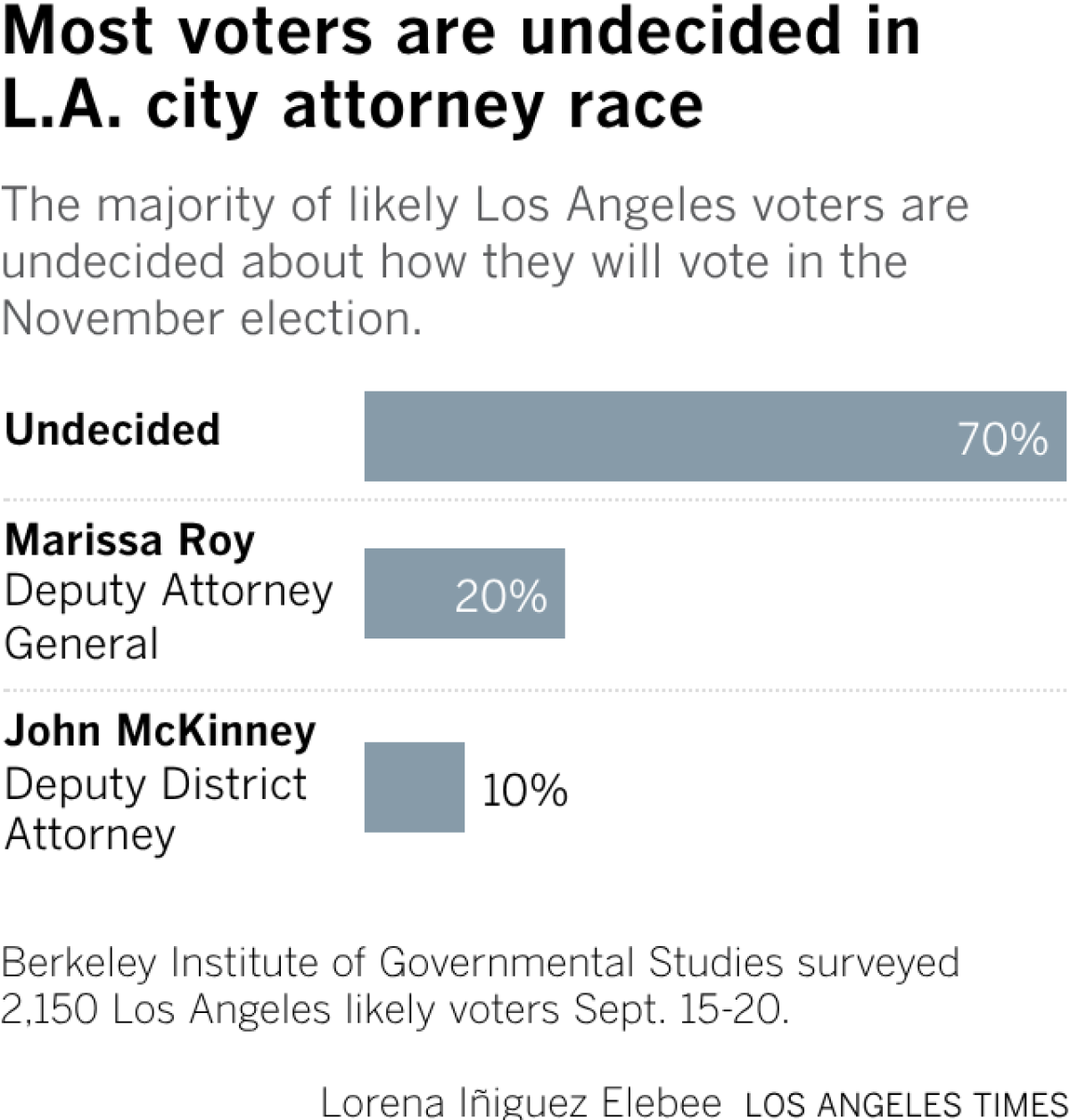
Among likely Los Angeles voters, Roy leads by 10 percentage points over her rival, Los Angeles County Deputy Dist. Atty. John McKinney, following the pair’s shocking electoral upset in June, according to a poll released last week by UC Berkeley’s Institute of Governmental Studies and co-sponsored by The Times.
The spread closely mirrors City Councilmember Nithya Raman’s breakaway lead in her bitter fight to unseat Mayor Karen Bass, who has outraised her for months.
But that’s where the similarities end.
The mayor’s contest has been called a “knife fight” for its no-holds-barred campaigning. It has also drawn sustained — and occasionally sensational — national attention since Raman’s buzzer-beating entrance in February.
By contrast, the city attorney’s race remains all but unknown: More than two-thirds of likely voters are still undecided, versus about a third who remain uncommitted in the mayor’s contest, polling showed.
L.A.’s top litigator commands a budget of nearly $200 million, plays a role in shaping city ordinances, and wages court battles on behalf of the public. The city attorney also prosecutes misdemeanors — a job most other cities keep separate. Each year, the office weighs some 120,000 violations, deciding whether to file charges and how to pursue them.
More recently, city attorneys across the country have championed activist litigation, spearheading suits against the Trump administration, among others.
Yet, few local voters know the job exists, and fewer still know the candidates by name.
Seventy percent of likely voters said they had no opinion of either McKinney or Roy — a fairly typical result for a down-ballot race, experts note.
Still, new data about voter priorities could signal how those undecideds might shake up the race in its final weeks.
Roughly a third of L.A. voters rank “moving homeless people indoors” and “crime and public safety” as top priorities, respectively; just slightly less say “fixing streets, sidewalks, streetlights and other city infrastructure” is essential.
McKinney, 58, pitches himself as a law-and-order moderate with plans to use the city attorney’s prosecutorial power to reduce disorder and move unhoused people off the streets. He manages more than 300 people at the district attorney’s office and spent decades in the courtroom securing high-profile convictions — advantages that he contends outweigh his lack of civil litigation experience.
Roy, 34, campaigns with an aura of sunny progressive pragmatism, arguing that the city can rein in ballooning liability in part by tackling its vexing infrastructure issues. She nods to the recent $17-billion settlement with Meta — a case her team at the attorney general’s office led — as evidence of the kind of ambitious, public interest litigation a large municipal attorney’s office could join.
Those disparate visions — along with crucial endorsements and influxes of cash — helped the pair define clear brands and constituencies going into the primary.
Both also got a boost from nationwide anti-incumbent fervor, staking sides across a mutual opponent whose name recognition had turned sour while rarely taking aim at each other.
But the general election is a different animal.
Although the Los Angeles electorate has been moving leftward for years, primary voters typically skew older and more conservative than those who show up for the general election, experts said.
Polls suggest that fact could create an uphill battle for McKinney, whose sway is biggest among conservatives, about 19% of the city’s electorate.
Some 21% of Republicans and nearly 30% of self-identified MAGA voters favored McKinney in the most recent poll, while Roy is favored by 25% of Democrats and by 3 in 10 voters who identify as progressive or democratic socialists.
By contrast, about a quarter of Republican voters now say they favor Bass for mayor, while Raman has a 14-point lead among Democrats. (Both are about equally underwater with MAGA voters.)
Like Raman, Roy has deep ties to the city’s insurgent democratic socialist political machine and hard-won endorsements from its progressive clubs. She has also successfully courted L.A.‘s influential unions and got an early boost from the L.A. County Democratic Party when it endorsed her this spring.
McKinney is endorsed by the city’s powerful police union and championed by L.A. County Dist. Atty. Nathan Hochman.
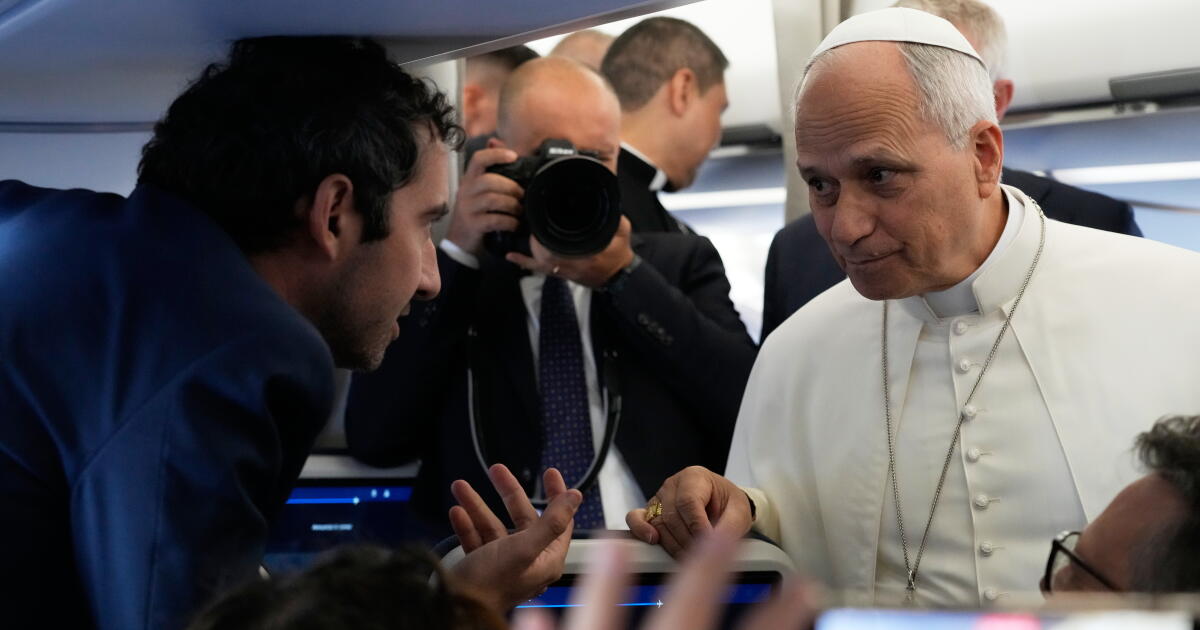
ABOARD THE PAPAL PLANE — Pope Leo XIV told journalists they were welcome to report on him, as he responded to the Trump administration’s attempt to bar U.S. media from the White House and affirmed the importance of journalists covering public figures.
Leo spoke to reporters Friday on his way to France for a four-day visit. Asked by a CNN reporter about the Trump administration’s attempt to bar CNN and other reporters, Leo said the media was welcome on his plane.
“I am very happy that here, you are all welcome,” he said. Good media coverage is important, he said, and equally important “that we have it all the way around, for everyone”
CNN, MS NOW and Politico were back at the White House on Thursday after a judge handed them a reprieve from President Trump’s ban, but the extraordinary showdown between him and outlets whose coverage he dislikes continued.
On a high-profile day when Chinese leader Xi Jinping was visiting Washington and attending a state dinner, no major American network was airing live coverage, and both CNN and MS NOW said their journalists were denied access to Xi’s state dinner arrival.
The American pope has long affirmed the need for free and independent press, a point he made in one of his first audiences as pope. Speaking to journalists who covered the 2025 conclave that elected him, Leo called for the release of imprisoned journalists and affirmed the “precious gift of free speech and the press.”
That said, since the COVID-19 pandemic, independent media have been prevented from covering photo opportunities inside the pope’s private studio when heads of state visit. Additionally, many of the pope’s private audiences with other groups and individuals are closed to non-Vatican press.
Leo had opposed Trump on the war
Leo’s airborne comments about Trump followed his April back-and-forth over the American president’s criticism of his opposition to the Iran war. Leo’s position won him points with some Parisans opposed to Trump’s policies who came out in droves to celebrate the first official state visit by a pope in 18 years.
“He dared, at his level, to oppose the American president,” said retiree Thierry Marien, who lined up hours early to grab a spot on the popemobile route to Notre Dame cathedral, where Leo was to celebrate vespers later Friday. “Not because he is opposed to the American president but because he’s opposed to countries where we can see there’s a risk of their political systems becoming a bit more dictatorial and there are already enough of those in the world.”
“I appreciated that he did that. He could quite easily have said to himself, ‘In my situation, I won’t criticize any heads of state,’” he said.
Leo took further distance from the Trump administration policies later Friday by making a lengthy visit to UNESCO, the U.N. cultural and educational agency, from which the U.S. has withdrawn as part of its retreat from the international organization.
Leo, who has championed multilateral diplomacy, toured the UNESCO grounds inside and out, greeted its employees and received a guided tour of some of its art collections. He then delivered a speech on the values UNESCO espouses to promote peace through culture and education.
Leo apologizes to reporters
Also on the flight Friday, Leo also apologized for missing an opportunity to speak with the press the last time he traveled internationally, when his Iberia charter broke down in Spain’s Canary Islands and he returned home solo on the king’s private jet, skipping his traditional airborne press conference.
More than 70 reporters and the Vatican delegation waited for several hours at the airport for a replacement plane to arrive. Leo addressed the media’s disappointment when he came to the back of the plane to greet reporters.
“A special mention I would like to make for those of you who were traveling with me when we returned to Rome from Spain,” he said. “I want to apologize personally for an incident, that I had nothing to do with, but which I know left a number of you unhappy with the fact that we couldn’t have the flight back together back to Rome.”
In other comments to reporters, Leo said he believed his alma mater Villanova would be the fan favorite when the Augustinian university plays the Catholic University of Notre Dame’s basketball team in Rome on Nov. 1.
“They tell me that the people coming to the match, 90% are Villanova and 10% Notre Dame, so the voice of the people of God will be very strong on the Villanova side,” Leo said.
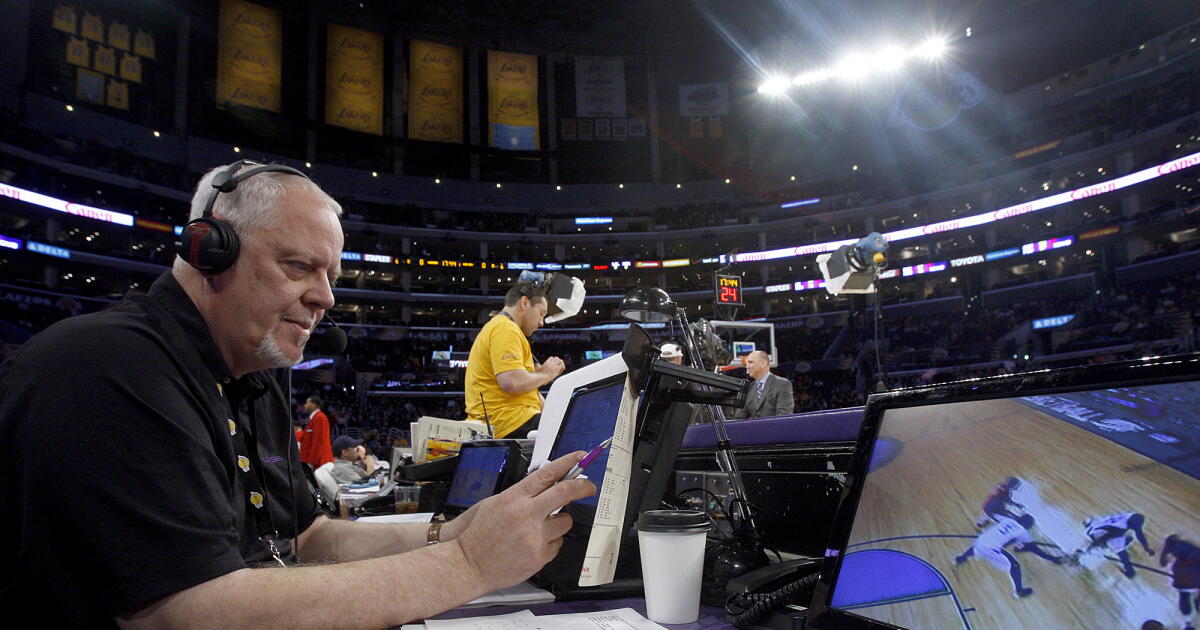
The Lakers’ longtime public address announcer Lawrence Tanter died Wednesday, the team announced. He was 76.
Remembered for his smooth, baritone voice, Tanter served as the voice of the Lakers for more than four decades. Tanter narrated chapters of Kareem Abdul-Jabbar and Magic Johnson, Kobe Bryant and Shaquille O’Neal, LeBron James and now Luka Doncic. After a stroke suffered in March forced him to retire from his game-day role, he transitioned to an advisory role in June.
“For 43 years, LT’s voice served as the soundtrack to Lakers games at the arena,” the team said in a statement Wednesday. “He will be remembered as a cherished member of the Lakers family.”
Tanter started with the team in 1982 when the Lakers played in the Forum. His signature calls — “toooo many steps,” “Kobeee Bryant,” “Lllaker Girlsss” — were not boastful or over the top. For a franchise that came to embody old Hollywood glamour, Tanter’s voice became the ideal soundtrack.
“A true original that added his unique style to Showtime,” Lakers governor Jeanie Buss wrote on X. “Rest in peace, LT.”
He backed fans up as they celebrated 10 championships during his tenure. He offered comfort in other painful times.
Days after Lakers legend Kobe Bryant died in a helicopter crash in 2020, Tanter guided a sold-out crowd through a tearful pregame routine, introducing all five of the Lakers’ starters with a familiar call: “Number 24, 6-6, 20th year out of Lower Merion High School, Kobeeee Bryant.”
The 6-foot-7 Tanter towered over many, but greeted everyone with a kind smile and warm conversation. Just as the players he serenaded with his calls became institutions in the sport, so did he. Tanter was inducted into the Southern California Sports Broadcaster Hall of Fame.
“I hope the team wears an LT patch this season,” former Lakers center and current team broadcaster Mychal Thompson wrote on X on Tuesday.
“He was a great vibe dude, always engaged me in conversation about jazz, he was a music lover and the best announcer in the NBA,” Red Hot Chili Peppers bassist and longtime Lakers fan Flea wrote on X. “I realized when attending many other NBA arenas that no one else came close.”
While many in his profession brought energy with loud, hyped-up calls, Tanter held firm with his cool style. He “never tried to be a cheerleader,” Tanter told The Times’ Bill Plaschke in June.
“It’s been a great run,” Tanter said after announcing his retirement. “I’ve been blessed.”
HOME Improvement star Jonathan Taylor Thomas has been arrested and jailed in Los Angeles, The U.S. Sun can confirm.
A spokesperson for the Malibu/Lost Hills Sheriff’s Station told The U.S. Sun that the former actor, 45, was a passenger in a vehicle that was pulled over by police on September 21 around 12:30 am.
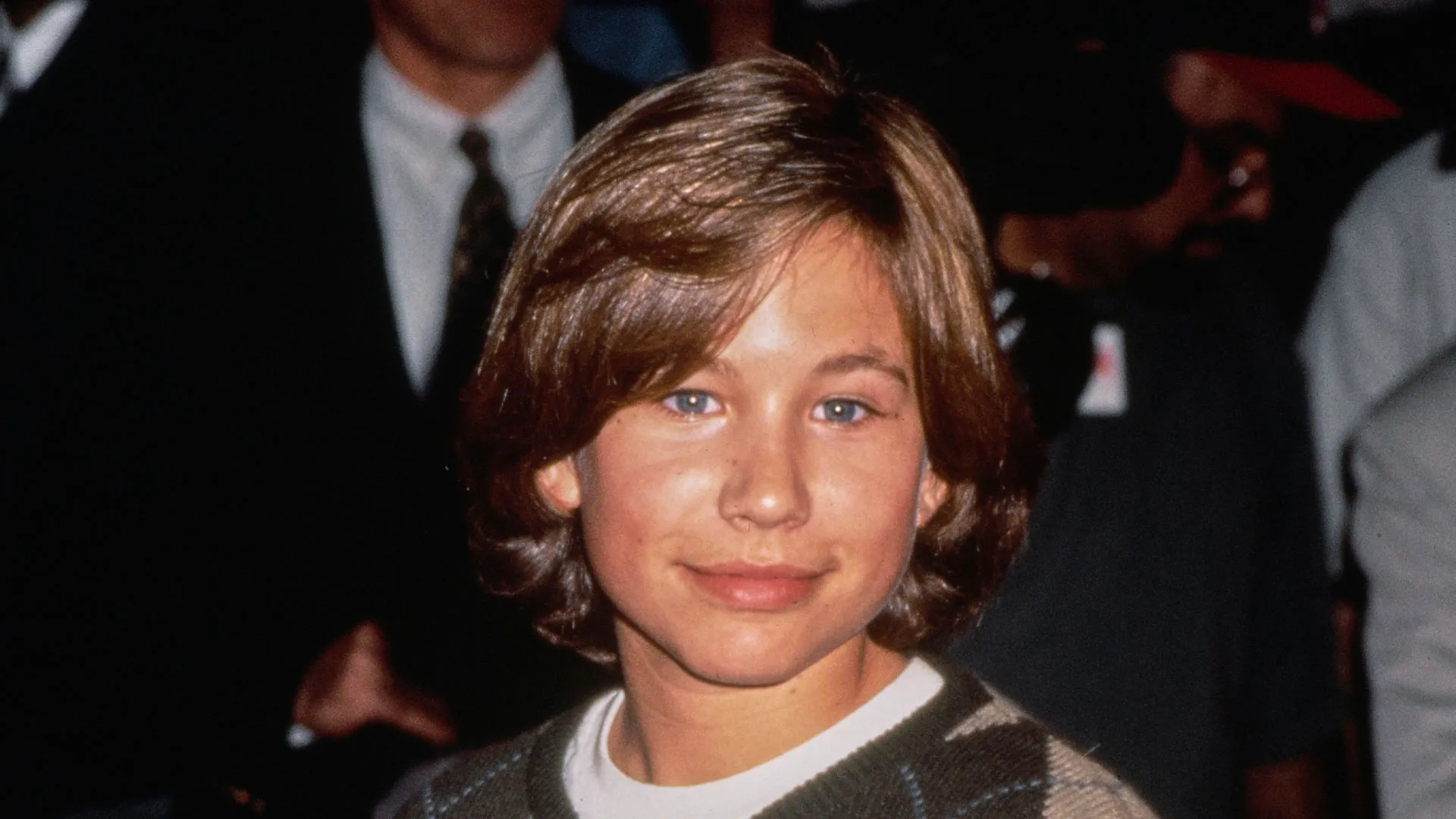
Jonathan Taylor Thomas, here in 2013, rose to fame as a child star in the 1990s on sitcom Home ImprovementCredit: FilmMagicJonathan stepped out in 1995, when he was a household name in the U.S.Credit: Getty Images
According to the police spokesperson, a DUI investigation was conducted.
“During the investigation, [Jonathan] stepped out of the vehicle and became uncooperative and resistant, and was subsequently arrested for [being] drunk in public,” the spokesperson said.
Sign up for the Showbiz newsletter
Thank you!
He was charged with being drunk in public and resisting or deterring an executive officer.
Jonathan has not yet spoken out about the incident.
Jonathan rose to fame in the 90s as a main cast member on Home Improvement opposite superstar Tim Allen.
He played middle son Randy for eight seasons, and soon jumped to bigger Hollywood projects.
He took on the role of Tom Sawyer in Tom and Huck in 1995, and voiced a young Simba in The Lion King in 1994.
Most read in Entertainment
Jonathan reunited with Home Improvement mom Patricia Richardson and brother Taran Noah Smith in July 2026Credit: Instagram/prichardsonlaJonathan played middle brother Randy on Home Improvement. He posed with the cast in 1992Credit: Getty











![Onasis Munoz of Valencia, Venezuela, has seen his dialysis treatment interrupted by power outages [Courtesy of Onasis Munoz]](https://i0.wp.com/www.aljazeera.com/wp-content/uploads/2026/10/2615546f-db48-4e1d-9291-455ccb057b32-1791255429.jpg?w=640&ssl=1)