protester

Rubio is optimistic on eventual Iran nuclear talks despite congressional skepticism

Secretary of State Marco Rubio said Tuesday that he is optimistic about the potential for a resumption in nuclear talks with Iran despite a shaky ceasefire in the war that is looking increasingly in doubt.

Rubio defended the Trump administration’s approach to Iran and other global hot spots in back-to-back hearings before the Senate Foreign Relations Committee and a House Appropriations subcommittee. He was briefly disrupted by protesters at each session.

In his first public testimony since the Iran war began at the end of February, Rubio said the Iranians have agreed to negotiate on nuclear points that they had not been willing to address in the past but would not offer an assessment on what those talks might produce.

“They have agreed to negotiate aspects of their nuclear program that just a month ago, just a year ago, they were refusing to even mention,” Rubio told the Senate. He noted, however, that there was no guarantee “it will lead to a deal that’s acceptable” and that negotiations have been made difficult by the instability of Iran’s leadership.

Rubio’s optimism ran counter to pessimistic reports from two semiofficial Iranian news agencies that Iran has stopped communicating with mediators after Israel threatened to bomb Beirut as it fights the Hezbollah militant group. President Trump disputed that Iran has cut off communication with mediators, calling Iranian reports of a cessation in talks “false and erroneous.”

Democrats criticize Trump administration’s approach to Iran, and Rubio defends it

Rubio’s wide-ranging testimony was met with fierce objections from Democrats, including tough questions about the status of U.S. foreign assistance to respond to diseases such as the Ebola outbreak in Africa. Rubio insisted that the dismantlement of the U.S. Agency for International Development had not affected Washington’s ability to assist with global humanitarian responses.

Sen. Chris Van Hollen (D-Md.) blasted Rubio and Trump for foreign aid cuts and overseas intervention. Van Hollen specifically took aim at the U.S. and Israeli decision to strike Iran, accusing the Republican president of entering the war on behalf of Israel.

Israeli Prime Minister Benjamin Netanyahu “said he’s been waiting 40 years to do this,” Van Hollen said. “It turns out he finally found a president who was both stupid and reckless enough to join him. Let’s face it, Mr. Secretary, the Trump foreign policy has become a dumpster fire.”

Rubio’s testimony, which was taking place as Israel and Lebanon began a new round of political talks at the State Department with the situation between Israel and Hezbollah still uncertain, did not provide definitive answers on any of the main questions of the day.

He said Iran is not guaranteed a massive payout for reopening the Strait of Hormuz, the crucial waterway for global oil shipments, and would have to commit to further concessions on its nuclear program to get significant sanctions relief.

“The more they give, the more they would get,” he said, later adding, “They’re not going to get it as a signing bonus.”

Rubio also said there are indications that Iran’s new supreme leader, Mojtaba Khamenei, is taking a bigger part in the discussions despite not being seen publicly since the war began.

“I think there are indications out there that he is increasingly engaging at some level, although all of his communications have been in writing and through intermediaries,” he said.

Democratic senator says drugs being on boats isn’t a targeting criterion for U.S. strikes

On other issues, Rubio dismissed questions about the legality of Pentagon strikes against dozens of alleged drug-smuggling vessels in the Caribbean Sea and the eastern Pacific Ocean, which have killed more than 200 people since early September.

Sen. Tim Kaine (D-Va.) said the military’s targeting criteria for those strikes does not include drugs being present on the boat. He called it “odd” but said he could not share much more because the criteria are classified.

Rubio pushed back, saying every strike has a legal officer who makes a determination on whether a strike is legal. He also said the U.S. military has “walked away from strikes” multiple times because they did not meet the targeting criteria.

The Trump administration says the U.S. is at war with drug cartels, while many Democrats have questioned the legality and effectiveness of the strikes.

The Republican former senator faces a second congressional hearing Tuesday and a pair of others Wednesday about the State Department’s annual budget request, though questions have mostly focused on top foreign policy issues.

Rubio wades into Taiwan arms sales opposed by China

Rubio acknowledged that the Trump administration is holding up a new potential $14-billion arms sale to Taiwan but said it remained under consideration and would not be canceled. He noted that the U.S. recently sold arms to Taiwan in December worth $11 billion.

He said the deal is not under review because of pressure from China, although he said the Chinese bring up the issue in discussions with the United States. Trump also has described it as a great negotiating chip.

“They are constantly talking about Taiwan arms sales, but that in no way is what is holding up our decision-making or the White House’s decision-making,” Rubio said. “It is something the president will have to decide on the timing of when and how that is executed on.”

Protesters chant at Rubio about Cuba

Rubio, the son of Cuban immigrants, also was questioned about the Trump administration’s escalatory behavior toward Cuba, as Trump has hinted that the small island country could be the next U.S. target after operations in Iran are wrapped up.

He faced chants from protesters who urged him to “stop killing Cubans” when he entered the Senate briefing room. The protesters were quickly pulled from the room. Their chants also included “Let Cuba live!”

Rubio defended the administration’s approach to Cuba and said it would remain focused on changing the Cuban government’s policies.

“I really don’t believe this system is capable of reform unless new people take over or a new mindset takes hold,” he said.

Despite a series of meetings between U.S. and Cuban officials, Trump and Rubio have renewed threats against the island’s government, which take on greater weight following the administration’s announcement of criminal charges against former President Raúl Castro.

Over his congressional career and now as America’s top diplomat, Rubio has maintained that Cuba is a national security threat due to its ties to U.S. adversaries, and that Trump is intent on addressing it.

Amiri, Lee and Finley write for the Associated Press. Amiri reported from New York.

Source link

Newark imposes curfew around Delaney Hall after clashes over ICE site

The mayor of Newark imposed a curfew early Sunday around an immigration detention center in New Jersey after a series of intense clashes between protesters and police.

The curfew around Delaney Hall will be in place between 9 p.m. and 6 a.m. until further notice, Mayor Ras Baraka said in a statement.

The move came after another night of standoffs between law enforcement and demonstrators at the facility, as protesters could be seen in photographs and videos fighting over barricades as police used riot shields to push them back. A video posted on social media showed police on horseback marching into crowds, attempting to break up groups of demonstrators.

The high-profile demonstrations at Delaney Hall began this month after advocates said detainees launched a hunger strike over poor living conditions at the 1,000-bed facility, the latest focus of opposition over the federal government’s immigration crackdown.

The private company GEO Group operates the lockup under the supervision of U.S. Immigration and Customs Enforcement. The shuttered facility reopened for immigration detainees in February 2025.

New Jersey state police on Friday replaced federal immigration enforcement agents who had been facing off against protesters at the facility for days.

In a statement Sunday morning, New Jersey Gov. Mikie Sherrill said masked people attacked a barrier in a designated protest area set up by state police and were “throwing projectiles, utilizing the barriers as weapons, and lighting tires on fire in the street.”

“These actions put both peaceful protesters and law enforcement in danger,” Sherrill said, urging calm to focus on advocating for “better conditions for the detainees, for their families, and ultimately, for the closure of Delaney Hall.”

Sherrill also said that the federal government has reopened family visits at Delaney Hall starting Sunday.

Asked about visitations resuming, the U.S. Department of Homeland Security said in a statement, “To be clear: Visitation was only suspended because of violent riots. Now that we have a secure perimeter, visitation can resume.”

Source link

New Jersey state police set up protest zone at ICE center

New Jersey state police set up designated protest zones and vehicle checkpoints outside an immigration detention center in Newark on Friday, replacing federal immigration enforcement agents who have been clashing with protesters for days.

Gov. Mikie Sherrill said she sent in state police to bring order outside Delaney Hall as the demonstrations have intensified, with violence and arrests increasing as night falls.

“It has grown unsafe, and that’s completely unacceptable,” the Democratic governor said at a news conference announcing the new measures. “We need to take this opportunity to lower the temperature.”

As police erected protest barriers, U.S. Immigration and Customs Enforcement agents who had formed a line in front of protesters moved inside the building’s perimeter fence.

New Jersey State Police Lt. Col. David Sierotowicz said ICE officers agreed to stand down with state police assuming responsibility.

Demonstrators had mixed reactions. Some staged a sit-in and refused to move into one of the new protest areas police set up using metal barriers and concrete blocks.

Rachel Cohen worried that demonstrators exercising their 1st Amendment rights were being silenced.

“It is not helpful to quell protest for the sake of a false peace,” she said. “There is no peace while we are torturing our neighbors on [the] government dime inside this facility.”

U.S. Homeland Security Secretary Markwayne Mullin, on social media, called the measures a “win for law and order” and noted that Sherrill had resisted sending state police for days.

The protests began a week earlier after immigrant advocates said detainees inside launched a hunger strike over poor living conditions at the 1,000-bed facility, which opened last May.

Demonstrators have been attempting to block people and vehicles from entering and exiting, linking their arms in a human chain and using trash cans, umbrellas and other items as makeshift shields and barricades.

ICE officers wearing helmets and tactical vests have used pepper spray and batons to try to disperse the protesters and clear the roadway for vehicles.

At least six demonstrators were arrested and accused of assaulting law enforcement officers Wednesday night, and more have been arrested on other nights, according to the Department of Homeland Security.

Acting U.S. Atty. Gen. Todd Blanche shared images online Friday of bloody wounds and bruises sustained by ICE officers.

“These riots are clearly not ‘peaceful protests’ as you can see from the photos of these horrific wounds,” he said. “Assault a federal officer, you’ll be held accountable.”

Another demonstrator, Lisa O’Dwyer, said she was fine with the designated protest areas.

“I like to get my point across and stay safe at the same time,” the Westfield resident said.

Eyesha Marable, pastor at Mt. Zion AME Church in Millburn, agreed, even while acknowledging that there were “different schools of thought” among protesters.

“There are people here who are angry. Their family members are inside. Their friends are inside. People have been taken off the streets, out of their communities,” she said.

“We have to keep the peace,” Marable said. “The goal is to get our people free, to get them liberated, and we cannot do that if we’re fighting out here.”

State Atty. Gen. Jennifer Davenport said it was important to “de-escalate” the situation as “violence, either against protesters or by protesters, is unacceptable.”

Sherrill said she did not want to give ICE a pretext to expand operations in the state, noting that federal immigration officers around the country have killed and injured protesters in recent months.

“We all need to do everything we can to cool things down now,” she said.

The governor and other Democratic officials tried to visit detainees Monday but were denied entry.

Democratic members of Congress from New York City, however, were able to tour Delaney Hall the day after that. They reported dire conditions, with detainees being fed small portions of often spoiled food and their varied medical needs going ignored.

Families and supporters of detainees also say their loved ones have also been subjected to pepper spray and physical force in retaliation for their hunger strike and the protests outside.

Marcelo and Shaffrey write for the Associated Press and reported from New York and Newark, respectively.

Source link

6 protesters arrested after clash with ICE officers outside a New Jersey detention center

Protesters clashed with armed federal immigration officers in front of a New Jersey detention center where advocates have demonstrated for days while asserting that people detained there are staging a hunger strike over poor living conditions.

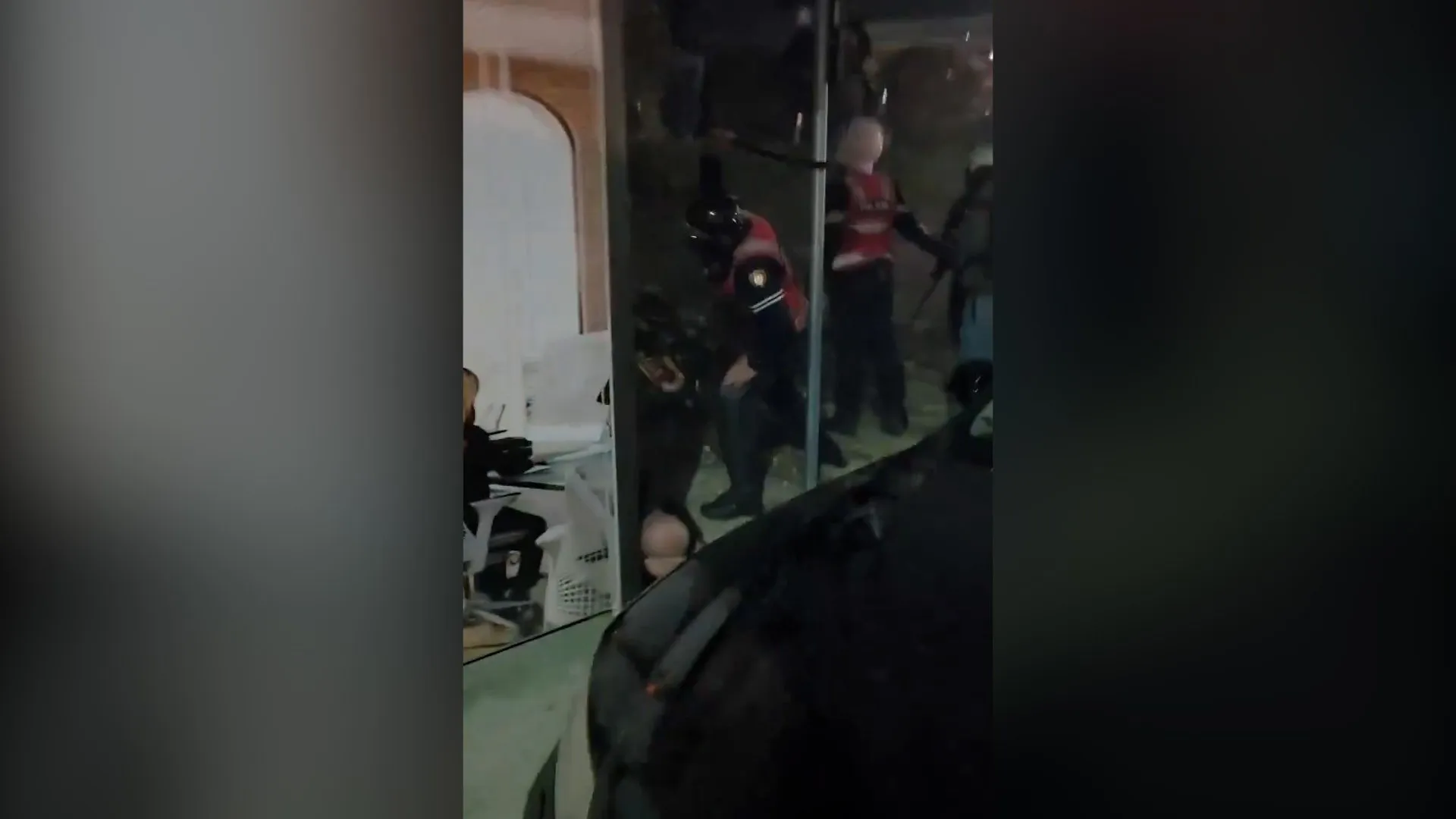
Groups of demonstrators, many wearing gas masks and other face coverings, linked arms in a human chain in front of Delaney Hall in Newark on Wednesday night, videos and photos posted on social media show.

Some used trash cans, old mattresses, umbrellas and other materials as makeshift shields and barricades as they confronted U.S. Immigration and Customs Enforcement officers. Others attempted to block people and vehicles from entering and exiting the building or threw orange traffic cones and other objects in the direction of the ICE officers lined at the entry gate.

The group chanted, “You will hang!” and, “Every cop, every fed, shoot yourself in the head,” and other taunts at the officers, many of whom wore helmets and tactical vests.

The ICE officers used pepper spray to try to disperse the protesters, according to videos posted to social media. Some used their batons to beat and push back protesters as the officers attempted to clear the roadway for vehicles.

At least one truck driver got out of his vehicle to vent his frustration when some protesters tried to block vehicles driving on the road in front of the detention center. People detained inside could at times be seen waving to protesters from Delaney Hall’s windows.

The U.S. Department of Homeland Security, which oversees ICE, said about six demonstrators were arrested for assaulting law enforcement officers.

“Assaulting and obstructing ICE law enforcement is a crime and felony,” the agency said in a statement. “Anyone who assaults law enforcement will be prosecuted to the fullest extent of the law.”

On Thursday, demonstrators again returned to Delaney Hall.

New Jersey Gov. Mikie Sherrill also said state health department officials were “denied full access” to the facility for a health inspection. The Democrat said the officials were only allowed to inspect a limited part of the facility as she called on ICE to “de-escalate” the situation.

“As I’ve said repeatedly, refusing to provide full access raises serious questions about what ICE is trying to hide from public view,” Sherrill said in a statement that also repeated her calls to shut down the facility outright.

Earlier Wednesday, Democratic members of Congress from New York City toured the facility as part of an oversight visit. A private prison company runs the detention center, which sits along an industrial stretch of Newark Bay.

Reps. Jerry Nadler, Daniel Goldman and Adriano Espaillat, who all represent Manhattan, described dire conditions where people held in the facility are fed small portions of often spoiled food and their varied medical needs are ignored.

Homeland Security spokespersons have denied any hunger strike, abuse or poor conditions inside the center and dismissed criticism from opponents as political posturing.

Source link

Police arrest protester after five-days atop Washington bridge | US-Israel war on Iran

NewsFeed

Police have arrested an anti-war protester after he ended a five-day sit-in atop Washington’s Frederick Douglass Memorial Bridge. Guido Reichstadter, opposed to the war on Iran, started the protest to rally others into non-violent opposition.

Source link

While ICE cracked down on L.A. protests, Marines were told to use force as ‘last resort’

Before being deployed to Los Angeles during anti-ICE protests last summer, U.S. Marines were given 12 rules for engaging with protesters, and Rule 1 was clear: Force “of any kind” was allowed only as a last resort.

If force were used, the rule stated, it “should be the minimum necessary to accomplish the mission.”

That detail is among 178 pages of federal documents released by the Marine Corps to the nonprofit watchdog group American Oversight through the Freedom of Information Act and shared exclusively with The Times.

The documents paint a thorough picture of how Marines prepared to deploy in Southern California, where they stood alongside National Guard members and agents with the Department of Homeland Security.

The documents also illuminate a glaring contrast between the training of Marines and that of immigration agents, who have been accused repeatedly of using unnecessary force against peaceful protesters, bystanders and immigrants during enforcement operations.

“Ironically, I would’ve felt much safer with Marine engagement than with DHS because of the depth of training,” said Ryan Schwank, a former instructor for Immigration and Customs Enforcement recruits at the ICE Academy within the Federal Law Enforcement Training Center in Georgia.

Schwank is a whistleblower who resigned in February after revealing that the Trump administration had slashed immigration officer training. After reviewing the documents obtained by American Oversight, he said the training given to Marines on crowd control was “significantly more in-depth and longer than training given to an ICE officer, even under the best of circumstances.”

A ICE agent walks through tear gas that was fired to push protesters back

An ICE agent walks through tear gas that was fired to push protesters back during a raid on Atlantic Boulevard in the city of Bell on June 20, 2025.

(Genaro Molina / Los Angeles Times)

The Department of Homeland Security did not respond to questions and instead pointed to a February news release that said training has not been cut back and that new hires receive additional training after leaving the academy.

“ICE law enforcement officers are trained to use the minimum amount of force necessary to resolve dangerous situations to prioritize the safety of the public and our officers,” said Lauren Bis, a department spokesperson. “Officers are highly trained in de-escalation tactics and regularly receive ongoing use of force training.”

Schwank noted that the Marines and ICE officers came to Southern California with different objectives: As protectors of people and property, the Marines had a more limited, reactive mission, while ICE officers were charged with making arrests, a confrontational role.

“We’re giving [ICE officers] less training on it and fewer refreshers than the Marines are getting and yet we’re putting them in a situation where they’re taking the more confrontational actions to where they’re more likely to have to make split-second decisions,” Schwank said.

For most of history, he added, ICE agents detained people who were already in the custody of another law enforcement agency. He said ICE was never meant to act as riot police.

“The real fundamental problem isn’t ICE agents using force,” Schwank said. “It’s ICE agents using force in an environment they are not trained for.”

The training of Marines, and the lead-up to their deployment, is outlined in the documents reviewed by The Times.

On June 6, a commanding general emailed other generals to say that “national-level leadership” had directed Marines to assume an “alert posture” and be ready to support the Los Angeles Police Department, Los Angeles County Sheriff’s Department and ICE officers who were already responding to civil unrest in downtown Los Angeles.

The Marines would safeguard federal facilities and thus “protect lives and property through the restoration of civil order,” the email said.

The Trump administration directed 4,200 California National Guard soldiers and 700 Marines to Southern California starting June 7.

Marines push back anti-ICE protesters in front of the Federal Building

Marines push back anti-ICE protesters in front of the Federal Building during a “No Kings Day” in downtown Los Angeles last June.

(Carlin Stiehl / Los Angeles Times)

First, though, they needed to be trained.

The five-day course reviewed use-of-force policies, less-lethal weapons and handling of civil disturbances.

Overall, the 12 rules emphasized safety, urging Marines to be reasonable, to de-escalate tensions and to avoid confrontations with individuals who posed no threat.

Marines could use non-deadly force, if necessary, to control a situation or protect themselves or other federal personnel, and deadly force “only when all lesser means have failed.”

“Exercise due regard for the safety of innocent bystanders when using any type of force,” the rules state.

Schwank said there is no equivalent to the Marines course at Homeland Security. When he left the academy in February, he said, “there was no crowd control training, period.”

Crowd control was briefly added to the curriculum in 2021 for experienced law enforcement officers, he said, but it was later removed. ICE recruits may also have gotten lessons on crowd control after leaving the academy and joining their respective field offices, he said.

When Schwank left the agency, a six-hour class called “Public Order Public Safety” was in development for the 2026 curriculum, according to documents he provided to Congress. Homeland Security did not respond when asked if the class had started.

“I wouldn’t assume that any of the ICE officers on scene in L.A. had received any sort of actual crowd control class,” Schwank said. “They might have gotten a one-to-two-hour PowerPoint slideshow, but that would’ve been it.”

Marine Col. Beth R. Smith confirmed that the entire 2nd Battalion 7th Marines received academic and practical training before deploying to Los Angeles.

Managing civil disturbances has been an issue for Homeland Security since at least 2021, according to an audit conducted by the agency’s internal watchdog review of a 2020 deployment to Portland, Ore.

That year, President Trump mobilized federal power against the protests that spilled into Portland streets after the murder of George Floyd by a Minneapolis police officer. Trump sent 755 Homeland Security agents to defend federal property in what would come to be seen as a dry run for much larger operations of his second term.

Two vehicles, one in flames

A protester damages a Waymo vehicle at Los Angeles Street and Arcadia Street in L.A. on June 8, 2025.

(Robert Gauthier / Los Angeles Times)

Nested on rooftops, agents launched chemical weapons against protesters. Ground forces fired less-lethal rounds at point-blank range and forced participants into unmarked vans without explanation.

The audit by the Homeland Security inspector general found that only seven of 63 officers reviewed had received any level of riot and crowd control training. Some officers told investigators that they needed additional training, and many “questioned their involvement in the operation” due to the lack of preparation.

”Without the necessary policies, training, and equipment, DHS will continue to face challenges securing Federal facilities during periods of civil disturbance that could result in injury, death, and liability,” the audit concluded.

As of spring 2025, Homeland Security records show, the department had not corrected the training failures flagged in the audit years earlier.

Schwank agreed that the concerns raised in the inspector general’s report were never addressed.

Liz Hempowicz, deputy executive director of American Oversight, said the Marine Corps’ emphasis on de-escalation and on using force only as a last resort stands in stark contrast to what happened on the ground in Los Angeles with immigration agents.

The practices outlined in the documents “differ from positions taken by senior DHS leadership, whose separate internal communications revealed a mindset that appeared far more encouraging of violence,” she said.

Internal Homeland Security emails also obtained by American Oversight revealed that the agency’s lead attorney said federal agents in Los Angeles should have “just started hitting the rioters and arresting everyone that couldn’t get away.”

“These records underscore that the difference between disciplined restraint and unnecessary harm can come down to the tone set at the top — and when that tone shifts toward hostility, the human cost can be devastating,” Hempowicz said.

Jennifer Kavanagh, director of military analysis at Defense Priorities, a military research group, said that for Homeland Security, the issue is partly a training deficiency and partly a cultural shift against agent accountability.

“Trump talks about ‘the enemy within’ — this is what he’s talking about,” she said. “To some at DHS, the enemy within is all immigrants, it’s cartels — it’s also groups that are protesting the government.”

Conversely, the Marines’ documents emphasized personal liability and responsibility. For example, one page said that “if you either use more force than is necessary, or respond with DEADLY-force to a NON-deadly threat — You will likely lose your right to self-defense, and you will be viewed, under the law, as the ‘Aggressor.’”

Marines were told to immediately report anyone violating the 12 rules of engagement.

The high level of training for Marines shows that command considered the optics of military personnel harming or even killing civilians, Kavanagh said. But just because the deployment worked out last year doesn’t make it a good idea in the long run, she said.

Kavanagh, alongside Gov. Gavin Newsom, Mayor Karen Bass, and LAPD Chief Jim McDonnell, opposed the military deployments to Los Angeles last year, maintaining that Marines are trained for foreign combat, not domestic crowd control.

“I see these deployments as a recipe for disaster,” she said.

Schwank said ICE’s training touches on personal liability but not in as much depth. Last fall, Stephen Miller, Trump’s deputy chief of staff, said ICE officers “have federal immunity in the conduct of your duties, and anybody who lays a hand on you or tries to stop you or tries to obstruct you is committing a felony.”

On the ground in Los Angeles, ICE agents and other local law enforcement fired a range of less-lethal weapons at protesters, such as pepper balls, hard foam rounds or canisters delivering flash-bang grenades and tear gas.

At a June 12 protest, a federal agent shoved freelance journalist Anna Sophia Moltke to the ground, causing sprains on her left arm and leg and deep scrapes to her hip and knee that have since scarred. She was carrying a camera, she said, and wore clear press credentials and a helmet that said “PRESS.”

“I remember distinctly there being no violence at all until police and ICE showed up,” she said. “We saw them firing rubber bullets into the crowd. People started running away. I was halfway turned around when they started rushing the crowd, and a tall, 6-foot-4 masked man used both hands to push me onto the concrete.”

Moltke said she recalled a large group of protesters gathered near the Marines stationed at the northern end of the detention center, just before police and ICE swept through and forced her to the ground. To her knowledge, she said the Marines remained at their post and didn’t participate in street skirmishes.

Source link