Gunshots, water cannon and tear gas have been used by Kenya’s police in the central town of Nanyuki, where hundreds of protesters lit fires and hurled stones at law enforcement officers as they demonstrated against a quarantine centre for US citizens exposed to Ebola.
Tuesday’s violence came as the proposed quarantine centre at the town’s Laikipia Air Base has caused anger among Kenyans who accuse the United States of shifting the risks of caring for people exposed to the Ebola outbreak in eastern Democratic Republic of the Congo and Uganda onto Kenya.
Kenya has never recorded a case of Ebola, and many residents oppose bringing potential carriers of the virus into the country.
The centre is designed to have 50 isolation beds, run by US staff, and was nearing completion late last week.
Construction has continued despite a temporary halt order from Kenya’s High Court and vocal opposition from local politicians.
President William Ruto’s government has pledged to press ahead with the project, arguing that Kenya owes Washington for years of financial and technical support.
The US has committed $13.5m to support Kenya’s Ebola preparedness efforts.
SACRAMENTO — Disability rights advocates on Monday gathered outside the state Capitol to push back on Gov. Gavin Newsom’s proposed cuts to in-home supportive services.
“These aren’t just numbers in a budget; these are real people,” said Assemblymember Jeff Gonzalez (R-Indio). “These are children, seniors, veterans and individuals with disabilities whose independence and quality of life depend on these services every single day.”
The In-Home Supportive Services program helps disabled and elderly people remain in their houses by providing in-home care. It pays assistants to help with tasks such as showering, cooking or attending doctor appointments. Newsom’s revised budget proposal, which was unveiled last month, would cut $367.7 million from the program and shift some of that financial burden onto counties.
Gonzalez explained that the issue hits close to home for his family. He said his son has cerebral palsy and a seizure disorder, and relies on assistance to live with dignity.
“Families should not have to wonder every budget season whether the support they rely on will be taken away,” Gonzalez said. “These services should not be treated as bargaining chips in budget negotiations.”
Assemblymember Laurie Davies (R-Laguna Niguel) questioned why a successful state like California would need to enact such cuts.
“It’s hard to go a day without hearing the governor or the administration brag about how we are the fourth-largest economy in the world and yet we can’t fully fund [this program for] the most vulnerable?” Davies said.
The governor has previously explained that difficult decisions must be made as the state could soon face an economic downturn. The budget proposal relies on a tax windfall, largely attributed to the stock market success of artificial intelligence companies, to erase California’s deficit — but some analysts have warned that the AI bubble could burst.
H.D. Palmer, deputy director for external affairs for the California Department of Finance, on Monday said some of the proposed cuts are a byproduct of the federal government’s changes in funding and eligibility for health and human services programs.
The so-called “Big, Beautiful Bill” signed by President Trump last year shifted federal funding away from safety-net programs, he said.
Palmer stressed that state budget negotiations are ongoing.
“Until we land on an agreement, speculation regarding the resolution of any specific differences between the Governor’s budget plan or the Legislature’s respective budget proposals would be premature,” he stated by email.
Monday’s event drew some bipartisan support. Brody Fernandez, communications director for Assemblymember Esmeralda Z. Soria (D-Fresno), said the legislator had been fighting for In-Home Supportive Services funding since she was elected.
Fernandez said his daughter has special needs and her mother had to give up her career to become a full-time caregiver. “This is personal for us and for many of the incredible individuals standing behind me,” he said.
Graham Knaus, chief executive of the California State Assn. of Counties, told The Times that he appreciated efforts to raise awareness about the burden these changes would place on counties.
“We applaud the Senate and Assembly for recognizing counties’ concerns and rejecting this proposal,” he said. “We ask them to hold the line in final negotiations.”
Elizabette Guecamburu, a bookkeeper who has a rare neuromuscular disorder, spoke at Monday’s rally and implored the governor to remember the teachings of their shared alma mater Santa Clara University, a Jesuit-led private school.
“I want him to remember where he came from,” she said, adding that students were taught to value compassion and community. “Don’t forget your Jesuit roots.”
Hundreds marched in Tunisia’s capital demanding press freedom and the release of political prisoners detained during President Kais Saied’s crackdown on dissent, which has jailed opposition figures including Ennahda party leader Rached Ghannouchi.
CJP organisers rally supporters to demand the resignation of Education Minister Dharmendra Pradhan.
Published On 6 Jun 20266 Jun 2026
Hundreds of supporters of the Cockroach Janta Party (Cockroach People’s Party, or CJP), a satirical social media movement in India, have gathered in New Delhi after weeks of grabbing news headlines.
The party, a play on Prime Minister Narendra Modi’s Hindu-nationalist Bharatiya Janata Party (BJP), has attracted millions of online followers and widespread support among young Indians.
Recommended Stories
list of 3 itemsend of list
On Saturday, hundreds gathered in New Delhi’s protest zone near parliament, with some participants wearing cockroach masks.
Last month, India’s Chief Justice Surya Kant likened young people who criticised the government to “cockroaches” and “parasites” during a court hearing.
Kant later said his comments were taken out of context. But Abhijeet Dipke, a political communications strategist and Boston University student, used the insult as inspiration for a parody political party.
Within a week of launching a website and social media accounts, CJP’s Instagram page soared and by Saturday had amassed more than 22.2 million followers, with the slogan: “A political front for the youth, by the youth, for the youth.”
For Saturday’s march, CJP organisers rallied supporters to demand the resignation of Education Minister Dharmendra Pradhan, after an exam irregularity controversy in May that quickly transformed into frustration over India’s education system and limited job opportunities.
CJP supporters chanted slogans including: “Cockroaches are coming, Dharmendra Pradhan is going!”
Organisers of the march encouraged participants to bring India’s national flag and a book, which they said symbolised the right to education and equal opportunity for all. They also urged demonstrators to remain peaceful and avoid any confrontations with police.
Ahead of the protest, Indian police tightened security at the airport and the Jantar Mantar protest site, setting up steel barricades at key points.
Cockroach Janta Party (CJP) founder Abhijeet Dipke, centre, shouts slogans during a protest over alleged irregularities in the country’s major examinations, in New Delhi [AFP]
The group’s rise echoes a similar trend across South Asia, where youth movements born out of social media have been crucial in antigovernment protests, particularly in Sri Lanka, Bangladesh and Nepal.
With the cockroach now a symbol of endurance, CJP supporters have jokingly described themselves as unemployed and perpetually online.
While young people in India make up more than a quarter of the population, they face limited job opportunities, leading to rising unemployment and growing disillusionment with traditional politics.
Some supporters of Modi’s party have dismissed the CJP as nothing more than a social media gimmick. They argue that the parody party’s social media success might not translate into political street mobilisation and that its rapid rise will likely be fleeting.
Demonstrators march during a rally in Tirana on Wednesday calling for a proposed $1.6 billion luxury resort in an enironmentally sensitve island location off Albania’s Adriatic Sea coast by an international consortium led by Donald Tump’s son-in-law, Jared Kushner. Kushner and wife Ivanka Trump stumbled upon the uninhabited island during a vacation. Photo by Malton Dibra/EPA
June 4 (UPI) — Thousands of Albanians marched in the capital Tirana for a third day straight to protest against a $1.6 billion luxury resort backed by Donald Trump‘s son-in-law, Jared Kushner, in a national marine park off the country’s Adriatic Sea coast.
Some demonstrators in Wednesday’s protest held inflatable flamingos aloft to highlight the impact they fear the project will have in and around Sazan Island, where work recently got underway in the midst of one of the Mediterranean’s most environmentally-vulnerable areas.
Scuffles broke out with police who fired water canon at protesters.
An offer to meet with opponents from Prime Minister Edi Rama, who has staked his premiership on what he has billed as a developmental coup for the former communist state, was rejected as calls for the project to be halted grew, with protests also set to spread to the south of the country.
“From start to finish there has been a total lack of transparency. We have seen no public consultation or public documentation regarding permits, and so now what we are saying is, if they remove the bulldozers, remove the fence and restore the habitats to what they were, then we can start talking,” said Aleksandr Trajce, executive director of Protection and Preservation of the Natural Environment in Albania.
“We were on a friend’s boat, and we stopped for a swim. Effectively, that’s how we found it. We swam to the island. We went on a hike, barefoot all the way up to the top, and we were just captivated,” Ivanka Trump said.
Environmentalists are worried about the effect the resort will have on an area that includes the currently uninhabited Sazan Island and the nearby wetlands and coastal habitats of the Karaburun-Sazan Marine Park.
BirdLife International said the park’s waters around Sazan and the Karaburun peninsulta were among the last places where Mediterranean monk seals survive and support populations of flamingos and Dalmatian pelicans as well as 200 other species of birds, many of which are endangered.
Sazan Real Estate Development, which is developing the plans in partnership with Kushner’s Miami-based investment firm, Affinity Partners, insisted it was committed to sustainable development.
“Our focus remains on responsible stewardship, environmental enhancement, job creation, and creating long-term value for local communities. We respect the ongoing public and institutional processes,” said Sazan Real Estate Development chair Asher Abehsera.
Teachers in north-eastern Nigeria held protests, demanding stronger protection for learning institutions.
The outcry comes after the abduction of dozens of school children in Borno State last month. Al Jazeera’s Felix Niwara explains.
Hundreds have rallied in Albania against plans by a Jared Kushner-linked investment firm to develop Albania’s Sazan Island and parts of a protected national park into a luxury seaside resort. Anger was fuelled by comments by Kushner’s wife, Ivanka Trump, describing Sazan as a ‘private island’ they ‘discovered’.
Health workers wearing full personal protective equipment prepare May 23 to transport the body of an Ebola victim for a safe burial at Sofepadi Hospital in Bunia, Democratic Republic of the Congo. On Monday, hundreds of people in Kenya protested plans for a nearby field hospital to quarantine and treat Americans exposed to Ebola. Kenya has no Ebola cases thus far. Photo by Stringer/EPA
June 1 (UPI) — Hundreds of residents in central Kenya marched Monday in protest of plans for a U.S.-run field hospital in which Americans exposed to Ebola would be treated and quarantined.
Officers from the U.S. Public Health Service would run the facility at Laikipia Air Base near Nanyuki, Kenya. The hospital was supposed to open last Friday. However, a Kenyan court blocked that opening, with another hearing set for Tuesday, The Washington Post reported.
Kenya has had no cases of Ebola in this outbreak thus far, but there have been about 1,000 cases worldwide, with about 200 suspected deaths, mostly in the Democratic Republic of Congo. Kenya has increased screening and security measures to lessen the risk of the disease spreading to the country.
Nanyuki residents said the hospital facility would endanger the lives of those living nearby.
“If it is not good for America, why is it good for us? Why does the U.S. only care about itself?” Gibson Maina, 25, said to The Washington Post. “The moment we get sick people here, how sure are we that we will be able to contain the disease and that we will be able to survive it?”
The protests were largely peaceful with “localized disruptions,” Capital News in Kenya reported. The Post, however, said some demonstrators set fires and “clashed with the police.”
Officials have said the hospital would keep U.S. citizens with Ebola from returning to the United States for treatment. Katiba Institute, a constitutional rights advocacy group in Kenya, filed the lawsuit that blocked the facility from opening.
The Law Society of Kenya has also opposed the hospital, Capital News reported. Charles Kanjama, leader of the society, said that Ebola treatment centers should be closed to the outbreaks and not in countries with no cases.
“We owe patients human solidarity, but public health requires facilities to be placed near outbreak epicenters,” Kanjama said.
Sarah Korere, a local leader, also said such a hospital should be closer to the problem areas.
“As residents of Nanyuki, we have said we do not want the Ebola rescue center in Nanyuki,” she said to Capital News. “And it’s not just Nanyuki; we’ve said we do not want it in Laikipia, and not yet Laikipia, we don’t want it in Kenya.”
Kenyan Health Cabinet Secretary Aden Duale said any international agreement for Ebola treatment facilities must comply with Kenyan laws and public health protocols. The United States said in a statement last week that it was in talks with Kenyan officials after the lawsuit.
Walt Disney Co.’s ABC has filed renewal applications with the Federal Communications Commission “under protest” after an order mandating a years-early review of the network’s eight television station licenses.
The criticism was part of the network’s applications for the FCC review, which were filed ahead of a deadline Thursday. In an objection to the early renewal, Disney’s New York station WABC called the FCC order “unlawful, arbitrary and unconstitutional” and said it was “legally indefensible.”
“The Commission had not demanded early renewal in over five decades,” the station wrote in its filing. “And it has never before demanded simultaneous license renewal applications from a group of stations commonly owned with a network as it has here. The order has no legitimate purpose.”
The licenses for the eight ABC-owned TV stations, including KABC in Los Angeles, were originally scheduled for renewal between 2028 and 2031.
The FCC order came shortly after ABC late-night host Jimmy Kimmel made a joke about First Lady Melania Trump looking like an “expectant widow” days before a gunman tried to breach the White House Correspondents’ Assn. gala last month that President Trump attended.
Trump has frequently threatened to have TV station licenses pulled when he is unhappy with their coverage, but the order is the first time the government has acted on his wishes, sparking anger from free speech advocates. The FCC has said the order is part of an investigation into whether Disney’s diversity and inclusion policies violate federal law and the agency’s rules against “unlawful discrimination.”
In its response, WABC said the “only plausible reason” to issue the order was to “punish the station for speech the government does not like.”
“The ultimate injury here is not to the station or its parent company. It is to the public,” WABC wrote. “When a broadcaster must weigh regulatory retaliation before making editorial decisions, the public loses access to journalism that is free from government influence.”
FCC Chairman Brendan Carr said in a statement Thursday that Disney filed its applications to renew its broadcast licenses only after the company was told its previous answers were “disingenuous, deficient and improper.”
“Contrary to Disney’s claim that the FCC called in their broadcast licenses for early renewal for no reason, the record shows something very different,” Carr said. “Broadcast licensees have a unique obligation to operate in the public interest. The FCC will follow the facts and law wherever they may lead.”
FCC Commissioner Anna M. Gomez, the panel’s only Democrat who has backed Disney in its fight, cheered the Burbank media and entertainment company’s filing, saying in a post on X that she was “glad to see them expose the FCC’s actions as nothing more than naked political retribution and an unlawful assault on free speech and a free press.”
Times staff writer Meg James contributed to this report.
CLOVIS — Jurupa Valley senior AB Hernandez placed third in the CIF state championship long jump on Saturday, medaling in the event for the second consecutive year.
Hernandez, who is transgender, has faced harassment and ire from anti-trans protesters and conservative pundits during the past two years. She jumped 20 feet, 2 1/4 inches on Saturday, behind first-place finisher Ellie McCuskey-Hay of St. Ignatius (20-3½) and Gianna Gonzalez of Moorpark (20-3½).
Under CIF policy, transgender athletes who place at the state championships receive medals but do not displace cisgender girls in the final standings. The federation announced last year that the policy would apply specifically to the long jump, triple jump and high jump — the three events Hernandez competed in — and the rule remained in effect for her three events this weekend.
Hernandez shared her third-place podium with St. Mary’s Berkeley jumper Corrine Jones, who reached 19-9 ½.
Hernandez secured her place in Saturday’s finals on her opening long jump attempt Friday, posting a mark strong enough to hold the top qualifying position. She passed on her remaining two attempts after safely locking up advancement.
The atmosphere surrounding the state championships was notably calmer than a year ago, when demonstrations over Hernandez’s participation drew national attention. On Friday, the most visible protest activity came before the meet, when Republican California gubernatorial candidate Steve Hilton held a news conference outside Veterans Memorial Stadium, noting that the primary election was just four days away.
Standing before signs reading “Hey, CIF: Girls’ Sports Girls Only” on Friday, Hilton criticized the California Interscholastic Federation’s policies governing transgender athletes.
On Saturday, the Rainbow Families Action group hosted a news conference outside in support of Hernandez. Counter-protesters showed up toward the end and shouted toward the Hernandez supporters and the two sides exchanged some words before dispersing.
Inside the stadium, however, the focus largely remained on the competition. Spectators cheered as Hernandez began her long-jump approach, and some fans wore bracelets bearing the message “We Stand With AB.”
Event organizers prohibited signs inside the venue. Unlike last year, when advocacy groups on both sides staged more visible demonstrations, the off-track theatrics were largely absent.
Meanwhile, Democrat Tom Steyer released a video on X on Friday featuring a previous conversation with Hernandez, in which he expressed support for her participation in high school athletics.
The 17-year-old arrived in Clovis after sweeping all three of her events at the Southern Section championships.
Entering the state meet, Hernandez ranked among the nation’s top 10 performers in all three events. She shared California’s best high jump mark, was tied for second in the long jump and ranked second in the triple jump. She will compete in the high jump and triple jump later Saturday.
NEWARK, N.J. — New Jersey state police set up designated protest zones and vehicle checkpoints outside an immigration detention center in Newark on Friday, replacing federal immigration enforcement agents who have been clashing with protesters for days.
Gov. Mikie Sherrill said she sent in state police to bring order outside Delaney Hall as the demonstrations have intensified, with violence and arrests increasing as night falls.
“It has grown unsafe, and that’s completely unacceptable,” the Democratic governor said at a news conference announcing the new measures. “We need to take this opportunity to lower the temperature.”
As police erected protest barriers, U.S. Immigration and Customs Enforcement agents who had formed a line in front of protesters moved inside the building’s perimeter fence.
New Jersey State Police Lt. Col. David Sierotowicz said ICE officers agreed to stand down with state police assuming responsibility.
Demonstrators had mixed reactions. Some staged a sit-in and refused to move into one of the new protest areas police set up using metal barriers and concrete blocks.
Rachel Cohen worried that demonstrators exercising their 1st Amendment rights were being silenced.
“It is not helpful to quell protest for the sake of a false peace,” she said. “There is no peace while we are torturing our neighbors on [the] government dime inside this facility.”
U.S. Homeland Security Secretary Markwayne Mullin, on social media, called the measures a “win for law and order” and noted that Sherrill had resisted sending state police for days.
The protests began a week earlier after immigrant advocates said detainees inside launched a hunger strike over poor living conditions at the 1,000-bed facility, which opened last May.
Demonstrators have been attempting to block people and vehicles from entering and exiting, linking their arms in a human chain and using trash cans, umbrellas and other items as makeshift shields and barricades.
ICE officers wearing helmets and tactical vests have used pepper spray and batons to try to disperse the protesters and clear the roadway for vehicles.
At least six demonstrators were arrested and accused of assaulting law enforcement officers Wednesday night, and more have been arrested on other nights, according to the Department of Homeland Security.
Acting U.S. Atty. Gen. Todd Blanche shared images online Friday of bloody wounds and bruises sustained by ICE officers.
“These riots are clearly not ‘peaceful protests’ as you can see from the photos of these horrific wounds,” he said. “Assault a federal officer, you’ll be held accountable.”
Another demonstrator, Lisa O’Dwyer, said she was fine with the designated protest areas.
“I like to get my point across and stay safe at the same time,” the Westfield resident said.
Eyesha Marable, pastor at Mt. Zion AME Church in Millburn, agreed, even while acknowledging that there were “different schools of thought” among protesters.
“There are people here who are angry. Their family members are inside. Their friends are inside. People have been taken off the streets, out of their communities,” she said.
“We have to keep the peace,” Marable said. “The goal is to get our people free, to get them liberated, and we cannot do that if we’re fighting out here.”
State Atty. Gen. Jennifer Davenport said it was important to “de-escalate” the situation as “violence, either against protesters or by protesters, is unacceptable.”
Sherrill said she did not want to give ICE a pretext to expand operations in the state, noting that federal immigration officers around the country have killed and injured protesters in recent months.
“We all need to do everything we can to cool things down now,” she said.
The governor and other Democratic officials tried to visit detainees Monday but were denied entry.
Democratic members of Congress from New York City, however, were able to tour Delaney Hall the day after that. They reported dire conditions, with detainees being fed small portions of often spoiled food and their varied medical needs going ignored.
Families and supporters of detainees also say their loved ones have also been subjected to pepper spray and physical force in retaliation for their hunger strike and the protests outside.
Marcelo and Shaffrey write for the Associated Press and reported from New York and Newark, respectively.
Bolivia’s president has warned protesters “time is running out” amid a weeks-long standoff over the country’s economic and political crisis. President Rodrigo Paz has secured powers to declare a State of Emergency, but protesters remain unmoved.
NEW ORLEANS — At least four states have adopted laws this year making it a crime to disrupt worship services, a reaction to a high-profile protest inside a Minnesota church that prompted outrage from faith leaders.
The Republican lawmakers sponsoring most of the legislation say those gathering at sacred sanctuaries deserve protection beyond what existing trespassing laws provide. They also say these new laws will prevent escalating clashes between congregants and protestors as many churches, mosques and synagogues remain on edge over recent mass shootings and acts of violence targeting religious groups.
“People should go to church to be able to sit in peace, worship as they please, without having to worry about people coming in and harassing them,” said Idaho Sen. Mark Harris, a Republican who co-sponsored legislation criminalizing protests inside places of worship. “I think the thing that happened in Minnesota was kind of a shock to some of us, that churches would be used as a place to berate people.”
Critics in both parties have warned that the laws infringe on free speech rights.
Here’s a look at the situation.
The laws make it a crime to interfere with worship
Bills have been signed into law in Republican-dominated Idaho, Louisiana and Oklahoma. In Kansas, a bill is becoming law without the signature of Democratic Gov. Laura Kelly.
Similar bills have been introduced for this year’s legislative sessions in at least seven other states and in Congress. Nassau County, New York, passed a similar measure this year. In 1994, President Bill Clinton signed a law making it a federal crime to intentionally injure or interfere with or intimidate someone entering a place of worship or a reproductive health facility.
The details in the bills differ, but they all make it a crime to interfere with religious assemblies.
Laws against trespassing already apply to disruptions on the grounds of churches or other private property. But legislators say the new laws would boost penalties and bar other protest activity like holding signs near places of worship.
The penalties could be harsher than for trespassing. In some states, people could face up to a year in prison and fines as high as $10,000 for first offenses. The laws also give the states a way to prosecute cases if local authorities decline to do so.
A protest in Minnesota touched off the call for action
Thirty-nine people, including two journalists, were charged in February for roles in a protest during a St. Paul, Minnesota, church service. The protesters had learned that one of the church pastors was also an official at U.S. Immigration and Customs Enforcement who had been overseeing an intensive Minnesota operation.
The U.S. Department of Justice charged the protesters with conspiracy against religious freedom and interfering with the right of religious freedom. The protesters and journalists have pleaded not guilty and the cases are pending in federal court.
Louisiana Rep. Gabe Firment, a Republican, said he was inspired to introduce legislation that allows protestors to be forcibly removed from churches and other places of worship after seeing videos showing the fearful expressions of children at the Minnesota church.
“The first thought that came to my mind was those poor kids,” Firment said. “You certainly have a right to protest, but just like you don’t have the right to come into someone’s home and act like that, you don’t have the right to come into private church property to do that.”
Oklahoma Sen. Todd Gollihare, a Republican, wrote his bill after anti-abortion protestors disrupted his church service last year. His law bars blocking highways within one mile of a service or approaching someone to hand them a flyer within 100 feet of a place of worship.
His Republican colleague, Sen. Kendal Sacchieri, described the law as extreme and said she was afraid of the precedent it would set.
Court challenges could await the laws
The Nassau County ordinance is already facing a court challenge from the New York Civil Liberties Union, which says there’s no history of residents facing intimidation, harassment or violence outside places of worship — and that the statute denies people their constitutionally protected rights of expression in public places.
Kevin Goldberg, vice president at Freedom Forum, which advocates for First Amendment rights, said that if the laws are challenged in courts, governments would have to show there’s a need for them. “You can’t be guessing, you can’t be speculating,” he said. “There has to be some evidence that there’s an actual threat going on — that there’s been a problem there, that you can reasonably forecast there will be a problem.”
In Louisiana, Democrats raised concerns about mandatory jail time for disrupting services and warned that the laws were too arbitrary, suggesting that they could be applied against a congregant for singing out of turn as a pastor delivers a homily.
“If the spirit just hits me and I start singing during the middle of his homily, and it disrupts his homily in a way where he’s got to say ‘Hey, take a seat’, I mean that would materially disrupt his service and now I’m going to jail for 30 days,” Rep. Edmond Jordan said during a March hearing in the Louisiana Legislature.
The law’s proponents said police officers and judges would have discretion about how to apply the law.
Brook and Mulvihill write for the Associated Press. Mulvihill reported from Haddonfield, N.J.
“No to the yankee drill” and “Yankee go home” banners during a protest on Saturday. (Rome Arrieche)
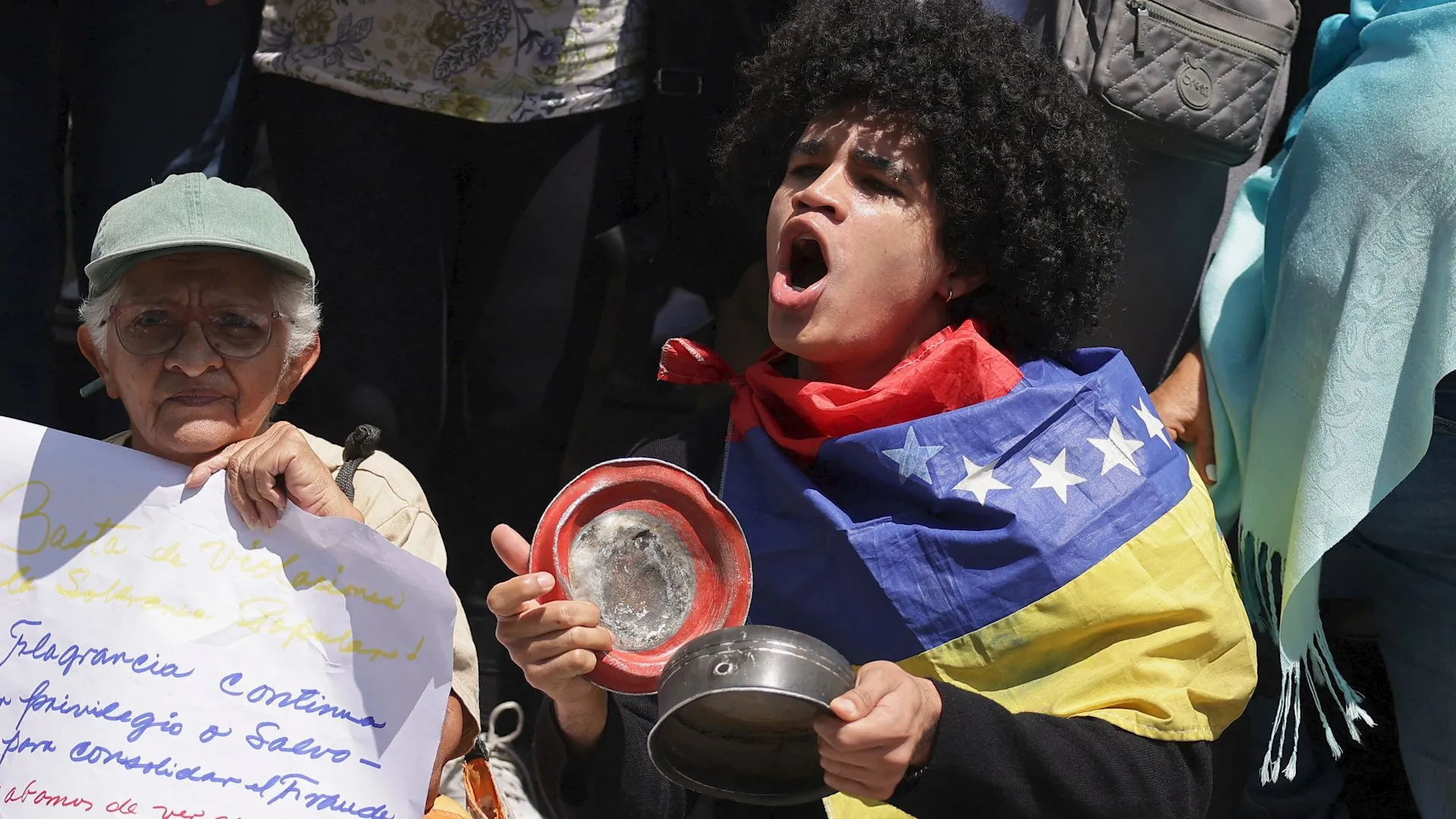
Caracas, May 24, 2026 (venezuelanalysis.com) – Venezuelan grassroots organizations took to the streets on Saturday to protest the US holding “rapid response” military drills in Caracas.
Dozens of activists from multiple collectives belonging to the ALBA Movimientos coalition gathered in the morning in front of the Indigenous Resistance monument in Plaza Venezuela and read a statement expressing “outrage” at the US holding an exercise in Caracas less than five months after its January 3 bombings and kidnapping of President Nicolás Maduro and First Lady Cilia Flores.
“As Venezuelan popular organizations, 141 days since the brutal US military attack and kidnapping of President Maduro and Deputy Cilia Flores, […] we repudiate yankee militarist imperialism and are outraged that the US is executing military exercises in our country,” the organizations expressed.
Speakers, including National Assembly deputies Rigel Sergent and Oliver Rivas, condemned the US-Israel war against Iran and the growing threats against Cuba while reiterating support for the Venezuelan government led by Acting President Delcy Rodríguez.
Also on Saturday, several leftist organizations held a rally in Chacaíto to protest the violation of the country’s sovereignty and denounce the Venezuelan government’s accommodation of US impositions.
“This exercise is extremely serious because it makes concepts like sovereignty appear hollow for younger generations,” trade unionist Adelmo Becerra told those present. “Our challenge is to maintain the idea of sovereignty alive in collective memory.”
Demonstrators painted posters reading “Yankee go home!” and chanted slogans such as “We refuse to be a US colony!” Participating organizations included the Communist Party (PCV), Corriente Comunes, and the Socialist Workers’ League (LTS).
A third rally, called by members of the ruling United Socialist Party (PSUV), took place in Plaza Bolívar, with participants shouting anti-imperialist slogans and burning posters of US President Donald Trump and Secretary of State Marco Rubio.
On Saturday morning, US forces flew two Osprey MV-22B aircraft over Caracas before landing near the embassy compound in the southeast of the capital. The tiltrotor transport aircraft took off from the USS Iwo Jima, one of the warships that participated in the January 3 attacks and where Maduro and Flores were airlifted to after being kidnapped by US special forces.
“Ensuring the military’s rapid response capability is a key component of mission readiness, both here in Venezuela and around the world,” a social media statement from the US embassy read.
US Southern Command (SOUTHCOM) Commander General Francis Donovan oversaw the military drills and visited Caracas for a second time. He flew in on an Osprey alongside a marine contingent.
According to US officials, Donovan met with “senior” Venezuelan government leaders at the embassy. At the time of writing, there is no public information on which officials were present. Donovan’s previous visit in February saw him hold talks with Rodríguez, Interior Minister Diosdado Cabello, and then-Defense Minister Vladimir Padrino López.
In a statement, SOUTHCOM reiterated US forces’ commitment to the Trump administration’s “three-phase plan,” which ends with a political “transition.”
For its part, the Venezuelan government did not comment on the US military drills. Caracas issued a statement on Thursday announcing that it had authorized “evacuation exercises” for eventual “medical emergencies and catastrophic events.” Foreign Minister Yván Gil read the communiqué in a video published through official social media channels.
However, amid fierce public backlash, Venezuelan authorities deleted the statement and video from all accounts. A similar incident occurred in late February when the Foreign Ministry published a statement that criticized Iran’s response to the US-Israeli aggression and then withdrew it following outcry from grassroots and solidarity movements.
On Saturday night, the Communications Ministry posted a video stressing the importance of “controlling emotions and waiting for the right moment.” Though making no reference to the US exercises, it stressed that the priority is safeguarding “the existence and the security of the state.”
Since the January strikes, the Trump White House has exacted major concessions from the acting Rodríguez administration, including taking control of Venezuelan oil revenues, auditing its Central Bank, pushing pro-business legislative reforms, and securing the handover of former diplomatic envoy Alex Saab to face money laundering charges in Florida.
Saturday’s military exercises also elicited strong anti-US reactions on social media from Chavista and opposition figures alike. Writer José Roberto Duque, a staunch government supporter, urged people to paint patriotic murals and express their repudiation of “imperialist arrogance.”
Claudio Fermín, a longtime opposition politician, expressed his “outrage” in a social media message, comparing US forces to “cats marking their territory.” Jesús “Chuo” Torrealba, former secretary-general of the opposition MUD coalition, argued that the US actions appeared to be a “demonstration of military prowess.”
Inmates in Venezuela’s western Barinas prison staged a protest on the roof of the detention centre calling for the removal of the prison’s director, who reportedly oversaw guards as they shot unarmed prisoners.
Lifelong Angels fan Johnny Gonzalez has reached his boiling point as the team sits at the bottom of the standings, but he’s not giving up. And he’s not alone.
The Angels completed a surprise sweep of the Rangers Sunday, but the team still is tied for the worst record in Major League Baseball with a 20-34. Their fans spent the holiday weekend pushing back against the idea that the franchise would never be more than a bargain option amid rising prices all around them.
Frustrated fans have gone shirtless during the Angels’ homestand and chanted for owner Arte Moreno to “sell the team.” And about 75 fans heeded Gonzalez’s call for a protest, gathering in front of the Angel Stadium State College Boulevard entrance on Saturday chanting “sell the team,” “we want playoffs” and “winning matters.” Drivers passing the spectacle honked their horns in support.
“They’re not doing much for us fans,” said Gonzalez, who organized the protest using the Instagram account @AngelsBoycott. “It seems like every other team is just doing a lot more than us, despite us having a huge following [and] having some of the best players to ever play the game. I mean, it’s just like a lack of commitment, to say the least, and that’s why we’re here today.”
Angels fans wave signs and urge owner Arte Moreno to sell the team to an ownership group willing to invest more in winning during a pregame protest Saturday at Angel Stadium.
(Joaquin Ruiz / For The Times)
It has been three months since Angels owner Arte Moreno told the Orange County Register that, according to Angels survey results, winning was not a top-five priority for fans and that data showed they valued affordability, safety and a “good experience” first.
Outrage over the remarks has grown as the Angels remain anchored at the bottom of the standings.
With a megaphone in his hand, Gonzalez pointed to the Ducks’ recent Stanley Cup playoff run as proof that Anaheim enjoys winning. He also noted how the nearby Dodgers and even the Padres demonstrate how Southern California teams can play for the postseason.
The Angels have missed the MLB playoffs for 11 consecutive seasons — including six with stars Shohei Ohtani and Mike Trout on the roster — and have reached the postseason six times since Moreno purchased the team in 2003 after the franchise’s sole World Series title win in 2002.
Team officials did not respond to The Times’ request for comment on the fans’ protest, but manager Kurt Suzuki addressed the “sell the team” chants that are so loud they can be heard during Angels television broadcasts.
“I know it’s a thing, the no shirts and waving,” Suzuki said. “But yeah, we see it. We recognize it. They have the right to their opinion, and … they cheer for the guys, they roll-call them. I think it’s pretty neat for them to have that kind of support.”
A fan wears a bag over his head that says “Sell the Team Arte!!!” during a game against the Rangers on Friday at Angel Stadium.
(Mark J. Terrill / Ap Photo/mark J. Terrill)
Suzuki added that the Angels remain focused on winning and haven’t paid the chants too much attention.
The Angels entered Sunday’s game ranked No. 9 in MLB attendance with 34,555 announced fans per night, according to ESPN. There are swaths of empty seats during every home game, suggesting some season ticket holders are choosing to stay home.
There is an expanding contingent of fans in the upper deck adjacent to the right-field foul pole who have chanted “sell the team” while waving T-shirts, joining in on a trendy “tarps off” fan movement across MLB sparked by Cardinals fans in St. Louis.
Angels fans who haven’t joined the protests are pleased to see the calls for change.
“I think it’s good that there’s fans that are passionate enough to actually speak out, to want to see a better team and really want to get us back into the playoffs,” Darren Shimasaki, an Angels fan from Yorba Linda, said Friday.
Debbie and Reed Olive, meanwhile, said they usually attend games for the promotions.
“You’re not going to come away with the wins,” Debbie said. “So, we got to get something for our ticket price.”
Even the fan experience unrelated to winning that Moreno touted has taken a hit.
Angels officials said they quickly resolved a rodent infestation Orange County health inspectors flagged at an outdoor food stand in View Level Section 432. Videos of stadium workers capturing a possum in one fan section and spraying gnats on the field during the last few weeks haven’t helped the team’s image.
Reed said the rodent infestation “was a bad look” and that the Angels need a new stadium in addition to a new owner.
Catcher Logan O’Hoppe, who has spent his five-year career with the Angels, said he understands the fans’ frustration.
“We don’t like not doing well, either,” O’Hoppe said. “It’s not OK to us. It doesn’t matter how much we’re getting paid or that we get treated great throughout the league and things like that. We hate it, too. I think people definitely don’t realize that. I think I can speak for a lot of guys in here that we dedicate our lives to this. … We’re not happy with how it’s going, but we’re doing everything we can to fix it.”
O’Hoppe is a New York Rangers fan and gets frustrated when his team struggles, but he said he reminds himself that “we’re all humans.”
The Rangers’ Josh Jung is tagged out at home by Angels catcher Logan O’Hoppe on Friday at Angel Stadium.
(Mark J. Terrill / Ap Photo/mark J. Terrill)
Angels left fielder Wade Meckler, who made his debut on Friday night, is an Orange County native who grew up cheering for the team.
“I mean, I get it,” Meckler said. “It’s a hungry fan base. The fan base is hungry for a winning team. So I understand, you know, being frustrated. They just really want a winning team.”
Meckler has been following the Angels since age 5 and remembers feeling dejected after attending the Angels’ 4-1 home loss to the Royals in Game 2 of the 2014 American League Division Series.
“It’s a super loyal fan base,” Meckler said. “I feel like they show up with energy every day.”
The Angels are on track to miss the postseason for a 12th consecutive season, prompting restless fans to call for new owners who will invest in building a team capable of reaching the playoffs.
“Arte don’t know what he’s talking about,” said Austin Kleschka, an Angels fan who joined Gonzalez at the front of Saturday’s protest. “Winning is a priority. We want that.”
Demonstrators hold signs and wave flags during a protest outside the U.S. consulate in Nuuk, Greenland, Friday. The new diplomatic building officially opened earlier in the day amid tensions over American interests in Greenland. Photo by Oscar Scott Carl/EPA
May 22 (UPI) — A new American consulate opened in Nuuk, Greenland, Friday, and hundreds of Greenlanders showed up to protest it.
There has been a small consulate in the country since 2020, but the new one is 30,000 square feet and is on one of Nuuk’s busiest roads.
The consulate hosted an opening event with visitors and red, white and blue decorations inside. Ambassador to Denmark Kenneth Howery unveiled a new plaque and said he looked forward to a closer partnership with the semi-autonomous country, which is part of the Kingdom of Denmark.
“The Arctic is clearly a region of global importance,” the BBC reported Howery said. “We will always be neighbors and be with you into whatever future you choose as allies and partners.”
But outside, the locals made their voices heard, chanting, “We don’t want your money” and “Greenlanders know a MAGA Trojan horse when we see one,” The New York Times reported.
The locals have dubbed the new consulate, “Trump Towers.”
Protest organizer Aqqalukkuluk Fontain, 37, said, “The waves they are trying to create, and the propaganda they are pushing — people are not falling for it.”
“Our government already told Donald Trump and his administration that Greenland is not for sale,” the BBC reported he said. “Our message is for the American people and to the rest of the world — that in a democratic world, no means no.”
The United States had thousands of troops stationed in Greenland during World War II and the Cold War, but the bases have all closed except one. American officials have begun visiting the old bases as they consider reopening some, The Times reported.
Earlier this week, President Donald Trump’s special envoy to Greenland Louisiana Gov. Jeff Landry visited Nuuk on a “goodwill mission” and found he wasn’t very welcome. He handed out chocolate chip cookies and MAGA hats to few takers.
Inge Bisgaard told the BBC that Landry’s visit was disrespectful. “It’s so important to show this is not OK.”
“We get this fear from the United States. People were just recovering from last time, when it all began again in January,” she said about Trump’s previous comments about buying or invading Greenland.
Protesters stood for two minutes of silence with their backs facing the consulate, then resumed chanting for Americans to go away.
“Look at how little signage there is showing that it’s a consulate,” The Times reported protester Nivi Christensen, a museum director in Nuuk, said. “The other consulates fly large flags outside and are proud of it. This feels different. It feels as though they are doing it in a sketchy way.”
President Donald Trump speaks at an event with Environmental Protection Agency (EPA) Administrator Lee Zeldin in the Oval Office at the White House on Thursday. Photo by Al Drago/UPI | License Photo
Spain, Netherlands, Ireland, Iceland and Slovenia all withdrew in protest against Israel’s participation in the midst of its war on Gaza.
Published On 16 May 202616 May 2026
As the Eurovision Song Contest took to the stage for the Saturday night final in Vienna, thousands protested outside against Israel’s inclusion, and five countries boycotted the event over the genocidal war on Gaza.
Protesters marched through the Austrian capital to highlight what critics described as a double standard. The European Broadcasting Union (EBU) organisers refused to exclude Israel, despite banning Russia following its invasion of Ukraine four years ago.
Recommended Stories
list of 3 itemsend of list
Eurovision, which attracted 166 million viewers last year, is seeing the largest boycott in its 70-year history.
Spain, the Netherlands, Ireland, Iceland and Slovenia all withdrew because of Israel’s inclusion, with some of their national broadcasters refusing to air the show.
Spain’s Prime Minister Pedro Sanchez, who has emerged as one of Israel’s strongest critics in Europe, said on Friday that the decision puts Spain on “the right side of history”.
Last month, more than 1,000 artists called on fans to boycott Eurovision in an open letter against Israel’s participation. Among the artists were outspoken critics of Israel, Macklemore and Paloma Faith. Macklemore has released songs protesting against Israel’s war in Gaza.
Double standards
On Monday, Amnesty International Secretary-General Agnes Callamard denounced the EBU for allowing Israel to participate.
“The failure of the European Broadcasting Union to suspend Israel from Eurovision, as it did with Russia, is an act of cowardice and an illustration of blatant double standards when it comes to Israel,” she said.
Reporting from Vienna, Al Jazeera’s Charlie Angela said 2,000 demonstrators gathered in the city earlier on Saturday to protest against Israel’s participation.
Angela reported that protesters accused the competition of normalising Israel’s actions in Gaza, adding that Eurovision was “bending over backwards” to justify including Israel while excluding Russia.
Russia has faced a widespread cultural boycott following the Ukraine invasion. It is banned from international football tournaments, and FIFA and UEFA have excluded Russian domestic teams from all competitions, including the Champions League.
The winner of Eurovision will be selected by both a professional jury and TV viewers voting for their favourite act.
Austria won the competition last year, with Israel second.
The Israeli government was later accused of unfairly influencing voting. New rules have since been introduced.
Protesters have demanded the resignation of President Rodrigo Paz, who was elected on a platform of economic reform.
Demonstrators, led by mining groups and rural unions, have clashed with law enforcement in Bolivia as tensions simmer over the country’s economic crisis, the worst in decades.
On Thursday, small explosions were heard in the midst of the protest in La Paz, credited to miners setting off small sticks of dynamite. Some protesters were reported as attempting to breach the presidential palace.
Recommended Stories
list of 3 itemsend of list
The unrest follows weeks of road blockades, as miners, farmers, teachers and rural workers express frustration over the country’s ongoing economic turmoil.
Bolivia used to be a major exporter of natural gas, but in recent years, its reserves began to shrivel, and its production has plummeted. Now, rather than being a fuel exporter, it has become a net importer, reliant on oil and natural gas from abroad.
The collapse of the natural gas industry has been coupled with dwindling supplies of foreign currency in the country. The result has been soaring inflation, supply shortages and higher prices.
Bolivians have experienced long lines for fuel, and hospitals have reported a lack of basic supplies like oxygen and medication.
Demonstrators from mining unions take part in a protest against President Rodrigo Paz’s government in La Paz, Bolivia, on May 14 [Claudia Morales/Reuters]
Centre-right leader Rodrigo Paz was elected in October last year in part on a promise to address the economic tailspin.
His victory marked a political sea change in Bolivia. For much of the past two decades, except for a brief period in 2019, the country has been governed by the Movement Towards Socialism (MAS).
The decline of MAS has been credited, in part, to the uproar over the economy.
But on Thursday, Paz likewise faced calls from protesters for his resignation, just as his MAS predecessor, Luis Arce, had.
Earlier in the day, a group of 20 miners were invited to the presidential palace to meet with Paz and discuss their demands, according to the Reuters news agency.
Ahead of the meeting, Economy Minister Jose Gabriel Espinoza said his government was “open to dialogue”.
Among the issues reportedly discussed were fuel subsidies, welfare benefits and changes to an agrarian reform measure, Law 1720, that was repealed on Wednesday after outcry.
Still, officials have refused demands that Paz step down. “The president is not going to resign,” Mauricio Zamora, the minister of public works, services and housing, said earlier this month.
Some of Paz’s allies have blamed the unrest on former President Evo Morales, a former trade union leader who continues to draw popular support in Bolivia’s rural areas.
Morales, who led Bolivia from 2006 to 2019, previously supported protests against Paz’s predecessor Arce, after splitting from MAS.
He is also the subject of an arrest warrant: Morales has been accused of statutory rape and was held in contempt of court for failing to show up to a hearing last week.
A prolific social media user, Morales posted multiple times on Thursday about the protests, accusing the government of using him as a scapegoat. He also echoed calls for officials to address the shortages of food, fuel and other basic supplies.
“They believe that the thousands of Bolivians currently protesting — in the streets and on the roads — are merely obeying a single individual,” Morales wrote in one post.
“The outraged are driven by their social conscience and their fury against a government that, from day one, betrayed its constituents and the nation.”
Large crowds marched across Argentina’s major cities to demand that President Javier Milei comply with a university funding law, and reverse sweeping budget cuts to the country’s tuition-free public university system.
British anti-royals have staged a ‘No Kings’ protest outside Buckingham Palace in London, chanting “Down with the Crown” and calling for an elected head of state.
Three professors at Atlanta’s Emory University in the United States have filed a lawsuit over their arrests during a 2024 campus protest over Israel’s genocidal war on Gaza.
Their lawsuit on Thursday argued that the university broke its own free-speech policies when it called in police and state troopers to aggressively disband the protest, making 28 arrests.
Recommended Stories
list of 3 itemsend of list
“The judicial system would find that Emory failed to protect its students, to protect its staff, to protect the educational mission of the university,” said philosophy professor Noelle McAfee, one of the plaintiffs.
“So this isn’t just about people’s individual rights. It’s our educational mission to train people in free and critical inquiry, to be able to learn how to engage with others, to be fearless.”
Laura Diamond, a spokesperson for Emory, responded that the university believes “this lawsuit is without merit”.
“Emory acts appropriately and responsibly to keep our community safe from threats of harm,” Diamond said in a statement. “We regret this issue is being litigated, but we have confidence in the legal process.”
The suit is just one example of how the nationwide wave of protests from 2023 and 2024 continues to reverberate on elite campuses.
There have been multiple instances where students and faculty have filed lawsuits against universities, arguing they were discriminated against because of the protests.
But the Emory suit is unusual. McAfee and her fellow plaintiffs — English and Indigenous studies professor Emilio Del Valle-Escalante and economics professor Caroline Fohlin — all remain tenured faculty members. None were convicted of any charges.
The civil lawsuit in DeKalb County State Court demands that the private university repay money the three spent defending themselves against misdemeanour charges that were later dismissed, along with punitive damages.
McAfee said she’s suing her employer “to try to get them to be accountable and to change”.
All three say they were observers on April 25, 2024, when some students and others set up tents on the university’s main quad to protest the war. They say Emory broke its own policies by calling in Atlanta police and Georgia state troopers without seeking alternatives.
McAfee was charged with disorderly conduct after she said she yelled “Stop!” at an officer roughly arresting a protester. Del Valle-Escalante said he was trying to help an older woman when he was arrested and charged with disorderly conduct.
Fohlin said that, when she protested against officers pinning a protester to the ground, she herself was thrown face-first to the ground and arrested, suffering a concussion and a spine injury. Fohlin was charged with misdemeanour battery of an officer.
Emory claimed that those arrested that day were outsiders who trespassed on school property. But 20 of the 28 people arrested were affiliated with the university.
The professors said that, after their arrests, they were targeted by threats and harassment, part of a pushback by conservatives who said universities were failing to protect Jewish students from anti-Semitism and allowing lawlessness.
Nationwide, however, advocates say there is a “Palestine exception” in which universities are willing to curb pro-Palestine speech and protest. Palestine Legal, a legal aid group supporting such speech, said Tuesday that it received 300 percent more legal requests in 2025 than its annual average before 2023, mostly from college students and faculty.
McAfee served as president of the Emory University Senate after her arrest. The body makes policy recommendations and has helped draft the university’s open expression policy.
She said she asked then-President Gregory Fenves in fall 2024 why Emory police weren’t dropping the charges against her and others. McAfee said Fenves told her that he wanted “to see justice”.
The open expression policy was revised after 2024 to clearly prohibit tents, camping, the occupation of university buildings and demonstrations between midnight and 7am.
Whatever the policy, McAfee said students are afraid to protest at Emory, saying the university has turned its back on what Atlanta civil rights icon John Lewis called “good trouble”.
“Students know right now that any trouble is not going to be good trouble at Emory, that they could get arrested,” she said. “So students are afraid.”