promised

Holidaymakers promised DOUBLE the number of trains to major airport as Britain’s biggest rail operator is nationalised

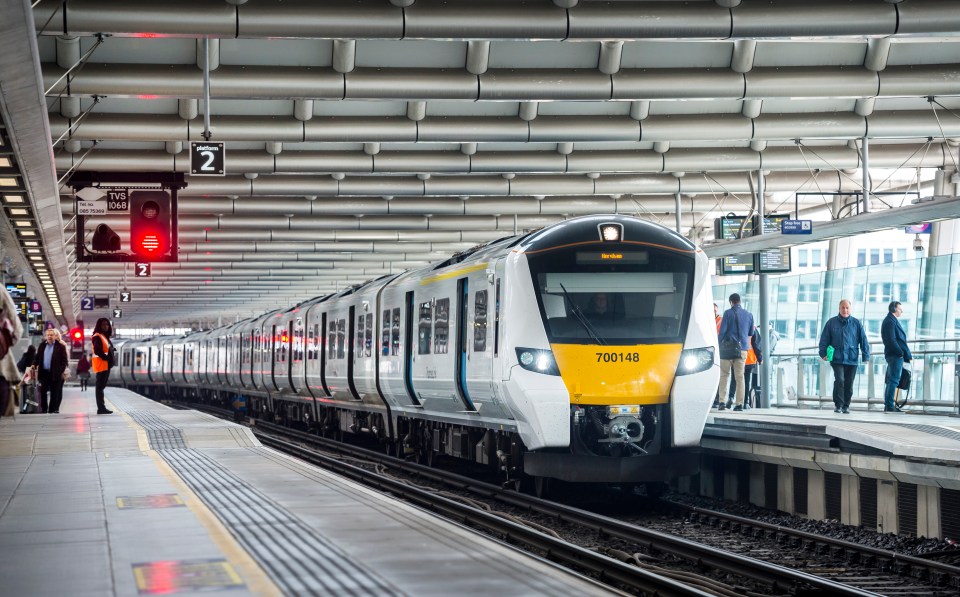
Govia Thameslink train stopped at a station.
govia thameslink train Credit: Peter Alvey

HOLIDAYMAKERS are to get twice as many trains to one of Britain’s busiest airports after the country’s largest rail operator was taken into public ownership.

The Government has pledged to double the frequency of Gatwick Express services between London Victoria and Gatwick Airport from December, as Govia Thameslink Railway (GTR) became the latest train company to be nationalised today.

Transport Secretary Heidi Alexander hailed it as “a defining moment in our reform of the railway”, with GTR’s four brands – Southern, Thameslink, Great Northern and Gatwick Express – carrying one in six of all train journeys made across Britain.

As well as the boost for Gatwick passengers, more early morning services on Saturdays and Mondays will be introduced from this summer.

The Government also pledged to crack down on graffiti in Thameslink train toilets, upgrade signalling between Farringdon and Blackfriars to cut delays, and deploy 110 new travel safe officers to tackle anti-social behaviour across the network.

Ms Alexander said millions of passengers across the South East and East of England would now be “travelling on rail services back in public hands — run for the public good, not private profit.”

PLAY BALL

Six city staycation breaks ideal for summer as huge sporting event comes to UK


TRAVEL UPDATE

European country to allow Brits to use airport e-gates – and skip queues

She added the nationalisation gave the Government “an opportunity to tackle the bread and butter issues people want, like driving down cancellations and improving the frequency of services to Gatwick Airport.”

GTR chief operating officer John Whitehurst said the railway “carries millions of people to work, to school, and to see friends and family every single day,” adding that public ownership “gives us the chance to go further to deliver the railway that millions of people across the South East deserve.”

GTR is the fifth operator to be nationalised under the current Government, joining c2c, Greater Anglia, South Western Railway and West Midlands Trains. LNER, Northern, Southeastern and TransPennine Express had already been brought into public hands before Labour came to power.

The nationalisation is part of a sweeping overhaul of Britain’s railways, with a new body called Great British Railways (GBR) set to bring responsibility for both tracks and trains under a single roof for the first time since privatisation in the mid-1990s.

Legislation to create GBR was included in the recent King’s Speech, and the first train carrying its branding — a Southern service — was unveiled in Brighton earlier this month.

Chiltern Railways is next in line to be nationalised on September 20, followed by Great Western Railways on December 13, with the full programme expected to be completed by the end of next year.

GTR’s takeover into public hands comes years after Southern became notorious for chronic delays and cancellations.

At its worst, the 7.29am Brighton to London Victoria service failed to arrive on time during any of its 240 runs throughout 2014.

The operator blamed high demand and congestion, though it was also hit by a bitter industrial dispute with drivers and conductors over staffing, including a row over who should operate train doors.

Source link

Can Hungary wean itself off Russian energy, as its new leader has promised? | Explainer News

Hungary’s newly elected leader, Peter Magyar, stormed to power last weekend after campaigning to, among other things, take a step back from Russia.

Instead, Magyar has promised voters he will steer Hungary back towards the European Union, following the 16-year rule of far-right Prime Minister Viktor Orban, who went to great lengths to deepen ties with Russia.

Recommended Stories

list of 3 itemsend of list

Under Orban, Hungary opposed most of the European Union’s stances against Russia and  blocked sanctions and obstructed military aid for Ukraine.

Above all, he and his Fidesz party entrenched Hungary’s reliance on Russian oil.

Now, following a massive electoral turnout and a landslide victory, Magyar – once a devotee of Orban and now leader of the centre-right Tisza party – has promised to end Russian oil imports by 2035. But how realistic a goal is that? And can he achieve it?

Magyar
Peter Magyar celebrates after Prime Minister Viktor Orban conceded defeat in the parliamentary election in Hungary, April 12, 2026 [File: Leonhard Foeger/Reuters]

How much does Hungary depend on Russia for energy?

Hungary has been central to keeping Russian oil and gas flowing into the EU, even as Europe and the US banned some imports and imposed sanctions on anyone paying more than $60 a barrel for Russian oil.

Following Russia’s invasion of Ukraine, the EU banned seaborne imports of Russian oil but kept land flows legal. That allowed Hungary to continue importing most of its crude by pipeline via Ukraine.

The EU first announced plans to phase out Russian energy imports in May 2022, shortly after Russia’s invasion of Ukraine. In December 2025, a binding agreement was made for member nations to completely phase out Russian oil and gas imports by late 2027. But, instead of diversifying from Moscow, Hungary increased its dependency.

According to a 2026 report by the Center for the Study of Democracy (CSD), Hungary had expanded its reliance on Russian crude from 61 percent in 2021 to 93 percent by 2025.

Much of the crude oil Hungary imports from Russia comes via the Druzhba pipeline. It is one of the key pipelines that ensures the continued flow of Russian crude to both Hungary and Slovakia. At 5,500 km (3,420 miles) long, it begins in Almetyevsk in western Russia and runs into Belarus. It splits at Mozyr, with one branch going to Poland and Germany and the southern branch goes through Ukraine into Slovakia, Hungary and Czechia.

pipeline
The Druzhba oil pipeline from Russia at the Danube Refinery in Szazhalombatta in Hungary, May 18, 2022 [File: Bernadett Szabo/Reuters]

In January, the section of the pipeline running through Ukraine suffered significant damage. Ukraine blamed a Russian airstrike – Moscow denies that.

Hungary and Slovakia have complained that Ukraine has been deliberately slow to repair the damage. As a result, in March, Orban vetoed a 90 billion euro ($106bn) loan from the EU to Ukraine until the pipeline reopens.

On Tuesday this week, Ukraine’s President Volodymyr Zelenskyy said oil will flow again through the conduit by the end of April as he expects the new Hungarian leadership to lift its veto on the loan by then.

As for gas, Hungary remains one of the most dependent EU member states on Russian natural gas, accounting for roughly three-quarters of its annual imports, the CSD report shows.

Since the start of Russia’s invasion, Hungary has imported an estimated 15.6 billion euros ($18.4bn) worth of Russian gas. Long-term contracts with Russia’s state-owned Gazprom, the continued reliance on TurkStream – a natural gas pipeline running from Russia to Turkiye – and “the weak use of alternative interconnectors have locked the country into Russia’s reconfigured gas export system”, the CSD report states.

Nuclear energy dependency is yet another issue. Hungary granted Rosatom, the Russian state nuclear energy corporation, the construction contract for the expansion of its Paks atomic plant, 100km (62 miles) southwest of Budapest on the Danube River. Russia, in turn, provided Hungary with a state loan to finance most of the development of new reactors. The European Commission approved the plan in 2017 and construction started in February.

Now, Magyar says he intends to reassess the project’s financing. But the Paks plant provides 40 to 50 percent of all electricity generated in Hungary. The expansion plans will increase that to between 60 and 70 percent, which would cut reliance on imported energy, but keep Hungary tied to Russia. 

According to a 2025 joint research paper by the Center for the Study of Democracy and the Center for Research on Energy and Clean Air, Hungary could potentially diversify its energy supply by importing non-Russian oil via alternative sources such as the Adria pipeline. It transports crude from the Adriatic Sea to refineries in Croatia, Serbia, Hungary and Slovakia. Their refiners, which are controlled by Hungarian oil and gas company MOL, are capable of processing non-Russian crude, the research paper said.

Russian oil has been coming in at a discounted rate as a result of Western sanctions, so any diversification will likely be more expensive.

Can Hungary wean itself off its dependence on Russian oil?

It won’t be easy, and Magyar knows it. “The geographical position of neither Russia nor Hungary will change. Our energy exposure will also be here for a while,” he said before last weekend’s election. And in an interview with the Financial Times, Magyar insisted that Russian imports should remain an option. “This does not mean that by ending dependence on someone you no longer continue to buy from them,” he said.

Magyar will seek to strike a balance between respecting current contracts with Moscow to ensure Hungary’s energy security, while establishing political distance, said Pawel Zerka, a senior policy fellow at the European Council on Foreign Relations.

“I would expect this government not to be pro-Russia in the sense of going to Moscow and keeping ties with the Russian government, but they don’t have easy options to replace Russian fuel with something else, especially considering the international situation with the Middle East,” Zerka said, referring to the closure of the Strait of Hormuz in the Gulf which has blocked the shipping of 20 percent of the world’s oil and LNG supplies.

Zerka added that the newly elected leader will not have political room to be particularly cordial with Russian President Vladimir Putin, considering the disapproval of Russia by his electoral base. A recent poll by the European Council on Foreign Relations shows that a majority of Tisza’s voters see Russia as an adversary or rival to compete with.

“It will be interesting to see how he combines this with energy needs,” Zerka said.

How does the EU view Hungary’s energy ties to Russia?

The strong energy ties between Russia and Hungary have long caused friction with the EU. Following Moscow’s invasion of Ukraine in 2022, the European bloc has worked to cut imports of Russian oil and gas. Budapest has done the opposite.

In January, the EU passed legislation to completely phase out Russian gas and LNG imports by late 2027.

Orban’s government had called for all restrictions on Russian oil to be lifted as a result of the global energy crisis triggered by the war in the Middle East. While Trump has made some concessions on Russian oil already loaded on tankers at sea – causing several heading for China to head to India instead – EU leaders have maintained they will hold firm on sanctions.

In the lead-up to last weekend’s election, Magyar’s manifesto called the dependence on Russian energy a “systemic risk” and he would wean Hungary off its reliance by 2035. But whether he can do that in time to beat the EU’s 2027 deadline is likely to provoke discussion in Brussels.

Source link