procurement

Industrial Base Concerns Over Building F/A-XX And F-47 Remain: Top Pentagon Procurement Officer

As both the Navy and the USAF were racing to field a new generation of advanced tactical jets, the seagoing service’s program hit a wall. A major reason behind this from the Pentagon was concern that the U.S. industrial base could not handle simultaneous final development and production of two extremely complex new fighter aircraft. This was a controversial justification that many had a hard time swallowing. The Navy’s program, dubbed F/A-XX, is supposedly back on and a down-select on who will build it is coming soon, but that concern appears to linger among at least one of the Department of War’s top acquisition officials.

Though he remains confident that the U.S. Air Force F-47 sixth-generation fighter will fly in the next two years, Air Force Gen. Dale R. White, Director, Critical Major Weapon Systems — the service’s leading weapons procurement advisor — remains concerned about the overall capacity of industry to provide the military with the aircraft it needs, including two new fighters. His comments were in response to questions about the Navy’s challenges in building its own sixth-gen fighter alongside F-47.

The concerns are “not unique” to the F-47 or the Navy’s program but the problem exists to various degrees across the industrial base too, White told reporters Tuesday during a media roundtable at the Air & Space Forces Air, Space and Cyber Conference that TWZ is attending.

White has a dual-hatted role, serving as the Pentagon’s top weapon’s procurement officer and as the senior acquisition advisor to the Secretary of the Air Force for all acquisition matters.

With the first example of Boeing’s F-47 sixth-generation stealth fighter for the U.S. Air Force now in production, a company official has highlighted how its prototyping effort allowed the program to move forward at a rapid pace. Winning the Next Generation Air Dominance (NGAD) program was “humbling,” said Steve Parker, president and CEO of Boeing Defense, Space and Security. He added that the fact the F-47 is now in production is testament to “the maturity of our design and pedigree coming off the prototype.”
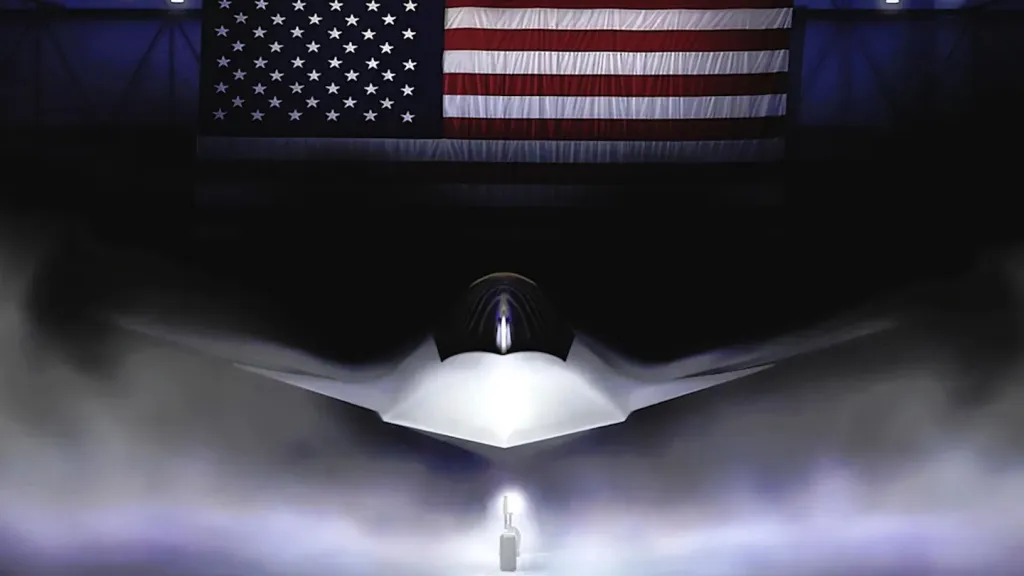
A rendering of the F-47. (U.S. Air Force) U.S. Air Force

“We’re seeing it in multiple platforms,” said White, who did not elaborate. “And so what we’re having to do is, at some point, we’re having to make some trade space in between some of these.”

“I see Boeing making smart investments,” White said of the prime contractor of the F-47, selected for the U.S. Air Force’s Next Generation Air Dominance (NGAD) ‘fighter’ initiative. “They have a lot of CAPEX [capital expenditure] that they’re pouring in, but we have to get through the process of the design piece, getting that completed and closed out. Then we all hit some major milestones with things like flight tests and software and those things.”

F-47 specifications infographic (USAF)

“Really, it’s just being able to manage the overall resourcing as it relates to number one, people resources,” the general added. “Number two, when you start getting into the production conversation, do we have enough capacity to be able to produce at that rate? And so, by and large, I have concerns. I have concerns about the capacity of our industrial base, but they are not unique to F-47 or to any program.”

As for the F-47, White said the program “continues to progress exceptionally well.”

“As you know, many, many years in tech maturation and risk reduction gave us a tremendous head start on this program,” White explained. “Extremely proud of what the team has done, what they continue to do each and every day. We are still absolutely on path to be able to hit the mark of flying within this administration. So we see no issues in front of us right now.”

While the first example of the F-47 has been in production for about a year now, the Navy has yet to even select a prime contractor for its next generation fighter. The current competitors for the F/A-XX are Boeing and Northrop Grumman. A decision was supposed to have been made by last month.

“The F/A-XX program remains on track, and we have no further information to provide at this time,” a Navy official told us last week.

Despite intervention from Congress, the next-generation carrier-based fighter has remained in question since the Pentagon moved to effectively shelve the program last year.

In response to a question from TWZ earlier this year, the Chief of Naval Operations acknowledged the uncertainty over the F/A-XX program.

“One of the challenges we’re seeing is, not only [are] our peer competitors improving their capability for anti-air, either air-to-air or surface-to-air, but the lower cost of entry of very capable weapons is also making more players on the field in which that level of stealth and technology is required,” Adm. Daryl Caudle told us back in April at the Sea-Air-Space 2026 exposition. “So this is not about the need for a peer adversary. This is just having an aircraft that can operate with a level of uncertainty and with the acceptable level of risk.”

With Boeing as a finalist, it is also possible that F/A-XX could be a variant of the F-47. As we noted in a past story, the Boeing render for its F/A-XX concept is remarkably similar to artwork for its F-47.

Last year, Steve Parker, Boeing Defense and Space CEO, said he didn’t see a problem with his company building both jets stating that this had been part of the strategy all along.

If this is the case, the company’s claim that it would not have a problem building both the Navy and Air Force next-generation fighters would make more sense. There are a number of advantages when it comes to establishing a high-degree of commonality between F/A-XX and F-47, although there would also be challenges, especially when it comes to getting the most out of a design that was not meant to operate from a carrier deck and scaling production up for both services. There is already significant sharing of elements of both the Navy’s and Air Force’s sixth-generation fighter programs. So commonality in some subsystems and interoperability is already baked in.

We should hopefully finally get a clearer picture in the coming weeks about the status of the F/A-XX and possibly the answer to who will actually build it, which will give us a better idea of what the industrial base impact actually will be.

Contact the author: howard@twz.com

Howard is a Senior Staff Writer for TWZ. He writes frequently about conflict, focusing heavily on the Middle East and Ukraine, and interviews with military and intelligence officials and industry leaders from around the globe. He lives near Tampa, Florida, home of U.S. Central Command, U.S. Special Operations Command.


Tyler’s passion is the study of military technology, strategy, as well as foreign policy, and he has fostered a dominant voice on those topics in the defense and national security space. Tyler was the creator of the hugely popular defense site Foxtrot Alpha before developing TWZ, which he continues to lead as the Editor-In-Chief to this day.


Source link

European Commission proposes EU preference in public procurement, excluding Chinese firms

Published on •Updated

The European Commission unveiled on Wednesday a legislative proposal allowing EU public authorities to favour European companies in public procurement for key public services such as energy, water, railways, ports, airports and postal services.


ADVERTISEMENT


ADVERTISEMENT

The move comes as European policymakers seek to shield the bloc’s market from China amid heated trade negotiations, as the EU grapples with a trade deficit with Beijing of roughly €1 billion a day.

Public procurement markets in Europe represent €2 trillion every year — 15% of Europe’s GDP.

“Public money must serve our collective interests,” Commission Vice-President Stéphane Séjourné said on Wednesday. “A public buyer will be able to organise his European preference and to exclude operators coming from countries with which we do not agree on public markets, both on the basis of the nationality of the company or on the base of the origin of the products.”

Under the Commission’s proposal, EU public authorities will be able to exclude non-European companies from public contracts when they come from countries that do not allow Europeans access to their own public procurement markets.

“A municipality will be very clearly able to exclude a Chinese company or a European company that offers Chinese products,” Séjourné added. “It will also be able to give more points and more visibility in his offer to European offers compared to competition offers.”

Swift reaction from China

The Commission proposes that at least 30% of the evaluation of supplies for public procurement rely on quality criteria and not only on price, which will also hit low-cost Chinese products.

“The new standard is the best quality-price ratio, and not just the price,” Séjourné said. “Our choices must also be able to meet social and environmental demands, but also sovereignty.”

The legislation, which still has to be adopted by the EU co-legislators — the European Parliament and the EU Council — prompted a swift reaction from China. In a statement released after the commission’s announcement, China’s Chamber of Commerce to the EU said that such a European preference could “distort a level playing field” for Chinese companies participating in the European public procurement market.

“Public procurement should not discriminate against suppliers or goods on the basis of the supplier’s nationality or the country of origin of the goods.”

In March, another proposal creating a European preference in EU strategic sectors such as green tech, cars and energy-intensive industries also prompted Chinese ire, with Beijing threatening to retaliate.

EU Trade Commissioner Maroš Šefčovič will travel to China in early October, hoping to reach a political deal with Beijing to rebalance the trade relationship with the EU.

Source link

European Commission proposes EU preference in public procurement, excluding Chinese firms

Published on •Updated

The European Commission unveiled on Wednesday a legislative proposal allowing EU public authorities to favour European companies in public procurement for key public services such as energy, water, railways, ports, airports and postal services.


ADVERTISEMENT


ADVERTISEMENT

The move comes as European policymakers seek to shield the bloc’s market from China amid heated trade negotiations, as the EU grapples with a trade deficit with Beijing of roughly €1 billion a day.

Public procurement markets in Europe represent €2 trillion every year — 15% of Europe’s GDP.

“Public money must serve our collective interests,” Commission Vice-President Stéphane Séjourné said on Wednesday. “A public buyer will be able to organise his European preference and to exclude operators coming from countries with which we do not agree on public markets, both on the basis of the nationality of the company or on the base of the origin of the products.”

Under the Commission’s proposal, EU public authorities will be able to exclude non-European companies from public contracts when they come from countries that do not allow Europeans access to their own public procurement markets.

“A municipality will be very clearly able to exclude a Chinese company or a European company that offers Chinese products,” Séjourné added. “It will also be able to give more points and more visibility in his offer to European offers compared to competition offers.”

Swift reaction from China

The Commission proposes that at least 30% of the evaluation of supplies for public procurement rely on quality criteria and not only on price, which will also hit low-cost Chinese products.

“The new standard is the best quality-price ratio, and not just the price,” Séjourné said. “Our choices must also be able to meet social and environmental demands, but also sovereignty.”

The legislation, which still has to be adopted by the EU co-legislators — the European Parliament and the EU Council — prompted a swift reaction from China. In a statement released after the commission’s announcement, China’s Chamber of Commerce to the EU said that such a European preference could “distort a level playing field” for Chinese companies participating in the European public procurement market.

“Public procurement should not discriminate against suppliers or goods on the basis of the supplier’s nationality or the country of origin of the goods.”

In March, another proposal creating a European preference in EU strategic sectors such as green tech, cars and energy-intensive industries also prompted Chinese ire, with Beijing threatening to retaliate.

EU Trade Commissioner Maroš Šefčovič will travel to China in early October, hoping to reach a political deal with Beijing to rebalance the trade relationship with the EU.

Source link