WITH the sun shining brightly across the country, many families are itching to get out to a waterpark and cool off from the soaring spring heat.
And there’s no more fun way to cool off than in a waterpark – and the UK is home to plenty of world-class ones, with thrilling slides, rides and even their own spas.
We’ve rounded up the top waterparks for families of all agesCredit: Getty
Whether you want to try an adrenaline-fuelling trap-door waterslide, tackle a Total Wipeout-style obstacle course, or let a lazy river do all the work – we’ve got you covered.
From indoor tropical waterparks with adults-only spas, to the UK’S largest wave pool and water rollercoaster, we’ve rounded up the top waterparks for families of all ages.
And to top it all off, the entry prices start from £5.31pp – proving you can have an action-packed summer day out on a budget.
Here are some of the best on offer across the UK…
Waterworld, Stoke-on-Trent
Have a go on waterslides, Hurricane or Tornado Alley at Waterworld in Stoke-on-TrentCredit: Waterworld
Crowned the UK’s number one indoor tropical aqua park, Waterworld is a massive water wonderland packed with over 30 different rides.
The top attraction for adrenaline junkies is Thunderbolt – the UK’s very first trap-door drop waterslide.
You stand inside a capsule, wait for the floor to drop beneath your feet, and plummet straight down a vertical flume at a staggering 25mph.
For more thrills, you can tackle Hurricane, a high-speed slide that hurls you down at 17mph through glow-in-the-dark neon lighting.
For something a little more family-friendly, the newly refurbished Python ride has plenty of slithery twists and turns that are gentle enough for toddlers.
You’ve also got a classic wave pool and fast-flowing rapids that swirl you around the tropical temperature waters.
Plus, if you visit when the weather‘s hot, you can soak up the sunshine outside.
The park has an outdoor pool and sun loungers where parents can relax while kids splash around.
You can also wind down in the calming bubble pools and relaxation areas, or hit the on-site restaurant to refuel the family on fresh pizza, bubble waffles, and thick milkshakes.
Single tickets start at £17.50 online for adults and children, including spectators. Baby tickets cost £7. Make sure to book online in advance, as walk-in tickets will cost you up to £8.50 extra.
Sandcastle Waterpark, Blackpool
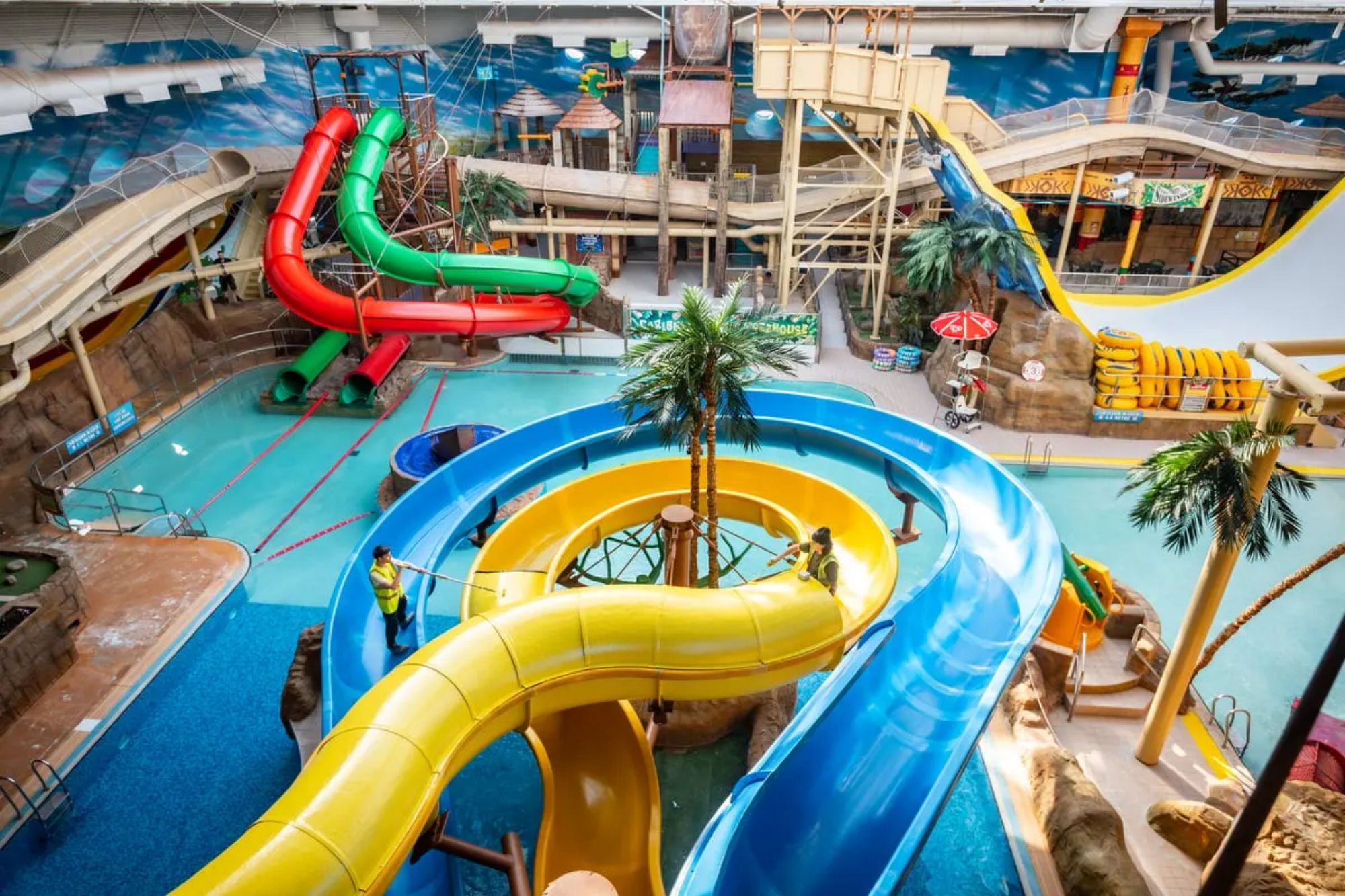
Sandcastle Waterpark in Blackpool is the largest waterpark in the UKCredit: Sandcastle Waterpark
Sandcastle Waterpark is the UK’s largest and home to Britain’s longest indoor water rollercoaster and 18 thrilling rides.
If you want to feel like you’re on holiday abroad, head here for a 29C tropical climate.
The Masterblaster holds the record for the UK’s longest indoor rollercoaster waterslide, with a 200m stretch of water tubing fun.
Meanwhile, the Sidewinder is the world’s first indoor half-pipe waterslide, resembling a giant, slippery skating ramp.
For the little ones, there’s the Treetops Water Chutes, multi-lane slides perfect for racing, and the HMS Thunder Splash – a giant pirate ship packed with water activities.
Another kid-friendly favourite is the Caribbean Storm Treehouse, a massive water climbing frame complete with a giant coconut that dumps 600 gallons of water onto unsuspecting swimmers every few minutes.
If you need a breather from the screaming and splashing, grown-ups can escape to the Sea Breeze Spa.
For an extra £7, adults can spend three hours unwinding in the sauna and steam room while making use of the foot spas and aromatherapy room.
For £60pp, adults get access to a private oasis with their own hot tub, a flatscreen TV, a fridge packed with cold drinks, and a dining and seating area.
You also get full-day admission to the waterpark and a meal deal included in the price.
Tickets start at £25.50 for ages 8+, £16.50 for children aged 3 -7, with under 3s going free. Make sure to book online in advance, as same-day tickets can cost you £2 extra.
Alton Towers Waterpark, Staffordshire
Alton Towers Waterpark at Splash Landings Hotel has Caribbean temperatures and a range of ridesCredit: Alamy
You don’t need to brave the theme park’s rollercoasters for an action-packed day out at Alton Towers.
The Alton Towers Waterpark at the Splash Landings Hotel is a massive, tropical-themed park with Caribbean-type temperatures in the middle of the Staffordshire countryside.
TheWacky Waterworks Treehouse is a sprawling interactive play area packed with more than 70 interactive features, including water cannons, pull-cords, and buckets.
Thrill-seekers can twist and turn down the Rush ‘N’ Rampage waterslides, or slip down the outdoor Flash Floods slides into a giant pool – perfect for a sunny day.
And if you just want to take it easy, you can drift along the lazy river or laze on a lounger while the kids hit the slides.
When you want something to eat, head to the Calypso Cave for lunches like burgers and chicken tenders, or grab an ice cream float or sundae from the Ice Cream Shack.
Tickets start at £18 online for adults and children, with those under 90cm going free. There are also parent and toddler tickets from £23. Make sure to book online for the best rates.
Dorset Adventure Park
Dorset Adventure Park has giant inflatable obstacle courses on lakes beside Corfe CastleCredit: Not known, clear with picture desk
If you prefer muddy knees, fresh air, the sun on your back and giant outdoor obstacles, Dorset Adventure Park is for you.
Set across two massive lakes on the grounds of Corfe Castle, Dorset Adventure Park is home to an action-packed outdoor inflatable course.
The Total Wipeout-style floating playground has huge trampolines, balance beams, wobbly bridges, and high-flying slides that launch you straight into the lake.
Plus, little ones even have their own inflatable, Splash Castle, manned by lifeguards and designed for kids aged 2 to 6.
If that isn’t muddy enough for the kids, the park is also home to a legendary Mud Trail.
On this 2km assault course, you can tackle mud pits, climbing walls, cargo nets, and tyre crawls that guarantee nobody leaves clean.
Back on dry land, the grounds have plenty more to see and do. There’s everything from axe throwing to relaxing woodland sauna pods.
For a bite to eat, the Snack Shack and Watering Hole have hot food, ice-cold drinks and ice creams with views of Corfe Castle.
The park provides wetsuit and buoyancy aid hire too, so you don’t need to worry about bringing anything other than a towel and a change of clothes.
Tickets start at £22pp for waterpark admission, £11 for the Mud Trail and £5 per child for Splash Castle.
The Wave, Coventry
The Wave in Coventry is home to the largest wave pool in the UK, plus plenty of slidesCredit: The Wave
Home to the largest wave pool in the UK which cycles 20 million litres of water per day, The Wave in Coventry is a high-tech indoor waterworld.
Above the huge pool are six speedy waterslides, including the colourful Cascade with its bright lights and The Rapids water coaster, described by the park as the ‘Big Dipper’ rollercoaster on water.
There’s also The Riptide, a rubber-ring ride that launches you down an exhilarating 90-degree angle.
The Cyclone, on the other hand, hurls you around a massive open bowl before dropping you out of the bottom.
Families with toddlers can head straight to The Reef, a colourful splash zone packed with mini-slides and water jets away from the big flumes.
Adults can slip away to the dedicated lane-swimming pool, work out at the fitness centre, or book into the luxurious Mana Spa to use its steam room, sauna, or enjoy a relaxing massage.
Tickets start at £15 per adult, £13 for ages 11 and under with under 1’s going free.
Time Capsule Water Park, Scotland
The Time Capsule Water Park in Lanarkshire has a Tornado Tantrum area with twisting ridesCredit: Time Capsule Water Park
The Time Capsule Water Park in Coatbridge, Lanarkshire is an affordable option with plenty of activities for mixed-age families.
Plus this waterpark is attached to an indoor ice rink, making it an ideal spot to visit and cool off on a hot day.
Inside you’ll find a lazy river, splash zones and waterslides, plus water cannons and a giant tipping bucket.
The most unique attraction here is the Tornado Tantrum – a setup of 10m-high Storm Chasers, thunder and lightning effects and twisting water flumes.
For families with young children, the Cove Island area has plenty of splash play zones for toddlers.
There’s also a Tiny Tots Play Zone on site, a soft play area for children aged 5 and under.
Head to the Tsunami Café for poolside burgers or a sit down with a cold drink.
The Time Capsule Water Park is one of the most affordable on the list, costing £6.50 per adult to enter and £4.50 per child. There is also free parking available.
LC Swansea Waterpark, Wales
Try out surfing on the Boardrider at LC Swansea in WalesCredit: LC Swansea
LC Swansea is Wales‘ biggest water park, packed with exciting rides, relaxing pools and even an indoor surfing machine.
Try out surfing or body-boarding on the Boardrider – a never-ending wave machine built for those who want to learn to ride waves like a pro.
Here you’ll also find the MasterBlaster water coaster, launching rubber ring riders uphill before gravity plummets them back down into the pool.
Younger kids can make a splash at Volcano Bay, an interactive zone with fountains, a smaller slide and tipping buckets.
For a slower pace, you can drift along the peaceful, lazy river or soothe your muscles in the bubbling whirlpool.
There’s a range of sessions to book, including Toddler Splash early mornings, women’s only and evening splash sessions.
To burn off some energy outside of the pool, there’s a water-themed Climb and Play area with four storeys of obstacles plus a 30ft climbing wall.
There’s also a Costa Coffee on site, plus a shop where you can pick up any extras you might need like swim hats and goggles.
Tickets start at £5.31 per adult or child for a General Splash session, with infant tickets for ages 1 to 3 starting at £2.97 and under 1s going free.
Love Your Weekend host Alan Titchmarsh questioned Jeremy Vine after the presenter opened up about an embarrassing celebrity encounter.
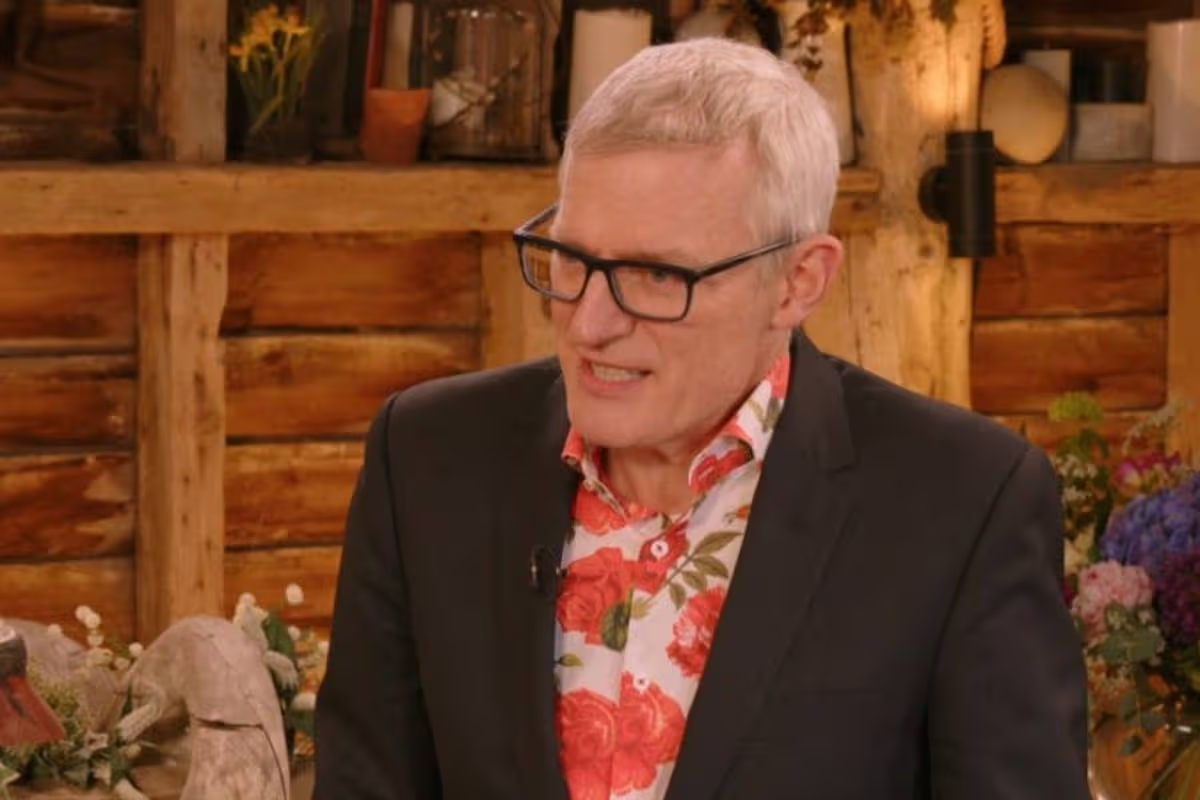
Jeremy Vine spoke about his eventful bathroom visit(Image: ITV)
Jeremy Vine has shared a cringe-worthy story about meeting one of pop music’s biggest stars under rather unfortunate circumstances.
Love Your Weekend With Alan Titchmarsh returned to ITV this morning, with the much-loved presenter heading to The Big Cat Sanctuary in Kent for this week’s episode.
The veteran host kicked off the programme by quizzing his celebrity guests about their greatest “pinch me moments”.
Jeremy then launched into a rather risqué anecdote about a particularly memorable bathroom visit during his time at BBC Radio 2, prompting Alan to step in with a cautionary word.
“Behind Radio 2 reception there was a loo…” he began, as Alan interjected: “I think you’re going to take this slightly downmarket…”
“I wont!” Jeremy insisted as Alan questioned: “Is this really necessary?”
Jeremy then explained: “I’ve got to tell this story; I’ve got to unload because I haven’t really told it before.”
Alan then cheekily warned Jeremy that the phrase ‘I’ve really got to unload’ hardly inspired great confidence given the direction the tale was heading, reports the Express.
Undeterred, Jeremy continued: “So behind Radio 2 reception there is a single cubicle toilet and it was always locked because the receptionist said we don’t want anyone going in there for obvious reasons.
“And one day I was bursting and I could see the door unlocked, so I say, ‘Do you mind if I go in?’ and I lock the door and I’m in a seated position…
“You’re on the verge of oversharing!” Alan exclaimed, as Jeremy continued: “I don’t understand what’s going on outside the door because I’ve got no idea.
“But Barry Gibb of the Bee Gees has said to reception, ‘I need to use the loo urgently.’
“And reception looks round and the door is locked because it always is because they lock the door to stop people using it,” he clarified.
“So they gave him the master key and I’m sitting in the loo in a seriously private moment and [the door] suddenly opens and Barry Gibb walks in!
“This is the guy who wrote Islands in the Stream!” Jeremy added, as the studio erupted into laughter.
“He walks in a completely continuous movement and I think he made the noise ‘ha?!'” the presenter said, imitating a similar sound to what the Bee Gees sing in their famous track, Stayin’ Alive.
“I’ve only met him once and that was it,” Jeremy concluded, as Alan swiftly steered the conversation elsewhere.
For her standout moment, Kate recounted the occasion she encountered legendary Hollywood actor Dustin Hoffman following a theatrical performance.
She recalled being completely starstruck having previously watched him in classics such as Tootsie and The Graduate, while younger cast members recognised him from the animated blockbuster Kung Fu Panda.
Meanwhile, Michael disclosed he had recently had an audience with Pope Leo XIV, describing it as amongst the greatest days of his life.
Love Your Weekend With Alan Titchmarsh airs every Sunday at 9.30am on ITV1 and ITVX.
But it seems that Madonna also has royal standards when it comes to travel. I can reveal that the Like A Prayer hitmaker brought her own private chef on to a British Airways flight last month.
Sign up for the Showbiz newsletter
Thank you!
Madonna has royal standards when it comes to travelCredit: instagram/madonnaThe Queen of Pop brought her own private chef on to a British Airways flight last monthCredit: instagram/madonna
She jetted from Los Angeles to London’s Heathrow with former foot- baller boyfriend Akeem Morris.
Her chef plated her up some sushi before they took off for the 11-hour flight to England.
A source said: “Madonna is strict about her lifestyle and avoids processed foods.
“She has the luxury of taking her private chef when travelling. He knows exactly what she eats to ensure she is sufficiently nourished when travelling between timezones.”
Madge is understood to follow a strict macrobiotic diet which is favoured by A-listers including actress Gwyneth Paltrow.
She avoids sugar, caffeine, alcohol and processed items, instead favouring fruit, veg and protein.
Functional nutritionist Pauline Cox previously told The Sun: “Madonna has a carefully planned diet that allows her to carry on performing at a high level.
“She eats complex carbohydrates — brown rice, beans and oats — for slow energy release.”
I previously told how Madonna turned night owl for a new music video, shooting between 5pm and 2am.
She is set to premiere the ten-minute film at the Beacon Theatre at the Tribeca Festival in New York in the US on June 5.
It is built around the first six tracks from her album, Confessions II, out on July 3.
ELLIE KNUCKLES DOWN
Ellie Goulding returned to the stage for the first time after giving birth to baby number twoCredit: GettyShe wore a baggy white tee and diamond knuckle-dusterCredit: Splash
ELLIE GOULDING let her hair down as she returned to the stage for the first time after giving birth to baby number two in March.
Wearing a baggy white tee, leather shorts and diamond knuckle-duster, inset above left, for her show at Radio 1’s Big Weekend in Sunderland, the singer revealed that her five-year-old son Arthur was watching.
She said: “So, guys, this is kind of a big deal, because my son is watching me for the first time today.”
Ellie also sang her new song Black Prada Dress.
Great to have you back, Ellie.
BBCRADIO 1 host Charlie Hedges has pleaded for Harry Styles to return to the Live Lounge.
The DJ, who hosts Dance Anthems, revealed how she was presenting a 24-hour show when the former One Direction star was in the building.
She told Biz on Sunday: “Harry was confirmed to be in the Live Lounge however it was the same day that I’d decided to do a 24-hour Radio 1 dance day. So I missed Harry Styles.
“I stitched myself up because it was my idea to do the 24-hour show. I can’t blame anyone. I am fuming.”
Meanwhile Charlie – who is in Sunderland for Radio 1’s Big Weekend – revealed Lewis Capaldi is one of her favourite guests.
She said: “He is probably the funniest man I have ever met in my entire life, let alone being an incredible performer.”
ZARA McDERMOTT cheered on boyfriend Louis Tomlinson from the side of the stage yesterday.
Louis Tomlinson performs during Radio 1’s Big WeekendCredit: SplashZara McDermott was cheering her boyfriend onCredit: Getty
Sam Workman is hoping to make sparks fly in the Love Island villaCredit: Instagram
HUNKY electrician Sam Workman is hoping to make sparks fly in the Love Island villa.
The lad, from Dudley, is lined up for the next series of the ITVdating show in Majorca, which kicks off on June 1.
A source said: “Sam is ready to use his electrician charm in the villa.
“He has also been hitting the gym to make sure he’s villa ready.”
Sam has started his summer in style and was spotted at Coachella Festival in California, US, in April.
Hopefully Sam finds himself a festival sidekick in the villa.
STORM OFF, YAS
Yasmin Pettet has left modelling agency Storm ManagementCredit: Getty
SHE signed up with top modelling agency Storm Management after leaving Love Island last year.
But I can reveal that Yasmin Pettet has left the company that has launched the careers of supermodels Kate Moss and Cara Delevingne.
A source said: “Yasmin loved working with Storm and learned a lot from the agency. However her career is going in another direction.”
The agency posted a snap of Yasmin – who finished third with Jamie Rhodes on the dating show – on their Instagram last year to announce the new signing.
It read: “Yasmin’s fearless, edgy aesthetic positions her within the new wave of British It girls: challenging conventions and breaking the mould.”
MARRIED MILEY’S WEBBED BLISS
Miley Cyrus was joined by designer Donatella Versace and actress Anya Taylor-Joy at her Hollywood Walk of Fame ceremonyCredit: Reuters
MILEY CYRUS is a married woman, according to her mother.
The revelation came at the singer’s Hollywood Walk of Fame ceremony in LA on Friday, where Miley wore this webbed maxi dress.
Onlookers witnessed Tish call Miley’s fiancé Maxx Morando, who proposed in winter 2025, her “husband”.
As Miley’s mum herded together family and friends for photographs, she looked over at Maxx, drummer for the rock band Liily, and declared, “We’re gonna bring the husband.”
Miley wore this webbed maxi dress to the ceremony in LACredit: ReutersMaxx Morando posed next to Miley at the eventCredit: Reuters
Maxx then posed next to Miley and kissed her on the cheek.
Tearful Miley lavished praise on her father Billy Ray even though he wasn’t present to see her being honoured with the Hollywood Walk of Fame star.
The singer, who was also joined by designer Donatella Versace and actress Anya Taylor-Joy, declared, “My dad used to say a skyscraper starts with a jackhammer” as she vowed her career is fuelled by making her art immortal.
With tears on her face, Miley continued: “To my family, my future family, parents, my mom, my siblings, my friends, my collaborators, thank you for loving and supporting not only the choices that I make, but my fears, and then facing them with me.
“Today is something that I’ll never forget and I’m always going to cherish.”
AD SUITS YOU, TOM
Tom Hiddleston has shot a top-secret Ralph Lauren collaborationCredit: BBC
The actor has shot a top-secret Ralph Lauren collaboration, which will be unveiled later this year.
Thor star Tom has been a mainstay at the American label’s events lately, including sitting front row at Milan Fashion Week and attending the post-runway dinner party where he sat pride of place next to Ralph’s son.
A source said: “Tom has a busy filming schedule, but he managed to squeeze in this ad as he was delighted to be asked.
“He loves the brand and plans to wear it on red carpets and at awards dos.” Tom, who is engaged to Fresh Meat actress Zawe Asthon, gushed about fashion earlier this year.
Speaking to Esquire he said: “There’s a certain element of respect when you wear a suit. Not just for yourself, but for the people you’re in the company with.
“I admire the craft of it all, and there’s something about how tailoring can honour shape and athleticism as a man. I love texture. I love the idea of getting dressed up.
“I love the construction of it and the details add up to a whole that I find pleasing.
“My tan shoes match my watch strap, and my pocket square gives a flourish.”
AIR WE GO… OFF TO AMERICA
Donna Air is quitting the UK as she hopes to land some roles in the USCredit: Getty
SHE’S kept her head down since appearing in the Jeffrey Epstein files earlier this year, but I can reveal that Donna Air is quitting the UK.
The ex-Byker Grove actress is returning to her acting roots and hoping to land some roles in the US.
This follows The Sun on Sunday story in February revealing her links to the paedophile businessman. Plus, earlier this month, Donna lost her dad Trevor to cancer.
Posting on social media she wrote: “I’ve packed up my home, and I’m off to pastures new.”
A source said: “It’s been a tough year for Donna. She wants a change of scene and a fresh start. She is hoping to audition for some roles in America and see what comes her way.”
STARS OUT FOR THE BBC
A 1986 BBC advert starring comic John CleeseCredit: Supplied
A HOST of top stars from music, films and telly are backing the BBC after filming a new ad promoting the licence fee.