Mexican drug kingpin Ismael ‘El Mayo’ Zambada has been sentenced to life in prison in the US, following a plea deal last year when he admitted to trafficking millions of kilograms of cocaine. El Mayo led one of Mexico’s most violent drug cartels, the Sinaloa Cartel, for about four decades.
Ismael Zambada Garcia, also called El Mayo, was sentenced to life in prison without the possibility of parole Monday by a U.S. federal judge. He is the co-founder and the former leader of Mexico’s Sinaloa drug cartel. File Photo by Ulises Ruiz Basurto/EPA
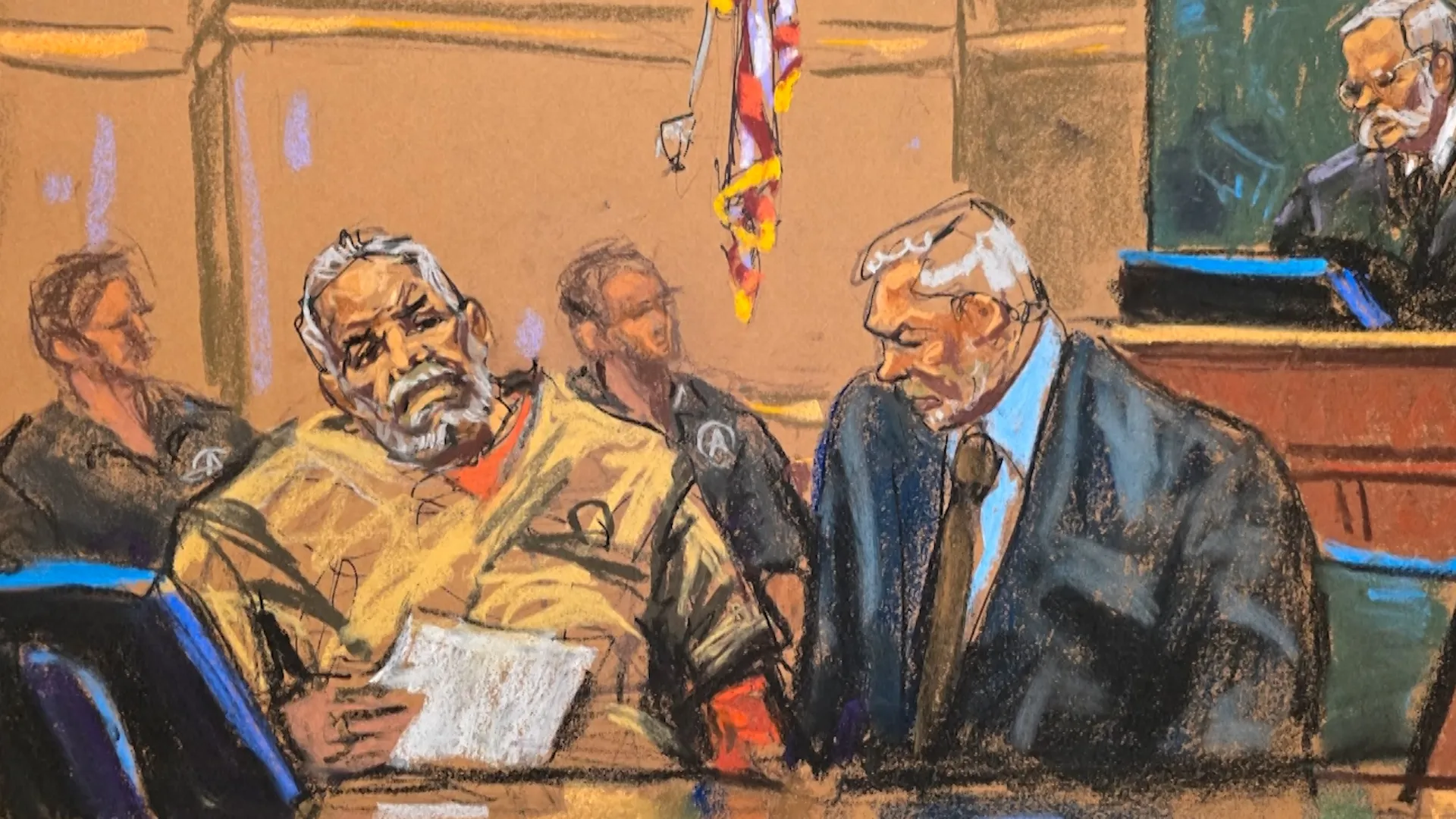
July 20 (UPI) — Ismael Zambada Garcia, also called El Mayo, was sentenced to life in prison without the possibility of parole Monday by a U.S. federal judge.
Zambada Garcia, 76, the co-founder and the former leader of Mexico’s Sinaloa drug cartel, pleaded guilty last year to leading the extensive criminal network, in which he made billions of dollars through illegal drug trafficking and violent crime. He worked with Joaquín Guzmán Loera, also called El Chapo, who is also serving life in prison.
Zambada Garcia avoided arrest for decades before authorities captured him in 2024 in El Paso, Texas. His arrest created extensive violence in the Sinaloa state of Mexico as people rushed to fill the power vacuum, The Washington Post reported.
“Ismael Zambada Garcia spent nearly four decades poisoning American communities to make billions of dollars in profit and ordering the murders of anyone who stood in his way,” said Joseph Nocella, U.S. attorney for the Eastern District of New York. “Today, that chapter closes for good.”
Zambada Garcia read a statement in Spanish in his courtroom appearance. He expressed remorse and said his upbringing was in “an environment where violence and crime seemed normal,” The New York Times reported.
“To the next generation, I say: Choose a different path,” he said.
Judge Brian Cogan of the Federal District Court in Brooklyn also ordered Zambada Garcia to forfeit $15 billion, though it’s unlikely that will happen, The Times reported.
Zambada Garcia was arrested after an ally — the son of Joaquín Guzmán Loera — took him onto a plane to allegedly go look at real estate. Instead, they flew over the border to Texas, where federal authorities arrested him. Tensions between U.S. and Mexico authorities continue over the operation, and the Mexican attorney general office said this month that it is investigating if the U.S. government lied about its involvement.
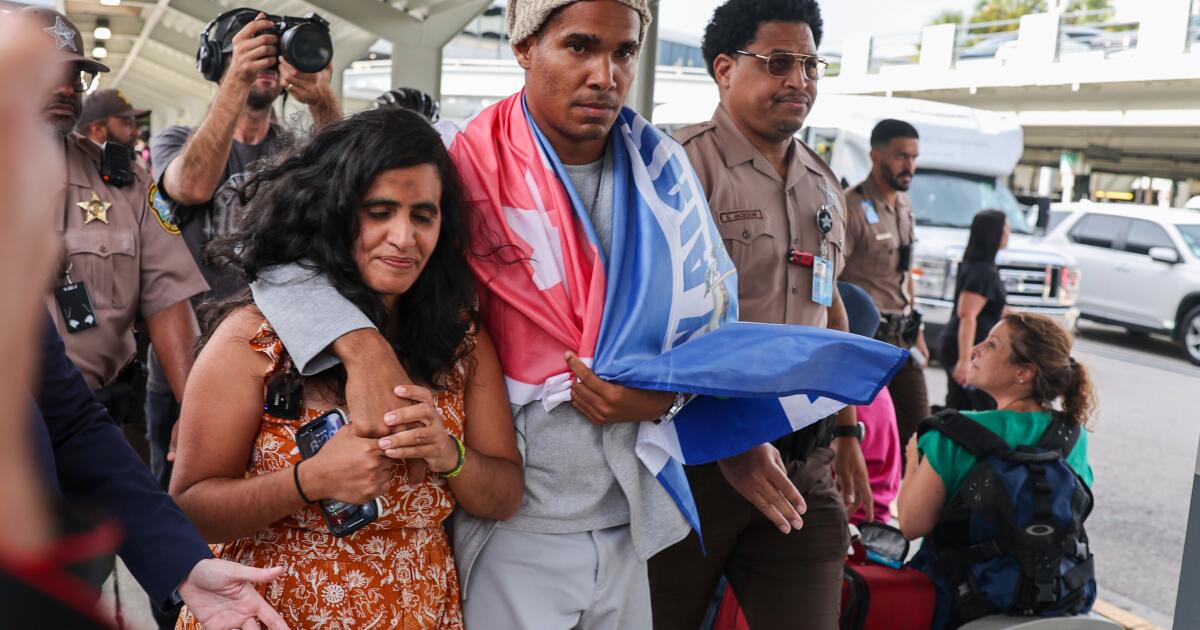
MIAMI — Cuban dissident and Grammy-winning musical artist Luis Manuel Otero Alcántara arrived in Miami on Saturday after being released from a five-year prison sentence on condition that he leave his country.
Alcántara, 38, was greeted at the airport by a crowd that was cheering, singing and holding their phones high in the air to get a photo of him. They draped him in a Cuban flag, printed with the words “Patria y Vida” — Homeland and Life — the title of a song he shared a Grammy for that became an anthem for Cuba’s political opposition against repression.
The United States granted him parole into the country last week, according to a social media page maintained by his friends and supporters. They wrote that he accepted exile as the only way to escape persecution and continue his art and activism.
Alcántara co-founded a group of Havana artists, writers and musicians called the San Isidro Movement, named for the neighborhood where Alcántara lived.
He was arrested July 11, 2021, during a public protest. In 2022, a court sentenced him to five years in prison for public disorder, contempt and disrespect toward national symbols.
His arrest and incarceration had long been denounced by human rights organizations and the U.S. government. Groups including Amnesty International called him a political prisoner, a designation the Cuban government rejected.
Alcántara was held in a maximum-security prison, he said, and was expected to be released earlier this month. But for days, advocates said they still could not contact him and did not know where he was.
The organization Cubalex, which legally advises dissidents and reports human rights violations from outside of the country, filed a habeas corpus petition on his behalf Monday.
Until he boarded a plane Saturday, his advocates were unsure of his location or whether he truly had been released.
His said his first stop on American soil would be at the National Shrine of Our Lady of Charity in Miami to make an offering.
Other political prisoners remained behind bars in Cuba, including his fellow artist Maykel “Osorbo” Castillo Pérez, his advocates said, and they hoped Alcántara’s release would lead to Pérez also being freed.
Alcántara brought from Cuba a broken statue of the Virgin Mary, which he described as a symbol of hope and healing, a chance to put back together something from fragments.
WASHINGTON — The U.S. Department of Justice civil rights division was created in 1957 with an initial focus on combating racial inequality and protecting voting rights.
But in the first two years of President Trump’s second term, its mission has been reimagined.
Now, the division is focused on combating diversity initiatives, rolling back pro-transgender policies and rooting out allegations of election fraud.
It had for decades investigated police departments for using excessive force. Now it investigates police departments with excessive delays in approving gun permits.
California has served as the division’s laboratory for all of these changes, or, as one former civil rights staffer put it, its “punching bag.”
The civil rights division has been involved in twice as many cases in California as in any other state, according to a Times analysis of cases brought by the Justice Department.
And an examination of press statements by the civil rights division shows that California has accounted for a higher proportion of actions in the second Trump administration than during the same time period in the Biden administration.
The division is led by Harmeet Dhillon, a Californian and a conservative legal crusader, who made her name bringing legal challenges against many of the state’s institutions and once served as the chair of the San Francisco Republican Party.
More recently, she was a leading legal figure in challenges to COVID-19 mandates and has shown steadfast support for Trump; her firm represented him in his successful 2024 fight to remain on the ballot in Colorado.
The Times spoke with a dozen former attorneys in the division, nearly all of whom said that the division has taken on a more partisan approach under Dhillon’s leadership and that the changes in the second Trump administration are far more dramatic than anything that occurred during Trump’s first term.
“It is an ideological civil rights division in a way that we’ve never seen before,” said Regan Rush, the former chief of the division’s special litigation section, which largely focused on investigations into police departments and prisons.
Rush is now director of the Red Line for Civil Rights at Democracy Forward, a nonprofit group that tracks the division’s activities.
In response to questions from The Times, Dhillon wrote that the division’s actions aren’t political.
“This Department speaks plainly and directly when we identify violations of federal law. Being clear about violations of federal civil rights law isn’t political or combative — it’s transparent,” Dhillon said. “I stand behind the work we’ve done since I took over the Civil Rights Division.”
While California produced President Reagan — a hero on the right who as governor frequently sparred with UC Berkeley, as Dillon does today — the state has now become, in conservative circles, a symbol of everything wrong in America.
“If there’s any state that is the antithesis of the Trump administration, it’s California,” said Erwin Chemerinsky, dean of the law school at UC Berkeley.
Dhillon said the division brings cases wherever it sees violations of federal law.
“California is where some of the most significant violations of federal civil rights law have occurred, as our enforcement actions demonstrate,” she said.
Former attorneys in the division said the desire to target California was obvious to them.
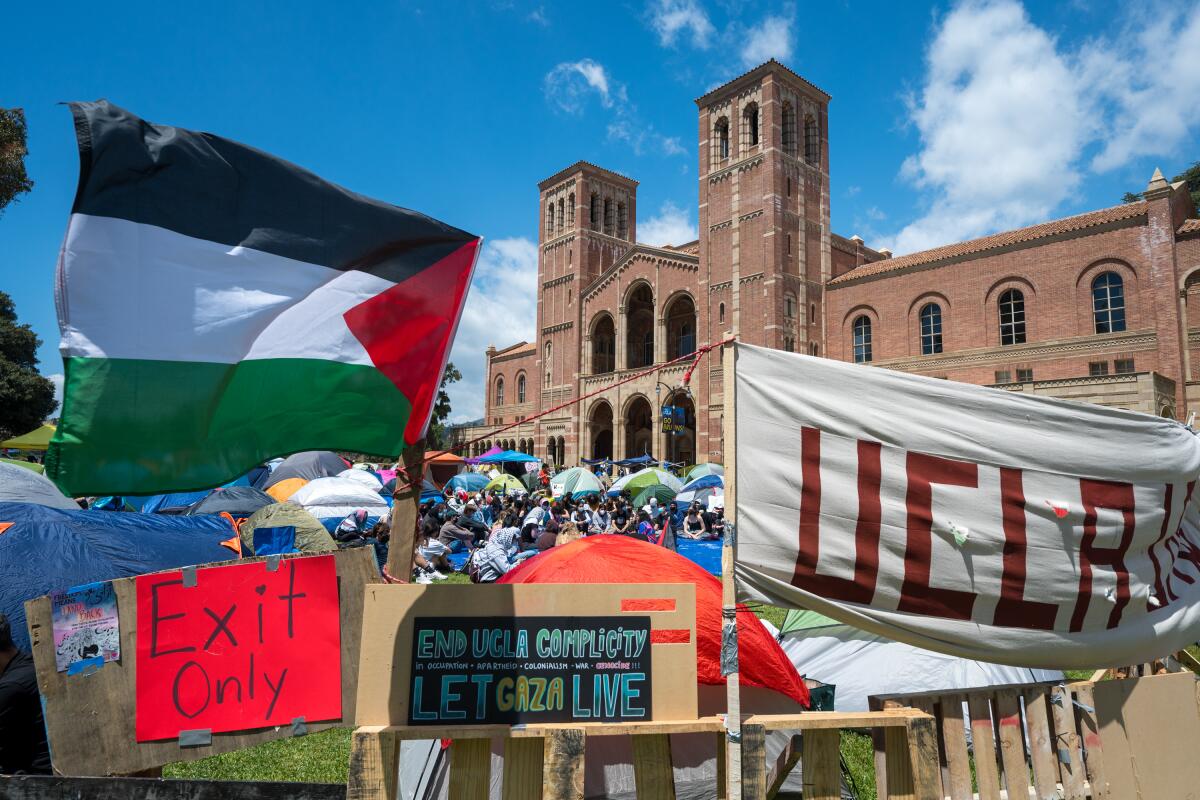
As one example, the division has announced more than a dozen actions involving universities in California, largely focused on allegations of antisemitism — the subject of an earlier Trump executive order — at University of California campuses and alleged racial preferences in hiring in the UC system and in the admissions practices at several medical schools in the state.
The division concluded that the medical schools at UC Davis and UCLA racially discriminated against white and Asian applicants and that UCLA failed to adequately respond to complaints of antisemitic harassment of Jewish and Israeli students. Other investigations are ongoing.
A pro-Palestinian encampment at UCLA in 2024.
(Michael Owen Baker / For The Times)
“We were never explicitly told that California institutions are of a particular interest, but it was something that was very easy to notice,” said Ejaz Baluch, a former Justice Department attorney who worked on the employment litigation team that looked into allegations that antisemitism at UC campuses had created a hostile work environment.
Trump’s priorities
Dhillon told podcast host Michael Malice in May that she was in “constant contact” with the White House on a “daily, sometimes several-times-a-day basis.”
That represents a major shift from how the division previously operated, said her predecessor, Kristen Clarke, who was the assistant attorney general overseeing the division during the Biden administration.
“There was a fairly sturdy and necessary wall between the Justice Department and the White House,” Clarke said. “This is a complete 180.”
Dhillon has said she sees her job as enforcing civil rights law through the lens of Trump’s executive orders, which took aim at diversity, equity and inclusion efforts, immigration and pro-transgender policies, among other conservative priorities.
She said that while the division “operates within the administration’s law enforcement priorities … investigative and prosecutorial decisions, including which matters to pursue and how, are made by the Division based on the law and the facts.”
Sen. Adam Schiff (D-Calif.), a former federal prosecutor in Los Angeles, said that the division’s changes under Dhillon represent a stark shift from how it operated in the past.
“It is now very much the anti-civil rights department,” Schiff said. “We’re living in this upside-down world where departments that were set up for one purpose are acting in a way that’s antithetical to the purpose of the department.”
Dhillon said that under her leadership, the division “enforces federal civil rights laws evenhandedly, on behalf of all Americans.
“That includes protecting religious liberty, Second Amendment rights, and women’s and girls’ spaces, standing against illegal race-based policymaking and DEI, and defending parents’ fundamental right to direct their children’s upbringing and education.”
Her reorientation of the division led to a mass exodus of career staff — nearly three-quarters of the roughly 400 attorneys who were there at the beginning of 2025, by Dhillon’s telling.
That’s far more departures than in the first Trump administration.
“I said, ‘My way or the highway,’ and my way isn’t my way, it’s President Trump’s way,” Dhillon told Malice.
Dhillon told The Times that the division has added 100 new lawyers and staff in the last 15 months and plans to hire 100 more.
Prisons and police
As the division has shifted its focus to align with the priorities laid out in Trump’s executive orders, it has shut down a number of cases brought during prior administrations.
Former attorneys in the division worry that other preexisting cases are languishing.
In March, the division opened an investigation into two women’s prisons in California — California Institution for Women in Chino and the Central California Women’s Facility in Chowchilla, 35 miles northwest of Fresno — over whether they had violated the rights of other female inmates by housing transgender women in the facilities.
“There have been allegations of sexual assaults, rape, voyeurism and a pervasive climate of sexual intimidation due to the presence of males in the women’s prison,” the Justice Department said in announcing the investigation, misgendering transgender inmates.
Former attorneys in the division said that leadership also sought to open an investigation into the impact of transgender housing policies on juvenile institutions in California, but didn’t find sufficient evidence to warrant opening an investigation.
The investigation into transgender inmates at the women’s prisons came as a prior investigation into the same two prisons remains unresolved over reports from hundreds of women that they had been sexually abused by guards, even as evidence supporting the allegations mounts.
Separate from the civil rights investigation, one of the former guards at the Chowchilla facility was found guilty in January 2025 of more than 60 counts of sexual abuse of inmates and sentenced to 224 years in prison.
“We haven’t seen any kind of relief,” said Megan Marks, former deputy chief in the division’s special litigation section and the deputy director and managing editor for the Red Line for Civil Rights at Democracy Forward.
Dhillon said both investigations into the two women’s prisons are “being pursued vigorously and simultaneously.”
For the last three decades, the division has investigated allegations of police misconduct, authority it was granted by Congress after the 1991 beating of Rodney King by Los Angeles Police Department officers.
But in the second Trump administration, the division has closed a number of active police investigations and moved away from what Dhillon characterized to Malice as a “standing order to persecute police departments and impose nonsense restrictions on them.”
Instead, the division has brought actions against law enforcement agencies deemed to have failed to protect the rights of gun owners.
California was the first target.
The division filed a first-of-its-kind lawsuit in September 2025, alleging that the Los Angeles County Sheriff’s Department had systemically denied people their 2nd Amendment rights because of long delays in approving concealed carry permits.
Last month, it filed a second gun rights lawsuit in California, this time against the state and Atty. Gen. Rob Bonta, over the state’s ban on Glock pistols, which acting U.S. Atty. Gen. Todd Blanche characterized as a “blatant trampling of our rights by the California government.”
Changing tone
Former attorneys in the civil rights division say the pugnacious tone in press releases, such as the one announcing the lawsuit opposing the Glock ban, and in numerous social media posts by Dhillon announcing her intent to open investigations, represents a major shift from how the department has operated in the past.
“What really stands out more than any other civil rights division is how much they demonize and personalize,” said Christy Lopez, a former attorney in the division who is now a professor at Georgetown Law. “We tried to build rapport with the jurisdiction.”
Dhillon defended the approach she and the division have taken.
“Our job is to enforce the law and ensure compliance,” Dhillon said. “That includes public messaging to ensure the public is both aware of what the law requires and knows when others violate the law. We’ve designed our messaging strategy with this goal in mind, and we are pleased with the effect it’s had.”
Numerous former lawyers in the division also said that the current leadership has put its thumb on the scale at the outset of investigations.
“We were basically fed an answer before we conducted an investigation, which is the total antithesis of how these investigations are supposed to be conducted,” said one former Justice Department attorney who worked on the investigation into allegations of antisemitism in the UC system and requested anonymity for fear of reprisal.
Attorneys visited UC Berkeley and UC Davis, but found enough evidence only at UCLA to bring a lawsuit on claims that antisemitism created a hostile work environment.
One of Dhillon’s early top deputies, former Huntington Beach City Atty. Michael Gates, denied that politics played a role in decision-making in his time in the division.
“We evaluated every case on a case-by-case basis,” he said. “There was nothing about politics that influenced any of that.”
Gates, who left the department in November, is now the Republican candidate challenging Bonta to be state attorney general.
Dhillon said to The Times that she is “proud of the record we’ve built” and believes the division has been “active and effective.”
But its former leaders worry that with the exodus of attorneys and the changing nature of the division’s approach, it has lost the ability to fulfill its mission.
“Where does it leave the division today?” said Clarke, its former leader. “It’s a broken agency not able to adequately stand up and defend the civil rights of all Americans.”
July 17 (UPI) — The Department of Homeland Security on Friday ramped up the Trump administration’s efforts to address what the president claims are lapses in election security, threatening state officials with prison time if they don’t comply with federal demands.
DHS Secretary Markwayne Mullin told reporters in Washington he would apply “maximum pressure” against states that refuse to work with his department.
The Trump administration has focused on noncitizens allegedly casting ballots, which experts say is extremely rare, and the possibility that voting machines can be hacked — although they are, by design, never connected to the internet.
“If the election officials, once we gave them the information they need to secure their elections, and they chose not to, then those individuals can also be held accountable by fines, by penalties, and even, depending on how far it goes, prison time,” Mullin told reporters.
Mullin’s remarks come a day after President Donald Trump, in a primetime address, enumerated a series of debunked claims that the U.S. elections are rigged or have been influenced by foreign governments.
“Our elections were left vulnerable to being rigged and stolen, and the trust of the American people was lost,” Trump said Thursday. “This cannot be allowed to continue.”
Mullin said DHS has found more than 250,000 noncitizens registered to vote in four states — California, Nevada, New Jersey and Pennsylvania — and sent letters to their respective secretaries of state seeking answers.
“Before and after the election, we will scrub all election records looking for illegal aliens and those who are ineligible to vote, including those that somehow voted yet they were deceased,” Mullin said. “If you’re illegal and attempted to vote, or you tried to vote illegally for someone else, we will find you and we will charge you.”
In its letters, DHS did not accuse any of the noncitizens of having actually voted.
“We will pursue maximum pressure on this,” Mullin told reporters. “To let you know, we will be proactively looking at early voting, and then after post-election, we will continue to scrub all those that did vote.”
Al Schmidt, the Republican secretary of state in Pennsylvania, said, “All evidence has shown that noncitizen voting is extremely rare across the country,” including in his state.
“In Pennsylvania, every voter must take steps to verify their identity before they cast a ballot, including providing proper identification every time they register to vote, vote by mail, or vote at a new polling place,” Schmidt told The Hill.
In Nevada, Secretary of State Francisco Aguilar, a Democrat, said the administration’s efforts are intended to undermine elections.
“The administration lacks a fundamental understanding of how elections work,” Aguilar said in a statement. “They just want to cause chaos and doubt ahead of the midterms.”
President Donald Trump delivers a prime-time address to the nation from the East Room of the White House on Thursday. Pool photo by Saul Loeb/UPI | License Photo
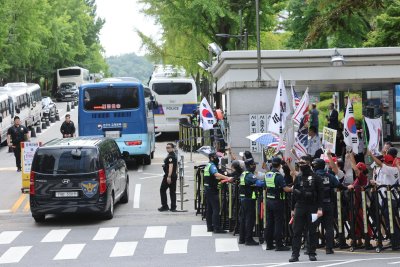
A vehicle believed to be carrying former South Korean President Yoon Suk Yeol enters the Seoul court complex in southern Seoul on Monday. Photo by Yonhap
A Seoul district court on Monday sentenced former President Yoon Suk Yeol to two years in prison after finding him partially guilty of accepting illegal political funds in the form of free opinion polls from a self-proclaimed power broker.
The Seoul Central District Court convicted the jailed former president on charges of violating the Political Funds Act in a ruling that marked a departure from a separate trial where his wife was acquitted on the same charges.
Special counsel Min Joong-ki’s team earlier indicted Yoon on charges of colluding with his wife, former first lady Kim Keon Hee, and receiving 58 opinion polls worth about 270 million won (US$180,100) in total for free from the power broker, Myung Tae-kyun, between April 2021 and March 2022.
In its ruling, the court recognized that Yoon had received 14 opinion polls from Myung for free over the period, sentencing him to prison and ordering a forfeiture of 13.96 million won.
It recognized the special counsel team’s argument that Yoon had promised to support former Rep. Kim Young-sun’s nomination as a candidate for the conservative People Power Party in the parliamentary by-elections in June 2022 in exchange for the opinion polls.
“The defendant’s actions sowed distrust in politics and undermined the public trust in the development of democracy,” the court said. “A punishment commensurate with the wrongdoing is inevitable.”
The court also sentenced Myung to 18 months in prison on the charges.
The special counsel team had sought a four-year prison sentence for Yoon and a three-year term for Myung.
The ruling diverged from an appellate court’s acquittal of Yoon’s wife on charges of accepting free opinion polls from Myung in a separate trial.
In Kim’s acquittal in April, the Seoul High Court ruled the couple could not be seen as profiting off the opinion polls as Myung had provided them to other people as well. Min’s team has appealed that ruling.
After the ruling, Yoon’s lawyers vowed to appeal, saying the verdict was “difficult to understand” given the former first lady’s acquittal in her trial.
The special counsel team called the latest ruling “very meaningful,” noting the bench appeared to have closely considered the various evidence and arguments presented in its judgment.
It marked the latest conviction for Yoon, who has been standing multiple trials following his failed 2024 martial law bid. In February, Yoon was sentenced to life imprisonment for leading an insurrection through his short-lived imposition of martial law.
Copyright (c) Yonhap News Agency prohibits its content from being redistributed or reprinted without consent, and forbids the content from being learned and used by artificial intelligence systems.
MILWAUKEE — Former Wisconsin Judge Hannah Dugan was spared from prison Wednesday for ushering a Mexican defendant out of her courtroom to evade U.S. Immigration and Customs Enforcement agents. A federal judge fined her $5,000 and cited her otherwise law-abiding life in issuing the sentence.
“I think this is a situation where an otherwise good person, upset by immigration policies in this country, made a bad decision in the moment,” U.S. District Judge Lynn Adelman said.
Dugan, 67, was convicted of felony obstruction in December. Her lawyers argued during her trial that President Trump’s administration sought to “crush” Dugan in an effort to ensure judicial compliance with the ICE strategy of targeting immigrants as they showed up for court hearings.
Dugan resigned the Milwaukee County circuit judgeship she had held for nine years in January amid threats of impeachment from Republican state lawmakers who labeled her an activist judge. In her resignation letter, she said her prosecution threatened “the independence of our judiciary.” Republican U.S. Rep. Tom Tiffany, a fierce Trump loyalist running for Wisconsin governor, urged authorities to “lock her up” in a social media post following her conviction.
Two Marquette University law professors spoke on her behalf, including a former state Supreme Court justice and a Jesuit priest who read a statement describing Dugan as a defender of oppressed people and saying he didn’t believe there was a need for punishment. “Hannah models what it means to be a Christian,” Gregory O’Meara said.
Dugan says she was just trying to do her job
Dugan then rose to address the court, saying she’s tried to do her best as a judge, and that her actions that day in April 2025 were not done maliciously but rather to maintain the “decorum and safety of the courtroom.”
“I have been cast as both a scofflaw and a hero. I am neither. I am a public servant who’s just trying to do my job,” Dugan said, adding that she has had to retire from public life due to threats against her and her family.
A prosecutor then acknowledged that “she has experienced collateral damage because of her conduct,” but said “judges can’t choose to disregard the law.”
Adelman then spoke, saying he doesn’t believe prison is necessary. He noted that Dugan lost her job, now has a felony conviction and experienced threats that forced her to move and stop attending community events.
“This is a few minutes of conduct for someone who has dedicated her life to public service,” the judge said. “It’s a marked deviation from an otherwise law-abiding life.”
He also noted that Dugan’s actions didn’t stop the ICE agents from arresting the defendant outside the courthouse.
Prosecutors pushed for a ‘serious sentence’
While jurors found her guilty of felony obstruction, they acquitted her of concealing an individual to prevent arrest, a misdemeanor.
Prosecutors argued in a sentencing memo filed last week that Dugan violated her oath as a judge and put both law enforcement and the public at risk.
“Judges are entrusted with tremendous discretion, but there is a line they cannot cross,” Executive Assistant U.S. Attorney Richard Frohling wrote. “The defendant crossed that line.”
Dugan’s attorneys argued she has been “punished enough,” including resigning as a judge and facing threats of violence. They argued in her sentencing memo that she should not be sentenced to any jail time besides the part of one day she already spent in federal custody.
Under federal sentencing guidelines, the presentence report calls for 15 to 21 months behind bars. The judge is not bound by those guidelines.
Prosecutors said the average sentence for obstruction cases is 16 months, but they did not recommend a sentence.
“This was a serious offense, and it warrants a correspondingly serious sentence,” Frohling wrote.
Attorney Jason Luczak said after the sentencing that they would still appeal Dugan’s conviction.
Dugan’s case was a first for Wisconsin
Dugan’s case marked the first time that a state judge in Wisconsin went to trial on charges of obstructing immigration agents.
On April 18, 2025, immigration officers went to the Milwaukee County courthouse after learning Eduardo Flores-Ruiz, 31, had reentered the country illegally and was scheduled to appear before Dugan for a hearing in a state battery case.
Dugan confronted agents outside her courtroom and directed them to the chief judge’s office, saying their administrative warrant wasn’t sufficient to arrest Flores-Ruiz.
After the agents left, she led Flores-Ruiz and his attorney out a private jury door. Agents spotted Flores-Ruiz in the corridor, followed him outside and arrested him after a foot chase. A week later, FBI agents arrested Dugan in the courthouse, leading her outside in handcuffs.
Flores-Ruiz was deported in November.
Savage and Bauer write for the Associated Press. Bauer reported from Madison, Wisc. AP contributors include Hannah Fingerhut in Des Moines, Iowa.
Dr. Hussam Abu Safia, held in Israeli prisons without charge since December 2024, is being tortured and on the verge of death, according to his lawyer who found him badly beaten on July 2nd.
Inmates and guards have been killed in fighting at a prison near Sri Lanka’s capital. Reports suggest at least 25 people have died and more than 100 others have been injured.
Elyas Abu Safia says his father can barely breathe or speak after more than 555 days in Israeli prison.
Published On 5 Jul 20265 Jul 2026
The son of a prominent Palestinian doctor abducted and held by Israel without charge has issued an urgent appeal for his father’s release, warning that his health has sharply deteriorated after more than 555 days in prison, as a rights group warned that his life was in danger.
Elyas Abu Safia, the son of Dr Hussam Abu Safia, said in a video message on Sunday that his father, the director of Kamal Adwan Hospital in northern Gaza, showed signs of severe abuse after Israeli authorities transferred him to solitary confinement in a maximum-security prison.
Recommended Stories
list of 3 itemsend of list
“The day before yesterday, the lawyer Nasser Odeh managed to visit my father, where he told us painful details about this visit,” said Elyas, who is also a doctor.
“My father was unable to breathe. My father was unable to speak,” he said, adding: “His face was disfigured from the marks of torture and pain, and the blood he endured inside the prison, especially after the last court session held in Jerusalem.”
Israeli forces arrested Abu Safia at work on December 27, 2024, as they intensified their attacks on northern Gaza’s healthcare system as part of the genocidal war against Palestinians in Gaza. Two months earlier, an Israeli drone attack killed another of his sons, Ibrahim, at the entrance of the hospital where he worked.
Elyas accused Arab and Muslim leaders of abandoning his father.
“You deprived us even of your voices, your solidarity and your support, which should have been there from the start of the detention,” he said.
“But sadly, your silence is a betrayal and a crime, and complicity in torturing my father and the hostages inside Israeli prisons,” he added.
‘The most shocking testimony’
Physicians for Human Rights Israel warned that Abu Safiya’s life is in immediate danger after his transfer to the Rakefet section of Nitzan prison.
The group said lawyer Nasser Odeh visited Abu Safia on July 2 and documented severe injuries, signs of assault, difficulty breathing and repeated loss of consciousness. It said guards brought him into the visit with his hands and feet bound and surrounded him with masked officers.
Odeh also saw fresh bruises and injuries on Abu Safiya’s head, around his eyes, ears and neck. The wounds were so severe that the lawyer struggled to recognise him, the group said.
“The information we received raises serious and immediate concerns for Abu Safiya’s life. The lawyer’s testimony is among the most shocking we have heard since the beginning of the war: a man detained without charge tells his lawyer that he believes they will kill him, after he arrived for the visit injured, suffering from difficulty breathing, and on the verge of losing consciousness,” Naji Abbas, director of the Prisoners and Detainees Department at Physicians for Human Rights, told the official Palestinian news agency Wafa.
Israeli authorities have not filed charges against Abu Safia. They classified him as an “unlawful combatant”, a designation Israel has used to hold Palestinians for prolonged periods without trial.
Physicians for Human Rights has demanded his release, along with other imprisoned Palestinian doctors. In March, United Nations experts also called on Israel to free Abu Safia immediately and ensure he receives medical care.
He is one of 14 Palestinian doctors from Gaza currently held by Israel without charge.
NEW ORLEANS — Louisiana’s attorney general has been indicted over accusations she threatened the jobs of New Orleans leaders who fought a Republican-led overhaul of local courts in the heavily Democratic city.
The 16-count indictment against Republican Liz Murrill, handed up Thursday by a New Orleans grand jury, charges Louisiana’s first female attorney general with intimidation and malfeasance.
At the center of the case are deepening rifts between state leaders in Louisiana, which is heavily Republican, and Democrats who control the state’s most prominent city.
Republican Gov. Jeff Landry promised a swift pardon, saying Murrill would not have her reputation tarnished by an “Orleans kangaroo court.” Mayor Helena Moreno, a Democrat, was among those who had accused the state’s top law enforcement official in May of making threats against public officials.
Murrill called the case against her “retaliatory, meritless, and unconstitutional.” Late Thursday, Murrill said she had filed for an emergency stay with the Louisiana Supreme Court.
“I will not back down. I will continue enforcing the law, fighting corruption, and doing the job the people of Louisiana elected me to do,” she wrote on X.
For months, political tensions intensified between Louisiana Republicans and New Orleans officials over a new law that abolished a court clerk office won by an exoneree, Calvin Duncan, who spent nearly three decades in prison. The change consolidated that job with another clerk’s office, which Republican supporters said would make the local judicial system more efficient.
The change was staunchly opposed by New Orleans leaders, and in May, the City Council set a special election that would have given Duncan a chance to win the newly combined job. Murrill responded by warning local officials in letters that they could lose their offices for violating state “usurper” laws, which forbid support for an unauthorized officeholder.
“We’re very interested in elected officials in New Orleans not being intimidated or threatened by letter or any other way,” special prosecutor Laurie White told reporters.
Bond for Murrill was set at $400,000 on Thursday, according to court records.
Landry said he was ordering state police to investigate what he called “alleged improprieties” of the grand jury and those who ran it.
“The criminal justice system is a circus at its finest in Orleans and we will not have any of that!” he wrote on X.
The Republican Attorneys General Assn. said that making statements to local officials — in writing — was simply “issuing a legal opinion and warning public officials about the law” as part of her official duties. It called the indictment “as outrageous as it is dangerous.”
Moreno, who was elected in January and was defiant after Murrill sent the letters, on Thursday called it a “matter for the courts” and did not directly address the allegations.
“My focus, as always, remains on fulfilling the responsibilities the people of New Orleans elected me to carry out,” Moreno said.
Duncan has said he believes state officials were retaliating against him in eliminating the job he won with 68% of the vote. Murrill and Landry have long refused to acknowledge his innocence, though he’s listed on the National Registry of Exonerations.
Republicans have said the change was not personal and supporters have noted that the offices of criminal and civil clerks of courts are combined in other parishes.
Duncan was a jailhouse lawyer who later graduated from law school. He founded a nonprofit dedicated to expanding incarcerated people’s access to the court system and was the driving force behind a 2020 U.S. Supreme Court decision that ended nonunanimous jury convictions.
Duncan spent more than 28 years in prison over a fatal shooting during a robbery in 1981.
The night before a 2011 hearing to consider new evidence, prosecutors offered to reduce Duncan’s sentence to the time he’d already served in prison if he pleaded guilty to manslaughter and armed robbery. Duncan took the deal and was freed but didn’t give up on clearing his name.
In 2021, a judge agreed that Duncan had been unjustly convicted and vacated his sentence altogether. Landry and Murrill have pointed to the 2011 plea deal in objecting to Duncan calling himself exonerated.
Riddle and Hanna write for the Associated Press. Associated Press reporter Jack Brook in New Orleans contributed.
US Secretary of State Marco Rubio says the gang had also been classified as a ‘Specially Designated Global Terrorist’.
Published On 2 Jul 20262 Jul 2026
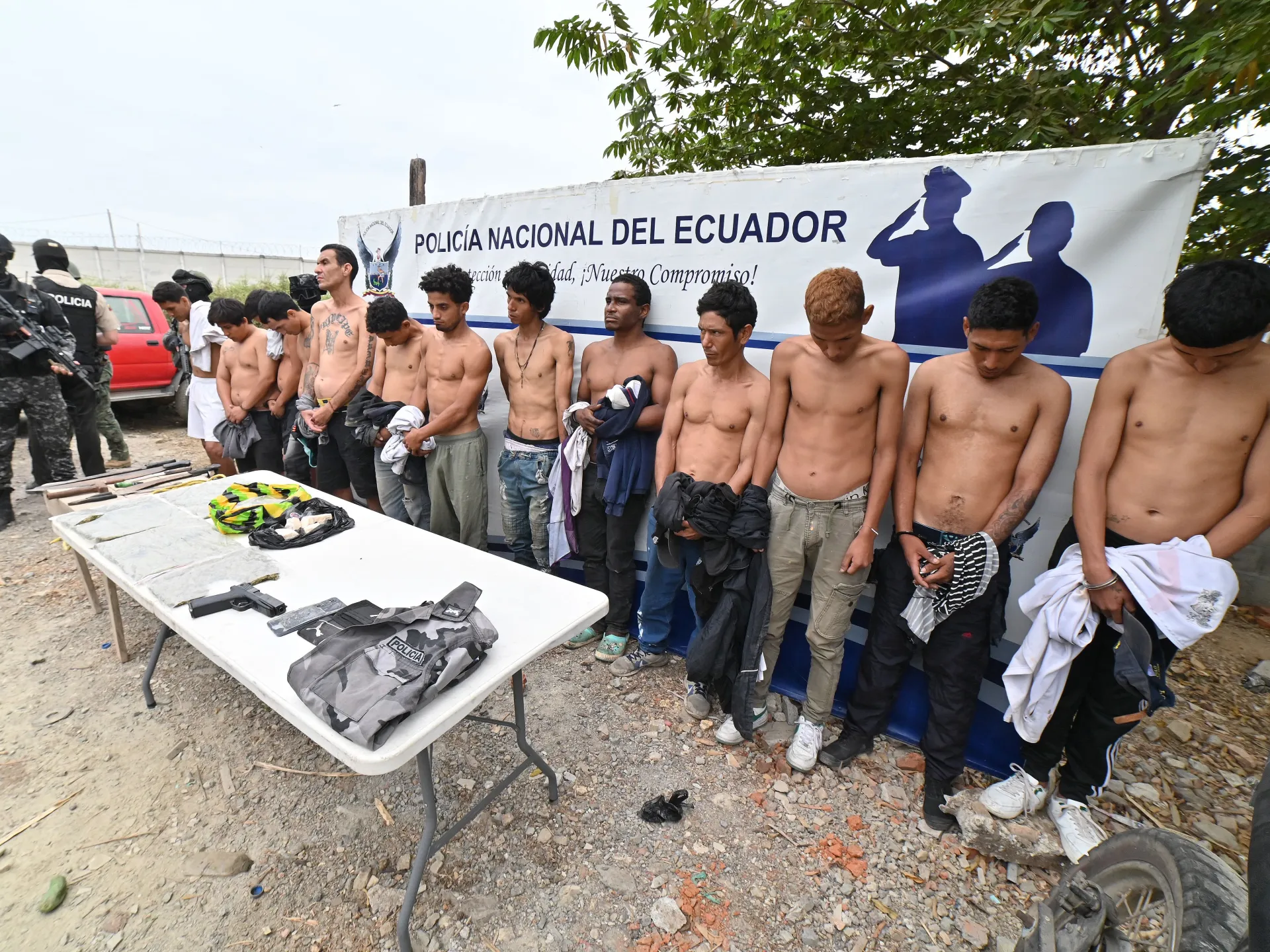
The US State Department has designated the Ecuadorean gang Chone Killers as a foreign “terrorist organisation”, imposing sanctions on a crime group that Washington has accused of carrying out attacks on civilians and public officials.
US Secretary of State Marco Rubio said the gang has also been classified as a “Specially Designated Global Terrorist”.
Recommended Stories
list of 3 itemsend of list
“Chone Killers has committed numerous attacks targeting civilians, law enforcement officers and government officials, including high-profile assassinations of public officials,” Rubio said in a statement announcing the designations.
The move against the Ecuadorian street gang is part of a broader campaign by US President Donald Trump’s administration on organised crime and drug trafficking in Latin America.
The Trump administration has designated several other Latin American gangs and drug cartels as “terrorist” organisations, including Venezuela’s Tren de Aragua and the Mexican Sinaloa cartel.
“The Trump administration, in partnership with Ecuador and President Daniel Noboa, will continue to protect our hemisphere by keeping illicit drugs off our streets and disrupting the revenue streams funding violent narcoterrorists,” Rubio said.
Rubio also alleged that Ecuadorean gangs help Mexican cartels transport and export illegal drugs, which he said fund “terrorism” and other criminal activity.
Ecuador’s Ministry of Foreign Affairs welcomed the US decision, saying it reflected Washington’s strong support for Noboa’s campaign against criminal organisations.
“The Government of Ecuador thanks the firm support of the United States for the decision by President Daniel Noboa to maintain an all-out fight against criminal organisations,” the Foreign Ministry said in a statement posted on X.
Noboa, a staunch ally of Trump, has imposed curfews and deployed the military to several provinces in a US-backed crackdown aimed at stamping out gang activity.
Carl Erik Rinsch, the director of the 2013 Keanu Reeves action film “47 Ronin,” will serve more than two years in federal prison for defrauding Netflix of $11 million.
U.S. District Judge Jed S. Rakoff on Monday sentenced 48-year-old Rinsch to 30 months in prison, the U.S. Attorney’s Office, Southern District of New York, announced. Federal prosecutors convicted Rinsch in December of wire fraud, money laundering and other counts. A legal representative for Rinsch did not immediately respond to a request for comment on Tuesday.
Federal prosecutors indicted Rinsch in March 2025, alleging the $11 million went into Rinsch’s personal accounts. The filmmaker “quickly transferred” the money from the Rinsch Co. account, where it had been deposited March 6, 2020, by Netflix, through additional accounts until about $10.5 million wound up weeks later in a personal brokerage account. He lost more than half of that money in less than two months via risky investments in the stock market, the indictment said.
Though Rinsch told the streamer that his sci-fi show “White Horse” was progressing nicely, the filmmaker allegedly moved the remaining money into cryptocurrency and profited from crypto speculation over the next couple of years. The streamer had invested around $44 million in the show. Rinsch was accused of spending around $10 million on five Rolls-Royces, a Ferrari, watches, clothing, luxury bedding and linens, credit card bills, attorneys to sue Netflix for more money, and lawyers to work on his divorce.
He was arrested in West Hollywood and released the same day after agreeing to post a $100,000 bond to guarantee his appearance in a New York federal court.
Rinsch never finished the Netflix show.
During his sentencing, Rinsch and his legal team told the court his behavior was a result of mental health struggles and medication problems and they are working to address those issues with a new care provider, the Associated Press reported.
“I failed to recognize the danger of the state I was in,” Rinsch said, though his mental issues were not described in court, and his attorneys declined to provide further detail.
Ahead of the sentencing, Reeves — the star of Rinsch’s most notable project to date — penned a letter in May requesting “leniency and mercy as well as justice” in the filmmaker’s sentencing.
In addition to prison time, Rinsch must serve three years of supervised release, forfeit the $11 million and pay $700 in mandatory special assessments, according to Monday’s announcement. U.S. Attorney Jay Clayton said in the announcement: “Today’s sentence sends a deterrent message: fraud will not be tolerated.”
The Associated Press and former Times assistant editor Christie D’Zurilla contributed to this report.
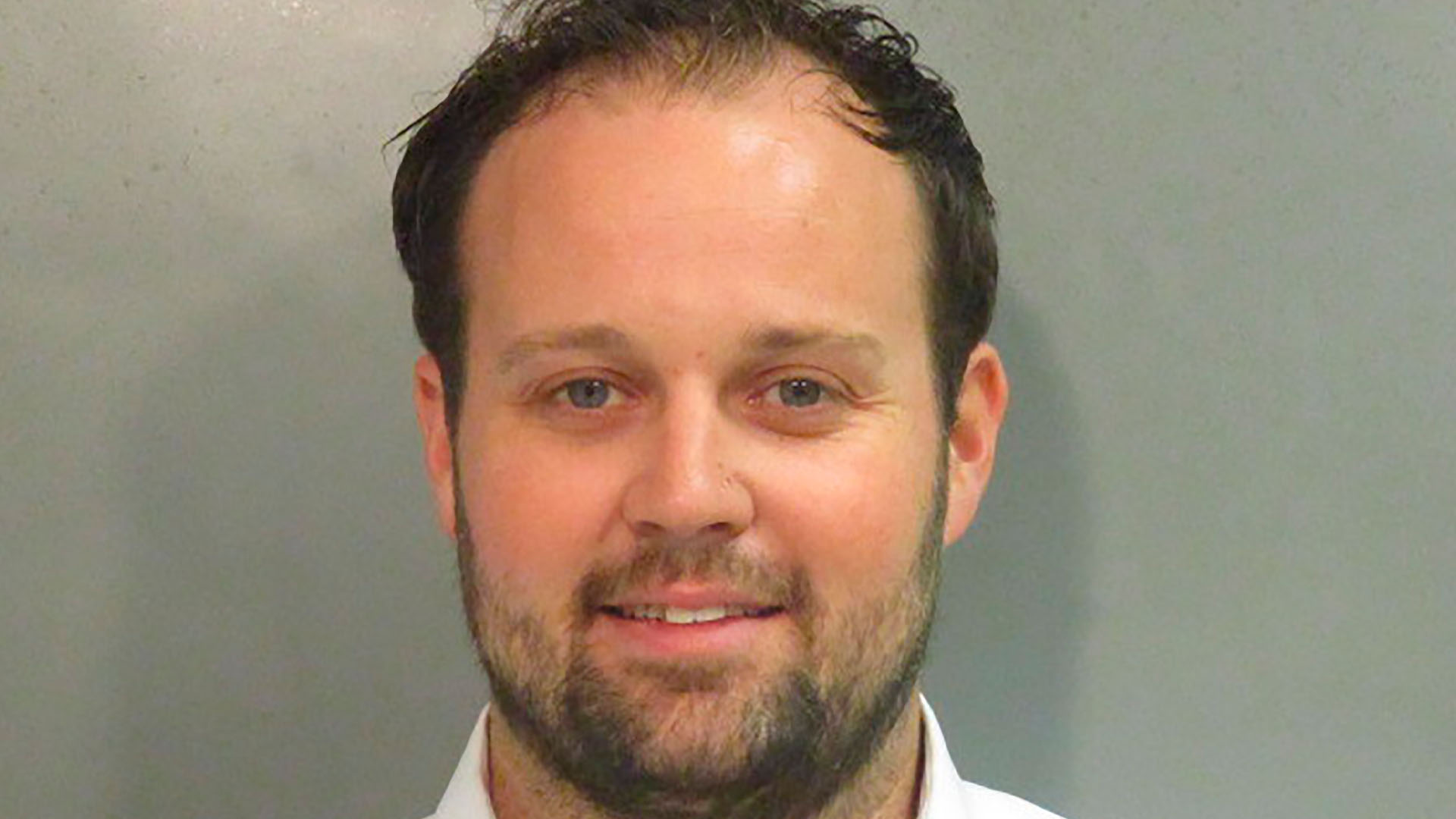
JOSH Duggar has been moved to a new federal prison more than 100 miles closer to his wife and family after leaving a medical facility, The U.S. Sun can exclusively reveal.
The disgraced TLC reality star, 38, is currently serving more than 12 years after being convicted of receiving and possessing child sexual abuse material following his arrest in April 2021.
Sign up for the Showbiz newsletter
Thank you!
A federal judge sentenced reality Duggar to about 12 1/2 years in prison for his conviction on one count of receiving child pornographyCredit: APAnna is pictured picking the couple’s children up in 2024 while Duggar was behind barsCredit: The U.S. SunJosh and Anna Duggar have been married for almost 18 years after tying the knot in 2008Credit: AlamyJosh Duggar previously served time at FCI Seagoville, Texas after being convictedCredit: John Chapple for The U.S. Sun
Official records show he has been transferred to the Federal Transfer Center in Oklahoma City after a short stay at the Federal Medical Center in Fort Worth, Texas.
A Bureau of Prisons spokesperson previously said inmates may be transferred for a variety of reasons, including medical concerns, or other measures designed to maintain institutional safety and inmate protection.
Duggar is now about 218 miles from the family’s home in Tontitown, Arkansas — compared to the roughly 350-mile journey to FCI Seagoville in Texas, where he had been incarcerated since 2022.
The new facility serves as a temporary processing hub for federal inmates being moved between prisons, which means Duggar could be transferred again before serving out the remainder of his sentence.
The U.S. Sun has reached out to the bureau and Duggar’s lawyers comment.
He has been incarcerated since his conviction on federal child pornography charges stemming from downloads made at the used car dealership he operated in Springdale, Arkansas.
In December 2021, a federal jury found him guilty of receiving and possessing child sexual abuse material after investigators traced illegal downloads to a password-protected computer at his business.
Prosecutors argued Duggar was the only person with the knowledge and access needed to download the files.
Most read in Entertainment
In May 2022, he was sentenced to 151 months — more than 12 years — in federal prison, followed by 20 years of supervised release.
He was also ordered to pay a $10,000 fine.
Ever since, Duggar has unsuccessfully fought to overturn his conviction, arguing that errors were made during his trial and that evidence should not have been admitted.
Federal appeals courts have rejected the arguments, leaving his conviction and sentence intact.
His wife Anna has remained publicly loyal to her husband throughout his imprisonment despite the scandal that ended the Duggar family’s reality TV empire.
She has regularly visited him in prison and attended court hearings during his legal battle, while continuing to raise the couple’s seven children in Arkansas.
They have been married since September 2008 and have seven children together.
The Bureau of Prisons has not disclosed why Duggar was transferred or where he will ultimately be sent next.
Federal inmates are commonly moved because of security classifications, institutional needs, programming opportunities, medical reasons or other administrative decisions.
For now, Duggar remains in Oklahoma City as officials determine his permanent placement.
His projected release date remains October 2, 2032, according to Bureau of Prisons records.
Meanwhile, his racy messages to his wife Anna while he was in custody in Arkansas were revealed in a report by PEOPLE.
“[I] miss you my lover. i miss being in the shower with you scrubbing, i miss watching you try on clothes, I miss watching you being sexy,” Josh wrote.
He also congratulated his wife for “making the scale numbers lower than expected” and suggested she buy herself “something low cut” to wear in the shocking text.
He continued, “[O]r you can try on clothes and send me a pic of you in your bra and panties 😉 or try on ‘go to the private pool for sun’ swimsuit? btw you should order you a 2-piece swimsuit since summer is coming on soon, get something hot and fun.”
Josh then signed off, telling her he would love her forever and calling her “sexy.”
He wrote a similar sign-off in a message sent to Anna, 38, days later, and added, “p.s. – send pics asap as requested, imlied (sic), inferred or otherwise stated lol. nice one(s) with your twos in it! (OvO).”
A night on the beers could start in a jail cell in this unique pub, but it’s just one of the unusual buildings that has seen new life after being turned into a ‘Spoons – here’s a roundup of some unique places you can enjoy Curry Club or just a quiet pint
This Lake District pub is a unique place for a pint(Image: J D Wetherspoon plc)
Love or hate Wetherspoons, you have to admit that the giant pub chain has a knack for turning some unique venues into places to grab a pint and enjoy a cheap lunch.
Across the UK, many abandoned buildings are being turned into drinking venues, and while the settings are unique, all the places have the same classic ‘Spoons menu and deals, so you know what you’re getting when you visit.
Here are some of the weirdest venues snapped up by Wetherspoons, from an old bank where you can sit in the vault, to a dramatic opera house that has kept its opulent vibes for a classy start to your night on the town.
1. The Chief Justice of the Common Pleas – a courthouse with jail cells
Built around 1901 in the Lake District town of Keswick, The Chief Justice of the Common Pleas was originally a magistrates’ court and a police station, where unlucky criminals would often be caught and thrown in one of its cells for the night before trial. No doubt many a drinker ended up here after a few too many beers.
Nowadays, the sturdy brick cells have been turned into booths where you can enjoy a drink with friends, and while there’s a much cheerier atmosphere, you can still see the remains of the building’s old life. There are heavy metal doors with locks and high windows covered with bars that once kept people securely inside. However, punters are free to roam outside for a drink in the beer garden, surrounded by the classic Lake District stone buildings of this charming market town.
2. The Rawson Spring – former swimming pool
Kids who grew up in the 70s and 80s around Sheffield may well have taken their first dip in the former Hillsborough Baths, which are now a ‘Spoons called The Rawson Spring. These vast council-run baths opened in 1926 and closed in 1991, hosting many decades of swimming lessons and summer fun.
The cavernous space has since been turned into a giant Wetherspoons, and many of the original features may still be recognised by eagle-eyed former customers. The balcony around the top where spectators once stood is still intact, and you can still see the old poolside changing rooms where tables are now set up.
3. Opera House
If you’re looking for a classy and cultural setting in which to enjoy your chicken basket, then head to the Opera House in Tunbridge Wells. The name pretty much sums it up. This ornate Grade II listed building was designed by famous architect John Priestley Briggs and completed in 1902, becoming a bingo hall in the 60s before Wetherspoons snapped it up in 1996.
Its red interiors with gold accents and chandeliers still make it feel much like a space for a grand performance, and occasionally the local opera group will put on a show worthy of this beautifully preserved building.
4. The Counting House – former bank with vault
Wetherspoon has converted plenty of old banks over the years, but one of the most notable is The Counting House in Glasgow, where you can drink inside a former vault.
Once a major branch of the Bank of Scotland, this Italian Renaissance-style building was constructed between 1867 and 1870, with a high domed ceiling, marble fireplaces, Corinthian columns, and stone statues. Nowadays, the main bar sits under the dome, and punters can also sit behind bars in the old vault. Although luckily, with Wetherspoons prices, you won’t need to rob a bank to get a round in.
5. Piccadilly Hall – former amusement park loved by 90s kids
If you were a 90s kid on a day out to the capital, odds were you’d beg your parents to take you to London Trocadero. This iconic building set at 30 Shaftesbury Avenue was once the ultimate indoor amusement park, with several floors of arcade machines and even an indoor drop ride at its centre. It’s perhaps best remembered as the home of SegaWorld, which was reached by a giant rocket escalator.
When Trocadero closed, parts of it became a pod hotel, and now there are plans to turn some of the building into one of London’s largest ‘Spoons in the heart of Theatreland. Reportedly set to open in late 2026, Piccadilly Hall will span over 3,600 square feet, offer a massive 280 covers, and open from 7am until midnight, seven days a week.
Have a story you want to share? Email us at webtravel@reachplc.com
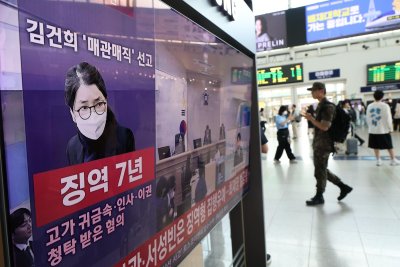
A TV screen shows a live broadcast of former first lady Kim Keon Hee’s bribery trial at Seoul Station on Friday. Kim was sentenced to seven years in prison. Photo by Yonhap
A Seoul court on Friday sentenced former first lady Kim Keon Hee to seven years in prison for taking expensive gifts in return for job appointments and business favors.
The Seoul Central District Court handed down the sentence to Kim, the wife of ousted former President Yoon Suk Yeol, after she was indicted on charges of accepting bribes for mediation, including over 100 million won (US$64,750) worth of jewelry in exchange for a government job for a son-in-law of a construction company chairman.
In total, she was charged with taking approximately 300 million won worth of gifts, and the court found her guilty on all counts.
“The defendant disregarded the social responsibilities associated with the position of first lady and used it merely as a means to pursue her private interests,” presiding judge Cho Sun-pyo said during the hearing, which was televised live.
Kim was indicted in December on charges of receiving a Van Cleef & Arpels necklace and other jewelry from the construction company chairman between March and May 2022; a golden turtle ornament in April 2022 from Lee Bae-yong, former head of the National Education Commission, in exchange for her appointment; a Dior bag worth 5.4 million won from a pastor the same year; and a Vacheron Constantin watch from another businessperson in September 2022.
In February 2023, she was accused of receiving a painting by renowned artist Lee Ufan from a former prosecutor in return for her help in securing him a nomination for an election.
The exchanges mostly took place during the period her husband was in office from May 2022 until his ouster in April 2025.
The judge said Kim sought to evade responsibility for her crimes by returning some of the gifts once an investigation got under way or arguing she had purchased them herself.
“This shows that she was fully aware of the illegality of her actions but tried to conceal it,” he said.
Special counsel Min Joong-ki’s team, which had demanded a 7 1/2-year prison term, welcomed the ruling. Kim’s lawyers said they would appeal.
The court also sentenced the construction company chairman to a one-year prison term, suspended for two years, the businessperson who gifted the watch to a 10-month prison term, suspended for two years, and the pastor to a fine of 8 million won.
The former first lady has already been sentenced by an appeals court to four years in prison in a separate corruption case.
She is also set to stand trial over her alleged involvement in a case where members of the Unification Church were reportedly forced to join the now main opposition People Power Party ahead of the 2022 presidential election in an attempt to influence the outcome of the party primary to pick its presidential candidate, which her husband Yoon won.
Copyright (c) Yonhap News Agency prohibits its content from being redistributed or reprinted without consent, and forbids the content from being learned and used by artificial intelligence systems.
Detroit Lions cornerback Terrion Arnold has been arrested in connection to an alleged armed attack on a group of men in Tampa, Fla., in February. He faces eight felony charges of kidnapping and robbery that could keep him in prison for life if convicted.
Investigators believe Arnold was the “primary conspirator” in an alleged plot that left three young men with “visible injuries from being battered, held at gunpoint, and pistol-whipped before their personal property was stolen and they were ordered to leave,” the Tampa Police Department said Wednesday in a news release.
Six other suspects previously were arrested. Two women already pleaded guilty and agreed to help authorities prosecute Arnold, police said.
The second-year player turned himself in Wednesday night and was held in a Hillsborough County jail without bond before his arraignment hearing Thursday afternoon.
Arnold appeared remotely during the brief hearing, where he was charged with three counts of robbery with a firearm or deadly weapon for less than $750 and three counts of kidnapping to harm or terrorize, all of which are first-degree felonies. He was also charged with two second-degree felonies for conspiring to commit those crimes.
“He’s absolutely denying these allegations,” defense attorney R. Timothy Jansen said during Hillsborough County court proceedings.
Arnold will be held without bond until a pretrial detention hearing Monday, where the Hillsborough County state attorney’s office will argue for him to remain behind bars until trial.
According to Tampa police, several items belonging to Arnold and others were stolen Feb. 1 from an Airbnb rental property in Largo. They reported to Largo police that the items were worth more than $250,000.
The alleged incident that led to Arnold’s arrest occurred early Feb. 4. It was plotted, Tampa police said, because Arnold suspected that two of the three men were responsible for stealing the items. Investigators later determined those men were not involved, police said.
Police said the victims were lured to an apartment, where they were held at gunpoint and hit by suspects who were streaming the alleged attack to Arnold, who is accused of helping coordinate the plot and giving orders to the alleged attackers on a group chat during the incident. He later arrived at the apartment and drove some of the suspects away, police said.
“Fame doesn’t get you out of criminal charges or our pursuit of justice and holding criminals accountable,” Tampa police chief Lee Bercaw said in a statement posted to X. “Our victims now have some closure thanks to the great work of our detectives and our strong partnership with State Attorney Suzy Lopez.”
The head of the management agency that represents Arnold said in a statement that the former first-round draft pick “categorically denies any involvement in the matters unlying the allegations made against him and maintains his innocence.”
“There is no credible evidence linking Mr. Arnold to these allegations,” EAG Sports Management CEO Denise White said. “Instead, the government appears to be relying on testimony from multiple convicted felons who have admitted their own involvement and may have substantial incentives to shift blame in an effort to lessen their sentences.”
Arnold has played in 24 games for the Lions. He had 31 tackles and an interception last season before going on injured reserve with a shoulder injury on Dec. 1.
The Lions said they are aware of Arnold’s situation but have no further comment.
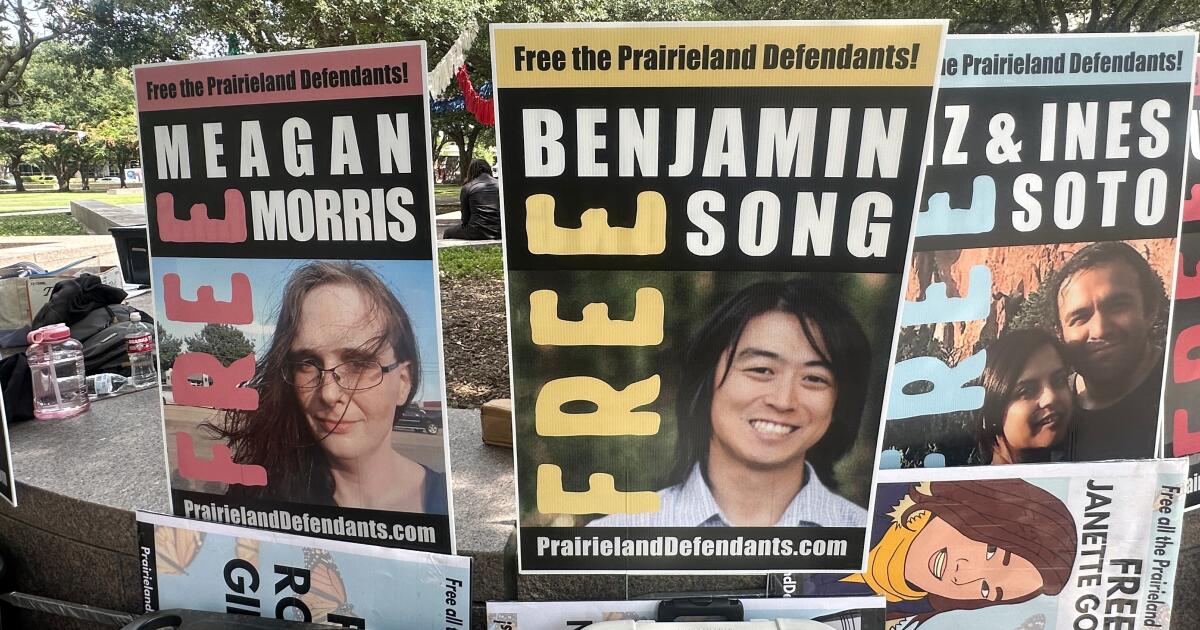
FORT WORTH, Texas — A demonstrator who shot and wounded a police officer outside a Texas immigration center last July 4 was sentenced to 100 years in federal prison Tuesday, while other protesters accused of having links to antifa were given multiple decades in federal prison.
Benjamin Song was convicted of attempted murder last March after prosecutors say he opened fire and wounded a police officer at the Prairieland Detention Center in Alvarado.
The seven other protesters sentenced Tuesday received prison terms ranging from 30 to 70 years.
“Our issue with this case has always been this isn’t a bunch of terrorists. This is a bunch of kids and young adults who really have a really big heart and really wanted their voice to be heard,” Philip Hayes, Song’s attorney, said outside the federal courthouse in Fort Worth. “It was never intended that anybody get hurt. It was never intended that any shots would be fired.”
He said his client would appeal the sentencing.
“Song, aside from this day, has had an impeccable life. A former Marine. A good student,” Hayes said. “He had a lot of good qualities that were just ignored. The judge went ahead and gave as much as he could.”
One of the defendants, Daniel Sanchez Estrada, was convicted of corruptly concealing a document and conspiracy to conceal documents. Others pleaded guilty to providing material support to terrorists rather than take their case to trial.
Prosecutors say the eight are members of antifa, a decentralized anti-fascist organization that has become a target of the Trump administration. They have denied any affiliation and maintain they attended the demonstration to show support for immigrants inside the detention center.
President Donald Trump last fall signed an executive order designating antifa a domestic terrorist organization, even though there is no domestic equivalent to the State Department’s list of foreign terror organizations.
Critics warn the case could have wide-reaching impact on protests given that organizations operating within the U.S. are supposed to be protected by First Amendment free-speech rights.
Short for “anti-fascists,” antifa is not a single organization but rather an umbrella term for far-left militant groups that confront or resist neo-Nazis and white supremacists at demonstrations.
Last week, federal prosecutors charged 15 people with impeding the Trump administration’s immigration crackdown in Minnesota. They claimed the demonstrators were members of antifa who conspired against the federal government to block arrests and deportations by setting up blockades around government buildings and throwing chunks of ice at federal vehicles, among other actions.
Stengle and Marcelo write for the Associated Press. Marcelo reported from New York.
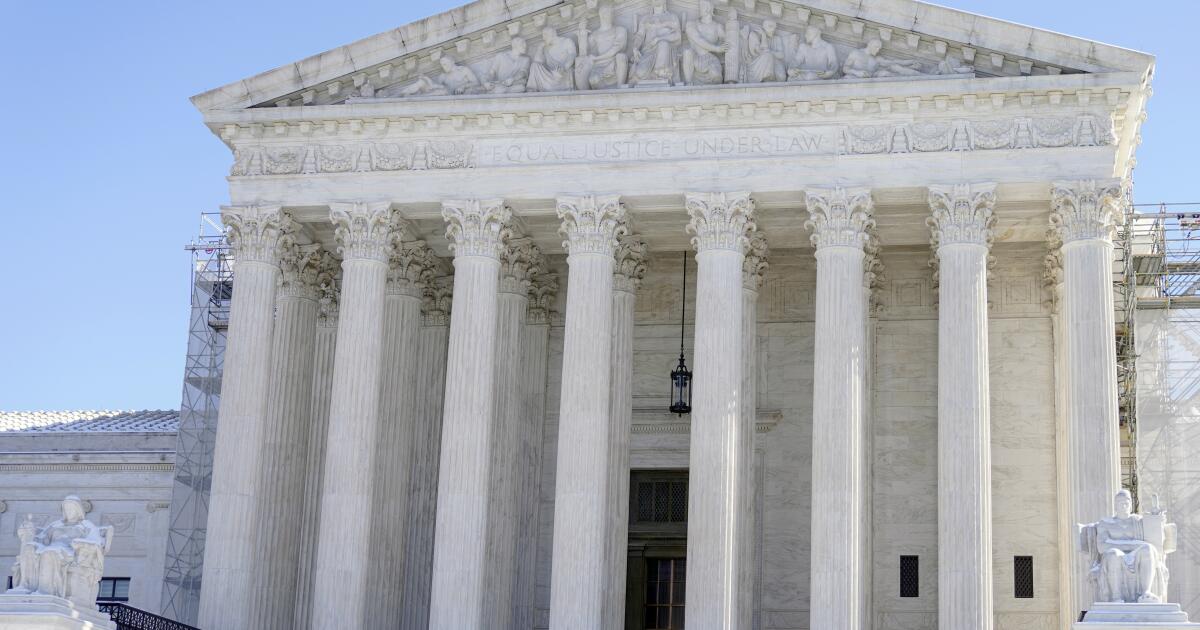
WASHINGTON — Prison inmates whose religious rights are clearly violated by guards and wardens may not sue them for damages, a divided Supreme Court ruled Tuesday.
In a 6-3 decision, the justices said federal law protecting religious liberty allows for suits against state prison systems, but not employees of the prison.
The decision came in the case of a devout Rastafarian in Louisiana. Damon Landor had grown dreadlocks for nearly two decades. He had three weeks left in a five-month prison term when he was transferred to another prison in Louisiana.
He had with him a copy of a federal appeals court opinion that said Rastafarian inmates had a protected religious right to wear dreadlocks.
But the guards threw the appeals court decision in the trash, and the warden ordered the guards to handcuff Landor to a chair and shave his head.
Shortly after he was released, Landor sued the warden and the guards for violating the 2000 law, known as RLUIPA, which promised “appropriate relief” to those whose rights were violated.
But a federal judge, the 5th Circuit Court and now the Supreme Court have tossed out Landor’s suit.
Justice Neil M. Gorsuch wrote for the six conservatives.
He explained that when the federal government gives states money for prisons, education, healthcare and other matters, it can require them to follow the law but it does not authorize private lawsuits against their employees
“To know that is enough to know the Court of Appeals was correct. Mr. Landor does not have a federal RLUIPA cause of action against the officers,” Gorsuch wrote. “Congress lacks regulatory authority to impose liability on them directly.”
The three liberals dissented.
“Today’s decision magically transforms a federal statute into an invitation to be accepted or declined, deemed binding only if each particular defendant has explicitly agreed to be penalized,” wrote Justice Ketanji Brown Jackson. “Prisoners like Landor who suffer violations of their religious freedom in state prisons — no matter how blatant — will often be left remediless.” Justices Sonia Sotomayor and Elena Kagan agreed.
Civil liberties advocates denounced the decision.
“Our justice system is built on the promise of accountability when rights are violated,” said Rachel Rossi, president of the Alliance for Justice. “If there is no remedy for such a transgression, then there is no justice. This ruling will further erode critical civil rights protections of the far too many incarcerated people in this country.”
Rachel Laser, chief executive of Americans United for Separation of Church and State, said today’s decision “endangers the religious freedom of incarcerated people, like Damon Landor, who are particularly vulnerable to abuse and having unnecessary burdens placed on their religious exercise. Once again, we see a court that will bend over backward for the religious freedom of Christians, but allows the government to trample the religious freedom of non-Christians.”
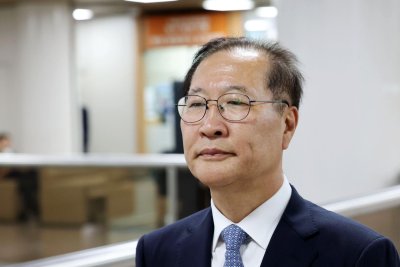
Former Justice Minister Park Sung-jae appears for his trial on charges of playing a key role in former President Yoon Suk Yeol’s martial law bid at the Seoul Central District Court on Monday. Photo by Yonhap
Former Justice Minister Park Sung-jae was sentenced to 25 years in prison Monday after a district court found him guilty of playing a key role in an insurrection through his involvement in former President Yoon Suk Yeol’s martial law bid.
The Seoul Central District Court handed down the heavy punishment for Park, which surpassed the 20-year prison term sought by special counsel Cho Eun-suk’s team. The court immediately placed Park under custody, citing concerns that he may destroy evidence.
Cho’s team earlier indicted Park on charges of playing a key role in an insurrection and abusing his power by calling a meeting of senior ministry officials following Yoon’s declaration of martial law on Dec. 3, 2024.
The court convicted Park on both charges, recognizing the special counsel team’s argument that Park had called the meeting to review dispatching prosecutors to a martial law-supporting body, check the capacity of correctional facilities, allegedly to hold politicians and key figures expected to be arrested under the martial law, and order ministry officials in charge of imposing travel bans to report for work.
“The defendant ultimately turned his back on his duty of upholding the Constitution at the idea that the insurrection could succeed, choosing to instead take part in it,” the court said.
Park joins other members of Yoon’s Cabinet who have been convicted of playing a key role in an insurrection, including former Prime Minister Han Duck-soo and former Defense Minister Kim Yong-hyun.
In February, Yoon was sentenced to life imprisonment for leading an insurrection through his short-lived imposition of martial law. He has appealed the ruling.
Meanwhile, the court dismissed additional charges against Park for violating the anti-graft law, ruling that it did not fall under the special counsel’s investigation mandate.
The special counsel team had also indicted Park on charges of giving inappropriate orders to his subordinates in line with a request from Yoon’s wife, Kim Keon Hee, in May 2024, to check certain details of the prosecution’s investigation into her corruption allegations.
Copyright (c) Yonhap News Agency prohibits its content from being redistributed or reprinted without consent, and forbids the content from being learned and used by artificial intelligence systems.
Syrian journalist Mousa al-Omar reportedly filed a complaint about Akkad’s social media comments prior to his arrest.
British Syrian activist Hassan Akkad has been detained by security forces in Damascus, in an alleged response to his online comments criticising a prominent journalist.
Akkad, founder of the Give Us the Money That You Owe! campaign, was taken into custody on Wednesday at about 9:45pm local time (18:45 GMT) while at a cafe in the capital’s al-Malki neighbourhood, the statement said.
Recommended Stories
list of 3 itemsend of list
His detention appears to be related to a legal complaint filed by Syrian journalist and presenter Mousa al-Omar in relation to “Hassan’s social media activities and public comments”, the campaign reported.
It added that he was summoned by the cybersecurity branch on June 4. Al Jazeera understands that Akkad is still detained.
“He later became aware that additional cases had also been filed against him, although he was not informed of the identities of the complainants,” the campaign said.
Al Jazeera reached out to the Syrian government regarding he case but has yet to receive a response regarding the activist’s arrest. Public Prosecutor Judge Hossam Khattab confirmed that Akkad had been detained due to a search warrant being issued for him, but that the case against him had been dropped.
Al-Omar told Al Jazeera that he had instructed his lawyer to tell the police that he had dropped the case against Akkad and said he was “saddened” by what had happened.
“I am sorry for what happened to Hassan as a result of his mistakes; I followed the legal path under the cybercrime law… Everything I pledged, amounting to $700,000 in projects and cash, was paid in the donations,” he said.
Akkad’s campaign tracks financial commitments related to a public drive for donations to fund Syria’s reconstruction since the ouster of President Bashar al-Assad.
The activist reportedly criticised al-Omar on social media in recent weeks for allegedly failing to deliver on his financial pledges to the country’s rehabilitation efforts, pledges he claimed were worth thousands of dollars.
The campaign said after Akkad was summoned, he paused his online activities related to the case, to “allow the investigation and legal process to proceed”.
Akkad, a refugee and former English teacher in his late 30s, previously won BAFTA and International Emmy awards for documenting his journey from Turkiye to Europe after fleeing the Syrian civil war that began in 2011, during which he was arrested by the al-Assad’s authorities.
He eventually settled in the United Kingdom in 2015, returning to Syria after years in exile when al-Assad fled the country.
According to witness accounts cited in the statement, five plainclothes security officers entered the coffee shop where Akkad was meeting with several journalists.
Witnesses said the officers initially requested Akkad’s mobile phone before informing him that he was being arrested.
His lawyers said the arrest raises questions about whether authorities followed established legal procedures.
“No legal basis for the arrest … was presented at the time of his detention,” the statement said,
It added that since the allegations appear to be related to his online commentary, the arrest raises “broader concerns regarding the protection of freedom of expression”.
The statement further questioned the reported use of a cybersecurity law enacted during the rule of al-Assad, arguing that reliance on such legislation “appears inconsistent with the interim government’s commitments to expand protections for freedom of expression following the collapse of the previous regime”.
A bill to tighten California’s rules on mental health diversion — a process that allows certain criminal defendants to avoid prison for arrests linked to mental illness — is now on the verge of being signed into law by Gov. Gavin Newsom.
Assembly Bill 46, authored by Stephanie Nguyen (D-Elk Grove), gives judges much wider discretion to decide whether a defendant should be eligible for diversion. Under the current law, judges must presume mental illness was a factor if a defendant with a legitimate diagnosis seeks diversion. In order to defeat a diversion request, the burden is on prosecutors to prove mental health issues were not a factor in the alleged crime.
The new measure — which moved through the state Senate with no opposition last month and is expected to clear the reconciliation process in the Assembly this week — also gives judges more latitude to block diversion if a defendant poses “a risk of danger to public safety,” as opposed to the higher “unreasonable risk” standard that was passed in 2018. Defendants charged with attempted murder will no longer be eligible for diversion under the new bill.
Proponents of more inclusive diversion policies argue that many people with mental health issues are locked up in California prisons and jails, where they are unable to receive the help they need.
The pending bill’s supporters say its changes are designed to address cases like that of Gilberto Guttierrez, a Los Angeles County man who has been accused of attacking his wife four times over the last 12 years.
In 2014, a misdemeanor domestic violence allegation landed Guttierrez on probation. Three years later, Guttierrez was ordered to take anger management classes after prosecutors brought felony domestic violence charges against him. Last February, prosecutors allege, he carried out a “brutal attack” on his wife with a glass bottle, leaving her with “extensive injuries,” according to a motion filed in his current criminal case. That time, the court filings show, Guttierrez threatened to kill her.
Despite objections from prosecutors and L.A. County probation officials, a judge granted a request to give Guttierrez mental health diversion last July.
A month later, prosecutors allege, he beat his wife until she fell into a coma.
When it passed in 2018, the original mental health diversion law was heralded as a needed off-ramp for defendants suffering from serious psychological issues — offering treatment to those who need it rather than a prison cell. But with voters statewide souring on progressive criminal justice reforms, lawmakers have sought to make it harder for defendants to qualify.
“AB 46 preserves diversion as an important pathway to care while ensuring judges have a clearer and more workable standard when serious public safety concerns are present,” Nguyen said in a statement last month.
Under the existing rules, defendants who successfully argue for pretrial mental health diversion spend two years undergoing a court-appointed treatment plan instead of facing a conviction. Prosecutors must prove the defendant is likely to commit a serious violent crime, a so-called “super strike,” again in order to block diversion.
Los Angeles County Dist. Atty. Nathan Hochman, one of many prosecutors statewide who supported Nguyen’s bill, said that has been a nearly impossible standard to overcome.
“Guttierrez being your example: Judge, if you release him, he’s going to probably beat his wife up again, and if he does this time, he could kill her. But for the grace of God, he hasn’t killed her up until now,” Hochman said.
He added that due to the judge’s decision to grant diversion in Guttierrez’s case, “you have three little kids who likely won’t have their mom for the rest of their life.”
A spokesperson for Newsom did not respond to a request for comment about his plans for the legislation.
A 2020 Rand Corporation study found 61% of the nearly 5,500 mentally ill inmates housed in Los Angeles County at that time were “likely appropriate candidates” for diversion.
But a number of troubling incidents have led to pushback against the existing diversion law.
In a letter supporting Nguyen’s bill, the California District Attorneys Assn. rattled off a list of cases in which prosecutors say the law’s shortcomings had deadly consequences. They pointed to a case in Sacramento where a defendant stabbed a 40-year-old man to death after he was granted diversion in a robbery case. In Santa Clara, the letter said, a woman on mental health diversion for carjacking proceeded to steal another car and slam it into an outside table at a restaurant, leaving one person dead and others injured.
Nikhil Ramnaney, a former federal prosecutor who now works as a defense attorney in Southern California, said thousands of people benefit from mental health diversion every year without reoffending and chastised the bill’s supporters for cherry-picking horrible — but rare — cases to muster support for their proposal.
“This is their most effective strategy because it works. Pick up the most visceral, outrageous anecdotes and then repeat them and amplify them as much as possible,” he said. “That’s how we get bad policy.”
Defense attorney Alexandra Kazarian said California politicians are repeating age-old mistakes of trying to arrest their way out of a mental health crisis.
“Without this option, you throw them into prison for a couple of years, they get out, and nothing changes. I’ve seen real change in my clients who have been granted these and who have just been on horrific mental health breaks and who, two years later, fully have their lives together,” she said. “You’re always going to be able to find an outlier. You’re always going to be able to find somebody who ruins what is a great project or program.”
Hochman said the modified mental health diversion law is a “rebalancing” of the scales in California after years of attempts to lower the state’s overcrowded jail populations affected public safety.
“In the end, I’m not looking for pendulum swings,” he said. “I think we did have a pendulum swing when these laws were being passed and people weren’t really discussing, or at least understanding, the public safety impact of laws that seem on their surface to be very — I wouldn’t even use the word ‘progressive,’ but very helpful to people who are suffering.”