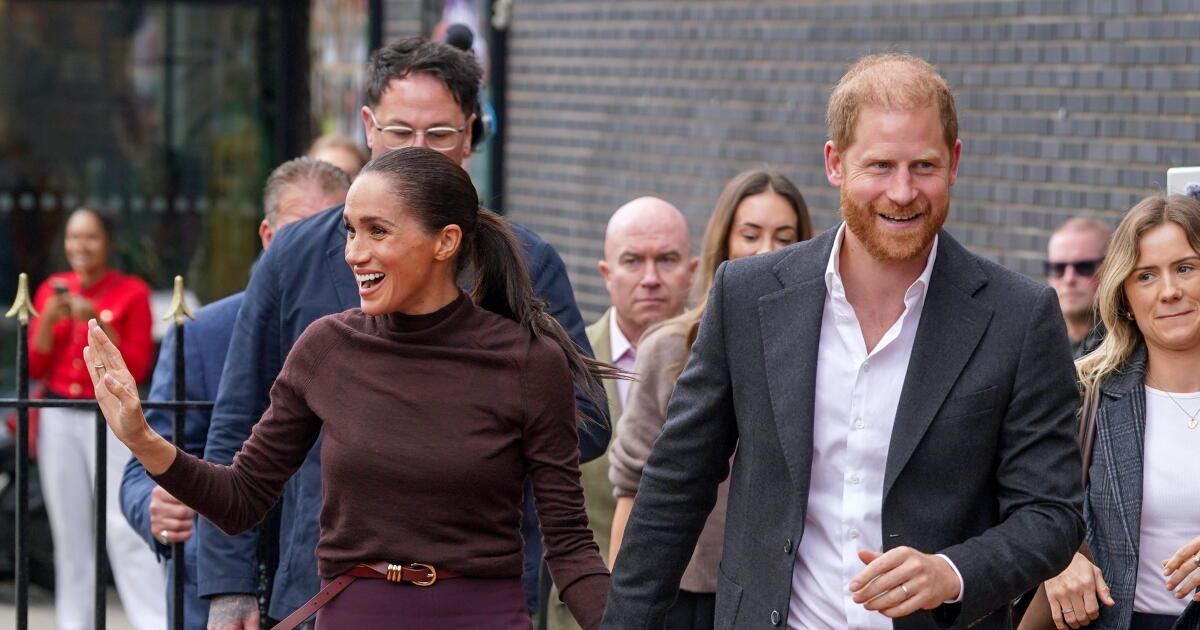
Prince Harry is opening up about his and wife Meghan Markle’s unexpected decision earlier this year to move back to the United Kingdom years after their dramatic fallout with the British royal family.
The Duke of Sussex spoke about the move in an interview with GQ’s Zach Baron, explaining that he and the duchess of Sussex returned to Britain for “opportunities for the family.” Prince Harry — promoting his session on grief with neuroscientist Dr. Mary-Frances O’Connor for the MasterClass online platform — said the ability to put his and Meghan’s two children “in a British school has meant a lot to me” as was being “back closer to my family.”
“To be back on U.K. soil for longer than a few days or a week here or there,” he continued, “it’s nice to be back.”
Reports of Harry and Meghan’s return to the United Kingdom surfaced in August after the spouses made clear in 2020 that their departure was due to several factors, including severe scrutiny by the British media and alleged racism and bullying by the royal family. During the GQ interview, published Tuesday, Harry said he felt more confident and “optimistic” about returning to the U.K. and its tabloid scene, saying, “I can respect them if they respect me and our position.”
After Harry and Meghan separated themselves from the British family, they settled in California in the affluent neighborhood of Montecito. While in the United States, the pair took on a variety of media ventures — including a podcast, a television series and documentaries — under their multimedia company Archewell Productions. Memorably, Harry also penned his memoir, “Spare,” in 2023, providing readers a look at his family and his scathing view of the paparazzi. Subject to media scrutiny for nearly the entirety of his life, Harry told GQ, “I prefer me to be putting things out there rather than the machine creating stuff.”
“Why not try to be in control of your own story?” he added. “Because if they can’t be responsible enough to tell your story, then you have to tell your own story.”
Prince Harry also said in the interview he felt the stars aligned for his and Meghan’s return and that their two children, Prince Archie and Princess Lilibet, had been “loving” their time attending British school. “It’s just giving them a whole different experience.”
As for his other family members, brother Prince William and father King Charles III, Prince Harry said, “I want it to work out.”
“Of course I do. Again, with everything else that’s going on in the world, the most important thing is to reconcile,” he said. “That’s the key point.”
Between the treetops, I can see the towers of a distant mist-shrouded castle. Is it possible I could make contact with the spirit of the great Welsh hero Owain Glyndŵr so soon, at the very start of our hike? We are not even on the actual trail of Glyndŵr’s Way. I’ve had to make a detour to find accommodation that takes dogs, as Stevie the terrier is with me. The Castle Inn at Knucklas is a mile off the route, and two miles or so from the pretty border town of Knighton – where the 135-mile (217km) Glyndŵr’s Way officially begins.
The towers slide away behind trees and a railway viaduct emerges. The medieval castle ruins, it turns out, are believed to have been plundered to build the viaduct in the 1860s, and the builders dropped in a couple of crenelated towers to honour the origins of the stone. I fear this may be an early omen: the spirit of Glyndŵr will be as elusive as the man himself was in his lifetime.
After his great rebellion of 1400 devolved into a murderous guerrilla campaign, the last Welsh prince of Wales simply disappeared. His English adversaries thought he had supernatural powers. Writing two centuries after the events, Shakespeare has Glyndŵr declare (under the anglicised name Owen Glendower) in Henry IV: Part I that “the earth did shake when I was born” and “I can call spirits from the vasty deep”. The last known sighting was in about 1819, when William Blake saw him in a vision and sketched his gaunt head. Since then, nothing. If he’s been hard to pin down for six centuries, what chance now?
Welsh rebel leader Owain Glyndŵr seen in battle in a painting by AC Michael. Photograph: Lordprice Collection/Alamy
I plan to cover the 75-mile southern section of the national trail’s great horseshoe across mid-Wales, starting with a late afternoon two-mile warm-up from Knighton station up to Knucklas. On our first full day of walking, we head south out of Knucklas and soon reconnect with the main path. The hills are bone dry, lying like dead giants across our route, defended by armies of sheep. Stevie is nonchalant. He was born near Rhayader and is good friends with a tup called Patrick. Nevertheless, I keep him on a tight leash.
The rebellion started with a land theft, an English lord helping himself to some of Glyndŵr’s hectares, a personal feud that laid bare a vast hinterland of Welsh disgruntlement. Men flooded back from England to join Glyndŵr. Edward I’s great fortress at Conwy was captured; a battle near Knighton was won. It was all going well until the teenage son of Henry IV (the future Henry V) was put in charge of the English forces. Not for the first time, British history turned on an arrow: this one burying itself six inches into the young Henry’s skull at the Battle of Shrewsbury. He survived. The rebellion faltered.
It is coming over Bailey Hill that Stevie gets the first hint of danger. A flock of sturdy old ewes spot him and form a tight huddle, a testudo formation, to slink up behind us. Stevie turns and does a comedy backwards leap of surprise. The ewes stamp their feet. Stevie hides behind a tussock. The ewes creep forward. I pull him through a gate. He has not barked or rushed at them. He has done well. Soon, we drop down into the hamlet of Llangunllo, where there is a pub. “It’s closed,” says a local woman. “Evenings and weekends, and for drinking only.” There is a dearth of facilities along Glyndŵr’s Way, widely considered the most remote of all 17 English and Welsh national trails, and I have brought a stove and teabags. This will prove a good decision. We set off up the lane and then on to the hills. It is quiet, very quiet. Nothing moves except the distant wind turbines.
The writer on remote Glyndŵr’s Way. Photograph: Kevin Rushby
Rebellion is in the air at the moment. The Uprising, a film about the 1381 Peasants’ Revolt, directed by Paul Greengrass, will be released in the UK on 9 October. And a new play by Gary Owen, Owain & Henry, opens on 5 November in Cardiff with Michael Sheen in the lead role. On a call before I set off, I ask Sheen why Glyndŵr remains such a potent hero. “His vision for a Welsh nation was based on a Welsh parliament, universities, religion and the laws of Hywel Dda,” he tells me. “It’s a vision that resonates. The play feels like a conversation between then and now.”
Sheen himself has walked parts of Glyndŵr’s Way. He says: “Owain could only do the uprising because of that landscape; it enabled a guerrilla war and you still feel that today.”
Stevie and I take a break in the Llangunllo bus shelter. There are no refreshments, but there are stacks of unwanted books. I find a copy of Francis Kilvert’s Diary, by the Victorian curate who kept a vibrant record of life in the Welsh borders. “Who died on the cross to save us all?” he asks one wild child from a remote Welsh farm. “Lord Chesterfield,” she replies. I tuck the book in my pocket.
Approaching the hamlet of Llangunllo. Photograph: Simon Whaley Landscapes/Alamy
Soon we are climbing over hills where the heather and gorse is in glorious bloom and there are no roads except droving tracks. These green lanes were once used to send cattle and sheep across the border, a tough, brawling existence hinted at in Kilvert’s Diary. By then, however, the railways had arrived and the old droving life was doomed.
At our first encounter with cattle, Stevie is happy to be carried. Different breeds, we soon learn, represent different threats: big cows can’t be bothered, small feisty ones are to be avoided. We take some long detours.
Our second night is at Brandy House farm, a welcoming place with various types of accommodation. We choose the vintage caravan. Nearby Felindre has a simple pub, the Wharf Inn, serving one of my favourite beers, Wye Valley Brewery’s Butty Bach.
Now the walk really begins to deliver. Majestic upland stages pass epic locations such as the Castell y Blaidd, the castle of the wolf, before arriving at Abbeycwmhir, the abbey that Glyndŵr reputedly sacked. I’m staying in a cabin at Wales in the Woods, a couple of miles up the hill in a deep, silent pine plantation, perfect for Glyndŵr reflections.
The ‘lovely, eccentric’ town of Llanidloes. Photograph: Joe Dunckley/Alamy
Next day, rain threatens, but we dodge all the showers, passing Saint Harmon, where Kilvert was briefly vicar, enjoying a stop at the superb Welsh Mountain Cider, then dropping down to Llanidloes. After three days on the trail, this lovely, slightly eccentric town seems like the big city, with so many pubs to choose from. We stay at the Unicorn. The following morning, we pass the Clywedog dam and climb to Y Star Inn, one of the highest pubs in Wales, which has three smart new pods to stay in. From here, the path rises again on what, for me, is the greatest stage of all. Leaving the trail, Stevie and I climb the 564-metre hill of Foel Fadian, opening up great panoramas of Cadair Idris, Yr Wyddfa (Snowdon) and the Irish Sea. We follow the trail down and reach our destination, Machynlleth, a town that has the same eccentric edge as Llanidloes, with lots of interesting independent shops, pubs and cafes.
It was in Mach (as the locals often call it) that Glyndŵr briefly set up his parliament, and the building, albeit partially reconstructed in 1460, survives. It is an atmospheric spot and there, on the wall, charging into battle, is the great hero himself. Now I get the ghostly shivers. But it turns out the Victorian artist used the face of his patron, David Davies, the indefatigable railway builder of the 1850s and 60s. After five days of walking, Owain has eluded me yet again.
The Graham Norton Show returns tonight and Hollywood actor Tom Cruise addresses Prince William and Kate Middleton attending the premiere of his new movie, Digger
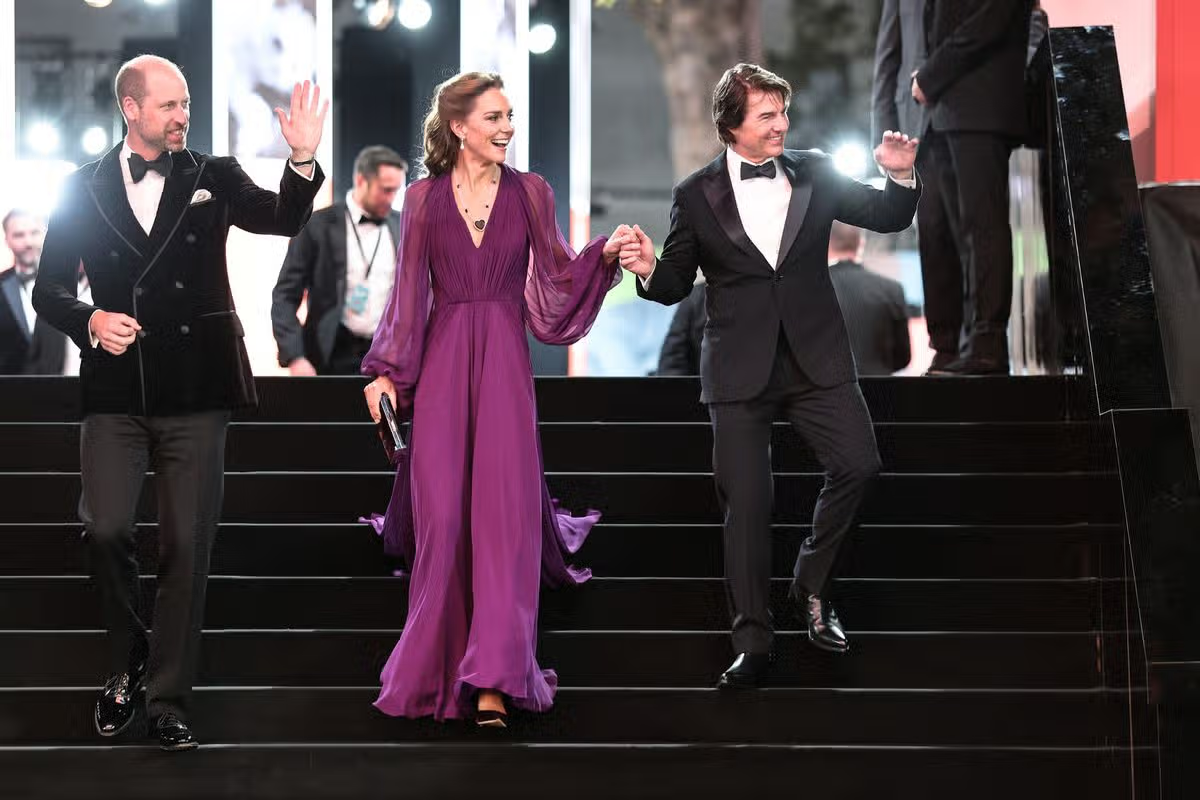
The Prince and Princess of Wales attended the world premiere of Tom Cruise’s movie Differ earlier this week(Image: Getty Images for Warner Bros.)
Tom Cruise has opened up about being joined by the Prince and Princess of Wales on the red carpet at his movie premiere.
Prince William and Kate Middleton attended Tuesday’s (September 22) premiere of Digger, which stars the 64-year-old Hollywood actor. The trio were snapped at the star-studded event with Tom pictured holding Kate’s hand as her husband William wove to fans in the crowd.
Tom is one of the guests of The Graham Norton Show which returned tonight (Friday, September 25) for a new series alongside Oscar-nominated actor Florence Pugh, comedian and actor Lolly Adefope, top comic John Bishop and singer-songwriter Emeli Sandé.
When asked by host Graham about the Royal couple attending the premiere, Tom gushed: “They are amazing – very charismatic. I had such a good time.”
The Mission Impossible star also explained the extensive transformation he had to undergo using prosthetics for Digger, saying: “The makeup was taking so long that I decided to get it down from six hours to one – it was like a ballet getting everything in place. It was just like Formula 1.” Adding jokingly: “I had someone else hold the stopwatch!”
Tom stars opposite Riz Ahmed, Sandra Huller and Jesse Plemons in the film, in which he plays an oil tycoon whose company sets off an ecological disaster before being tasked with a mission to save humanity from his own mess.
He told Graham: “My character is outrageous and unpredictable. He says things that others may be thinking and never say. It’s a timeless story about power, greed, and ego framed in a very timely manner by Alejandro G Inarritu – one of the greatest filmmakers of all time.
“I’ve never read a script like it, and I have never seen a character like Digger.” He also shared his childhood dream to have an “adventurous life”.
Tom explained: “I am always doing something, learning something new which I can add to characters. I want to push every artform. I love the challenge of doing one thing while working on another. To create is life.”
Elsewhere on the show, Don’t Worry Darling actress Florence chatted about starring in the new adaptation of the Steinbeck classic East of Eden, saying, “It is a sweeping epic, and my character is also epic in every way. It has been the most amazing journey working with Zoe (director Zoe Kazan).
“It has been so special and it’s like releasing our baby. I am very protective of it, and really excited.” When asked about playing a character over seven episodes, Florence said, “Because I play a character that goes across several decades the thrill for me was figuring her out as she aged.
“It really was amazing and I had a brilliant time. Creating the series was a dream and I will be talking about this role for the rest of my career.”
The Graham Norton Show continues Friday, October 2 at 10.40pm on BBC One and BBC iPlayer