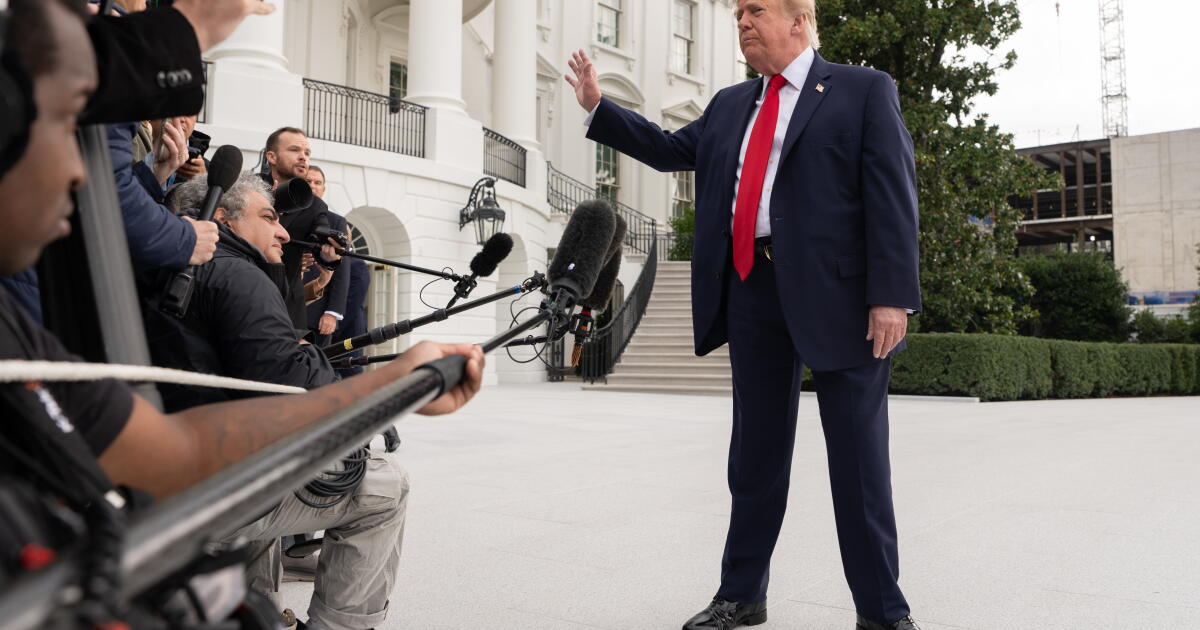
With bans and taunts, Trump escalates his assault on the media
WASHINGTON — Under a light rain on Sunday at the Australian ambassador’s residence in Washington, CNN hosted its third annual tennis tournament, the Kangaroo Cup, pitting Beltway journalists against administration officials. The event aims to inject some levity into an historically adversarial relationship, reminding both sides of the spirit of the game. Themed drinks and tennis whites set the tone.
White House officials played with grace. But the mood this year was altogether different down Pennsylvania Avenue. Despite a federal judge demanding the administration reverse course on President Trump’s punitive actions toward his disfavored news outlets — CNN, MS NOW and Politico — he has refused to resume full access to the storied cable news channel, dismissing its reporters as “fake news.”
It is only the latest attack on press freedom by a president whose drive to punish critics and exert influence over the media appears to be growing.
During last week’s lavish state visit for Xi Jinping, Trump praised China for having “the friendliest press corps” and dismissed their repression of speech, despite the World Press Freedom Index ranking China among the world’s worst offenders — at the bottom of the list, alongside North Korea and Eritrea — for restrictions on journalists.
Five times in the last two months, the president has sneered at and insulted female reporters, mocking their appearance or dismissing their credentials.
He has declined to name a successor for his former press secretary, Karoline Leavitt, whose final news conference, on Aug. 27, was one of only a handful of briefings held throughout the summer. His administration launched its own streaming service last week, called Trump TV, in an attempt to circumvent traditional cable news. And on Monday, he posted renderings of the White House briefing room reconverted to its former use as a presidential pool and spa.
Trump’s escalating attacks on the press come just weeks before the midterm elections, as former officials and election experts warn the administration could seek to undermine confidence in the results. They also come at a precarious moment for public trust in the media, with more Americans saying limits on the press can be justified to combat misinformation.
A Pew Research Center survey released earlier this month found that 73% of Americans regard a free press as “very” or “extremely” important to society. Yet the country remains deeply divided over whether journalists should be barred from reporting “inaccurate” information, with a majority, 53%, supporting limits in some circumstances — even if it means the government itself would have the final say in determining what is true.
Trump’s attempt to bar three outlets from the White House grounds came just three days after the Pew poll was released.
“Plenty of presidents have complained about the press before. And presidents have restricted certain forms of press access or press action during wartime,” said Peter Kastor, chair of the History Department at Washington University in St. Louis. “In the moment — and especially afterward — Americans condemned this as antithetical to the constitutional protections for press freedom and the national commitment to an open democracy.
“What I find most striking about Trump’s press action is that he has made it unabashedly personal,” Kastor added. “He doesn’t like the way media outlets are covering him, so he is going to punish them.”
President Nixon famously limited White House access for the Washington Post over its coverage of the Watergate scandal. But he never attempted to bar press credentials completely — and ultimately authorized the conversion of the pool facility into the briefing room that exists today.
Other presidents have jostled with the press. President Obama was accused of limiting access to independent photojournalists, and famously favored nontraditional media outlets at the advent of the social media age. President George W. Bush limited his personal interactions with the press and curtailed access to government records.
Thomas Jefferson, the nation’s third president, once stated he “deplored” the “putrid state into which our newspapers have passed, and the malignity, the vulgarity, and mendacious spirit of those who write for them.”
Yet, “it is however an evil for which there is no remedy,” he also said. “Our liberty depends on the freedom of the press, and that cannot be limited without being lost.”
Trump’s particular style — as a showman and his own spokesman — makes his relationship with the media innately personal, said Andrew Rudalevige, a professor of government at Bowdoin College and author of “The New Imperial Presidency.”
“Presidents almost always feel that bad press is a feature of their staff’s poor communication of their policies — not that the policies themselves are unpopular or ill-advised,” Rudalevige said.
“Since President Trump does so much of his communication, though, this deflection is less available,” he added, and “thus the problem is with the press itself, not the policy or its purveyor.”
CNN’s legal fight continues, even after securing temporary reprieve from a judicial restraining order. So does the Associated Press’ lawsuit over the administration’s effort last year to punish the wire service for refusing to adopt Trump’s preferred name, “Gulf of America,” for the internationally recognized Gulf of Mexico.
While he keeps losing in court on 1st Amendment grounds, the president keeps testing new limits, looking for what will stick.
On the tennis court Sunday, at least, his administration won.