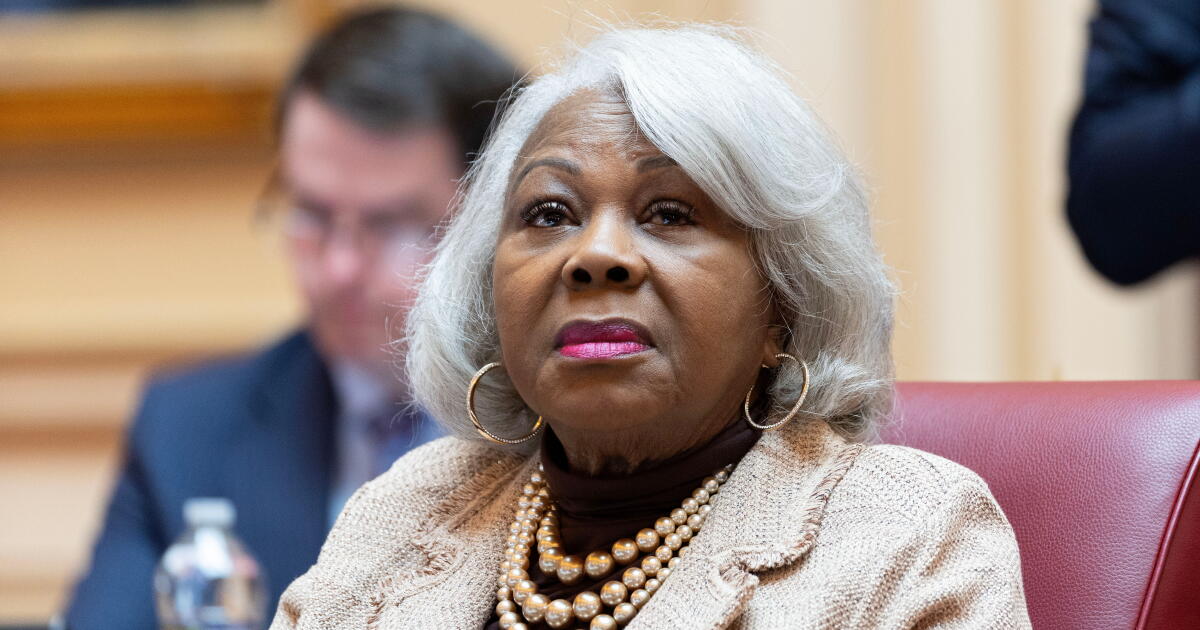
RICHMOND, Va. — Virginia state Sen. L. Louise Lucas, one of the state’s most powerful Democrats, was charged Thursday with leading what authorities alleged was a wide-ranging criminal enterprise that acquired and distributed large quantities of marijuana and laundered the proceeds.
Lucas, who has been in elected office for decades, used her political power to insulate the operation from scrutiny, according to an indictment charging her and six other defendants, including several of her relatives. She “put her own financial interests before the people she was elected to serve,” said U.S. Atty. Gen. Todd Blanche, who spoke at a news conference with FBI Director Kash Patel.
Lucas surrendered, the Justice Department said. She made a brief appearance in federal court on Thursday afternoon, where she was released on her own recognizance, according to court records. She left the court without addressing media gathered outside and went straight into a waiting vehicle.
The charges, including drug trafficking and money laundering, came after the FBI searched Lucas’ hometown office and a cannabis shop in which she has a stake in May. At the time of the search, Lucas — who has been a vocal critic of Republican President Trump’s administration — characterized it as an attempt to intimidate her.
“This is the circus we always expected it to be,” said Brian Woolfolk, chief counsel for the L. Louise Lucas Legal Defense Fund.
Lucas says she won’t be bullied by the federal government
A statement attributed to Lucas posted on her social media account did not directly address the substance of the charges but said Thursday’s actions amounted to the federal government wielding its “full weight” against a great-grandmother.
“I will not be intimidated. I will not be bullied. And I will not back down,” Lucas said in the statement.
The brash 82-year-old lawmaker has spent decades ascending the ranks of Virginia politics and has served since 1992 in the state Senate, where she’s the president pro tempore, overseeing the chamber in the lieutenant governor’s absence. More significantly, she leads the powerful Senate finance committee, through which all legislation with any budget impact must flow. She’s used the position to kill legislation she opposes.
Justice Department denies politics played a role
The indictment comes as Trump’s Justice Department has faced intense scrutiny over investigations and prosecutions against foes of the president that critics have called politically motivated.
Blanche rejected any suggestion politics played a role in Lucas’ case, noting the investigation began well before the second Trump administration started in January 2025.
“We don’t do political paybacks,” Blanche told reporters.
A person familiar with the May search told the Associated Press at the time that the probe was opened during Democratic President Biden’s administration. The person spoke on condition of anonymity to discuss a continuing criminal investigation.
FBI alleges a ‘criminal marijuana enterprise’
Patel said in a statement that “Lucas and a close-knit group of family members and associates orchestrated a multi-year scheme to enrich their own criminal marijuana enterprise, ‘the Lucas Enterprise’ — using Lucas’ position as Chairwoman of the Senate Finance and Appropriations Committee to insulate the enterprise from criminal scrutiny and influencing legislation to financially benefit themselves.”
The indictment describes Lucas as the “leader of the enterprise” who “approved and directed criminal activities,” including arranging for the acquisition and distribution of marijuana and supervising the laundering of the proceeds.
The indictment alleges Lucas worked this year with another of the defendants to use her political position to obtain a recreational marijuana license for him, with the understanding that the proceeds from sales under the license would be shared with her to support the “enterprise.”
Since 2021, marijuana has been legal to possess in Virginia, and many shops across the state have sold cannabis-derived products. But full recreational sales are not yet underway; legislation enacted earlier this year will allow them beginning in July 2027.
Law enforcement made multiple controlled purchases of marijuana from Lucas’ shop, which purported to sell hemp products, in 2024 and 2025, the indictment said.
In addition to drug and money laundering charges, Lucas faces a charge of racketeering conspiracy, conspiracy to commit honest services fraud and maintaining a drug-involved premises. An arraignment is scheduled for next month.
Among the other defendants who face a mix of those and other charges are two daughters of Lucas and a grandson. It was unclear if they had obtained legal representation. They were also scheduled to make an initial court appearance Thursday afternoon.
Virginia officials react
A forceful advocate of legalizing marijuana, Lucas partnered in opening the shop, The Cannabis Outlet, in 2021. She has publicly spoken about her ownership stake as recently as June, though her most recent financial disclosure forms do not list the business by name.
At the time of the search — when marijuana was recovered at The Cannabis Outlet, according to the indictment — many Democrats spoke up to defend Lucas.
On Thursday, Scott Surovell, the Democratic leader of the state Senate, said in a statement that the indictment contained “serious allegations” but emphasized that “Senator Lucas has the right to defend herself, and she has my full support as she does so.” Atty. Gen. Jay Jones, a Democrat who is close with Lucas, said the allegations against her must be tested in a “full and fair” legal process.
House Speaker Don Scott, Lt. Gov. Ghazala Hashmi, and Gov. Abigail Spanberger, all Democrats, echoed those sentiments, with Spanberger adding that the timing of the indictment so close to the midterm election would “further erode” Americans’ trust in the Justice Department. Lucas herself is not on the ballot this year.
Ryan McDougle, the Senate Republican leader, said he would not comment while the court proceedings play out.
The senator draws comparisons to Trump
Lucas, who represents a district that includes her hometown of coastal Portsmouth, operates with a sometimes-profane, unapologetic style that’s drawn comparisons to Trump.
She amassed a six-figure following on X and national attention, using the social media platform to advocate forcefully for her priorities and to bash her critics, including former GOP Gov. Glenn Youngkin. She’s also occasionally blasted members of her own party, including Spanberger, with whom she’s had disagreements.
Earlier this year, Lucas helped lead Democrats’ ultimately unsuccessful plan to gerrymander the blue-leaning state’s congressional districts into a map intended to elect 10 Democrats and only one Republican. Along the way, she posted quips about four GOP members the intended map sought to oust, joking that they soon would be working at McDonald’s. She and other Democrats defended the maps as a reasonable response to Trump-backed efforts to boost the GOP’s midterm advantage in other states.
Lucas has been in politics for decades
Lucas has notched several historic firsts in her career. According to a biography from the state library, in 1971 she became the Norfolk Naval Shipyard’s first female shipfitter, a physically demanding job that involves working on metal assemblies for vessels.
She launched her political career in 1984, when, the biography said, she became the first Black woman elected to the Portsmouth City Council.
In the state Senate, Lucas has been a staunch advocate for abortion rights and increased public school funding and a leading voice on issues of racial justice and civil rights.
In 2019, after Democrats flipped control of the chamber, her peers elected her to serve as president pro tempore. And in 2024, she was tapped to lead the chamber’s budget committee, gaining enormous sway over any legislation tied to the state budget.
Richer and Rankin write for the Associated Press. Richer reported from Washington and Rankin reported from Richmond, Va. AP journalists Eric Tucker in Washington and Steve Helber in Norfolk, Va., contributed to this report.