Mission Viejo High’s massive offensive line aims for greatness
Mission Viejo High’s offensive line did not want to be on the field against St. Paul on Friday night. This was evident by their first two plays.
The Diablos’ opening drive began with a 60-yard rushing touchdown, created by a massive gap on the left side of the offensive line. Senior running back Carson Vandermade wasn’t close to being touched by a defender on his way to the end zone.
A 60-yard passing touchdown immediately ensued on the next possession. Of course, the offensive line made sure sophomore quarterback Brett Burnor had more than enough protection to launch one deep to a wide receiver
Coach Chad Johnson knows the level of skill he has on his hands. He’s never had a more talented and cohesive line in his two-plus decades of coaching high school football.
“It’s abnormal for us to have a line like this, and I’m really enjoying it,” Johnson said after Mission Viejo’s 77-12 victory.
The reason for that rarity is a simple one: every single starting lineman this season is a returning player. Nobody lost to graduation. No transfers. Johnson said he doesn’t recall that ever being the case.

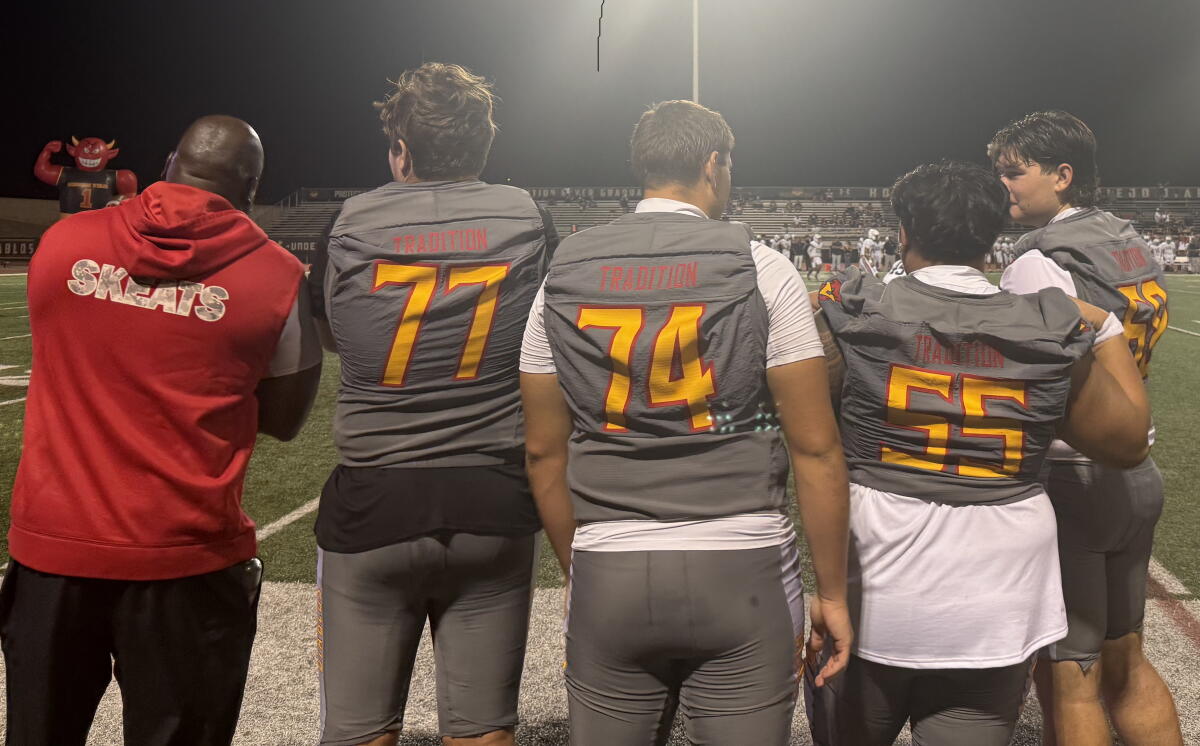
Mission Viejo High offensive linemen (starting second from left) Tyler Johnson, Dylan Felli and Noah Lee in their custom-made jerseys they put on after the Diablos built a huge lead against St. Paul and they were pulled from the game.
(Caleb Otte / For The Times)
In addition, four of the five starting lineman have NCAA Division I offers.
Senior left tackle Dylan Felli has offers from the University of San Diego and Montana. The guy who helped him create the first touchdown of the game, senior left guard Amaziah Siale, is committed to Louisiana State. Center Max Davidson, who is a junior, has an offer from Northern Arizona, and senior right tackle Tyler Johnson is committed to Cornell.
If the experience and college offers aren’t enough to prove their stature, their size should. Davidson and Felli are listed at 6 feet 4. Siale is 6-7 inches tall and weighs 345 pounds, while Johnson is 6-6 and nearly 300 pounds.
They wouldn’t look out of place lining up across from USC or UCLA. Standing near them is staggering. Trying to out muscle them is nearly impossible.
Johnson said that his team finally has a threatening run game because of the gaps the linemen create.
“Usually we have to throw the ball to get [opponents] to back off, and then we can run it,” he said. “This year, we’re gonna run the ball until they commit everybody and then we’ll throw it.”
There are two other linemen who also play key roles: senior right guard Noah Lee and senior Baxter Middagh.
Lee is the smallest guy in the group. At 5-10, he looks out of place standing next to the big boys. Once he is on the field, however, the size difference is forgotten.
At 295 pounds, with a low center of gravity, Lee can’t be moved. It’s why he has earned his starting position over the last two seasons despite competing with potential DI players. He might not have any offers, but he doesn’t drag the rest of the group down. In fact, he’s often the leading voice on the sideline.
As for Middagh, his role is adding a new wrinkle to the offensive scheme this season. Last year he was playing on the line. Against St. Paul, he was deployed at tight end. His blocking expertise and size — 6-6 and 295 pounds — allow him to still help in pass and run protection, but now his impact can be felt with the ball in his hands.
Case in point, Middagh scored a touchdown on a screen pass Friday. He was surprisingly fast, making it even harder to tackle him. Opponents will struggle if Mission Viejo can get Middagh, who is committed to Idaho, into open space.
Johnson said he might rotate who plays on the line based on what a possession needs, but that their best 11 includes Middagh on the field.
“He is super athletic and can catch the ball really well,” Johnson said. “The catches he makes are insane, some one-handed, and he runs a 5.3 [second] 40-yard dash at 300 pounds.”
Off the field, the mountainous young men turn into humble and funny teenagers. After being taken out at halftime, all six players cheered on the backups and joked with each other about everything and nothing.
At one point, Middagh’s family came down to the sideline and he went over to hug everybody and chat. There was no embarrassment by their presence near his teammates and friends, just an appreciation for those who love and support him.
Siale also sheepishly waved to his family in the stands, getting a slight grin on his face when they yelled back down to him. Late in the fourth quarter, the public-address announcer credited Siale with a block on a big run play even though the big man hadn’t touched the field all half. He just laughed and high-fived some teammates who were offering sarcastic congratulations.
Despite their talent, cohesiveness and positive personalities, Johnson said that his offensive line isn’t perfect. In Mission Viejo’s 55-17 win against Chaparral in the season opener, they made some silly penalties for unnecessary roughness after the play ended, which negated big gains. Johnson wants that cleaned up moving forward.
“You don’t play up to a good team and down to a team that is not as good. You stay consistently great,” he said.
His team obliged. Whenever the offensive line gives the quarterback time to pass and the running backs space to run, there isn’t much complaining a coach can do.
“I’m going to try to take it all in and soak every game up, because I know at some time the curtain is going to call and they’re going to graduate,” he said.
Two guys standing on Mission Viejo’s sideline were wearing custom made shirts of the offensive line. It was a picture of them all standing together, with the words “Higher Council” printed below. The message is clear.
Siale succinctly said what everybody else was dancing around.
“We’ve got the number one offensive line in the nation,” he said.
That claim will be put to the test against one of California’s best teams next week, when Mission Viejo travels to Sacramento to play Folsom High. Northern California will meet the Higher Council.