Poll

Poll shows Bass, Raman and Pratt in tight race for mayor

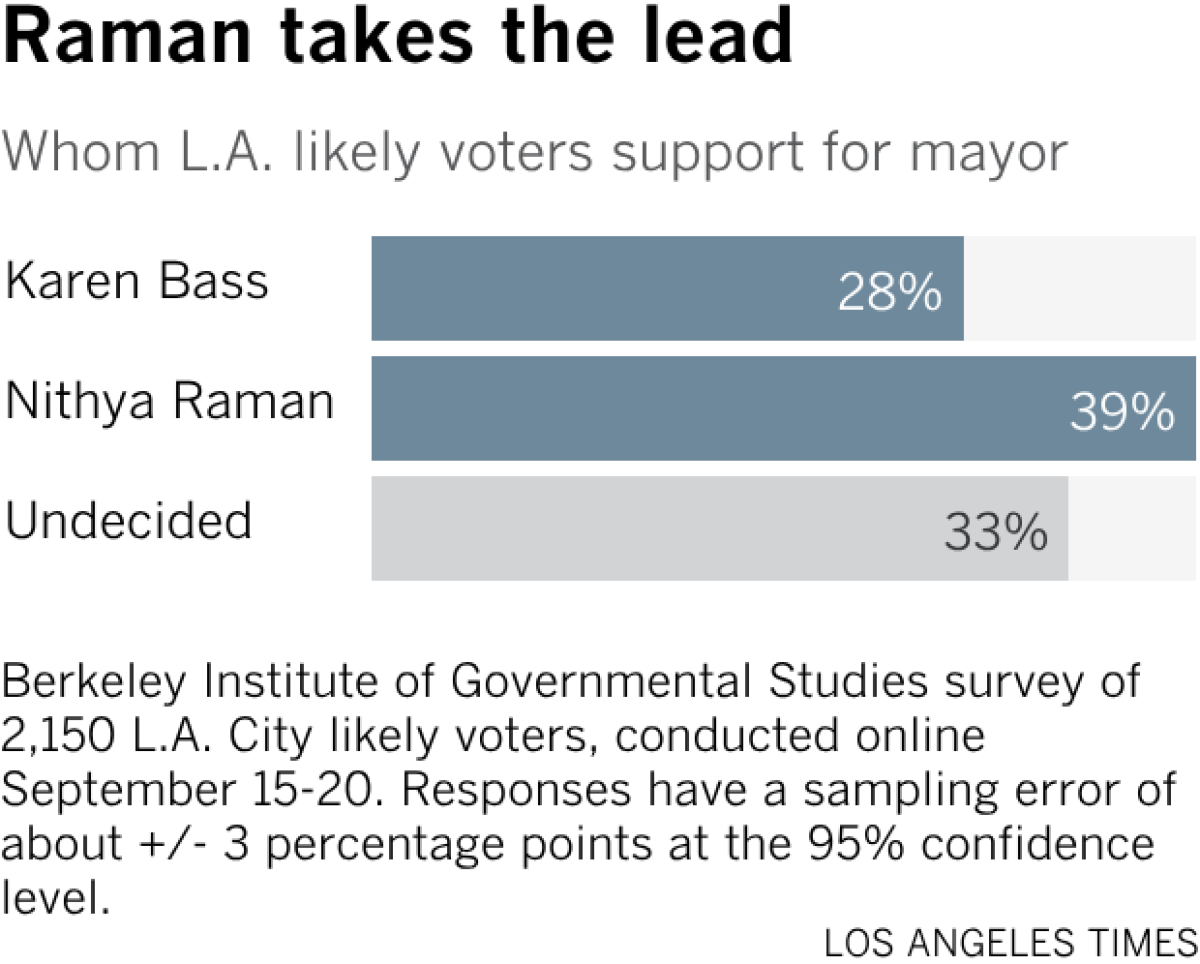
Karen Bass, Nithya Raman and Spencer Pratt are locked in a tight battle for Los Angeles mayor, according to a poll released Thursday, with incumbent Bass holding what pollsters called a statistically insignificant lead ahead of Tuesday’s primary.

Bass had 26% support from likely voters, followed by City Councilmember Raman with 25% support, according to the poll by the UC Berkeley Institute of Governmental Studies, which was co-sponsored by The Times.

Pratt, the former reality TV personality making his first bid for elected office, had support from 22% of the likely voters surveyed.

Up until this latest poll, Bass had enjoyed a substantial lead over her challengers, with analysts predicting she would garner enough votes to make a Nov. 3 runoff with either Raman or Pratt. The latest survey suggests any of the three could advance.

“You’ve got three very different candidates, each with very different constituencies, all within the margin of error. It’s going to boil down to turnout,” said Mark DiCamillo, the director of Berkeley IGS polls.

The poll also showed that in a head-to-head runoff between Bass and Raman, the councilmember would lead, 32% to 28%, among the city’s registered voters, but in this scenario, a quarter of likely voters say they would choose neither or would not vote, and 15% were undecided.

The survey of 1,913 registered voters — 1,351 of whom are considered likely voters — is the largest sample of any public poll released in advance of the election. It was conducted between May 19 and 24. The poll has a margin of error of around 3% in either direction.

Just 10% of voters were still undecided, the poll found, down from 26% when the last survey by Berkeley IGS was conducted March 9-15.

Mayoral candidate Spencer Pratt at a campaign block party in South Los Angeles last week.

Mayoral candidate Spencer Pratt at a campaign block party in South Los Angeles last week.

(Robert Gauthier / Los Angeles Times)

Since then, Pratt and Raman have made steady gains while support for Bass has nearly flatlined.

The March poll had Bass with support from 25% of likely voters, followed by Raman with 17% and Pratt with 14%. Since then, Bass has gained just 1 percentage point, while support for Raman and Pratt jumped by 8 percentage points each.

There are 14 candidates running for mayor in Tuesday’s primary and all were listed in the Berkeley IGS poll, but Bass, Raman and Pratt have consistently led in polling. They’ve also raised the most money in campaign contributions. The latest campaign finance reports, filed last week, showed Pratt with $3.26 million in contributions through May 16, followed by Bass with $3.13 million.

Raman reported a total of more than $931,000 through the May 16 filing period, of which $60,000 came in the form of a loan from Raman to her own campaign. She also received the maximum amount of matching funds available in the race, $1.25 million.

Leftist candidate Rae Huang was favored by 9% of the likely voters surveyed, up 1 percentage point from March, while tech entrepreneur Adam Miller dropped from 6% to 5%, despite infusing his campaign with $4 million of his own money after the first poll.

The major issues in the race have included the city’s approach to homelessness, housing affordability and public safety.

Pratt, whose home burned in the Palisades fire, has blamed Bass for failing to prepare for the conflagration and for her postfire response. Raman has criticized Bass’ Inside Safe program for the unhoused, saying its high cost isn’t sustainable.

Bass has deemed Raman an ineffective City Council member who struggles to build alliances on the legislative body, and has said Pratt does not have a clue about how to run a city like Los Angeles.

Although Pratt now appears to have a chance at making the runoff, the poll showed he would face a steeper climb in potential November runoff scenarios with Bass or Raman. Pratt, a Republican who has been labeled “Trumpian” by Raman, is competing in a city where GOP registration is less than 15%.

“Pratt is an unusual candidate and is generating a lot of enthusiasm in the primary, but he trails by double digits to Raman and Bass in a runoff,” DiCamillo said.

In a showdown between Bass and Pratt, the incumbent mayor was ahead, 47% to 29%, among the city’s registered voters, with 12% undecided and 12% choosing neither or saying they would not vote.

Raman also led Pratt in a potential runoff, 45% to 28%, with 16% undecided and 11% choosing neither or saying they would not vote.

Pratt has repeatedly pointed out that the mayor’s race is nonpartisan. Even so, President Trump said last week that he hopes Pratt does well and that he heard Pratt was “a big MAGA person.”

Trump’s unpopularity in Los Angeles could lessen Pratt’s appeal to Democrats, according to a poll by Cygnal, a national polling group that has worked for Republican candidates.

Los Angeles mayoral candidate Nithya Raman walks down Olvera Street

Los Angeles mayoral candidate Nithya Raman walks down Olvera Street alongside Olvera Street business owners on May 19 in Los Angeles.

(Ronaldo Bolaños / Los Angeles Times)

There’s been just one debate featuring all three of the leading candidates, during which Raman asserted that Bass and Pratt were working to ensure that she would be knocked out in the primary, which Bass and Pratt disputed.

The debate was followed by a huge influx of campaign contributions to Pratt, who also was polling in second in an Emerson College poll earlier this month.

Raman’s strong showing in Thursday’s poll shows she is very much in the race despite assertions by Bass’ campaign and Pratt’s campaign that she is faltering after a lackluster debate performance.

The poll shows Bass and Pratt with high unfavorability ratings. Bass was considered unfavorably by 57% of likely voters, up 1 percentage point from the March survey. Pratt’s unfavorable rating in the current poll was also 57% — up dramatically from the 28% unfavorable rating in the previous poll, although in that poll, 55% of likely voters had no opinion of him.

In the May poll, Pratt was rated favorably by 25% of likely voters, and Bass by 35%.

The poll found that 40% of likely voters rated Raman favorably, with 35% viewing her unfavorably.

Source link

Poll of judges, lawyers sees grave Trump threat to rule of law

Sometimes it seems as though the only thing that stands between a functioning democracy and a full-on Trump autocracy is a thin, black-robed line.

Although the Supreme Court, in general, and conservative appellate courts, in particular, have bowed and granted President Trump permission to do pretty much anything he wants, they haven’t thoroughly capitulated to his endless grasping for ever more power. (The way invertebrate congressional Republicans have.)

At the lower-court level, judges have repeatedly ruled in ways intended to check Trump, most notably when it comes to violating civil and constitutional rights in pursuit of his indiscriminate immigration dragnet.

The tendency to slow-walk his administration’s response to those rulings — and ignore others that Trump thinks he can safely snub — only contribute to the perception of presidential lawlessness and a sense that our judicial system is being strained to something approaching a breaking point.

Go ahead, if you’d like, and dismiss those concerns as just so much overwrought hand-wringing, or the mindless anti-Trump blathering of your friendly political columnist. A new survey of legal experts — including federal judges, top-tier lawyers and scores of professors from some of the country’s leading law schools — finds widespread concern about the brittle state of our legal system.

And it’s not just the fears of a lot of shaggy-thinking liberals.

“The nation is strong as is its commitment to the rule of law,” said one appellate judge, a Republican appointee. “The current president presents the greatest threat in decades.”

The survey was conducted by Bright Line Watch, a nonpartisan academic group that monitors the health and resilience of American democracy, in conjunction with the Safeguarding Democracy Project at UCLA’s School of Law.

Conducted between mid-February and early March, the poll anonymously surveyed 21 federal judges, 113 lawyers, 193 law professors, 652 political scientists and a nationally representative sample of 2,750 Americans.

What leapt out to UCLA’s Rick Hasen, director of the Safeguarding Democracy Project, was that “across the ideological spectrum and across judges, lawyers and law professors, there was considerable agreement that the rule of law in the U.S. is under tremendous stress.” That consensus, he said, suggests “a real risk to democracy.”

Most legal experts agreed that Trump is using executive power excessively, with a majority doubting the conservative-leaning Supreme Court would handle cases involving the Trump administration impartially. The experts also expressed concern about politicized law enforcement — Trump seeking to persecute his perceived enemies — executive branch overreach, and the failure of Congress or the Supreme Court to do more to rein in the rogue president.

Eight in 10 of those surveyed said federal officials fail to comply with court orders somewhat or very often, and nearly 9 in 10 said political appointees in Trump’s Justice Department mislead federal judges somewhat or very often.

Talk about contempt of court — not to mention our vital system of checks and balances.

There was, unsurprisingly, a split among conservatives and liberals who took part in the survey. (The study defined legal conservatives as those saying the Supreme Court should base rulings on its understanding of what the Constitution meant as originally written. Liberals, who made up most of the respondents, were defined as those saying the court should base its rulings on what the Constitution means in current times.)

Conservatives, for instance, were more likely than liberals to see former President Biden as a greater threat to the rule of law than Trump. Liberals were more likely than conservatives to see evidence of Trump politicizing the Justice Department.

There were also differences between legal experts — those most intimately involved in the judicial system — and the public at large. The experts were more concerned about Trump’s excesses and threats to the rule of law, which, Hasen said, stands to reason.

The legal system is not something most people encounter daily in the same way they do, say, gasoline prices or the cost of groceries. “Yet,” Hasen said, “it’s one of these background things that really matters.”

Why?

Hasen put it this way: “Imagine that a person had a dispute with their neighbor and it ended up in small claims court before a judge and the judge made the decision not based on the merits of the case but based on whether he was friends with one of the parties, or didn’t like people who were similar to one of the parties.”

Now imagine that kind of corrupted, perverted system of justice writ large.

If, for instance, “people know that the government can successfully seek retribution from people who criticize it, people will be less likely to criticize the government,” Hasen said, leaving the country worse off by muzzling those who would hold their elected leaders to account.

Or if, say, rioters overran the U.S. Capitol and tried to steal an election and, instead of being punished, received cash payouts from the federal government, what incentive would there be to follow the law?

Happily — and who couldn’t use a bit of good cheer right about now — all is not lost.

People “can demand that their elected representatives take steps to assure that the rule of law will be followed,” Hasen said, and can insist “that the government [not] play favorites or seek retribution against perceived enemies.”

That’s the power people have, come election time. That’s why voting matters.

There are lots of things riding on the outcome in November, not least the sanctity and integrity of our legal system.

Bear that in mind when you cast your ballot.

Source link

GOP governor hopefuls give closing arguments to oft-forgotten Central Valley Republicans

In the waning days before California’s primary election, the two top Republicans running for California governor delivered closing arguments in front of a friendly Central Valley audience Friday evening.

Though Riverside County Sheriff Chad Bianco and former Fox News host Steve Hilton have attacked each other throughout the campaign, they abstained from feuding and instead focused on common enemies — Gov. Gavin Newsom and Democratic lawmakers who control the Legislature.

Hilton criticized Newsom’s new $20-million program to provide free diapers for families of newborn babies, referring to the outgoing governor as “the great loaded diaper of California himself.”

Earlier this year, Hilton and Bianco topped the governor’s race polls as a packed field of Democrats split many of the state’s liberal voters. Under California’s “jungle primary” system, where the top two candidates advance from the primary to the general election regardless of political affiliation, that led to fleeting hope among Republicans that the two candidates could shut Democratic candidates out of the November election.

“That idea was always a fantasy,” Hilton wrote in an op-ed published in the New York Post earlier this week in which he urged Bianco to drop out of the race “for the sake of the state we both love.”

“Steve, it is time for you to drop out,” Bianco retorted in a video posted to social media soon after. “In no world, no world does Steve Hilton beat a Democrat in November.”

After winning an endorsement from President Trump in early April, Hilton has steadily outpaced Bianco in polls. A poll commissioned by the California Democratic Party released last week showed Hilton leading the field with support from 22% of likely voters, followed by Democrat and former Biden Cabinet member Xavier Becerra with 21%. Bianco was at 10%, down from 15% in a previous poll conducted two weeks prior.

Still, Bianco, the two-term sheriff of California’s fourth most populous county, is a favorite of many Republicans in the state and won more support from delegates during the party’s recent endorsing convention than Hilton, though neither reached the necessary 60% to win the party backing.

While the two candidates have needled each other with personal digs and insults throughout much of the campaign, they appeared to set that energy aside during the Clovis forum and even traded some compliments. Hilton praised “sheriffs like Chad who actually understand what public safety looks like” while Bianco acknowledged that his opponent “should be very proud” to have Trump’s endorsement.

State Sen. Shannon Grove (R-Bakersfield), who moderated the more than 90-minute event, praised their “extraordinary civility” before she pressured each to commit to backing whichever Republican makes it through the June 2 primary — or if they both advance, continue to focus on policy debates over attacks.

The forum was hosted by the Fresno County & City Republican Women Federated as part of a fundraiser and dinner honoring the upcoming 250th anniversary of the nation’s founding. About 450 attendees were served dishes inspired by presidential favorites including sirloin steak for Theodore Roosevelt, a chopped salad from Chasen’s, a favorite Los Angeles eatery for Ronald Reagan, and a chocolate pie with cherry vanilla ice cream for Trump.

The Central Valley stretches from Bakersfield to Redding and is home to some of the nation’s most lucrative farmland. It also includes the heart of California oil country in Kern County. Yet residents feel largely neglected by statewide politicians who are more drawn to the ample votes and wealthy donors in Southern California and the Bay Area.

“We are the breadbasket of the world but we’ve been overlooked for too long,” said Andrea Shabaglian, a vice president of the Fresno Republican women’s group. “When gubernatorial candidates come here to sit down and listen to our communities, they realize that a stronger Valley means a stronger California.”

Though he lost California handily to former Vice President Kamala Harris in the 2024 election, Trump dominated in the state’s midsection. Even in Fresno County, where the Republican forum was held, Trump beat Harris by a four percentage point margin despite Democratic voters slightly outnumbering Republicans.

“We need a Republican in office because California is a mess. I mean, anybody with common sense can see that,” said LuAnne Pinedo-Madden, a retiree living in the Sierra foothill community of Coarsegold who listed transgender girls being allowed to compete in girls’ sports and government corruption as her top concerns.

Pinedo-Madden said she was “pretty sure” she had decided which of the Republican candidates to vote for but declined to say whom. “I feel that if we don’t get a Republican in office, we’re looking at moving” to Utah, Idaho or Nevada, she said. “We can’t take this anymore.”

Bianco and Hilton spoke about their plans to improve public safety, small businesses, homeowner’s insurance and water management, a crucial issue for the conservative-leaning owners of vast swaths of California’s agricultural heartland.

Signs along the major highways that straddle California’s Central Valley proclaim that “Food grows where water flows” and criticize Newsom for allowing water to flow into the ocean instead of capturing and storing more of it for farming.

Both of the GOP candidates described their visions for the state, which include building new dams and raising existing ones to store more water.

“We don’t have the water problem. We have a water management problem,” Bianco said before falsely arguing that “we get more water every single year than any other state in the country” and that California has “never, ever, ever been in a drought.”

“The water will be flowing to our farmers, the oil will be flowing to our refineries, the forests will be managed, the timber will be harvested” and used to build new single-family homes, Hilton said. “We’ve got the best weather, we’ve got the best people, we’ve got the best farmers, we’ve got everything we need to make this place amazing, except a good governor. Very soon we’ll have that as well.”

Though a Republican governor would likely face a hostile Legislature intent on blocking many priorities, Bianco and Hilton both promised sweeping cuts and cutbacks of state agencies. Both pledged on Friday to replace every member of the state’s parole review board, which drew criticism in February when it granted elderly parole to a man convicted of 16 counts of kidnapping and child molestation in 1999.

“California criminal justice is absolutely broken and it was forced upon us in the name of reform. What I’m going to do is make it a crime to hear the word reform again, because we lost track of what that word even means,” Bianco said.

He also pledged to eliminate laws and environmental regulators often blamed for slowing housing development: the California Environmental Quality Act, the California Coastal Commission and the state Air Resources Board.

Though his opponent has the coveted Trump endorsement, Bianco argued that it will hurt Hilton’s chances of winning the general election. The Republican president has never been popular in deep-blue California; just 25% of adults in the state approved of Trump’s performance according to a February survey by the Public Policy Institute of California.

“Steve should rightfully be proud of being endorsed by President Trump [but] we have to actually realize, is that a good thing in California? It’s a good thing in this room,” Bianco said as the crowd cheered at the mention of the president’s name. “We have to realize strategically that President Trump ran three elections in this state, and he lost 60-40 in all three of them.”

The Riverside sheriff argued he is “the only person that can actually sway Democrats to vote for a Republican across party lines on a public safety platform.”

Source link

Economic confidence plummets in US amid Iran war, poll shows | Business and Economy News

As petrol prices rise, new survey suggests economic confidence in the US is at -45, the worst since 2022.

Only 16 percent of Americans view the economy in the United States as “good” or “excellent”, a new Gallup poll suggests, as inflation continues to rise amid the war on Iran.

The survey, released on Friday, deepens US President Donald Trump’s political woes ahead of the midterm elections in November, which will determine whether his Republican Party can retain control of Congress.

Recommended Stories

list of 3 itemsend of list

The survey, dubbed Gallup’s Economic Confidence Index, showed confidence in the economy has dropped to -45.

Forty-nine percent of respondents said economic conditions are poor and 34 percent rated them as fair. At the same time, 76 percent said they think the economy getting worse, while 20 percent said it is getting better.

The index averages the results on economic conditions, currently at -33 and economic outlook, currently at -56.

It was the worst set of findings on the economy that the index recorded since 2022 when the cost of living rose after the COVID-19 pandemic and Russia’s invasion of Ukraine.

Petrol costs in the US have skyrocketed since the start of the conflict with Iran late in February. The average price of one gallon (3.8 litres) of gasoline has risen to $4.55 from less than $3 before the US and Israel launched the war.

According to official government reports, consumer prices overall rose in March and April due to the energy crisis.

Iran has responded to the US and Israeli strikes – which killed several top officials, including Supreme Leader Ali Khamenei, as well as hundreds of civilians – by closing the strategic Strait of Hormuz, sending oil and gas prices soaring.

The US has also imposed a naval siege on Iranian ports, deepening the strain on energy supplies across the world.

Despite the ceasefire that began in April, the blockades have persisted in the absence of a permanent end to the war, and Iran is now claiming sovereignty over Hormuz, which operated as a free international passageway before the war.

Parts of the strait run through Iranian and Omani territorial waters.

Although the US is one of the world’s largest oil producers, energy prices are set globally, so the disruption has spiked costs for American consumers.

As a candidate, Trump promised to be a president of “peace”, saying he would pursue “America first” policies that would prioritise domestic issues over foreign interventions.

But the US president joined Israel in attacking Iran without direct provocation. His administration argues that the military campaign is necessary to prevent Tehran from obtaining a nuclear weapon.

Iran denies seeking nuclear weapons. And Trump’s own intelligence chief Tulsi Gabbard has said that Tehran is not building a nuclear bomb.

Trump has repeatedly argued that the cost of the war is worth it, stressing that petrol prices will drop rapidly once the conflict is over.

Last month, the US State Department released a legal justification of the war, saying that Washington joined the conflict “at the request of and in the collective self-defence of its Israeli ally, as well as in the exercise of the United States’ own inherent right of self-defence”.

The Gallup survey on Friday is the latest in a series of negative polls for the Trump administration.

A New York Times/Sienna poll released earlier this week suggested that only 31 percent of voters approve of Trump’s handling of the war with Iran.

Earlier this month, the US president suggested the economic fallout from the war and its effect on people in the US do not play a role in his approach to Iran.

“I don’t think about Americans’ financial situation. I don’t think about anybody,” he said. “I think about one thing: We cannot let Iran have a nuclear weapon. That’s all. That’s the only thing that motivates me.”

Source link

Where Trump stands with Republicans nationally in a new AP-NORC poll

Republicans are unhappier with President Trump’s handling of the economy than they were a few months ago, but they’re largely continuing to stand behind him as the war with Iran continues, a new AP-NORC poll finds.

About 6 in 10 Republicans approve of how Trump is handling the economy, according to the poll from the Associated Press-NORC Center for Public Affairs Research. That’s down from about 8 in 10 in February, before the war began.

The poll comes as the Mideast war fuels higher gasoline prices, while the U.S. and Iran struggle to move toward a permanent ceasefire. Trump’s hold on the GOP remains strong, as he demonstrated Tuesday when his handpicked candidate defeated Rep. Thomas Massie, a critic of the president, in a primary election challenge. The findings highlight Trump’s continued strength within the Republican Party, even as economic frustration grows.

Ariel Gutierrez, a 55-year-old Republican in Wisconsin, usually requires his teenage children to pay for their own gas. But with spiking gas costs, he’s helping out his 15-year-old, who’s just learning to drive.

“The whole Iran issue has just exacerbated it,” he said. “Maybe we were seeing it in groceries before, but now — with this push on gas and travel and all that — that is how people want to live the leisure part of their lives … and it is directly impacting us there now. And yes, that is, I believe from Trump’s policies, not from his predecessors.”

Trump remains unpopular outside his base. Most Americans continue to disapprove of Trump’s approach to both Iran and foreign policy. His overall approval rating in the new poll stands at 37%, up slightly from 33% in April. Nearly all Democrats disapprove of his performance as president, as do about 7 in 10 independents.

The economy remains a struggle

About one-third of U.S. adults approve of how Trump is handling the economy. That’s in line with an AP-NORC poll conducted in late April, but down slightly from the start of his second term, when 40% of U.S. adults approved.

The economy was a strength for Trump in his first term, but he’s struggled with skepticism about his handling of the issue since his return to the White House last year, after repeatedly promising to bring prices down. His second-term economic approval has fallen among Republicans, in particular. While a majority, 63%, still approve, that’s down from 79% in February, a few weeks before the war with Iran began.

Richard Baumgartner, a 77-year-old Republican from Las Vegas, believes higher costs are a necessary side effect of the war, which he supports.

“Unfortunately, because of the war, the economy is a little bit off-kilter,” Baumgartner said. “I think it’ll fall back into place after things resolve over there. Temporary price increases — it’s unfortunate, but it’s something that has to be confronted in a situation like this where you have a very serious problem.”

Trump regains some strength on immigration

Although economic promises were pivotal to Trump’s reelection, so were his goals of stricter immigration enforcement — and this issue may be reemerging as an asset.

Immigration emerged as one of Trump’s strengths early in his second term, with about half of U.S. adults saying they liked his approach, but approval of his handling of the issue dipped to 38% in January and February, after months of aggressive immigration enforcement that led to the shooting deaths of two U.S. citizens in Minneapolis.

Now, just under half of U.S. adults, 45%, approve of how he is handling that issue.

Brenda Theiss, an independent from Cullman, Ala., doesn’t like everything Trump is doing. But she gives him credit for being willing to disrupt the status quo to reduce the flow of immigrants who are in the country illegally, compared with Democratic Presidents Obama and Biden.

“I liked Obama; I voted for Obama — but Trump was the only one that did something. All of the other presidents sat back and went, ‘Well, there’s nothing we can do,’” the 73-year-old said. “He’s closing the border. He did it. Biden didn’t do it. For that, I give him one hundred.”

Over the last few months, the Trump administration has appeared to recalibrate its approach on immigration, moving away from aggressive, public-facing tactics toward a quieter approach to enforcement.

Immigration remains one of Trump’s stronger issues among Republicans. About 8 in 10 approve of his handling of the issue, which is roughly 10 points higher than the share who say he’s doing a good job as president.

Few approve of Trump on Iran or issues abroad

Trump’s handling of the war with Iran remains unpopular.

Only about one-third of U.S. adults approve of how he is handling Iran. Roughly two-thirds of Republicans approve, though an AP-NORC poll conducted last month found that younger Republicans are more likely to disapprove of Trump’s performance on the issue than older ones.

Similarly, about one-third of Americans approve of Trump’s approach to foreign policy. Though Trump has zeroed in on a more aggressive international approach this year — including capturing the leader of Venezuela and threatening Cuba — Americans’ views of his overall handling of foreign policy have not shifted significantly in recent months.

Amanda Wylie, a 22-year-old who lives in Athens, Ga., says Iran is one of the few issues where Trump doesn’t have her support.

“I feel like we’re wasting resources over there at this point and not for the benefit of the American people,” said Wylie, who identifies as a Republican-leaning independent. “Especially if everyone is worried about gas prices and the ultimate goal of this is to prevent Iran from having a nuclear weapon. Yes, that’s important, but at what cost?”

Sanders and Thomson-Deveaux write for the Associated Press. The AP-NORC poll of 1,117 adults was conducted May 14-18 using a sample drawn from NORC’s probability-based AmeriSpeak Panel, which is designed to be representative of the U.S. population. The margin of sampling error for adults overall is plus or minus 3.8 percentage points.

Source link

Poll shows Lula and Bolsonaro tied before Brazil’s presidential election | Elections News

Right-wing challenger Flavio Bolsonaro faces new scrutiny over a film funding scandal, which could affect his race against incumbent Lula.

A new poll has reaffirmed the tight race for Brazil’s presidency this year, with both the left-wing incumbent Luiz Inacio Lula da Silva and his right-wing challenger, Flavio Bolsonaro, tied in a head-to-head contest.

On Saturday, Datafolha, the polling firm for the Grupo Folha media conglomerate, released its latest numbers, tracking the candidates’ progress in the run-up to October’s generation election.

Recommended Stories

list of 3 itemsend of list

Nearly 2,004 responded to the latest survey, which asked them to identify whom they would vote for if Lula and Bolsonaro progressed to a run-off.

Lula, now 80 years old, is angling for a fourth nonconsecutive term.

Brazil’s presidents are limited to two four-year terms at a time, and Lula first served as president from 2003 to 2011, championing social programmes to reduce hunger and increase federal assistance to the poor.

Bolsonaro, on the other hand, is hoping to continue his father’s far-right political legacy. The eldest son of imprisoned former President Jair Bolsonaro, Flavio — a senator representing Rio de Janeiro — has pledged to seek his father’s release should he be elected.

Jair Bolsonaro is currently serving a 27-year prison sentence for attempting to plot a coup and subvert the election results in 2022, which saw an end to his term and the beginning to Lula’s latest.

Saturday’s poll results put Lula and the younger Bolsonaro in a dead heat.

Both candidates received 45 percent of the polled voter support, with an additional 9 percent indicating they would cast “null” ballots. The remaining 1 percent was undecided.

But the poll, conducted on May 12 and 13, was conducted before the latest scandal involving the younger Bolsonaro’s campaign gained public traction.

Controversy over film deal

On May 13, The Intercept Brasil, a news publication, printed a report containing leaked WhatsApp messages between Bolsonaro and a banker arrested for an alleged fraud scheme, Daniel Vorcaro.

Bolsonaro had reportedly approached Vorcaro to finance a film about his father’s life, called Dark Horse.

The Bolsonaro family has long maintained that Jair Bolsonaro is a victim of political persecution, and it had tapped US actor Jim Caviezel to play the ex-president.

According to The Intercept’s reporting, Flavio Bolsonaro and his brother Eduardo Bolsonaro had soliciting funding from Vorcaro, who ultimately pledged $24m, or 134 million Brazilian reals, to the film project.

In a statement, Flavio Bolsonaro acknowledged that he had reached out for financing, but he denied the exchange had anything to do with Vorcaro’s alleged fraud scheme.

“It is necessary to separate the innocent from the criminals,” the statement said. “In our case, what happened was a son seeking PRIVATE sponsorship for a PRIVATE film about his own father’s life.”

Left-wing lawmakers, however, have called for an investigation into the incident.

The controversy over the Dark Horse film is not the only scandal to have rocked Flavio Bolsonaro’s presidential campaign in recent months.

In December, the senator entered the presidential race with his imprisoned father’s blessing.

But shortly afterwards, he faced criticism for statements appearing to suggest he might withdraw from the race in exchange for his father’s freedom. He later clarified that his candidacy was “irreversible”.

In April, Brazil’s Supreme Court also gave the go-ahead for federal police to investigate whether Flavio Bolsonaro had made defamatory statements about Lula.

While Lula was the frontrunner by a wide margin in late 2025, Bolsonaro has since narrowed the gap, leading to the two candidates racing neck and neck before October’s election.

Source link

New West Virginia law requiring photo IDs at polling places greets voters in primary election

Presenting a utility bill as a valid form of identification at a voting precinct in West Virginia has gone the way of the tavern polling place and the punch-card ballot.

State lawmakers tightened an existing voter identification law by requiring photo ID at the polls, with some exceptions. The law was used for the first time in Tuesday’s primary election, and officials said they’ve seen very few glitches.

“The whole point of the law is just making sure you are who you say you are,” Secretary of State Kris Warner said Monday.

Voters will nominate candidates for U.S. Senate, U.S. House and state legislature. They also will elect two new state Supreme Court justices.

During the in-person early voting period that ended Saturday, Warner said his office hadn’t heard of anyone who demanded to vote without a photo ID. He said the state had asked residents to use photo IDs for the past few elections, so “it was not a big shock that it was now law.”

During his statewide travels over the past two weeks, Warner said he was told of some instances where people returned to their vehicle to retrieve a photo ID after entering a polling place. Another voter used an exception to the law by filling out a form that was verified by a poll worker who has known them for at least six months. There also were exceptions for first-time voters.

Most states either require or request some form of ID for in-person voting at the polls.

Proponents say the West Virginia law will cut down on voter fraud and that a photo ID is already required for everyday tasks such as getting on an airplane or buying alcohol.

The bill sailed through the Republican-supermajority legislature last year. All votes against it were cast by Democrats, some who argued it would suppress access to the polls. State Democratic Party Chair Mike Pushkin said no credible evidence was shown during legislative debate that West Virginia had a widespread problem with ineligible voting. Pushkin said the legislation was “designed more for political messaging than solving actual problems.”

But Warner said it allows senior citizens to use expired driver’s licenses, as long as it was valid on their 65th birthday

“I wanted to make sure it didn’t prevent anyone from voting,” Warner said.

Forms of identification that are no longer accepted at polling places include utility bills, bank statements, hunting and fishing licenses, bank or debit cards, and concealed carry gun permits. Acceptable forms of photo IDs include a driver’s license, U.S. passport, military ID, employee ID issued by a government agency and a student ID from a high school or college.

Monongalia County Clerk Carye Blaney said for several years her county has used an electronic system to scan bar codes on the back of driver’s licenses to check in voters at polling places.

“I think that it makes voters feel more secure, or it confirms for the voters the security of our elections when we are verifying a photo to a person,” Blaney said.

Raby writes for the Associated Press.

Source link

How Trump’s immigration crackdown is affecting everyday Americans, according to a new AP-NORC poll

Most U.S. adults say the United States is no longer a great place for immigrants, according to a new AP-NORC poll, as about one-third of Americans report knowing someone impacted by the Trump administration’s aggressive immigration enforcement.

A new survey from The Associated Press-NORC Center for Public Affairs Research of more than 2,500 U.S. adults finds about 6 in 10 say the country used to be a great place for immigrants but is not anymore. About one-third of U.S. adults — and more than half of Hispanic adults — say that over the last year they, or someone they know, have started carrying proof of their immigration status or U.S. citizenship, been detained or deported, changed travel plans, or significantly changed routines, such as avoiding work, school or leaving the house, because of their immigration status.

The poll comes as the Supreme Court is considering whether the Trump administration should be allowed to restrict birthright citizenship, as well as following months of sweeping immigration enforcement and mass deportations of immigrants.

Missouri retiree Reid Gibson, an independent, is furious about the Trump administration’s treatment of immigrants. He hopes America eventually becomes more welcoming to immigrants again, but he worries “it may take many years to reverse the damage that the Trump administration has inflicted” with its policies.

The poll finds that many Americans know someone who has been affected by Trump’s approach. That includes Gibson’s stepdaughter, who he says started carrying her passport because of concerns that her darker skin would make her a target in immigration crackdowns.

“It’s just plain wrong,” Gibson, 72, added. “This is not a good country for immigrants anymore.”

Americans’ personal connections to immigration enforcement

Many U.S. adults have adapted their lives to heightened immigration enforcement over the last year, as Trump increased detentions and sought to conduct the largest deportation operation in American history.

Democrats are more likely than independents or Republicans to know someone affected, and those with a personal connection are more likely to say the U.S. is no longer a great place for immigrants.

Kathy Bailey, a 79-year-old Illinois Democrat, has seen the administration’s immigration policies seep into the small-town swim class she regularly attends. She said two women in the class — both naturalized U.S. citizens — have begun carrying their passports when they leave home. Bailey says one of the women, who is from Latin America, has been especially worried about sticking out in an overwhelmingly white community.

“She’s an American citizen now, but she’s so scared that she has to carry her passport,” said Bailey. “She’s just another sweet old grandmother swimming at 5 in the morning.”

About 6 in 10 Hispanic adults say they or someone they know has been impacted by immigration enforcement in this way, much higher than among Black or white adults.

“This is terrible for these women!” Bailey said. “I’m just stunned at what we are coming to.”

Most believe the U.S. used to be a great place for immigrants

Nick Grivas, a 40-year-old from Massachusetts, said his own grandfather’s immigration to the U.S. from Greece has made him feel the impact of the president’s policies. It’s part of why he believes the U.S. stopped being a promising place for people seeking a new life.

“We can see how we’re treating children and the children of the immigrants, and we’re not viewing them as potential future Americans,” Grivas said.

Roughly 3 in 10 U.S. adults say the U.S. is a great place for immigrants, according to the poll, while about 1 in 10 say it never was. The belief that America is no longer great for immigrants is more common among Democrats and independents, as well as among those born outside the U.S.

Grivas, a Democrat, worries that federal policies against immigration could stunt the country by discouraging new arrivals from investing in their local communities, especially if they don’t believe they will be allowed to remain.

“You’re less willing to commit to the project if you don’t think that you’re gonna be able to stay,” he said.

Most support birthright citizenship, but also hold nuanced views

The Supreme Court recently heard arguments in President Trump’s efforts to restrict birthright citizenship by declaring that children born to parents who are in the country illegally or temporarily are not American citizens.

About two-thirds of U.S. adults in the poll say automatic citizenship should be granted to all children born in the country, a view that most Democrats and independents back. Republicans are more doubtful: just 44% support birthright citizenship. The poll also shows that some people are conflicted, saying in general that they support birthright citizenship but also that they oppose it in some specific circumstances.

Among those who object to automatic citizenship is Linda Steele, a 70-year-old from Florida, who believes that only children born to American citizens should be granted citizenship. Steele, a Republican, does not believe foreigners living legally in the U.S. — whether for work or other reasons — should be able to have a child who automatically becomes a U.S. citizen.

“That shouldn’t be allowed,” she said. “They’re just here visiting or going to school.”

When asked about some specific circumstances, about 6 in 10 U.S. adults say they support birthright citizenship for children born to parents on legal U.S. tourist visas, while only about half support it for those born to parents who are in the country illegally. An even higher share, 75%, support automatic citizenship for children born in the U.S. to parents who are in the country legally on work visas, with much of that increased support coming from Republicans saying this was an acceptable situation.

Kevin Craig, a 57-year-old from Wilmington, North Carolina, does not believe citizenship should be automatically granted. Craig, who leans conservative, believes there should be “at least some opportunity for intervention by a human being who can make some sort of a judgment.”

But he added: “I think my personal opinion is that I can’t think of a situation where it would not be granted.”

Sanders, Sullivan and Catalini write for the Associated Press. Sullivan reported from Minneapolis. Catalini reported from Morrisville, Pa. The AP-NORC poll of 2,596 adults was conducted April 16-20 using a sample drawn from NORC’s probability-based AmeriSpeak Panel, which is designed to be representative of the U.S. population. The margin of sampling error for adults overall is plus or minus 2.6 percentage points.

Source link

Kamala Harris endorses L.A. Mayor Karen Bass for reelection

Former Vice President Kamala Harris endorsed Los Angeles Mayor Karen Bass for reelection on Monday.

“Mayor Karen Bass is the leader Los Angeles needs right now. She has done what so many said couldn’t be done — the first ever two-year decline in homelessness, reducing crime to levels this city hasn’t seen since the 1960s, and refusing to back down when the federal government came after our neighbors,” Harris said in a statement. “She has my full support for re-election.”

The endorsement comes as ballots have begun arriving in Californians’ mailboxes at a critical moment in the race to lead the nation’s second-largest city. Although Bass leads in polls, she is viewed unfavorably by many Angelenos for her perceived lack of leadership in the aftermath of the devastating Palisades fire.

A quarter of voters supported Bass in a March poll by the UC Berkeley Institute of Governmental Studies that was co-sponsored by The Times. City Councilmember Nithya Raman had the backing of 17%, and conservative reality TV star Spencer Pratt had 14%. A quarter of voters were undecided.

Though Bass led the other prominent mayoral candidates, political strategists say the numbers are troubling for the incumbent because she is facing off against lesser-known rivals and because 56% viewed her unfavorably. And Pratt and Raman had raised more money than Bass this year through April 18, according to fundraising disclosures filed with the city’s Ethics Commission. However, Bass had nearly $2.3 million in the bank because she started fundraising for reelection two years ago.

Though Bass and Harris were rivals to be selected as presidential nominee Joe Biden’s running mate in 2020, the two Democrats have known each other for more than two decades and have a long shared history. Bass was sworn in by Harris as the 43rd mayor of Los Angeles in 2022. Two years later, at the Democratic National Convention where Harris became the party’s presidential nominee, Bass spoke about working with her more than a decade ago on youth homelessness and fixing the child welfare system when Bass led the California Assembly and Harris was a state prosecutor.

Harris also endorsed Rob Bonta for reelection as state attorney general, Malia Cohen for reelection as state controller and Lt. Gov. Eleni Kounalakis for state treasurer. Here’s a look at those races and the rest on the ballot.

Source link

Poll finds 61 percent of Americans believe attacking Iran was a mistake | US-Israel war on Iran News

Poll finds that Americans are concerned about impact of the war on the cost of living and sceptical of success thus far.

A new poll has found that a large majority of people in the United States believe that the decision to take military action against Iran was a mistake, as the war roils the global economy and fuels cost-of-living concerns in the US.

A Washington Post-ABC-Ipsos poll released on Friday shows that 61 percent of respondents believe the use of military force against Iran was a mistake, with just 36 percent saying it was the right decision.

Recommended Stories

list of 3 itemsend of list

The poll is the latest to find low levels of support for the war launched against Iran by the US and Israel in late February, which has killed thousands of people across the Middle East and sent global energy prices surging.

Asked if they had changed their behaviour due to higher gas prices, 44 percent of respondents said they had cut back on driving, and 42 percent said they had done the same for household expenses. Those figures increased to 56 percent and 59 percent for respondents making less than $50,000 per year.

Those concerns come at a time when President Donald Trump’s approval ratings have dropped to new lows, with voters expressing frustration over economic issues and the cost of living.

The war has also been depicted as a contrast with Trump’s promise to keep the country out of unnecessary foreign wars, and 46 percent of respondents said the decision to attack Iran was inconsistent with the position Trump took during his presidential campaign.

Despite relatively low casualty figures among US forces, the poll found that the war on Iran is as unpopular as the Iraq War was during a period of heightened violence in 2006 and the Vietnam War was in the early 1970s.

Asked whether US military actions against Iran have been successful thus far, 39 percent said they had been unsuccessful, while 19 percent said they had been successful. A plurality of 41 percent said it was too soon to tell.

Support for the war remains robust among members of Trump’s Republican Party, however. Nearly 80 percent of Republicans said that the decision to attack Iran was the correct one, even as they were split evenly between rating operations as successful or stating that it was too soon to tell.

Source link

Majority of S. Koreans back raising senior age to 70: poll

A majority of South Koreans support raising the country’s senior age threshold to 70 from the current 65, a survey showed Friday. In this file photo, attendees take part in a Senior Citizens’ Day ceremony in Seoul on October 2, 2025. File Photo by Yonhap

A majority of South Koreans support raising the country’s senior age threshold to 70 from the current 65, a survey by Gallup Korea showed Friday.

The survey, conducted from Tuesday to Thursday on 1,002 adults aged 18 and older, found that 59 percent of respondents favored raising the eligibility age for senior benefits.

Opposition stood at 30 percent, while 12 percent either declined to answer or said they were unsure.

In similar surveys conducted in 2015 and 2023, 46 percent and 60 percent of respondents, respectively, backed raising the threshold.

The poll also found 60 percent of respondents believe individuals should be primarily responsible for their own livelihood in old age.

By contrast, 29 percent said the government and society should take responsibility, while 4 percent said such responsibility fell on their offspring and 3 percent chose other options.

Across all age groups, more than half said individuals should take primary responsibility for their retirement.

Copyright (c) Yonhap News Agency prohibits its content from being redistributed or reprinted without consent, and forbids the content from being learned and used by artificial intelligence systems.

Source link

Trump approval dips to record low amid Iran war, inflation woes: Poll | Donald Trump News

Only 22 percent of US voters back the president’s performance on the cost of living, Reuters/Ipsos survey suggests.

United States President Donald Trump’s approval rating has dropped to its lowest point since he returned to the White House, sinking to 34 percent amid economic uncertainty and the US-Israel war on Iran, a Reuters/Ipsos poll suggests.

The poll, released on Tuesday, also showed that only 22 percent of respondents back Trump’s performance on the cost of living. Affordability has been a top issue for US voters.

Recommended Stories

list of 3 itemsend of list

The Iran war, which saw Tehran block most shipping through the Strait of Hormuz, has sent energy prices soaring across the world and fuelled inflation in the US.

The Reuters poll was conducted April 24-27, and it surveyed 1,014 US adults.

It comes months before the midterm elections in November when Trump’s Republican Party will have to contend with the US president’s abysmal job approval ratings as it tries to retain control of the Senate and House of Representatives.

Trump continues to enjoy near-unanimous support from Republicans in Congress despite growing criticism of the war on Iran by some right-wing commentators and podcasters.

The conflict has also been unpopular with US voters, including a sizeable Republican constituency.

A Marquette Law School survey released last week suggested that only 32 percent of voters approve of Trump’s handling of the war.

The number rose to 65 percent among Republican respondents, but it still showed significant dissent within the party on the issue.

A separate Associated Press-NORC poll last week reported similar findings – Trump’s overall approval rating at 33 percent, support for the war at 32 percent and his handling of the economy at 30 percent.

The US and Iran reached a two-week ceasefire on April 8 that Trump extended indefinitely, but tensions remain high in the region.

Duelling blockades in the Gulf – Iran shutting down the Strait of Hormuz and the US laying a naval siege on Iranian ports – have caused global energy supply issues to persist despite the truce.

In the US, the average price of 1 gallon (3.8 litres) of petrol is currently at $4.17, up from less than $3 before the war.

Still, Trump has suggested that he is comfortable with the status quo, claiming repeatedly that the Iranian economy is crumbling and that time is on his side.

“Iran has just informed us that they are in a ‘State of Collapse,’” the US president wrote in a social media post on Tuesday.

“They want us to ‘Open the Hormuz Strait,’ as soon as possible, as they try to figure out their leadership situation (Which I believe they will be able to do!)”

It’s not clear how or why Iran, which is currently refusing to hold direct negotiations with the US without it lifting the naval blockade, would inform Trump that its own economy is collapsing.

Source link

As primary election nears, top candidates for California governor debate tonight

With the California governor’s race quickly approaching, six candidates will face off Wednesday evening in the first debate since former Rep. Eric Swalwell dropped out of the race in the aftermath of sexual assault and misconduct allegations.

The debate takes place at a critical moment in the turbulent contest to replace termed-out Gov. Gavin Newsom. Ballots will start landing in Californians’ mailboxes in less than two weeks, and voters are split by a crowded field of eight prominent candidates. The debate also takes place after former state Controller Betty Yee ended her campaign because of a lack of resources and support in the polls.

Two Republicans — Riverside County Sheriff Chad Bianco and conservative commentator Steve Hilton — and four Democrats — billionaire Tom Steyer, former Biden administration Secretary Xavier Becerra, former Orange County Rep. Katie Porter and San Jose Mayor Matt Mahan — will take the stage at Nexstar’s KRON4 studios in San Francisco. Former Los Angeles Mayor Antonio Villaraigosa and state Supt. of Public Instruction Tony Thurmond, both Democrats, were not invited to participate because of their low polling numbers.

As the candidates strive to distinguish themselves in a crowded field, the debate could include fiery exchanges about the role of money in politics and potential heightened attacks on Becerra, who has surged in the polls since Swalwell dropped out. With the debate taking place on Earth Day, environmental issues are also likely to be raised.

The Wednesday night gathering is the first televised debate in the gubernatorial contest since early February. Last month, USC canceled a debate hours before it was set to begin over mounting criticism that its criteria excluded all major candidates of color.

The 7 p.m. debate is hosted by Nexstar and will be moderated by KTXL FOX40 anchor Nikki Laurenzo and KTLA anchor Frank Buckley. It can be viewed on KRON4 (San Francisco), KTLA5 (Los Angeles), KSWB/KUSI (San Diego), KTXL (Sacramento), KGET (Bakersfield) and KSEE (Fresno). NewsNation will also air the debate.

Source link

Becerra sees momentum, money and movement in the polls in governor’s race

Xavier Becerra, a former cabinet secretary in President Biden’s administration, appears to be surging in the curiously unsettled California governor’s race.

Until recently, the former U.S. Health and Human Services secretary had been mired in the single digits in polling to replace termed-out Gov. Gavin Newsom and lead the nation’s most populous state.

But after former Rep. Eric Swalwell, (D-Dublin) dropped out of the race earlier this month amid accusations ofsexual assault and other misconduct Becerra has seen a boost in polls, fundraising and endorsements.

On Tuesday, Assembly Speaker Robert Rivas endorsed Becerra alongside 14 Democratic members of the legislative body.

Arguing that Californians are under constant threat from President Trump’s policies, Rivas cited Becerra’s decades-long record in public office, including defending Obamacare and young immigrants, or dreamers, to argue that Becerra is best positioned to lead the state.

“There’s no time to learn on the job — we need a governor who’s ready to fight back on day one,” Rivas said in a statement, noting that Becerra sued the Trump administration 122 times while he was California’s attorney general. “We have a strong Democratic field for governor. But right now, we need someone ready on day one. Xavier Becerra is that leader.”

Becerra said he was honored to receive the legislators’ backing.

“I look forward to working with the Speaker and legislators on Day One to tackle the problems Californians care about most — from the skyrocketing cost of groceries and housing to our unyielding fight against the Trump Administration’s disastrous policies,” he said in a prepared statement. “Californians need an experienced and trusted leader who doesn’t need on-the-job training.”

Despite Becerra’s long tenure in state and federal office, the unflashy politician is not well-known among California voters. He was among the underdogs in the 2026 gubernatorial race. Swalwell, by contrast, was among the leading Democratic candidates.

Amy Thoma, a former Republican strategist who is no longer affiliated with a political party, noted that Becerra’s surge comes at a critical moment in the election, shortly before ballots land in Californians’ mailboxes.

“Voters are starting to tune into the race. Yes, they want someone who will stand up to Trump, but it also seems they want someone with experience who can address the very real issues facing the state,” Thoma said.

She added that Becerra’s life story is “incredibly compelling.”

“The word authentic is overused, but every time he talks about his love for this state, for his family and wanting to make California work for everyone, it comes across incredibly sincere,” Thoma said. “Voters can see through candidates who fake it.”

Becerra was respected by colleagues across the aisle, including former GOP legislative leader and state Republican party chairman Jim Brulte. Both men were elected to the state Assembly in 1990 and though their politics often sharply differed. However, they had a warm relationship.

“He was progressive and I am a conservative,” Brulte said. “We never agreed much on policy, but he is a good man with a great heart.”

The 2026 governor’s race has been unlike any in recent memory, with no clear front-runner in a crowded field of candidates and voters just beginning to pay attention to the contest shortly before the June 2 primary.

There were two prominent Republicans and eight prominent Democrats in the race, leading to fears among Democratic leaders in the state that their party’s candidates could be shut out of the governor’s race in the general election because of California’s unique primary system. The two candidates who win the most votes in the June 2 primary will move onto the November general election, regardless of party affiliation.

Democratic leaders remain concerned that despite California’s sapphire-blue tilt, the number of their party’s candidates in the race could lead to a splintering of Democratic voters that results in two Republicans advancing to the November ballot.

Six prominent Democrats remain in the race, after Swalwell and former state Controller Betty Yee dropped out.

The race — lacking a global superstar such as Arnold Schwarzenegger or the scion of a storied political family and former governor like Jerry Brown — is ephemeral. Anything can happen before the June 2 primary.

But Becerra is having a moment. In addition to the new endorsements, he has seen notable movement in polls, most recently in a survey released Monday by the state Democratic party. Becerra jumped nine points from the party’s last poll, tying with billionaire Tom Steyer at 13%.

While Becerra will never be able to match Steyer’s deep pockets, he raised more than $1 million on ActBlue, the top Democratic fundraising platform, in the week ending on April 18, making him the biggest fundraiser on the site in the nation.

“Ninety-seven percent were first-time donors,” Becerra’s campaign said in a statement. “This is not a donor base being recycled. It is a movement being born.”

Source link