politics

Blanche says Trump administration is scrapping $1.8B fund meant to compensate president’s allies

Acting Atty. Gen. Todd Blanche said Tuesday that the Trump administration was scrapping plans to create a $1.8 billion fund meant to compensate allies of the Republican president after widespread political backlash and setbacks in the courts.

“We are not moving forward with the fund, period,” Blanche said in response to questions at a House hearing on the Justice Department budget.

““Not moving forward, ever?” asked Rep. Grace Meng, a New York Democrat.

The blunt declaration marked an extraordinary turnabout for a Trump Justice Department that just two weeks ago had pronounced the fund as essential to make up for what officials insist was weaponized law enforcement during President Biden’s Democratic administration. Since then, though, the idea has faced mounting pressure from Republicans who demanded reassurances that plans for the fund were off the table before they would move forward with legislation funding President Trump’s immigration enforcement agencies.

Blanche said the Justice Department was not abandoning an element of a settlement with the IRS that gave Trump and his family immunity from tax audits.

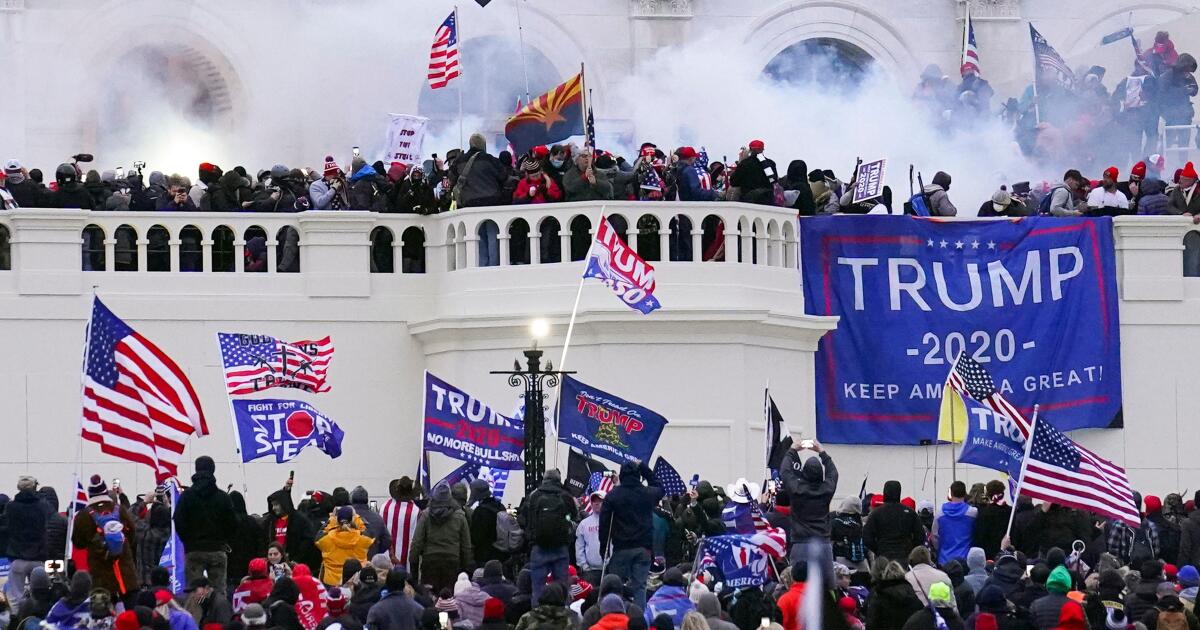
The hearing before a House Appropriations subcommittee was scheduled for discussion of the Justice Department’s budget, but lawmakers quickly focused their questioning on the creation of a fund that has provoked outrage over the mere possibility that violent pro-Trump rioters who stormed the U.S. Capitol on Jan. 6, 2021, could be eligible for payouts.

Signs for the retreat surfaced Monday when a person familiar with the matter said the Republican president was now reconsidering whether to move forward with the fund established to resolve his lawsuit against the Internal Revenue Service over the leak of his tax returns. The Justice Department also said Monday it would comply with a Virginia court temporarily blocking the administration’s “Anti-Weaponization Fund,” effectively agreeing to pause the plan for at least two weeks.

Another judge in Florida raised the prospect of reopening the IRS lawsuit because of “grievous allegations” of improper dealing made against the administration by settlement critics.

The Trump administration has defended the fund as an appropriate measure to make up for what officials insist was a weaponized Justice Department during President Joe Biden’s Democratic administration, a claim the Biden administration strongly denied. Though some Trump supporters, including participants in the Capitol riot, have celebrated the announcement, the reaction among Republicans in Congress has been decidedly more hostile, forcing Blanche to try to assuage a GOP constituency that generally operates in close alignment with the administration.

The furor has especially complicated matters in the Senate, where Republicans defiantly left town 10 days ago without passing legislation to fund Trump’s immigration enforcement agencies. Republicans who returned to Washington on Monday said they won’t have the votes to pass the Homeland Security spending bill until the White House works with them to place parameters on the fund. Many have pushed the administration to impose limits or scrap the idea altogether.

At a Senate budget hearing last month, Blanche refused to rule out the possibility that those who carried out violence on Jan. 6 could be eligible for payouts and has repeatedly said in interviews that anyone who feels persecuted by the criminal justice system is free to apply. Payouts will be decided by a five-member commission appointed by Blanche.

But he has apparently struck a more conciliatory tone in private when confronted by Republican anger.

Blanche encountered a groundswell of opposition last month at a tense private meeting with GOP senators, with more than half raising concerns, including by shouting at the Justice Department’s top official, Republican Sen. Ted Cruz of Texas said in a recent episode of his podcast.

“There were fireworks at an epic level — and I’ve got to say, it’s one of the roughest meetings I’ve seen in my entire time in the Senate,” Cruz said.

Behind closed doors, Blanche was “adamant” that no one who assaulted police at the Capitol would receive compensation, according to Cruz.

“He said not just ‘no,’ but ‘hell no,’” the senator recalled.

Tucker and Richer write for the Associated Press.

Source link

Competition to run JPL comes at fraught moment

Weeks after Trump administration officials announced that management of NASA’s Jet Propulsion Laboratory would open to competitive bidding for the first time, questions remain as to why Caltech could lose control of the lab its researchers founded in 1936.

On one hand, observers note, high-profile delays and cost overruns on significant recent JPL projects earned sharp criticism from NASA even before the 2024 presidential election.

On the other, the second Trump administration’s record of squeezing scientific funding and attacking institutions in Democratic-led states make it difficult to consider any action as separate from the charged political atmosphere, analysts say.

“My first instinct is that this [competition] isn’t necessarily a bad thing. It’s not written in stone that Caltech must run JPL, and it wouldn’t be the worst thing to have some competition for running the place,” said Casey Dreier, chief of space policy at the nonprofit Planetary Society.

“That said, that requires this contract evaluation to be fair and unbiased, and this administration has no credibility in such things,” he added. “The responsibility is on NASA to earn the trust and ensure such an evaluation is open and free from political meddling. That’s almost impossible.”

JPL became part of NASA when the space agency was formed in 1958, and Caltech has been awarded the contract to run the institution outright ever since.

Its current 10-year contract with NASA, which is valued at up to $30 billion, runs through Sept. 30, 2028.

NASA Administrator Jared Isaacman announced the competition on May 22 as part of a slate of sweeping organizational changes at the space agency.

“When you step back, it is worth considering how many additional missions we could have undertaken with the resources lost to program cancellations and cost overruns over the years,” Isaacman wrote in a memo to staff. “That is the problem we must fix, so the American taxpayer and space-loving community can receive the highest scientific return on every dollar we spend at NASA.”

Allowing competition on the contract for JPL, the lone Federally Funded Research and Development Center (FFRDC) in NASA’s portfolio, was an effort to address cost-efficiency concerns, Isaacman wrote.

“This process will take several years, and I do not anticipate it having any impact on the projects underway or the location of the facilities,” he wrote. “It does, however, provide an opportunity to evaluate management costs, overhead burdens, and ideally find ways to get after the science faster and more affordably.”

In a joint statement, Caltech President Thomas F. Rosenbaum and JPL Director Dave Gallagher said that the competition was “no surprise” and that a team was already in place “to ensure we are positioned for success.”

In July, NASA’s Office of Procurement held an informational event for companies and institutions interested in the upcoming FFRDC contract.

The dozens of registered attendees included universities such as USC, Texas A&M and Georgia Tech; aerospace companies such as Boeing and Lockheed Martin; and nonprofit corporations like MITRE, which manages several FFRDCs, and Universities Space Research Assn., a university consortium founded by the National Academy of Sciences in 1969. (SpaceX, which has been awarded more than $13 billion in NASA contracts in the last decade, was not on the list.)

“Lockheed Martin has more than 50 years of deep space exploration success with JPL, supporting landmark missions to Jupiter, Venus, Saturn, Pluto, including nearly a dozen missions to Mars,” said Bob Behnken, vice president of exploration and technology strategy. “We look forward to building on that unmatched partnership in the years ahead. We are closely following NASA’s review and will continue to assess how we can best contribute to the agency’s mission.”

Other attendees contacted by The Times declined to discuss their involvement.

Isaacman indicated that JPL could come under scrutiny even before he took over NASA. The billionaire entrepreneur referenced high costs at the La Cañada Flintridge institution in a memo prepared in advance of his confirmation hearings on his priorities for the space agency.

“Contract structure: Very expensive,” Isaacman wrote of JPL in a table outlining organizational issues at each of NASA’s centers. “Must increase the output and ‘time-to-science’ KPI,” or key performance indicator.

The institution has recently suffered a number of high-profile management stumbles.

After the JPL-managed Psyche mission to a metal-rich asteroid failed to meet its 2022 launch date, NASA commissioned an independent review that said internal reorganizations and personnel changes created distracted and uninformed managers and burned-out, stretched-thin staffers.

After a 2023 independent review found there was “near zero probability” of the JPL-managed Mars Sample Return mission making its proposed 2028 launch date, and “no credible” way to bring rocks back from the Red Planet within the stated budget, Isaacman’s predecessor, Bill Nelson, put out a call for proposals to industry and all other NASA centers, forcing JPL to compete for its own project.

After Trump’s election, Nelson announced that the final decision would be in the next administration’s hands.

The White House pushed for massive cuts to NASA’s 2026 budget that Congress overturned, and has lobbied for similarly steep cuts again this year. JPL has instituted painful cost-cutting measures of its own, reducing staffing from roughly 6,500 employees in 2023 to 4,500 last year through layoffs and attrition.

Its struggles come at a point when NASA is enthusiastically embracing private industry. Last month the agency awarded several key contracts for its upcoming lunar missions to Jeff Bezos’ Blue Origin and other private companies.

Trump has also made no secret of his willingness to punish states that haven’t voted for him through job losses. In announcing his decision to move U.S. Space Command from Colorado to Alabama, Trump acknowledged that his loss in Colorado in three presidential elections played a part in the move.

It’s impossible to consider any decision on JPL’s future as separate from the administration’s track record of politically motivated decisions, Dreier said.

“At the heart of this is why? Why now? If this is not just some rank political attack on California, what do they hope to gain from this?” he said. “That deserves explanation, because the administration otherwise has no credibility here.”

Source link

In deep blue California, frustration with Democratic status quo fuels governor, L.A. mayor race

As primary voters head to the polls Tuesday to determine which candidates will face off in November to become California’s governor and Los Angeles’ mayor, both races are wide open, with a new crop of candidates challenging the Democratic status quo.

For Democrats, little clear consensus has emerged so far on who should lead the city and state into the future.

In California’s crowded gubernatorial race, Democrats have struggled in recent months to settle on a candidate to succeed term-limited Gov. Gavin Newsom.

After former Rep. Eric Swalwell suspended his campaign in April amid allegations of sexual misconduct, Xavier Becerra, a former Biden cabinet member, inched ahead by positioning himself as the safe, experienced Democratic candidate. Another Democrat, billionaire climate activist Tom Steyer, and Republican Steve Hilton, a former Fox News commentator, trail close behind.

In L.A., experience seems to be as much a liability as an advantage.

Mayor Karen Bass finds herself in the extraordinary position, as an incumbent, of fighting to make the runoff as she is assailed from the left and the right. The latest UC Berkeley-L.A. Times poll shows Bass leading with just 26% of the vote, one point ahead of City Councilmember Nithya Raman, a wonkish Democratic socialist, and four points ahead of Republican Spencer Pratt, a former reality TV star.

“There’s a clear sense of frustration with the Democratic Party,” said Sara Sadhwani, a professor of politics at Pomona College. The reason a wave of conservative outsiders like Pratt and Hilton are doing so well in such a solidly liberal city and state, Sadhwani said, is that they’re more willing to spell out the challenges that L.A. and California face.

“Democrats tend to be very concerned about not upsetting one coalition or another, so it’s politics as usual with many of the Democratic candidates,” Sadhwani said. “Spencer Pratt has blown a hole in that by just naming the problems that everyday residents and voters are seeing and feeling on the ground.”

On homelessness, many Angelenos are frustrated Bass hasn’t significantly moved the needle.

“We can point to facts and figures that might suggest that things have changed,” Sadhwani said. “But when you walk down the streets of Los Angeles, it doesn’t feel like it, so she hasn’t passed the field test. That’s the problem.”

A growing segment of Angelenos also chafe at the city’s high cost of living. And many are angry about the Bass administration’s lack of preparation and response to the 2025 Palisades fire.

“The Democrats have to account for those challenges,” Sadhwani said. “They have been in power for all of this time.”

California, of course, remains a Democratic stronghold, and polls show state voters are overwhelmingly opposed to President Trump. His second-term agenda — including a sweeping immigration crackdown, tariffs and the war in Iran — only seems to have cemented California’s status as a resistance state.

But after so many years of Democratic dominance, in Sacramento and at Los Angeles City Hall, leaders have to answer for voter frustrations.

The top two vote-getters in California’s nonpartisan primaries will advance to theNovember runoff, unless one candidate manages to pick up more than 50% of the vote.

Republicans have turned out at higher rates than Democrats in early voting. Paul Mitchell, vice president of the Sacramento-based bipartisan firm Political Data Inc., said that older Democrats who reliably turn in their ballots were slower to vote this year, likely because two Republicans were on the gubernatorial ballot and the Democratic field was fractured.

“That has caused them to dive into a lot more strategic voting,” Mitchell said, noting many seemed to be waiting to cast their ballots for the Democrat who looks to have the best chance of moving on to November.

For the GOP, getting a candidate on the November ballot for governor means more than just demonstrating Republicans are players in California. A GOP candidate would bring out more Republicans to vote in the general election, raising the party’s prospects of winning down-ballot races and passing a GOP-led ballot initiative on voter ID.

For Democrats, the midterm races offer the party its first major chance to chart a new path for the future.

As polls show Trump cratering in popularity, Democrats in California and beyond are struggling a year and a half after Kamala Harris’ bruising 2024 defeat to agree on what went wrong.

The Democratic National Committee’s long-awaited autopsy of that election — which said Harris “wrote off rural America,” wrongly assumed identity politics would win over voters of color and failed to develop “defined or consistent” strategy against Trump — has only generated more hand-wringing.

“There is not a clear vision, there is not a clear policy agenda, and the Donald Trump presidency upended the policy world as we knew it,” Sadhwani said. “It’s unclear how any Democrat, including any of the individuals in these two races, is going to navigate the waters into the future. One thing is for certain: We aren’t going back. So, which of these candidates is going to lead us into an uncertain future?”

Referendum on Bass

In L.A., the election is a referendum on Bass, who pledged in 2022 to solve homelessness, cut crime and make the city more affordable.

“How has L.A. changed in four years?” said Christian Grose, a professor of political science and public policy at USC. “The Bass campaign is saying it has changed for the better and she still needs more time. All the other candidates, from very different perspectives, are saying that it’s much worse than it was four years ago, and it’s time for new leadership.”

Bass told The Times she plans to win in November by demonstrating her administration’s progress in clearing homeless encampments and accelerating the building of affordable housing. She has also noted that data shows homicides in the city are at their lowest since 1966.

Challenging Bass from the left is Raman, who was elected in 2020 as the first DSA-backed L.A. City Council member. Pitching herself as the viable progressive in the race, Raman has accused Bass of not doing enough to make the city affordable and critiqued Bass’ spending on Inside Safe, her program to move unhoused people into stable housing. Although Raman presents herself as an outsider, she is a former Bass ally who has chaired the council’s Housing and Homelessness Committee for more than three years.

“She’s absolutely a part of the establishment,” Sadhwani said. “She’s been in City Hall longer than Karen Bass.”

As Raman tacked to the center during the campaign to appeal to more moderates and distanced herself from past calls to defund the police, she alienated some DSA members who complained they didn’t know what she stood for. Her three fellow DSA City Council members endorsed Bass.

Pratt is challenging Bass and the entire Democratic status quo.

A former star of “The Hills” who lost his home in the Palisades fire, he has surprised many political observers with his success assailing the city’s handling of the 2025 firestorms. He has called unhoused people drug-addled “zombies” and argued that L.A.’s housing crisis requires heavy-handed policing.

Pratt has raised vastly more campaign contributions than Bass and Raman. He has also generated national online buzz by waging an aggressive social media campaign and inspiring supporters to post a stream of viral AI election campaign ads.

Still, most political experts agree that Bass has the most viable path to victory, starting with a solid base of Black voters and a large share of Latino voters, plus support from powerful unions.

“Under normal circumstances, or at least under historic circumstances, that would be plenty to get her over the finish line,“ said Jim Newton, executive director of UCLA Blueprint magazine and a former political journalist for The Times. “What’s problematic for her is that there are people who are angry with her.”

A reset in California

Newsom has emerged in recent years as the national face of Democratic resistance to Trump, bolstering California’s status through a barrage of lawsuits and all-caps trolling against Trump.

Whatever candidate replaces Newsom, things are going to be different.

The emerging front-runner, Becerra, is a safe-bet career politician who has served as California attorney general and U.S. secretary of Health and Human Services. Asked recently why he had climbed in the polls, Bercerra said he thought voters wanted experience, not “glitz and sizzle.”

He has pledged to issue executive orders declaring California’s housing shortage a state of emergency and directing state agencies to maintain coverage for every Californian affected by federal or Medi-Cal cuts. He also touts his record, as the state’s attorney general, of suing Trump 122 times.

Steyer, a hedge-fund billionaire, calls himself “the most progressive candidate on the ballot.” He has pledged to build one million affordable homes, make the wealthy pay more taxes, and defend the environment — stances that are certain to unsettle Sacramento lobbyists and test the limits of California’s progressivism. But his past investments in coal plants and ICE prisons raise questions for some voters.

“His wealth is in one way his Achilles heel in the election,” Grose said. “Voters think of him as a billionaire more than progressive.”

Republicans seem to have rallied around Hilton — a British immigrant and former top strategist forconservative prime minister David Cameron — who has secured Trump’s backing and is campaigning on the message that California is a failed state in need of radical reform.

Hilton has pledged to cut government spending, make housing more affordable and bring gas prices down. But to achieve some of his goals he would scale back public services and environmental regulations and ramp up domestic production of oil and natural gas — strategies that many Californians might hesitate to get behind.

Whichever candidates make it to the runoff, the California Democratic Party will face questions about its strategy and vision. Less than two months ago, the party chair had urged Becerra to drop out of the race to make way for Swalwell.

“Clearly, the party itself has lost its way in California,” Sadhwani said. “I would not be surprised if the California Democratic Party looks for new leadership after this election.”

Can a Republican win?

Because the top two spots in each contest are up for grabs, elections experts warn that the vote results may not be known for days.

If Republicans make it to the runoff, they face steep odds of being elected in November in a state where Democratic registered voters outnumber Republicans by more than 20 percentage points.

Rob Stutzman, a GOP strategist, said neither Hilton nor Pratt was likely to win. But if they made the runoff they could have a huge impact on the political environment by advancing “grievance issues that really put up a spotlight on what I call the blue state incompetence.”

Of all the candidates, Mitchell said, Pratt as an outsider adept at Instagram and TikTok has the greatest opportunity to create a new surge electorate. But he’s also going after the hardest voters to get to turn out: disaffected voters who are upset at the system.

Pratt had more retweets and viral videos than any other candidate, Mitchell said. “But that doesn’t buy him the vote of the disaffected DoorDash driver who believes that the system is broken, and who hasn’t voted in the last five elections.”

If Republicans don’t make it past the primary, Mitchell said, Democrats would likely hit the reset button.

“Pratt running has kind of obfuscated the differences between Raman and Bass,” Mitchell said. “It’s like a WWE match versus a chess match. I think Raman versus Bass would be more of a strategic and nuanced election than Spencer Pratt trying to hit Karen Bass over the head with a chair.”

Source link

Marco Rubio: Iran must reopen Strait of Hormuz, discuss nuclear program

June 2 (UPI) — Secretary of State Marco Rubio told the Senate on Tuesday morning that Iran must reopen the Strait of Hormuz and commit to future talks on its nuclear program before the United States will make concessions.

He testified before the Senate Foreign Relations Committee before a scheduled afternoon meeting with a House panel on State Department spending. Both sessions were planned so that Rubio could defend the department’s nearly $36 million budget request for the 2027 fiscal year.

Rubio is also President Donald Trump‘s national security adviser.

The Washington Post reported that Rubio’s testimony with lawmakers has been mostly friendly. He served in the Senate for 14 years and in the House for 8, representing Florida.

Lawmakers from both sides of the aisle have expressed frustration with the cost and potential political fallout from the war with Iran.

“This war and the administration’s decision to blockade has now held the entire world economy, and the U.S. economy, hostage to the ability to negotiate an agreement with Iran,” said Sen. Chris Murphy, D-Conn, The Post reported.

The Strait of Hormuz, which has been closed by Iran since late February, must reopen, Rubio stressed. The strait is a critical waterway for shipping of much of the world’s oil, gas and fertilizer. The closure has caused gas prices to rise, causing anxiety as Republicans fear losing House and Senate seats in November.

Rubio said Trump demands that Iran enter into negotiating “severe and long-term limitations” on its nuclear program, including disposing of enriched uranium, and those talks could take months.

But he said he’s optimistic that Iran is more willing to negotiate on nukes.

“They have agreed to negotiate aspects of their nuclear program that just a month ago, just a year ago, they were refusing to even mention,” The Guardian reported Rubio said. He warned that it’s “not a guarantee that ultimately it will lead to a deal that’s acceptable,” and Iran’s leadership instability has made the negotiations more difficult.

Rubio said Iran had intended to use its conventional weapons capabilities as a “shield” to protect its nuclear program, The Guardian reported.

“What they tried to do is, they were going to try to build a conventional shield and hide behind that conventional shield,” he said, explaining why Trump wanted to start the war.

He also admitted, after questioning by Sen. Ted Cruz, R-Texas, that another sticking point for Trump was that Iran stop supporting terrorist proxy groups. He said Trump is not willing to ease sanctions just for opening the strait.

Rubio said that Iranian Ayatollah Mojtaba Khamenei is believed to be alive.

“I would imagine, given what’s happened to multiple leaders in that system, being very public is probably not something that’s recommended for them internally,” he said. “But that said, I think there are indications out there that he is increasingly engaging at some level, although all of his communications have been in writing and through intermediaries.”

Along with Iran, lawmakers were expected to ask Rubio about the president’s comments about Cuba and Taiwan.

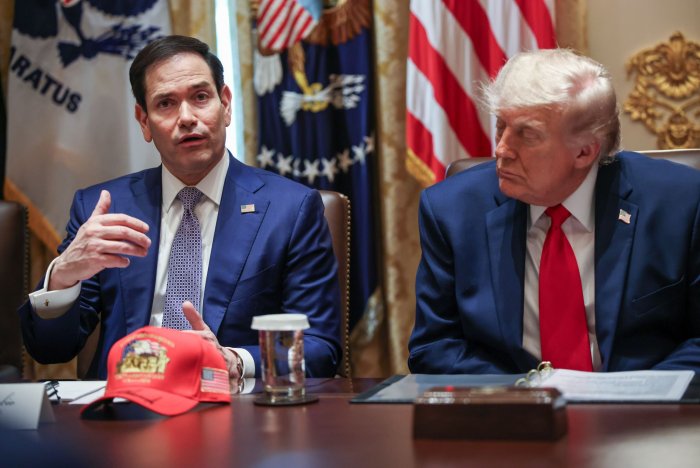
Secretary of State Marco Rubio and President Donald Trump participate in a Cabinet meeting in the Cabinet Room of the White House on Wednesday. Photo by Samuel Corum/UPI | License Photo

Source link

Trump signs an executive order to vet top AI models for national security risks

President Trump signed an executive order on artificial intelligence Tuesday, less than two weeks after postponing a White House ceremony over his concerns that a similar policy could dull America’s edge on AI technology.

The order establishes a framework for the federal government to vet the national security risks of the most advanced AI systems for up to a month before their public release. The government will be able to work with trusted partners “that will have early access to covered frontier models to promote secure innovation and strengthen the cybersecurity of critical infrastructure,” the order says.

It was not immediately clear to what extent the order differed from the one he declined to sign on May 21.

Trump canceled an Oval Office event with tech industry executives last month because he did not like what he saw in the earlier version of the order’s text. “We’re leading China, we’re leading everybody, and I don’t want to do anything that’s going to get in the way of that lead,” Trump told reporters at the time.

That directive was characterized as a voluntary collaboration with participating U.S.-based tech companies, including Anthropic, OpenAI and Google.

O’Brien writes for the Associated Press.

Source link

Colombia’s Petro doubles down on election fraud allegations

Colombian President Gustavo Petro said he has evidence of software modifications that allegedly introduced hundreds of thousands of voter identification records that were not properly registered and altered voting tables. Photo by EPA

June 2 (UPI) — Colombian President Gustavo Petro reiterated allegations Tuesday of possible electoral fraud in the first round of the country’s presidential election, claiming irregularities in the voter registry and vote-counting systems ahead of the June 21 runoff.

In a message posted on X, Petro said he was presenting the “verified basis of possible fraud” and claimed he could submit evidence to the relevant authorities.

Petro said he has evidence of software modifications that allegedly introduced hundreds of thousands of voter identification records that were not properly registered and altered voting tables.

Petro contended that last-minute technical changes to systems operated by Colombia’s National Civil Registry, known as the Registraduria Nacional, resulted in irregularities, including an increase of 885,409 voter identification records in the electoral roll and the appearance of 1,493 additional voting tables that he claimed were not authorized.

He also alleged that the algorithms used in private software for preliminary vote counting and official tabulation were secretly modified three times during the final week of the campaign.

As a result, Petro said, he would only recognize the final official results certified by judicial authorities serving on Colombia’s electoral review commissions.

He said the alleged irregularities benefited far-right candidate Abelardo de la Espriella and harmed his preferred candidate, left-wing Sen. Ivan Cepeda.

After preliminary results showed De la Espriella leading with 43.74% of the vote and Cepeda in second place with 40.90%, Petro said he would not accept the preliminary count and pledged to present evidence to electoral authorities.

Before the election, several polls had projected Cepeda as the frontrunner, although analysts noted a rapid surge in support for De la Espriella during the final weeks of the campaign.

Petro intensified his criticism Tuesday, claiming electoral authorities were seeking to “close the vote count quickly” to avoid reviewing his allegations.

The National Civil Registry reported that the official count had reached 99.98% completion and said final results matched the preliminary count of 99.94%, rejecting claims of widespread manipulation.

According to Colombian media reports, Cepeda significantly softened his position Monday after initially supporting Petro’s concerns on election night.

The candidate of the Historic Pact coalition said that after an extensive review conducted by his monitoring team, no evidence was found of irregularities significant enough to call the legitimacy of the first-round results into question.

Voters will return to the polls June 21 to choose between two sharply different political visions.

De la Espriella, a political outsider associated with what supporters describe as a “new right,” has centered his campaign on public security and advocates a hardline approach to crime inspired by the policies of El Salvador’s President Nayib Bukele and Argentine President Javier Milei.

Cepeda, meanwhile, has campaigned on social justice and supports continuing and expanding Petro’s agrarian reform and energy transition agenda, while promoting negotiations with armed groups as part of a broader peace strategy.

Source link

Live Election 2026 primary results, updates: Who won California’s governor, congressional races?

We’re tracking races across California, including primary elections for U.S. congressional districts that were recently redistricted. Results for governor, statewide officers such as the attorney general and insurance commissioner, as well as state Senate and Assembly contests are available on this page.

In state-level primary races, the top two finishers will move on to the general election in November. Their names will be indicated with checkmarks once their races are called by the Associated Press.

Initial results are expected shortly after the polls close at 8 p.m.

Every registered voter in the state receives a ballot by mail. To vote by mail, these ballots must be postmarked by June 2. They may take several days to process. Results from provisional and conditional ballots also take longer, and will be added to the tally once they are cleared.

The data on this page updates periodically as results come in from the Associated Press. The secretary of state will certify results in early July.

Icon: Figure standing at podium

Governor

The California governor’s race is a tight battle between 24 Democrats , 12 Republicans and 25 candidates from other parties or with no party preference . Half a dozen of which had real support in the polls. The crowded field is vying to replace Democratic Gov. Gavin Newsom. California has never elected a woman as governor and only once a person of color, making this race potentially historic for the state. The top two vote-getters move on to the general election regardless of party preference.

Back to top

Election live results section icon showing a map of California.

Statewide races

Back to top

Board of Equalization

Back to top

Icon: Capitol building

U.S. House

California’s congressional map was redrawn last year after the passage of Proposition 50. Several seats are expected to flip from red to blue due to Newsom’s redistricting effort. In some cases, districts were moved slightly and incumbents remain unchallenged. However, in one area, lines have been redrawn with no overlap at all with their current boundary: Rep. Ken Calvert’s 41st District in the Inland Empire was eliminated and completely redrawn in Los Angeles County. Calvert is now challenging Republican incumbent Young Kim in the 40th District. Both are marked as incumbents on the table below.

The 1st Congressional District — which was redrawn further south to cover portions of Butte, Colusa, Glenn, Lassen, Modoc, Shasta, Siskiyou, Sutter, Tehama and Yuba counties — is holding a special primary election to fill the seat left vacant by Rep. Doug LaMalfa’s death in January.

Back to top

State Senate

Back to top

State Assembly

Back to top

Source link

US targets Brazil with new tariffs over trade practices | International Trade News

The administration of United States President Donald Trump has proposed a new 25 percent tariff on imports from Brazil amid allegations of unfair trading practices.

US Trade Representative Jamieson Greer announced the new punitive tariffs late on Monday, stemming from issues including digital trade and illegal deforestation.

Recommended Stories

list of 4 itemsend of list

The new tariffs would be imposed under Section 301 of US trade policy — a statute that gives the US government broad authority to impose trade sanctions based on violations of trade agreements, as well as what it deems “unfair” trade practices under the Trade Act of 1974.

Greer said there has been an investigation that began in July. The practices under investigation were related to issues such as illegal deforestation, ethanol market access, and anticorruption enforcement, among other key issues, according to the summary released by the US Department of Commerce on Tuesday.

In the 107-page document, the US government said that trade practices between the two nations “are unreasonable and burden or restrict US commerce”, and pointed to agreements that Brazil has with Mexico and India.

“Brazil’s trade arrangements with Mexico and India also create incentives to offshore US production by creating a financial advantage to exporting to Brazil from these countries, as opposed to exporting from the United States,” the document says.

There is a comment period for the general public to weigh in on the proposed tariffs, which begins on Thursday. The written comment period ends on July 1, and there will be a public hearing in Washington on July 6.

Beef, coffee, rare earths, other metals, energy, and aircraft parts are among the products that would be exempt from the tariffs.

On CNBC, Greer said that it would release more findings on unfair trade practices in the next several weeks in order to address what Greer called a “giant” trade deficit.

However, the data shows that the US maintains a trade surplus with Brazil. In March, Brazil bought more goods, worth $3.3bn, from the US than it exported at $2.9bn, representing a $420m trade surplus.

Other countries under investigation include China and Vietnam.

The new tariff would partially replace a tariff of 50 percent on many Brazilian goods imposed last year by Trump, with 40 percent serving as a punishment for Brazil’s prosecution of former President Jair Bolsonaro, a Trump ally.

The White House also recently dropped tariffs on select aluminium, copper, and steel imports, which include agricultural equipment such as harvesters. Those tariffs will drop from 25 percent to 15 percent. The tariffs expire in December 2027.

The new tariffs come after the Supreme Court, in February, struck down the use of the International Emergency Economic Powers Act (IEEPA), which the White House used to impose its sweeping global tariffs.

“They are the first of many new tariffs to replace the IEPPA national security tariffs. The period of public comment will allow for potential modest tweaks and exemptions. Ultimately, it will add to some inflation pressure compared to the last few months but not compared to a year earlier,” Rachel Ziemba, a senior adjunct fellow at the Center for a New American Security, told Al Jazeera.

Political tensions

The changes come despite President Luiz Inacio Lula da Silva’s visit to Washington last month, as relations have deteriorated in recent months.

The US State Department has also designated two of Brazil’s criminal gangs as “terrorist organisations”, a move that supported Senator Flavio Bolsonaro’s position, Lula’s main rival in October’s election, and over the objections of Brazilian officials.

“I expressly asked President Trump not to tariff our companies,” Bolsonaro wrote on X on Tuesday. “Tariffs are not the solution.”

The White House did not respond to Al Jazeera’s request for comment.

Source link

Live Election 2026 primary results, updates: who won Los Angeles mayor, city council, LAUSD

Elections in the city of Los Angeles include mayor, City Council, three ballot measures and Los Angeles Unified School District board seats and, if you live in the city, you’ve maybe seen an ad about them.

The high-profile competition between incumbent Mayor Karen Bass, City Councilmember Nithya Raman and conservative reality star Spencer Pratt has been tumultuous. And that is to say nothing of Rae Huang, Adam Miller and the nine others contenders.

With leaked files, millions in campaign fundraising donated by a candidate’s mother, and a multi-campaign effort by L.A.’s chapter of Democratic Socialists of America, the race for mayor isn’t the only one making headlines this primary.

A candidate can win by getting a majority of the vote. If no one receives 50% + 1 vote, the top two advance to the November election.

Mayor

The Associated Press, which surveys the numbers posted by local election officials and projects the winner using vote returns and other data, will call a winner (or a runoff) for L.A. mayor.

City Council

Back to top

Officers

Back to top

Ballot measures

Back to top

Los Angeles Unified School District

Back to top

Source link

Live Election 2026 primary results, updates: who won California’s competitive congressional districts

On the ballot this year is an entirely new congressional map.

Redrawn with the passage of Proposition 50, the new districts favor Democrats in November. But those gains aren’t guaranteed. Candidates have to make it through California’s primary, where the top two vote-getters move on to the general election regardless of party preference.

While many districts shifted only slightly, some Republican districts were split, some Democrat districts were strengthened, and in one district lines were redrawn with no overlap at all with their 2024 boundary.

Several seats are competitive — either with a tight race between Republicans or because the seat is expected to flip from red to blue. With redistricting, only four seats are considered solidly Republican, according to the Cook Political Report, down from the nine GOP seats won in 2024.

The 1st Congressional District — which was redrawn farther south to cover portions of Butte, Colusa, Glenn, Lassen, Modoc, Shasta, Siskiyou, Sutter, Tehama, and Yuba counties — is one to likely flip.

Rep. Ken Calvert’s 41st District in the Inland Empire was eliminated and completely redrawn in Los Angeles County. Calvert is now challenging Republican incumbent Young Kim in the 40th District. Both are marked as incumbents in the results below.

In its new position, the 41st District was carved, in part, out of the previous 38th District. The current representative for the 38th District, Democrat Linda Sánchez, is running in the 41st District and is marked as an incumbent.

Several seats, such as former House Speaker Nancy Pelosi’s 11th District, are competitive between candidates from differing wings of the Democratic party. While in District 22, Democrats are competing to challenge Republican Rep. David Valadao in a redrawn, Latino-majority swing district.

Also on this page are noncompetitive local districts that may still be of interest to Times’ readers in Southern California.

Not seeing the race you’re looking for? See all of California’s U.S. House races on the statewide election page.

Source link

Trump taps housing finance director Pulte as acting director of national intelligence

President Trump has tapped Bill Pulte, head of the Federal Housing Finance Agency, to be the acting director of national intelligence — putting a real estate scion and fierce Trump loyalist in a key national security post as the U.S. remains at war with Iran.

Trump made the surprise announcement Tuesday on social media that Pulte would be replacing Tulsi Gabbard, the former Hawaii congresswoman who served as the director of national intelligence.

The Republican president cited Pulte’s work at the FHFA and his role as chair of the mortgage giants Fannie Mae and Freddie Mac, saying that the 38 year-old “has deep experience managing the most sensitive matters in America, the safety and soundness of the Markets, and over 10 Trillion Dollars at Fannie Mae/Freddie Mac, a substantial increase from where it was just 12 months ago.”

Pulte’s sudden elevation to a role coordinating sensitive national security matters is a sign of how Trump is putting a priority on loyalty over a traditional resume full of previous military and intelligence assignments. It’s unclear what national security expertise Pulte has, but he has been a frequent guest on Air Force One as Trump has traveled to Mar-a-Lago, his home and club in Palm Beach, Florida.

As the grandson of the founder of PulteGroup, one of the country’s largest homebuilders, Pulte has cut a combative streak on social media and used his post at the FHFA to attack perceived opponents of the Trump administration.

His time overseeing mortgage finance has been linked with criminal referrals for mortgage fraud by public officials Trump sought to punish, including New York Attorney General Letitia James, a Democrat; Sen. Adam Schiff, D-Calif.; and Lisa Cook, a member of the Federal Reserve, who was nominated by a Democratic president, Joe Biden.

Pulte has famously gone after then-Federal Reserve Chair Jerome Powell for not cutting the central bank’s benchmark interest rates as aggressively as the president wanted. He has also been linked to ideas such as the 50-year mortgage and efforts to lower mortgage rates through the purchase of home loan debt that have not paid off as promised.

Trump said Pulte will keep his other positions even as he fills in for Gabbard, who resigned last month after revealing her husband’s cancer diagnosis.

If formally nominated, Pulte would need to be confirmed by the Senate to hold the position full time.

Boak writes for the Associated Press.

Source link

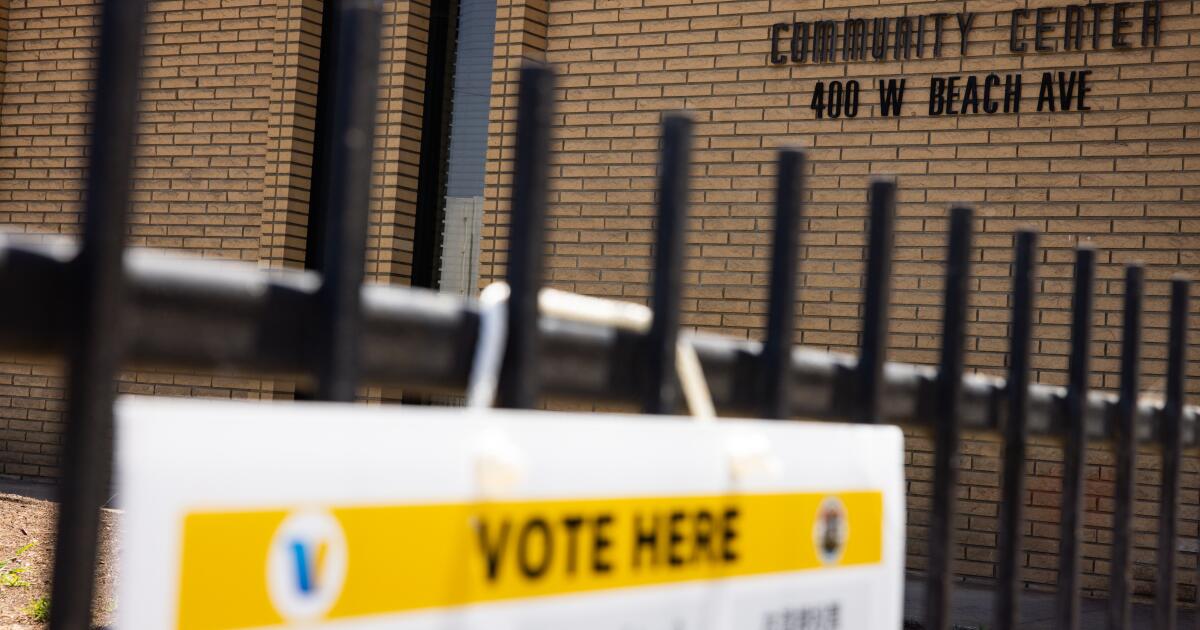
Your last-minute guide to election day challenges in California’s 2026 primary election

It’s election day in California’s 2026 primary, and you’re headed to the polls — until you realize you’re not sure you’re registered, or fear you might not make it to the vote center on time.

Here are some common election day concerns and challenges and how to end your Tuesday with an “I voted” sticker.

I forgot to register to vote

You can still register to vote on election day as a conditional voter through the same-day voter registration process.

Eligible citizens who need to register or re-register to vote within 14 days of an election can complete this process and vote at county elections offices, polling places or vote centers. To register you’ll need to provide a driver’s license, a state identification number or the last four digits of your Social Security number.

A complete list of county election office addresses can be found here.

Your submitted ballot will be processed and counted once the county elections office has completed the voter registration verification process.

If you’re unsure about your voter status, you can find your record here by providing some personal information including your date of birth and driver’s license number.

I don’t know where my polling place is

You can find your nearest polling place on the California secretary of state’s website here.

You can also use Los Angeles County’s voter center locator on the registrar-recorder/county clerk website here.

On election day, voting centers are open from 7 a.m. to 8 p.m. across the state.

I can’t submit my mail-in ballot myself

You can have someone else submit your ballot.

Anyone can drop off your mailed ballot as long as you authorize them to do so and they do not get paid on a per-ballot basis, according to the secretary of state.

You and the person you’ve authorized to submit your mailed ballot must fill and sign the outside of the ballot envelope.

I forgot my check-in code for in-person voting

Los Angeles County election officials say you can check in at a vote center by scanning your “quick check-in code” — a number that verifies your voter registration.

Your code can be found on your mailed sample ballot and vote center postcard. Take either of those hard copies to the vote center.

If you forgot the hard copies, you can retrieve the code by verifying your voter registration here. You’ll need to input your last name, birth date, the house number of your residential address and ZIP Code. For assistance call, (800) 815-2666, Option 2.

I want to drop my ballot in a box but fear it’s too late

There are three ways you can submit your mailed ballot on election day:

  • You can put it in a ballot drop box. The cutoff time for doing so is 8 p.m., which is also when the polls close on election day.
  • Drop it off at a vote center, where the deadline is the same.
  • Drop it off at a United States post office. Be sure to get a hand-stamped postmark from a postal employee. Mailed ballots must be postmarked on election day and received no later than seven days after election day.

I think I forgot to sign by mailed ballot envelope

If you failed to sign your vote-by-mail ballot return envelope, your vote will still count.

Your county elections official will notify you by mail, phone or email, according to the secretary of state. You can also be notified by way of the “Where’s My Ballot?” tracking tool if you have signed up for automatic notifications that will ping you if there are issues with your ballot.

Your county elections office will provide you with a form to fill out and return completed.

The form will be given to you two days prior to the day your county certifies the election, so be sure to fill it out and return it to your county elections office right away.

I’m going to be late getting to the polls; can I still vote?

In California, any voter who is in line at 8 p.m. when the polls are scheduled to close is allowed to vote, according to the secretary of state.

If there is a line when the polls close, a poll worker stands at the back of the line to let people who arrive after 8 p.m. know that the polls have closed.

Any voter who arrives after the polls have closed may not be allowed to vote, even if voters who were in line to vote before the polls closed are in the process of voting.

Source link

Bass, Raman or Pratt? Three L.A. residents explain who got their vote for mayor

As the voters deliver their ballots to neighborhood drop-off sites and others wait to vote in person Tuesday, Times reporters fanned out across the city to ask residents whom they planned to support for mayor.

Here is a sample of what voters said about their preferred candidate.

‘The other choices were not worth my vote’

Steven Travers
57
Glassell Park
Self-employed

Voter Steven Travers told The Times that he didn’t feel like there were many options for him in the mayoral election this year, except for the incumbent Karen Bass.

Shopping at Vons in Echo Park, Travers said, “Just what I’ve seen of her, and you know, the way she speaks, she seems to be OK.”

“I guess she’s done an OK job since she’s been the mayor,” Travers said. “The people she’s running against, I mean, there’s really nobody else that I think I would want to be in that position.”

This decision to vote for Bass, despite the wide field of options, came down to how she had handled homelessness in the city and Travers’ neighborhood of Glassell Park, where there had been homelessness issues “for a period of time.”

The issue, Travers said, has been lessened and “certain areas things are getting a little bit cleaned up. And I’m assuming that she’s, you know, part of that whole thing.”

Travers also said that “anybody involved in politics in Los Angeles” seems to always talk about homelessness “more than anything else” and that Bass “seems to be trying to maybe do something about it.”

Simply put, “The other choices were not worth my vote,” Travers said.

Looking for a more humane L.A.

Zorah Archie-Winston
22
View Park
Recent USC graduate

Zorah Archie-Winston said that she’s probably voting for Nithya Raman for mayor.

“If I had to choose, like, right now, I think I’m leaning more towards Raman,” Archie-Winston said.

One of the main reasons for that, she said, is Raman’s personality and the humanity she brings to the table.

The 22-year-old View Park resident said that the unhoused population is something she feels very passionately about, and she believes Raman shares that.

“We could have, like, a lot more of a compassionate view on the unhoused population and those adjacent,” Archie-Winston said.

She said she’s been following along with Raman’s journey on the L.A. City Council and looks forward to seeing what the candidate could do as mayor, especially for tenancy rights.

“I think there are a lot of resources and things that are really inaccessible to those who are struggling to live in L.A. for one reason or another, and I think that’s something Raman will be able to help with,” Archie-Winston said.

‘He might be our only saving grace’

Ann Raljevich
66
Westchester
Medical biller

Ann Raljevich, a 66-year-old medical biller, says Spencer Pratt could be the city’s hero in the mayoral race.

“I think he might be our only saving grace,” said Raljevich, of Westchester.

Under the city’s current leadership, Raljevich tells The Times, she said she hasn’t seen change in the city. She said she still sees the same unkempt streets, drug addicts around town and high sales taxes.

“Being in the medical field — the drugs bring on the schizophrenia and bring on all the other things, and I mean, I see it when I drive in and out of town,” Raljevich said. “I see it everywhere.”

Raljevich said she also admired that Pratt was from Southern California and graduated from USC.

She said the fact that he hasn’t directly declared a political party affiliation shows that he doesn’t care what people think and is just here to do the job.

“He never really came out to say whether he’s a Republican or a Democrat,” Raljevich said. “He’s just for the people.”

Source link

Democratic voters confident California election is secure, Republicans less so, poll finds

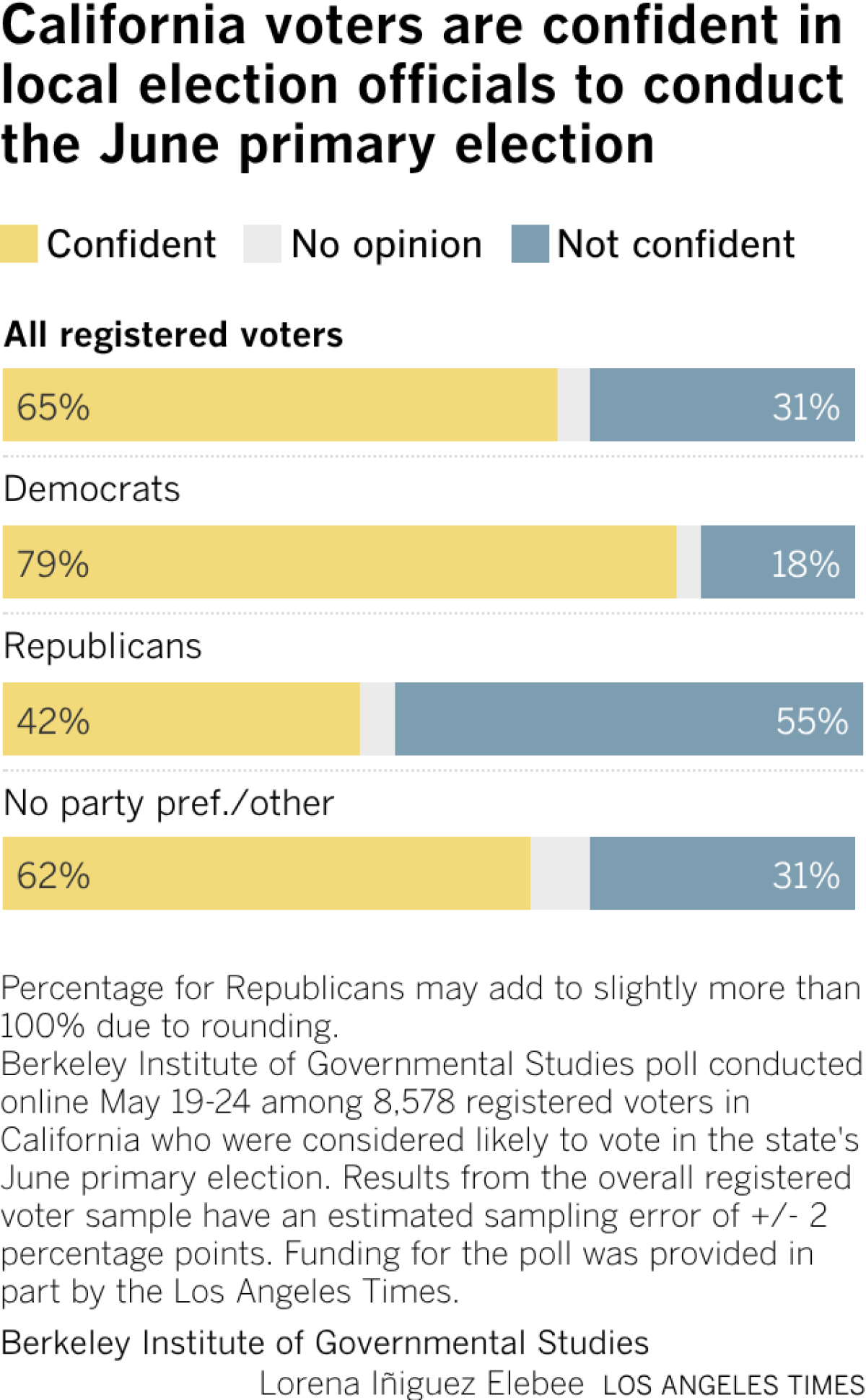
California voters are deeply divided over the trustworthiness of state elections heading into Tuesday’s primary, with most Democrats but less than half of Republicans expressing confidence in the electoral process, according to a new poll.

The polarized view follows a years-long campaign by President Trump and his Republican allies to question the legitimacy of American elections, especially in California and other blue states. It also follows robust efforts from liberal leaders, elections officials and voting rights experts to denounce Trump’s claims as baseless.

Overall, registered voters in the state — which skews heavily Democratic — expressed confidence in local election officials by a 2-to-1 margin, with 65% expressing confidence and 31% expressing a lack of confidence, according to the poll released Tuesday by the UC Berkeley Institute of Governmental Studies and co-sponsored by The Times.

However, those figures shift dramatically when sorted by political party, and even more when parsed by partisan leaning.

For example, 79% of Democratic voters expressed confidence in local officials running a secure and fair election, compared to 62% of independent voters and 42% of Republican voters, the poll found.

While 82% of voters who identified as strongly liberal expressed confidence, just 38% of voters who identified as strongly conservative did so.

A volunteer assists a voter at a polling site.

A volunteer assists Melani Hurwitz at a polling location Monday at the Cal State Long Beach Walter Pyramid.

(Eric Thayer / Los Angeles Times)

“It’s clearly a partisan issue, and it is being promoted by the president and others who are his followers,” said Mark DiCamillo, the director of Berkeley IGS polls. “Strong conservatives and the Republicans are the least confident, and a lot of them are saying [they are] not at all confident. That’s a pretty extreme statement.”

Rick Hasen, an election law expert and director of the Safeguarding Democracy Project at UCLA Law, said he expected Republican confidence to be even lower given Trump’s decade of undermining trust in elections, especially in liberal, diverse states such as California. But he said neither Trump’s narrative nor public sentiment about election security — which generally shows voters are more confident “when their side wins” — reflects reality, which is that “our elections are administered well.”

“There’s very little evidence of manipulation or of fraud or even of incompetence,” Hasen said. “Anyone who looks objectively would see that there are numerous safeguards to ensure we have free and fair elections in California.”

Trump has long contended without evidence that voter fraud is pervasive among undocumented immigrants and in states, such as California, that use mail ballots, and blamed his 2020 loss to Joe Biden on such fraud despite experts rejecting the claim and Trump’s own allies and lawyers being unable to prove it.

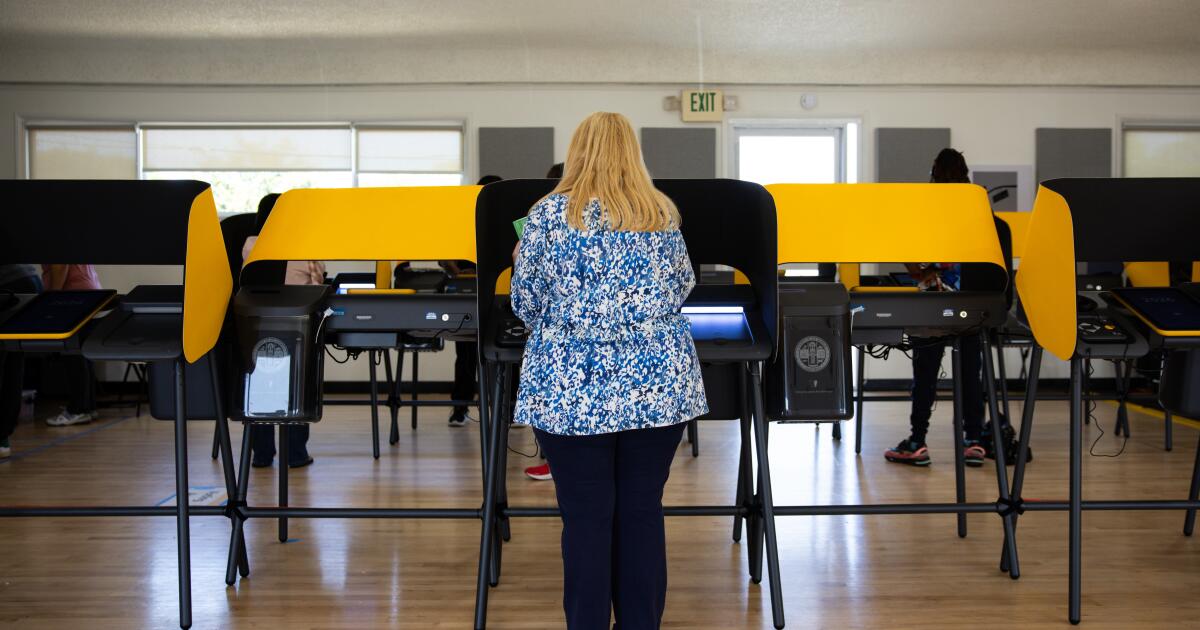
A voter's feet in a poll booth.

A voter casts their vote inside the Westchester Family YMCA Annex on Monday.

(Kayla Bartkowski / Los Angeles Times)

Since returning to the White House last year, Trump has tried to implement strict new requirements for voter ID and proof of citizenship and to limit or bar mail-in voting, and called for greater federal or Republican Party control over state-run elections. In February, he said that “Republicans ought to nationalize the voting” in “at least 15 places” where they lose.

On Saturday, Trump falsely claimed that California doesn’t have any voting booths and only accepts mail ballots.

Democratic leaders, elections experts and voting rights advocates have all pushed back. They’ve backed their assurances that the state’s elections are safe with lawsuits to block Trump’s efforts to assert federal control. They also warn that his administration may try to intervene anyway, including by sending federal immigration agents to polling locations or intercepting or invalidating mailed ballots.

When Trump issued an executive order in March 2025 purporting to require voters to provide proof of citizenship, California sued, with a court blocking the policy while the litigation continues. When the Justice Department sued California Secretary of State Shirley Weber in September for refusing to hand over the state’s voter rolls, California won a dismissal in court. When Trump issued another executive order this March directing the U.S. Postal Service to take control of mail balloting, California sued again. That litigation is ongoing.

Last week Gov. Gavin Newsom signed a bill barring federal agents and other law enforcement from interfering with local and state elections officials or confiscating ballots, voter rolls or voting machines without a warrant. Newsom said California voters were experiencing “legitimate anxiety” over election integrity given the threats from the Trump administration and the recent actions of Riverside County Sheriff Chad Bianco — a MAGA-backed Republican candidate for governor who recently seized hundreds of thousands of ballots as part of what he said was an investigation into potential fraud in last year’s election.

An election worker carries a bin of ballots.

An election worker collects extracted vote by mail ballots to be tallied at the Los Angeles County Registrar-Recorder/County Clerk Ballot Processing Center in City of Industry.

(Gary Coronado / For The Times)

Newsom said he expects Trump to interfere with the upcoming election as well because “every single thing that Donald Trump is saying only suggests that he will do more, not less, to intimidate and to impact the outcome of this election,” but that the state stands ready to respond.

California Atty. Gen. Rob Bonta last week said that his office is preparing for “all different types of scenarios” involving federal interference, from ballots being seized to immigration agents showing up at polling locations.

“We are currently monitoring any potential risks or threats, and we’re ready for any possibility,” he said.

Sen. Alex Padilla (D-Calif.) last week blasted the U.S. Postal Service for issuing a proposed rule to implement Trump’s mail ballot changes, despite the ongoing litigation. In April, Rep. Nancy Pelosi (D-San Francisco) helped convene a pair of “shadow hearings” in California where fellow House Democrats and a panel of experts shot down Trump’s claims about widespread fraud and expressed confidence in state elections.

A Berkeley IGS Poll from a year ago found that California voters support requiring first-time voters to show ID to prove citizenship in order to register, and that most supported requiring a government ID every time a voter casts a ballot. However, another Berkeley IGS Poll from last month found that strong majorities of California voters believe American democracy is under attack or being “tested.”

Dean Logan, head of the L.A. County registrar-recorder/county clerk’s office, said that overall confidence, “despite a sometimes volatile state and national narrative,” was “gratifying.”

“Election officials take connection to their community seriously. We recognize that our job is to facilitate their voting experience, and that voter participation is key to election security,” Logan said. “Regardless of party affiliation, our role as election officials focuses on the function and process of ensuring the voice of the electorate is heard and that compliance with the election laws adopted in our state is achieved.”

Jesse Salinas, president of the California Assn. of Clerks and Elections Officials and the registrar of voters in Yolo County, said local elections officials are “proud to be a steady source of trust at a consequential moment,” and stand ready to “open our doors to any voter who wants to see firsthand how our elections work and to answer any questions they may have.”

Times staff writer Iris Kwok contributed to this report.

Source link

Why a loss for Hilton would be a win for Trump

If the last few weeks have shown us anything, it’s that the gubernatorial primary is an unexpectedly close race among a trio unlikely leaders: MAGA Republican Steve Hilton, and Democrats Xavier Becerra and Tom Steyer.

Though Trump endorsed Hilton, a former Fox News host, a Hilton loss may be just what Trump wants — more fuel to fire up his MAGA base with false claims of rigged elections.

“Whether Hilton finishes first, second, or third, Trump will declare with zero evidence that there is voter fraud.,” Matt Barreto told me. He’s a professor of political science at UCLA and a founder of its Voting Rights Project, meant to promote free and fair elections.

And since California will probably take days or weeks to count all the ballots, a tight race will be fertile ground for those fraudulent fraud claims. President Trump has already started, clearly planning to use our primary to further his push to assert federal control of state-run elections.

“You have a really rigged vote in California,” Trump said last week, when asked about Hilton and Los Angeles mayoral candidate Spencer Pratt, another unlikely right-wing contender. “California’s one of the most dishonest states for voting.”

California is not, of course, dishonest in its voting, and Trump has whined about elections for so long that this rhetoric might elicit little more than a shrug from most. But California elections matter at this pivotal moment only months before the midterms. Fraud claims here will further erode trust in our electoral system and could provide Trump with ammunition for interference across the country.

Voter fraud claims may also test a new California law meant to protect real election integrity and trust — a law (Senate Bill 73, signed by Gov. Gavin Newsom last week) that has received little notice but one that could provide a model of protection for the rest of the U.S. It stops law enforcement agents, including federal agents, from “providing unauthorized access, disruption, modification, or seizure of voter rolls, voter lists, or certified voting technology,” without a court order.

Call it the Sheriff Chad Bianco Act.

Bianco, another MAGA gubernatorial hopeful, seized hundreds of thousands of ballots from a recent election, claiming he was investigating the kind of wrongdoing Trump constantly alleges without proof. State Sen. Tom Umberg (D-Santa Ana), a former federal prosecutor, said the warrant Bianco obtained from a friendly judge was “woefully deficient.”

So Umberg helped pass the measure to “protect the integrity of California elections” from “rogue law enforcement officials,” he said.

And he’s not just talking about Bianco.

“I am worried about interference in the election by federal authorities,” Umberg said. “I believe Donald Trump when he says, ‘I’m going to interfere in the election.’”

Umberg is so concerned that he has two other bills in the works he hopes will be law by November. One would stop Immigration and Customs Enforcement agents from being present at polling places. The other would make it illegal for anyone running for a third term as president to appear on the California ballot.

The buildup of fraud claims around California elections and the pushback from legislators like Umberg is a background battle that hasn’t received much attention, but one that is real and consequential.

Trump, through demands for voter rolls by the U.S. Department of Justice, the promotion of the SAVE Act, vague threats of ICE or other federal agents at polls, and the placement of election deniers in key federal rolls has gutted safeguards for voting on the national level.

States have been slow to meet the threat, largely waiting for November to see how it plays out. California, to it’s credit, isn’t so complacent.

The strange circumstances of this particular California election may be a test for both sides. Barreto, the UCLA voting expert, said he thinks “Hilton has the highest probability of finishing first on Tuesday with Becerra close by in second, and Steyer in third.”

But that could — and probably would — change as more ballots are counted.

By Thursday, Barreto said, it’s probable (far from certain) that Becerra is in the lead and Hilton is second.

“There will definitely be millions more ballots counted on Wednesday and Thursday and they will be disproportionately Democratic and contribute to both Becerra and Steyer numbers,” he said.

Maybe pushing Steyer into second? Again, a long shot. But possible.

Democrats have been holding on to their ballots until the last minute this year, with a huge number waiting until just the last few days to vote. It’s possible (though unlikely) that by sheer numbers, Democratic voters will propel both Steyer and Becerra toward November.

We do know that Republicans, despite their smaller numbers, have been voting, and trusting the postal service with their ballots this time around at a fairly high rate. That’s despite Trump’s claims that mail-in voting is inherently fraudulent.

So at the same time that we are expecting a big influx of Democratic ballots in coming days, Republicans may be closer to their voting peak, meaning Hilton’s numbers could top out on election night.

If Hilton doesn’t make the top three, after having been in the lead during in-person voting, MAGA will most certainly lose its collective mind.

And Trump will have something just as good as a Republican governor in the Golden State — “proof” we cheated.

Source link

Trump administration unveils Medicaid work requirement

June 1 (UPI) — The Trump administration unveiled a new rule Monday adding work requirements to Medicaid eligibility, attracting concern from patient groups and condemnation from Democrats.

Republicans instituted the requirement as part of President Donald Trump‘s massive tax cut and spending bill signed into law in July.

The Centers for Medicaid & Medicare Services said in a statement that the Interim Final Rule tying eligibility to an 80-hour-per-month work requirement promotes “economic stability, self-sufficiency and independence.”

“This rule helps Americans build skills and independence through work, education, job training or community service, creating new opportunities for themselves and their families,” CMS Administrator Mehmet Oz said in a statement.

Medicaid is a joint federal-state program helping those with limited income and resources pay their medical bills. The new rule will is the implementation of a Medicaid work requirement provision that Congress put into President Donald Trump’s so-called One Big Beautiful Bill.

Democrats had vocally opposed the measure before the Republican-controlled Congress passed it into law, arguing it would create bureaucratic obstacles to hinder the ability of those who need the coverage.

Sen. Ron Wyden, D-Ore., and the ranking member of the Senate Finance Committee, said Monday that the rule is “the dark heart of Republican plan to kick millions of working Americans and their children off their health insurance by placing a mountain of paperwork in front of them.”

“When these requirements go into effect at the beginning of next year, it’s going to be a complete train wreck for America, and not just for the Americans caught in the bureaucratic maze Republicans have created: every community will be left with worse healthcare,” he said in a statement.

The provision requires most adults ages 19 through 64 to “demonstrate work requirement activities,” including employment, participating in certain work programs or community service.

Those exempt include people who are pregnant or have recently given birth, parents and caretakers of children or those with disabilities, the disabled or medically frail and American Indians and Alaska Natives, among others.

States generally have until Jan. 1 to implement the new rule, according to a CMS fact sheet.

While Republicans and the White House have described the move as installing safeguards against fraud, medical groups are voicing concern that it will cut patients, including those fighting cancer, from coverage.

American Cancer Society Cancer Action Network President Lisa Lacasse said the requirements mean those with cancer or suffering from sides effects of the disease or treatment would have to prove that they can’t work, a task she said is likely too difficult and time-consuming for them.

The 80-hour requirement may also be too much even for those who are able to work, she said.

“Cancer patients who can still work — and many want to, for example, when they are well enough to work in between chemo rounds — will have to choose between losing their Medicaid coverage, working the required 80 hours per month or giving up working altogether to qualify for an exemption,” she said in a statement.

The social welfare advocacy group Protect Our Care lambasted Republicans for “weaponizing government bureaucracy against the American People” instead of using the government to lower medical costs or make care more accessible.

“They are betting that if they make the process confusing and exhausting enough, millions of people will fall through the cracks and lose the care they depend on to survive,” Protect Our Care President Brad Woodhouse said in a statement.

“Hospitals will suffer, providers will be pushed further to the brink and families across the country will pay the price while Republicans once again put wealthy donors and corporate greed ahead of the health and well-being of everyday Americans.”

Source link

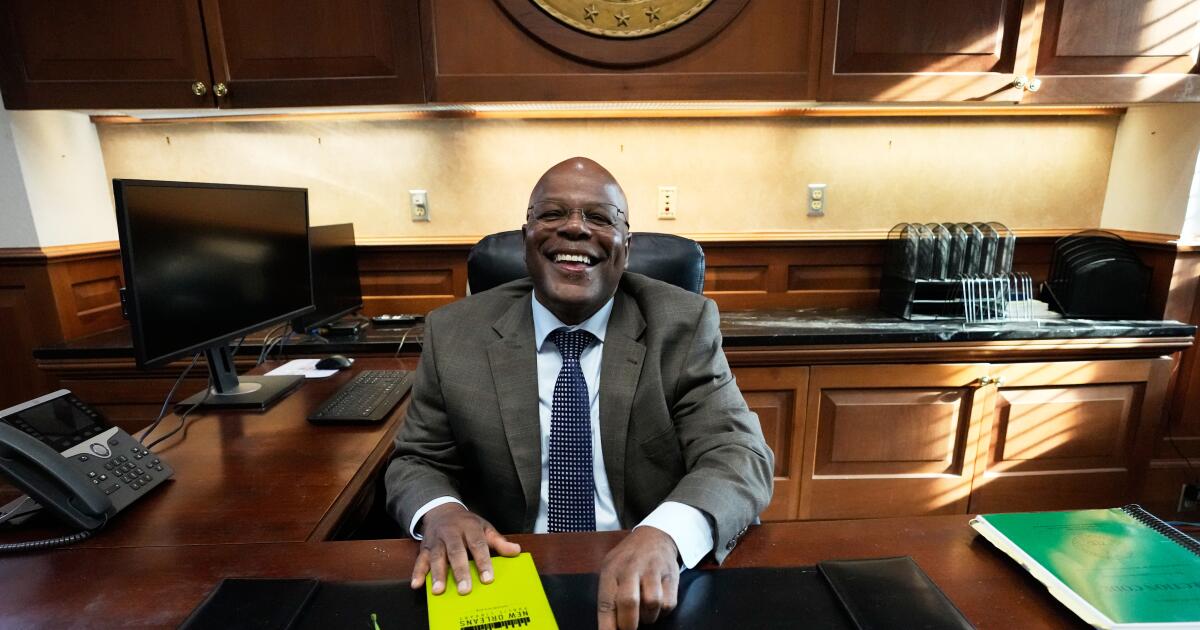
Louisiana Supreme Court rules against exoneree whose office was abolished

A sharply divided Louisiana Supreme Court on Monday signed off on abolishing an elected office won by a New Orleans exoneree who had spent nearly 30 years in prison for murder before his conviction was vacated.

The 4-3 decision leaves Calvin Duncan with little path forward to try assuming the role of Orleans Parish clerk of criminal court, a job he won in a landmark election last year before Republican lawmakers raced to eliminate the office this spring.

In a blistering dissent, the court’s Democratic justices said the ruling opened the door to allowing Louisiana lawmakers to subvert the will of voters. The court’s conservative majority disagreed, writing that “this change was entirely within the authority of the Legislature.”

The court also rejected the New Orleans City Council’s attempt to hold a special election, which would have given Duncan the option to run again.

“At a time when our voting rights are under unprecedented attack, this decision clarifies that if we want to live in a democracy, we have to fight for it with every tool our system of government provides,” Duncan said in a statement.

Signed by Republican Gov. Jeff Landry, the bill eliminating the New Orleans clerk’s office was championed by GOP lawmakers as a necessary step toward government efficiency. Supporters denied that it had anything to do with Duncan or his past.

Democrats blasted the change as overreach from a largely white, conservative Legislature that they accused of seeking to thwart the will of a predominantly Black city. Those tensions surfaced again last month when Landry signed a new congressional map that eliminated one of the state’s two majority-Black House districts.

Duncan was convicted of a 1981 murder and was released from prison in 2011. In 2021, an Orleans Parish district judge vacated Duncan’s sentence, finding he had been unjustly convicted and the charges against him were dropped. Duncan is listed on the National Registry of Exonerations.

Brook writes for the Associated Press.

Source link

Celebration, shock and scepticism follow Colombia’s presidential election | Elections News

Less than two hours after polling stations closed on Sunday, it was clear that Colombia’s presidential race would be settled in a run-off between two finalists: hard-right political outsider Abelardo de la Espriella and leftist Senator Ivan Cepeda.

Though the overall result surprised few, de la Espriella’s strong showing upended pollsters’ predictions.

Recommended Stories

list of 3 itemsend of list

Cepeda, President Gustavo Petro’s chosen successor, had been expected to win the most votes, based on public opinion surveys.

But instead, de la Espriella came in first place, winning 43.74 percent of the vote. Cepeda trailed with 40.90 percent.

Supporters of de la Espriella, a criminal defence lawyer, held rapturous celebrations in the coastal city of Barranquilla, where the candidate has an office.

“Colombia won, and with more than 10 million votes, democracy won,” said Elsa Suarez, a de la Espriella voter living in Bogota.

The far-right candidate has modelled himself after politicians like Donald Trump in the United States and Javier Milei in Argentina, flamboyant media personalities who won the presidency despite having little to no political experience.

Like them, de la Espriella has pledged a return to “law and order”, as well as a pared-back national government and policies to support traditional family values.

Notably, he promises to use an “iron fist” to stamp out crime and build megaprisons to jail criminals, mimicking the policies of Salvadoran strongman Nayib Bukele.

Analysts say de la Espriella’s populist messaging resonated with voters in Colombia’s interior, where urban crime is a growing concern.

Electoral maps show de la Espriella besting Cepeda in 16 of the country’s 32 departments, primarily in the heart of Colombia and along the border with Venezuela.

“In more central areas and closer to the capitals, people prioritise security,” explained Laura Bonilla, the deputy director at the Peace and Reconciliation Foundation (PARES), a Bogota-based research nonprofit.

By contrast, de la Espriella’s security messaging failed to sway voters along the coast and in border areas afflicted by rebel violence.

Bonilla argues that people in these regions instead place greater value on the socioeconomic issues that Cepeda represents, as the continuity candidate for Petro’s Historic Pact party.

“Over the past four years, they have received constant attention from the government,” said Bonilla, citing state development projects under the Petro administration.

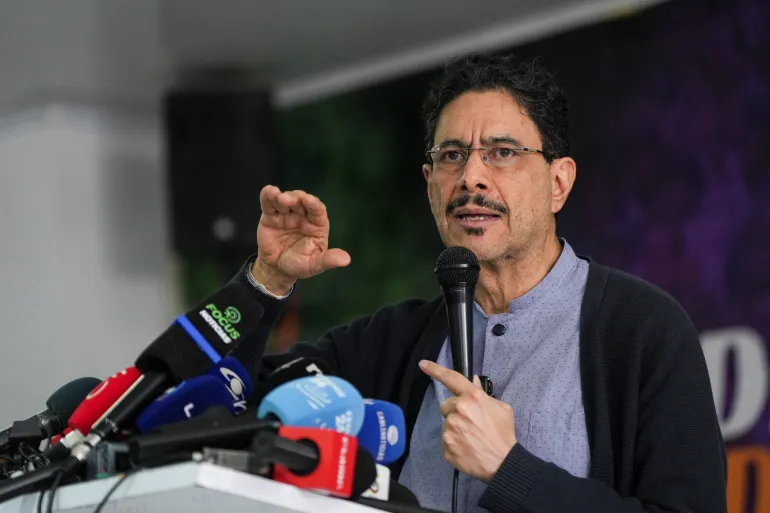
Colombian presidential candidate Ivan Cepeda of the Historic Pact party attends a press conference about the second phase of the presidential race, in Bogota, Colombia, June 1, 2026. REUTERS/Enea Lebrun
Colombian presidential candidate Ivan Cepeda of the Historic Pact party holds a news conference in Bogota, Colombia, on June 1 [Enea Lebrun/Reuters]

A blow to the conservative establishment

De la Espriella’s success also highlights growing anti-establishment sentiment in Colombia, according to experts.

The lawyer, who has never run for public office before, comfortably beat his main rival on the right, Senator Paloma Valencia, who was backed by former President Alvaro Uribe, the figurehead of Colombian conservatism.

Initially, Sunday’s election was predicted to be a close race between Valencia and de la Espriella, both of whom lagged behind Cepeda in the polls.

But as Sunday’s ballots were tallied, Valencia flopped with less than 7 percent of the vote.

Miguel Silva, a Colombian political consultant, credited some of de la Espriella’s success to his campaign messaging.

De la Espriella, he explained, used his campaign to draw a distinction between the haves and the have-nots, those who have benefitted from the government and those who feel ignored.

“He [succeeded] by portraying himself and the people he represents as ‘Los Nunca’ and by portraying Paloma and her followers as ‘Los Siempre’,” Silva said, using the Spanish words for “The Nevers” and “The Always”.

Pollsters predicted the right would be divided in the first round, paving the way for Cepeda to win the most votes, but de la Espriella captured millions of votes from traditional conservatives, marking a shift in Colombia’s political landscape.

In Bogota, the only province in the country’s interior to vote for Cepeda, the left-wing candidate’s supporters were shocked by Sunday’s results.

“Everyone is a little surprised,” said Juan Camilo Rodriguez, who voted for Cepeda. “These results don’t match the polls.”

Newspapers at a newsstand show the results of the first round of Colombia's presidential election, in Bogota, Colombia, June 1, 2026. REUTERS/Enea Lebrun
Newspapers at a Bogota newsstand show the results of the first round of Colombia’s presidential election on June 1 [Enea Lebrun/Reuters]

Petro himself had hammered his base to flood the polls, warning that the left’s chances of success could be hampered by electoral fraud.

The outgoing president rejected last night’s results, which were based on the “pre-conteo”, or preliminary count, a non-legally binding process.

Instead, Petro called on the public to wait for the official, scrutinised count, which will be released in the coming days.

Cepeda echoed the president’s scepticism in a speech on Sunday night. “Only once the vote-counting committees have fully, clearly, and thoroughly clarified this matter, will we comment on tonight’s results,” he told supporters.

But the candidate appeared to mellow his stance this morning, acknowledging that there was no evidence of irregularities in the vote. He trailed de la Espriella by more than 670,000 votes.

Experts warn that Cepeda is losing precious time by focusing on fraud allegations and should instead concentrate on swaying moderate voters.

“By crying fraud so early, it’s hard to bring more voters to the table,” said Silva.

A second round of voting, between Cepeda and de la Espriella, is scheduled for June 21.

Up for grabs are more than a million votes for centrist candidate Sergio Fajardo and 1.6 million for Paloma Valencia. While Valencia endorsed de la Espriella, her running mate, moderate politician Juan Daniel Oviedo, did not.

Miguel Jaramillo Lujan, a Colombian political strategist, said the final two candidates must tread carefully in the next three weeks to prevail.

“As the saying goes, whoever makes fewer mistakes will be the winner.”

Source link

NBC News will put the Kornacki Cam on L.A. mayoral and California gubernatorial races

After the polls close in California on Tuesday, NBC News data analyst Steve Kornacki will just be getting started.

Since December, the khacki-clad vote-counting guru has been going live and uninterrupted on streaming platforms to provide results and analysis of every special election and even some state Senate contests.

The stream — called the Kornacki Cam — provides unadulterated number-crunching without any pundits weighing in. Rather than getting updates that last a few minutes, Kornacki provides continuous real time results until the last available total is counted.

“This all happens in full view,” Kornacki said Monday in a phone interview. “The audience gets to see the whole thing. They get to see the buildup, the anticipation, the payoff.”

In the 10 Kornacki Cam sessions streamed by NBC News so far, 20 million viewers have sampled on YouTube alone. The coverage — consisting of Kornacki, his Big Board, his producer and a Stedicam operator — is also available on NBCNews.com, the NBC News app and the division’s social media accounts on Instagram, Facebook and TikTok.

The Kornacki Cam will focus on the primaries for Los Angeles mayor, California and several Congressional districts, shortly after the state’s polls close at 8 p.m. Pacific.

In a Monday chat with The Times, here are the trends Kornacki says he’ll be looking for on the night.

Polling in mayoral races is typically pretty unreliable. What do you make of the contest based on what you’ve seen?

You don’t always have super-competitive mayoral elections and they’re not all created equal. It’s not quite like a presidential election so you just don’t have a wealth of data to draw on for expectations either.

I’ve seen the polling you’ve seen. It suggests that of the three candidates, (Mayor Karen Bass, reality TV star Spencer Pratt and City Council member Nithya Raman) Bass is in the best position to get into the runoff. It also suggests that Spencer Pratt has had the most positive movement in the last month or so of the campaign. But we go in knowing there will be volatility and I’m open to any and all possibilities.

Spencer Pratt is an unusual candidate who has been able to take up a lot of oxygen in the race. Is there a hidden vote for him that people might not be eager to admit to pollsters?

You can look at the city and know where to look for whether Pratt is having a big night. The San Fernando Valley is gonna be more than a third of the vote, probably close to 40%. If he gets in the general election, he wants to be winning there by a big margin. 
If it’s not happening there for Pratt, I don’t think it’s happening anywhere else. Karen Bass is going to rely on central and south L.A., with probably a third of the vote coming out of those two places. Those should be her bulwarks. The Westside, I think could be more of a toss-up. There’s a fair chunk of the vote there.

We don’t do a ton of mayoral races around the country. So we’re still trying to figure out exactly how detailed we’re going to be able to zoom in, at the neighborhood level and the precinct level.

Turnouts usually are low for Los Angeles mayoral races. Will this year be different?

This mayoral race has received a lot more national attention than 2022. 
So my thought is that the turnout would be higher, just based on that. But this is something that is resonating nationally because Pratt has that celebrity factor. The number was 646,000 (total votes) for 2022. So that’s something we’ll be following — are we trending over or under that?

And what will be the best indicators for the gubernatorial race?

The place that I kind of got circled here is Orange County. In the last two sort of major statewide elections, it was the first to report out vote. 
At 8:06 p.m local time in California, in 2024, Orange County reported out half of its vote, right? So you’re getting, you know, you’re getting hundreds of thousands of votes, potentially, from this enormous county within, potentially within 10 minutes of polls closing. 
There were a couple others — the Central Valley, and we got a we got a good chunk of Merced and Fresno quickly.

So how long are we going to have to wait for a result on Tuesday night?

One of the other things that just surrounds everything in California, whether it’s the mayor’s race, or governor’s race, or anything else, is nothing is definitive in the first hour or so after the polls close. We’re probably realistically looking at a days or even weeks-long process of getting all the vote counted.

I know it drives many people nuts. Without editorializing on that, it’s just a fact that they can get out of about two-thirds of their vote on election night, and if the races aren’t clear and definitive, then you’re generally in for a pretty long haul.

We do know in California that they’re not going (to count) nonstop until they get a result. They’re going to then start doing updates as they process and count the remaining vote by mail, which is usually a considerable pile in a lot of these places. The vote by mail in California can continue coming in for seven days after the election.

So do you think your coverage reflects a shift in what the consumer wants? We already know how fragmented the audience is. Are there now enough political junkies who want the pure uncut stuff?

I’ve been doing this about 20 years, and when I would tell people that I reported on politics for a living, they either moved away from me or changed the subject. And now, you know, I found the last, you know, 10 years or something, has just totally changed. People come up to me, even if they don’t know I work in politics, and they want to talk politics. Everybody seems into it whatever side they’re on.

Source link

Trump’s $1.8-billion fund unravels amid court setbacks, bipartisan pushback

The Trump administration is backing away from plans to create a $1.8-billion fund to compensate people who claim the government was weaponized against them, a retreat that comes amid a cascade of legal setbacks and a revolt within members of the Republican Party.

But Senate Democrats say the concession is not enough, and are pushing legislation to ensure no president can ever attempt the creation of such a fund again.

“If Republicans are serious about ending this brazenly corrupt scheme, they should have no problem voting for legislation banning any president from creating such a slush fund in the future,” Sen. Adam Schiff (D-Calif.) wrote Monday in a post on X.

Senate Minority Leader Chuck Schumer (D-N.Y.) added that Democrats plan to force a vote on a measure to ensure that Trump and Republicans are “truly abandoning this corrupt scheme.”

“Trump’s word is nowhere near enough,” Schumer wrote on X. Earlier in the day, Schumer vowed to force a floor vote to make Republican lawmakers take a public stance on the issue.

Schiff, along with Sens. Mark Kelly of Arizona and Elissa Slotkin of Michigan, introduced the “Drain the Slush Fund Act” on Monday. The bill, if approved, would bar any payout arising from a lawsuit filed by a president or vice president, language that is designed to permanently foreclose the fund, or anything like it, from being put in place by a future administration.

The White House did not comment on the president’s thinking. But in a statement, the Department of Justice said the decision to scrap the fund was in response to a federal judge’s ruling last week that temporarily blocked payouts from the fund while legal challenges remain pending. The department said it “disagrees strongly” with the move, but stopped short of saying it would challenge the decision.

“This fund was open to anybody who was so weaponized, targeted, or persecuted, whether they were Democrat, Republican, Conservative, Independent, or otherwise,” the statement read. “The Department will abide by the Court’s ruling.”

U.S. District Judge Leonie Brinkema, who was nominated to the bench by President Clinton, a Democrat, has scheduled a June 12 hearing for argument on whether to extend the order blocking the fund.

While the court ruling is not permanent, the unraveling over the fund is a notable defeat for Trump, who has cast it as a long-overdue reckoning for Americans he says were targeted by “an evil, corrupt and weaponized Biden administration.” For Republicans who publicly criticized the fund, it may come as a relief as the concept had been widely seen as a political liability heading into the midterm elections.

The Department of Justice created the fund to settle a lawsuit Trump personally brought against the Internal Revenue Service over the leak of his tax returns. The settlement also includes a clause permanently barring the IRS from pursuing any tax claims against Trump and his businesses that were filed before May 19 — a provision that, according to an analysis by Forbes, would save Trump and his family more than $600 million.

The White House declined to comment on whether the administration would also make changes to the tax immunity clause. The Democrats’ bill does not address that provision.

“Congress doesn’t need to pass a law to remind the Acting Attorney General [Todd Blanche] that he doesn’t have the authority to grant a blanket pardon for tax crimes by the president, much less when the AG is his personal attorney,” a Schiff spokesperson said in a statement. “The attempt at IRS immunity is corrupt and undoubtedly illegal — and we look forward to seeing it exposed as a fraud.”

Beyond Trump’s own legal disputes with the IRS, the fund was structured to accept claims from anyone who said they had been targeted by the government, a category the administration made clear could include those who were convicted for attacking the U.S. Capitol on Jan. 6, 2021.

Trump pardoned and commuted the prison sentences of 1,500 people who were charged in connection with the attack, and neither he nor Vice President JD Vance ruled out the possibility that those individuals would be able to receive money from the fund.

That possibility immediately ran into trouble with lawmakers. Senate Republicans, many of whom were caught off guard by the arrangement, publicly revolted against the fund and derailed plans to vote on legislation to fund Trump’s immigration crackdown amid the deep disagreement.

A closed-door meeting last month between Blanche and GOP senators grew heated, with lawmakers demanding answers the administration was seemingly not prepared to give.

Sen. Ted Cruz (R-Texas), who attended the meeting, described it as “angry” in an episode of his podcast last month. Cruz said that roughly 45 Senate Republicans had attended and estimated that “at least half of them were blasting the attorney general.” Based on those reactions, Cruz predicted the administration would need to amend its position on the fund.

“We will see the administration announcing at a minimum a modification of this, because if they don’t they’ve got a full-on revolt in the Senate,” he said.

The fund also led to criticism outside of Congress. Former Vice President Mike Pence, who served in Trump’s first administration, told NBC News in an interview Sunday that it was a “bad idea from the start.”

“I would encourage the administration just to drop it,” Pence said.

Source link