politics

Bush and Civil Rights: Words Matter, but Actions Talk

What exactly is President Bush trying to achieve on civil rights?

Against the backdrop of the racial controversy that cost Trent Lott (R-Miss.) his job as Senate majority leader, Bush’s own intentions have come under closer scrutiny. But the president has sent such mixed signals that some critics believe he’s playing a double game — moderate on decisions that can be traced directly to him and much more conservative on judicial appointments that will profoundly affect the reach of civil rights law, but only gradually and far away from the White House.

Bush drew praise even from his staunchest critics in the traditional civil rights community for his strong condemnation of Lott’s wink toward segregation. Indeed, while the White House always said publicly that Bush didn’t want Lott to resign, the president’s sharp rebuke during a speech in Philadelphia probably did more to doom the Mississippi senator than anything else that happened since Lott’s remarks at Strom Thurmond’s 100th birthday party Dec. 5.

But since Bush’s speech, the liberal civil rights community has repeatedly insisted that the president’s stirring words in defense of equal opportunity needed to be measured against his actions. Just minutes before Lott stepped down Friday, a coalition of civil rights groups held a news conference in Washington to pound at that message.

Conservatives rightly argue that support for the agenda of the liberal civil rights community isn’t the only measure of commitment to equal opportunity. But it’s reasonable for the civil rights groups to insist that a president’s actions should always be weighed more heavily than his words.

So far, Bush has moved cautiously on the civil rights issues most directly under his control. He has appointed conservatives to most key civil rights positions, and liberals charge that the administration isn’t enforcing the laws as aggressively as Bill Clinton did when he was president.

But Bush’s record hasn’t generated the intense conflict that characterized the liberal response to the enforcement of the civil rights laws under Ronald Reagan, and even Bush’s father. William L. Taylor, chairman of the Citizens’ Commission on Civil Rights, a leading liberal group, says that Bush’s record shows “a policy that is largely inert, not moving forward, and in a few areas is regressing.” Considering the source, that’s mild criticism.

Nor has Bush moved to retrench the key federal programs that promote affirmative action — policies meant to expand opportunities for minorities in hiring and government contracting. For years, conservative thinkers have viewed these programs as unfair to whites and counterproductive — a group entitlement that exacerbates social divisions.

But Bush has made no effort to repeal the executive order requiring federal contractors to establish goals and timetables for hiring women and minorities. Conservatives have long accused that program, which affects fully one-fifth of all workers in America, of encouraging quotas. Nor has the administration retrenched the programs providing minorities preferences in federal contracting. In all, Bush has done little to disturb the “mend it, don’t end it” balance on federal affirmative action programs that Clinton established in 1995.

Likewise, even before Lott, the administration was hesitant about joining a lawsuit opposing racial preferences in admissions at the University of Michigan now heading toward the Supreme Court. After Lott, officials say, it’s even less likely that Bush will use the suit to argue for a sweeping rollback of affirmative action.

Bush has had such a hands-off policy on these issues that conservatives are starting to grumble. “Conservatives are going to be very disappointed if two years from now there hasn’t been any positive movement,” says Roger Clegg, general counsel of the Center for Equal Opportunity, a conservative group.

Clegg probably shouldn’t hold his breath. While Bush has always declared himself against quotas and preferences, he’s never shown any enthusiasm for direct combat on this front. His calculation seems to be that conflict over affirmative action would eclipse efforts to reach minority voters on other issues, such as education and homeownership. “Once you enter this thing,” one Bush political advisor says, “it’s hard to move the ball on anything else.”

But liberal groups take little comfort in Bush’s cautious approach to direct action. Their fear is that Bush is filling the federal courts with conservative judges who will reshape the civil rights laws in ways he wouldn’t risk through executive or legislative initiatives that carry his fingerprints.

It’s not an unreasonable fear. Many of Bush’s judicial nominees have records on civil rights much more conservative than the views Bush has expressed. Civil rights groups argue that Bush appellate court nominees such as Carolyn Kuhl, Jeffrey Sutton and Charles W. Pickering Sr. have displayed a determination to narrow the way civil rights laws are enforced.

All of these nominations will generate fireworks in the new year (especially if Bush fulfills his promise to renominate Pickering, whom the Democratic Senate Judiciary Committee rejected last year largely around accusations of racial insensitivity). But this conflict will really come to a head if Bush receives an opportunity to nominate a Supreme Court justice.

“That’s the big one,” insists Ralph Neas, president of People for the American Way, a liberal advocacy group. “If they get a firm [conservative] Supreme Court majority, it will render the progressive agenda moot for decades. This is the whole ballgame for them. That’s why they are willing to make compromises legislatively or in the executive branch.”

Bush is under no obligation to support Neas’ agenda on civil rights. But voters have a right to demand accountability from elected officials. If Bush wants to roll back affirmative action, it’s hard to explain his executive actions; if he doesn’t, it’s hard to explain his court nominations.

Bush is sending dissonant signals, perhaps intentionally. But in the end, it’s his decisions on the courts that will speak loudest. Words matter, but words fade. When he condemns Lott, Bush is writing in sand. When he picks judges, he is carving in granite.

*

Ronald Brownstein’s column appears every Monday. See current and past Brownstein columns on The Times’ Web site at: www.latimes.com/brownstein.

Source link

Pope Leo XIV flies to Angola, says he is not debating Trump

1 of 2 | Pope Leo XIV waves during a welcome ceremony at Quatro de Fevereiro International Airport in Luanda, Angola, Saturday. The Pope is on an 11-day trip to Africa, with stops in Algeria, Cameroon, Angola and Equatorial Guinea. Photo by Jose Sena Goulao/EPA

April 18 (UPI) — Pope Leo XIV said he has no interest in debating President Donald Trump as he flew to Angola for the third leg of his 11-day trip to Africa.

In Cameroon on Thursday, Leo told attendees at a prayer meeting that the world was being “ravaged by a handful of tyrants.”

“The masters of war pretend not to know that it takes only a moment to destroy, yet often a lifetime is not enough to rebuild,” he said.

While traveling on the papal plane from Cameroon to Angola Saturday, Leo said his words were not an attack on Trump or his actions in Iran.

He told reporters that his speech was written “weeks ago, well before the president ever commented on myself, and on the message of peace I am promoting,” NBC News reported. “It looked like I was trying to debate the president, which is not my interest at all.”

Last Sunday, Trump lashed out at Leo over his criticism of the war in Iran, claiming a reason the American was named pontiff was because the Catholic Church was trying to curry favor with his administration.

Leo responded saying, “I have no fear of the Trump administration or of speaking out loudly about the message of the Gospel, which is what the Church works for.”

Aboard the plane Saturday, Leo vowed to “promote peace in our world,” and said that his Africa trip is to “be with, to celebrate with, to encourage and accompany all of the Catholics throughout Africa.”

Leo landed in Luanda, Angola, around 3 p.m. WAT Saturday and was welcomed by President João Manuel Gonçalves Lourenço.

The pope met with Angola’s authorities and others at the Presidential Palace in Luanda Saturday. In his speech, he acknowledged those who were affected by recent flooding in the Benguela Province, a coastal area south of Luanda. More than 30 people were killed.

He said he is praying for the victims and noted the national response, that Angolans are “united in a great chain of solidarity in support of those affected.”

Leo said the country’s most important resources are not material but human. “Your people possess treasures that cannot be sold or stolen. There is within them a joy that not even the most adverse circumstances have been able to extinguish,” he said.

The pope is scheduled to celebrate mass at Kilamba, a Luanda suburb, before travelling to the Shrine of Muxima. On Monday, he will travel to Saurimo, where he will visit the elderly and celebrate mass, before returning to Luanda. Tuesday morning, he travels to Equatorial Guinea for his final stop on the trip.

Source link

Advocates call for ban on gifts in wake of Calderon raid

SACRAMENTO–A housing advocacy group, casting embattled state Sen. Ronald S. Calderon (D-Montebello) as a symbol of the influence special interests have on lawmakers, called for tighter bans on lobbyist gifts at a Thursday rally at the Capitol.

Around 50 members of the Alliance of Californians for Community Empowerment (ACCE) convened at the Capitol’s south steps, many clad in matching yellow T-shirts. Members focused on Calderon’s notable accumulation of gifts, which they said indicated close ties to industries–sometimes, they charged, at the expense of his constituents.

Peggy Mears, an organizer from the Inland Empire, said her group had no specific knowledge of wrongdoing or cause for the FBI raid on his offices Tuesday.

“We’re not here to say the charges against him are false or true,” Mears said. “What we’re saying is that there’s an epidemic in the elected officialdom of accepting gifts. And we want this to stop.”

Calderon’s office did not immediately respond to a call for comment.

Mears called for a ban on all gifts from lobbyists and lobbyists’ employers. Lobbyists currently cannot give more than $10 per month to an elected official. But Mears said those limits can be skirted by giving through employers or nonprofit foundations. She also criticized lawmakers like Calderon for holding out-of-state fundraisers.

“The constituents of this state pay you enough money. You can buy your own gifts,” said Abdullah Muhammad, who lives in Calderon’s district. “You don’t need Christmas year-round. You don’t need your birthday year-round.”

The group has clashed with Calderon before, particularly in their advocacy for the Homeowner’s Bill of Rights, a foreclosure protection measure. ACCE members said the Senate banking committee, of which Calderon is a member, often posed an obstacle.

Calderon voted for the bill and lauded its passage last summer.

“Although we got the Homeowner’s Bill of Rights passed, it was a hard-fought battle,” Mears said. “We had to fight lobbyists. We were like David and they were Goliath.”

ALSO:

FBI’s Ron Calderon probe has lawmakers feeling somber

Calderon ties to water district may be part of FBI investigation

FBI search targeted Calderon’s office, not Latino caucus, officials say

melanie.mason@latimes.com

@melmason


Source link

Should California secede? How the state is politically out of step with the rest of the country

Not since 2010 has California felt itself politically so out of step with the times. That year the state resisted the nationwide wave of anti-incumbent, anti-regulation and anti-big government voting to elect Jerry Brown as governor, ease the passage of big-money state budgets and turn away a challenge to its pioneering greenhouse gas regulations.

This election day, California voters tightened gun control, extended taxes on the rich, hiked cigarette taxes, legalized marijuana, boosted multilingual education — and of course provided Hillary Clinton with all of her winning margin of 2 million popular votes, and then some, in her losing campaign for president.

It’s impossible to look at the Trump campaign and not see a direct threat to the civil liberties and dignity of California citizens.

— Billionaire activist Tom Steyer

No wonder the election has inspired talk of California’s seceding from the United States. The nascent campaign, organized under the banner of the Yes California Independence Campaign and heralded by the Twitter hashtag #Calexit, has been energized by remarks by Brown, and others, that a Trump election would necessitate “building a wall around California” to preserve its forward-looking policies against a reactionary federal regime. And why not, the argument goes. After all, with a gross domestic product of $2.5 trillion, the state’s economy ranks sixth in the world, sandwiched between Britain and France.

Secession talk is more valuable as a pointer to all the ways that California and federal policies are likely to come into conflict during the next few years than as a formula for practical politics.

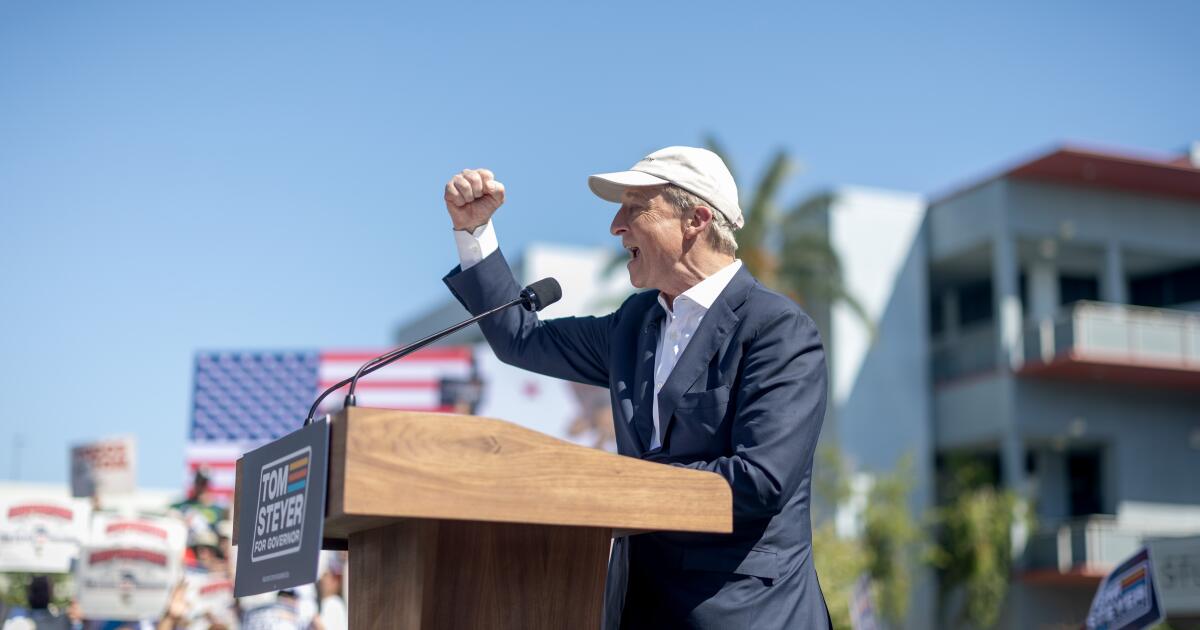
“It’s impossible to look at the Trump campaign and not see a direct threat to the civil liberties and dignity of California citizens,” says Tom Steyer, the progressive billionaire who in recent years has focused his energy on combating climate change via his organization NextGen Climate.

To dispense with the prospect of California’s seceding from the union: On the gonna-happen scale, it’s a Not. “We’d either have to win the ensuing civil war or have Congress kiss us goodbye,” says Joel D. Aberbach, director of the Center for American Politics and Public Policy at UCLA. “There isn’t a procedure for seceding” in the Constitution. The very notion of the U.S. as a divisible entity was settled by the Civil War.

A constitutional amendment is the longest of long shots. It must be approved by a two-thirds majority in each house of Congress and ratified by three-fourths of the states (38 of the 50).

But the conflicts between state and federal policy will be serious. Here’s a look at what may be some of the most important.

Climate change: California has been among the national leaders in reducing greenhouse gas emissions, and as recently as September strengthened its policies with a law mandating the reduction of climatologically harmful emissions to 40% below 1990 levels by 2030. Its auto emission rules traditionally have set a benchmark for the auto industry and federal regulators.

During his campaign, Trump dismissed climate change as a Chinese hoax and pledged to withdraw the U.S. from the Paris agreement to reduce greenhouse gas emissions, which already has been ratified by 113 of the 197 signatory countries. The U.S. ratified the agreement by presidential order on Sept. 3.

“The single biggest achievement of the Obama administration in energy and climate was to get those countries to agree,” Steyer said. “It was an example of the best kind of American leadership — moral, technical, financial.”

Since the election, Trump has backed off his assertions about climate change and his promise to withdraw from the Paris pact. If he makes good on his threat, however, American leadership on climate change will pass to the states. Brown has pledged to keep California in the forefront of that movement, and earlier this month sent a state delegation to a U.N. climate change conference in Marrakech, Morocco.

That just continues the sort of state-level leadership that has emerged in recent years. “Over the past decade, Congress has not passed a single bill that takes direct aim at climate change,” former New York Mayor Michael Bloomberg observed in a recent speech. “Yet at the same time, the U.S. has led the world in reducing emissions.”

Trump could stifle federal funding for crucial research on climate change. One of his science advisors says he plans to eliminate NASA spending on earth science, calling it “politically correct environmental monitoring” and refocusing the agency exclusively on space research. That mirrors congressional Republicans’ approach to NASA, whose role in climate monitoring they disdain even though it has made crucial contributions to understanding of global warming.

Immigration: Trump campaigned on a pledge to cut off federal funding to “sanctuary cities” as part of his crackdown on illegal immigration. His chief of staff-designate, Reince Priebus, reiterated the policy in an interview after the election.

These are cities whose police departments aren’t required to check the immigration status of people they stop or arrest or to notify U.S. immigration officials of the status of undocumented persons they release from custody. The roster of sanctuary cities includes Los Angeles, San Francisco, Sacramento and Oakland; an estimated 1 million of the nation’s 11 million immigrants without legal status, many of whom Trump has threatened to deport, live in L.A. County.

Leaders of those cities have pledged to keep protecting immigrants and fight Trump’s proposed cuts in federal funding cuts, which would require congressional action. The stakes are high: Los Angeles receives about $500 million a year in federal funding for such municipal services as port security and homeless shelters. But there are practical as well as moral reasons for cities to steer clear of immigration enforcement. Complicity with immigration agents shatters trust in police in immigrant-rich communities, complicating street-level patrolling. And with undocumented immigrants part of the fabric of diverse communities, rigorous enforcement can have bad economic consequences.

Trump’s anti-immigrant stance has spurred calls to action to protect potential deportees. The Los Angeles Unified School District says it will rebuff any federal request for students’ immigration status. Cal State University Chancellor Timothy P. White, whose system includes as many as 10,000 students without legal documentation, has said that campus police won’t honor federal requests for deportation holds. Last week University of California President Janet Napolitano stated that UC campus police departments would not involve themselves in investigations of the immigration status of individuals on campus and ruled out “joint efforts” on immigration with federal, state, or local law enforcement agencies. She said the university aimed to “vigorously protect the privacy and civil rights of the undocumented members of the UC community.”

An estimated one in three of the 742,000 “Dreamers” — young people who were brought to this country by their parents without documentation and granted protection from deportation under the Obama administration’s Deferred Action for Childhood Arrivals program, or DACA — lives in California. Trump has pledged to shut down the program.

Healthcare: Few states gave the Affordable Care Act, which Trump and congressional Republicans pledge to repeal, support as full-throated as California. The state has enrolled about 1.4 million people in Obamacare health plans via its statewide individual insurance exchange, Covered California, and added about 3 million low-income residents to Medicaid rolls via the law’s Medicaid expansion, the cost of which has been 100% paid by the federal government.

It’s doubtful that this record could be maintained if Trump and congressional Republicans repeal the ACA. Repeal would eliminate the federal tax credits that reduce premiums on Covered California plans and other costs for about 90% of enrollees. That would drive many of them off coverage. The state would surely be unable to make up those subsidies. California would also suffer from the loss of the ACA’s consumer protection elements, including a ban on exclusions for preexisting conditions and on annual or lifetime benefit limits. A study published last June by the Robert Wood Johnson Foundation forecast that without the ACA, the ranks of the uninsured in California would soar by 2021 to 7.5 million, compared with only 3.4 million if the ACA remains in place.

Among the dangers in the GOP plans is uncertainty. The party has promised to “replace” the ACA with something that works better, yet has never coalesced around an alternative in more than six years of trying. But doubts that Covered California and other ACA marketplaces will eventually stabilize could drive more big insurers out of the market and force prices higher.

The prospects of disastrous tampering with healthcare were heightened Monday with Trump’s nomination of Rep. Tom Price (R-Ga.) as secretary of Health and Human Services. Price, an orthopedic surgeon, is a sworn enemy of the Affordable Care Act. He’s the author of an alternative law that could throw older and sicker patients out of the insurance pool and make insurance all but unaffordable for women of child-bearing age. The Price plan would repeal Obamacare and replace it with something resembling the pre-2010 individual insurance market, when overpriced, low-benefit plans were the norm for anyone except young, healthy males.

Republican proposals to convert Medicaid to a block-granted program—almost certainly a prelude to cutting the federal share of its budget—could pose a particular problem for House Majority Leader Kevin McCarthy, R-Bakersfield. In his district, which largely spans Kern and Tulare counties, roughly half of all residents are enrolled in Medi-Cal, the state’s Medicaid program. Efforts to trim the program would have a direct effect on them.

Gun control and marijuana: Voters on election day flouted federal policy in both areas. Proposition 63 mandates background checks for ammunition sales and outlaws high-capacity ammo magazines. Proposition 64 legalizes marijuana.

Trump established himself as an ally of the National Rifle Assn. during the campaign, but White House policy may not be the biggest problem for the state’s firearms policy: the courts would be. In rulings in 2008 and 2010, the Supreme Court extended the reach of the 2nd Amendment’s protection of the right to bear arms. Within a day of the election, the NRA was talking about challenging Proposition 63 and related state laws before the courts.

Trump hasn’t expressed strong objections to the legalization of marijuana, but as the biggest state to legalize pot, California could find itself in the crosshairs of revived anti-marijuana enforcement by his administration. Obama’s Justice Department took an indulgent approach to the wave of state legalizations of the drug, declaring in 2013 that although it was still illegal under federal law, its prosecutors would focus chiefly on preventing sales to minors and to keeping profits out of the hands of criminal gangs.

But Trump’s attorney general-designate, Sen. Jeff Sessions (R-Ala.), stated in April that “marijuana is not the kind of thing that ought to be legalized, it ought not to be minimized, that it’s in fact a very real danger.” One anti-pot activist described him to the Washington Post as “by far the single most outspoken opponent of marijuana legalization in the U.S. Senate.” How he plans to enforce federal law in a legalization state as big as California is still a mystery.

Keep up to date with Michael Hiltzik. Follow @hiltzikm on Twitter, see his Facebook page, or email michael.hiltzik@latimes.com.

Return to Michael Hiltzik’s blog.

ALSO

Trump speaks with Taiwan’s president, which could provoke China

For 11 years, he’d never felt like he’d been targeted for the way he looked. Donald Trump’s victory changed that

California lawmakers want to reform a bail system they say ‘punishes the poor for being poor’

Orange County’s new ‘homegrown’ congressman plans to bring an immigrant’s perspective to Washington


Source link

Welcome to Bass’ virtual State of the City (Part II)

Good morning, and welcome to L.A. on the Record — our City Hall newsletter. It’s Noah Goldberg, with an assist from David Zahniser, Sandra McDonald and Alene Tchekmedyian, giving you the latest on city and county government.

Mayor Karen Bass is planning to give her second State of the City address of the year on Monday, with a digital twist from years past.

Traditionally the speech is given — in person — before City Council members and other machers at City Hall or another location. This year’s speech will be delivered by video.

Of course, Bass already did one State of the City speech this year, holding forth on the Olympics, the World Cup and Palisades fire rebuilding in a February address at Exposition Park.

The video State of the City will probably be more about the city budget, which also will be released Monday. The city is facing a budget gap of a few hundred million, according to Matt Szabo, the city administrative officer.

“Mayor Bass will update L.A. on the State of our City through a video that anyone can watch, anytime, anywhere,” said Paige Sterling, a spokesperson for Bass. “From Day One through today, Mayor Bass’ focus is changing the direction of L.A. by reversing long-standing [and long ignored] trends on homelessness, housing, public safety and infrastructure.”

You’re reading the L.A. on the Record newsletter

Sign up to make sense of the often unexplained world of L.A. politics.

Parisian payback

The city controller released information this week that showed how much L.A. paid for flights to Paris for L.A.’s delegation to the 2024 Summer Olympics.

One purchase stuck out: $22,000 for a first-class ticket for Bass to fly to Paris and back. It was purchased March 6, the same day Bass boarded the flight to the City of Light, according to the city, which released the information in response to a public records act request.

One reason for the high cost was the last-minute purchase, the mayor’s office said, which it said was the consequence of a packed mayoral schedule that makes advance planning difficult.

Secondly, the city was transferring over its travel booking platform to a company called Concur, and the only flights available for the mayor to purchase to arrive in Paris in time on the platform were first-class seats.

The mayor then reimbursed the city for $12,270, with half coming from her personal bank account, while the other half came from her Karen Bass For Mayor 2022 account, according to checks. That left the city on the hook for $10,000.

“Mayor Bass voluntarily paid for the majority of the ticket herself. City rules didn’t require her to, but she did it anyways. This was the only flight that would get her there on time, and this was the only ticket available,” said Kolby Lee, a spokesperson for the mayor.

Bass and a council delegation, including Councilmember Katy Yaroslavsky, were in Paris that March to “see behind the curtain” about how a city prepares to host the Games, Bass said at the time.

Yaroslavsky’s round trip cost the city $1,600.

Raman out of council leadership

Sometimes the drama at City Hall comes in the fine print. Last Friday, the City Council released its agenda for its April 14 meeting. Casual observers would be forgiven for missing a small change on the first page.

Under Council President Marqueece Harris-Dawson’s name, and under the name of President Pro Tempore Bob Blumenfield, there was a third name: Assistant President Pro Tempore John S. Lee.

That makes Lee No. 3 in council leadership, appointed to the position by Harris-Dawson. For all intents and purposes, the largely ceremonial position means he gets to sit on the dais and preside over council if Harris-Dawson and Blumenfield can’t make it.

But on the fourth floor of City Hall, where council offices are, the move had staffers chattering.

Lee replaces Councilmember Nithya Raman, who threw her hat in the ring to run for mayor against Bass — an ally of Harris-Dawson.

Bass had previously thrown her weight behind Raman during the council member’s tough 2024 reelection campaign.

Some thought Harris-Dawson was punishing Raman for her surprise bid against Bass, but Raman said that wasn’t the case.

“When I first announced my candidacy for Mayor, I told the Council President that I would step back from all of my appointed roles. One change has now been made. I remain focused on serving my district and the City of Los Angeles,” Raman said in a statement.

Harris-Dawson didn’t immediately respond to a request for comment.

There’s a long tradition of council members stepping down from leadership positions or getting the ax when they run for higher office.

In 2021, then Councilmember Joe Buscaino was voted out as president pro tempore after making disparaging remarks about numerous council members (including Raman) while he was running for mayor.

In 2011, then-Councilmember Eric Garcetti stepped down from his role as council president during his run for mayor.

Spotlight on Soto

Los Angeles City Atty. Hydee Feldstein Soto, who is seeking reelection in the June 2 primary, is taking heat from challenger Marissa Roy for her appearance last weekend at the Hope Fest LA rally at the L.A. Coliseum.

The event was put on by Hope California, which is led by evangelical pastor Ché Ahn, a supporter of President Trump and a write-in candidate for California governor. Ahn spoke at a Stop the Steal rally in Washington, D.C., the day before the Jan. 6, 2021, storming of the Capitol, and has repeated the unfounded claim that Joe Biden stole the election from Trump. (“I don’t have facts. I don’t have proof. That’s just my own personal opinion,” Ahn, who also opposes abortion, told The Times.)

Feldstein Soto is pro-choice and anti-Trump, and the speakers immediately preceding her expressed anti-gay and anti-trans views.

Roy said the positions expressed at the rally were wildly out of step with those of Los Angeles voters, and criticized the city attorney’s appearance at the rally as “disturbing.”

“Los Angeles is overdue for a City Attorney who fights for the people,” Roy said in a statement.

At the rally, Feldstein Soto spoke about the scourge of human sex trafficking, including of children along the Figueroa corridor in Los Angeles. She had been invited to the event by a human trafficking survivor to speak about their shared commitment to the issue, spokesperson Naomi Goldman said.

“The primary purpose of the City Attorney’s attendance was to shine a light on the exploitation of women and girls, and to stand in solidarity with those affected. She stayed at the event briefly to deliver her remarks and then departed,” Goldman said.

State of play

— THE KIDS ARE ALRIGHT: A strike that would have shut down schools for nearly 400,000 students was averted at the eleventh hour early Tuesday after the Los Angeles Unified School District reached a tentative agreement with the union that represents workers including custodians, bus drivers and cafeteria workers. Mayor Bass stepped into negotiations at the last minute to help avert a disruptive work stoppage.

— LA USD$: The price of the union deal will be nearly $1.2 billion in annual contract costs, and questions remain about whether the district can afford it.

— ONE AND DONE?: Mayoral candidate Spencer Pratt went on the Joe Rogan Experience this week and told the podcaster that Angelenos are fed up with their leadership. He explained the rules of the city’s June 2 primary to Rogan, saying that there would be no runoff — as most analysts expect — if a candidate wins 51% of the vote. “I think I become mayor June 2 and it won’t even go to November,” Pratt said.

COUNTY BUDGET: The county unveiled its nearly $50-billion budget plan Monday, proposing $2.7 million invested to beef up the team of people investigating fraud within a deluge of recent sex abuse lawsuits, suggesting a broadening probe at the district attorney’s office. The supervisors must now review, then vote on the budget.

— HAHN AND OFF: L.A. County Supervisor Janice Hahn was booed by her neighbors in San Pedro at a Tuesday night town hall meeting after she spoke in support of a proposed substance abuse rehabilitation center in the South Shores neighborhood. “There will be a difference of opinion on this project, but let’s not tear each other apart,” Hahn urged residents, who picketed last weekend at the site of the proposed project.

— E-HIKE: A Los Angeles City Council panel is pushing to ban electric bikes from most city recreational trails, saying the machines pose a threat to hikers and equestrians. The council’s Arts, Parks, Libraries, and Community Enrichment Committee voted 3 to 0 in favor of the measure, which now goes to the council’s Transportation Committee before potentially advancing to the full City Council, which would have to approve the ban before it takes effect.

QUICK HITS

  • Where is Inside Safe? The mayor’s signature program moved more than 25 people off the street and inside in Koreatown this week.
  • On the docket next week: The mayor will release her budget on Monday, along with her second State of the City. She is planning to hold a news conference on the budget Monday.

Stay in touch

That’s it for this week! Send your questions, comments and gossip to LAontheRecord@latimes.com. Did a friend forward you this email? Sign up here to get it in your inbox every Saturday morning.

Source link

Judge blocks Trump administration’s pre-emptive lawsuit against Hawaii

April 17 (UPI) — A federal judge on Friday blocked a lawsuit against the state of Hawaii that the federal government filed to prevent it from suing oil companies.

The Department of Justice last year sued Hawaii to stop a suit against fossil fuel companies for the impact of climate change on the state, but Senior Judge Helen Gillmor of the U.S. District Court in Hawaii said they it has no standing, The Hill and The New York Times reported.

In the ruling, Gillmor said that an “abstract, theoretical future harm” is not a valid basis for a lawsuit because stating an intention to file suit — which the state’s governor declared on television that he planned to do — does not amount to “concrete harm” that would allow an entity to sue.

Gillmor blocked the lawsuit because the DOJ’s theory of harm would require predicting claims brought against unknown companies; predicting that the lawsuit would be successful; “guessing” that oil companies would react in specific way; and then hypothesizing that the reaction would somehow harm the United States’ commerce and future energy policy, she wrote in the 30-page decision.

The DOJ’s suit, which was filed by now-former Attorney General Pam Bondi, alleged that Hawaii’s action was a “burdensome and ideologically motivated” lawsuit that could cause “crippling damages” with the energy and climate policies the state allegedly is pursuing.

“We disagree with the Hawaii District Court’s ruling, which ignored Supreme Court precedent regarding the United States’ interest in the supremacy of federal law,” the DOJ’s principal deputy assistant attorney general Adam Gustafson said in a statement. “We are exploring all options.”

Source link

She’s a housekeeper with a side job: cleaning the trashed streets of her own neighborhood

The first stop on Sabine Phillips’ three-hour inspection of her neighborhood was at Fountain Avenue and St. Andrew’s Place, where detached pieces of a sofa had been plopped onto the sidewalk as if this were an outdoor living room.

Phillips slid off her yellow Huffy cruiser, grabbed a pen, and entered the finding into her spiral notebook.

“This stretch is a common dumping ground,” she told me, eyes hidden behind sunglasses under a floppy sun hat.

Her part-time assistant, Keith Johnson, was wearing a “Trash Club Hollyood” T-shirt. He squeezed the handle of his garbage-grabbing tool to snare cookie and chip wrappers that floated near some empty Pacifico beer bottles and a Big Gulp container the size of a drum. When they report neighborhood problems to the city, Johnson said, “sometimes they’re helpful and many times they’re not, so we end up doing things on our own.”

Sabine Phillips, 66, and Keith Johnson, 71, right, ride their bikes documenting debris left on sidewalks.

Sabine Phillips, 66, and Keith Johnson, 71, right, ride their bikes documenting debris left on sidewalks of their East Hollywood neighborhood on April 15.

(Genaro Molina / Los Angeles Times)

Much of the discarded furniture and other goods left on the streets ends up being used to build homeless encampments, Phillips said. That often leads to more trash, fires, drug activity and other nuisances that threaten public safety and set residents on edge.

Phillips doesn’t just take notes. She reports her findings into the city’s MyLA311 system on Wednesdays, so city crews can make pickups on Thursdays and Fridays. And they usually do respond, Phillips said. But the cycle immediately repeats, and she has typically reported 50 or more additional items, week after week, month after month.

In a quarter of a century of writing about the many plundered patches of paradise, I’ve been repeatedly impressed by those who step up and make a difference out of some combination of pride, frustration and the spirit of volunteerism. But I also understand the rage of taxpayers who wonder why Los Angeles City Hall is so incapable of managing the basics.

In the race for leadership of the city, even Mayor Karen Bass and Councilmember Nithya Raman say things have got to change, which isn’t necessarily the best commentary on their stewardship.

“Unfortunately, it’s become fairly universal across all 99 neighborhoods in this city that L.A. government isn’t working,” mayoral candidate Adam Miller said at a recent West L.A. appearance I dropped in on, and he added that he’d use his business and nonprofit experience to tackle homelessness, housing and public safety challenges, among other issues. “We pay some of the highest taxes in the country, where people feel like we’re not getting our money’s worth anymore.”

Last week, after my column about the substantial inventory of blight around City Hall — including a graffiti-scarred fountain that’s been out of operation for most of the last 60 years (no lie) — I heard from readers with their own problems.

Richard Vasquez wrote to say the Plaza de Mexico in Lincoln Heights is still a cemetery of missing statues. Richard Zaldivar wrote to say the nearby AIDS memorial was vandalized and multiple calls for help fell on deaf ears. Estela Lopez of the downtown industrial improvement district, where trash is routinely dumped illegally, wrote to say a county report warned that typhus levels downtown had reached an all-time high.

Sabine Phillips documents abandoned furniture and debris found on sidewalks.

Sabine Phillips documents abandoned furniture and debris found on sidewalks of her neighborhood on Wednesday in East Hollywood.

(Genaro Molina / Los Angeles Times)

I also heard from Stefanie Keenan, who had a clever idea a few years ago, born of exasperation with City Hall. She hired her own housekeeper — that would be Phillips — to help patrol and clean the neighborhood they both live in, and Phillips’ work was featured by NBCLA and substacker Sam Quinones.

“It’s not getting done otherwise, and our neighborhood would have burned down,” Keenan told me.

Keenan, who has been tending to her streets for several years, has been paying Phillips $100 for Wednesday scouting forays and another $100 to fill four or five huge bags on Saturday trash patrol. Keenan, a photographer, told me she has spent tens of thousands of dollars out of her own pocket.

But Keenan doesn’t have unlimited funds, and this was Phillips’ last week on the job. Lord knows what the neighborhood will look like without her on patrol. As she pedaled along her regular route Wednesday, Phillips found several more sofas, among other things.

A freezer. A refrigerator. Rugs. Chairs. Stools. Dressers. Drawers. Bed frames. Mattresses. Box springs. A printer. Electronics. Televisions.

And heaps of trash, some of which blocked sidewalks and some of which spilled off curbs and into streets.

On Lexington Avenue she stopped to make the following entry in her log:

“3 toilets.”

Nothing surprised her, and nothing slowed her down. At a house where a construction worker dumped lumber onto the sidewalk, Phillips strode up and asked what the thought would happen to the scrap pile. He said he had no idea; she made an entry in her log.

Sabine Phillips takes a break from documenting addresses of abandoned furniture and debris.

Phillips takes a break from documenting addresses of abandoned furniture and debris.

(Genaro Molina / Los Angeles Times)

I tried to recruit Phillips to run for mayor, but the native of Germany wasn’t interested. She did say, however, that she was “the first female bouncer in Berlin,” and that was “at a Hells Angel discotheque.”

The Berlin bouncer kept moving, and scribbling. She filled three pages in her notebook with more than 60 notations, including sidewalk graffiti.

“I’ve seen some weird stuff,” Phillips said. “Twice I found safes outside, just on the side of the curb.”

The studio-adjacent neighborhood she patrols has an eclectic mix of upscale houses and block-long stretches of apartment buildings, with people moving in and out and leaving possessions on the curb as they come and go.

That’s not the city’s fault. But the city could do a better job of educating residents on how to arrange for pickups, and a better job of cracking down when they don’t. I reached out to the office of Councilmember Hugo Soto-Martinez, but we hadn’t yet connected when I hit my deadline.

At the Lexington Avenue pocket park, Phillips told me she had never seen kids on the grounds.

“I will show you why I would never have kids playing here,” she said, pointing into the sandbox. “There is glass … needles, and … you will see human waste there in the corner.”

A blue tarp covered a makeshift home next to the sandbox. Someone slept on a bench. The slide had a gang tag painted onto it, and two people hovered under the slide on the edge of the sandbox. Phillips said she has seen homeless people use the water fountain to bathe, and a 15-year-old from a nearby high school died in 2022 after buying drugs here.

Jenny Carpio and her dog, Sky, walk past debris along a sidewalk in East Hollywood.

Jenny Carpio and her dog, Sky, walk past debris along a sidewalk in East Hollywood.

(Genaro Molina / Los Angeles Times)

While Phillips and Johnson were in the park, a city rec and parks employee pulled up. He said he was there to check the condition of the park, which was slated for a new playground that would cost about $300,000. He said a body had been found in the park not long ago. He guessed about 30% to 50% of the city’s parks have similar iproblems.

I’m reminded of Kurt Vonnegut’s refrain in “Slaughterhouse-Five.”

So it goes.

The insanity of investing in a new playground when a dozen festering issues make the park unsafe should be crystal clear to one and all. Surely there’s more to the plan, one would hope — something substantive and sustainable. But that’s a risky bet.

It might be better to admit defeat for now, close the park, and do something else with that $300,000.

Use it to put Phillips, and a team trained and supervised by her, on a fleet of yellow Huffys.

I guarantee it would be money well spent.

steve.lopez@latimes.com

Source link

The ‘new kid on the block’ in LAUSD’s union coalition

When the heads of three Los Angeles Unified School District unions stood side by side at City Hall to announce their new contracts after nearly going on strike hours earlier, one of them looked out of place.

Max Arias was decked out in a purple letterman’s cardigan emblazoned with “99,” for Service Employees International Union Local 99. United Teachers Los Angeles President Cecily Myart-Cruz wore a tie-dyed T-shirt that read “Solidarity LA.”

And then there was Maria Nichols, who looked like the school principal she once was.

Shiny black shoes. Black slacks. Light makeup. Tight smile. The only flash of color was her green V-neck union T-shirt, the logo peeking out of a black blazer.

Arias and Myart-Cruz gave impassioned speeches hailing the last-minute deals, which still need to be approved by union members and the school board. Nichols, who leads the Associated Administrators of Los Angeles/Teamsters Local 2010, started with a joke about her mere year and 10 months as a union leader.

“I’m the new kid on the block,” the 60-year-old said. “But we made a commitment. It’s not about equality, it’s about equity. … We are all better today for our collective work.”

AALA’s tentative contract calls for raises of more than 11% for the LAUSD’s 3,000 principals, assistant principals and middle managers — a lower percentage increase than SEIU’s 24% and UTLA’s 14%. But the contract also secured a 40-hour week with flex time off for extra hours, addressing long-standing complaints about grueling schedules.

On top of all that, Nichols has led her members into a new era.

“For a long time, principals have been perceived” as a class apart from other school employees, Arias said at the City Hall news conference Tuesday.

Not only are they many workers’ bosses, but with median salaries of $160,139 for elementary schools and $174,628 for higher grades, they make a lot more money. When UTLA went on strike in 2019, AALA stayed on the job.

This time, AALA and the other two unions vowed to all go on strike together if any one of them failed to get a contract.

“So them coming in,” Arias continued, “really shows our members that it is important to start figuring out how we work in solidarity.”

Nichols “called us and said, ‘I know that you guys have already been rolling, but I want to join in,’” Myart-Cruz added. “Having the leadership to be able to articulate that message to her administrators is a great thing. Solidarity is a great thing, but we now have unity.”

“I may be the new kid on the block,” Nichols told me afterward with a grin, “but I’ve been fighting for better schools for 42 years.”

We met a few days later at AALA’s Echo Park office.

“Excuse the mess,” Nichols cracked as we walked to her corner suite. She now wore a bright red pantsuit, union pins on her lapel. Hundreds of signs reading “Enough is Enough” leaned upside down against desks and cabinets. Chips, water and other snacks were piled inside collapsible carts.

“This was all going to be used for the strike,” she said. “You know what they say — expect the best but prepare for the worst.”

AALA /Teamsters 2010 President Maria Nichols hugs UTLA President Cecily Myart-Cruz

AALA /Teamsters 2010 President Maria Nichols hugs UTLA President Cecily Myart-Cruz during a news conference announcing a tentative agreement between LAUSD and the unions representing teachers, principals and workers at City Hall in Los Angeles on April 14, 2026. Above them is SEIU Local 99 President Max Arias.

(Robert Gauthier / Los Angeles Times)

A breakfast of blueberries and yogurt sat untouched as Nichols recounted her life story. She moved to Los Angeles at age 5 from her native Peru to join parents who left after a military coup. A star volleyball setter at Fairfax High, she gave up a University of Arizona scholarship her freshman year after breaking her wrist and finding it “too hard to watch the games and not be involved.”

Back home, she joined LAUSD as a bilingual teacher’s assistant while pursuing a degree in physical therapy at Cal State Northridge. Thanks to a succession of bosses she called “angels,” she stayed in public education. She worked in San Fernando Valley elementary schools as an assistant, a teacher and an assistant principal before a decade-long run as principal at Vena Avenue Elementary in Arleta, which was designated a California Distinguished School during her tenure.

That led to a promotion as a regional director for Valley schools, a job she loved despite the difficulties of shrinking budgets and enrollment. Nichols credited then-LAUSD Superintendent Austin Beutner with granting autonomy to principals in the district.

“We were all administrators from the field that had served time in this district and gone up the ranks,” she said. “That disappeared with [current Supt. Alberto] Carvalho. Gone. Gone.”

She pointed to a flow chart on the wall, titled “Ready for the World,” that Carvalho’s team distributed after he arrived in 2022. He brought in his own people instead of empowering existing administrators, she said.

“It’s a great plan,” Nichols said with no sarcasm while reading its goals aloud. “Because that is what we want. But we don’t invest in staff because we have a shortage. … We can’t have joy and wellness if your people are drying on the vine because they’re exhausted.”

Friction between principals and teachers over budgets and educational strategies increased. Frustrated, Nichols attended her first AALA meeting about two years ago.

“There were like 20 people there. And I thought, ‘This is it? This is where we are?’” she recalled.

Some principals urged her to run against the union’s incumbent president. One of them was Kathie Galan-Jaramillo, whom Nichols had hired to lead Sylmar Leadership Academy.

“Our union was very small, and it was very difficult for us to stand for what we believe in,” Galan-Jaramillo said. “But Maria knew all of the things and hurdles that we [administrators] had to do and go through, and the expectations.”

To prepare for negotiating a new contract, Nichols studied the existing one.

“It was so weak. The language was so antiquated,” she remembered thinking, especially when it came to making sure members weren’t being overworked. “And then I looked at UTLA’s contract and I said, ‘Holy crap. No wonder they get everything.’”

At the end of 2024, 85% of AALA members approved a Nichols-backed merger with Teamsters 2010, which represents higher education workers in California, to shore up their resources and try a different, tougher mindset.

“She has what’s lacking among many leaders — she has the judgment and humility to say, ‘I have things to learn and I’m up to it,’” said Teamsters 2010 Secretary-Treasurer Jason Rabinowitz, who sat with Nichols in contract negotiations. “And she’s a learner and quick study. That’s not always easy to do, because labor leaders have ego.”

After contract talks hit an impasse in February, Nichols reached out to Arias and Myart-Cruz to share research and strategy. They sold her on a united front. But initially, not all AALA members embraced the move, with some questioning why the union would still strike after getting a new contract.

“I was getting a lot of push back from members — ‘But if we get a TA [temporary agreement], why would we strike?” Nichols said. “But it wasn’t about the TA anymore. It was about the coalition. It was about sticking together. It was about power and unity. … My folks were not used to that.”

Nichols expects that AALA members will ratify the agreement.

“We’ll be done, and in May, we [Arias and Myart-Cruz] will go out and have some dinner, and, you know, adult beverages,” she said with a loud laugh.

Maria Nichols, head of the LAUSD principals union (AALA/Teamster 2010)

Maria Nichols, head of the LAUSD principals union, AALA/Teamsters 2010, at her AALA office in Echo Park.

(Robert Gauthier / Los Angeles Times)

Then comes what she describes as the new alliance’s “heavy lies the crown” moment.

LAUSD plans to bankroll the contracts with money from Sacramento that may or may not come through, even as it plans to cut more than 600 jobs and school enrollment keeps dropping. SEIU’s new contract includes extra hours for members — who include custodians, bus drivers and cafeteria workers — so they can qualify for health benefits, Nichols pointed out.

“They deserve it,” she said, citing her respect for them because her father was a dishwasher and her mother cleaned houses. “But that impact of health benefits, it’s going to be directed at school budgets. OK, great. We got all of these wins, but how is that going to impact our budget at schools? Where’s the money going to come from?”

But these were issues for another day.

The conference room table was now covered in stacks of the same green T-shirt Nichols had worn at City Hall.

“We were going to give them out during the strike,” she said as her staff busied for a flurry of meetings. “But we’ll still give them out. We’ve got a job to do.”

Source link

Trump seeks ‘resolution’ of his $10bn lawsuit against IRS, spurring concern | Donald Trump News

Court filings have indicated that lawyers for President Donald Trump are seeking a resolution with the Department of Justice over a $10bn lawsuit he filed against the Internal Revenue Service (IRS).

But the trouble, critics say, is that such a settlement would leave Trump essentially negotiating with an executive branch under his control.

Recommended Stories

list of 3 itemsend of list

Friday’s court filing, however, emphasises the efficiency of seeking a settlement.

In the document, Trump’s lawyers call for the case to be paused for 90 days to allow a resolution to be hammered out.

“This limited pause will neither prejudice the parties nor delay ultimate resolution,” the filing says. “Rather, the extension will promote judicial economy and allow the Parties to explore avenues that could narrow or resolve the issues efficiently.”

How did the case start?

The case stems from an incident that began in 2017, when a worker named Charles “Chaz” Littlejohn was re-hired as a contractor through the government consulting firm Booz Allen.

While working on IRS files, Littlejohn stole copies of Trump’s tax returns, which had been the source of prolonged public scrutiny.

Until Trump, every president since Richard Nixon had released their tax returns as a gesture of transparency. Trump, however, claimed he could not, citing ongoing audits.

The tax returns Littlejohn stole were ultimately released to the media, and in 2020, The New York Times released a series of articles that showed Trump paid no income taxes in 10 of the 15 preceding years.

Other years, he paid relatively small sums, like $750, because he reported more losses than gains. ProPublica also ran stories based on the leaked tax returns, highlighting inconsistencies and Trump’s low tax payments.

Privacy law protects taxpayer information from being released by the IRS without explicit permission. Littlejohn was sentenced to five years in prison in 2024.

But in late January of this year, Trump filed a lawsuit arguing that he, his businesses and his sons Eric and Donald Jr had suffered “significant and irreparable harm” from the leaks.

The defendants in the lawsuit were the IRS and its overseeing body, the Treasury Department, both of which are part of the executive branch.

“Defendants have caused Plaintiffs reputational and financial harm, public embarrassment, unfairly tarnished their business reputations, portrayed them in a false light, and negatively affected President Trump and the other Plaintiffs’ public standing,” the lawsuit reads.

Questions of ethics and legality

But experts have warned that the lawsuit contains flaws that would normally prompt the Justice Department, also under Trump’s control, to seek dismissal.

The lawsuit, for instance, arrives at its whopping $10bn sum by supposedly tallying up media references to Trump’s leaked tax returns.

However, experts say the formula for damages is calculated by the number of unauthorised disclosures by a government employee, not by media re-printings.

Then there is the question of Littlejohn’s employment status. He was an outside contractor, not a government employee.

Trump also has to contend with the two-year statute of limitations in the case. The lawsuit contends that “President Trump did not discover the numerous violations” of his tax returns until January 29, 2024.

But critics point out he had posted on social media about his tax information being “illegally obtained” as far back as 2020, when The New York Times published its series.

Opponents say the lawsuit should be dismissed or at least delayed until Trump is no longer president. Otherwise, they argue it represents a conflict of interest, with Trump fundamentally negotiating with his own administration for a payout.

Controlling ‘both sides of the litigation’

Trump himself has acknowledged that such a payment would “never look good”. But he has justified the sum by saying it would be donated to charity.

“Nobody would care because it’s going to go to numerous very good charities,” he said in February.

Even that, legal experts argue, could run afoul of the Emoluments Clause in the US Constitution, which prohibits the president from profiting off his position, apart from his salary.

Government watchdogs have attempted to stop a settlement from unfolding. On February 5, for instance, the group Democracy Forward filed an amicus brief arguing the court should act to prevent an abuse of power.

“This case is extraordinary because the President controls both sides of the litigation, which raises the prospect of collusive litigation tactics,” the brief explains.

“To treat this case like business as usual would threaten the integrity of the justice system and the important taxpayer and privacy protections at the heart of this case.”

But the $10bn IRS lawsuit is not the only case Trump is seeking to settle with his own government. In 2023 and 2024, Trump filed administrative complaints seeking compensation for federal investigations he considered to be unfair.

One complaint concerns an FBI investigation into alleged Russian interference in the 2016 election, and the other is about the FBI’s raid of Trump’s Mar-a-Lago estate after he refused a subpoena to return classified documents.

For those complaints, Trump is reportedly seeking additional damages to the tune of $230m.

Source link

Judge sides with Arizona election official in ruling that has implications for midterm voting

The top election official in Arizona’s most populous county will get more authority in running elections after a judge sided with his office in a prolonged legal fight with the local board that shares responsibility for overseeing the vote.

The decision could have broad implications in one of the nation’s most prominent battleground states, which will have several high-profile races this fall. Maricopa County, which includes Phoenix, has been roiled by election conspiracy theorists ever since President Trump lost the state to Democrat Joe Biden during his bid for reelection in 2020.

Justin Heap, the Republican recorder in Maricopa County, sued the predominantly Republican county board of supervisors last summer, alleging it had illegally taken control of certain aspects of election administration. Heap claimed the board transferred funding, IT staff and some key functions — including management of ballot drop boxes and establishing early voting sites — away from his office through an agreement negotiated with his predecessor, whom he had recently defeated in a GOP primary.

Maricopa County Superior Court Judge Scott Blaney mostly sided with Heap’s office in his ruling, which was filed Thursday but appeared on the public docket Friday. The board of supervisors “acted unlawfully and exceeded its statutory authority by seizing the Recorder’s personnel, systems and equipment and refusing to return them” to the recorder, he wrote.

Blaney also ruled that the recorder’s office is responsible for overseeing in-person early voting, among other duties, while the board is responsible for other operations, such as selecting election day voting locations, supplying polling locations and hiring poll workers.

“The Board’s assertion of plenary authority over election administration through its general supervisory powers is inconsistent with Arizona law,” the judge wrote.

Board Chairwoman Kate Brophy McGee said the board will consider an appeal.

“I disagree with other portions of the ruling, and I will explore all options with the Board of Supervisors, including an expeditious appeal,” McGee, a Republican, said in a statement. “From day one, the Board of Supervisors has provided Recorder Heap the resources and staffing needed to fulfill his statutory duties. We will continue to do so because voters always come first.”

In a statement, Heap praised the ruling as a “clear and decisive victory for the rule of law and for the voters of Maricopa County.”

“The court confirmed that the Board cannot override state law, use funding as leverage, or take control of election duties assigned to the Recorder,” Heap said. “This ruling restores both the authority and the resources necessary for my office to do its job.”

Heap, a former Republican state lawmaker, was elected in 2024 after unseating incumbent Stephen Richer in the GOP primary and defeating a Democratic candidate in the general election. In the past, Heap has stopped short of repeating false claims that the 2020 and 2022 elections were stolen but has said voters don’t trust the state’s voting system and that it’s poorly run.

False claims of fraud since the 2020 presidential election led to threats of violence against Richer and others in the Maricopa County elections office. Richer blamed Heap for contributing to an atmosphere of distrust and vitriol directed toward the office.

“He catered to the really ugly stuff that the people in that office had to live through,” Richer said of Heap, in an interview last month. “And he allied with people who were very much in the eye of the storm in terms of creating it.”

Once he took office, Heap terminated a previous agreement that was reached between Richer and the board that had revised how election operations were divided between the two offices. Heap filed his lawsuit with the backing of America First Legal, a conservative public interest group founded by Stephen Miller, now deputy chief of staff in the White House.

Kelety writes for the Associated Press.

Source link

Democratic, Republican leaders warily watch Prop. 14 election

Two days after he was finally sworn in as California’s lieutenant governor after a grueling partisan battle, Republican Abel Maldonado appeared on national TV with political comedian Stephen Colbert to discuss his signature issue, a primary election designed to reduce the influence of party hardliners in the Legislature.

“Why on Earth would you want to destroy the two-party system?” demanded Colbert, who parodies a right-wing cable news host.

Leaders from both major parties in California, who vehemently oppose the open-primary measure, are asking essentially the same question, only they don’t see it as a laughing matter.

Proposition 14, which appears on the June 8 ballot, would put all candidates for statewide, congressional and legislative offices on the same primary ballot and allow voters to choose from the full list. The top two vote-getters for each office — regardless of party — would face each other in a runoff.

A poll released Wednesday by the nonpartisan Public Policy Institute of California showed 60% of respondents in favor of the measure, 27% opposed and 13% undecided.

Backers, including Gov. Arnold Schwarzenegger, say the system would free candidates from the need to court the radical wings of their parties to win nomination to the November ballot. That, in turn, would lead to the election of more moderate lawmakers and more cooperation on tough issues like fixing California’s $19.1billion budget deficit.

Under the current system, Republicans vote on one ballot in a primary election and Democrats on another. Independents, who now represent a record 20% of the California electorate, are allowed to choose either ballot. But few do, so their influence in a primary is minimal, and candidates for November are generally chosen by hard-core party loyalists.

About a third of California congressional and legislative districts are dominated by a single party, according to a recent report by the nonpartisan Center for Governmental Studies in Los Angeles. Almost all are Democratic strongholds. In some, Democrats have such an advantage that the two top primary vote-getters might both be Democrats.

In those cases, Proposition 14 supporters said, they hope the more moderate candidate could win by appealing to Republicans and independents.

As of Friday, Schwarzenegger and the California Chamber of Commerce had helped raise more than $4.7 million for a Yes on 14 campaign, which has started airing a radio ad that claims the measure would reduce “the influence of the major parties which are now under the control of the special interests.”

In a display of harmony that would seem unthinkable on other issues, leading state Democrats and Republicans announced a joint campaign to defeat the measure. They had raised $200,000 as of Friday.

“Both political parties in California hate this measure,” said Tony Quinn, co-editor of the nonpartisan California Target Book, which tracks state political races. “They like having these little private clubs. But the voters don’t.”

Party leaders say passage of Proposition 14 would invite a slew of unintended consequences, including higher campaign costs and political skullduggery.

“It allows for mischief where Democrats could go and choose the Republican nominee,” said John Burton, chairman of the state Democratic Party.

He said there are Democrats in safe districts who might try to help their party by casting their primary votes for hard-line Republicans who are “so far out” that they could not win a general election.

Under the current system, primary campaigns are less expensive than general elections because candidates have to woo only voters registered in their own party. With an open system, candidates would need to appeal to all voters, sending out a lot more mail and potentially buying expensive air time on radio and TV. The increased costs could drive them deeper into the arms of well-heeled special interests, party leaders say.

Those leaders also take issue with the underlying notion that they are a source of unhealthy division.

“Broad-based political parties are an essential part of our democracy,” said California Republican Party Chairman Ron Nehring. “The alternative is to have voters divided by … region, or ethnicity or religion.”

Burton, whose Democrats control both chambers of the Legislature, scoffed at the notion that he can call the shots for lawmakers.

“If I had power, this wouldn’t even be on the ballot, because I urged the [Senate president] pro tem and the Assembly speaker not to do it,” he said.

In fact, it was the Legislature that put the measure on the ballot after one lone moderate broke last year’s budget stalemate. Maldonado, then a state senator, agreed to vote for tax increases after legislative leaders agreed to put the open-primary measure before voters.

But the Legislature’s leaders don’t want the measure to pass and are now opposing it. The move won Maldonado a friend in Schwarzenegger, however, and the governor nominated him for the vacant lieutenant governor post.

The confirmation process quickly descended into a partisan fight.

“They came at me from all sides, and it was all driven by the party bosses,” Maldonado said of the roughly 150 days he spent in limbo, waiting for confirmation. “But with the open primary initiative, you would only be accountable to the people.”

While politicians debate the measure’s possible effect, many academics wonder if it would have any noticeable effect. Bruce Cain, a professor of political science at UC Berkeley, said he expected the major parties and big donors would adapt quickly and make sure they have only one credible candidate in each primary.

“As a social scientist, I’m glad that California wants to do another experiment; it generates more papers and more studies,” Cain said. “But I share the prevailing skepticism of my profession that any significant change will come about.”

jack.dolan@latimes.com

Source link

US judge blocks Justice Department bid to seize voter data in Rhode Island | Donald Trump News

Ruling is latest loss for Trump administration, which has sought access to state voter data ahead of the US midterms.

A federal judge in the United States has dismissed a Department of Justice lawsuit seeking to access voter data from Rhode Island.

The decision on Friday was the latest loss for the administration of President Donald Trump, which has sought to access voter data in dozens of states across the country.

Recommended Stories

list of 3 itemsend of list

In the ruling, US District Court Judge Mary McElroy sided with election officials and civil rights groups, writing that the Justice Department does not have the authority “to conduct the kind of fishing expedition it seeks here”.

Rhode Island Secretary of State Gregg Amore praised the ruling in a statement afterwards.

“The executive branch seems to have no problem taking actions that are clear Constitutional overreaches, regularly meddling in responsibilities that are the rights of the states,” Amore wrote.

“But the power of our democratic republic, built on three, coequal branches of government, is clearer than ever before.”

The Justice Department has sued at least 30 states for their voter information, maintaining it needs the information to secure election security. State officials have said that turning over the data raises an array of privacy concerns.

Under the US Constitution, state officials administer elections. Only Congress can pass laws related to how states oversee voting.

But Trump has sought to transform election administration, claiming that voting has been marred by widespread fraud.

In particular, Trump has continued to maintain that the 2020 election, in which he lost to former President Joe Biden, was “stolen”.

No evidence has ever been put forward to support the claims.

Federal judges have rejected attempts in California, Massachusetts, Michigan and Oregon to force the states to hand over voter files to the federal government. At least 12 states, however, have willingly provided or pledged to provide voter information to the Trump administration.

The push for voter information is one of several actions that have raised concerns over how the Trump administration will approach the midterm elections in November, which will decide the makeup of the US Congress.

He is currently calling on Republicans to pass the so-called SAVE America Act, a bill that would create higher documentation standards for voters to prove their citizenship when registering to vote and casting ballots.

The majority of Republican lawmakers have embraced Trump’s claim that the law is needed to prevent non-citizens from registering to vote, despite studies showing that instances of voter fraud are glancingly rare.

Critics say the measure would risk disenfranchising millions of voters, particularly those who have legally changed their names, which is a common practice in US marriages.

Source link

ICE acting director Todd Lyons will resign at end of May, DHS says

U.S. Immigration and Customs Enforcement acting director Todd Lyons, a key executor of President Trump’s mass deportations agenda, will resign at the end of May, federal officials announced Thursday.

Homeland Security Secretary Markwayne Mullin announced Lyons’ departure, calling him a great leader of ICE who helped to make American communities safer. Mullin said Lyons’ last day will be May 31.

“We wish him luck on his next opportunity in the private sector,” Mullin said in a statement. The Department of Homeland Security did not immediately respond to an email from the Associated Press asking why he is resigning.

Lyons, who was named acting director in March 2025, led the agency at the center of President Trump’s plans to reshape immigration to the U.S.

Under his leadership, the agency was granted a massive infusion of cash through Congress, which it used to expand hiring and detention capabilities, and it ramped up arrests to meet demand from the administration.

ICE was also central to a series of high-profile immigration enforcement operations in American cities, including Chicago and Minneapolis, a deployment that ended after backlash erupted over the deaths of two American protesters at the hands of federal immigration officers.

Stephen Miller, the president’s deputy chief of staff and the main architect of his immigration policy, called Lyons a “dedicated leader.”

“His courageous work at ICE has saved countless thousands of American lives and helped deliver safety and tranquility to millions of Americans,” Miller said in a statement.

White House spokesperson Abigail Jackson described Lyons in a post on X as “an American patriot who made our country safer.”

It’s not clear who might replace Lyons. But whoever does will take over an agency flush with cash while still a flashpoint for controversy. ICE is at the center of a battle in Congress, with Democratic lawmakers demanding restraints on immigration officers before agreeing to restore routine funding for DHS.

On Thursday, Lyons, along with two other top immigration officials, appeared before a House subcommittee to argue for his agency’s budget and faced continued scrutiny from lawmakers of ICE’s actions.

Lyons’ departure also comes as DHS is under new leadership after Trump fired former Secretary Kristi Noem, who led the department through the administration’s major immigration policy changes.

Mullin, who took over as secretary last month, is likely to continue to advance the president’s agenda but has struck a softer tone on some of the administration’s most contentious policies.

Public perceptions of ICE during Lyons’ tenure were low. In a February AP-NORC poll, most U.S. adults, including independents, said they have an unfavorable view of the agency.

Lyons faced questions in Congress over the shooting deaths of Renee Good and Alex Pretti and was asked if he would apologize for the way some Trump administration officials characterized Good as an agitator. He declined to do so.

“I welcome the opportunity to speak to the family in private. But I’m not going to comment on any active investigation,” Lyons said.

Lyons said he had seen video that captured Pretti’s shooting but said he could not comment, citing an active investigation.

Lyons, who joined ICE in 2007 as an immigration enforcement agent in Texas, signed off on a memo, first obtained by the Associated Press, that granted federal immigration officers sweeping powers to forcibly enter homes and make arrests without a judge’s warrant.

Trump’s border advisor Tom Homan described Lyons as serving selflessly and “a highly respected and effective acting Director of ICE.”

Goldenberg and Golden write for the Associated Press. Golden reported from Seattle.

Source link

Outlines of a deal emerge with major concessions to Iran

Upbeat claims from President Trump over an imminent peace deal to end the war with Iran were met with deep skepticism Friday across the Middle East, where Iranian and Israeli officials questioned the prospects for a lasting agreement that would satisfy all parties.

The outlines of an agreement began to emerge that would provide Iran with a major strategic victory — and a potential financial windfall — allowing the Islamic Republic to leverage its control over the Strait of Hormuz to exact significant concessions from the United States and its ally Israel as Trump presses for a swift end to the conflict.

In a series of social media posts and interviews with reporters, Trump announced that the strait was “fully open,” vowing Tehran would never again attempt to control it. But Iranian officials and state media said that conditions remained on passage through the waterway, including the imposition of tolls and coordination with the Islamic Revolutionary Guard Corps.

Iranian diplomats posted threats that its closure could resume at any time of their choosing, and warned that restrictions would return unless the United States agreed to lift a blockade of its ports. Trump had said Friday that the blockade would remain in place.

“The conditional and limited reopening of a portion of the Strait of Hormuz is solely an Iranian initiative, one that creates responsibility and serves to test the firm commitments of the opposing side,” said a top aide to Iran’s president, dismissing Trump’s statements on the contours of a deal as “baseless.”

“If they renege on their promises,” he added, “they will face dire consequences.”

In an overture to Iran, Trump said Israel would be “prohibited” from conducting additional military strikes in Lebanon, where the Israeli government of Prime Minister Benjamin Netanyahu seeks to prevent Hezbollah, an Iranian proxy militia, from rearming, a potential threat to communities in the Israeli north.

But in a speech delivered in Hebrew, Netanyahu would say only that Israel had agreed to a temporary ceasefire, while members of his Cabinet warned that Israel Defense Forces operations in southern Lebanon were not yet finished. A top ally of the prime minister at a right-wing Israeli news outlet warned that Trump was “surrendering” to Iran in the talks.

It was a day of public messaging from a president eager to end a war that has proved historically unpopular with the American public, and has driven a rise in gas prices that could weigh on his party entering this year’s midterm elections.

Yet, Republican allies of the president have begun warning him that an agreement skewed heavily in Tehran’s favor could carry political costs of its own.

Trump was forced to deny an Axios report Friday that his negotiating team had offered to release $20 billion in frozen Iranian assets in exchange for Tehran agreeing to hand over its fissile material, buried under rubble from a U.S. bombing raid last year.

That sum would amount to more than 10 times what President Obama released to Iran under a 2015 nuclear deal, called the Joint Comprehensive Plan of Action, that was the subject of fierce Republican criticism in the decade since.

“I have every confidence that President Trump will not allow Iran to be enriched by tens of billions of dollars for holding the world hostage and creating mayhem in the region,” said Sen. Lindsey Graham (R-S.C.), a strong supporter of the war. “No JCPOAs on President Trump’s watch.”

Still, Trump said in a round of interviews that a deal could be reached in a matter of days, ending less than two weeks of negotiations.

He claimed that Tehran had agreed to permanently end its enrichment of uranium — a development that, if true, would mark a dramatic reversal for the Islamic Republic from decades developing its nuclear program, and from just 10 days ago, when Iranian diplomats rejected a U.S. proposal of a 20-year pause on domestic enrichment in favor of a five-year moratorium.

He said Iran had agreed never to build nuclear weapons — a pledge Tehran has made repeatedly, including under the Nuclear Nonproliferation Treaty, in a religious decree from then-Supreme Leader Ayatollah Ali Khamenei, and in the 2015 agreement — while continuing nuclear activities viewed by the international community as exceeding civilian needs.

And he repeatedly stated that Iran had agreed to the removal of its enriched uranium from the country, either to the United States or to a third party. Iranian state media stated Friday afternoon that a proposal to remove the country’s highly enriched uranium had been “rejected.”

Iran’s agreement to allow safe passage for commercial vessels through the Strait of Hormuz is linked to a ceasefire in Lebanon that the Israeli Cabinet approved for only a 10-day period. Regardless of whether it holds or is extended, Israeli officials said their military would not retreat from its current positions in southern Lebanon — opening up Israeli forces to potential attack by Hezbollah militants unbound by a truce brokered by the Lebanese government.

The Lebanese people, Hezbollah officials said, have “the right to resist” Israeli occupation of their land. Whether the fighting resumes, the group added, “will be determined based on how developments unfold.”

An Iranian official threw cold water on the prospects of reaching a comprehensive peace deal in the coming days, telling Reuters that a temporary extension of the current ceasefire, set to expire Tuesday, would “create space for more talks on lifting sanctions on Iran and securing compensation for war damages.”

“In exchange, Iran will provide assurances to the international community about the peaceful nature of its nuclear program,” the official said, adding that “any other narrative about the ongoing talks is a misrepresentation of the situation.”

Trump told reporters Friday that the talks will continue through the weekend.

While Trump claimed there aren’t “too many significant differences” remaining, he said the United States would continue the blockade until negotiations are finalized and formalized.

“When the agreement is signed, the blockade ends,” the president told reporters in Phoenix.

Times staff writer Ana Ceballos contributed to this report.

Source link

Pressure mounts on Peru’s election authorities amid presidential race delay | Elections News

The vote count continues to determine who will join conservative Keiko Fujimori in Peru’s presidential run-off in June.

Calls to remove the head of Peru’s electoral authority have intensified as delays and alleged irregularities clouded the presidential vote count.

As of Friday, no clear challenger has emerged to face conservative frontrunner Keiko Fujimori in the June 7 run-off.

Recommended Stories

list of 3 itemsend of list

The general election was held on Sunday, but an extension was granted to accommodate for the difficulties in ballot distribution.

Pressure has mounted against the head of Peru’s National Office of Electoral Processes (ONPE), Piero Corvetto. Complaints over errors and logistical problems during Sunday’s election have been compounded by a slow tally that has rattled investor confidence and heightened uncertainty.

According to the ONPE, leftist Roberto Sanchez and ultraconservative former Lima Mayor Rafael Lopez Aliaga remain locked in a close battle for second place, separated by about 13,000 votes as of Friday.

With 93.3 percent of the ballots counted, Sanchez held 12.0 percent of the vote and Lopez Aliaga 11.9 percent.

Fujimori, meanwhile, remained firmly in first place with 17 percent, positioning her for the run-off. Final results could take up to two weeks, according to local election-monitoring group Transparencia.

The vote counting has been further delayed by the roughly 5 percent of ballots that were identified for review due to missing information or errors in polling station records, according to ONPE data. Those ballots will be reviewed by a special electoral jury before being included in the final count, officials said.

Business leaders and lawmakers from across the political spectrum have called on Corvetto to step down, arguing that a replacement should oversee the second round.

“Errors this serious have consequences,” Jorge Zapata, head of business chamber CONFIEP, told local radio station RPP.

Earlier this week, Corvetto acknowledged that there had been some logistical delays that forced voting to be extended by a day, mainly in Lima. Those delays triggered fraud allegations, notably from Lopez Aliaga, who has called for counting to be suspended. Corvetto has denied that any irregularities took place.

Even so, Peru’s top electoral court, the National Jury of Elections, filed a criminal complaint with prosecutors against Corvetto, citing alleged offences, including violations of voting rights. Representatives for Corvetto did not immediately respond to a Reuters request for comment.

An investigation is also under way after materials from four polling stations were found on a public road in Lima on Thursday, the police said. ONPE said on the social media platform X that the votes from those stations had already been recorded for counting.

European Union election observers said this week that they found no evidence of fraud.

Source link

Trump’s lawyers are in talks with the IRS to resolve president’s $10-billion lawsuit

Lawyers for President Trump are engaged in talks with the IRS to resolve a $10-billion lawsuit the president filed against his own tax collection agency over the leak of his tax information to news outlets between 2018 and 2020.

In a federal court filing Friday, Trump asks a judge to pause the case for 90 days while the two sides work to reach a settlement or resolution.

“This limited pause will neither prejudice the parties nor delay ultimate resolution,” the filing says. “Rather, the extension will promote judicial economy and allow the Parties to explore avenues that could narrow or resolve the issues efficiently.”

Tax and ethics experts say the lawsuit raises a plethora of legal and ethical questions, including the propriety of the leader of the executive branch pursuing scorched-earth litigation against the very government he oversees.

Earlier this year, Trump filed a lawsuit in a Florida federal court, alleging that a previous leak of his and the Trump Organization’s confidential tax records caused “reputational and financial harm, public embarrassment, unfairly tarnished their business reputations, portrayed them in a false light, and negatively affected President Trump, and the other Plaintiffs’ public standing.”

The president’s sons, Donald Trump Jr. and Eric Trump, are also plaintiffs in the suit.

In 2024, former IRS contractor Charles Edward Littlejohn, of Washington — who worked for Booz Allen Hamilton, a defense and national security tech firm — was sentenced to five years in prison after pleading guilty to leaking tax information about President Trump and others to two news outlets between 2018 and 2020.

The outlets were not named in the charging documents, but the description and time frame align with stories about Trump’s tax returns in the New York Times and reporting about wealthy Americans’ taxes in the nonprofit investigative journalism organization ProPublica. The 2020 New York Times report found Trump paid $750 in federal income tax the year he first entered the White House, and no income tax at all some years, thanks to reported colossal losses.

When asked in February how he would handle any potential damages from the case, Trump said, “I think what we’ll do is do something for charity.”

“We could make it a substantial amount,” he said at the time. “Nobody would care because it’s going to go to numerous very good charities.”

Several ethics watchdog groups have filed friend-of-the-court briefs challenging the president’s lawsuit.

The watchdog group Democracy Forward’s February filing states that the case is “extraordinary because the President controls both sides of the litigation, which raises the prospect of collusive litigation tactics,” and “the conflicts of interest make it uncertain whether the Department of Justice will zealously defend the public fisc in the same way that it has against other plaintiffs claiming damages for related events.”

Hussein writes for the Associated Press.

Source link

Starmer Faces Renewed Pressure Over Mandelson Vetting Scandal as Leadership Questions Mount

Keir Starmer is facing renewed calls for resignation after fresh revelations surrounding the appointment and vetting of former UK ambassador to the United States Peter Mandelson. The controversy has reignited scrutiny over governance standards inside the Labour government, coming at a politically sensitive time just months after Labour’s landslide election victory in 2024.

The Vetting Controversy:
The core of the scandal centres on reports that Mandelson did not properly pass security vetting before being appointed as ambassador. Despite this, official communications suggested that clearance had been confirmed. Downing Street has since dismissed a senior Foreign Office official, intensifying questions about how the appointment was handled and who within government was aware of the vetting status.

Political Fallout Inside Government:
The issue has exposed tensions within the Labour Party, with some lawmakers expressing concern over administrative failures while others defend the Prime Minister. Senior minister Darren Jones said Starmer was “furious” about not being informed of the vetting issues, while acknowledging serious breakdowns in communication between departments.

Opposition Pressure and Leadership Questions:
Opposition figures, including Conservative leader Kemi Badenoch, have accused Starmer of misleading Parliament and questioned his credibility. The central allegation is whether the Prime Minister knowingly misrepresented the status of Mandelson’s clearance when defending the appointment. These accusations have intensified calls for resignation from political rivals.

Wider Political Context:
The controversy comes at a politically sensitive moment for Starmer, as Labour prepares for key local elections across England, Scotland, and Wales. The government is also managing broader foreign policy challenges, including Britain’s positioning in global conflicts involving the United States and Middle East tensions, adding further pressure on leadership stability.

Institutional and Governance Concerns:
Beyond individual accountability, the scandal has raised broader concerns about administrative competence within the Foreign Office and Downing Street. The dismissal of senior officials has highlighted breakdowns in communication and vetting procedures, raising questions about how high-level diplomatic appointments are approved and overseen.

Analysis:
The Mandelson vetting scandal has evolved from a procedural controversy into a wider test of political authority and administrative control for Starmer. While there is no clear evidence yet that the Prime Minister deliberately misled Parliament, the perception of mismanagement and lack of oversight has created significant political vulnerability.

At its core, the issue reflects a deeper challenge of governance: maintaining institutional trust while managing complex bureaucratic systems. Even if the government survives immediate calls for resignation, the damage is likely to linger, particularly if further inconsistencies emerge. With elections approaching and internal party tensions rising, Starmer’s ability to project control and competence will be central to whether this episode becomes a temporary setback or a longer-term political liability.

Source link

ICE went on a hiring spree. Sterling credentials were not required, AP investigation finds

Their backgrounds stand out. And not in a good way.

Two bankruptcies and six law enforcement jobs in three years. An allegation of lying in a police report to justify a felony charge against an innocent woman — an incident that led to a $75,000 settlement and criticism of his integrity. A third job candidate once failed to graduate from a police academy, then lasted only three weeks in his only job as a police officer.

Their common bond: All were hired recently by U.S. Immigration and Customs Enforcement during an unprecedented hiring spree — 12,000 new officers and special agents to double its force — after the agency received a $75-billion windfall from Congress to enact President Trump’s mass deportation campaign.

The president put a premium on swift action, and for ICE that meant rapid-fire recruitment and hiring, which in turn led to new employees with questionable qualifications. Their backgrounds and training have come under scrutiny after numerous high-profile incidents in which ICE agents used excessive force.

“If vetting is not done well and it’s done too quickly, you have higher risk of increased liability to the agency because of bad actions, abuse of power and the lack of ability to properly carry out the mission because people don’t know what they are doing,” said Claire Trickler-McNulty, who served as an ICE official during the Obama, first Trump and Biden administrations.

The agency has said the majority of new hires are police and military veterans. But evidence is mounting that applicants with questionable histories were either not fully vetted before they were brought on or were hired in spite of their past, an investigation by the Associated Press found.

ICE’s acting director, Todd Lyons, said during a congressional hearing in February that he was proud of the hiring campaign, which drew more than 220,000 applications. “This expansion of a well-trained and well-vetted workforce will help further ICE’s ability to execute the president’s and secretary’s bold agenda,” he said.

Unlike many local law enforcement agencies, ICE said it shields the identity of employees to protect them from harassment, making a full accounting of the new hires impossible.

The AP focused on more than 40 officers who recently made public their new jobs as ICE officers on LinkedIn pages, using public records to check their backgrounds. All but one were male.

While most of them had conventional qualifications as former correctional officers, security guards, military veterans and police officers, it’s unclear how many should have potentially been disqualified because AP did not have access to their full personnel files. But several had histories of unpaid debts that resulted in legal action, two had filed for bankruptcy and three others had faced lawsuits that alleged misconduct in prior law enforcement jobs, the AP found.

Marshall Jones, an expert on police recruiting at the Florida Institute of Technology, said it’s hard to get a full picture of ICE’s new employee pool without more data. But he said ICE has likely hired some “less than ideal candidates” who meet minimum requirements but would be passed over in a normal hiring cycle.

“If you’re hiring hundreds or thousands of people, even with the best of background processes, there are going to be outliers,” he said. “The question is, are these normal outliers from human beings doing things, or is there a systemic challenge in properly vetting folks if there are issues?”

DHS says ‘vetting is an ongoing process’

The Department of Homeland Security, ICE’s parent agency, did not answer questions about specific hiring decisions. But it acknowledged some applicants received “tentative selection letters” and offers to begin working on a temporary status before they had been subjected to full background checks.

“ICE is committed to ensuring its law enforcement personnel are held to the highest standards and rigorously vets them throughout the hiring process,” the department said. “Vetting is an ongoing process, not a one-time occurrence.”

The process includes reviewing their criminal histories and credit scores and conducting background investigations that include interviewing prior employers and other associates, which can take weeks. But the deluge of hires has strained the agency, which promised signing bonuses of up to $50,000 and advertised that college degrees were not required.

An internal memo, first reported by Reuters in February, told ICE supervisors that if they receive “derogatory information about a newly hired employee’s conduct” they should refer the allegations to an internal affairs unit for investigation. Such information could include the employees’ termination or forced resignations, the memo said.

Two bankruptcies, six jobs before ICE hired him

Among the new hires is Carmine Gurliacci, 46, who resigned as a police officer in Richmond Hill, Ga., to join ICE in Atlanta in December, according to a resignation letter obtained by AP.

He filed for bankruptcy in 2022, saying he had no income and had been unemployed for two years after moving from New York to Georgia, court filings show. He said he was living with a friend and doing chores in exchange for housing, listing tens of thousands of dollars of unpaid loans, bills, child support and other debts. He also had filed for bankruptcy in 2013 in New York, when he listed $95,000 in liabilities, records show.

Serious financial problems are “a pretty big red flag” because they might make employees susceptible to bribes or extortion, which have been problems at ICE, Trickler-McNulty said.

After his 2022 bankruptcy petition was approved, Gurliacci rejoined the work force, hopping to six Georgia law enforcement agencies within three years, each time resigning before moving on, records obtained by AP show.

He left one campus security job in 2023, citing “unforeseen personal issues that render me unable to fulfill my duties,” a resignation letter shows. But he then began working for the Butts County Sheriff’s Office soon after.

He lasted months there before moving to the Chatham County Sheriff’s Office, where he quit after two months on the job, records show. The federal government recently obtained his Chatham County personnel file as part of a background check, two months after he started at ICE.

Reached by phone, Gurliacci told a reporter he would call back. He never did and did not respond to follow-up messages.

Critic says new ICE hire ‘abuses his power’

Another new hire is Andrew Penland, 29, who joined ICE after resigning in December as a sheriff’s deputy in Greenwood County, Kansas.

Penland had spent most of his career as a deputy in Bourbon County, Kansas, but left last year after facing a lawsuit alleging he arrested a woman on false allegations in 2022. The county’s insurer paid $75,000 to settle the case, the agreement shows.

The woman, June Bench, recounted in an interview what happened. One of her neighbors, a county official, claimed Bench had purposely made a wide turn and nearly hit him with her car.

Penland responded to the property. Body camera video shows he urged the neighbor to press charges and told the man Bench would go to jail but he would not have to testify in court because it would get resolved through a plea.

Bench denied the allegation and said it was part of a personal dispute. But Penland arrested her on a felony assault charge, took her to jail and seized her car. Penland wrote in a report that he watched surveillance video showing her neighbor jumping out of the way of her speeding car.

It took a week for Bench to get out of jail and more than a year to defeat the charge, which was dismissed for lack of evidence. When she obtained the video Penland cited as proof, it showed her car appearing to make a routine turn and no near-collision with the neighbor.

Bench said she was outraged to learn Penland had been hired by ICE.

“That’s scary to me. He abuses his power,” she said.

After being reached for comment, Penland deactivated his LinkedIn account and alerted ICE to the inquiry but did not respond to AP.

New hire struggled at police academy

A third new ICE hire, Antonio Barrett, initially failed to graduate from a Colorado law enforcement academy in 2020, one of two students who did not “complete portions of the academy” and received “an incomplete grade,” an email obtained by AP shows.

He finished the program after a community college arranged a special one-day training and test for him, and landed a job at the police department in La Junta, Colo., in July 2020. But he worked only three weeks before resigning and never worked in local policing again.

Previously, Barrett worked as a corrections officer at a Colorado prison.

He was accused in a lawsuit of excessive force for inflicting pain on a handcuffed inmate when he and another colleague forcibly removed the man from a wheelchair in 2017. But state officials argued their actions were not excessive and a court agreed, dismissing the case.

Barrett didn’t respond to a message seeking comment.

Ex-ICE instructor says training is inadequate

ICE has denied removing any training requirements, saying new recruits receive 56 days of training and 28 days of on-the-job training. The agency said that most of the new officers have already completed law enforcement academies.

But former ICE academy instructor Ryan Schwank testified in February that agency leaders cut training on the use of force, firearms safety and the rights of protesters. He said the new recruits include some as young as 18 who lack college degrees and whose primary language is not English.

“We’re not giving them the training to know when they’re being asked to do something that they’re not supposed to do, something illegal or wrong,” he said.

Foley writes for the Associated Press.

Source link

Trump draws Marie Antoinette comparisons as he leans into the gilded trappings of the presidency

President Trump had something urgent to address while flying back to Washington from his Mar-a-Lago estate on a recent Sunday.

It wasn’t the Iran war, nor the partial government shutdown over Department of Homeland Security funding. He was focused on a monumental issue of a different kind, hoisting artist renderings of the $400-million White House ballroom he’s building, complete with hand-carved “top-of-the-line” Corinthian columns.

“I’m so busy that I don’t have time to do this. I’m fighting wars and other things,” Trump said before extensively detailing plans for “the greatest ballroom anywhere in the world.”

His divided attention has become a Democratic point of attack and a concern for some Republicans who worry he’s not spending enough time on issues that voters care most about ahead of November’s midterm races.

The contrast was on full display Thursday, when, as Trump flew to Las Vegas to discuss tax cuts for Americans earning tips, his administration was pushing ahead with another of his splashy projects: Plans to build a 250-foot Triumphal Arch near the Lincoln Memorial replete with a Lady Liberty-like statue and a pair of golden eagles.

The president’s ability to speak to the concerns of working people has always seemed incongruous with his biography as a billionaire real estate developer. Yet his populist policies and emphasis on the economy during his 2024 campaign helped catapult him back to the White House.

Republican strategist Rick Tyler noted that, when Trump first ran for president in 2016, his wealth was a selling point.

“While other people, like Mitt Romney, played down how rich he was, Trump was giving free helicopter rides at the Iowa State Fair,” Tyler said. “People loved it.”

Still, Trump’s preoccupation with some of the gilded trappings of the presidency, as more Americans worry about bills, has drawn accusations that he’s a modern-day Marie Antoinette.

“ ‘Fighting wars’ and surging gas prices, yet Trump has time to brag about his billionaire backed ballroom,” Sen. Andy Kim (D-N.J.) responded on X to Trump’s Air Force One presentation.

Democratic California Gov. Gavin Newsom, a potential 2028 presidential hopeful, has been more direct in comparing Trump to the last queen before the French Revolution, who has come to embody extravagant opulence — even posting an AI-generated image of Trump’s face on her body on social media.

“TRUMP ‘MARIE ANTOINETTE’ SAYS, ‘NO HEALTH CARE FOR YOU PEASANTS, BUT A BALLROOM FOR THE QUEEN!’” Newsom wrote in October 2025, at the start of last fall’s 43-day government shutdown.

White House says Trump’s success benefits all Americans

Asked about opponents invoking Marie Antoinette, White House spokesman Davis Ingle said Trump “is going to go down in history as the most successful and consequential president in our lifetime.”

“His successes on behalf of the American people will be imprinted upon the fabric of America and will be felt by every other White House that comes after him,” Ingle said in a statement.

The president faced similar critiques during his first term. But lately he’s been unabashed about accusations he’s disconnected from Americans’ worries about high costs, which could leave Republicans with an uphill battle to retain control of Congress.

Republicans have been loath to question Trump, though notably there has been little criticism of a federal judge’s ruling that work on the project must stop until it has congressional approval. The GOP-controlled House and Senate also haven’t prioritized legislation to move the ballroom project forward.

“I’m not much into architecture,” Republican Sen. John Kennedy of Louisiana said last fall.

About two-thirds of Americans said Trump is “out of touch” with the concerns of most people in the United States today, according to an ABC News/Washington Post/Ipsos poll from February, though the same percentage said the same about the Democratic Party.

Presidents are usually removed from voters, separated by layers of security and surrounded by adoring subordinates. In her book “Why Presidents Fail and How They Can Succeed Again,” Elaine Kamarck argues that presidents get too focused on their own political narratives rather than the public’s concerns. Yet, when it comes to Trump, “All of this stuff is frankly unique to him.”

She pointed to the ballroom as well as Trump’s other White House renovations, soon adding his signature to paper currency and renaming the Kennedy Center after himself.

“It’s a reflection, I think, of his own background as a businessman and somebody who made his fortune selling his name,” said Kamarck, who worked in Bill Clinton’s White House.

While Trump focuses on the ballroom and other Washington projects, some public work projects in other parts of the country have languished.

Joe Meyer, the former mayor of Covington, Ky., spent years pushing for critical improvements to the Brent Spence Bridge connecting his town with Cincinnati, a project listed as a top federal priority dating back to Trump’s first administration.

Federal funds for improvements were approved under President Biden but held up by a Trump-ordered review. Work is finally set to begin later this year, though delays will likely limit design options and slow the project, Meyer said.

“The ballroom is Washington inside-baseball,” Meyer said. “The bridge is just a wreck. It’s frustration that we’ve been dealing with forever.”

A $100 tip and a golden tractor

Trumpeting new tax deductions for tips, Trump staged ordering McDonald’s to the Oval Office — which he has adorned with gold flourishes — and tipped the grandmother making the delivery $100. When she described large medical bills from her husband’s cancer treatments, Trump said she should bring him to an upcoming UFC fight on the White House lawn.

When hundreds of farmers were invited to the White House for an agricultural policy speech, they stood on the South Lawn beside a tractor that had been painted gold. It drizzled, but Trump stayed dry, addressing them from a covered second-floor balcony.

“You don’t mind rain,” the president told the farmers below.

He then flew to Miami for a conference of Saudi investors who, the president noted, were too rich to be impressed by U.S. families scrounging to save up $5,000.

“I know they’re looking like, ‘What the hell is $5,000?’ ” Trump joked. “Their shoes cost them more than $5,000.”

When asked in February, meanwhile, for his message to young people wanting to buy a home, Trump replied: “Save a little longer. Wait a little longer.”

Members of the Cabinet have also fed the perception that Trump’s promised “Golden Age” may not be arriving for everyone. Health Secretary Robert Kennedy Jr. advised Americans to buy liver instead of beef.

“If you go and buy a steak, it’s still pretty expensive. But if you buy the cheaper cuts, it’s great meat. And it is very, very affordable. Or liver, or, you know, all these alternatives,” he told podcast host Joe Rogan.

Agriculture Secretary Brooke Rollins said people could still afford meals consisting of “a piece of chicken, a piece of broccoli, corn tortilla and one other thing.”

Texas-based Republican consultant Brendan Steinhauser said he thinks that Trump “can kind of get away with” building a ballroom because voters have come to expect that from him as a brash dealmaker and businessman.

But Steinhauser said he worries that dramatic increases in gas prices and a potentially weakening economy could resonate with voters. Ahead of the midterms, Steinhauser said, Democrats could score points “trying to make it more about Trump and his oligarch friends.”

Price and Weissert write for the Associated Press. AP writers Linley Sanders in Washington and Ali Swenson in New York contributed to this report.

Source link

US Congress extends controversial surveillance power under FISA for 10 days | Privacy News

The measure has long been criticised for allowing US intelligence agencies to collect citizen data without a warrant.

The United States Congress has temporarily extended a controversial surveillance law which allows federal intelligence agencies to collect the data of foreigners, including their contacts with US citizens.

The move allows a provision of the Foreign Intelligence Surveillance Act (FISA) to continue until April 30. The short-term extension was passed by the House of Representatives and approved by the Senate on Friday.

Recommended Stories

list of 3 itemsend of list

The patch comes after President Donald Trump’s efforts to secure a more lasting extension broke down.

Section 702 of FISA allows the National Security Agency (NSA) and other intelligence services to collect data from foreigners outside of the country.

That could include their interactions with US citizens, a prospect that has alarmed rights advocates.

Collecting such data, which can include correspondence on email and telecommunications platforms, typically requires a warrant approved by a court.

The process has been described by critics as a “backdoor search” that circumvents existing privacy laws.

Speaking after Friday’s vote, Senate Majority Leader John Thune said there was still some openness to reforming the law.

“We’ve got to pivot and figure out what can pass, and we’re in the process ⁠of figuring out how to do that here,” he told reporters.

Supporters of reform, who stretch across party lines, have long sought to repeal or amend Section 702.

While FISA was initially passed in 1978, Section 702 was added as an amendment in 2008.

The addition came amid the US’s “global war on terror”. But during its approval, revelations emerged that the administration of former US President George W Bush had already used the tactics Section 702 legalised.

Supporters, including Trump, maintain that reforming the provision would lead to a lapse in national security.

“I have spoken with many in our Military who say FISA is necessary in order to protect our Troops overseas, as well as our people here at home, from the threat of Foreign Terror Attacks,” Trump wrote in a Truth Social post on Wednesday.

He has pushed for the law to be extended for 18 months without changes. That effort initially appeared on track in the House but was ultimately scuttled by pushback from within Trump’s own Republican Party.

Among the detractors was Republican Congressman Thomas Massie, who has been a regular critic of Trump.

“I will be voting NO on final passage of the FISA 702 Reauthorization Bill if it does not include a warrant provision and other reforms to protect US citizens’ right to privacy,” he wrote ahead of the House vote.

Source link

About 15 Latin American deportees from the U.S. arrive in Congo

Around 15 people deported from the United States landed in Congo’s capital Kinshasa early Friday, one of their lawyers told the Associated Press.

It was the latest example of the Trump administration using agreements with African countries to accelerate migrant removals that have raised questions about respect for the migrants’ rights.

An official at the Congolese migration agency confirmed the arrivals but didn’t provide details.

The deportees are all from Latin America and the Congolese government plans to keep them in the country for a short period, said U.S. attorney Alma David, who represents one of the deportees. She has been speaking with her client since arriving in Kinshasa.

All the deportees are believed to have legal protection from U.S. judges shielding them against being returned to their home countries, David said. The deportees are believed to be staying at a hotel in Kinshasa.

The International Organization for Migration, a United Nations-affiliated agency, will be involved to offer “assisted voluntary return,” David told AP.

“The fact that the focus is on offering them ‘voluntary’ return to their home country when they spent months in immigration detention in the U.S. fighting hard to not have to go home is very alarming,” she said.

An International Organization for Migration spokesperson said the organization was providing humanitarian assistance to the deportees at the request of the Congolese government. It said it may also offer assisted voluntary return, which is “strictly voluntary and based on free, prior and informed consent.”

Congo’s Ministry of Communications said in a statement earlier this month that it will receive some migrants as part of a new deal under the Trump administration’s third-country program.

It described the arrangement as a “temporary” one that reflects Congo’s “commitment to human dignity and international solidarity.” It would come with zero costs to the government with the U.S. covering the needed logistics, it said.

The statement said no automatic transfer of the deportees is planned, adding: “Each situation will be subject to individual review in accordance with the laws of the Republic and national security requirements.”

The U.S. has struck such third-country deportation deals with at least seven other African nations, many of them among countries hit hardest by the Trump administration’s policies restricting trade, aid and migration.

The Trump administration has spent at least $40 million to deport about 300 migrants to countries other than their own, according to a report released recently by the Democratic staff of the Senate Foreign Relations Committee.

Lawyers and activists have raised questions over the nature of the deals with countries in Africa and elsewhere. Several of the African nations that have signed such deals have notoriously repressive governments and poor human rights records — including Eswatini, South Sudan and Equatorial Guinea.

Kamale and Banchereau write for the Associated Press. Banchereau reported from Dakar, Senegal. AP writer Saleh Mwanamilongo in Bonn, Germany contributed to this report.

Source link