politics

As primary election nears, top candidates for California governor debate tonight

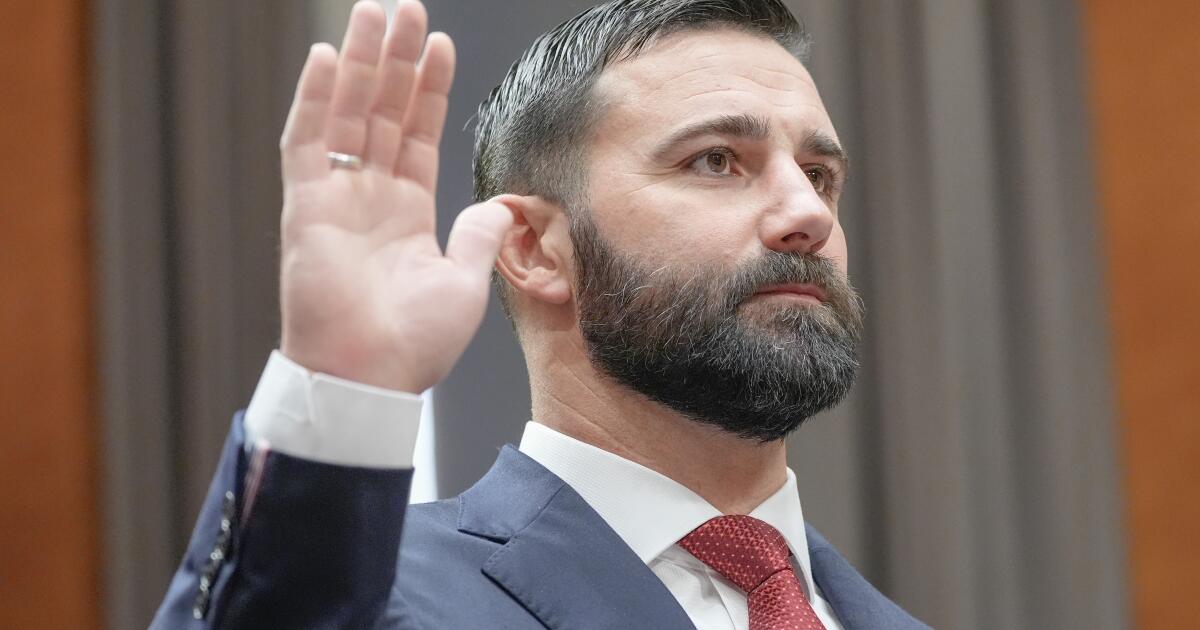
With the California governor’s race quickly approaching, six candidates will face off Wednesday evening in the first debate since former Rep. Eric Swalwell dropped out of the race in the aftermath of sexual assault and misconduct allegations.

The debate takes place at a critical moment in the turbulent contest to replace termed-out Gov. Gavin Newsom. Ballots will start landing in Californians’ mailboxes in less than two weeks, and voters are split by a crowded field of eight prominent candidates. The debate also takes place after former state Controller Betty Yee ended her campaign because of a lack of resources and support in the polls.

Two Republicans — Riverside County Sheriff Chad Bianco and conservative commentator Steve Hilton — and four Democrats — billionaire Tom Steyer, former Biden administration Secretary Xavier Becerra, former Orange County Rep. Katie Porter and San Jose Mayor Matt Mahan — will take the stage at Nexstar’s KRON4 studios in San Francisco. Former Los Angeles Mayor Antonio Villaraigosa and state Supt. of Public Instruction Tony Thurmond, both Democrats, were not invited to participate because of their low polling numbers.

As the candidates strive to distinguish themselves in a crowded field, the debate could include fiery exchanges about the role of money in politics and potential heightened attacks on Becerra, who has surged in the polls since Swalwell dropped out. With the debate taking place on Earth Day, environmental issues are also likely to be raised.

The Wednesday night gathering is the first televised debate in the gubernatorial contest since early February. Last month, USC canceled a debate hours before it was set to begin over mounting criticism that its criteria excluded all major candidates of color.

The 7 p.m. debate is hosted by Nexstar and will be moderated by KTXL FOX40 anchor Nikki Laurenzo and KTLA anchor Frank Buckley. It can be viewed on KRON4 (San Francisco), KTLA5 (Los Angeles), KSWB/KUSI (San Diego), KTXL (Sacramento), KGET (Bakersfield) and KSEE (Fresno). NewsNation will also air the debate.

Source link

Top ministers quit after Peru’s president postpones F-16 fighter jet deal | Government News

Two cabinet-level ministers in Peru have resigned after interim President Jose Maria Balcazar announced he would defer a decision to buy F-16 fighter jets from the United States company Lockheed Martin.

Defence Minister Carlos Diaz and Foreign Minister Hugo de Zela cited their opposition to the move in their resignation letters on Wednesday.

Recommended Stories

list of 3 itemsend of list

“A strategic decision has been taken in the area of national security with which I have a fundamental disagreement,” Diaz wrote.

The fighter jets have long been a source of controversy in Peru, where critics have questioned whether the purchase is a sign of deference to US President Donald Trump.

Last week, the left-wing Balcazar — Peru’s ninth president in a decade — announced he would leave the decision about whether to invest $3.5bn in the purchase to the country’s next elected leader.

Balcazar himself had only been in office since February, selected by Congress to replace the latest in a string of impeached presidents.

Last week, he abruptly cancelled a signing ceremony for the F-16 deal, which would have seen an initial batch of 12 new planes added to Peru’s ageing air force. The country aims to acquire 24 jets overall.

Balcazar explained he was not pulling out of the deal, but that he felt the next presidential administration should be involved in making such a hefty financial commitment.

“For us to commit such a large sum of money to the incoming government would be a poor practice for a transitional government,” Balcazar said at the time.

“We remain firm in respecting all agreements that may have been reached at the level of the armed forces, or in this case, with the relevant ministry of the air force, to carry out the corresponding negotiations.”

His decision, however, was met with pushback, both domestically and from the US. The US ambassador to Peru, Bernie Navarro, responded on April 17 with a warning posted on social media.

“If you deal with the U.S. in bad faith and undermine U.S. interests, rest assured, I, on behalf of
[President] Trump and his administration, will use every available tool to protect and promote the prosperity and security of the United States and our region,” Navarro wrote.

Critics of the deal, however, have argued that Peru has received more competitive offers from French and Swedish aircraft makers like Dassault Aviation and Saab AB, respectively.

But Navarro on Wednesday denied that the US had been outcompeted. In a statement, he wrote that the “bid was made at a high level of competitiveness” and called the plane fleet “the most technically advanced fighter jets ever built”.

He also denounced the delay as an unreasonable stoppage on a deal he characterised as already signed.

“In planning the delivery of a product of this calibre, there is no such thing as an inconsequential delay,” he wrote.

“Every delay results in significant costs. The same package cannot be available in a couple of months, or even weeks.”

The decision to spend the $3.5bn on 24 fighter jets was made in 2024 under former President Dina Boluarte. The purchase was to be financed by $2bn in domestic borrowing in 2025 and $1.5bn in 2026.

In September, the US Department of Defense approved a potential sale of F-16s to Peru.

But Boluarte was removed from office in October, and her successor, Jose Jeri, lasted just four months in office before he too was impeached.

The instability in Peru’s presidency comes at a time when the Trump administration is seeking greater influence over Latin America, as part of what the US president has called his “Donroe Doctrine”.

Already, the Trump administration has pushed Peru to distance itself from Chinese investment. In February, for instance, it publicly protested against Chinese ownership in the Pacific port of Chancay.

“Peru could be powerless to oversee Chancay, one of its largest ports, which is under the jurisdiction of predatory Chinese owners,” the Trump administration wrote in a social media post.

“We support Peru’s sovereign right to oversee critical infrastructure in its own territory. Let this be a cautionary tale for the region and the world: cheap Chinese money costs sovereignty.”

Just this week, one of Trump’s allies, Representative Maria Elvira Salazar, warned that the Chinese-owned port was a danger to the US.

“That’s a direct threat in our hemisphere, right in the country of Peru,” she told a congressional committee. “For that reason, the new Peruvian government, which will be elected next June, must take it back.”

She added that, if the Peruvian government responded accordingly, “the United States will help them under the Trump administration”.

The country, however, is enmeshed in a messy presidential race replete with vote-counting delays and accusations of malpractice.

Election experts have said there is no evidence of voter fraud. But the slow vote count has left the race’s outcome undetermined, more than a week after the ballots were cast on April 12.

Right-wing leader and former First Lady Keiko Fujimori is all but assured of progressing to a run-off in June. But who will join her is uncertain.

Left-wing Congress member Roberto Sanchez is currently in the lead in the race for second place, with 12 percent of the votes tallied, but far-right candidate Rafael Lopez Aliaga, a former mayor, is close behind with 11.9 percent. Lopez Aliaga has been a vocal supporter of the Trump administration.

The final vote count for the first round of the election is expected to be delivered in May.

Traditionally, Peru’s new president should be sworn in on July 28, the country’s independence day.

Source link

Angry Altadena residents ask officials to halt Edison’s undergrounding work

Eaton wildfire survivors’ anger about Southern California Edison’s burying of electric wires in Altadena boiled over Tuesday with residents calling on government officials to temporarily halt the work.

In a letter to the Los Angeles County Board of Supervisors, more than 120 Altadena residents and the town’s council wrote that they had witnessed “manifest failures” by Edison in recent months as it has been tearing up streets and digging trenches to bury the wires.

The residents cited the unexpected financial cost of the work to homeowners and possible harm to the town’s remaining trees. They also pointed out how the work will leave telecommunication wires above ground on poles.

“The current lack of coordination is compounding the stress of a community still reeling from the Eaton Fire, and risks causing further irreparable harm,” the residents wrote.

The council voted unanimously Tuesday night to send the letter.

Scott Johnson, an Edison spokesman, said Wednesday that the company has been working to address the concerns, including by looking for other sources of funds to help pay for the homeowners’ costs.

“We recognize this community has already faced a number of challenges,” he said.

Johnson said the company will allow homeowners to keep existing overhead lines connecting their homes to the grid if they are worried about the cost.

Edison’s crews, Johnson said, have also been trained to use equipment that avoids roots and preserves the health of trees.

The utility has said that burying the wires as the town rebuilds thousands of homes destroyed in the fire will make the electrical grid safer and more reliable.

But anger has grown as work crews have shown up unexpectedly and residents learned they’re on the hook to pay tens of thousands of dollars to connect their homes to the buried lines.

Residents have also found the crews digging under the town’s oak and pine trees that survived last year’s fire. Arborists say the trenches could destroy the roots of some of the last remaining trees and kill them.

Amy Bodek, the county’s regional planning director, recently warned Edison that a government ordinance protects oak trees and that “utility trenching is not exempt from these requirements.”

Residents have also pointed out that in much of Altadena, the telecom companies, including Spectrum and AT&T, have not agreed to bury their wires in Edison’s trenches. That means the telecom wires will remain on poles above ground, which residents say is visually unappealing.

“While our community supports the long-term benefits of moving utilities underground, the current execution by SCE is placing undue financial and planning burdens on homeowners, causing irreparable harm to our heritage tree canopy, and proceeding without adequate local oversight,” the residents wrote.

They want the project halted until the problems are addressed.

Edison announced last year that it would spend as much as $925 million to underground and rebuild its grid in Altadena and Malibu, where the Palisades fire caused devastation.

The work — which costs an estimated $4 million per mile — will earn the utility millions of dollars in profits as its electric customers pay for it over the next decades.

Pedro Pizarro, chief executive of Edison International, told Gov. Gavin Newsom last year that state utility rules would require Altadena and Malibu homeowners to pay to underground the electric wire from their property line to the panel on their house. Pizarro estimated it would cost $8,000 to $10,000 for each home.

But some residents, who need to dig long trenches, say it will cost them much more.

“We are rebuilding and with the insurance shortfall, our finances are stretched already,” Marilyn Chong, an Altadena resident, wrote in a comment attached to the letter. “Incurring the additional burden of financing SCE’s infrastructure is not something we can or should have to do.”

Other fire survivors complained of Edison’s lack of planning and coordination with residents.

“I’ve started rebuilding, and apparently there won’t be underground power lines for me to connect with in time when my house will be done,” wrote Gail Murphy. “So apparently I’m supposed to be using a generator, and for how long!?”

Johnson said the company has set up a phone line for people with concerns or questions. That line — 1-800-250-7339 — is answered Monday through Saturday, he said.

Residents can also go to Edison’s office in Altadena at 2680 Fair Oaks Avenue. The office is open Monday to Friday from 8 to 4:30.

It’s unclear if the Eaton fire would have been less disastrous if Altadena’s neighborhood power lines had been buried.

The blaze ignited under Edison’s towering transmission lines that run through Eaton Canyon. Those lines carry bulk power through the company’s territory. In Altadena, Edison is burying the smaller distribution lines, which carry power to homes.

The government investigation into the cause of the fire has not yet been released. Pizarro has said that a leading theory is that a century-old transmission line, which had not carried power for 50 years, somehow re-energized to spark the blaze.

The fire killed at least 19 people and destroyed more than 9,400 homes and other structures.

Source link

Trump maintains blockade as Iran’s factions struggle to unite

Iranian forces attacked three commercial vessels in the Strait of Hormuz on Wednesday, stoking an already tense standoff in the Persian Gulf as a U.S. naval blockade strains Tehran’s economy and pressures its divided leadership to return to peace talks.

The Islamic Revolutionary Guard Corps, or IRGC, claimed responsibility for the attack, saying it seized two ships and damaged a third after the vessels “ignored repeated warnings.” British maritime monitors confirmed the incidents, describing one cargo ship left disabled in the water and another that took heavy damage to its bridge.

“Disrupting order and safety in the Strait of Hormuz is considered a red line for Iran,” the Iranian Navy Command said in a statement.

Hours before, President Trump confirmed he would maintain the naval blockade in the gulf, but agreed to give Iranian leaders additional time to agree on a new peace proposal, he wrote in a Truth Social post.

“Based on the fact that the Government of Iran is seriously fractured, not unexpectedly so and, upon the request of Field Marshal Asim Munir, and Prime Minister Shehbaz Sharif, of Pakistan, we have been asked to hold our Attack on the Country of Iran until such time as their leaders and representatives can come up with a unified proposal,” Trump wrote Tuesday.

More than a dozen American warships have prevented exports from leaving Iranian ports since peace talks in Islamabad failed earlier this month. The tactic has greatly constrained Iranian oil exports — about 90% of which flow through the Strait of Hormuz — contributing to rising inflationary pressure.

The restrictions could wipe out roughly $435 million in daily economic activity, according to Miad Maleki, a senior fellow at the Foundation for Defense of Democracies. Oil exports, Tehran’s primary revenue source, have halted. At the same time, Iran has been unable to import food or industrial goods. As a result, the blockade is expected to empty Iran’s war coffers and sharply accelerate inflationary effects on its people.

Trump is betting that the strategy will force Iran’s fractured negotiating team — which appears to be split between parliamentary moderates and hard-liners within the Revolutionary Guard — to agree on a “unified” peace proposal.

Karoline Leavitt, the White House press secretary, said Wednesday the president extended the ceasefire agreement to allow Iran to get their “act together,” and emphasized that Trump has not given Iran a “firm deadline” to respond yet.

“President Trump will ultimately dictate the timeline and he will do so when he feels it is in the best interest of the United States and the American people,” Leavitt told reporters.

Though she declined to specify who the administration is negotiating with in Iran, Leavitt said the president was “generously offering a bit of flexibility” to the regime so that they can come up with a unified response.

“This is a battle between the pragmatists and the hard-liners in Iran right now,” Leavitt told reporters at the White House.

That division was visible earlier this week when plans for a second round of talks in Islamabad collapsed after Iranian officials failed to confirm participation and instead introduced new preconditions under pressure from hard-line factions.

Iranian Parliament Speaker Bagher Ghalibaf initially signaled a willingness to attend talks, but was overshadowed by Islamic Revolutionary Guard Corps commander Maj. Gen. Ahmad Vahidi, who insisted that the United States lift its blockade before discussions could begin. A report by the Institute for the Study of War said Vahidi sought to derail negotiations rather than secure meaningful economic relief.

“One challenge with the ongoing negotiations is the divided nature of Iran’s negotiating team,” the report said, adding that “[Trump’s] reference to a ‘unified’ proposal appears to imply that previous proposals were not unified in some way.”

And while hard-liners continue attempts to derail diplomacy with continued demands and attacks in the strait, moderates in Iran continue to push for peace.

This week, prominent Sunni cleric Moulana Abdol Hamid called a “fair agreement” the only viable path forward and warned that those who seek to block negotiations would bear responsibility for the “homeland’s devastation.”

Benjamin Radd, a political scientist at UCLA who studies Iran, said the dispute is a sign of a larger power struggle for control of Tehran’s government.

“There are clear divisions within the leadership,” Radd said in an interview. “Right now, it’s the IRGC faction that has all the power. They have the guns, they have the weapons. What they don’t have is the diplomatic connections and experience dealing with the United States.”

Radd pointed to the economic toll of the U.S. blockade as a key driver of tension inside Iran.

“They’re facing a huge domestic crisis,” he said. “They’re not able to replenish their own needs. Nothing can get in or out of the country. They can’t make any money.”

The consequences of the U.S. strategy could push the more moderate Iranian leaders to strike a deal on nuclear enrichment or a reopening of the strait in exchange for the United States lifting the blockade, Radd said.

“That would start rebuilding some sort of trust,” Radd said. “And then we’re seeing the IRGC is basically steadfast, refusing to do any of this.”

With renewed Israeli attacks in Lebanon killing at least three people Wednesday, despite a 10-day ceasefire agreement, Iranian leaders are preparing for the possibility that talks with the United States will fail altogether.

“Iran has prepared for a new phase of fighting,” the IRGC-affiliated Tasnim News Agency reported this week, citing military redeployments and updated target lists.

Meanwhile, Iranian Judiciary Chief Gholam Hossein Mohseni Ejei warned that renewed U.S. or Israeli strikes were likely. Iran Foreign Ministry spokesman Esmaeil Baghaei made a similar statement in a news briefing Wednesday. He announced the country’s armed forces were “on high alert” and ready to defend against any threat, while being open to Pakistan’s mediation efforts.

He did not confirm if the government was participating in a second round of negotiations.

“Diplomacy is a tool for ensuring national interests and security,” he said, “and we will take the necessary steps whenever we conclude that the necessary and logical grounds exist to use this tool to achieve national interests.”

Until then, it appears both Washington and Tehran will continue brinkmanship in the strait.

On Wednesday morning, the IRGC released a statement confirming it seized the two cargo ships and identified them as the MSC Francesca and the Epaminondas. It claimed the MSC Francesca was linked to Israel and accused both of “jeopardizing maritime security by operating without necessary permits and tampering with navigation systems.”

A third ship, the Euphoria, which sails under the Panamanian flag and is owned by a company based in the United Arab Emirates, was fired upon early Wednesday while heading east out of the Strait of Hormuz, according to Vanguard, a maritime intelligence firm.

The Euphoria later resumed sailing toward the Gulf of Oman, according to Lloyd’s List.

In Lebanon, Amal Khalil became the fourth journalist killed by Israeli fire since hostilities with the Lebanese Shiite militant group Hezbollah intensified on March 2.

Khalil’s body was reported to have been found under the rubble of a house where she and freelance photographer Zeinab Faraj were sheltering, according to their colleagues.

Khalil and Faran were in the southern Lebanese town of Al-Tayri, covering developments there when an Israeli attack targeted the vehicle in front of them, killing its occupants.

The two journalists then sheltered in a house but were hit by Israeli fire once more, according to a statement from the Lebanese Health Ministry.

When Red Cross crews scrambled to the area to rescue the trapped journalists, they were targeted with a sound bomb and machine-gun fire.

The Israeli military said it was not preventing rescue teams from reaching the area and that the incident was under review. It acknowledged targeting a vehicle it said had come out of a structure used by Hezbollah and was heading toward Israeli troops.

The Red Cross reached the house by the early evening local time, and rescued Faraj, who is reported to be in stable condition after undergoing surgery for a head wound, according to her colleagues.

Times staff writers Ana Ceballos in Washington and Nabih Bulos in Beirut contributed to this report.

Source link

A Civil Rights Ruling Dear to South’s GOP

There is no little irony in the U.S. Supreme Court’s recent holding that racial redistricting is permissible as long as race is not the sole or dominant factor. With the Senate equally divided and Republicans holding a razor-thin advantage in the House of Representatives, the court’s ostensibly liberal ruling, one backed by civil rights organizations and opposed by the court’s four conservatives, could not be more dear to the hearts of Southern Republicans. The 5-4 decision will buttress GOP efforts to retain control of Congress by making the election and reelection of Republicans in the South easier after congressional districts are redrawn to reflect the 2000 census.

The strategy of racial redistricting, or creating “minority majority” congressional districts, was put into full play after the 1990 census. Racial gerrymandering isolates blacks, who vote overwhelmingly for liberal Democrats, in awkwardly shaped districts that often cut across the entire width of some states, particularly in the South. In turn, white conservative voters are placed in surrounding districts, which virtually guarantees the election of Republicans in those districts. As a result, although more minorities may be elected to Congress, fewer Democrats and more Republicans end up in the House of Representatives.

During the first Bush administration, the Department of Justice hit upon racial redistricting as a way to both increase minorities’ representation in Congress and elect more Republicans at the expense of the Democrats. The 1965 Voting Rights Act requires that all redistricting in Old South states not dilute black votes. Somewhat perversely, the department parlayed this standard into an affirmative action policy to benefit Republicans. By forcing Southern state legislatures to redistrict along racial lines, it slightly increased the number of minority-majority districts while greatly boosting the number of those disposed to vote Republican.

The Congressional Black Caucus welcomed the Bush administration’s innovative compliance with the Voting Rights Act, but white Democratic politicians in states like Virginia, North Carolina and Georgia were left in a no-win situation. On the one hand, they could not argue, at least vehemently in public, against the creation of such minority-majority districts without inviting charges of racism. On the other, they faced losing seats in districts that lacked their most reliable supporters.

Make no mistake, this affirmative action strategy worked for Republicans. Following the 1990 census, 26 new minority-majority districts were created. More blacks and Latinos were elected to Congress. But so were Republicans like Newt Gingrich; in 1994, the Grand Old Party won control of the House in large part because of their wins in the South.

Ever since, the Republican National Committee has pushed its self-serving version of affirmative action to maintain party hegemony in the South. Although not widely known, the committee has even developed computer programs and models–so-called “Max Black” plans–to help Southern legislatures draw racially gerrymandered districts for distribution to black politicians.

Ironically, during the last decade, the Supreme Court’s five most conservative justices voted to strike down such districts. The lead case, Shaw v. Reno (1993), involved a challenge to North Carolina’s 12th Congressional District. As redrawn in 1992, it was overwhelmingly black and slithered, snake-like, about 160 miles along Interstate 85, from Charlotte to Winston-Salem and to Durham. Writing for the court in that case, Justice Sandra Day O’Connor was joined by Chief Justice William H. Rehnquist and Justices Antonin Scalia, Anthony M. Kennedy and Clarence Thomas. She held that “bizarre,” ’tortured” and “irregular” minority-majority districts run afoul of the 14th Amendment’s equal protection clause.

O’Connor’s bare majority hung together in rejecting other racial gerrymandered districts in the 1990s. But she never completely ruled out race as a factor in redistricting. By contrast, Scalia and Thomas, the court’s most conservative justices, have held that race-based redistricting is never permissible.

The more liberal members of the court–Justices John Paul Stevens, David H. Souter, Ruth Bader Ginsburg and Stephen G. Breyer–steadfastly dissented. They argued for judicial self-restraint and deference to politics in determining the shape and composition of congressional districts.

The court’s latest ruling on North Carolina’s 12th Congressional District is its fourth. Redrawn three times since the 1993 case, the district is currently about 40% black and more compact, stretching across only one-third of the state, from Charlotte to Winston-Salem.

But this time, O’Connor abandoned her more conservative colleagues and joined with the more liberal dissenters. Race may be considered in redistricting, according to the court’s new majority, but only as long as it’s not the “predominate factor.” In other words, race may be a factor in redistricting but not the sole factor, and blacks apparently may not constitute a majority in the district.

With congressional redistricting underway, the decision in Hunt v. Cromartie could not be more timely. But it is certain to be a hollow victory for liberal Democrats, because, as O’Connor knows, it signals Republicans to press ahead with their brand of affirmative action in racial redistricting to hold onto their control of the House.

It’s noteworthy that the ruling turned on the vote of the justice with the most political experience and, arguably, the vote of the most political justice on the court. Before her appointment in 1981 by former President Ronald Reagan, O’Connor served on state courts and in Arizona’s state legislature, where she must have learned something about the politics of redistricting.

Moreover, she is at the court’s center stage, casting the pivotal vote on such hotly contested political issues as abortion and affirmative action. Recall, too, that on election night in November at a cocktail party, O’Connor reportedly became upset when news organizations initially announced that Vice President Al Gore had won the presidency. Her husband explained that she had planned to retire if Bush was victorious. Time will tell whether O’Connor will give President George W. Bush his first opportunity to make his mark on the Supreme Court.

Source link

Jury awards $2.25 million to Riverside County sergeant forced to resign after reporting harassment

Riverside County has been ordered to pay $2.25 million to a former sergeant who said he was pressured into early retirement in retaliation for reporting workplace harassment by a superior.

Sgt. Frank Lodes was forced to leave the job he loved in 2022 — penning a resignation letter in a Del Taco parking lot — while a high-ranking department official threatened him with mounting investigations, according to the complaint. On Tuesday a civil jury concluded that Lodes resigned involuntarily due to his reporting of a hostile workplace and was awarded the multimillion-dollar payment as compensation for his emotional damages.

Lodes’ attorney Bijan Darvish said the award was a “significant number” that adequately represents the harm inflicted on Lodes, noting that the period since his forced retirement has been the “darkest four years” of Lodes’ life.

He said that his client did not wish to comment on the verdict as discussing the events remained painful. The Sheriff’s Department and the county did not immediately respond to a request for comment.

“Being a cop was his life; he lived and breathed it 24/7,” Darvish said. “It was his entire identity, and that’s why it was so difficult for him when it was taken away.”

The jury award comes amid a rare wide-open governor’s race that includes the head of the Sheriff’s Department, Chad Bianco, who is a leading GOP candidate for the seat. Bianco has staked his campaign on his lengthy career in law enforcement, which spans more than three decades, including serving as the elected sheriff of Riverside County since 2019.

Although high-ranking Sheriff’s Department officials were involved in Lodes’ case, Darvish said there was no evidence presented at trial that Bianco had direct knowledge of his client’s mistreatment. Bianco was not a defendant in the lawsuit. His campaign did not respond to a request for comment.

Darvish argues that the case points to a departmental culture of covering up allegations of misconduct.

“When there’s a harassment complaint made against the captain and they never investigated, and they pressure someone to resign and withdraw the complaint,” he said, “then that’s a systemic issue.”

The retaliation began after Lodes, a 25-year veteran of the department, formally reported workplace harassment with human resources in March 2022, according to the complaint.

Lodes had been called mentally ill in front of his peers by a captain during a promotability meeting around October 2021. A few months later, he found degrading posters of his head on a child’s body shoved inside his uniform pockets and gun holster and plastered over the station walls, according to the complaint.

The department responded to his harassment report by launching an investigation into Lodes unlawfully using informants and threatening him with possible criminal prosecution, according to Darvish.

The jury agreed that these allegations were a manufactured excuse to cover up unlawful retaliation.

Within days of filing the workplace harassment complaint, a Internal Affairs sergeant packed Lodes’ personal belongings in a box and drove them to his house, according to the complaint. The sergeant spent hours pressuring Lodes, then 47, to accept early retirement.

The following day, Lodes was told to meet with a high-ranking official in the Sheriff’s Department in a Del Taco parking lot who instructed him to resign immediately and withdraw his harassment complaint.

The $2.25-million award in the civil case will come from the county’s coffers.

The award casts renewed scrutiny on Bianco’s Sheriff’s Department two weeks before primary election ballots land in Californians’ mailboxes.

He was also in the spotlight in March after seizing more than 650,000 ballots from the November election as part of an investigation to determine if they were fraudulently counted. He put the investigation on hold shortly before the California Supreme Court halted it pending further review.

Times staff writer James Queally contributed to this report.

Source link

Rep. David Scott, a Georgia Democrat seeking his 13th term in Congress, dies at age 80

U.S. Rep. David Scott, a Georgia Democrat and the first Black chairman of the House Agriculture Committee, has died. He was 80.

Scott, who was seeking his 13th term in Congress despite challenges from within his party, was once a leading voice for Democrats on issues related to farm aid policy and food aid for consumers and a prominent Black member of the party’s moderate Blue Dog caucus. But he faced criticism and concerns in recent years because of declining health, enduring a primary challenge in 2024 and facing another one at the time of his death.

Democrats on Capitol Hill praised the longtime lawmaker.

“The news of Congressman Scott’s passing is deeply sad,” House Minority Leader Hakeem Jeffries told reporters on Wednesday.

“David Scott was a trailblazer who served district that he represented admirably, rose up from humble beginnings to become the first African American ever to chair the House Ag Committee,” Jeffries said. “He cared about the people that he represented. He was fiercely committed to getting things done for the people of the great state of Georgia, and he’ll be deeply missed.”

News of Scott’s death came during the Congressional Black Caucus’ weekly luncheon on Capitol Hill. The Black Caucus’ chair, Rep. Yvette Clarke, told lawmakers at the outset of the meeting, according to a person who insisted on anonymity to discuss a private conversation. Many lawmakers in the room, some of whom had served with Scott for decades, were shocked and saddened by the news.

Scott’s death slightly widens Republicans’ narrow House majority going into the thick of this midterm election year.

The congressman was not especially active on the campaign trail in 2026. But he had been dismissive of pressure to retire.

“Thank God I’m in good health, moving and doing the people’s work,” Scott said in 2024.

David Albert Scott was born in rural Aynor, South Carolina, on June 27, 1945, in the era of Jim Crow segregation. He graduated from Florida A&M University, one of the nation’s largest historically Black college campuses — and in office he was an outspoken advocate for federal support of HBCUs. Scott also earned an MBA from the University of Pennsylvania’s Wharton School.

He was already a veteran state lawmaker in Georgia before being elected to Congress in 2002.

Barrow, Brown and Amy write for the Associated Press. Brown reported from Washington.

Source link

Former ‘CBS Mornings’ executive producer joins MS NOW as political director

Shawna Thomas, who exited CBS News earlier this year, has joined MS NOW as political director.

The cable network formerly known as MSNBC announced Wednesday that Thomas will lead the organization’s political unit and direct coverage of campaigns and elections. She will also appear as an on-air analyst.

Thomas lands at the progressive-leaning MS NOW after five years as executive producer for “CBS Mornings.” She announced her departure from the program last month, just as co-host Gayle King was signed to a new deal.

Thomas is among a number of executives and on-air talent who have left CBS News since the arrival of editor-in-chief Bari Weiss, although she told colleagues her decision was about getting away from the grind of early morning television.

MS NOW is owned by Versant, a company created out of the cable assets spun off by Comcast. The new company chose not to rely on the news-gathering resources of NBC News, which oversaw MSNBC, and is building its own editorial operation.

Last month, MS NOW poached long time NBC News White House correspondent Peter Alexander, who will have a daily program on MS NOW and handle extended breaking news coverage starting later this year.

Thomas is a veteran of political coverage. She is a former Washington bureau chief for the news division at Vice Media, overseeing politics and policy stories for the HBO series “Vice News Tonight.”

Thomas spent a decade working for NBC News in various production roles, including planning its election coverage. She also had a stint as an executive at Quibi, the short-form streaming video platform.

Source link

U.S. troops may sue military contractors for their injuries, Supreme Court rules

The Supreme Court ruled Wednesday that U.S. troops may sue military contractors for their injuries, siding with a soldier who was badly injured when a Taliban operative working at the Bagram Airfield detonated a suicide bomb.

Five soldiers were killed and 17 were wounded, including 20-year-old Winston Henceley, who suffered a fractured skull and brain injuries and is permanently disabled.

In a 6-3 decision, the court ruled that neither federal law nor the Constitution shields military contractors if their mistakes or negligence result in solders being injured in a combat zone.

Justice Clarence Thomas wrote the court’s opinion for an unusual majority that included Justices Sonia Sotomayor, Elena Kagan, Neil M. Gorsuch, Amy Coney Barrett and Ketanji Brown Jackson.

In the past, Thomas has objected to court precedents that prevented troops from suing the U.S. government for their injuries, including from medical practice.

And he said that rule should not be expanded to shield military contractors.

Justice Samuel A. Alito Jr. dissented, along with Chief Justice John G. Roberts and Justice Brett M. Kavanaugh.

“Because the Constitution gives the federal government exclusive authority over foreign affairs and the conduct of wars, federal law preempts all state law that substantially interferes with the Government’s exercise of those powers,” Alito wrote.

Hencely had tried to stop and question Ahmad Nayeb, an Afghan employee, as he walked toward soldiers who had gathered for a Veteran’s Day 5K race in 2016.

The Army concluded that Hencely’s intervention “likely prevented a far greater tragedy,” and its investigation concluded that the Fluor Corporation that had a contract to run operations at the base was primarily responsible for the attack.

The report said Fluor was negligent in hiring an Afghan who had been a Taliban operative, and it failed to closely supervise him.

But Henceley sued Fluor for his injuries; a federal judge in South Carolina and the 4th Circuit threw out his suit.

“During wartime, where a private service contractor is integrated into combatant activities over which the military retains command authority, a tort claim arising out of the contractor’s engagement in such activities shall be preempted,” the 4th Circuit said.

The court agreed to hear his appeal and overturn the 4th Circuit, clearing his suit to proceed.

Source link

RFK Jr. goes before the Senate. One lawmaker’s competing loyalties will be on display

Bill Cassidy’s roles as a lawmaker, a doctor and a political candidate will collide on Wednesday as he questions Health Secretary Robert F. Kennedy Jr. in two high-stakes Senate hearings.

The Louisiana Republican chairs one of the Senate committees that oversees Kennedy’s department and sits on another, giving him two chances to interrogate the secretary about his plans for an agency responsible for public health programs and research. As a doctor, Cassidy has clashed with Kennedy’s anti-vaccine ideas even though he provided crucial support for the health secretary’s nomination last year.

At the same time, Cassidy is fighting for his political future in next month’s primary in Louisiana, where President Trump has endorsed one of his opponents in an unusual attempt to oust a sitting senator from his own party.

How Cassidy handles the hearings could affect his chances at a pivotal moment of his reelection campaign and set the tone for how Congress oversees the nation’s health agenda at a time of rampant distrust and misinformation.

Cassidy hasn’t faced Kennedy in public since September. In the subsequent months, Kennedy has attempted a dramatic rollback of vaccine recommendations that, if not blocked by an ongoing lawsuit, could undermine protections against diseases like flu, hepatitis B and RSV.

After a backlash, Kennedy has also pivoted to spending more time talking about less controversial topics like healthy eating — albeit with his own spin, including sharing exaggerated claims that various ailments can be cured by diet alone.

Cassidy will have to decide on Wednesday whether to grill Kennedy on vaccines, an issue deeply important to him, or put their differences aside and prioritize loyalty to the Trump administration.

“He’s taken a risk showing any sort of resistance to RFK,” said Claire Leavitt, an assistant professor at Smith College who studies congressional oversight. “He may pay an electoral price for that.”

Cassidy has long advocated for vaccines

Cassidy has spent years walking a political tightrope. He’s one of the few Republican senators who voted to convict Trump during an impeachment trial after the Jan. 6, 2021, attack on the U.S. Capitol.

As a liver doctor, he advocated for babies to receive hepatitis B vaccines shortly after birth, a step that could have prevented the disease in his patients. But when Trump nominated Kennedy, a longtime anti-vaccine activist, Cassidy supported him. He did so after securing various commitments, including that Kennedy would work within the current vaccine approval and safety monitoring system and support the childhood vaccine schedule.

The vote for Kennedy did not appear to mollify Trump. The president endorsed U.S. Rep. Julia Letlow, one of Cassidy’s two primary opponents.

Cassidy also faces opposition from Kennedy’s allies in the “Make America Healthy Again” movement, a group that includes both anti-vaccine activists and a wide variety of other crusaders for health and the environment. The MAHA PAC, aligned with Kennedy, has pledged $1 million to Letlow’s campaign. While the organization hasn’t publicly said so, some have questioned whether the support is partly in retaliation against Cassidy for criticizing Kennedy’s vaccine policy agenda.

“I’m not really sure what MAHA’s beef is,” Cassidy told reporters earlier this month. “Let me point out that I am the reason that Robert F. Kennedy is now the secretary of HHS. He would not have gotten there otherwise.”

Cassidy argues that he has “strongly supported” the MAHA agenda, especially when it comes to the fight against ultraprocessed foods. However, the physician-turned-senator acknowledged that he and MAHA have “disagreed on vaccines.”

“We’ve seen, frankly, that I am right,” Cassidy added, pointing to recent measles-related deaths of children who were not vaccinated.

At a hearing in September, he slammed Kennedy’s decision to slash funding for mRNA vaccine development. He interrogated Kennedy over his attempt to replace members of a vaccine committee, suggesting the new members could have conflicts of interest. He also raised concerns that Kennedy’s vaccine policy decisions could be making it harder for Americans to get COVID-19 shots.

Later that month, Cassidy convened a hearing featuring former U.S. Centers for Disease Control and Prevention Director Susan Monarez, who was ousted by Kennedy less than a month into her tenure after they clashed over vaccine policy, and former CDC Chief Medical Officer Debra Houry, who resigned in August citing an erosion of science at the agency.

“I want to work with the president to fulfill his campaign promise to reform the CDC and Make America Healthy Again. The president says radical transparency is the way to do that,” Cassidy said at the time.

Experts say Cassidy’s vaccine stance might not hurt him

Political consultants said they expect Cassidy’s primary opponents, Letlow and Louisiana Treasurer John Fleming, to seize on any sound bites from Wednesday’s hearings that can make Cassidy seem at odds with the Trump administration.

But Dorit Reiss, a vaccine law expert at UC Law San Francisco, said the political risk of advocating for vaccines may not be as strong among Republicans as some people assume.

“He’s probably not alienating voters by focusing on the issue and calling it out,” she said.

Louisiana political consultant Mary-Patricia Wray said she thinks most diehard MAHA voters already know who they are voting for, and it’s probably not Cassidy.

Instead, she said, he may still be able to appeal to Democrats who switch their party registration to vote in the primary, as well as a wide swath of still-undecided Republican voters who care about the same health care affordability issues he advocates for every day in Congress.

“If I was advising Bill Cassidy, I would tell him your goal here is not to get out unscathed,” Wray said. “Your goal is to prove that your consistency on issues regarding public health is an asset in your campaign, not a detriment.”

Election outcome will shape future oversight of HHS

Also at stake if Cassidy doesn’t make it to November’s general election is what will happen to his responsibility to oversee the massive U.S. Department of Health and Human Services as the chair of the Senate Health, Education, Labor and Pensions committee.

Leavitt, the Smith College professor, said seniority typically plays the most important role in who chairs Senate committees. She said another Republican in today’s increasingly hyperpartisan Congress may not be as willing as Cassidy to check Kennedy’s power.

Reiss, the vaccine law expert, said she wishes Cassidy had done more hearings or introduced legislation to rein in Kennedy. And she said the senator bears the blame for allowing Kennedy to bring unfounded vaccine fears into the government in the first place.

“His original sin, of course, was voting for Kennedy at all,” Reiss said.

Swenson writes for the Associated Press. AP writer Sara Cline contributed to this report.

Source link

Milei pushes sweeping overhaul of Argentina’s electoral system

Proposed electoral reform revives one of Argentine President Javier Milei’s campaign promises. File Photo by Demian Alday Estevez/EPA

BUENOS AIRES, April 22 (UPI) — President Javier Milei said he will send Congress a bill Wednesday to overhaul Argentina’s electoral system, including eliminating primary elections and changing the way political parties are financed.

The proposal revives one of Milei’s campaign promises and places renewed focus on a contentious issue in Argentina: how candidates are selected and how political campaigns are funded.

Milei announced the initiative on X, where he defended the reforms and intensified his criticism of the country’s traditional political establishment.

“We are eliminating the PASO: enough of forcing Argentines to pay for the internal elections of the political caste,” Milei wrote.

PASO, the Spanish acronym for Open, Simultaneous and Mandatory Primaries, is a nationwide system used in Argentina to determine candidates ahead of general elections. Under the current model, all political parties participate in a unified primary election to select candidates for national offices.

The government proposal would eliminate the mandatory national primary process and allow each political party to choose its candidates through its own internal mechanisms.

The PASO system has been in place since the 2011 elections and applies to national offices. The primaries are held every two years in August and determine party lists for congressional races, as well as presidential tickets that compete in the October general elections.

If approved, the reform would mark a significant change to Argentina’s electoral structure. Since its implementation, the PASO system has served both as a mechanism to organize internal party disputes and as an early measure of political strength before general elections.

The government also proposes changes to political financing, an issue that has long generated controversy in Argentina amid concerns over campaign funding sources and the use of public resources. A bill seeks to reduce public financing for political parties and strengthen oversight mechanisms.

Another central component of the proposal is the so-called “Clean Record” initiative, which would bar individuals with final corruption convictions from running for elected office.

In his post, Milei sharpened his confrontational rhetoric.

“Impunity is over. The party is over. Long live liberty, damn it,” he wrote.

According to Argentine newspaper La Nación, the bill also includes broader disqualifications for candidates. Those barred from the electoral registry under existing laws would be ineligible to run, as would people charged with serious crimes that include genocide, crimes against humanity, war crimes and human rights violations.

The proposal also would prohibit members of the armed forces and security services, judges, judicial officials and executives or representatives of companies holding public service concessions or linked to gambling operations from seeking elected office.

The measure further provides that people affected by these restrictions could not hold key executive branch positions, diplomatic posts or leadership roles in state-owned companies.

With the proposal, Milei adds another measure to his broader reform agenda and shifts the debate to Congress, where lawmakers are expected to face intense negotiations in a politically divided environment.


Source link

Trump calls Iran’s leadership ‘fractured’. Is it, and who’s in charge? | US-Israel war on Iran News

United States President Donald Trump has described the Iranian leadership as “seriously fractured” as he announced an extension to a ceasefire.

Trump said on Tuesday that the ceasefire would be extended to allow more time for negotiations and appeared to be suggesting that Iran’s leadership is in disarray.

Recommended Stories

list of 3 itemsend of list

He added that the US naval blockade on the Strait of Hormuz and Iranian ports would remain in place.

Three weeks ago, Trump claimed the US military campaign had succeeded in its goal of forcing a change in Iran’s government and the US was now dealing with “a whole new set of people” in charge of the country.

On April 11, Iran sent a delegation led by parliament Speaker Mohammad Bagher Ghalibaf to Pakistan’s capital, Islamabad, to begin talks with the US.

So is Iran’s government “fractured”? We take a look at the key Iranian stakeholders and power centres in Iran and how their approach to US negotiations may differ.

Who are the key figures in Iran, and are they ‘fractured’ over talks with the US?

Supreme Leader Mojtaba Khamenei

Khamenei is the second son of former Supreme Leader Ali Khamenei, who was killed in US-Israeli air strikes on Tehran on the first day of the war on February 28. Mojtaba Khamenei was selected as Iran’s new supreme leader on March 8, according to state media reports.

The 56-year old has never run for office or been elected but has for decades been a highly influential figure in the inner circle of his father, cultivating deep ties with the the Islamic Revolutionary Guard Corps (IRGC).

Observers said the younger Khamenei’s ascension is a clear sign that more hardline factions in Iran’s establishment have retained power and could indicate that the government has little desire to agree to a deal or negotiations with the US in the short term.

Since his ascension, however, Mojtaba Khamenei has not been seen in public. On March 13, US Secretary of Defense Pete Hegseth claimed Iran’s new supreme leader had been wounded in US-Israeli strikes.

An April 11, a Reuters news agency report that quoted three people close to the supreme leader’s inner circle said Khamenei was still recovering from severe facial and leg injuries suffered in the air strike that killed his father. The sources were quoted as saying he was taking part in meetings with senior officials through audioconferencing.

Al Jazeera could not independently verify these claims.

According to state media reports, Khamenei has been active in making decisions on the war.

In a message read on Iranian state TV on April 18, Khamenei warned that the Iranian navy was ready to inflict “new bitter defeats” on the US and Israel as tensions escalated in the Strait of Hormuz.

Parliamentary Speaker Mohammad Bagher Ghalibaf

Ghalibaf, 64, has served as Iran’s parliamentary speaker since 2020.

He was commander of the IRGC air force from 1997 to 2000. After that, he served as the country’s police chief. From 2005 to 2017, he was the mayor of Tehran.

Ghalibaf stood in elections for president in 2005, 2013, 2017 and 2024. He withdrew his bid for president before the election in 2017 when Hassan Rouhani won a second term.

Last month in the early days of the US-Israel war on Iran, it was suggested that Ghalibaf was the Trump administration’s “pick” to lead the country after the war ended. He has also been the main Iranian official leading negotiations with Washington since they began on April 11 in Pakistan.

In an overnight post on X on Tuesday, Ghalibaf wrote that Iran is “prepared to reveal new cards on the battlefield” after Trump threatened Tehran with “problems like they’ve never seen before” if the two-week ceasefire ended this week without a deal.

Ghalibaf expressed anger at Trump for “imposing a siege and violating the ceasefire”.

“We do not accept negotiations under the shadow of threats, and in the past two weeks, we have prepared to reveal new cards on the battlefield,” he said.

The ceasefire was supposed to have ended on Wednesday, but shortly before its expiration, Trump extended it until Iran “can come up with a unified proposal”.

Within Iran, however, Ghalibaf’s willingness to engage in negotiations with the US has been criticised by some people who have accused him of “betrayal”.

According to a report on Monday by the Iran International TV channel, some critics of Ghalibaf have said on social media platforms in Iran that the parliamentary speaker’s suggestion that peace talks with the US were progressing was “worrying”.

“There is no good in negotiation except harm,” one critic said.

But Ghalibaf has defended undertaking negotiations with the US. In a televised interview on Saturday, he said diplomacy does not mean “a withdrawal from Iran’s demands” but is a way to “consolidate military gains and translate them into political outcomes and lasting peace”.

Islamic Revolutionary Guard Corps

Iran’s military power structure is often described as opaque and complex.

The nation operates parallel armies, multiple intelligence services and layered command structures, all of which answer directly to the supreme leader, who serves as the commander in chief of all the armed forces.

The parallel armies comprise the Artesh, Iran’s regular army, which is responsible for territorial defence, defence of Iran’s airspace and conventional warfare, and the IRGC, whose role goes beyond defence and includes protecting Iran’s political structure.

The IRGC also controls Iran’s airspace and drone arsenal, which has become the backbone of Iran’s deterrence strategy against attacks by Israel and the US.

After the US and Israel struck Iran and killed Ali Khamenei, the IRGC promised revenge and launched what it called “the heaviest offensive operations in the history of the armed forces of the Islamic Republic against occupied lands [a reference to Israel] and the bases of American terrorists”. Since then, it has struck US military assets and infrastructure across the Gulf region.

Some experts said Iranian officials negotiating with the US are more closely aligned with the IRGC than other leaders and groups.

In an interview with Al Jazeera on March 25, Babak Vahdad, a political analyst specialising in Iran, noted that Iran’s appointment of Mohammad Bagher Zolghadr as secretary of Iran’s Supreme National Security Council suggested Iranian negotiations would become more tightly aligned with the IRGC’s priorities. Zolghadr is a former IRGC commander and has been secretary of the advisory Expediency Council since 2023.

But Javad Heiran-Nia, who directs the Persian Gulf Studies Group at the Center for Scientific Research and Middle East Strategic Studies in Iran, said a divide between the IRGC and Iran’s negotiating team was plain to see.

Iran has attacked three cargo ships in the Strait of Hormuz since Trump announced the ceasefire on April 6 and said the US naval blockade will remain.

“The attack on tankers during the ceasefire demonstrates the IRGC’s dominance over the diplomatic team and its disregard for their positions,” he told Al Jazeera.

IRGC
IRGC members attend an exercise in southern Iran on February 16, 2026 [Handout/IRGC via West Asia News Agency and Reuters]

Paydari Front

Heiran-Nia pointed to the role of the Paydari Front (Steadfastness Front), whose members are hardliners within Iran’s political structure who are deeply committed to preserving the original principles of the 1979 Islamic revolution and the absolute power of the supreme leader. This group, he said, has been using the negotiations to cement its position within the power structure and among its support base.

He added that the Paydari Front has also been questioning the negotiations.

“In Iran’s current political climate, various groups are trying to raise their weight, both within the power structure and in public opinion. Of course, the Paydari Front’s efforts are more meaningful in relation to their own support base rather than trying to influence other segments of society because their hardline approach holds no appeal for other social classes,” he said.

The influence this group could have over the progress of talks is debatable, however, he added.

“If a deal is reached, it will likely have a sovereign character. The establishment will impose its own narrative, and the IRGC will accept it. In the meantime, the hardliners will attack the administration of [President] Masoud Pezeshkian and Mohammad Bagher Ghalibaf over the deal. However, it is unlikely that this will spread to the decision-making body of the establishment,” he added.

Source link

Hiltzik: A not-so-fond farewell to Lori Chavez-DeRemer

Lori Chavez-DeRemer seemed at first to be a good Trump hire as Labor secretary. Wow, were we wrong

It has long become clear that those of us who saw a glimmer of hope in President Trump’s appointment of Lori Chavez-DeRemer as secretary of Labor got snowed.

It wasn’t just, or even chiefly, the miasma of sleaze and corruption that seemed to surround her wherever she went. Or her slavish sucking up to Trump in public, notably at a Cabinet meeting in which she pleaded with Trump to send his immigration goons into Portland, Ore., to “crack down.” (“Thank you for what you’re doing with your agents on ICE,” she said at the August 2025 session.) Fun fact: She had represented a Portland suburb as a Republican for a single House term.

No. It was the gulf between the expectations, even among Democrats, that she might be a decent pick for the job, and the reality.

We fought against sweatshopsWe took on big co. rporations that were cheating their employees. We kept workers safe.

— Former Labor Secretary Robert Reich, recalling his departments accomplishments under Bill Clinton

After all, she had been one of only three Republicans in the House to vote in favor of the so-called PRO Act, which would significantly strengthen collective bargaining rights. (The measure passed the House in 2019 and 2021 but hasn’t gotten out of committee in the current Congress.)

As I reported after her nomination, labor activists and pro-labor politicians made encouraging noises about her. Among them was Sen. Elizabeth Warren (D-Mass.): “It’s a big deal that one of the few Republican lawmakers who have endorsed the PRO Act could lead the Department of Labor,” Warren said. “If Chavez-DeRemer commits as Labor secretary to strengthen labor unions and promote worker power, she’s a strong candidate for the job.”

Get the latest from Michael Hiltzik

Commentary on economics and more from a Pulitzer Prize winner.

She received an explicit endorsement from Randi Weingarten, president of the American Federation of Teachers. “Her record suggests real support of workers & their right to unionize,” Weingarten tweeted. “I hope it means the Trump admin will actually respect collective bargaining and workers’ voices from Teamsters to teachers.”

The betting was that Chavez-DeRemer would be, at the very least, an upgrade from Trump’s previous appointee as Labor secretary during his first term. That was Eugene Scalia, son of the late Supreme Court justice, who had been a lawyer for big corporations fighting unions and resisting workplace regulations.

The most commonly expressed doubt about Chavez-DeRemer was whether she would have the fortitude to maintain a pro-labor stance in the face of the open hostility to workers displayed by Trump and the rest of his administration.

Within months, the answer was clear, and it was no. In May, she ceased enforcing a Biden administration rule that had discouraged businesses from designating their workers as independent contractors, depriving those workers of the legal protections and wage and hour benefits they would have received as employees.

The budget she submitted to Congress last year would slash her agency’s discretionary funding by more than 35%, to $8.6 billion from $13.2 billion, and cut its workforce by nearly 4,000 full-time workers, or more than 26%. In July she announced a plan to rescind 63 regulations that had been designed to help workers.

With language that sounded cribbed from the MAGA playbook, she said her goal is to “eliminate unnecessary regulations that stifle growth and limit opportunity.” Most of the regulations facing the guillotine related to worker health and safety protections.

Brief as it was, Chavez-DeRemer’s tenure wasn’t the first time that the Department of Labor was ill-served by its management. Republican presidents have displayed a decades-long tendency to fill the top spot with political cronies or pro-business activists masquerading as worker advocates, or worse.

Frances Perkins, Franklin Roosevelt’s Labor secretary, recalled having to clean up the agency — not just morally and ethically, but with broom and bucket, when she took over from William Nuckles Doak, Herbert Hoover’s appointee.

The Labor Department was located in a converted apartment building, its interior dark and foreboding, its shadowy corners occupied by silent, hulking men whom Perkins mentally labeled “cigar in the corner of the mouth types. Stale ashtrays and spittoons were everywhere, along with wastebaskets surrounded by mounds of misaimed and crumpled papers. (Its current Washington quarters are in the Frances Perkins Building.)

Doak didn’t seem inclined to leave the premises. Perkins got rid of him by sending him to lunch and packing up his personal effects while he was out.

Perkins’ first step as secretary was to disband an anti-immigrant squad that shook down foreign-born laborers for cash and helped employers harass labor organizers. She set a high standard for the agency, pushing forward legislation establishing the 40-hour workweek and the National Labor Relations Board — and also creating Social Security.

Many of Perkins’ Democratic successors have watched sadly as their efforts have been undone with a change in administrations. Robert Reich, who served under Bill Clinton (and is now an emeritus professor of public policy at UC Berkeley and an assiduous blogger), wrote Tuesday of having loved the agency’s mission: “to protect and raise the standard of living of working Americans.”

With Reich at Labor, the Clinton administration raised the federal minimum wage in 1997 from $3.35 an hour, where it had been stuck since 1980, to $5.15 (albeit still a cheeseparing $10.69 in today’s buying power). “We fought against sweatshops,” Reich recalled. “We took on big corporations that were cheating their employees. We kept workers safe.”

That the agency has been “treated like crap is an insult to generations of hardworking DOL employees, to American workers, to America,” Reich wrote.

Under Trump, the Department of Labor has become just another pro-business front pretending to advocate for workers. Genuine labor advocates are infuriated by its decline, which has proceeded under Republican and Democratic administrations alike.

The budget for its all-important wage and hour division, which enforces laws governing the minimum wage, overtime and prohibitions on child labor, has shrunk by 26% over a decade, according to David Weil, who headed the division under Obama and whose appointment by Biden to head the division was derailed by opposition from Big Business.

“There were 1,050 investigators working for the agency when I had the honor to lead it in the Obama administration,” Weil, who is a professor of social policy and management at Brandeis University, wrote last year. “It has barely over one-half that number now. The agency had 63 times more investigators per workplace in 1939 than in 2024.”

Trump poses as a pro-worker force, but his policies are atrocious for the laboring class. His Labor Department “walked away from a rule that expanded overtime protections to millions of workers,” Weil observed.

“While Congress’s ‘big beautiful bill’ boasts its worker-friendly removal of taxes on overtime, that provision benefits only a small slice of workers and revoking the overtime regulation further reduces the number of workers eligible for overtime protections when working long hours,” he wrote. “Or take the administration’s attack on low-paid workers whose employers hold federal contracts, by rescinding a $15 minimum wage for contractors covered by a Biden-era executive order, which benefited construction workers, purportedly a key Trump constituency.”

The Labor Department plays a role not only in regulating current workplace conditions but looking ahead at the “long-term prospects of our labor markets,” Weil told me Tuesday. “For example, the discussion of ‘affordability’ is rooted not only in rapidly rising price levels but also the low level of long-term earnings growth. Equally, our beliefs about the future prospects of employment and opportunity for college-educated workers are being upended by the potential impacts of AI.”

He added, “Questions like these require that the Labor Department be led by serious and knowledgeable individuals who place the interests of workers as their focus. So far, this administration has shown contempt for this mission,” as is shown by the decline and fall of Chavez-DeRemer.

Sometimes, the departure of an underperforming executive or official presages improvements ahead. That hasn’t been the pattern under Trump, and sadly, it’s not likely to happen at Labor.

Source link

Worst-run state? In Britain, Steve Hilton was inspired by California

Steve Hilton is a former Fox News host who has unexpectedly emerged as a leading candidate in the race for governor with a message that California is a failed state in need of radical reform.

But his sudden rise in California politics comes a decade and a half after he pitched the U.K. Conservative Party with a very different idea: Britain could learn a lot from the Golden State.

Back in 2010, when Hilton was a top strategist during David Cameron’s rise to power as Conservative prime minister, he looked to Silicon Valley’s high-charged ethos of techno-optimism and green innovation for inspiration as he sought to revitalize the ailing Conservative Party and the U.K.

Splitting his time between London and the Bay Area — his wife worked for Google — Hilton was instrumental in getting California companies to invest in the U.K. and persuading Google to open its first wholly owned and designed building outside the U.S. in London. So infatuated was he with California that one British political commentator dubbed the Cameron administration’s philosophy ”Thatcherism on a surfboard.”

But Hilton is now utterly unsparing in his criticism of California.

After moving to the Bay Area full time, teaching at Stanford University and hosting Fox News’ “The Next Revolution,” Hilton is running as a Republican on a platform of “Making California Golden Again.”

To the dismay of many Democrats, the 56-year-old British immigrant, a supporter of President Trump who dubs California “America’s worst-run state,” is ahead in multiple polls in a crowded race with no front-runner.

Even after former Democratic Rep. Eric Swalwell dropped out April 12 after multiple women accused him of sexual assault, Democrats are struggling to unite around one candidate. And Trump’s endorsement of Hilton this month almost seems to guarantee Hilton will secure enough Republican votes to make it past the June primary.

Hilton accuses Democratic leaders of turning the state into the “Wuhan lab of modern leftism.” As Democrats amassed power in Sacramento, seizing control of statewide offices and the Legislature, he argues, California government has become “a massive, bloated, bureaucratic nanny state,” so overregulated and poorly run, it is failing its people.

“We have the highest poverty rate in the country in California, tied with Louisiana, which is shameful, really, for a state that prides itself on being the home of innovation and opportunity,” he told The Times. “We’re ranked by U.S. News and World Report 50 out of 50 for opportunity. The performance of California, when measured against the rest of the country, is really dire.”

Most California voters rank affordability and cost of living as important as they weigh whom to elect as governor. But whether Hilton can persuade them that Democrats are responsible for the state’s problems, or make inroads as a Republican aligned with Trump on immigration and abortion, is unlikely in a state where Democrats outnumber Republicans nearly two to one.

Many Californians who do not watch Fox News know little about Hilton. Even some of Britain’s political observers who followed Hilton for years admit it’s been a struggle at times to make sense of his political odyssey.

Dubbed a “barefoot revolutionary” for his habit of striding around Downing Street without shoes, Hilton was credited with pulling the Conservatives into the 21st century and ushering in a more green, socially liberal strain of British conservatism. He helped turn around their image by highlighting climate change and supporting gay marriage.

Fraser Nelson, a columnist for the Times in London, said Hilton had been seen in Britain as a figure closer to Democratic Gov. Gavin Newsom than to Trump.

“When he popped up on Fox, it was like somebody reborn,” Nelson said. “Somebody who seemed to be on the left of politics was somehow on the Trumpish right. We thought it was like a joke. I’m not saying he is not sincere, just … the political journey of Steve Hilton … to being Newsom’s nemesis is something to behold.”

Born in London to Hungarian refugees who fled their homeland during the 1956 revolution, Hilton grew up in a household without much money.

After studying at Oxford University, a life-changing experience for a son of immigrants, Hilton worked at Conservative Party headquarters and as an ad executive on the Conservatives’ 1997 election campaign. When Labour’s Tony Blair won in a landslide, Hilton co-founded a consulting firm, Good Business, advising corporations on how to make money by investing in social and environmental causes.

In 2001, Hilton voted Green. But he returned to the Conservative fold in 2005 to try to detoxify the Tory brand. As an author of the party’s 2010 manifesto, he came up with Cameron’s “Big Society” agenda, which sought to scale back the state and hand more power to local communities. Critics, however, argued that the focus on local control was a fig leaf for austerity and dismantling the welfare state.

When Cameron won in 2010, Hilton infuriated colleagues in the coalition government, the British press reported, proposing a stream of wacky ideas: scrapping maternity leave, abolishing job centers, even buying cloud-bursting technology so Britain would have more sunshine.

Hilton ultimately became disillusioned with Westminster, deciding U.K. politics was stymied by excessive bureaucracy. In 2012, he moved full time to the Bay Area.

Hilton says he was drawn to California because of its “rebel spirit.”

But what he liked about California was the specific Silicon Valley ethos of disruption that emphasized meritocracy and risk-taking, not the state’s ascendant liberal identity politics.

Hilton settled in California precisely when Democrats were consolidating their political and cultural power. Just months after his move, Democrats gained full control of the Legislature with a two-thirds supermajority.

Meanwhile, populism was rising across the U.S. and Britain.

On the 2016 Brexit referendum on whether the U.K. should leave the European Union, Hilton was firmly pro Leave.

Hilton also disagreed with many fellow conservatives on Trump. In November 2016, George Osborne, chancellor of the exchequer under Cameron, watched the U.S. election on Hilton’s couch in Atherton, Calif. “Steve was the only person in the room who said, ‘I think Donald Trump’s going to win,’” Osborne said. “I think he identifies with Trump, although they’re obviously very different. … The outsider challenging the system.”

After the election, Hilton joined Fox News as a contributor and in 2017 was given his own Sunday night show, “The Next Revolution.” Produced out of Los Angeles, it explored populism in the U.S. and globally.

Like many conservatives, Hilton became agitated in 2020 by the COVID-19 lockdowns and Black Lives Matter protests that swept U.S. cities.

Early in the pandemic, Hilton invited Jay Bhattacharya, a professor of health policy at Stanford, to discuss COVID-19 after his study in Santa Clara County indicated the virus was more widespread and less deadly than initially thought. Bhattacharya argued the best path forward was not a general lockdown, but focused protection of the vulnerable. California leaders went on to impose some of the nation’s most stringent lockdowns.

After Joe Biden defeated Trump in November 2020, Hilton repeated Trump’s false allegations of voter fraud on air and called for an investigation.

Hilton became a U.S. citizen in 2021. Asked how his worldview changed in 2020, Hilton said: “I don’t think it changed. I think it actually enhanced my skepticism of centralized bureaucracy and it made me even more determined to dismantle it in California, because you saw all the worst features of it in California.”

In 2023, Hilton left Fox to launch a supposedly nonpartisan policy group, Golden Together, to develop “common sense” solutions to California’s problems. Two years later, he published “Califailure: Reversing the Ruin of America’s Worst-Run State,” a screed against Democrats. He accused them of spending “their time — and taxpayers’ money — pushing increasingly fringe race, gender, and ‘climate’ extremism instead of attending to the basics of good governance.”

A month later, Hilton announced he was running for governor “to make this beautiful state, that we love so much, truly golden again.”

On the campaign trail, Hilton has pledged to slash taxes, make housing more affordable and bring the cost of gas down to $3 a gallon. But how he plans to achieve some of these goals is controversial.

Hilton advocates scaling back environmental regulations. State agencies such as the California Coastal Commission and the California Air Resources Board, he argues, are a “massive roadblock” to housing development.

To lower gasoline prices, Hilton would ramp up California domestic production of oil and natural gas and reduce regulations on refineries.

Hilton would likely struggle to persuade a majority of voters to roll back environmental protections. According to the Public Policy Institute of California, about 55% of Californians think stricter state environmental regulations are worth the cost, while 43% believe they hurt the economy and jobs market.

Hilton is also at odds with most Californians on major issues from immigration to abortion.

If elected, he would foster more local cooperation with U.S. Immigration and Customs Enforcement and rescind state healthcare to undocumented immigrants. He would work with states such as Louisiana to extradite California doctors accused of prescribing and mailing abortion pills to women in states where abortion is illegal. He would also establish a Covid Accountability Commission to examine officials’ decisions during the pandemic.

Asked if Newsom and other Democrats could face prosecution, Hilton said: “They need to be held accountable for these crimes.”

With Trump in the White House, 2026 is a difficult year to mount a right-wing populist campaign for California governor, said Christian Grose, a professor of political science and public policy at USC.

“That message of ‘Newsom and the Democrats have been a disaster for California,’ that’s like, if you’re running in South Carolina,” Grose said. “It’s a caricature of California. While many California voters think there have been problems and the state is not doing as well, a Fox News presentation for East Coast viewers … that’s not going to win 50%.”

To make inroads past the primary, Grose said, Hilton would need to focus on governance and affordability and ditch the anti-Democratic red meat: “He has to massively soft pedal the kind of Fox News conservative stuff.”

Hilton’s Republican rival in the race, Riverside County Sheriff Chad Bianco, has questioned Hilton’s MAGA credentials, raising his green advocacy in the U.K. to cast him as an unprincipled opportunist.

Hilton, however, said he considers himself a “very strong environmentalist.” The problem, he argued, is the movement has become too narrowly focused on climate change and CO2 reduction. As crude oil production within California has fallen in recent decades and refineries have closed, he questioned California importing the bulk of its oil from as far away as Iraq and Ecuador.

“We are shipping oil halfway across the world in giant supertankers that run on bunker fuel, the most polluting form of transportation you can think of, rather than producing in Kern County and sending it in a nice, clean pipeline to the refineries in Long Beach,” Hilton said. “It’s total insanity. We are increasing carbon emissions in the name of climate change.”

Some political observers in the U.K. argue that Hilton’s questioning of California’s policy isn’t necessarily intellectually inconsistent.

“Perhaps in 2010 we needed more environmental policies,” Nelson said. “Perhaps in 2026 they’re doing more harm than good.”

Nor is it so odd, he argued, that Hilton now views California with a more critical eye.

“Even from a distance, when you look at California, there’s so much going fundamentally wrong,” Nelson said, citing its energy policy, homelessness and the exodus of residents to other states. “I’m not surprised by that, and I think it’s entirely consistent with Steve Hilton in 2010.”

Times staff writer Stephen Battaglio contributed to this report

Source link

Tucker Carlson’s too-little, too-late mea culpa for supporting Trump

Former Fox News host and ex-Trump advocate Tucker Carlson is feeling remorse for the role he and others played in publicly promoting Donald Trump as a candidate and as the president.

“In very small ways, but in real ways, you and me and millions of people like us are the reason this is happening right now,” Carlson said Monday on his podcast, “The Tucker Carlson Show.” He was chatting with Buckley Carlson, his brother and a former Trump speechwriter, about the erosion of conservative values within the Republican Party under Trump.

“I do think it’s a moment to wrestle with our own consciences,” Carlson said. “You know, we’ll be tormented by it for a long time. I will be, and I want to say I’m sorry for misleading people. It was not intentional, and that’s all I’ll say.”

After nearly 10 years of yammering nightly about the greatness of Trump, Carlson picks now to cut the conversation short?

There’s a lot more to say, but this time, it’s about Carlson’s too-little, too-late mea culpa. His claim that he did not intentionally mislead the public is in itself misleading. While Carlson promoted Trump and the Big Lie ad nauseam on his prime-time Fox News show, “Tucker Carlson Tonight,” he was privately disparaging the president and discrediting Trump’s claims that the 2020 election was stolen.

His off-camera thoughts were revealed when internal communications between Fox staffers went public in 2023 due to Dominion Voting Systems’ defamation lawsuit against Fox News for knowingly broadcasting false claims that its machines rigged the 2020 election. Texts and emails from Carlson and other high-profile hosts suggested they knew Trump’s election fraud claims were unfounded, yet they still pushed the “rigged” narrative on air.

In one such example, Carlson texted that Trump needed to concede, and agreed that “there wasn’t enough fraud to change the outcome” of the election, according to the filing. Yet three nights later, he was on air claiming that there were “legitimate concerns” about election integrity. There were several more communications from Carlson where he expressed doubt about Trump’s claims. But in the public eye, he continued to assail the election results and the legitimacy of Biden’s win.

The Fox News host also privately scorned the first Trump presidency as a “disaster,” then turned around and stumped for Trump in 2024, praising him as a “national leader” at the Republican National Convention and campaigning with him in Arizona just days before the election.

If that’s not intentionally misleading the public, then what is?

Perhaps Carlson should have heeded his initial instincts about Trump. Before gaining notoriety with his Fox show, he posted on the website Slate about Trump in 1999, referring to him as “the single most repulsive person on the planet.”

Today the podcaster is among a growing number of right-wing influencers who have turned on their former leader. Former Rep. Marjorie Taylor Greene and conspiracy theorist Alex Jones want to push Trump out of office by invoking the 25th Amendment. Carrie Prejean Boller, who was a Trump-appointed member of the Religious Liberty Commission up until February, simply called him an “evil psychopath”.

Carlson has criticized the Trump administration’s decision to go to war in Iran, calling it “absolutely disgusting and evil” in March, and later said it was the “single biggest mistake” of Trump’s presidency. And when Trump demanded on Truth Social that Iran “open the F—– Strait, you crazy bastards,” Carlson said the post was “vile on every level” and “the most revealing thing the president has ever done. … Who do you think you are? You’re tweeting out the F word on Easter morning?” Carlson said in his podcast.

The president has responded to criticism from Carlson by telling the New York Post that his detractor is a “a low-IQ person” who has “absolutely no idea what’s going on.”

But Carlson is hardly the only American with buyer’s remorse. A recent NBC poll found that Trump is facing the lowest job approval rating of his second term, largely due to strong disapproval of how the president has handled inflation and the cost of living. Carlson, unlike the rest of the country, rode the MAGA wave to prosperity. His show kicked off in 2016, within weeks of the election, and he rose to prominence on the fervor of Trumpism. Supporting Trump was a family business. From his brother, a Republican operative who previously wrote speeches for Trump, to his son, who worked until recently in Vice President JD Vance’s press office.

Now Carlson is making his way back into the conversation by opposing the man he once claimed to revere.

He is asking for forgiveness for backing a faulty product, while also claiming to be a victim of its beguiling charms. “You and I and everyone else who supported him … you wrote speeches for him, I campaigned for him. We’re implicated in this for sure,” Carlson told his brother on the podcast. “It’s not enough to say, ‘Well, I changed my mind,’ or ‘Oh, this is bad. I’m out.’”

True, that’s not enough. Carlson should apologize for misleading the public, intentionally.


Source link

Utah man sees politics in honking citation at ‘No Kings’ rally

On March 28, a sunny Saturday in southwestern Utah, Jack Hoopes and his wife, Lorna, brought their homemade signs to the local “No Kings” rally.

The couple joined a crowd of 1,500 or so marching through the main picnic area of a park in downtown St. George. Their signs — cut-out words on a black background — chided lawmakers for failing to stand up to President Trump and urged America to “make lying wrong again.”

After about an hour, the two were ready to go home. They got in their silver Volvo SUV, but before pulling away, Jack Hoopes decided to swing past the demonstration, which was still going strong. He tooted his horn, twice, in a show of solidarity.

That’s when things took a curious turn.

A police officer parked in the middle of the street warned Hoopes not to honk; at least that’s what he thinks the officer said as Hoopes drove past the chanting crowd. When he spotted two familiar faces, Hoopes hit the horn a third time — a friendly, howdy sort of honk. “It wasn’t like I was being obnoxious,” he said, “or laying on the horn.”

Hoopes turned a corner and the cop, lights flashing, pulled him over. He asked Hoopes for his license and registration. He returned a few moments later. A passing car sounded its horn. “Are you going to stop him, too?” Hoopes asked.

That did not sit well. The officer said he’d planned to let Hoopes off with a warning. Instead, he charged the 71-year-old retired potato farmer with violating Utah’s law on horns and warning devices. He issued a citation, with a fine punishable up to $50.

Hoopes — a law school graduate and prosecutor in the days before he took up potato farming — is fighting back, even though he estimates the legal skirmishing could cost him considerably more than the maximum fine. The ticket might have resulted from pique on the officer’s part. But Hoopes doesn’t think so. He sees politics at play.

“I’ve beeped my horn for [the pro-law enforcement] Back the Blue. I’ve beeped my horn for Black Lives Matter,” Hoopes said. “I’ve seen a lot of people honk for Trump and for MAGA.”

He’s also seen plenty of times when people honked their horns to celebrate high school championships and the like.

But Hoopes has never heard of anyone being pulled over, much less ticketed, for excessive or unlawful honking. “I think it’s freedom of expression,” he said.

Or should be.

A pair of handmade protests signs displayed at a 'No Kings' rally in St. George, Utah

Jack and Lorna Hoopes made their own protest signs to bring to the “No Kings” rally in St. George, Utah.

(Mikayla Whitmore / For The Times)

St. George is a fast-growing community of about 100,000 residents set amid the jagged red-rock peaks of the Mojave Desert. It’s a jumping-off point for Zion National Park, about 40 miles east, and a mecca for golf, hiking and mountain-bike riding.

It’s also Trump Country.

Washington County, where St. George is located, gave Trump 75% of its vote in 2024, with Kamala Harris winning a scant 23%. That emphatic showing compares with Trump’s 59% performance statewide.

St. George is where Hoopes and his wife live most of the time. When summer and its 100-degree temperatures hit, they retreat to southeast Idaho. The couple get along well with their neighbors in both places, Hoopes said, even though they’re Democrats living in ruby-red country. It’s not as though they just tolerate folks, or hold their noses to get by.

“Most of my friends are conservative,” Hoopes said. “Some of the Trump people are very good people. We just have a difference of opinion where our country is going.”

He was speaking from a hotel parking lot in Arizona near Lake Havasu while embarked on an annual motorcycle ride through the Southwest: four days, a dozen riders, 1,200 miles. Most of his companions are Trump supporters, Hoopes said, and, just like back home, everyone gets on fine.

“Right?” he called out.

“No!” a voice hollered back.

Actually, Hoopes joked, his charitable road mates let him ride along because they consider him handicapped — his disability being his political ideology.

Hoopes is not exactly a hellion. In 2014, he and his wife traveled to Africa to participate in humanitarian work and promote sustainable agriculture in Kenya and Uganda. In 2020, they worked as Red Cross volunteers helping wildfire victims in Northern California.

Virtually his entire life has been spent on the right side of the law, though Hoopes allowed as how he has racked up a few speeding tickets over the years. (His career as a prosecutor lasted four years and involved three murder cases in the first 12 months before he left the legal profession behind and took up farming.)

He’s never had any problems with the police in St. George. “They seem to be decent,” Hoopes said.

A department spokesperson, Tiffany Mitchell, said illicit honking is not a widespread problem in the placid, retiree-heavy community, but there are some who have been cited for violations. She denied any political motivation in Hoopes’ case.

“He must’ve felt justified,” Mitchell said of the officer who issued the citation. “I can’t imagine that politics had anything to do with it.”

And yes, she said, honking a horn can be a political statement protected by the 1st Amendment. “But, just like anything else, it can turn criminal,” Mitchell said, and apparently that’s how the officer felt on March 28 “and that’s the direction he took it.”

The matter now rests before a judge, residing in a legal system that has lately been tested and twisted in remarkable ways.

A pair of hands resting on a traffic citation given for alleged excessive honking

Jack Hoopes’ case is now before a judge in St. George, Utah.

(Mikayla Whitmore / For The Times)

As he left an initial hearing earlier this month, Hoopes said his phone pinged with a fresh headline out of Washington. Trump’s Justice Department, it was reported, was asking a federal appeals court to throw out the convictions of 12 people found guilty of seditious conspiracy for their roles in the Jan. 6, 2021, insurrection.

“We have a president that pardons people that broke into the Capitol and defecated” in the hallways and congressional offices, Hoopes said. “Police officers died because of it, and yet I get picked up for honking my horn?”

Hoopes’ next court appearance, a pretrial conference, is set for July 15.

Source link

Meet New York’s talk radio king — and Marty Supreme’s landlord

Some billionaires put their money into space rocket launches. Others invest in longevity treatments to extend their time on Earth.

But when New York grocery and oil magnate John Catsimatidis tapped into his fortune for a passion project, he chose WABC, an AM radio station well past its glory years.

Catsimatidis , 77, acquired WABC in 2019 and has turned it into the most listened to talk station in the U.S., according to Nielsen data, reaching more than 400,000 listeners a week.

He is also on the air every day as part of the station’s award-winning evening program “Cats & Cosby,” where he and veteran journalist Rita Cosby hold a daily salon with like-minded friends and big-name political figures.

In a windowed studio overlooking Third Avenue in midtown Manhattan, Catsimatidis can be seen scrolling through his mobile phone and looking as if his mind is elsewhere while on the air. But he quickly snaps into delivering a concise opinion or question whenever Cosby directs him.

“John can look like he’s taking a little bit of a nap, but he’s always ahead of you in the conversation,” said radio consultant Jerry Crowley, who first gave Catsimatidis his own program at Salem Broadcasting’s WNYM.

Catsimatidis is among the circle of media commentators who speak regularly with President Trump, whom he’s known for 45 years and strongly supports. The relationship has made WABC part of the national political conversation.

In December, Trump revealed the U.S. military’s first land strike on Venezuela to Catsimatidis during a morning call into WABC, to the surprise of some national security TV correspondents.

Catsimatidis may become even more well-known soon thanks to his cameo role in the Oscar-nominated film “Marty Supreme,” which will be available April 22 to the 60 million U.S. subscribers of streaming service HBO Max.

“Marty Supreme” director Josh Safdie cast Catsimatidis as Christopher Galanis, a financial backer of the table tennis phenom played by Timothée Chalamet in the film. Safdie told Vanity Fair he liked Catsimatidis’ “larger-than-life regional business man” look, which he noticed when the mogul ran for New York City mayor in 2013.

Rita Cosby and John Catsimatidis in WABC's New York studio with former NY Gov. David Paterson and Edward Cox.

Rita Cosby and John Catsimatidis in WABC’s New York studio with former NY Gov. David Paterson and Edward Cox.

(Justin Jun Lee/For The Times)

Catsimatidis added some verisimilitude to the role as he once rented a basement apartment to Marty Reisman, the table tennis champion who inspired the film.

“He put 20 pingpong tables in there,” Catsimatidis said. “And he was such a hustler. He’d give you 18 points and he’d still beat you.”

The brief scene required five days of shooting. “Even though it was a pain in the ass to do so many takes, I admire Josh for being a perfectionist,” Catsimatidis said during a recent interview at his office, where a plate of peeled or cut fresh fruit is always nearby.

After the film’s Christmas release Catsimatidis was getting calls from people he had not heard from in years.

“I didn’t know how important a movie this was,” Catsimatidis said. “When Josh said he had a role for me, I said, ‘OK. Why not? It’s a new adventure.”

Catsimatidis has had more than his share of adventures.

His father was a lighthouse keeper, living in solitude on the Greek island of Kandelioussa for 16 years before entering a family-arranged marriage with his mother. The couple emigrated from Greece to the U.S. when Catsimatidis was a toddler.

Catsimatidis grew up in West Harlem and studied electrical engineering at New York University. But he showed a talent for selling as a teenager when he hawked bottles of aftershave lotion out of the trunk of his Buick. In the late 1960s, he bought out a 50% share in an upper Manhattan supermarket where he worked as a clerk and, to the chagrin of his parents, dropped out of college to work full time in the grocery business.

John Catsimatidis during a live broadcast of his WABC radio show "Cats & Cosby" at the station's New York studio.

John Catsimatidis during a live broadcast of his WABC radio show “Cats & Cosby” at the station’s New York studio.

(Justin Jun Lee/For The Times)

By the age of 25, he had opened 10 stores under the name Red Apple and was earning $1 million a year. In his 30s, he became a jet pilot and owned a regional airline. Investments in real estate and an oil refinery he bought out of bankruptcy have driven his current net worth up to $4.8 billion, according to Forbes.

Business success earned Catsimatidis a seat at the table in national politics. He backed the 1988 presidential campaign of fellow Greek American Michael Dukakis and donated to Bill Clinton. By 2016, he was aligned with Trump, as are most of the hosts on WABC, including Newsmax’s Greg Kelly and Fox Business Network’s Larry Kudlow.

Catsimatidis has been a fixture in the New York tabloids for decades, not always in a positive way as he’s had legal battles with unions at his businesses over the years. He now deals with the occasional furors that arise when managing outspoken on-air personalities in the current divisive political media environment.

He clashed with Rudy Giuliani, who is suing Catsimatidis for removing the former mayor from his hosting role at the station in 2024. Giuliani was pulled off the air after he refused to stop talking about false claims of voter fraud in the 2020 presidential election — a matter that cost Fox News $787 million in a defamation suit.

When WABC’s fiery morning host Sid Rosenberg is mentioned, Catsimatidis bows his head and performs the sign of the cross.

Rosenberg, a relentless Trump supporter, called New York Mayor Zohran Mamdani a “radical Islam cockroach” during an on-air rant last month. Catsimatidis had the host deliver an on-air apology and issued one of his own online.

Catsimatidis, who is also chief executive of the Gristides supermarket chain, is no fan of Mamdani’s policies and is among the New York business types who declared they would leave the city if the Democratic Socialist took office. But he said he maintains a cordial relationship with Mamdani and offered advice on the mayor’s proposal to open city-run grocery stores.

“I don’t care if you’re a socialist, a Republican, a Democrat or an independent,” he said. “As long as you have common sense.”

Catsimatidis made millions from buying New York real estate on the cheap in the 1970s when the city was in deep economic trouble. So he recognized a bargain when his Red Apple Media group bought WABC for $12 million from Cumulus Media.

WABC was the most listened-to station in the country during the heyday of top 40 radio in the 1960s — riding the wave of the Beatles — and well into the ‘70s. The station’s booming 50,000-watt signal at 770 on the AM dial reached 40 states.

WABC switched to an all-talk format in 1982 and boosted the careers of conservative radio personalities Rush Limbaugh and Sean Hannity.

The station’s fortunes declined under Cumulus, which was crushed by debt and losing ground to new competition from digital media.

The challenges did not discourage Catsimatidis, who recalls listening to WABC on his transistor radio as a student attending Brooklyn Tech High School in the 1960s. He loves the station’s legacy, and brought back its famous jingles with the dial position and call letters put to the tune of Rodgers and Hart’s “Manhattan.”

Catsimatidis even hired one of WABC’s legendary disc jockeys, Bruce Morrow — known to millions of baby boomers as Cousin Brucie. Morrow, now 89, plays oldies on Saturday nights.

But the investment has gone beyond nostalgia. After taking over, Catsimatidis told its president, Chad Lopez, to drop its weekend infomercials and replace them with locally produced shows. The decision meant walking away from $2.7 million in annual revenue, but Catsimatidis insisted.

“John said, ‘I want to make WABC great,’” Lopez said. “Once we went to more live and local programming, you could see the audience start coming in.”

The station also reduced its commercial load. A typical talk station carries up to 21 minutes of ads in an hour. WABC carries about six to eight minutes per hour at most.

WABC does not break out its finances, but Catsimatidis said it turns a profit, which he puts back into the business. The station has expanded its digital presence, creating podcasts of its daily programs and bite-size versions of longer interviews on the station for downloads.

Every bit of news made on the station’s programs is quickly turned into social media content. The livestream of the station attracts listeners in all 50 U.S. states and 176 countries. WABC programs are syndicated to 532 radio stations in the U.S., including 16 in California such as KINS in Eureka.

Catsimatidis speaks of grandiose-sounding plans to take on the BBC or replace the Voice of America with WABC content, while keeping an eye out for other distressed radio properties he could turn around.

“Whatever we can buy for nothing, we’ll buy,” he said. “They became distressed because of stupid management.”

Source link

Virginia redistricting election results: Key takeaways from Democrats’ win | US Midterm Elections 2026 News

Virginia voters have narrowly approved a referendum to redraw the state’s congressional map, with about 51.5 percent voting yes and 48.6 percent voting no, and 97 percent of ballots counted, according to The Associated Press news agency.

The map redraws the boundaries of Virginia’s congressional districts, changes that can directly shape which party wins seats in the United States House of Representatives.

With most votes counted, the result remained close, but Democratic-leaning areas helped push it through.

The vote is part of a broader national fight over district lines – a battle that could decide who controls Congress.

Republicans in Florida, for instance, are planning a special session of the state legislature next Tuesday where they are expected to seek to redraw their state’s political map – a move that could help them gain as many as five seats, potentially wiping out any Democratic gain in Virginia.

Here are five key takeaways:

Democrats gain a major advantage in the House race

Currently, Virginia sends 11 members to the US House. At the moment, they comprise six Democrats and five Republicans.

The new map changes how those seats are drawn. By reshaping district boundaries, it makes most areas more favourable to Democrats by clumping together voters who lean towards the party strategically, while splintering communities that typically vote Republican.

  • Eight districts would be safely Democratic
  • Two would be competitive but lean Democratic
  • Only one would be safely Republican.

Because of this, Democrats could realistically win at least eight and possibly up to 10 of the 11 seats in the US house, instead of just six.

This shift follows a high-stakes political battle, with total spending estimated at $100m.

Democratic leaders, including Virginia Governor Abigail Spanberger, framed the new map as a direct response to efforts by US President Donald Trump and Republicans to redraw districts in their favour in other states.

However, even with this win, “there’s no guarantee they’ll send a delegation dominated by Democrats to Washington,” Al Jazeera’s Rosiland Jordan said, reporting from Virginia.

There are still six months until the midterm elections, and voter behaviour can shift. Even favourable maps can produce unexpected outcomes.

Virginia is one part of a bigger battle

Virginia is just one part of a bigger fight over who controls the US House.

After the 2024 election, Trump pushed Republican-led states to redraw congressional maps before the usual timeline to improve their chances in the 2026 midterms.

Republicans moved first in states like Texas, where new maps could give them up to five more seats.

Democrats responded with their own moves. In California, voters approved a plan backed by Governor Gavin Newsom that allowed lawmakers to draw a new, more partisan map. This is expected to give Democrats up to five extra seats.

The Virginia result fits into this bigger picture. If Democrats gain up to four seats there, it could help cancel out Republican gains in other states.

But the fight is not over. More changes could still happen, including in Florida, where Governor Ron DeSantis is looking at redrawing the map.

“Virginia just changed the trajectory of the 2026 midterms,” Democratic state House Speaker Don Scott said in a celebratory statement.

“At a moment when Trump and his allies are trying to lock in power before voters have a say, Virginians stepped up and levelled the playing field for the entire country.”

The measure has been approved by voters, but its future is still uncertain.

The Supreme Court of Virginia is expected to review ongoing legal challenges that could affect whether the new map takes effect. While the court allowed the vote to go ahead, it said it would examine the case in full if the measure passed.

The challenges focus on two key issues: Whether Democratic lawmakers followed the correct legal process when putting the proposal forward, and whether the wording on the ballot may have been misleading to voters.

A narrow win

Both parties were watching the vote closely.

Democrats were happy to win, even if it was close. Republicans, meanwhile, were relieved it wasn’t a big loss.

“Virginia Democrats can’t redraw reality,” said Republican Congressman Richard Hudson. “This close margin reinforces that Virginia is a purple state that shouldn’t be represented by a severe partisan gerrymander.”

Gerrymandering is the process of redrawing electoral maps in ways that can benefit one party over another.

Democrats said the tight result was partly down to voter confusion, which they blamed on Republican messaging. Democrats framed the effort as a response to Trump, promoting the plan with advertisements featuring former US President Barack Obama.

Opponents pushed back by pointing to past comments from Obama and Spanberger, both of whom have previously criticised gerrymandering, using that to question the Democrats’ position.

Gerrymandering is at the centre of the fight

The vote highlights the growing importance of partisan map-drawing in US politics.

Democrats say this balances Republican advantages elsewhere. Republicans call it a power grab in a competitive state.

Either way, redistricting is now a key tool shaping election outcomes, not just reflecting them.

Source link

Iran’s gunboat fires on container ship off Oman coast | US-Israel war on Iran News

The IRGC says the aggression came in response to what it described as the US seizure of an Iranian commercial vessel.

An Iranian gunboat has fired on a container vessel near the coast of Oman, according to a British maritime monitoring agency, in an incident that occurred hours after United States President Donald Trump said he would extend a ceasefire with Iran.

The United Kingdom Maritime Trade Operations (UKMTO) centre said on Wednesday that the ship’s captain reported that the vessel had been approached by a vessel of Iran’s Islamic Revolutionary Guard Corps (IRGC) before shots were fired.

Recommended Stories

list of 4 itemsend of list

It “has caused heavy damage to the bridge. No fires or environmental impact reported,” the agency added. No casualties were reported, and all crew members were said to be safe.

British maritime security firm Vanguard Tech said the ship was sailing under a Liberian flag and had been informed it had permission to pass through the Strait of Hormuz, one of the world’s most strategically important waterways.

Iranian news agency Tasnim, however, said the vessel had ignored warnings issued by Iran’s armed forces.

The incident followed a warning from the IRGC’s Khatam al-Anbiya Central Headquarters after what it described as the US seizure of an Iranian commercial ship in the Sea of Oman, the IRNA news agency reported.

It accused Washington of violating the ceasefire and carrying out “armed piracy” after allegedly firing on the Iranian vessel and disabling its navigation systems.

Trump extends ceasefire

Trump earlier announced he would delay a planned military attack on Iran after requests from Pakistan’s army chief Asim Munir and Prime Minister Shehbaz Sharif.

Writing on Truth Social, Trump said the decision was made because Iran’s government was “seriously fractured” and needed time to present a unified position.

“We have been asked to hold our Attack on the Country of Iran until such time as their leaders and representatives can come up with a unified proposal,” he wrote.

He added, however, that the US naval blockade of the Strait of Hormuz would remain in place and said the military had been ordered to stay “ready and able”.

The announcement marked a shift from comments made a day earlier, when Trump said it was “highly unlikely” he would extend the truce beyond Tuesday.

‘Positive and negative signals’ from Tehran

Al Jazeera’s Tohid Asadi, reporting from Tehran, said Iranian officials were sending mixed messages over the ceasefire and the prospects for negotiations.

“Tehran is saying they won’t negotiate under imposed terms and conditions … when we compare the initial 10-point and 15-point proposals by the Iranians and Americans, we can understand that the two sides are poles apart,” he said.

“The atmosphere is also clouded by this mistrust in Tehran towards the United States, as well as the simultaneous military rhetoric related to a potential failed negotiation … It is a warning that another round of confrontation may be ahead.”

He said Iran still viewed the Strait of Hormuz as a key source of leverage in any talks.

“It’s trying to exercise authority over the ships and vessels transiting this strategically significant chokepoint,” he said.

Asadi added that Iranian officials framed their regional position as based on mutual security. “Iranians are saying that the basis of their foreign policy behaviour, particularly when it comes to Israel, is security for all versus security for none,” he said.

Source link

Peru’s election chief steps down amid frustration over long vote count | Elections News

Ballot delivery delays and other missteps on election day have contributed to frustration with electoral authorities.

The head of Peru’s election authority has resigned from his role amid widespread anger over the country’s chaotic general election earlier this month, with vote counting still under way.

Piero Corvetto said in a social media post on Tuesday that he was stepping down as head of the National Office of Electoral Processes (ONPE), a government body tasked with organising elections in Peru.

Recommended Stories

list of 3 itemsend of list

In a letter to the National Board of Justice (JNJ), Corvetto denied that irregularities had taken place, as some politicians have alleged.

But he explained that he was leaving in a bid to increase public confidence, ahead of an anticipated second round of voting in the presidential race on June 7.

The first round of the election, held on April 12, was marred by logistical issues that led to the extension of voting hours around the capital Lima and elsewhere.

Election observers have acknowledged missteps with the electoral process but cautioned that there is no firm evidence of fraud.

Peru’s National Jury of Elections (JNE) said the voting results will be finalised no later than May 15, with the top two presidential candidates advancing to the final round.

Right-wing candidate Keiko Fujimori leads with about 17 percent of the vote and is likely to advance to the run-off.

But who will face her remains a mystery. Left-wing Congressman Roberto Sanchez and Lima’s former far-right mayor Rafael Lopez Aliaga remain virtually tied, with 12 percent and 11.9 percent respectively.

The hectic first round of voting could deepen dissatisfaction with the country’s political system at a time of protracted instability and sloping trust in government institutions.

Even before the April election, about 68 percent of Peruvians said that they had little to no trust in the country’s election authorities, according to a poll conducted by the Institute for Peruvian Studies (IEP) and the Institute Bartolome de las Casas (IBC).

Some presidential candidates, including Lopez Aliaga, have pushed unconfirmed claims of fraud and have called for the first round of voting to be nullified.

Election authorities have begun to review thousands of contested ballots that were challenged due to inconsistencies, missing details or tally sheet errors.

Source link

FBI probes cases of missing or dead scientists, including four from the L.A. area

Amid growing national security concerns, the FBI said Tuesday that it has launched a broad investigation in the deaths or disappearances of at least 10 scientists and staff connected to highly sensitive research, including four from the Los Angeles area.

“The FBI is spearheading the effort to look for connections into the missing and deceased scientists. We are working with the Department of Energy, Department of War, and with our state and state and local law enforcement partners to find answers,” the agency said in a statement.

The FBI’s announcement comes after the House Oversight Committee announced that it would investigate reports of the disappearance and deaths of the scientists, sending letters seeking information from the agencies involved in the federal inquiry as well as NASA, which owns the Jet Propulsion Laboratory in La Cañada Flintridge, where three of the missing or dead scientists worked.

“If the reports are accurate, these deaths and disappearances may represent a grave threat to U.S. national security and to U.S. personnel with access to scientific secrets,” Reps. James Comer (R-Ky.), chairman of the committee, and Eric Burlison (R-Mo.) wrote in the letters.

President Trump told reporters last week that he had been briefed on the missing and dead scientists, which he described as “pretty serious stuff.” He said at the time that he expected answers on whether the deaths were connected “in the next week and a half.”

Michael David Hicks, who studied comets and asteroids at JPL, was the first of the scientists who disappeared or died. He died on July 30, 2023, at the age of 59. No cause of death was disclosed.

A year later, JPL physicist Frank Maiwald died at 61, with no cause of death disclosed.

Two other Los Angeles scientists are part of the string of deaths and disappearances.

On June 22, 2025, Monica Jacinto Reza, a materials scientist at JPL, disappeared while on a hike near Mt. Waterman in the San Gabriel Mountains.

On Feb. 16, Caltech astrophysicist Carl Grillmair was fatally shot on the porch of his Llano home. The Los Angeles County Sheriff’s department arrested Freddy Snyder, 29, in connection with the shooting. Snyder had been arrested in December on suspicion of trespassing on Grillmair’s property.

Snyder has been charged with murder.

There is no evidence at this point that the deaths and disappearances, which occurred over a span of four years, are connected.

A spokesperson for NASA, which owns JPL, said in a statement on X that the agency is “coordinating and cooperating with the relevant agencies in relation to the missing scientists.

“At this time, nothing related to NASA indicates a national security threat,” agency spokesperson Bethany Stevens wrote. “The agency is committed to transparency and will provide more information as able.”

Representatives from Caltech did not immediately respond to a request for comment.

Source link

Warsh says he got no pressure from Trump to cut rates even as president publicly pushes for them

President Trump’s nominee to chair the Federal Reserve said Tuesday that he never promised the White House that he would cut interest rates, even as the president renewed his calls for the central bank to do so.

“The president never once asked me to commit to any particular interest rate decision, period,” Kevin Warsh, a former top Fed official, said under questioning by the Senate Banking Committee. “Nor would I ever agree to do so if he had. … I will be an independent actor if confirmed as chair of the Federal Reserve.”

Warsh’s comments came just hours after Trump, in an interview on CNBC, was asked if he would be disappointed if Warsh didn’t immediately cut rates and responded, “I would.”

The comments underscore the challenge faced by Warsh, 56, a financier and former member of the Fed’s board of governors whom Trump named in January to replace the current Fed chair, Jerome H. Powell. Democrats on the committee accused Warsh of flip-flopping on interest rates over the years, supporting higher interest rates under Democratic presidents and advocating rate cuts during Trump’s time in office. Investors are watching the hearing closely to see how Warsh balances Trump’s demands with worsening inflation, as the war in Iran pushes up the price of gasoline.

Higher inflation typically leads the Fed to raise rates, or at least keep them unchanged, rather than cut them. When the Fed changes its key rate, it can affect mortgages, auto loans and business borrowing.

Yet Warsh’s account was challenged by Sen. Ruben Gallego, an Arizona Democrat, who said that Wall Street Journal reporting last year found that Trump had urged Warsh to reduce borrowing costs.

“Who’s lying here? Is it you or the president?” Gallego asked.

“I think those reporters need better sources,” Warsh responded.

For all the back and forth, the hearing didn’t appear to advance Warsh’s nomination, which has been delayed by a Justice Department investigation into the Fed and Powell, over brief testimony Powell gave last June before the same panel about a building renovation.

Sen. Thom Tillis, a North Carolina Republican on the committee, reiterated Tuesday he wouldn’t vote for Warsh until the investigation is dropped. With the committee closely divided and all Democrats opposed to his nomination, Tillis’ opposition is enough to bottle it up in committee.

“We have got to get rid of this investigation,” Tillis said, “so I can support your nomination.”

Tillis has previously said that all seven Republicans on the committee have signed a letter stating that Powell did not commit a crime when he testified before the panel last June. Federal prosecutors, led by U.S. Atty. Jeanine Pirro, are investigating his testimony for potential perjury, though a judge said last month they offered no evidence to support the charge when he threw out subpoenas Pirro had issued.

Prosecutors from her office as recently as last week sought access to the Fed’s building project but were turned away, revealing that the Trump administration has not reversed course despite opposition from members of his own party that are essential to Warsh’s confirmation.

In his opening remarks, Warsh told the Senate Banking Committee that one of his top goals would be to fight inflation, which remains elevated at 3.3% annually.

“Congress tasked the Fed with the mission to ensure price stability, without excuse or equivocation, argument or anguish,” Warsh said. “Inflation is a choice, and the Fed must take responsibility for it.”

Warsh would be in a tough spot if confirmed. Inflation is worsening, making it much harder for the Fed to implement the interest rate cuts Trump so desperately seeks. The conflict could also slow the economy, as well as hiring. And if Warsh ultimately becomes chair, he may very well find his predecessor, Powell, still sitting on the Fed’s governing board, an uncomfortable arrangement that hasn’t occurred since the late 1940s.

Warsh said the Fed’s political independence is “essential,” and that the central bank wasn’t threatened when “elected officials — presidents, senators, or members of the House — state their views on interest rates.” Trump has repeatedly urged Powell to cut the Fed’s key rate from its current level of about 3.6% to as low as 1%, a view almost no economist shares.

Sen. Elizabeth Warren, a Massachusetts Democrat, said that Trump has not just stated his opinions on rates, but has sought to fire a Fed governor and is investigating Powell.

“The Senate should not be aiding and abetting Donald Trump’s illegal takeover of the Fed by installing his chosen sock puppet as chair,” she said Tuesday.

Warren also noted that Warsh has not disclosed all of his financial holdings, which include investments in startups and private companies, or the size of those financial stakes. For example, Warsh has said he has holdings in SpaceX and Polymarket, but has not said how large those investments are.

Warren charged that Warsh is not in compliance with ethics requirements. Warsh argued that the Office of Government Ethics has signed off on his plan to sell all his assets within 90 days of his confirmation.

The turmoil could make a potential transition from Powell to Warsh an unusually turbulent one for the world’s most pivotal central bank, which has historically experienced smooth transfers of power. Should the change in leadership prove particularly bumpy, it could unnerve markets and lift longer-term interest rates.

Powell’s term as chair ends May 15. He said last month that he would remain as chair until a successor is named. Powell also is serving a separate term as a member of the Fed’s governing board that lasts until January 2028. Fed chairs typically leave the board when their terms as chair end, but Powell said last month he would remain on the board, even if a new chair is approved, until the investigation is dropped.

Trump said he would fire Powell if he attempted to remain at the Fed. Yet Trump’s previous attempt to remove a Fed governor, Lisa Cook, has been tied up in court. During oral arguments in January, a majority of justices on the Supreme Court appeared to lean toward leaving Cook at the Fed.

Rugaber writes for the Associated Press.

Source link