Politics

Latest news about politics

Former Fox News host Kimberly Guilfoyle takes up position as U.S. ambassador to Greece

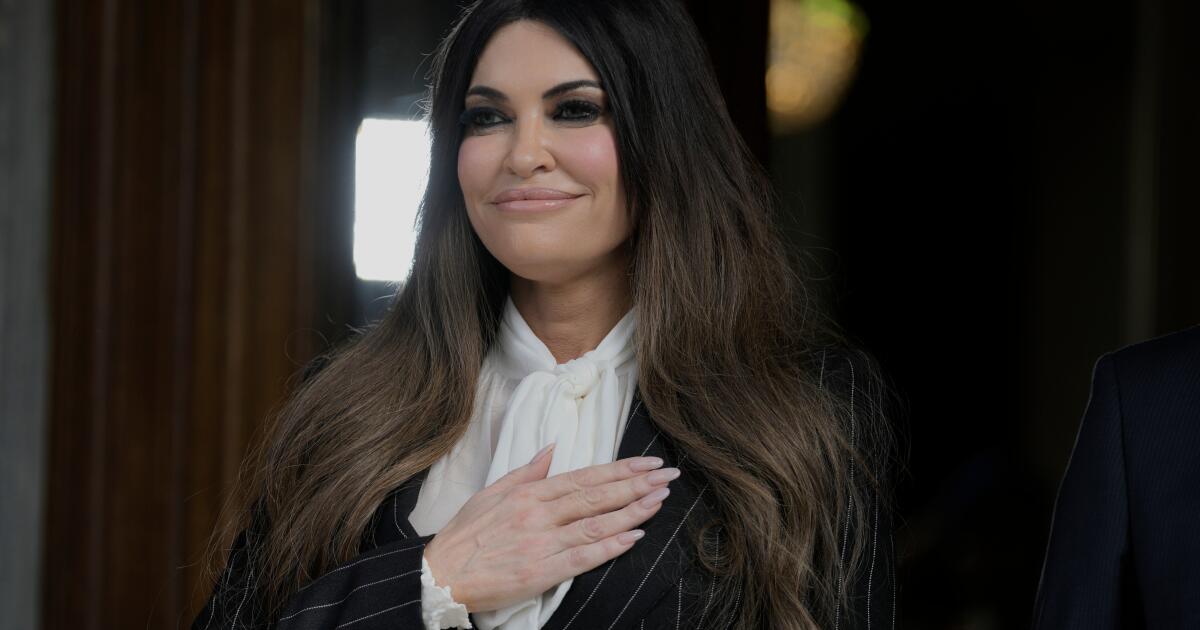
Kimberly Guilfoyle, a former California prosecutor, television personality and close ally of President Trump, officially took office Tuesday as the first U.S. female ambassador to Greece.

Guilfoyle, 56, who was once engaged to Donald Trump Jr., presented her diplomatic credentials to Greek President Constantine Tassoulas after being sworn in Sept. 29 in Washington.

The former Fox News host’s arrival comes as the United States works to boost liquefied natural gas exports to eastern Europe through Greek port facilities.

U.S. Energy Secretary Chris Wright and Interior Secretary Doug Burgum are expected in Athens this week for talks focused on expanding Western gas exports to war-torn Ukraine through a modified multinational pipeline network.

Guilfoyle and the visiting officials are scheduled to meet with Greek Prime Minister Kyriakos Mitsotakis and attend ministerial meetings organized by the Washington-based Atlantic Council.

Since 2018, Greece and the United States have strengthened military ties, including expanding U.S. access to Greek bases and increased involvement of American defense contractors in Greece’s multibillion-dollar armed forces modernization program.

Guilfoyle attended a black-tie welcome reception over the weekend in Athens. Joined by local business leaders and several Cabinet members, she took part in a lively Greek dance — linking arms with other guests and keeping pace as the music sped up.

“I know we will do amazing things for these two exceptional countries,” she told attendees. “I will not disappoint the United States of America. I shall not disappoint Greece.”

At Tuesday’s ceremony, Guilfoyle presented her credentials after the new ambassadors from Norway, Harriet Berg, and Canada, Sonya Thissen.

Source link

Bomb threats reported at election sites in New Jersey

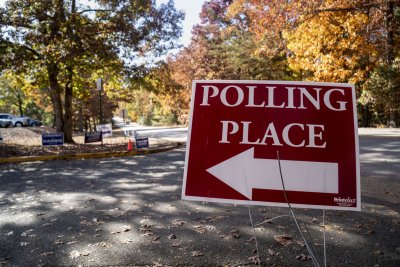
Nov. 4 (UPI) — Bomb threats have shut down polling stations throughout New Jersey Tuesday, and officials have moved several to new election sites.

Officials have said the threats, which were sent via email, were not credible.

“Early this morning, law enforcement responded to threats that were received by email involving certain polling places in Bergen, Essex, Mercer, Middlesex, Monmouth, Ocean, and Passaic counties,” the state Office of the Attorney General said in a statement Tuesday, NJ.com reported. “Law enforcement officers have responded at each affected polling place, and they have worked swiftly to secure these polling locations and ensure the safety of every voter. Some of these polling locations have already re-opened to the public. At others, voters will be directed to a nearby polling location to cast their ballot.”

The threats appear to have come from out of the country, said Paterson Mayor Andre Sayegh, PIX11 reported.

“We are doing everything in our power to protect voters and poll workers and coordinate closely with state, local and federal partners to ensure a smooth and safe election,” said Lt. Gov. Tahesha Way, who also serves as the New Jersey secretary of state.

The election Tuesday focuses on the New Jersey governor’s race. PIX11 New York said Republican nominee Jack Ciattarelli and Democratic nominee Mikie Sherrill are tied in polling.

“Voters should continue to have confidence that they can cast their ballot without fear of intimidation, and we will continue to work tirelessly to ensure a free, fair, and secure election,” said State Attorney General Matthew J. Platkin.

Source link

MAGA anti-Indian racism and antisemitism create a massive rift among conservatives

South Asians have played a prominent role in President Trump’s universe, especially in his second term.

Second Lady Usha Vance is the daughter of Indian immigrants who came to California to study and never went back. Harmeet Dhillon, born in India and a devout Sikh, is currently his U.S. assistant attorney general for the Civil Rights Division. And the head of the FBI, Kash Patel, is (like potential New York City Mayor Zohran Mamdani,) of Indian descent by way of Uganda.

Some Republicans have taken pride in this kind of diversity, citing it for the gains Trump made in 2024 with Black and Latino voters.

But these days, the MAGA big tent seems to be collapsing fast.

Last week, MAGA had a total anti-Indian meltdown on social media, revealing a deep, ugly racism toward South Asians.

It comes amid the first real rebellion about rampant and increasingly open antisemitism within the MAGAverse, creating a massive rift between traditional conservatives and a younger, rabidly anti-Jewish contingent called groypers whose leader, Nick Fuentes, recently posted that he is “team Hitler.”

Turns out, when you cultivate a political movement based on hate, at some point the hate is uncontrollable. In fact, that hate needs to be fed to maintain power — even if it means feasting on its own.

This monster of white-might ugliness is going to dominate policy and politics for the next election, and these now-public fights within the Republican party represent a new dynamic that will either force it to do some sort of soul searching, or purge it of anything but white Christian nationalism. My bet is on the latter. But if conservatives ever truly believed in their inclusive talk, then it’s time for Republicans to stand up and demand the big Trump tent they were hailing just a few months ago.

Ultra-conservative commentator Ben Shapiro, who opposes much of Fuentes’ worldview, summed up this Republican split succinctly.

Fuentes’ followers “are white supremacists, hate women, Jews, Hindus, many types of Christians, brown people of a wide variety of backgrounds, Blacks, America’s foreign policy and America’s constitution,” Shapiro explained. “They admire Hitler and Stalin and that splinter faction is now being facilitated and normalized within the mainstream Republican Party.”

MAGA’s anti-Indian sentiment had an explosive moment a few days ago when a South Asian woman asked Vice President JD Vance a series of questions during a Turning Point USA event in Mississippi. The young immigrant wanted to know how Vance could preach for the removal of nearly 18 million immigrants? And how could he claim that the United States was a Christian nation, rather than one that valued pluralism?

“How can you stop us and tell us we don’t belong here anymore?” the woman asked. “Why do I have to be a Christian?”

Vance’s answer went viral, in part because he claimed his wife, although from a Hindu family, was “agnostic or atheist,” and that he hoped she would convert to Christianity.

“Do I hope eventually that she is somehow moved by the same thing that I was moved in by church? Yeah, I honestly do wish that,” he said.

Vance later tried to do some damage control on social media, calling Usha Vance a “blessing” and promising to continue to “support her and talk to her about faith and life and everything else, because she’s my wife.”

But many South Asians felt Vance was dissing his wife’s heritage and attempting to downplay her non-whiteness. They vented on social media, and got a lot of MAGA feelings back.

“How can you pretend to be a white nativist politician who will ‘bring america back to it’s golden age’ … when your wife is an indian immigrant?” wrote one poster.

Dhillon received similar feedback recently for urging calm and fairness after a Sikh truck driver allegedly caused a fatal crash.

“[N]o ma’am, it is CRYSTAL CLEAR that sihks and hindus need to get the hell out of my country,” one reply stated. “You and your kind are no longer welcome here. Go the [expletive] home.”

Patel too, got it, after posting a message on Diwali, a religious holiday that celebrates the victory of light over darkness. He was dubbed a demon worshipper, a favorite anti-Indian trope.

Perhaps you’re thinking, “Duh, of course MAGA is racist.” But here’s the thing. The military has been scrubbed of many Black officers. The federal workforce, long a bastion for middle-class people of color, has been decimated. Minority cabinet members or top officials are few. Aside from another South Asian, Tulsi Gabbard, there’s Secretary of State Marco Rubio, Labor Secretary Lori Chavez‑DeRemer and HUD head Scott Turner.

South Asians are largely the last visible sign of pluralism in Republican power, an erstwhile proof that the charges of racism from the left are unfair. But now, like Latinos, they are increasingly targets of the base.

At the same time anti-Indian hate was surfacing last week, a whole load of MAGA antisemitism hit the fan. It started when Tucker Carlson, who in his post-network life has re-created himself as a hugely popular podcaster with more than 16 million followers on X, invited Fuentes on his show.

In addition to calling for the death of American Jews, Fuentes has also said women want him to rape them and should be burned alive, Black people belong in prison and LGBTQ+ people are an abomination.

Anyone who is not his kind of Christian “must be absolutely annihilated when we take power,” he said.

Turns out far-right Charlie Kirk was a bulwark against this straight-up American Nazi. Kirk’s popularity kept Fuentes — who often trolled Kirk — from achieving dominance as the spirit guide of young MAGA. Now, with Kirk slain, nothing appears to be stopping Fuentes from taking up that mantle.

After the Fuentes interview, sane conservatives (there are some left) were apoplectic that Carlson would support someone who so openly admits to being anti-Israel and seemingly pro-Nazi. They demanded the Heritage Foundation, historical backbone of the conservative movement, creators of Project 2025 and close allies of Tucker, do something. The head of Heritage, Kevin Roberts, offered what many considered a sorry-not-sorry. He condemned Fuentes, saying he was “fomenting Jew hatred, and his incitements are not only immoral and un-Christian, they risk violence.”

But also counseled that Fuentes shouldn’t be banished from the party.

“Join us — not to cancel — but to guide, challenge, and strengthen the conversation,” Roberts said.

Are Nazis really all bad? Discuss!

The response from ethical conservatives — Jewish and non-Jewish alike — has been that you don’t politely hear Nazis out, and if the Republican Party can’t clearly say that Nazis aren’t welcome, it’s got a problem.

Yes, the Republican Party has a problem.

The right rode to power by attacking what it denigrates at “wokeism” on the left. MAGA declared that to confront fascism or racism or misogyny — to tell its purveyors to sit down and shut up — was wrong. That “canceling,” or banishment from common discourse for spewing hate, was somehow an infringement on 1st Amendment rights or even terrorism.

They screamed loud and clear that speaking out against intolerance was the worst, most unacceptable form of intolerance itself — and would not be tolerated.

You know who heard them loud and clear? Fuentes. He has checkmated establishment Republicans with their own cowardice and hypocrisy.

So now his young Christian white supremacists are empowered, and intent on taking over as the leaders of the party. Fuentes is saying what old guard Republicans don’t want to hear, but secretly fear: He already is dangerously close to being the mainstream; just read the comments.

Roberts, the Heritage president, said it himself: “Diversity will never be our strength. Unity is our strength, and a lack of unity is a sign of weakness.”

Trying to shut Fuentes up or kick him out will likely anger that vocal and powerful part of the base that enjoys the freedom to be openly hateful, and really wouldn’t mind a male-dominated white Christian autocracy.

The far right has free-speeched their way into fascism, and Fuentes is loving every minute of it.

So now this remaining vestige of traditional conservatives — including senators such as Ted Cruz and Mitch McConnell — is faced with a painful reckoning. Many mainstream Republicans for years ignored the racism and antisemitism creeping into the party. They can’t anymore. It has grown into a beast ready to consume its maker.

Will they let this takeover happen, call for conversation over condemnation to the glee of Fuentes and his followers?

Or will they find the courage to be not just true Republicans, but true Americans, and declare non-negotiable for their party that most basic of American ideals: We do not tolerate hate?

Source link

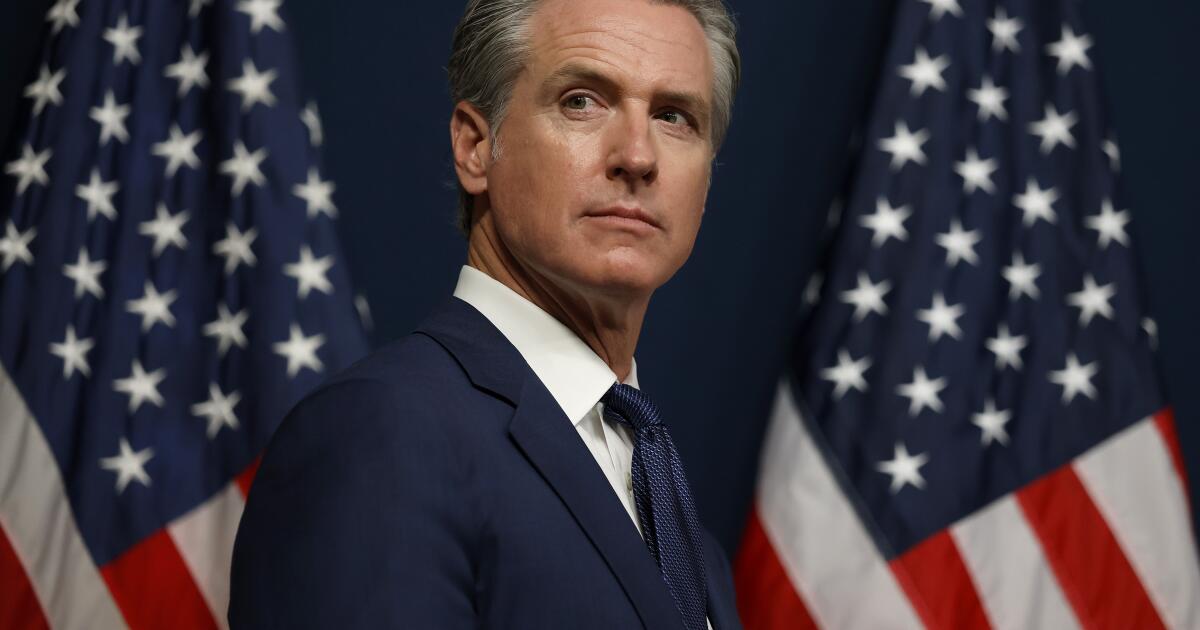
Gavin Newsom’s gamble on Prop. 50 may be his most calculated yet

Gov. Gavin Newsom stepped to the microphone at the state Democratic headquarters in mid-August with the conviction of a man certain he was on the right side of history, bluntly saying California has a moral obligation to thwart President Trump’s attempt to tilt the balance of Congress.

Over the next 2½ months, Newsom became the public face of Proposition 50, a measure designed to help Democrats win control of the U.S. House of Representatives by temporarily redrawing California’s congressional districts.

Newsom took that leap despite tepid support for a gerrymandering measure in early polls.

With Tuesday’s election, the fate of Proposition 50 arrives at a pivotal moment for Newsom, who last week acknowledged publicly that he’s weighing a 2028 presidential run. The outcome will test not only his political instincts but also his ability to deliver on a measure that has national attention fixed squarely on him.

From the outset, Newsom paired his conviction with caution.

“I’m mindful of the hard work ahead,” Newsom said in August, shortly after lawmakers placed Proposition 50 on the ballot.

It was familiar territory for a governor who has built a career on high-stakes political bets. As San Francisco mayor, his decision to issue same-sex marriage licenses in 2004 made him a progressive icon. It also drew accusations he’d energized conservative turnout that year in the presidential election that ended with George W. Bush winning a second term.

As the state’s newly elected governor, he suspended the death penalty in 2019 despite voters having twice rejected measures to do so, calling it a costly and biased system that “fails to deliver justice” — a move that drew fury from law enforcement groups and victims’ families. His decision to take on Florida Gov. Ron DeSantis in a 2023 prime-time debate hosted by Sean Hannity on Fox News was intended to showcase his command of policy and political agility, but instead fell flat amid an onslaught of insults.

With Proposition 50, Newsom placed himself at the center of another potentially career-defining gamble before knowing how it would land. Ahead of Tuesday’s special election, polling suggests he may have played his cards right. Six out of 10 likely voters support Proposition 50, according to a survey by UC Berkeley’s Institute of Governmental Studies that was co-sponsored by The Times.

“You know, not everybody would have done it,” veteran Democratic strategist Gale Kaufman said. “He saw the risk and he took it.”

If approved by voters, the ballot measure would redraw California’s congressional maps to favor Democrats beginning with the 2026 midterm elections in hopes of discounting Republican efforts to gerrymander more seats for themselves. California introduced the measure in response to Trump and his political team leaning on Republican-led states to redraw their district lines to help Republicans retain control of the House.

The balance of power in the closely divided House will determine whether Trump can advance his agenda during his final two years in office — or face an emboldened Democratic majority that could move to challenge, or even investigate, his administration.

And while critics of the governor see a power-craving politician chasing headlines and influence, supporters say this is classic Newsom: confident, risk-tolerant and willing to stand alone when he believes he’s right. He faced intense backlash from his political allies when he had conservative personality Charlie Kirk as his inaugural guest on his podcast this year, on which Newsom said he believed it was “deeply unfair” for transgender athletes to compete in women’s sports. After Kirk was killed, Newsom regularly brought up that interview as a point of pride, noting the backlash he received from his own party over hosting a Trump ally.

In recent months Newsom struck a deal to stabilize struggling oil refineries, pushed cities to ban homeless encampments and proposed walking back healthcare coverage for undocumented immigrants — a series of moves that have tested his standing with progressives. Supporters say the moves show his pragmatic streak, while critics argue they reflect a shift to the center ahead of a possible presidential run.

“In so many ways, he is not a cautious politician,” said Jessica Levinson, a law professor at Loyola Law School. “His brand is big, bold decisions.”

With Proposition 50, Newsom has cast the redistricting counterpunch as a moral imperative, arguing that Democrat-led states must “fight fire with fire,” even if it means pausing a state independent redistricting process largely considered the gold standard. The measure upends a system Californians overwhelmingly endorsed to keep politics out of the map-drawing process.

Levinson said Newsom’s profile has been rising along with the polling numbers for Proposition 50 as he has booked national television shows like ‘The Late Show with Stephen Colbert” and appeared in an ad in favor of the ballot measure with former President Obama, Massachusetts Sen. Elizabeth Warren and other prominent Democrats that ran during the World Series.

“We are talking about Proposition 50 on a nationwide scale,” Levinson said. “And it’s really hard to talk about Proposition 50 without saying the words ‘Gov. Newsom of California spearheading the effort to pass.’”

California Republicans have called the effort misguided, arguing that the retaliatory response creates a slippery slope that would erode the independent redistricting process California voters have chosen twice at the ballot box.

“When you fight fire with fire, the whole world burns,” said California Rep. Kevin Kiley (R-Rocklin), whose district is among those that would be overhauled under Proposition 50. “Newsom is trying to claim that Texas did a bad gerrymandering, but what California is doing is a good gerrymander because somehow it’s canceling it out … I just think gerrymandering is wrong. It’s wrong in Texas and it’s wrong in California.”

Kiley said Newsom never has been one to shy away from national attention “and for pursing explicitly partisan goals.”

“He’s certainly used this as an opportunity to do both of those things,” Kiley said.

Out of the gate, the redistricting plan had lackluster support. Then came the flood of ads by proponents peppered with talking points about Trump rigging the election.

Supporters of Proposition 50 took in more than four times the amount that opponents raised in recent weeks, according to campaign finance reports filed with the state by the three main committees campaigning about the measure. Supporters of Proposition 50 raised so much money that Newsom told them “you can stop donating.”

Political analysts said the redistricting fight has given Newsom what every ambitious politician craves: a narrative. It’s allowed him to cast himself as a defender of democracy while reenergizing donors. That message sharpened when Trump administration officials said they’d monitor polling sites in several California counties at the state GOP’s request, prompting Newsom to accuse the Trump administration of “voter intimidation.”

Republican strategist Rob Stutzman said the campaign gave Newsom something he’d struggled to find: “an authentic confrontation” with Trump that resonates beyond California.

“And I think it’s worked well for him nationally,” Stutzman said. “I think it’s been great for him in some ways, regardless of what happens, but if it does lose, it’ll hurt the brand that he can win and there will be a lot of disgruntled donors.”

While Newsom has framed the measure as good for the country, Stutzman said it’s clear that Proposition 50 has been particularly good for the governor.

“He’s used it for his own purposes very, very effectively,” Stutzman said. “If he becomes the [presidential] nominee, you could look back and say this was an important part of him getting there.”

Source link

British Chancellor Rachel Reeves signals that tax rises are coming

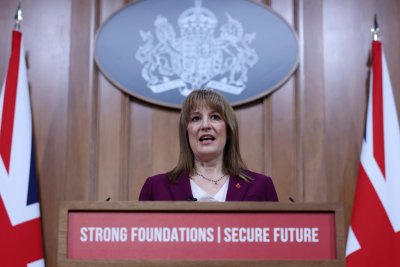
British Chancellor of the Exchequer Rachel Reeves delivers a rare pre-budget speech Tuesday at her official residence at No. 9 Downing Street, London, in which she suggested tax hikes were unavoidable. Photo by Andy Rain/Pool/EPA

Nov. 4 (UPI) — British Chancellor Rachel Reeves signaled Tuesday that she was likely to raise taxes on ordinary people in her upcoming budget this month in spite of an election pledge by the Labour government it would not do so.

In a speech in Downing Street, Reeves said she would make “the choices necessary” to ensure the foundation of the economy was sufficiently strong for the government to deliver on its mandate to protect the NHS, get down the national debt and rebuild the economy.

Notably, she did not repeat the manifesto pledge the party ran on in the 2024 general election, in which it swept to power to leave untouched the three main taxes — income tax, National Insurance and VAT.

Instead, seeking to explain her actions in advance of her watershed budget, which she will deliver to Parliament on Nov. 26, she said people needed to “understand the circumstances we are facing” and that everyone needed to do their bit to rectify the situation.

“As I take my decisions on both tax and spend I will do what is necessary to protect families from high inflation and interest rates, to protect our public services from a return to austerity and to ensure that the economy that we hand down to future generations is secure, with debt under control.

“If we are to build the future of Britain together, we will all have to contribute to that effort. Each of us must do our bit for the security of our country and the brightness of its future.”

Reeves dangled the prospect of rewards down the line, stating that getting it right now would yield more resilient public finances with the headroom to withstand global shocks, which in turn would provide businesses with the confidence to invest.

She said that would in turn leave the government with more leeway to act when necessary, investing in infrastructure and industry to build a stronger economy and get down the cost of government debt, spending less on interest and more and schools and the NHS.

Reeves is betting on the budget, her second, to win the endorsement of the market for her management of the country’s finances by showing she can stick to the fiscal rules she set for herself in October 2024.

Those rules state she must balance spending with revenue — within a plus or minus margin of 0.5% of GDP — within five years, meaning no borrowing for everyday spending from the 2029-30 financial year onward. In addition, the ratio of government debt to GDP must begin falling within the same timeframe.

To do that, however, she must demonstrate how she plans to plug a fiscal hole of as much as $40 billion and boost lackluster economic growth.

The only options to close the gap and balance the books are a return to austerity — which the government has categorically ruled out — or boost the amount of money flowing into government coffers.

Reeves raised some taxes on business in her first budget in November 2024 and to come back for more after promising she would not do so, particulary when it comes to raising the basic rate of income tax — currently 20% — is very high risk, politically.

It hasn’t been done for 50 years and it didn’t work out well for then-Labour government with the country plunged into a currency crisis and forced to seek a bailout loan from the IMF.

Reeves mostly laid blame at the feet of the previous Conservative administration’s policies, including Brexit, austerity and cuts to infrastructure spending, all of which she said had led to falling productivity.

She also cited high inflation globally and economic uncertainty created by the trade tariffs imposed by U.S. President Donald Trump in recent months.

Conservative shadow chancellor, Mel Stride, said it was now certain tax hikes for families and businesses were on the way.

He said that if Reeves proceeded to go back on her word, she should quit.

Daisy Cooper, Treasury spokesperson for the Liberal Democrats, said the government could no longer dodge responsibility.

“It’s clear that this budget will be a bitter pill to swallow as the government seems to have run out of excuses,” she said.

Source link

Supreme Court’s conservatives face a test of their own in judging Trump’s tariffs

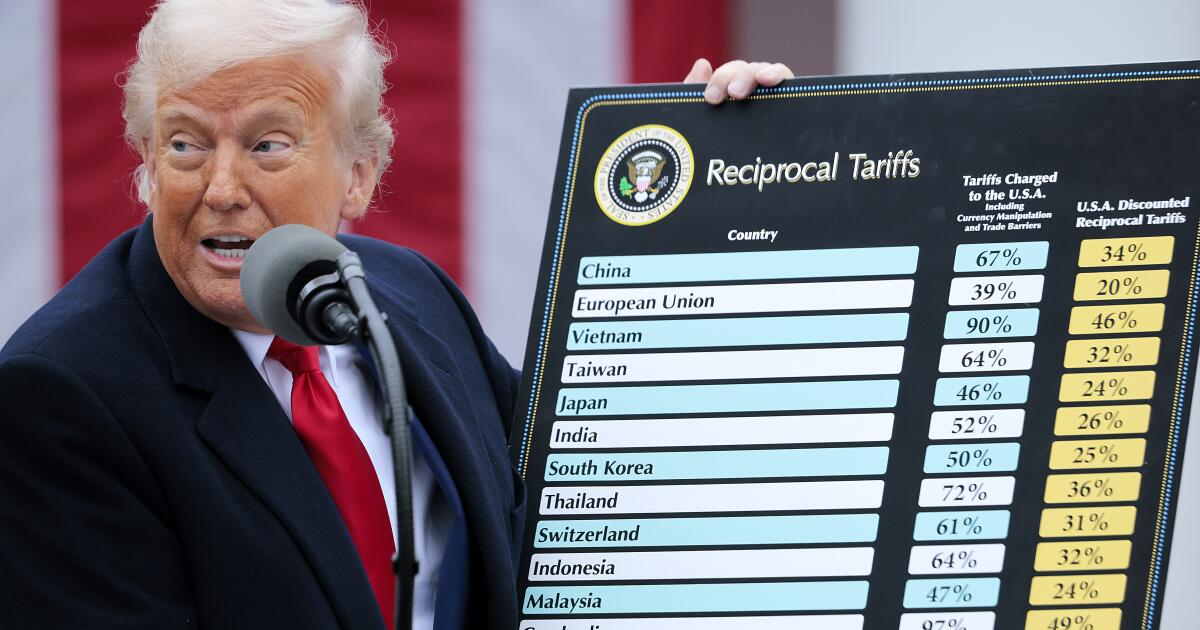
The Supreme Court’s conservatives face a test of their own making this week as they decide whether President Trump had the legal authority to impose tariffs on imports from nations across the globe.

At issue are import taxes that are paid by American businesses and consumers.

Small-business owners had sued, including a maker of “learning toys” in Illinois and a New York importer of wines and spirits. They said Trump’s ever-changing tariffs had severely disrupted their businesses, and they won rulings declaring the president had exceeded his authority.

On Wednesday, the justices will hear their first major challenge to Trump’s claims of unilateral executive power. And the outcome is likely to turn on three doctrines that have been championed by the court’s conservatives.

First, they say the Constitution should be interpreted based on its original meaning. Its opening words say: “All legislative powers … shall be vested” in Congress, and the elected representatives “shall have the power to lay and collect taxes, duties, imposes and excises.”

Second, they believe the laws passed by Congress should be interpreted based on their words. They call this “textualism,” which rejects a more liberal and open-ended approach that included the general purpose of the law.

Trump and his lawyers say his sweeping “Liberation Day” tariffs were authorized by the International Economic Emergency Powers Act, or IEEPA.

That 1977 law says the president may declare a national emergency to “deal with any unusual and extraordinary threat” involving national security, foreign policy or the economy of the United States. Faced with such an emergency, he may “investigate, block … or regulate” the “importation or exportation” of any property.

Trump said the nation’s “persistent” balance of payments deficit over five decades was such an “unusual and extraordinary threat.”

In the past, the law has been used to impose sanctions or freeze the assets of Iran, Syria and North Korea or groups of terrorists. It does not use the words “tariffs” or “duties,” and it had not been used for tariffs prior to this year.

The third doctrine arose with Chief Justice John G. Roberts Jr. and is called the “major questions” doctrine.

He and the five other conservatives said they were skeptical of far-reaching and costly regulations issued by the Obama and Biden administrations involving matters such as climate change, student loan forgiveness or mandatory COVID-19 vaccinations for 84 million Americans.

Congress makes the laws, not federal regulators, they said in West Virginia vs. Environmental Protection Agency in 2022.

And unless there is a “clear congressional authorization,” Roberts said the court will not uphold assertions of “extravagant statutory power over the national economy.”

Now all three doctrines are before the justices, since the lower courts relied on them in ruling against Trump.

No one disputes that the president could impose sweeping worldwide tariffs if he had sought and won approval from the Republican-controlled Congress. However, he insisted the power was his alone.

In a social media post, Trump called the case on tariffs “one of the most important in the History of the Country. If a President is not allowed to use Tariffs, we will be at a major disadvantage against all other Countries throughout the World, especially the ‘Majors.’ In a true sense, we would be defenseless! Tariffs have brought us Great Wealth and National Security in the nine months that I have had the Honor to serve as President.”

Solicitor Gen. D. John Sauer, his top courtroom attorney, argues that tariffs involve foreign affairs and national security. And if so, the court should defer to the president.

“IEEPA authorizes the imposition of regulatory tariffs on foreign imports to deal with foreign threats — which crucially differ from domestic taxation,” he wrote last month.

For the same reason, “the major questions doctrine … does not apply here,” he said. It is limited to domestic matters, not foreign affairs, he argued.

Justice Brett M. Kavanaugh has sounded the same note in the past.

Sauer will also seek to persuade the court that the word “regulate” imports includes imposing tariffs.

The challengers are supported by prominent conservatives, including Stanford law professor Michael McConnell.

In 2001, he and John Roberts were nominated for a federal appeals court at the same time by President George W. Bush, and he later served with now-Justice Neil M. Gorsuch on the U.S. 10th Circuit Court of Appeals in Denver.

He is the lead counsel for one group of small-business owners.

“This case is what the American Revolution was all about. A tax wasn’t legitimate unless it was imposed by the people’s representatives,” McConnell said. “The president has no power to impose taxes on American citizens without Congress.”

His brief argues that Trump is claiming a power unlike any in American history.

“Until the 1900s, Congress exercised its tariff power directly, and every delegation since has been explicit and strictly limited,” he wrote in Trump vs. V.O.S. Selections. “Here, the government contends that the President may impose tariffs on the American people whenever he wants, at any rate he wants, for any countries and products he wants, for as long as he wants — simply by declaring longstanding U.S. trade deficits a national ‘emergency’ and an ‘unusual and extraordinary threat,’ declarations the government tells us are unreviewable. The president can even change his mind tomorrow and back again the day after that.”

He said the “major questions” doctrine fully applies here.

Two years ago, he noted the court called Biden’s proposed student loan forgiveness “staggering by any measure” because it could cost more than $430 billion. By comparison, he said, the Tax Foundation estimated that Trump’s tariffs will impose $1.7 trillion in new taxes on Americans by 2035.

The case figures to be a major test of whether the Roberts court will put any legal limits on Trump’s powers as president.

But the outcome will not be the final word on tariffs. Administration officials have said that if they lose, they will seek to impose them under other federal laws that involve national security.

Still pending before the court is an emergency appeal testing the president’s power to send National Guard troops to American cities over the objection of the governor and local officials.

Last week, the court asked for further briefs on the Militia Act of 1908, which says the president may call up the National Guard if he cannot “with the regular forces … execute the laws of the United States.”

The government had assumed the regular forces were the police and federal agents, but a law professor said the regular forces in the original law referred to the military.

The justices asked for a clarification from both sides by Nov. 17.

Source link

Government urged to replace annual BBC TV licence fee with ads before price rise

The annual TV licence fee is set to rise in April 2026

Calls have been made to scrap the BBC TV licence fee and introduce either advertising or a paywall system before the annual price increase in April. A new online petition has urged the Government to make changes to the TV licence system.

The current fee stands at £174.50 and households must pay this if they watch or record live television, or face potential fines. This charge usually increases alongside September’s Consumer Price Index (CPI) inflation rate, which reached 3.8 per cent.

Such a rise would push the licence fee up by £6.65 to £181.15 for the 2026/27 financial year. The Daily Record reports that this isn’t guaranteed and awaits confirmation from the UK Government later this month, typically around the Autumn Budget on November 26.

From April 1, 2024, the UK Government determined the licence fee would increase annually with CPI inflation for the Charter period’s remaining four years. The BBC’s current Charter continues until the end of 2027.

Campaigner David Gilmore contends that “even if you don’t watch the BBC you still have to pay for it”. He continued: “You don’t have to pay for content put on by theatres or cinemas if you don’t watch it so why should you be required to pay the BBC if you don’t watch their content?”

The petition titled “Scrap the BBC TV licence and replace funding with adverts or paywall” appears on the UK Government’s petitions-parliament website. At the time of reporting, it had over 1,300 signatures.

The petition needs 10,000 signatures to receive a written response and at 100,000 signatures, it would be considered for debate in Parliament. The petition can be viewed online here.

Other calls to change the TV licence

Over 15,200 people have signed a similar petition, urging the UK Government to cover the TV licence fee for all State Pensioners and those who reach the current official retirement age of 66. As per the current rules, only those over the age of 75 who are receiving Pension Credit are entitled to a free TV licence, saving them £174.50 on the annual fee.

Michael Thompson, the creator of the petition, argues that “many pensioners live on the breadline with only the TV for company”.

He further stated: “With the cost of food soaring and utility bills ever higher, we feel there is a desperate need to provide all pensioners with at least this concession.”

Mr Thompson added: “We feel it is a double outrage that those who have given their all to this country in taxes and raising children have to pay a TV licence fee and are only exempt if they receive means-tested Pension Credit. Meanwhile, some media figures draw huge salaries.”

The “Fund free TV licences for all pensioners” petition can also be seen on the UK Government’s petitions-parliament website.

Source link

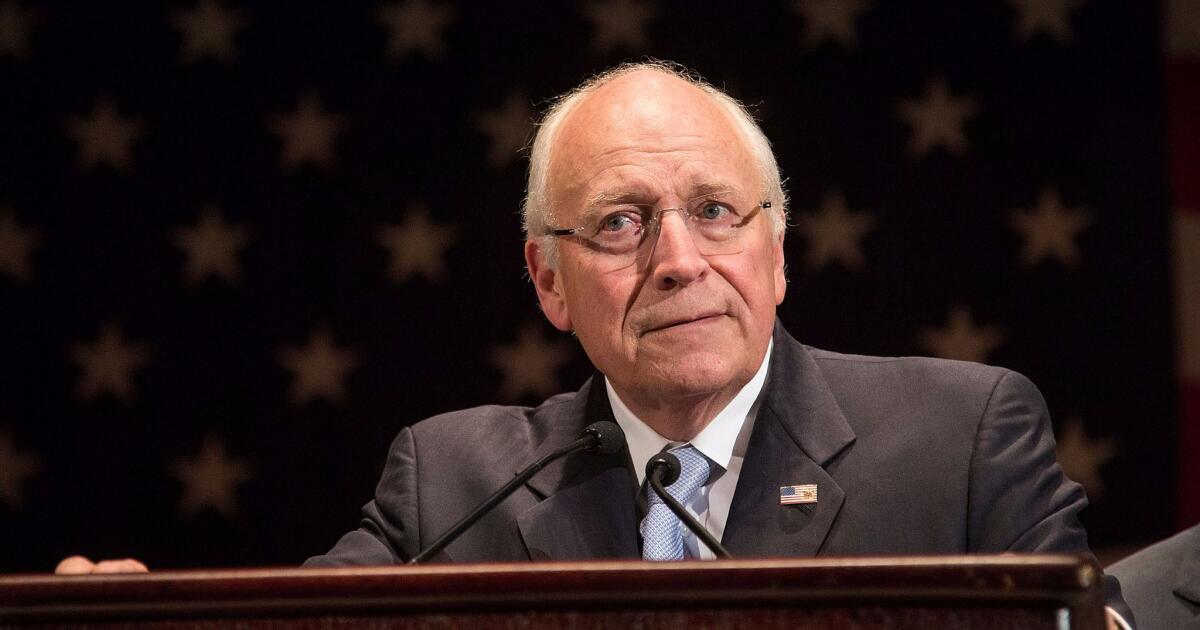
Dick Cheney, former vice president who unapologetically supported wars in Iraq, Afghanistan, dies at 84

Richard B. Cheney, the former vice president of the United States who was the architect of the nation’s longest war as he plotted President George W. Bush’s thunderous global response to the 9/11 terror attacks, has died.

Vexed by heart trouble for much of his adult life, Cheney died Monday night due to complications of pneumonia and cardiac and vascular disease, according to a statement from his family. He was 84.

“For decades, Dick Cheney served our nation, including as White House Chief of Staff, Wyoming’s Congressman, Secretary of Defense, and Vice President of the United States,” the statement said. “Dick Cheney was a great and good man who taught his children and grandchildren to love our country, and to live lives of courage, honor, love, kindness, and fly fishing. We are grateful beyond measure for all Dick Cheney did for our country. And we are blessed beyond measure to have loved and been loved by this noble giant of a man.”

To supporters and detractors alike, Cheney was widely viewed as the engine that drove the Bush White House. His two-term tenure capped a lifetime of public service, both in Congress and on behalf of four Republican presidents.

It often fell to Cheney, not President Bush, to make an assertive, unapologetic case for the American-led wars in Afghanistan and Iraq and for the controversial antiterrorism measures such as the Guantánamo Bay prison. And after the election of President Obama, it was once again Cheney, not Bush, who stood among the new president’s fiercest critics on national security.

In an October 2009 speech — one emblematic of the role he embraced after leaving the White House — Cheney blasted the Obama administration for opening a probe of “enhanced” interrogations of suspected terrorists conducted during the Bush years.

“We cannot protect this country by putting politics over security, and turning the guns on our own guys,” he said. The rhetoric was textbook Cheney: blunt, unvarnished, delivered with authority.

While Cheney at the time was attempting to occupy the leadership vacuum in the GOP in the age of Obama, there was little doubt that he also was motivated to preserve a legacy that appears to be as much his as former President Bush‘s. For eight years, Cheney redrew the lines that defined the vice presidency in a way no predecessor had. His office enjoyed greater autonomy than others before it, while working to keep much of his influence from plain sight. That way of operating led to a challenge before the Supreme Court as well as a criminal investigation over a leak of classified information.

Moreover, the image of a powerful backroom operator managing the Bush administration’s “war on terror,” combined with his service as Defense secretary during the Persian Gulf War and his stint as a chairman of defense contracting giant Halliburton, made Cheney a towering bête noire to liberals worldwide. To them, he embodied a dangerous fusion of politics and the military-industrial complex — and they viewed his every move with deep suspicion.

To his champions, however, he was the firm-jawed, hulking, resolute defender of American interests.

Standing with the administration was more than a duty to Cheney; it was an article of faith. The invasion of Iraq “was the right thing to do, and if we had to do it over again, we’d do exactly the same thing,” Cheney said in a 2006 interview, even as the nation slowly learned that U.S. intelligence suggesting Saddam Hussein’s regime possessed weapons of mass destruction was simply not true.

Three years earlier, Cheney had pledged that the U.S. would be greeted in Iraq as “liberators” — a comment that haunted him as insurgents in the country gained strength, killed thousands of allied troops and extended the conflict for years. The war in Afghanistan would drag on for 20 years, ending in 2021 as it had begun, with the Taliban back in control.

While Cheney will largely be remembered for his leading role in the response to the 9/11 terror attacks, he had long worked the corridors of power in Washington. He was a White House aide to President Nixon and later chief of staff to President Ford. As a member of the House from Wyoming, he rose quickly to become part of the Republican leadership during the 1980s. In the early ’90s, he ran the Pentagon during the Gulf War.

Richard Bruce “Dick” Cheney was born in Lincoln, Neb., on Jan. 30, 1941, and spent much of his teenage years in Casper, Wyo. His father worked for the U.S. Soil Conservation Service.

As a young man, he was more interested in hunting, fishing and sports than in academics, and a stint at Yale University was short-lived. He eventually obtained bachelor’s and master’s degrees from the University of Wyoming and studied toward a doctorate at the University of Wisconsin.

In 1964, he married Lynne Ann Vincent, who became a lifelong political partner while strongly influencing Cheney’s conservatism. Daughter Elizabeth, who was elected to Congress in 2017, was born in 1966 and her sister, Mary, arrived three years later. The sisters became embittered years later when Elizabeth — who preferred Liz — took a stance opposing same-sex marriage, which seemed a slap to Mary and her wife. Cheney, however, offered his support for such unions, an early GOP voice for same-sex marriage. Years later, he came to Liz’s defense when she broke with fellow Republicans and voted to impeach President Trump following the Jan. 6, 2021 attack on the U.S. Capitol. In addition to his wife and daughters, Cheney is survived by seven grandchildren.

A fellowship sent Cheney to Washington, where he soon began working for a politically shrewd House member who also was a lifetime influence, Donald H. Rumsfeld. When Rumsfeld joined the Nixon administration, Cheney followed.

After Ford succeeded Nixon in the wake of Watergate, Rumsfeld served as chief of staff, with Cheney at his side. Ford eventually appointed Rumsfeld secretary of Defense, and Cheney, at 34, ran the White House. Even then, his calm reserve was a hallmark.

Although nearly everyone working for him was older, “He was very self-assured,” James Cannon, a member of Ford’s White House team, said years later. “It didn’t faze him a bit to be chief of staff.”

Ford lost a narrow election to Jimmy Carter in 1976, but Cheney’s Washington career was just getting underway. He headed back to Casper and in little more than a year was running for Congress.

His health, though, already was a factor. In 1978, at age 37 and in the midst of a primary election campaign, he had a heart attack, the first of several. He would undergo multiple surgeries, including a quadruple bypass, two angioplasties, installation of a heart pump and — in 2012 — a transplant. His frequent trips to the hospital and seeming indestructibility provided fodder for late-night talk show hosts during Cheney’s vice presidency.

With the help of television ads reminding voters that Dwight D. Eisenhower and Lyndon B. Johnson had served full White House terms despite having had heart attacks, he narrowly won the Republican nomination and, in November 1978, secured election to the House of Representatives from Wyoming’s single district.

In Congress, he was known as a listener more interested in problem-solving than conservative demagoguery, even as he quietly built a voting record that left no doubt about where he stood on the political spectrum. He quickly moved into the ranks of GOP leadership.

Cheney stepped into the public spotlight after he was named Defense secretary by President George H.W. Bush in 1989. As the Berlin Wall fell and the Cold War cooled, Cheney was charged with overseeing a Pentagon that was more fractious than usual. In a test of political and managerial will, he oversaw major reductions in the Defense budget, a profound downsizing of forces and the closing of obsolete military bases. He helped implement the U.S. invasion of Panama in 1989 to oust the country’s leader, Manuel Noriega, for drug trafficking and racketeering.

But Cheney — along with his hand-picked chairman of the Joint Chiefs of Staff, Colin Powell — made his mark in the American response to the Iraqi invasion of Kuwait in 1990. Cheney played a key role in persuading the Saudi royal family to allow American troops to be stationed in Saudi Arabia to defend against a looming attack from Hussein’s forces.

The Cheney-led Pentagon then shifted to offense in 1991, amassing an enormous American force that totaled more than 500,000 soldiers, nearly twice the number employed in the 2003 U.S. invasion of Iraq. The U.S. military, with help from allied countries, overwhelmed the Iraqi forces in Kuwait in only 43 days and easily entered Iraq.

Characteristically, Cheney would defend the then-controversial decision to halt the U.S. advance toward Baghdad, which left Hussein in power. “I would guess if we had gone in there, we would still have forces in Baghdad today. We’d be running the country,” he said in a 1992 speech. “We would not have been able to get everybody out and bring everybody home.”

Cheney’s efforts to station U.S. troops in Saudi Arabia, considered critical to the push to repel Iraq, would have unforeseen ramifications. The military presence there helped radicalize young Islamic militants such as Osama bin Laden.

After President Clinton’s victory in 1992, Cheney left government service. Three years later, he assumed the helm of Halliburton, one of the world’s leading oil field companies and a prominent military contractor. The company thrived under Cheney’s leadership: Its relationship with the Pentagon flourished, its international operations expanded and Cheney grew wealthy.

In 2000, then-Texas Gov. George W. Bush, the Republican nominee for president, asked Cheney to head up the search for his running mate, then ultimately chose Cheney for the job instead. He brought to the ticket an element of maturity and Washington gravitas that the inexperienced Bush did not possess.

Cheney’s lack of design on the presidency, and his willingness to return to government 10 days shy of his 60th birthday, seemingly gave Bush the benefit of his experience and earned Cheney a measure of trust — and thus authority — commanded by few presidential advisors.

Once in office, Cheney, mindful of lessons learned in the Ford White House, sought to revitalize an executive office he believed had become too hemmed in by Congress and the courts. He termed it a “restoration.”

“After Watergate, President Ford said there was an imperiled president, not an imperial presidency,” said presidential historian Robert Dallek. Cheney, he said, felt “he badly needed to expand the powers of the presidency to assure the national security.”

In office barely a week, Cheney created a national energy policy task force in response to rising gasoline prices. A series of meetings with top officials from the oil, natural gas, electricity and nuclear industries were closed to the public, and Cheney refused to reveal the names of the participants. Cheney would exert similar influence over environmental policy and, with an office on Capitol Hill, forcefully advance the president’s legislative agenda.

A lawsuit seeking information about the task force made its way to the Supreme Court, which ruled in the vice president’s favor in 2004. One of the justices in the majority was Antonin Scalia, who was a friend and, it was later revealed, had recently gone duck hunting with the vice president.

Another hunting trip gone awry earned Cheney embarrassing headlines in 2006 when he accidentally shot and wounded a member of the party with a round of birdshot while quail hunting on a Texas ranch.

More troubling to Cheney was a federal criminal probe in connection with the 2003 leak of the identity of covert CIA operative Valerie Plame Wilson. The investigation resulted in the conviction four years later of Cheney aide I. Lewis “Scooter” Libby for perjury and obstruction of justice. Libby was later pardoned by President Trump.

Cheney, however, will be largely remembered for his unwavering belief that the U.S. invasions of Afghanistan and Iraq — especially the latter — were essential, a stance he maintained even as the missions in both theaters evolved from rooting out suspected terrorists to nation-building, and even as the casualties skyrocketed and it became clear the 20-year mission was doomed.

When U.S. troops and civilians were pulled out of Afghanistan in a fraught and fatal departure in 2021, it was Cheney’s daughter who spoke up.

“We’ve now created a situation where as we get to the 20th anniversary of 9/11, we are surrendering Afghanistan to the very terrorist organization that housed al Qaeda when they plotted and planned the attacks against us,” Rep. Liz Cheney (R.-Wyo.) said.

The former vice president’s steely resolve was captured years later in “Vice,” a 2018 biographical drama in which Christian Bale portrayed Cheney as a brainy yet uncompromisingly uncharismatic leader.

It was Cheney who insisted early on that Hussein possessed weapons of mass destruction. “There is no doubt he is amassing them to use against our friends, against our allies, and against us,” Cheney said in August 2002. The U.S. eventually determined that Iraq had no such weapons.

He argued forcefully that Hussein was linked to the 2001 terror attacks. When other administration officials fell silent, Cheney continued to make the connections even though no shred of proof was ever found. In a 2005 speech, he called the Democrats who accused the administration of manipulating intelligence to justify the war “opportunists” who peddled “cynical and pernicious falsehoods” to gain political advantage.

Cheney also frequently defended the use of so-called extreme interrogation methods, such as waterboarding, on al Qaeda operatives. He did so in the final months of the Bush administration, as both the president’s and Cheney’s public approval ratings plunged.

“It’s a good thing we had them in custody and it’s a good thing we found out what they knew,” he said in a 2008 speech to a friendly crowd at the Conservative Political Action Conference.

“I’ve been proud to stand by him, the decisions he made,” Cheney said of Bush. “And would I support those same decisions today? You’re damn right I would.”

Oliphant and Gerstenzang are former Times staff writers.

Staff writer Steve Marble contributed to this story.
Source link

Volunteers race to preserve U.S. history ahead of Trump edicts

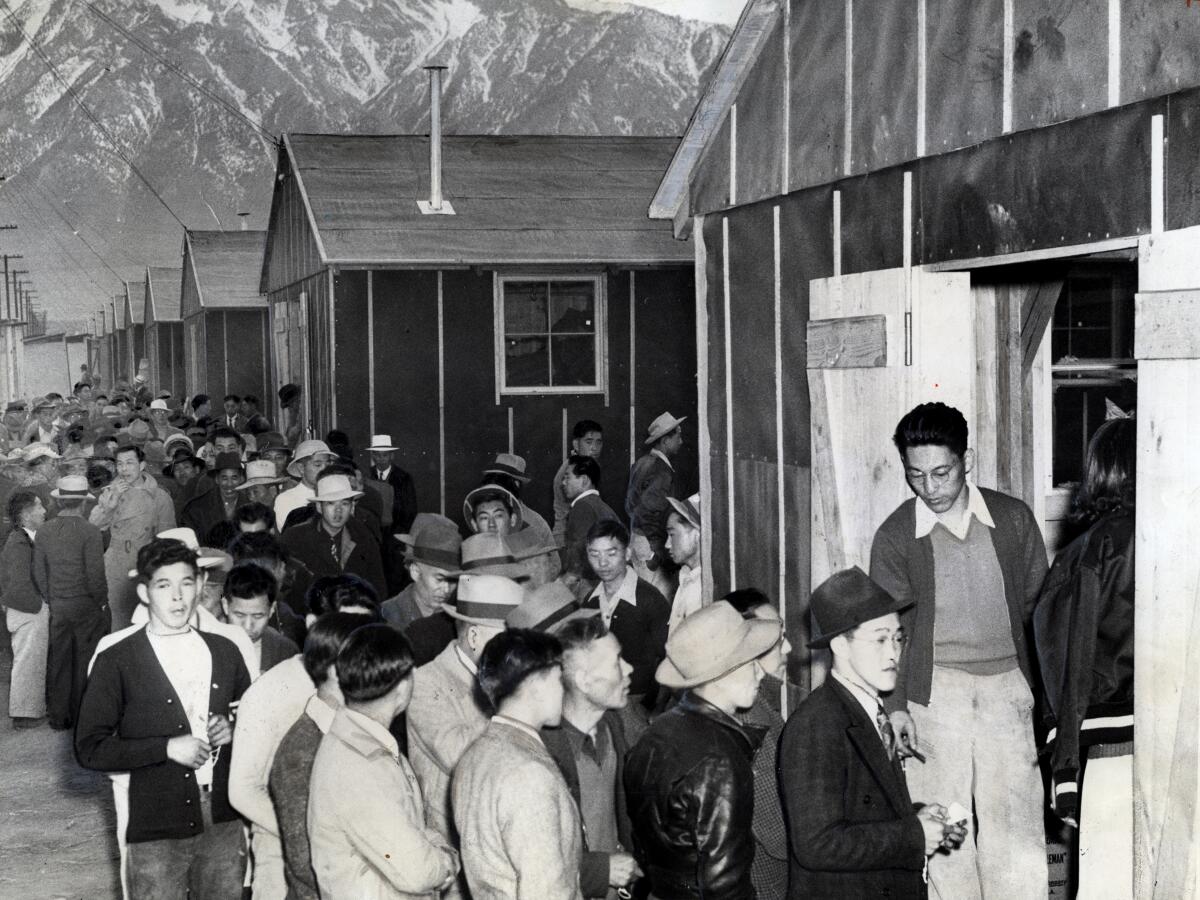
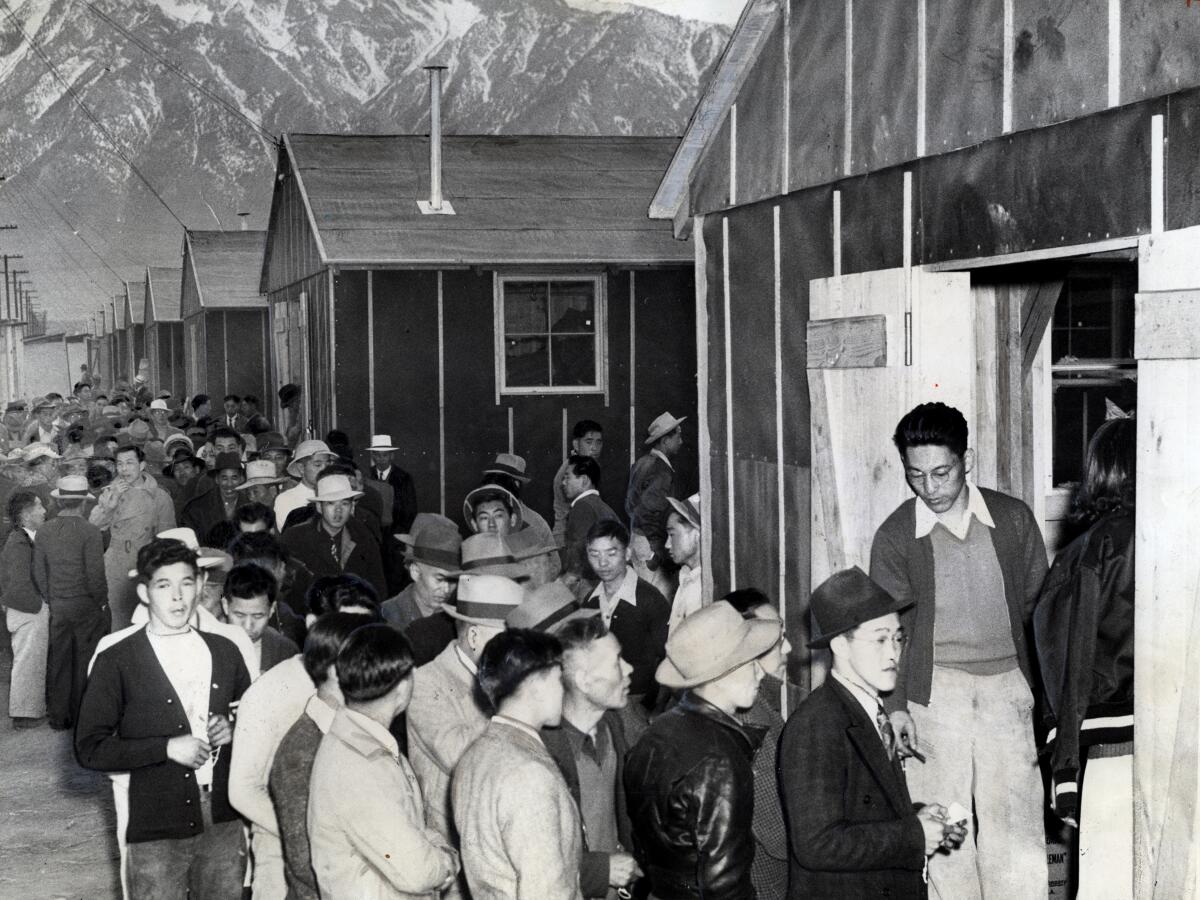
A famous Civil War-era photo of an escaped slave who had been savagely whipped. Displays detailing how more than 120,000 U.S. citizens of Japanese ancestry were forcibly imprisoned during WWII. Signs describing the effects of climate change on the coast of Maine.

In recent months, a small army of historians, librarians, scientists and other volunteers has fanned out across America’s national parks and museums to photograph and painstakingly archive cultural and intellectual treasures they fear are under threat from President Trump’s war against “woke.”

These volunteers are creating a “citizen’s record” of what exists now in case the administration carries out Trump’s orders to scrub public signs and displays of language he and his allies deem too negative about America’s past.

Hundreds of Japanese–Americans were forcibly incarcerated at Manzanar in the Owens Valley during World War II.

More than 120,000 people of Japanese ancestry were forcibly relocated and incarcerated in camps during World War II, including these Japanese Americans seen at Manzanar in the Owens Valley in 1942.

(LA Library)

“My deepest, darkest fear,” said Georgetown University history professor Chandra Manning, who helped organize an effort dubbed Citizen Historians for the Smithsonian, is that the administration plans to “rewrite and falsify who counts as an American.”

In March, Trump issued an executive order entitled “Restoring Truth and Sanity to American History” arguing that, over the past decade, signs and displays at museums and parks across the country have been distorted by a “widespread effort to rewrite our Nation’s history,” replacing facts with liberal ideology.

“Under this historical revision,” he wrote, “our Nation’s unparalleled legacy of advancing liberty, individual rights, and human happiness is reconstructed as inherently racist, sexist, oppressive, or otherwise irredeemably flawed.”

He ordered the National Parks Service and The Smithsonian to scrub their displays of content that “inappropriately disparages Americans” living or dead, and replace it with language that celebrates the nation’s greatness.

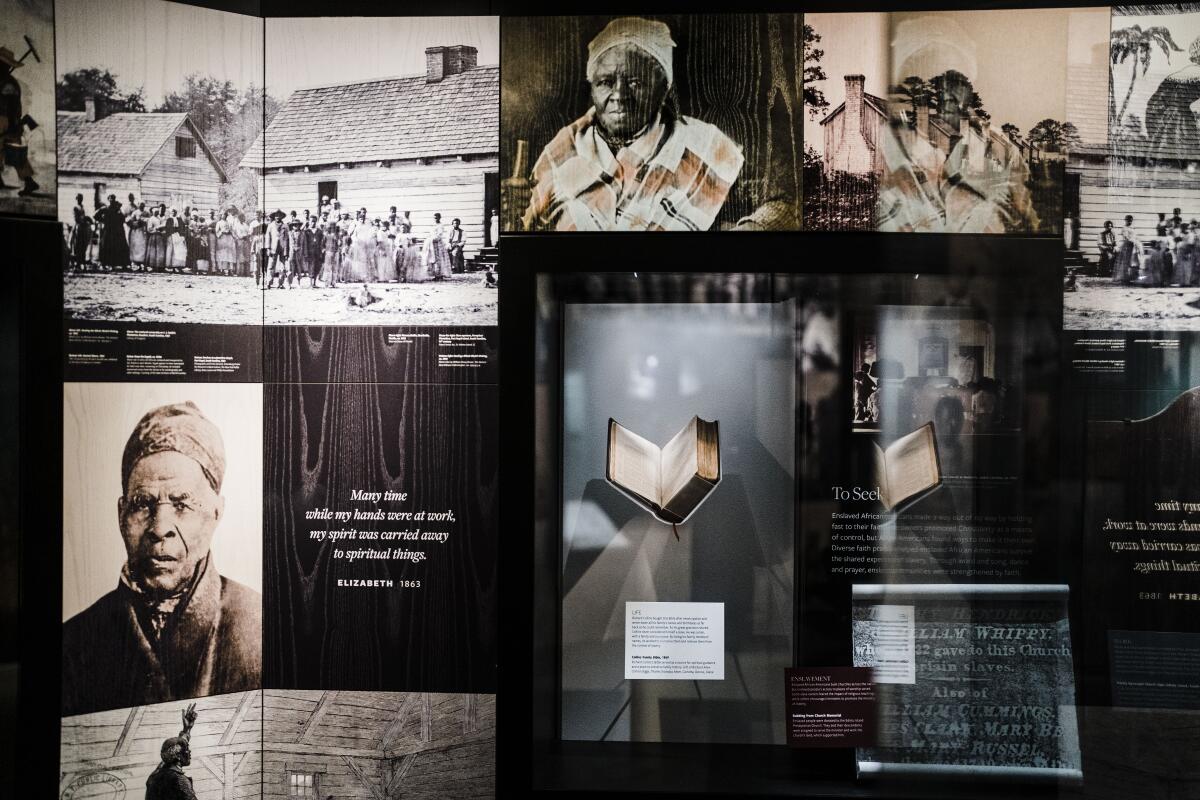
The Collins Bible at the National Museum of African American History and Culture in Washington, DC.

The Collins Bible — a detailed family history recorded by Richard Collins, a formerly enslaved man — is seen at the National Museum of African American History and Culture in Washington, D.C.

(Kent Nishimura/Los Angeles Times)

That’s when Manning’s colleague at Georgetown University, James Millward, who specializes in Chinese history, told her, “this seems really eerie,” Manning recalled. It reminded him of the Chinese Communist Party’s dictates to “tell China’s story well,” which he said was code for censorship and falsification.

So the professors reached out to friends and discovered that there were like-minded folks across the country working like “monks” in the Middle Ages, who painstakingly copied ancient texts, to photograph and preserve what they regarded as national treasures.

“There’s a human tradition of doing exactly this,” Manning said. “It feels gratifying to be a part of that tradition, it makes me feel less isolated and less alone.”

Jenny McBurney, a government documents librarian at the University of Minnesota, said she found Trump’s language “quite dystopian.” That’s why she helped organize an effort called Save Our Signs, which aims to photograph and preserve all of the displays at national parks and monuments.

The sprawling network includes Manzanar National Historic Site, where Japanese American civilians were imprisoned during the Second World War; Fort Sumter National Monument, where Confederates fired the first shots of the Civil War; Ford’s Theater National Historic Site in Washington, D.C., where Abraham Lincoln was assassinated; and the Martin Luther King, Jr. National Historic Park.

It would be difficult to tell those stories without disparaging at least some dead Americans — such as the assassins John Wilkes Booth and James Earl Ray — or violating Trump’s order to focus on America’s “unmatched record of advancing liberty, prosperity and human flourishing.”

At Acadia National Park in Maine, where the rising sun first hits the U.S. coast for much of the year, signs describing the effect of climate change on rising seas, storm surge and intense rain have already been removed.

McBurney doesn’t want volunteers to try to anticipate the federal government’s next moves and focus only on displays they think might be changed, she wants to preserve everything, “good, bad, negative or whatever,” she said in a recent interview. “As a librarian, I like complete sets of things.”

And if there were a complete archive of every sign in the national park system in private hands — out of the reach of the current administration — there would always be a “before” picture to look back at and see what had changed.

“We don’t want this information to just disappear in the dark,” McBurney said.

Another group, the Data Rescue Project, is hard at work filling private servers with at-risk databases, including health data from the Centers for Disease Control, climate data from the Environmental Protection Agency and the contents of government websites, many of which have been subject to the same kind of ideological scrubbing threatened at parks and museums.

Both efforts were “a real inspiration,” Manning said, as she and Millward pondered what they could do to contribute to the cause.

Then, in August, apparently frustrated by the lack of swift compliance with its directives, the Trump administration sent a formal letter to Lonnie G. Bunch III, the first Black Secretary of the Smithsonian, setting a 120-day limit to “begin implementing content corrections.”

Days later, President Trump took to Truth Social, the media platform he owns, to state his case less formally.

“The Smithsonian is OUT OF CONTROL,” he wrote, “everything discussed is how horrible our Country is, how bad Slavery was, and how unaccomplished the downtrodden have been.”

Even though the Smithsonian celebrates American astronauts, military heroes and sports legends, Trump complained that the museums offered nothing about the “success” and “brightness” of America, concluding with, “We have the “HOTTEST” Country in the World, and we want people to talk about it.”

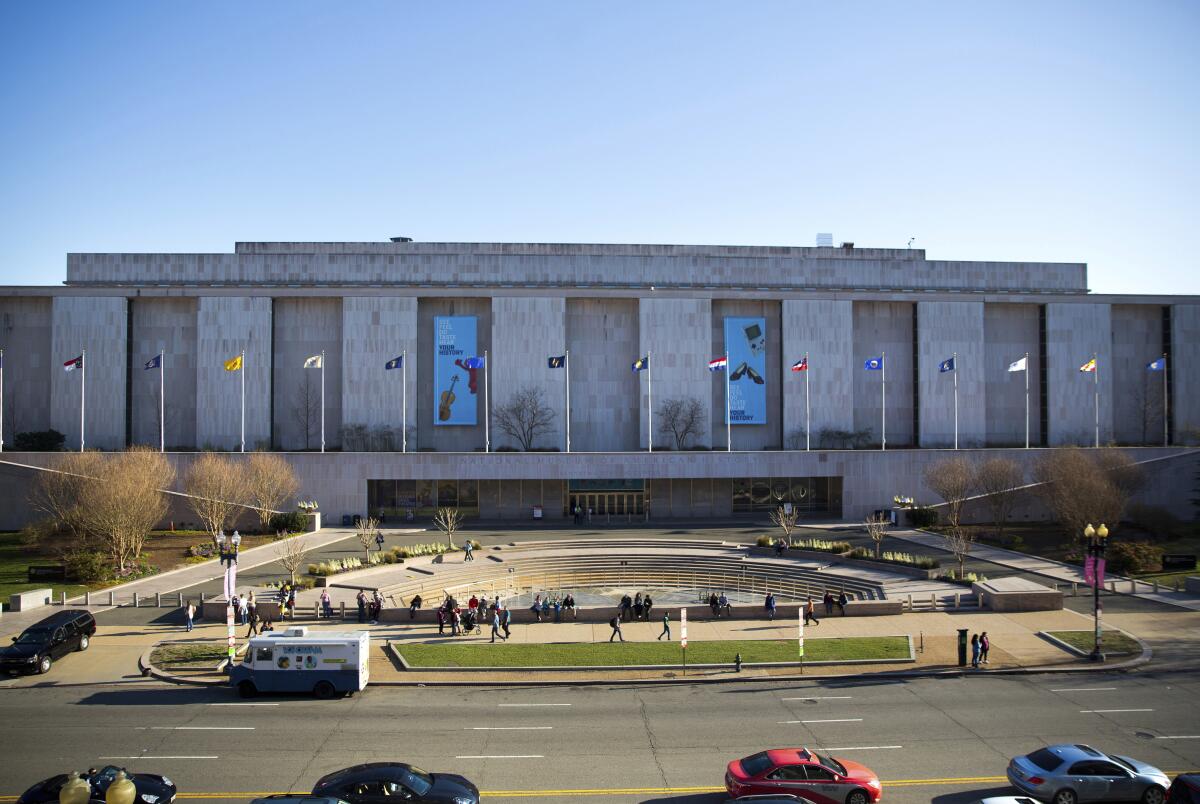
People visit the Smithsonian Museum of American History on the National Mall in Washington, April 3, 2019.

People visit the Smithsonian Museum of American History on the National Mall in Washington.

(Pablo Martinez Monsivais / Associated Press)

Immediately, Manning and Millward knew where they would focus.

They sent emails to people they knew, and reached out to neighborhood listservs, asking if anyone wanted to help document the displays at the 21 museums that make up the Smithsonian Institution — including the American History Museum and the Natural History Museum — the National Zoo and the United States Holocaust Memorial Museum.

Within about two weeks, they had 600 volunteers. Before long, the group had grown to over 1,600, Manning said, more people than they could assign galleries and exhibitions to.

“A lot of people feel upset and kind of paralyzed by these repeated assaults on our shared resources and our shared institutions,” Manning said, “and they’re really not sure what to do about it.”

With the help of all the volunteers, and a grad student, Jessica Dickenson Goodman, who had the computer skills to help archive their submissions, the Citizen Historians project now has an archive of over 50,000 photos and videos covering all of the sites. They finished the work Oct. 12, which was when the museums closed because of the government shutdown.

After several media outlets reported on the order to remove the photo of the whipped slave from the Fort Pulaski National Monument in Georgia — citing internal emails and people familiar with deliberations who spoke on the condition of anonymity because they were not authorized to comment publicly — administration officials described the reports as “misinformation” but declined to specify which part was incorrect.

A National Parks Service spokesperson did not respond to requests for comment for this story.

But the possibility that the administration is considering removing the Scourged Back photo is precisely what has prompted Manning, and so many others, to dedicate their time to preserving the historical record.

“I think we need the story that wrong sometimes exists and it is possible to do something about it,” Manning said.

The man in the photo escaped, joined the Union army, and became part of the fight to abolish slavery in the United States. If a powerful image like that disappears from public display, “we rob ourselves of the reminder that it’s possible to do something about the things that are wrong.”

Source link

NYC mayoral election: Candidates, polls, results and what’s at stake | Elections News

On Tuesday, voters in the largest city of the United States, New York, will choose a new mayor in a race that has stirred debate across the country and drawn global interest.

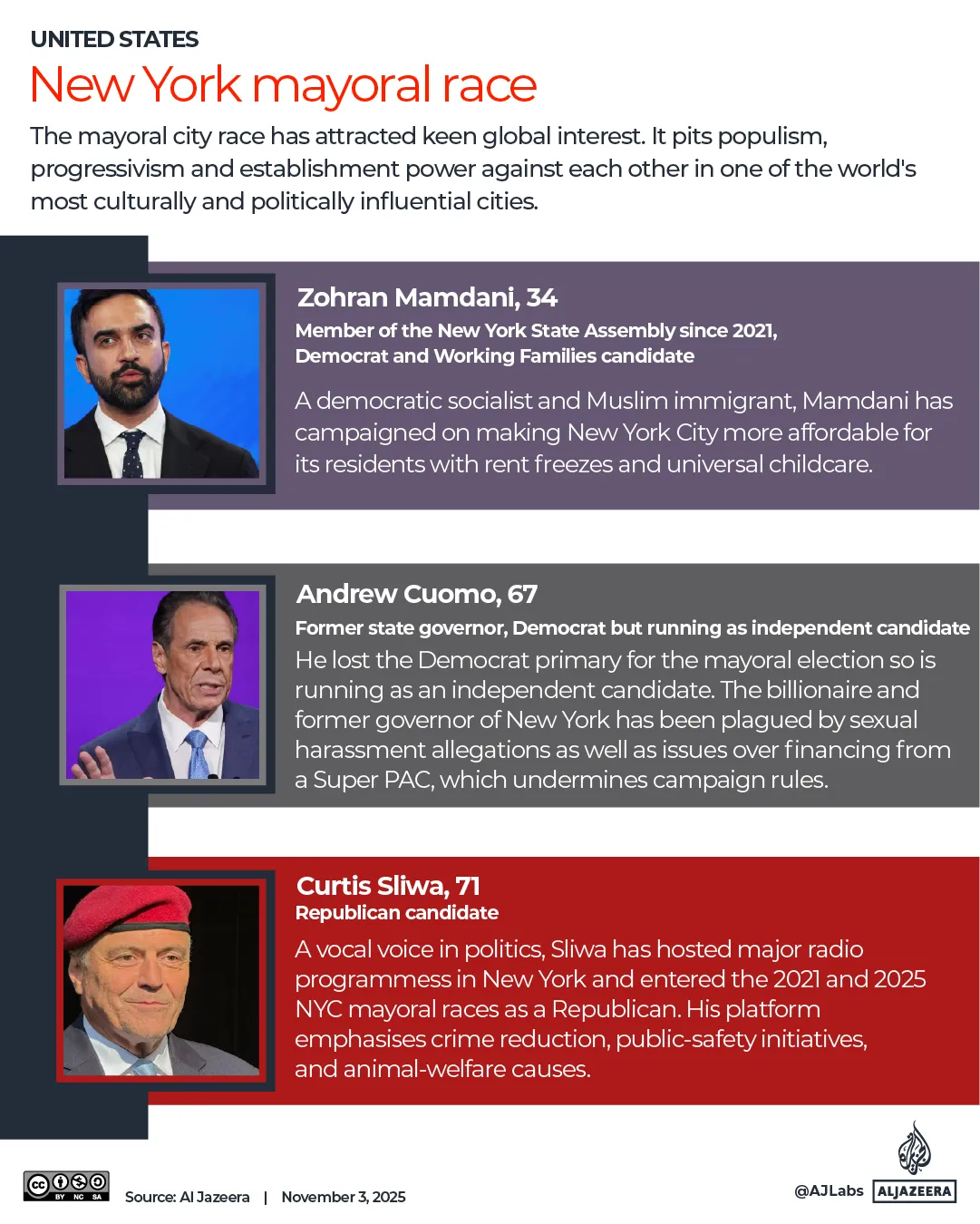
Zohran Mamdani, a 34-year-old state assembly democratic socialist who surprised many with his June win in the Democratic Party’s primary, is facing former Governor Andrew Cuomo, now running as an independent after losing the Democratic nomination. Republican Curtis Sliwa is among the other candidates in the race.

Recommended Stories

list of 2 itemsend of list

Here is what we know:

What’s happening on Tuesday?

Voters on both coasts of the US will cast ballots in a series of elections: gubernatorial contests in New Jersey and Virginia, the New York City mayoral race, and a vote in California on a redistricting measure.

But of these electoral battles, it is the New York mayoral vote that has grabbed the most attention .

Who are the candidates in NYC?

The three leading candidates are Zohran Mamdani, Andrew Cuomo, and Curtis Sliwa.

Zohran Mamdani

The Democratic nominee is running on a platform focused on affordability, calling for rent freezes, universal childcare, cheaper public transport, and a raise in the hourly minimum wage to $30. An immigrant, Muslim, and democratic socialist, his popularity has surged during the campaign, with nearly 370,000 early ballots already cast, and appealing strongly to young voters.

Mamdani, whose parents have Indian roots, was born in Uganda. If elected, he will be the city’s first Muslim mayor, the first to be born in Africa, and the first of South Asian descent.

Andrew Cuomo

Cuomo served as New York state’s governor from 2011 to 2021 and resigned after a state inquiry confirmed sexual harassment allegations by 13 women. He lost the Democratic primary to Mamdani (56 percent to 44 percent), but stayed in the race as an independent.

Curtis Sliwa

At 71, Sliwa has resisted pressure to withdraw from the race amid concerns he could split the anti-Mamdani vote. Known for his trademark red beret, he rose to prominence as the leader of the Guardian Angels, a volunteer crime-fighting group that became famous for its patrols of the New York subway system.

INTERACTIVE-NY-ELECTION-CANDIDATES-1762192064

Who is leading in the polls?

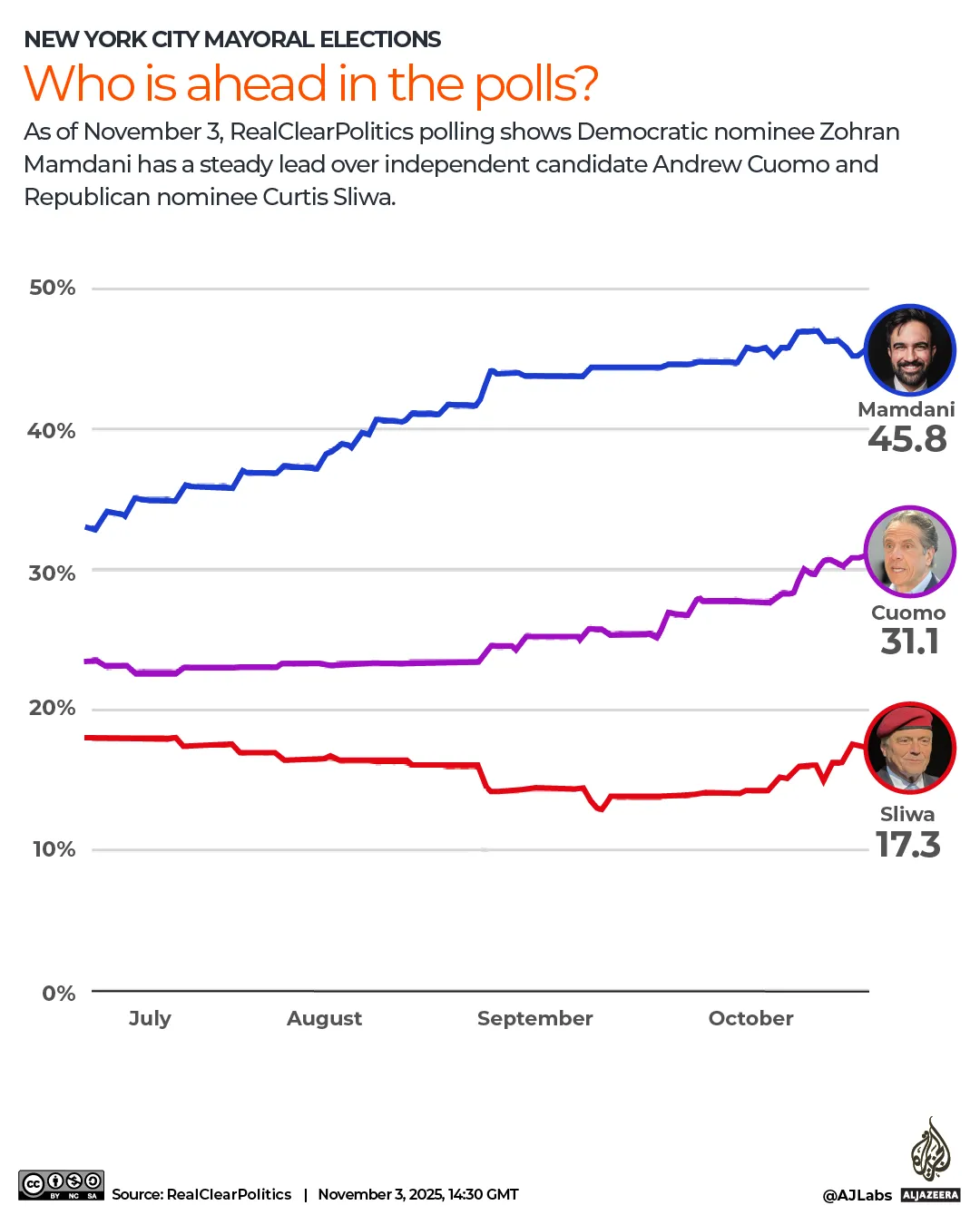
The latest RealClearPolitics average shows Democratic nominee Mamdani leading the mayoral race with 46.1 percent , giving him a 14.3-point edge over Cuomo (31.8 percent ) and a 29.8-point lead over Sliwa (16.3 percent ).

US President Donald Trump and businessman Elon Musk backed Cuomo late on Monday. Whether that high-profile, last-minute support will shift voter sentiment remains uncertain.

INTERACTIVE New York City mayor poll Mamdani Cuomo-1762244224

What time do polls open and close in New York?

Polling stations across the city will open on November 4 at 6am local time (11:00 GMT) and voting will continue till 9pm (02:00 GMT on November 5).

Early voting took place from October 25 to November 2.

When will we know results?

In New York, mayoral races are usually called quickly.

This time, however, with two candidates vying for the support of the city’s mostly Democratic voters, it may take longer to determine the outcome.

The 2021 mayoral race ended quickly – Democrat Eric Adams was declared the winner soon after the polls closed.

Interactive_NYC_Mayor_Oct30_2025-VOTING

What are the main issues and what’s at stake?

Being the US’s most diverse city, known around the world for its business and culture, makes picking a new mayor an especially important occasion.

New York’s election campaigns have mirrored the bigger national debates in the US, over identity, religion, political beliefs, and the country’s future.

Some of the key issues include:

Cost of living: The city is facing one of its tightest housing markets in decades. In 2023 the city had a vacancy rate of 1.41 percent , which means that only 14 out of every 1,000 housing units were unoccupied; 9.2 percent of all rental housing was described by city authorities as “overcrowded”. The number of new housing permits issued fell in 2024 compared with 2023.

This has made housing cost and availability a dominant issue. After a slate of California cities, New York is the costliest urban hub in the US to live in.

“Most of us are working multiple jobs, can’t make rent or rents are going up,” Tom Grabher, a city voter, told Al Jazeera.

Law and order: Serious crimes in the city, including murder, have gone down from their 17-year high in 2023. However, lower-level offences, such as shoplifting, remain higher than before the COVID-19 pandemic, adding to public worries about safety and disorder.

Migration: The city has long been a magnet for people from around the world, from its historic role as a gateway for immigrants to the recent influx of asylum seekers that critics say has placed new strains on the city’s resources.

Israel and Gaza: The ongoing Israel-Gaza conflict and the city’s large Jewish and Muslim populations have made foreign policy a key issue in this race.

What has Trump said about the race?

A former New Yorker, Trump has loomed over the mayoral race for months, threatening to arrest Mamdani, deport him, and take control of the city if he wins.

On Monday, Trump urged the city’s voters on his Truth Social platform to back Cuomo, saying they had “no choice” but to vote for the former governor.

When the federal government shut down in October, Trump put on hold roughly $18bn in federal funds, although $187m from New York’s security funding has since been restored. Trump has threatened to withhold more federal aid for the city if Mamdani wins.

What other elections are taking place?

Virginia governor

All eyes are on Virginia, a state next to Washington, DC, that has been directly affected by Trump’s spending cuts and the recent government shutdown.

Democrat Abigail Spanberger is facing off against Republican Lieutenant-Governor Winsome Earle-Sears.

New Jersey governor

In New Jersey, the governor’s race has centred on concerns about affordability. Although Democrats hold a voter advantage, Republicans are optimistic that Trump’s rising popularity in the state could lead to a surprise win. Democratic Congresswoman Mikie Sherrill is up against Republican Jack Ciattarelli , a former state assemblyman.

California

In California, a proposed ballot measure would redraw congressional districts in a way that could benefit Democrats in the 2026 midterm elections. Governor Gavin Newsom and state lawmakers say they introduced the plan in response to Trump’s earlier push for Texas to reshape its districts to give Republicans an advantage in five seats currently held by Democrats. If approved, the measure would effectively eliminate five Republican-held districts in California.

Source link

‘Making history’: Mamdani to voters on election eve as Trump backs Cuomo | Elections News

New York City – For Zohran Mamdani, it starts and ends in Astoria, the Queens neighbourhood he has represented as a state assemblyman for five years, and where he made his first public address following a shock victory in the June Democratic primary for mayor.

On Monday, the 34-year-old made his final appearance before Tuesday’s election day, standing at a playground at dusk, with children laughing in the background.

Recommended Stories

list of 3 itemsend of list

His message to his army of volunteers, which the campaign has said is made up of more than 100,000: “Leave everything out there on the field”.

“These are the hands that have brought us to this point of making history in this city”, he said, “making history to show that when you focus and fight for working people, you can, in fact, remake the politics of the place that you call home”.

While US President Donald Trump may have gained from deep disquiet over an affordability crisis in the country to win the 2024 presidential vote, Mamdani has argued that it is he and his mayoral campaign that can actually address those challenges in the biggest city of the United States.

NEW YORK, NEW YORK - NOVEMBER 03: Supporters of New York Mayoral Candidate Zohran Mamdani attend a campaign event at Dutch Kills Playground on November 03, 2025 in the Astoria neighborhood of the Queens borough in New York City. On the eve of Election Day, Mamdani was joined by elected officials as he spoke during a volunteer canvass launch in Astoria. Mamdani, who leads in the polls and is the front runner in the mayoral election, is running against Independent New York City mayoral candidate Andrew Cuomo and Republican mayoral candidate Curtis Sliwa. More than 735,000 people have voted early, according to the Board of Elections, more than four times as many as in the 2021 contest. Michael M. Santiago/Getty Images/AFP (Photo by Michael M. Santiago / GETTY IMAGES NORTH AMERICA / Getty Images via AFP)
Tasnuva Khan in Astoria, Queens [Michael MSantiago/AFP]

Indeed, Trump loomed large on Monday as Mamdani stood before a cadre of cheering canvassers, some clad in the campaign’s ubiquitous yellow beanies, and an equally large horde of local, national and international media.

Just hours earlier, the US president had explicitly endorsed former Governor Andrew Cuomo, saying New Yorkers must choose the “bad democrat” over the “communist”, a false label he has repeatedly applied to democratic socialist Mamdani.

Soon after, billionaire Elon Musk also threw his support behind Cuomo, a Democrat who is running as an independent after losing to Mamdani in the Democratic Party’s primary.

The most recent polls showed Mamdani maintaining a commanding, if shrinking, lead over Cuomo. The late endorsements for the former governor, who has explicitly called on conservatives to jump ship from Republican candidate Curtis Sliwa and support him instead, could also further destabilise an already volatile race.

Still, Mamdani’s supporters on Monday said they hoped their candidate’s speech will be a coda on a campaign that has been widely considered as a rebuke to the entrenched, donor-dominated Democratic establishment that Cuomo is seen to represent.

“I feel amazing right now,” said Tasnuva Khan, who was among the canvassers on Monday, adding that the race had revealed both the power of Muslim voters and the city’s fast-growing Bangladeshi community.

Mamdani would be the first Muslim, first person of South Asian descent, and the first person born in Africa to lead the city, if he wins.

“But I’m trying to stay balanced. What wins elections are votes. As long as we kind of stay focused and reach out to our community members, keep canvassing, knocking on doors, then I think we can definitely deliver,” she told Al Jazeera.

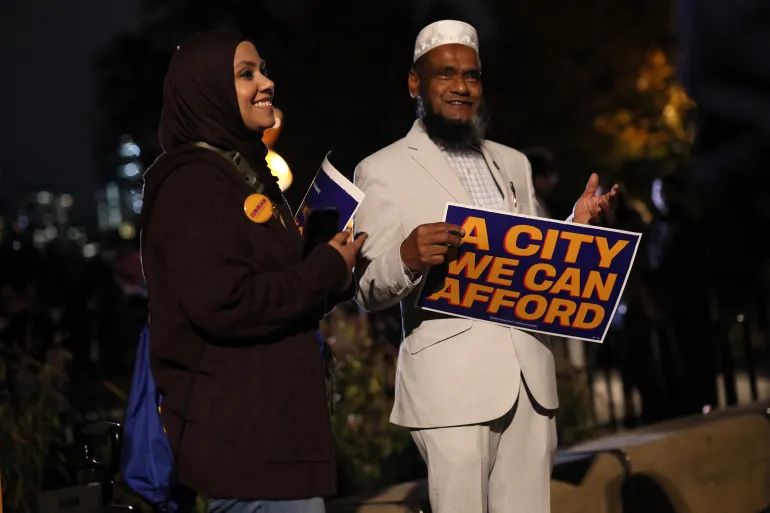
Attendees hold signs that read "vote for Zohran" at a campaign rally held by Democratic candidate for New York City mayor, Zohran Mamdani, on the eve of election day, in the Queens borough of New York City, U.S., November 3, 2025. REUTERS/Shannon Stapleton
Attendees hold signs that read, ‘Vote for Zohran’, in Astoria, Queens [Reuters]

But Shabnam Salehezadehi, a dentist from Long Island City, Queens, and a Mamdani supporter, said she feared the mayoral candidate’s real challenges would begin after the election.

Winning is just the bare minimum, she noted, but for Mamdani to enact many of his sweeping pledges – free buses, universal childcare, rent freezes for a large portion of city apartments, paid for by increasing taxes on corporations and the wealthy – he must win buy-in from a coalition of both state and city lawmakers.

“I’m really anxious – not so much whether he’ll win or not,” said Salehezadehi, who added she was first drawn to Mamdani for his staunch support of Palestinian rights, a break from the traditional Democratic mainstream.

“I just really hope we have the mandate to show that Zohran Mamdani is the candidate the city vehemently voted for,” she said.

Election day looms

Cuomo also spent the final day of the race cutting across the city, visiting the Bronx, Manhattan and Brooklyn.

In the Fordham neighbourhood of the Bronx, a community representative of some of the minority-dominated working-class areas Cuomo carried in the primary, the former governor stood on a park bench overlooking nearby street vendors.

He decried the “socialist city” New York would become if Mamdani were to win.

“Socialism did not work in Venezuela. Socialism did not work in Cuba. Socialism will not work in New York City,” he said, in what has become a mantra in the final days of the race.

At a subsequent stop in Washington Heights, Manhattan, he replied to a question about the nod from Trump, which comes as Cuomo has already faced scrutiny for sharing many of the same billionaire donors as the Republican president.

“He called me a bad Democrat. First of all, I happen to be a good Democrat and a proud Democrat, and I’m going to stay a proud Democrat. Mamdani is not a communist,” Cuomo said. “He’s a socialist. But we don’t need a socialist mayor either.”

Former New York Governor Andrew Cuomo, independent candidate for New York City mayor, makes a campaign stop in the Washington Heights neighborhood in the Manhattan borough of New York City on November 3, 2025.
Former New York Governor Andrew Cuomo is seen at a campaign stop in the Washington Heights neighbourhood in Manhattan, New York City [AFP]

But for Gwendolyn Paige, a 69-year-old special educator from the Bronx, the “socialist label” is not what’s deterring her from voting for Mamdani.

Instead, she pointed to the Cuomo legacy. Cuomo’s father, Mario Cuomo, had also served as governor of the state. The younger Cuomo left his post in 2021 amid sexual misconduct allegations.

“Cuomo is the only person who will stand up to the Trump administration,” Paige told Al Jazeera from the Fordham neighbourhood, even as she dismissed Trump’s endorsement.

“Listen, tomorrow, Trump will say something else,” she said. “So, I don’t put much stock in it”.

At least 735,000 voters have already cast their ballots in early voting, just a portion of the 4.7 million registered voters in the city.

Polls will be open from 6am to 9pm on Tuesday (11:00 GMT, Tuesday to 02:00 GMT, Wednesday), with a winner expected to emerge in the hours after. The victor will take office in January.

With just hours until election day, some votes are still up for grabs.

Lisa Gonzalez, a retired Army veteran, pointed to dire times for low-income residents of the US, including restrictions on food assistance benefits (SNAP) included in a bill passed by Trump and Republicans earlier this year.

Trump has further threatened to cut federal funding for New York City and deploy the National Guard if Mamdani is elected.

“I’m still deciding. The stakes feel really high,” she said. “So I’m just gonna be very careful tomorrow when I vote”.

Source link

US airports hit by major delays from record-breaking government shutdown | Aviation News

Absences surge among US air traffic controllers, who have been working for more than a month without pay.

Airports across the United States are experiencing major delays and cancellations due to an uptick in absences from air traffic controllers, who are under “immense stress and fatigue” from the ongoing, record-breaking US government shutdown, according to the Federal Aviation Administration (FAA).

More than 16,700 US flights were delayed and another 2,282 were cancelled over the weekend from Friday to Sunday, according to FlightAware, a US website that provides real-time flight tracking.

Recommended Stories

list of 4 itemsend of list

The delays continued into Monday evening in the US, as FlightAware counted more than 4,000 delays and 600 cancellations across major airports, like Chicago O’Hare, Dallas Fort Worth, Denver and Newark.

The FAA said on X that half of its “Core 30” facilities at major US airports were experiencing staffing shortages due to the shutdown, with absences at New York-area airports hitting 80 percent.

Air traffic controllers, who number nearly 13,000 across the US, are classified as “essential workers”, which means they have been working without pay since the shutdown began on October 1.

But the FAA said that there had been a surge in absences, which had forced it to reduce the flow of air traffic in the US to maintain safety standards.

“The shutdown must end so that these controllers receive the pay they’ve earned and travellers can avoid further disruptions and delays,” the FAA said on X on Friday. “When staffing shortages occur, the FAA will reduce the flow of air traffic to maintain safety. This may result in delays or cancellations.”

US Secretary of Transportation Sean Duffy told CBS News’s Face the Nation programme on Sunday that the delays will continue to maintain airline safety.

“We work overtime to make sure the system is safe. And we will slow traffic down, you’ll see delays, we’ll have flights cancelled to make sure the system is safe,” Duffy said, according to a transcript of the programme.

Duffy said that although air traffic controllers were using their absences to work second jobs elsewhere, they would not be fired. “When they’re making decisions to feed their families, I’m not going to fire air traffic controllers,” he said.

The government shutdown is due to enter its 35th day on Tuesday in the US, when it will tie with the 2018-2019 shutdown as the longest in US history.

At least 670,000 civilian federal employees have been furloughed due to the shutdown, while about 730,000 are working without pay, according to the Washington, DC-based Bipartisan Policy Center.


Source link

Trial starts in assault case against D.C. man who tossed sandwich at federal agent

Throwing a sandwich at a federal agent turned Sean Charles Dunn into a symbol of resistance against President Trump’s law-enforcement surge in the nation’s capital. This week, federal prosecutors are trying to persuade a jury of fellow Washington, D.C., residents that Dunn simply broke the law.

That could be a tough sell for the government in a city that has chafed against Trump’s federal takeover, which is entering its third month. A grand jury refused to indict Dunn on a felony assault count before U.S. Atty. Jeanine Pirro’s office opted to charge him instead with a misdemeanor.

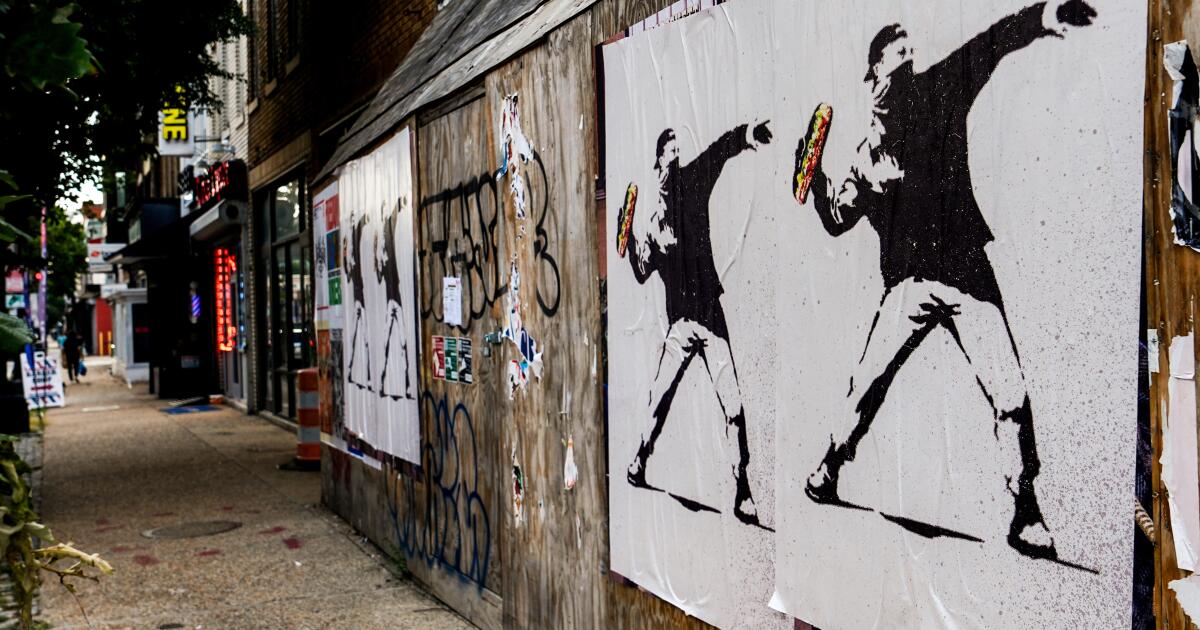
Securing a trial conviction could prove to be equally challenging for Justice Department prosecutors in Washington, where murals glorifying Dunn’s sandwich toss popped up virtually overnight.

Before jury selection started Monday, the judge presiding over Dunn’s trial seemed to acknowledge how unusual it is for a case like this to be heard in federal court. U.S. District Judge Carl Nichols, who was nominated to the bench by Trump, said he expects the trial to last no more than two days “because it’s the simplest case in the world.”

A video that went viral on social media captured Dunn hurling his subway-style sandwich at a Customs and Border Protection agent outside a nightclub on the night of Aug. 10. That same weekend, Trump announced his deployment of hundreds of National Guard troops and federal agents to assist with police patrols in Washington.

When Dunn approached a group of CBP agents who were in front of the club, which was hosting a “Latin Night,” he called them “fascists” and “racists” and chanted “shame” toward them. An observer’s video captured Dunn throwing a sandwich at an agent’s chest.

“Why are you here? I don’t want you in my city!” Dunn shouted, according to police.

Dunn ran away but was apprehended. He was released from custody but rearrested when a team of armed federal agents in riot gear raided his home. The White House posted a highly produced “propaganda” video of the raid on its official X account, Dunn’s lawyers said. They noted that Dunn had offered to surrender to police before the raid.

Dunn worked as an international affairs specialist in the Justice Department’s criminal division. After Dunn’s arrest, U.S. Atty. Gen. Pam Bondi announced his firing in a social media post that referred to him as “an example of the Deep State.”

Before trial, Dunn’s lawyers urged the judge to dismiss the case for what they allege is a vindictive and selective prosecution. They argued that the posts by Bondi and the White House prove Dunn was impermissibly targeted for his political speech.

Julia Gatto, one of Dunn’s lawyers, questioned why Trump’s Justice Department is prosecuting Dunn after the Republican president issued pardons and ordered the dismissal of assault cases stemming from a mob’s attack on the U.S. Capitol on Jan. 6, 2021.

“It’s an obvious answer,” Gatto said during a hearing last Thursday. “The answer is they have different politics. And that’s selective prosecution.”

Prosecutors countered that Dunn’s political expressions don’t make him immune from prosecution for assaulting the agent.

“The defendant is being prosecuted for the obvious reason that he was recorded throwing a sandwich at a federal officer at point-blank range,” they wrote.

Dunn is charged with assaulting, resisting, opposing, impeding, intimidating and interfering with a federal officer. Dozens of Trump supporters who stormed the Capitol were convicted of felonies for assaulting or interfering with police during the Jan. 6 attack. Trump pardoned or ordered the dismissal of charges for all of them.

Kunzelman writes for the Associated Press.

Source link

U.S. Senate convenes on 34th day of shutdown

Nov. 3 (UPI) — The U.S. Senate reconvened Monday afternoon for a possible funding bill as the federal government shutdown moved one day closer to a record 35 days, set in 2019 during President Donald Trump‘s first term.

There have been 13 unsuccessful procedural votes on a House-passed continuing resolution, which would fund the government through Nov. 21.

The Senate convened at 3 p.m. after last meeting on Thursday. The House hasn’t been in session since Sept. 19. The government shut down on Oct. 1.

Senate Majority Leader John Thune told reporters Monday that he is “optimistic” but not necessarily “confident” senators from both parties will reach a deal to reopen the government this week.

“Based on sort of my gut of how things operate, I think we’re getting close to an off-ramp. But this is unlike any other government shutdown in terms of the way Democrats reacted to it,” he said.

Thune hopes to have an agreement this week because the Senate is scheduled to be in recess next week for Veterans Day.

“There were a lot of conversations over the weekend and hopefully that will bring about the desired result,” Thine said. “But you know, if we don’t start seeing some progress or some evidence of that by at least the middle of this week, it’s hard to see how we would finish anything by the end of the week. And I think that would be the objective here, to try and get something that we could send back to the House that would open up the government.”

Thune said he is agreeable to extending the resolution until January.

Speaker Mike Johnson said Monday that GOP leaders are discussing ways to deal with the expiration date of the continuing resolution that passed the House 217-212 on Sept. 19.

The House only needs a majority to pass legislation.

In the Senate, they have failed to reach the required 60 votes. The Republicans have a 53-47 advantage.

Trump has called for Senate Republicans to “get rid of the filibuster” to allow them to pass the stopgap funding bill with a simple majority. The so-called “nuclear option” would eliminate the need for the 60-vote supermajority typically required to pass legislation in the upper chamber.

Thune said he’s against invoking the nuclear option for fear Democrats would use it as a precedent and take advantage of it when they control the Senate in the future.

In fact, he said Monday that there’s not enough support among his colleagues on scrapping the filibuster.

“The votes aren’t there,” Thune told reporters.

The Trump administration opposes negotiating with Democrats on healthcare until the government reopens. The Democrats don’t want to approve any funding bill until subsidies for the Affordable Care Act, known as Obamacare, are extended into next year.

“Our position has been very clear,” one White House official told CNN. “The clean CR [continuing resolution] needs to be passed, and then there’s room for talks after that.”

The White House is calling it a “Democratic shutdown” on its website and social media.

A bipartisan quartet of House lawmakers released a “statement of principles” Monday for an extension of Obamacare subsidies for two years and an income cap for eligibility, Politico reported. It was by Republican Reps. Don Bacon of Nebraska and Jeff Hurd of Colorado, and Democratic Reps. Tom Suozzi of New York and Josh Gottheimer of New Jersey.

House Minority Leader Hakeem Jeffries of New York said lawmakers have been on a “taxpayer-funded vacation” instead of negotiating and Trump was at his home in Florida, including hosting a $1 million-per-play campaign fundraising dinner.

“What’s Donald Trump been doing this weekend? He was on the golf course, spitting in the face of the American people with his inaction and his indifference,” Jeffries said.

Only essential personnel are working and without pay. That includes air traffic controllers. Flights have been delayed at airports throughout the nation. At last 670,000 federal employees have been furloughed and roughly 730,000 working without pay. In past shutdowns, workers off the job received back pay.

“There is a level of risk that gets injected into the system when we have a controller that’s doing two jobs instead of one,” Transportation Secretary Sean Duffy said Sunday on ABC News’ This Week. “We will delay, we will cancel, any kind of flight across the national airspace to make sure people are safe.”

Flights are being spaced out to handle the diminished staff.

From Friday morning until Sunday night, 98 Federal Aviation Administration facilities reported a “staffing trigger” in which air traffic controllers had to alter operations to keep the airspace safe.

FlightAware reported 5,890 total delays involving U.S. airports on Sunday. The delays aren’t only related to air traffic control issues.

Source link

Government shutdown could become longest ever as Trump says he ‘won’t be extorted’ by Democrats

The government shutdown is poised to become the longest ever this week as the impasse between Democrats and Republicans has dragged into a new month. Millions of people stand to lose food aid benefits, health care subsidies are set to expire and there are few real talks between the parties over how to end it.

President Trump said in an interview aired on Sunday that he “won’t be extorted” by Democrats who are demanding negotiations to extend the expiring Affordable Care Act subsidies. Echoing congressional Republicans, the president said on CBS’ “60 Minutes” he’ll negotiate only when the government is reopened.

Trump said Democrats “have lost their way” and predicted they’ll capitulate to Republicans.

“I think they have to,” Trump said. “And if they don’t vote, it’s their problem.”

Trump’s comments signal the shutdown could drag on for some time as federal workers, including air traffic controllers, are set to miss additional paychecks and there’s uncertainty over whether 42 million Americans who receive federal food aid will be able to access the assistance. Senate Democrats have voted 13 times against reopening the government, insisting they need Trump and Republicans to negotiate with them first.

The president also reiterated his pleas to Republican leaders to change Senate rules and scrap the filibuster. Senate Republicans have repeatedly rejected that idea since Trump’s first term, arguing the rule requiring 60 votes to overcome any objections in the Senate is vital to the institution and has allowed them to stop Democratic policies when they’re in the minority.

Trump said that’s true, but “we’re here right now.”

“Republicans have to get tougher,” Trump told CBS. “If we end the filibuster, we can do exactly what we want.”

With the two parties at a standstill, the shutdown, now in its 34th day and approaching its sixth week, appears likely to become the longest in history. The previous record was set in 2019, when Trump demanded Congress give him money for a U.S.-Mexico border wall.

A potentially decisive week

Trump’s push on the filibuster could prove a distraction for Senate Majority Leader John Thune, R-S.D., and Republican senators who’ve opted instead to stay the course as the consequences of the shutdown become more acute.

Republicans are hoping at least some Democrats will eventually switch their votes as moderates have been in weekslong talks with rank-and-file Republicans about potential compromises that could guarantee votes on health care in exchange for reopening the government. Republicans need five additional Democrats to pass their bill.

“We need five with a backbone to say we care more about the lives of the American people than about gaining some political leverage,” Thune said on the Senate floor as the Senate left Washington for the weekend on Thursday.

Virginia Sen. Tim Kaine, a Democrat, said on ABC’s “This Week” on Sunday there’s a group of people talking about ”a path to fix the health care debacle” and a commitment from Republicans not to fire more federal workers. But it’s unclear if those talks could produce a meaningful compromise.

Far apart on Obamacare subsidies

Trump said in the “60 Minutes” interview that the Affordable Care Act — often known as Obamacare because it was signed and championed by then-President Barack Obama — is “terrible” and if the Democrats vote to reopen the government, “we will work on fixing the bad health care that we have right now.”

Democrats feel differently, arguing that the marketplaces set up by the ACA are working as record numbers of Americans have signed up for the coverage. But they want to extend subsidies first enacted during the COVID-19 pandemic so premiums won’t go up for millions of people on Jan. 1.

Senate Democratic leader Chuck Schumer said last week that “we want to sit down with Thune, with (House Speaker Mike) Johnson, with Trump, and negotiate a way to address this horrible health care crisis.”

No appetite for bipartisanship

As Democrats have pushed Trump and Republicans to negotiate, Trump has showed little interest in doing so. He called for an end to the Senate filibuster after a trip to Asia while the government was shut down.

White House spokeswoman Karoline Leavitt said on Fox News Channel’s “Sunday Morning Futures” that the president has spoken directly to Thune and Johnson about the filibuster. But a spokesman for Thune said Friday that his position hasn’t changed, and Johnson said Sunday that he believes the filibuster has traditionally been a “safeguard” from far-left policies.

Trump said on “60 Minutes” that he likes Thune but “I disagree with him on this point.”

The president has spent much of the shutdown mocking Democrats, posting videos of House Democratic leader Hakeem Jeffries in a Mexican sombrero. The White House website is now featuring a satirical “My Space” page for Democrats, a parody based on the social media site that was popular in the early 2000s. “We just love playing politics with people’s livelihoods,” the page reads.

Democrats have repeatedly said that they need Trump to get serious and weigh in. Virginia Sen. Mark Warner said that he hopes the shutdown could end “this week” because Trump is back in Washington.

Republicans “can’t move on anything without a Trump sign off,” Warner said on “Face the Nation” on CBS.

Record-breaking shutdown

The 35-day shutdown that lasted from December 2018 to January 2019 ended when Trump retreated from his demands over a border wall. That came amid intensifying delays at the nation’s airports and multiple missed paydays for hundreds of thousands of federal workers.

Transportation Secretary Sean Duffy said on ABC’s “This Week” that there have already been delays at several airports “and it’s only going to get worse.”

Many of the workers are “confronted with a decision,” he said. “Do I put food on my kids’ table, do I put gas in the car, do I pay my rent or do I go to work and not get paid?”

As flight delays around the country increased, New York City’s emergency management department posted on Sunday that Newark Airport was under a ground delay because of “staffing shortages in the control tower” and that they were limiting arrivals to the airport.

“The average delay is about 2 hours, and some flights are more than 3 hours late,” the account posted.

SNAP crisis

Also in the crossfire are the 42 million Americans who receive SNAP benefits. The Department of Agriculture planned to withhold $8 billion needed for payments to the food program starting on Saturday until two federal judges ordered the administration to fund it.

Treasury Secretary Scott Bessent said on CNN Sunday that the administration continues to await additional direction from the courts.

“The best way for SNAP benefits to get paid is for Democrats — for five Democrats to cross the aisle and reopen the government,” Bessent said.

House Democratic leader Jeffries, D-N.Y., accused Trump and Republicans of attempting to “weaponize hunger.” He said that the administration has managed to find ways for funding other priorities during the shutdown, but is slow-walking pushing out SNAP benefits despite the court orders.

“But somehow they can’t find money to make sure that Americans don’t go hungry,” Jeffries said in an appearance on CNN’s “State of the Union.”

Jalonick writes for the Associated Press. AP writer Aamer Madhani contributed to this report.

Source link

Two men accused of plotting terror attacks at LGBTQ+ bars in the Detroit area

Two men who had acquired high-powered weapons and practiced at gun ranges were scouting LGBTQ+ bars in suburban Detroit for a possible attack, authorities said Monday in filing terrorism-related charges against the pair.

Momed Ali, Majed Mahmoud and co-conspirators were inspired by Islamic State extremism, according to a 72-page criminal complaint unsealed in federal court. Investigators say a minor, identified only as Person 1, was deeply involved in the discussions.

“Our American heroes prevented a terror attack,” U.S. Atty. Gen. Pam Bondi said on X.

The men, described as too young to drink alcohol, had looked at LGBTQ+ bars in Ferndale as a possible attack, according to the complaint.

FBI agents had surveilled the men for weeks, even using a camera on a pole outside a Dearborn house, according to the court filing. Investigators also got access to encrypted chats and other conversations.

FBI Director Kash Patel had announced arrests Friday, but no details were released at the time while agents searched a home in Dearborn and a storage unit in nearby Inkster.

The FBI said the men repeatedly referred to “pumpkins” in their conversations, a reference to a Halloween attack.

Ali and Mahmoud were charged with receiving and transferring guns and ammunition for terrorism. Mahmoud had recently bought more than 1,600 rounds of ammunition that could be used for AR-15-style rifles, and they practiced at gun ranges, the government alleged.

They will appear in court Monday for their initial appearance. Mahmoud’s lawyer, William Swor, declined to comment. Messages seeking comment from Ali’s lawyer, Amir Makled, were not immediately answered.

Over the weekend, Makled seemed to wave off the allegations, saying they were the result of “hysteria” and “fear-mongering.”

It’s the second case since May involving alleged plots in the Detroit area on behalf of the Islamic State. The FBI said it arrested a man who had spent months planning an attack against a U.S. Army site in Warren. Ammar Said has pleaded not guilty and remains in custody.

White writes for the Associated Press.

Source link

Disney asks YouTube TV to restore ABC for election coverage

Millions of YouTube TV subscribers could miss “Monday Night Football” on ESPN and ABC News’ election day coverage as the blackout of Walt Disney-owned channels stretches into a second week.

“Monday Night Football” features the Dallas Cowboys battling the Arizona Cardinals. In addition, several important political contests are on Tuesday ballots, including the New York City mayor’s election, gubernatorial races in Virginia and New Jersey, and California’s Prop. 50 to decide whether officials can redraw the state’s congressional map to favor Democrats.

Disney on Monday sought a temporary thaw in tensions with Google Inc. after the two sides failed last week to strike a new distribution contract covering Disney’s television channels on Google’s YouTube TV.

“Despite the impasse that led to the current blackout, we have asked YouTube TV to restore ABC for Election Day so subscribers have access to the information they rely on,” a Disney spokesperson said in a statement Monday. “We believe in putting the public interest first and hope YouTube TV will take this small step for their customers while we continue to work toward a fair agreement.”

A Google spokesperson was not immediately available for a comment.

ABC’s “World News Tonight With David Muir” is one of television’s highest rated programs.

More than 10 million YouTube TV customers lost access to ESPN, ABC and other Disney channels late Thursday after a collapse in negotiations over distribution fees for Disney channels, causing one of the largest recent blackouts in the television industry.

The two TV giants wrangled for weeks over how much Google must pay to carry Disney’s channels, including FX, Disney Jr. and National Geographic. YouTube TV — now one of the largest pay-TV services in the U.S. — has balked at Disney’s price demands, leading to the outage.

YouTube TV does not have the legal right to distribute Disney’s networks after its last distribution agreement expired.

“We know this is a frustrating and disappointing outcome for our subscribers,” a YouTube spokesperson said in a statement last week. “We continue to urge Disney to work with us constructively to reach a fair agreement that restores their networks to YouTube TV.”

YouTube has said that should the outage stretch for “an extended period,” it would offer its subscribers a $20 credit.

Spanish-language TelevisaUnivision-owned channels were knocked off YouTube TV in a separate dispute that has lasted more than a month. Televisa has appealed to high-level political officials, including President Trump and Federal Communications Commission Chairman Brendan Carr.

Last year, after Disney-owned channels went dark on DirecTV in a separate carriage fee dispute, Disney offered to make available to DirecTV subscribers its ABC coverage of the sole presidential debate between President Trump and then-Vice President Kamala Harris.

DirecTV viewed ABC’s offer as something of a stunt, noting the debate would be streamed. DirecTV countered by asking Disney to instead make all of its channels available.

That fee dispute resulted in a 13-day blackout on DirecTV, one that was resolved a few days later.

Heightened tensions in the television industry have led to numerous blackouts.

In 2023, Disney and Charter Communications were unable to iron out a new contract by their deadline, resulting in a 10-day blackout of Disney channels on Charter’s Spectrum service. A decade earlier, Time Warner Cable subscribers went nearly a month without CBS-owned channels.

Programming companies, including Disney, have asked for higher fees for their channels to help offset the increased cost of sports programming, including NFL and NBA contracts. But pay-TV providers, including YouTube have pushed back, attempting to draw a line to slow their customers’ ever-increasing monthly bills.

More than 40 million pay-TV customer homes have cut the cord over the last decade, according to industry data. Many have switched to smaller streaming packages. YouTube TV also benefited by attracting disaffected customers from DirecTV, Charter Spectrum and Comcast. YouTube TV is now the nation’s third-largest TV channel distributor.

Source link

What the latest polls are showing in the Mamdani vs Cuomo NYC mayoral race | Elections News

The most recent polls place Mamdani 14.7 points ahead of Cuomo, according to a RealClearPolitics poll average.

New York City’s mayoral race is entering its final stretch, with early voting now ended and residents among some five million registered voters set to cast their ballots on November 4 to choose the city’s next leader.

According to the New York City Board of Elections, 734,317 early votes have been cast over the past nine days – more than quadruple the total for the 2021 mayoral elections.

Recommended Stories

list of 3 itemsend of list

According to the latest RealClearPolitics average, Democratic nominee Zohran Mamdani leads with 45.8 percent, holding a 14.7-point advantage over independent Andrew Cuomo at 31.1 percent and a 28.5-point lead over Republican Curtis Sliwa at 17.3 percent.

INTERACTIVE-NY-MAYORAL-POLLS-NOV3-2025-1762185046

Mamdani, a member of the Democratic Socialists of America (DSA), has energised liberal voters, drawn to his proposals for universal, free childcare, free buses, and a rent freeze for New Yorkers living in about one million rent-regulated apartments.

New York City holds mayoral elections every four years, with a two-term limit for any individual. The current mayor, Democrat Eric Adams, who has been in office since January 2022, withdrew his candidacy earlier in the year following several controversies, most notably his federal criminal indictment on bribery and conspiracy charges, which was ultimately dismissed by a judge in April.

This year’s contest is notable for its three-way dynamic, bringing progressive, establishment and conservative forces to face off in the country’s largest city.

INTERACTIVE-NY-ELECTION-CANDIDATES-1762192064

How accurate are the polls?

The latest polls put Mamdani between three and 25 points ahead of Cuomo, according to a selection of polls from RealClearPolitics.

Every poll carries a degree of uncertainty. While pollsters aim to capture a representative sample and mirror the wider electorate, there are margins of error. As such, actual levels of support fall within a few points of reported figures, with each surveyor using differing wording in issues such as how to treat undecided voters.

Aggregating different results helps to reduce bias.

How does polling work?

Polling organisations, such as Emerson College, Marist College, and Quinnipiac University, regularly conduct public opinion surveys to gauge voter sentiment leading up to the primaries and general election.

Surveys use random sampling, including contacting voters by phone, text, or online, and ask respondents about their candidate preferences, key issues influencing their vote, and approval ratings.

Poll results include margins of error and sample sizes, which aid in interpreting accuracy and the fidelity of findings.

How the voting works

Unlike the primaries, which used ranked choice voting (RCV), the general election uses a first-past-the-post system, so whoever gets the most votes wins.

As of February, there were 5.1 million registered voters in New York City, of whom 65 percent were Democrats and 11 percent were Republicans. About 1.1 million voters were not registered with any party, and voter registration closed on October 25, one week before the November 4 election.

In the last New York City mayoral election, just more than 1.1 million voters cast ballots – about 21 percent of registered voters.

To be eligible to vote, residents of New York must:

  • Be a citizen of the United States
  • Have been a New York City resident for at least 30 days
  • Be at least 18 years old (you may preregister at 16 or 17, but can’t vote until you’re 18)
  • Not be in prison for a felony conviction
  • Not have been judged mentally incompetent by a court
  • Not be registered to vote elsewhere

Interactive_NYC_Mayor_Oct30_2025-VOTING

When do polls open and close?

Polling stations will be open between 6am (11:00 GMT) and 9pm on November 4 (02:00 GMT on November 5).

Timings vary from location to location in the city, but polling stations open between 8am and 10am and close between 4pm and 9pm.

Early voting began on October 25 and ended on November 2.

A full list of polling stations open for early voting is available on the website of the New York City Board of Elections.

Source link

What’s on the ballot in the first general election since Trump retook the White House

One year after Trump retook the White House and set into motion a dramatic expansion of executive power, the Republican president figures prominently in state and local elections being held Tuesday.

The results of those contests — the first general election of Trump’s second term — will be heralded by the victors as either a major repudiation or resounding stamp of approval of his second-term agenda. That’s especially true in high-profile races for Virginia and New Jersey governor, New York City mayor and a California proposition to redraw its congressional district boundaries.

More than half of the states will hold contests on Tuesday. Here’s a look at some of the major statewide and local races on the ballot:

Governors: New Jersey and Virginia

In New Jersey, Democrat Mikie Sherrill and Republican Jack Ciattarelli are the nominees to succeed term-limited Democratic Gov. Phil Murphy. Sherrill is a four-term U.S. representative and former Navy helicopter pilot. Ciattarelli is a former state Assemblyman backed by Trump. In 2021, Ciattarelli came within about 3 percentage points of toppling Murphy.

In Virginia, Republican Lt. Gov. Winsome Earle-Sears and Democratic former U.S. Rep. Abigail Spanberger look to replace term-limited Republican Gov. Glenn Youngkin. While Spanberger has made some efforts to focus on topics other than Trump in stump speeches, the president remained a major topic of conversation throughout the campaign, from comments Earle-Sears made about him in 2022 to some of his more polarizing policies, such as the so-called One Big Beautiful Bill tax and spending cut measure and the widespread dismissal of federal workers, many of whom live in northern Virginia.

Trump was scheduled to participate in telephone rallies for the candidates on Monday night.

As the only gubernatorial races held in the year following a presidential election, the contests have long served as the first major test of voter sentiment toward the party holding the White House. In every race for governor since 1973, one or both states have elected a governor from a party different than that of the sitting president.

New York City Mayor

The race to lead the nation’s largest city features Democratic state legislator Zohran Mamdani, independent candidate and former Democratic Gov. Andrew Cuomo and Republican Curtis Sliwa.

Mamdani’s comfortable victory over Cuomo in the June primary generated excitement from the party’s more progressive wing and apprehension among the party establishment. Party leaders like Gov. Kathy Hochul and U.S. House Democratic leader Hakeem Jeffries eventually endorsed the self-described democratic socialist months after he won the nomination.

The winner will replace outgoing Mayor Eric Adams, who initially sought renomination as a Democrat. After losing the primary Adams opted to run as an independent, but dropped out of the race in September and eventually endorsed Cuomo. In February, the Trump Justice Department asked a court to drop corruption charges against Adams because the case impeded Trump’s “ immigration objectives.” Trump later said he’d like to see both Adams and Sliwa drop out of the race in an effort to defeat Mamdani.

California Proposition 50

California voters will decide a statewide ballot measure that would enact a new congressional map that could flip as many as five Republican-held U.S. House seats to Democratic control.

Proposition 50, championed by Democratic Gov. Gavin Newsom, is in response to a new Texas map that state Republicans enacted in August as part of Trump’s efforts to keep the U.S. House under Republican control in the 2026 midterms. The Texas plan, which could help Republicans flip five Democratic-held U.S. House seats, has sparked an escalating gerrymandering arms race among states to pass new maps outside of the regular once-a-decade schedule.

Pennsylvania Supreme Court

Control of the Pennsylvania Supreme Court will be at stake when voters cast Yes or No votes on whether to retain three justices from the high court’s 5-2 Democratic majority.

Partisan control of the court could have major implications for the 2028 presidential race, since justices might be asked to rule on election disputes, as they did in 2020. Spending on Tuesday’s contests is on track to exceed $15 million as Republicans have campaigned to end the majority and Democrats have responded.

If all three justices are ousted, a deadlock in the confirmation process to replace them could result in a court tied at 2-2. An election to fill any vacant seats for full 10-year terms would be held in 2027.

Other notable contests

VIRGINIA ATTORNEY GENERAL: Republican incumbent Jason Miyares seeks a second term against Democrat Jay Jones. Much of the fall campaign has focused on text messages suggesting violence against political rivals that Jones sent in 2022.

TEXAS-18: Sixteen candidates hope to fill a vacant congressional seat previously held by the late Democratic U.S. Rep. Sylvester Turner.

STATE LEGISLATURES: Control of the Minnesota Senate and Virginia House of Delegates is at stake, while New Jersey Democrats defend their 52-28 General Assembly majority.

BALLOT MEASURES: Maine voters will decide statewide questions on voting and a “red flag” law aimed at preventing gun violence. Texas’ 17 ballot measures include constitutional amendments on parental rights and limiting voting to U.S. citizens. Colorado and Washington also have statewide measures on the ballot.

MAYORS: Detroit, Pittsburgh, Jersey City and Buffalo will elect new mayors, while incumbents in Atlanta, Minneapolis and Cincinnati seek another term.

Yoon writes for the Associated Press.

Source link