WASHINGTON — A Democratic U.S. senator warns the Trump administration is getting ready to round up 500 immigrant children in a hasty effort to remove them from the country, bypassing legal protections. It would be their second attempt after a federal court intervened last year in an overnight plan to fly out hundreds of children on Labor Day weekend.
Sen. Ron Wyden of Oregon wrote in a letter Wednesday to U.S. Health Secretary Robert F. Kennedy Jr., which oversees the Office of Refugee Resettlement caring for unaccompanied migrant children, that he had “credible information” that the Trump administration had a list of more than 500 migrant children it was targeting for a fast-track removal process and that the department was racing to act in days. He warned that the administration was abdicating “core humanitarian and child welfare mandates” and demanded an immediate halt to any plans to remove the children.
Wyden, who is the ranking member and senior Democrat of the Senate Finance Committee, which has jurisdiction over ORR, did not detail how he came by his information. His office declined to provide further details. ORR falls under the Department of Health and Human Services.
An HHS spokesperson denied any such plans.
“The new information I obtained leads me to believe that the Department is laying the groundwork for another lawless deportation effort, this time on a greater scale, across more countries of origin,” Wyden wrote.
“You have been entrusted with the care and safety of the children placed within the ORR network. Proceeding with this plan knowingly endangers their lives and violates your duty to these vulnerable children.”
Wyden also issued an early warning last August ahead of what eventually became a chaotic weekend of efforts by the Trump administration to remove Guatemalan children in its care and send them home.
HHS spokesperson Emily Hilliard said in “there are no plans to target these children,” calling Wyden’s claims ”irresponsible fearmongering.”
“The Trump Administration is working to identify the parents or legal guardians of unaccompanied alien children in our care because ensuring every child is placed with a properly vetted sponsor is our top priority,” she said.
Over the Labor Day weekend, dozens of migrant children either staying in government-supervised shelters or with foster families were taken from their homes and bused to airfields in Texas bound for Guatemala. A federal judge woken up in the middle of the night eventually stopped the planes. Lawyers for the children — many who had fled violence at home to come to the U.S. — later described how traumatic the middle-of-the-night removal effort was for them.
The administration insisted it was reuniting the Guatemalan children — at the Central American nation’s request — with parents or guardians who sought their return. Lawyers for at least some of the children said that wasn’t true and argued that in any event, authorities still would have to follow a legal process that they did not.
Migrant children traveling alone are usually entrusted to U.S. government care, and there are various legal protections designed to protect them once they’re in the U.S. and navigating the immigration system.
The Trafficking Victims Protection Reauthorization Act of 2008 is one of the key pieces of legislation designed to protect them. With some limited exceptions, it requires that children be placed in the “least restrictive setting possible,” which generally means that they can be released to a sponsor such as a relative in the U.S. while their immigration proceedings play out.
The children can apply for a specially protected status if they can’t return to their home country because of abuse or neglect and they can also apply for asylum.
The Trump administration has made it increasingly difficult for those children to be released to sponsors though. The administration says that they are doing due diligence to make sure that sponsors are thoroughly vetted and that in the past, children were released into dangerous situations.
But advocates say that the result has been children lingering for months in government shelters.
This time, Wyden said the children at risk of being removed come from various countries, potentially including Guatemala, Honduras, El Salvador, and Afghanistan, and have been in U.S. custody — mainly in foster care — for at least 180 days. He said they were described as not having any “viable sponsor” who could come forward and take care of them in the U.S.
Not having an identified sponsor could mean the child’s parents are in their home countries, are deceased or are too afraid to claim their children after ICE started arresting some parents who are not in the country legally during their reunification efforts.
Gonzalez and Santana write for the Associated Press.
The United States Supreme Court has sided with the maker of Roundup weedkiller in a ruling expected to block thousands of lawsuits alleging it failed to warn people the product could cause cancer.
The ruling on Thursday was tied to a case that came before the justices after a tidal wave of litigation that included some multibillion-dollar verdicts against the global agrochemical manufacturer Bayer, a Germany-based company that acquired Roundup when it bought its original producer Monsanto in 2018.
Recommended Stories
list of 4 itemsend of list
The decision is a victory for US President Donald Trump’s administration, but one that could be tricky politically since allies in the “Make America Healthy Again” movement want to rein in pesticide use.
The high court, in a 7-2 ruling, found that the company cannot face failure-to-warn lawsuits in state courts because federal regulations have found a cancer link unlikely and do not require a warning label.
The justices overturned a jury verdict in Missouri awarding $1.25m to a man named John Durnell who said he was diagnosed with non-Hodgkin lymphoma after years of exposure to glyphosate in Roundup. The Supreme Court agreed with Bayer that a US law that governs pesticides precludes failure-to-warn claims that are brought under state law from moving forward in court.
Bayer shares jumped nearly 18 percent following the ruling.
Trump’s administration had backed Bayer in the case.
Conservative Justice Brett Kavanaugh, who authored the ruling, said the US Environmental Protection Agency, or EPA, has concluded glyphosate does not cause cancer and has not required a cancer warning on Roundup.
The law preempts Durnell’s claim because it “would require Monsanto to add a cancer warning to Roundup’s label even though federal law requires Monsanto to use the EPA-approved label without a cancer warning”, Kavanaugh wrote.
Liberal Justice Ketanji Brown Jackson, in a dissent joined by conservative Justice Neil Gorsuch, said that Durnell’s claim would impose equivalent labelling requirements on Monsanto that the federal law requires and so should not be preempted.
Jackson called the ruling “remarkable and regrettable, for it unjustifiably closes the courthouse doors to state tort plaintiffs like Durnell”.
Bayer acquired Roundup as part of its $63bn purchase of agrochemical company Monsanto in 2018. More than 100,000 plaintiffs have filed cases in US state and federal courts alleging a cancer link, and the German drugmaking and crop science company had said that the lawsuits could threaten its ability to supply the herbicide to farmers.
The torrent of litigation already prompted Bayer to remove glyphosate from its consumer version of Roundup. Bayer said before the Supreme Court ruled that a decision in its favour could largely end the Roundup litigation.
“The US Supreme Court decision is good for science, farmers, and industries that depend on regulatory clarity for innovation. It should help significantly contain the Roundup litigation after nearly a decade of legal battles. The ruling should result in the dismissal of current warning-based claims and bar future failure-to-warn claims,” Bayer spokesperson Tino Andresen said in a statement.
The company emphasised throughout the litigation that the EPA repeatedly found that glyphosate does not cause cancer and approved its product labels without a warning.
Facing billions of dollars in potential liability, Bayer announced in February a proposed $7.25bn settlement to resolve tens of thousands of current and future lawsuits. The settlement would not affect claims that stem from pending appeals or that fall outside the deal, according to the company. Those amount to nearly $1bn, it said.
‘Disaster for public health’
Environmental activists and others criticised the court’s ruling on Thursday.
“Once again, the Supreme Court has sided with big business over people and the environment. Today’s ruling is a disaster for public health,” said Tarah Heinzen, legal director at the advocacy group Food and Water Watch.
“The harm from this decision will perpetuate our cancer, infertility and general chronic disease epidemic for generations to come,” said Kelly Ryerson, co-executive director of advocacy group American Regeneration and a Make America Healthy Again activist who posts on social media under the moniker “The Glyphosate Girl”.
The sprawling dispute centres on a US law called the Federal Insecticide, Fungicide and Rodenticide Act, or FIFRA, that governs the sale and labelling of pesticides and bars states from imposing differing or additional requirements.
The measure prohibits pesticides that are “misbranded” with labels that lack an adequate warning to protect health and the environment.
Bayer has argued that Durnell’s claims are preempted by this law. The EPA has repeatedly approved labels without such a cancer warning, demonstrating that these products are not misbranded, the company said, adding that labels cannot be substantially changed without the agency’s approval.
Durnell’s lawyers said that despite the EPA’s registration of Roundup, the label may still be challenged as misbranded. They also said Durnell’s claims are not preempted because Missouri state law that requires products to adequately warn of dangers imposes the same requirements as FIFRA’s prohibition on misbranding.
‘A new era’
Union Investment fund manager Markus Manns called Thursday’s ruling a significant milestone for Bayer, adding that a decade after the Monsanto acquisition, the company is “entering a new era”.
“While future lawsuits are not entirely off the table, they will become considerably more difficult. A final breakthrough would come if the settlement is accepted by the plaintiffs and approved by the competent court in July. This would bring Bayer’s glyphosate litigation chapter to a definitive close, allowing management to fully refocus on operational and strategic matters,” Manns said.
Durnell sued Monsanto in Missouri state court in 2019, claiming it failed to warn users of the dangers associated with Roundup and glyphosate.
He was diagnosed with a rare and often aggressive form of non-Hodgkin lymphoma, a cancer that starts in the white blood cells, and attributed the disease to his exposure to Roundup starting in 1996. For about 20 years, he was the “spray guy” for a neighborhood association in St Louis, killing weeds at local parks without protective equipment, according to court papers.
A jury sided with Durnell in 2023, and in 2025, a state appeals court upheld that verdict.
WASHINGTON — Senate Republicans who were berated by President Trump over opposition to his war in Iran held a late-night vote Wednesday to try to appease him, rejecting a war powers resolution a day after a similar measure passed.
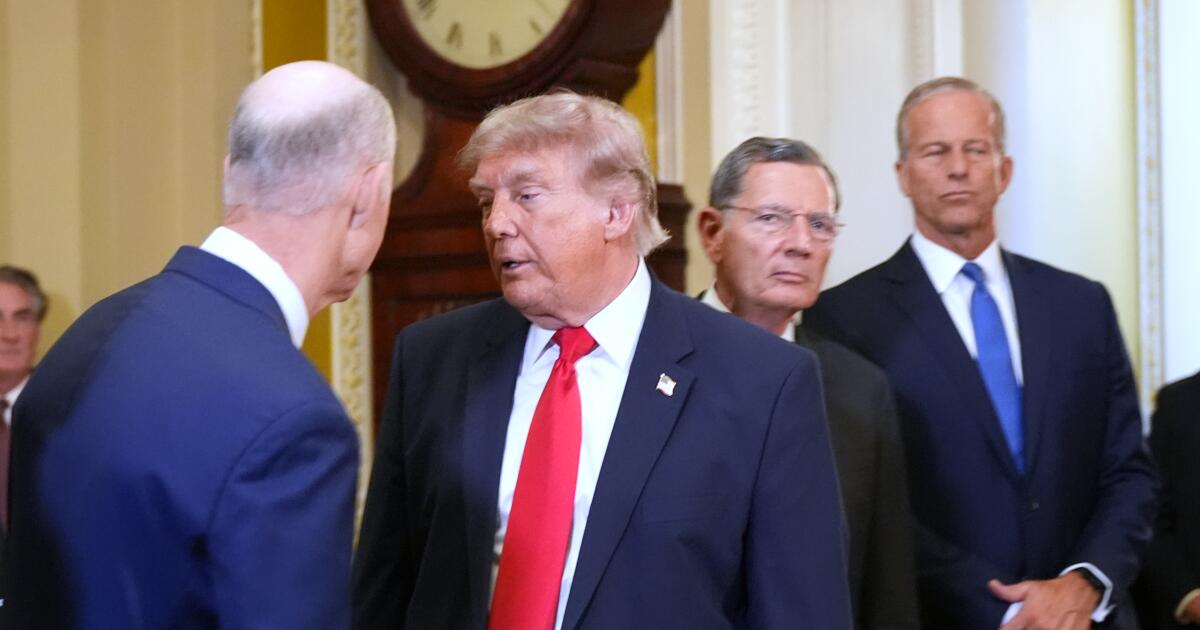
Trump harangued GOP senators face to face earlier in the day for allowing a vote to block his war in Iran on Tuesday, further escalating a feud that has diverted GOP efforts to focus on election-year affordability issues and brought much of the chamber’s business to a halt. He exchanged particularly harsh words with Louisiana Sen. Bill Cassidy, one of four Republicans who had voted with Democrats on the measure.
Hours later, though, Cassidy was invited to receive a personal briefing on the war at the White House from Vice President JD Vance and envoy Steve Witkoff. Cassidy then returned to the Capitol to vote against a separate but nearly identical war powers resolution.
“I want to thank Vice President Vance and Special Envoy Witkoff for the thorough briefing this afternoon on Iran. I appreciate the quick invitation to the White House to address many of my concerns,” said Cassidy, who lost reelection last month after Trump endorsed his opponent, in a post on X.
Kentucky Sen. Rand Paul, a Republican who has repeatedly voted with Democrats to halt the war, voted present this time “to give the President more space and leverage to negotiate a lasting peace,” he said on X. The measure failed 47-50-1 just before midnight on Wednesday, and the Senate then left town for a two-week recess.
It’s unclear whether the move will be enough to appease Trump, who had called the Republicans “losers” for voting against his war and had called Cassidy a “lunatic” at the lunch after their tense exchange. But the vote was a clear signal to the president from Republican senators who still want to placate him, despite increasing tensions in recent weeks and his decision Wednesday morning to reverse himself and delay signing a housing bill that received overwhelming bipartisan support.
Senate Majority Leader John Thune, R-S.D., and a small group of his Senate GOP colleagues called Trump after the vote. Thune told reporters that the president was “pleased with the outcome.”
Trump later thanked Thune in a social media post and noted that Cassidy and Paul had switched their votes. “This vote puts Iran on notice!” he wrote.
The war powers measure blocked by the Senate on Wednesday was on a separate track from the nearly identical resolution adopted on Tuesday, which had also been passed by the House. Both votes were largely symbolic, and the measures do not carry the full force of law.
Cassidy had sharp words for Trump
Invited by Florida Sen. Rick Scott to speak at a GOP luncheon in the Capitol, Trump had signaled ahead of time that he would use the closed-door meeting to push senators to pass his proof-of-citizenship voting bill. But the conversation was more focused on Tuesday’s vote on war powers.
Most Republicans stayed quiet. But Cassidy stood up and defended his vote.
“I stood and said, ‘You have not told the American people what’s going on,’” Cassidy told reporters after the meeting. “This was supposed to last four weeks, it’s lasted four months. Our original objectives have not been achieved.”
The two men “went back and forth,” Cassidy said, and he “matched his tone and volume.” Cassidy said that he eventually de-escalated, but he did not want to be bullied.
“I am voting for war powers until I get a briefing,” he said afterward.
Trump repeatedly told Cassidy to sit down, according to a person familiar with the private meeting who was not authorized to discuss it. At one point, the president called the senator a “lunatic.”
Publicly, Trump said afterward that they had “a really great meeting.” But he hinted at the discord.
“We like everyone in the room,” Trump told reporters on his way out. “I don’t like a few people, but that’s OK.”
The luncheon capped weeks of friction between Trump and Senate Republicans and added a new layer of frustration as Tuesday’s vote was the first time the Senate had adopted a war powers resolution on the Iran war. Trump made clear he was in no mood to compromise before it even started, calling off a scheduled signing ceremony on a housing bill that passed both chambers overwhelmingly this week and that GOP lawmakers were touting as an election-year achievement.
Trump reverses on housing bill
Republican senators were eager for a conciliatory meeting with the president after escalating tensions in recent weeks. But Trump upended their plans when he declared on social media just beforehand that he wouldn’t sign the legislation until they send him the SAVE America Act, his bill to require proof of citizenship for all voters.
North Carolina Sen. Thom Tillis said he doesn’t know why Trump is holding the housing bill “hostage” for the voting bill that “will never pass in this Congress.”
“It makes no sense to me,” Tillis said as he walked into the luncheon.
Thune said the housing legislation, which aims to lower costs, is “an affordability issue,” and that ”eventually I hope he finds a way to sign it.”
It’s unclear if Trump might veto the legislation or if the late Wednesday night vote will change his outlook. But by rejecting a public bill signing, Republicans worry that Trump is indicating a level of indifference to voters’ affordability concerns heading into November’s midterm elections.
Trump and Senate Republicans have been at odds
Trump’s move on the housing bill is his latest reversal after weeks of being at odds with Senate Republicans.
Trump has blocked the Senate from confirming one of his own nominees, asked them to fund parts of his White House ballroom project despite opposition and forced them to defend the Iran war even as they question the strategy and endgame.
Trump has also helped whittle down his own support in the Senate after endorsing primary challengers to two GOP incumbents who were previously reliable votes for his agenda — Cassidy and Texas Sen. John Cornyn. Both men have become more critical of Trump since losing reelection.
“If we’re going to win the midterm elections, we need to get on the same page,” Cornyn said ahead of the meeting. “We’re not on the same page now, and that I think is dangerous.”
Trump pushes Thune on SAVE America Act
Trump has pressed Republicans for months to kill the Senate filibuster and focus on the proof-of-citizenship voting bill, even though Thune has repeatedly told him that neither has the votes.
While Thune remains popular in his conference and cordial with the president, he has spent much of his time lately telling Trump what he doesn’t want to hear. Thune said Tuesday that while Trump and some in their conference want to see the voting bill pass, “it’s just not realistic.”
Thune devoted weeks of floor time to the voting bill earlier this year and has said he supports it. But he has repeatedly said there aren’t enough votes to scrap the filibuster that triggers a 60-vote threshold to pass most bills in the 53-47 Senate. And Democrats are uniformly opposed to the bill.
“I think people at some point have to come to grips with that,” Thune said.
Jalonick, Sloan, Cappelletti and Mascaro write for the Associated Press. AP writers Josh Boak and Kevin Freking contributed to this report.
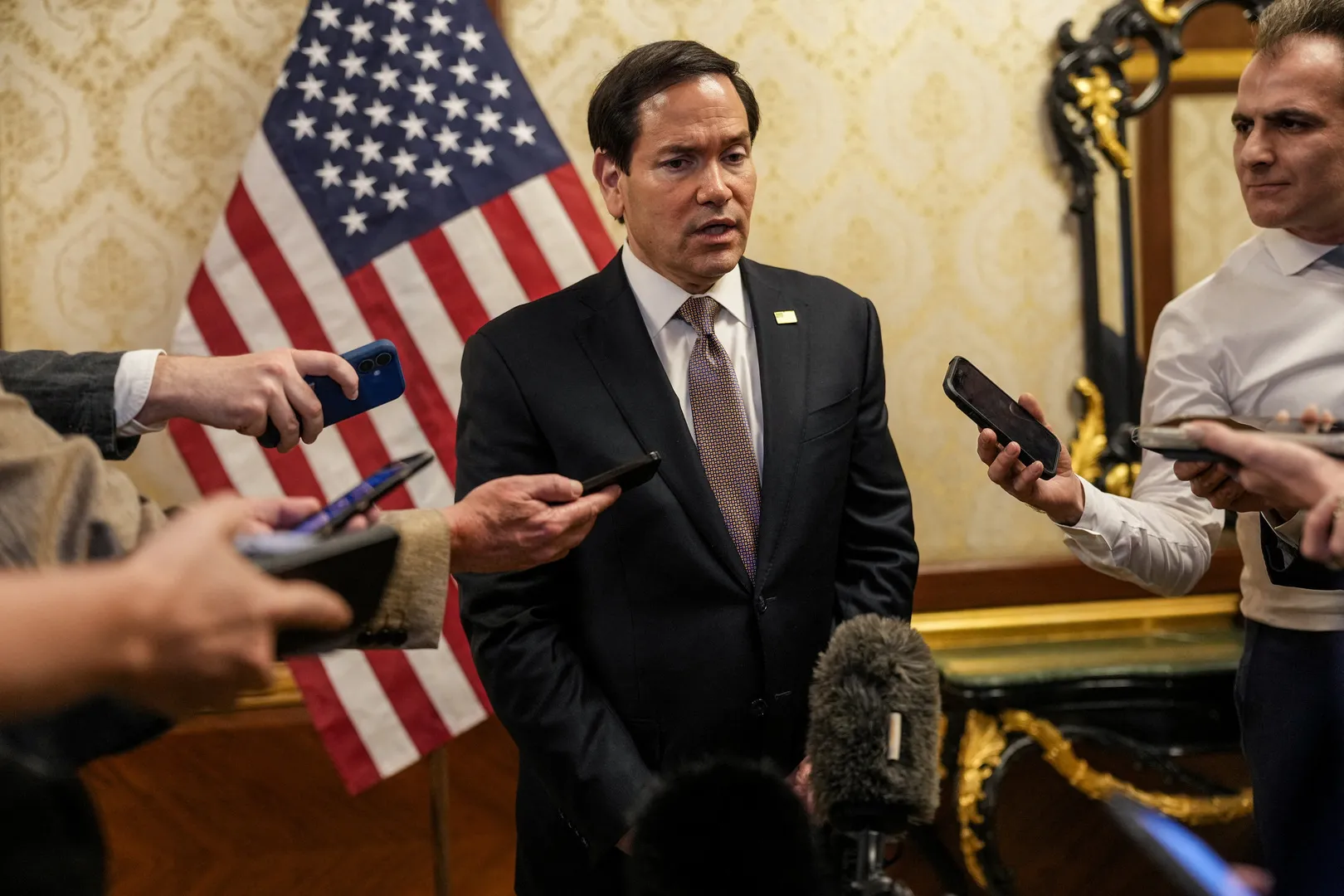
US Secretary of State Marco Rubio said all Gulf countries oppose a toll in the Strait of Hormuz during a tour of the region following US-Iran talks. Rubio added, “There isn’t a nation on Earth that supports having to pay money to go through the straits”.
WASHINGTON — The Supreme Court sided with the maker of the Roundup weedkiller Thursday in a ruling expected to block thousands of lawsuits alleging it failed to warn people the product could cause cancer.
The case came before the justices after a tidal wave of litigation that included some multibillion-dollar verdicts against the global agrochemical manufacturer Bayer, which acquired Roundup when it bought its original manufacturer Monsanto in 2018.
The decision is a victory for the Trump administration, but one that could be tricky politically since allies in the Make America Healthy Again movement want to rein in pesticide use.
The high court, in a 7-2 ruling, found that the company can’t be sued in state courts because federal regulations have found a cancer link unlikely and do not require a warning label.
The decision “is good for science, farmers, and industries that depend on regulatory clarity for innovation,” Bayer said in a statement. “It should help significantly contain the Roundup litigation after nearly a decade of legal battles.”
Though Bayer said the ruling should result in the dismissal of pending lawsuits containing failure-to-warn allegations, the company said it plans to proceed with a proposed $7.25 billion class-action settlement intended to resolve many of the remaining claims.
Lawyers for some residents pursuing Roundup litigation criticized the court’s decision.
“This Supreme Court ruling wrongly slams the courthouse door on Americans sickened by pesticides,” said attorney Christopher Seeger, who is proposed as a claimants’ representative in the settlement. But he said a settlement still would allow some people to receive compensation.
The case before the Supreme Court was filed by Missouri resident John Durnell. He developed a cancer called non-Hodgkin’s lymphoma after more than 20 years of serving as the neighborhood association’s “spray guy,” using Roundup on parks in his historic St. Louis community.
A jury agreed that the company failed to warn him about possible cancer dangers and awarded him $1.25 million. It’s one of thousands of similar cases, including some multibillion-dollar damage awards.
There’s still fierce debate about cancer and Roundup’s key ingredient, glyphosate. The World Health Organization’s International Agency for Research on Cancer classified the chemical as “probably carcinogenic” in 2015. The Environmental Protection Agency has determined that it’s not likely to cause cancer in humans when used as directed.
The agency approved a label without a cancer warning, and Bayer argues that it’s required to follow those federal standards — not the state laws that Durnell and others have sued under. The ruling still could allow other suits alleging problems with the way the product was designed, his attorney Ashley Keller has said.
Bayer disputes the cancer claims but previously set aside $16 billion to settle cases, and earlier this year proposed a $7.25 billion class-action settlement. A federal judge recently ruled that the proposed settlement will be heard in a Missouri state court, where many of the lawsuits have been filed. At the same time, the company has tried to persuade states to pass laws shielding it from liability in failure-to-warn lawsuits, and three states have agreed.
About 200,000 Roundup-related claims have been made against Bayer, mostly from home users. It has stopped using glyphosate in Roundup sold in the U.S. residential lawn and garden market.
The company has said it might have to consider pulling glyphosate from U.S. agricultural markets if it keeps getting sued. Agricultural industry group say could have a devastating effect on the food supply.
But pesticides have also created a rift between the Trump administration and members of Health Secretary Robert F. Kennedy’s MAHA movement, adding to their frustration with an executive order aimed at boosting glyphosate’s production.
Kennedy himself has said repeatedly that glyphosate causes cancer, even as he says he recognizes the executive order was necessary for food supply and national security reasons.
Whitehurst writes for the Associated Press. AP writer David A. Lieb in Jefferson City, Mo., contributed to this report.
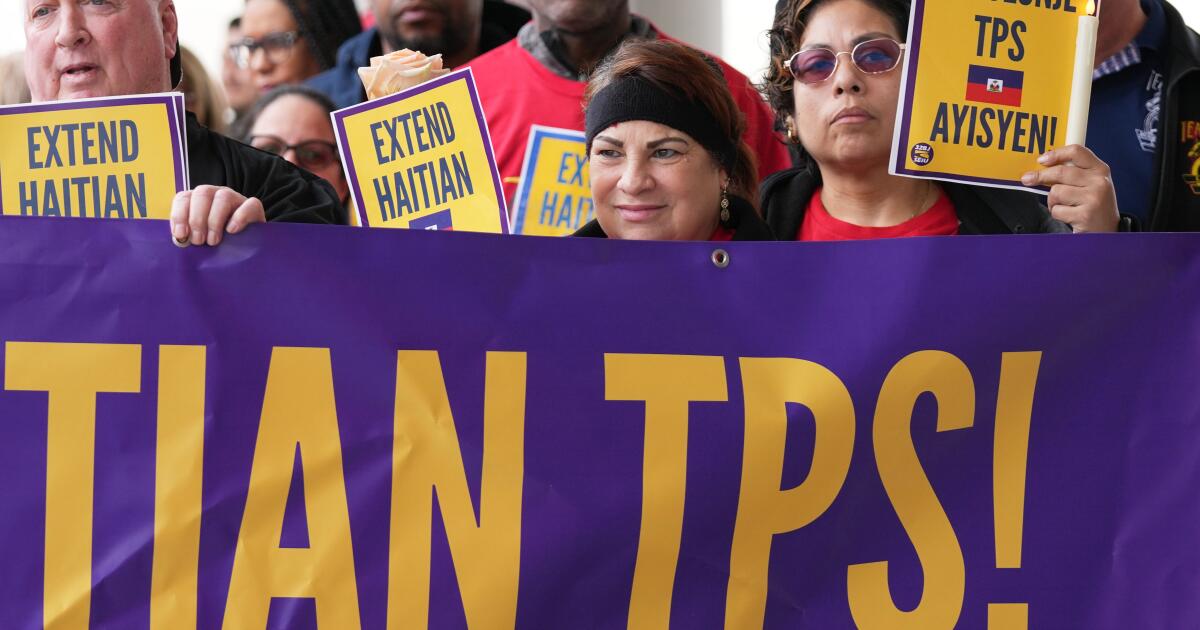
WASHINGTON — The Supreme Court ruled Thursday that the Trump administration may end the Temporary Protected Status granted to more than 350,000 Haitians and Syrians whose home countries remain unsafe.
In a 6-3 decision, the court’s conservative majority said Congress gave the administration, not judges, the power to cancel or renew this temporary protection for non-citizens who are living and working here.
In a second win Thursday for the Trump administration, the court also upheld the administration’s policy of blocking asylum seekers at the southern border.
By the same 6-3 vote, the court said migrants do not have a right to apply for asylum if they are not already in the United States.
The decision on Temporary Protected Status could affect up to 1.3 million non-citizens who are in the country.
In 1990, Congress authorized this emergency humanitarian relief for non-citizens whose home countries were wracked by armed conflict, natural disasters or other extraordinary disruptions.
Under the law, the Department of Homeland Security may grant this protection for 6, 12 or 18 months and either renew or extend it for a similar period.
But this legal authority has been under dispute since Trump returned to the White House last year and targeted the 1.3 million people with TPS from 17 countries who were living in the United States.
Trump’s lawyers said the law made clear there was “no judicial review” of the government’s decision to cancel the grant of temporary protection.
However, immigrant rights lawyers argued the government failed in its duty to consult the State Department and assess whether it was safe for migrants to return home.
Repeatedly, U.S. district judges agreed with the challengers and ruled the administration’s decisions were “arbitrary” and unreasonable. But in nearly every case, the Supreme Court granted emergency appeals from the administration and set aside those orders.
Since TPS was created, the government has ended the protected designation for citizens of 18 countries.
DHS under then-Secretary Kristi Noem ended TPS for Honduras, Nicaragua, Afghanistan and Venezuela. A spokesperson for the agency previously said the Haiti designation became “a de facto amnesty program” and that allowing Syrians to remain is contrary to national interest.
Advocates for the immigrants argue that the administration failed to conduct the required process to properly evaluate each country’s conditions and instead acted on political grounds driven by racial animus.
State Department travel advisories for both countries warn people against traveling to either because of the risk of terrorism, kidnapping and widespread violence. But Federal Register notices announcing the terminations said country conditions had improved enough.
Recently released internal documents show that DHS decided to terminate protections for Haitians without any input from the State Department.
Citing the documents, which were obtained by the National TPS Alliance in a separate lawsuit, lawyers for the Haitians asked the Supreme Court to dismiss the case and send it back to lower courts. They argued that the justices should first consider the communications before issuing a decision.
Internal emails show that homeland security officials sought a recommendation from the State Department in May 2025, ahead of Noem’s early June deadline on whether to extend protections for Haiti. But by the time Noem signed what appears to be a final decision memo, U.S. Citizenship and Immigration Services had not received input from the State Department, the emails show.
“State recommendation for Haiti TPS has not come in despite of many outreach,” a homeland security deputy assistant secretary wrote in a June 2, 2025, email. A recommendation “would be helpful to have,” the person added.
Eleven days later, a USCIS project manager wrote in an email that Noem “recently elected to terminate Haiti without country conditions from DOS.”
USCIS initially recommended automatically extending protections before Homeland Security decided to terminate them, earlier versions of the memo indicate.
The June decision was blocked by a federal judge. In November, DHS issued another notice terminating TPS protections for Haitians.
That time, according a previously publicized email, a homeland security senior counselor asked a State Department official for the agency’s views on the country conditions in Haiti. The official, Spencer Chretien, didn’t address the country conditions but responded that “there would be no foreign policy concerns.”
Lawyers for the Haitians argued that response didn’t meet the legal standard for a sufficient consultation, though the Trump administration disagreed.
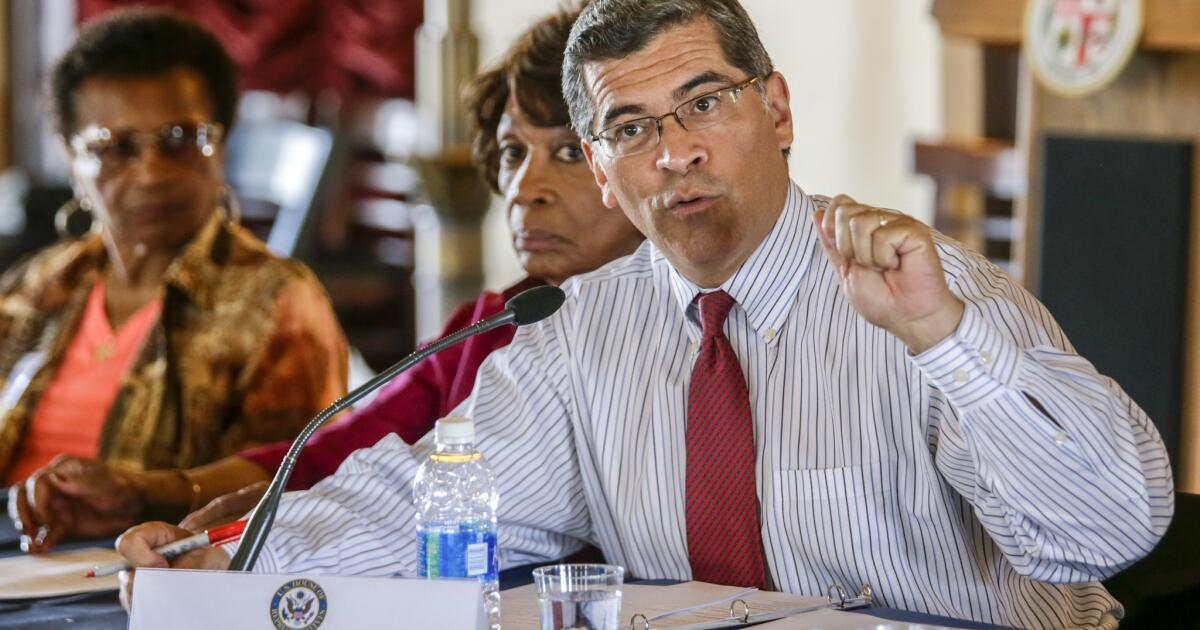
In a move that suggests a sharp battle to come with the administration of President-elect Donald Trump and upends conventional wisdom about who will emerge as the next generation of statewide elected officials, Gov. Jerry Brown picked House Democratic Caucus Chairman Xavier Becerra (D-Los Angeles) on Thursday to be California’s next attorney general.
If confirmed by both houses of the Legislature, he will succeed Kamala Harris, who was elected to the U.S. Senate in November.
Becerra, 58, has served 12 terms in Congress. Just days before the appointment, he had announced a bid to become the ranking Democrat on the powerful House Ways and Means Committee.
“It’s a phenomenal opportunity,” Becerra said. “It means I get to be home a lot more.”
Few statewide offices are as powerful, or prominent, as that of attorney general. The role has often been referred to as the state’s top lawyer and its top law enforcement officer, a nod to the breadth of responsibilities vested in the office and its leadership of the California Department of Justice.
Attorneys general not only must pursue cases of criminal and civil wrongdoing, they oversee criminal forensic work for most counties and make the final choice about defending state laws — even crafting the language that summarizes ballot measures for voters.
Becerra was beaming during an interview in his House office Thursday morning shortly after Brown offered him the job.
“I’m still processing,” Becerra said with a laugh. “I didn’t expect it.”
Becerra would be the state’s first Latino attorney general. The son of Mexican immigrants, he was the first member of his family to attend college, earning a law degree from Stanford Law School and a bachelor’s degree in economics from Stanford University. Elected to a two-year term in the state Assembly and then to the House in 1992, he rose through the ranks to become the highest-ranking Latino in Congress.
Becerra worked in the civil division of the state attorney general’s office, writing advisory opinions for former Gov. George Deukmejian, a Republican, and defending the state’s constitutional officers from 1987 to 1990 before entering the Assembly. He said he had always wanted to return to the office.
“It was a great place to be,” he said.
Brown’s pick was so sudden that Becerra has not yet had time to reactivate his state law license, though he would not be the first attorney general to have to do so. Inactive status allows attorneys to hold on to their licenses when they are not actively practicing law.
Becerra would also be the first attorney general appointed by a governor since Thomas Lynch, who was chosen by former Gov. Pat Brown in 1964. Few political appointments are likely to be as personal to the current governor as this one, given his own four-year stint as attorney general starting in 2006 and the fact that his father used the office as a steppingstone to governor more than five decades ago.
“Xavier has been an outstanding public servant — in the state Legislature, the U.S. Congress and as a deputy attorney general,” Brown said in a statement. “I’m confident he will be a champion for all Californians and help our state aggressively combat climate change.”
The choice sent political shock waves through California, in large part because Becerra was not on any of the widely circulated lists of potential picks. Brown had offered no details on whom he would pick or when.
Many suspected that he might choose a caretaker, perhaps even a career staffer who would simply carry out the office’s functions through the 2018 election. Virtually no Democrats who heard the news on Thursday believed that Becerra would be that kind of officeholder.
“He has the smarts, political experience and ambitions to run and win reelection,” said state Sen. Steve Glazer (D-Orinda), a former top political adviser to Brown.
If Becerra serves less than two years of Harris’ existing term, he could be eligible to run for up to two additional terms — eight years — as attorney general. Harris has said she plans to hold the position until she is sworn in to the Senate on Jan. 3, and at that point Brown could officially nominate Becerra.
Becerra said Thursday he’s thinking about the confirmation process at this point and not whether he’ll run for a full term as attorney general or another office in 2018. He must be confirmed by the state Senate and Assembly, both controlled by Democrats. Becerra said he hasn’t been told when a confirmation vote might happen.
Holding such a prominent statewide post would raise Becerra’s profile as the Golden State’s foil to Trump, potentially setting him up to run for governor or U.S. Senate in the future. The attorney general, by virtue of the office’s broad power, will likely be a key player alongside Brown in pushing back against Trump’s proposed efforts on issues important to California, including immigration and climate change. In Texas, a state that has its own experience fighting the federal government, attorneys general have been a major force in the battle over states’ rights.
“He has great tenacity and he respects the rights of all Californians — much-needed qualities for an attorney general given the troubling times ahead,” Assembly Speaker Anthony Rendon (D-Paramount) said Thursday.
Several congressional colleagues echoed that sentiment.
“Many of the values that we stand by in California will be under attack in the next few years, and Chairman Becerra is the fighter I want in our corner,” Rep. Tony Cardenas (D-Los Angeles) said in a statement.
Becerra said that with Trump headed to the White House, he’s prepared to protect California’s progressive policies on immigration, the Affordable Care Act, energy and criminal justice. As California politicians embrace their roles in guarding the state against Trump’s policies, Becerra threw down his own gauntlet Thursday.
“If you want to take on a forward-leaning state that is prepared to defend its rights and interests, then come at us,” Becerra said.
A vocal advocate for Hillary Clinton’s presidential bid, Becerra was briefly floated as a potential pick for vice president or a Cabinet position. With Clinton’s loss Nov. 8 and no upward mobility available in House leadership, Becerra’s future political career was unclear.
He’d reached the time limit on serving as caucus chairman, the fourth highest-ranking House Democratic leadership position, and with House Minority Leader Nancy Pelosi (D-San Francisco) and the other two Democrats above him in leadership staying put, there was no path up the ladder headed into the next Congress.
Becerra serves on the powerful House Ways and Means Committee, and made a play as recently as Tuesday to be the committee’s ranking Democrat. He was quickly endorsed by the current ranking member, Rep. Sandy Levin (D-Mich.), who said in a statement Thursday that he respects that Becerra “feels a special responsibility during these difficult times to look after vital legal interests in his home state.”
Democrats across California reacted Thursday with effusive praise for Becerra. Lt. Gov. Gavin Newsom called him “a thoughtful and effective leader, with a keen legal mind and a passion for giving a voice to the voiceless.”
In particular, some pointed out the importance of elevating a Latino politician to statewide office, alongside both Latino leaders of the Legislature and Secretary of State Alex Padilla.
“It’s good for the state’s future,” said Bill Lockyer, who served as attorney general from 1999 to 2007.
The announcement also meant early guessing as to who would replace Becerra in representing downtown Los Angeles and communities to the west and north in Congress. Becerra won reelection in November in the solidly Democratic district. A special election to fill the seat would probably take place in late spring of 2017, though the law gives Brown wide discretion on the precise schedule.
John A. Pérez, the former Assembly speaker and current University of California regent, announced his bid less than an hour after Brown’s announcement, and more contenders may follow.
June 25 (UPI) — The U.S. Postal Service plans to refuse delivery of mail-in ballots in states that don’t turn over their voter lists to the federal government, the postmaster general told Congress.
Postmaster General David Steiner told the Homeland Security and Governmental Affairs Committee about the proposed rule on Wednesday.
“Yes or no — if a state refuses to turn their absentee voter list over to the federal government, will the Postal Service still mail their ballots under this proposed rule?” Sen. Gary Peters, D-Mich., asked Steiner.
“Under our proposed regulation, no. We would tell the state that we need the manifest,” Steiner said.
Steiner argued the policy is to make sure ballots are delivered “securely, efficiently, and accurately.” But President Donald Trump has repeatedly demanded states’ voter lists over the past year and has been suing states to get them.
The proposed rule says that states would have to give the Postal Service the names, addresses and ballot barcode numbers for the people who are to get ballots in the mail. The proposal follows Trump’s executive order from March 31 that requires the federal government to compile state citizenship lists and for the Postal Service to refuse to mail ballots to those the federal government has determined are ineligible to vote.
The proposed rule is posted on the Federal Register, and the public can comment until July 2.
Democrats have pushed back, arguing the rule shows that Trump is trying to federalize elections and said the Postal Service doesn’t have the authority to enforce that rule. The Constitution says states are responsible for running elections.
“Just because President Trump wants to do this does not make it law, doesn’t make it right, doesn’t make it constitutional. There is certainly a massive difference between general mail requirements and regulating elections,” Peters said.
Steiner admitted that his agency doesn’t have the authority to enforce elections but said the rule is a precaution to be sure that only eligible voters will get ballots.
“I would think that states would want the information to ensure that the ballots that they think they’re sending out are the ballots that are actually getting sent out,” Steiner said.
Sen. Elissa Slotkin, D-Mich., said the rule is part of a broader strategy.
“The U.S. Postal Service is now part of this bigger story of this president desperate to federalize our elections. He has tried every which way to say that if he and his party don’t win in these November elections, they were rigged.”
Slotkin asked Steiner directly to stop the plan.
“Please push back on being a pawn in this authoritarian playbook,” she said. “The Postal Service is one of the most important institutions in our country. Don’t taint it with the obsession of this one man.”
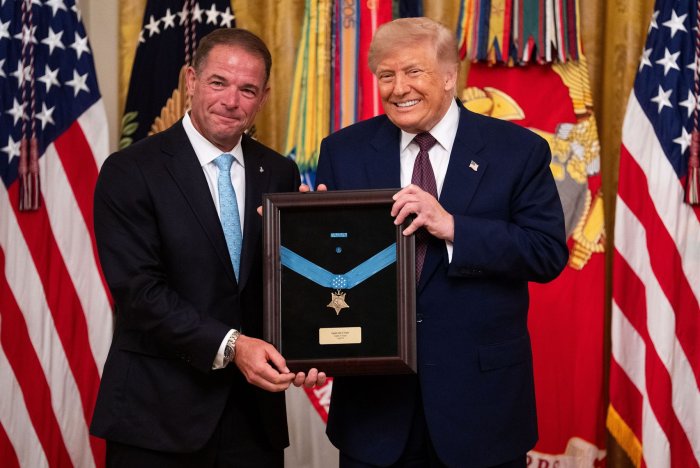
President Donald Trump presents a Medal of Honor to Tom Ripley on behalf of his father, John W. Ripley, during a Medal of Honor award ceremony in the East Room of the White House on Thursday. Photo by Aaron Schwartz/UPI | License Photo
Reporting from Sacramento — Gov.-elect Gavin Newsom on Thursday announced he will place his ownership interest in the collection of wineries, hotels, restaurants and other investments that made him a millionaire into a blind trust, a step he said “goes beyond anything required by law.”
Since his election in November, Newsom has been weighing how to handle his array of assets in the hospitality business, collectively known as the PlumpJack Group, a multimillion-dollar business enterprise that grew from a wine shop he opened in San Francisco in 1992. Those holdings have the potential to create ethical conflicts between Newsom’s job as California’s chief executive and his business interests.
“Governor-elect Gavin Newsom is announcing today that he will be the first governor in the history of California to release his tax returns every year, just as he has done as a candidate,” Newsom’s spokesman Nathan Click said in a statement. “Newsom will also disclose his personal and business holdings each year on his statement of economic interest and separate himself from the PlumpJack Group wine and hospitality businesses that he has built.’’
Bob Stern, coauthor of California’s 1974 Political Reform Act that dictates the state’s conflict-of-interest laws, praised Newsom’s decision.
“That’s as much as anybody could ask him to do, except for selling all the properties, which I wouldn’t recommend him doing,” Stern said Thursday.
Stern added, however, that placing those assets in a blind trust does not remove the potential that Newsom could face a possible conflict of interest as governor. Under the law, Newsom is required to disclose all assets in the blind trust until those assets are sold, Stern said.
Newsom is in the process of transferring title to and control of the businesses into the blind trust, Click said. Newsom selected family friend Shyla Hendrickson, an attorney and certified public accountant with more than two decades of experience in the investment management business, as trustee, he said.
Under the terms of the blind trust, Hendrickson will have total authority over the assets, Click said, including the power to sell off Newsom’s business ownership without consulting him. She also is barred from discussing those decisions with Newsom.
Picking a family friend to serve as trustee is allowable under state law, Stern said, adding that the fact that Newsom’s sister, Hilary Newsom Callan, serves as president of the PlumpJack Group is “not a problem” under the law.
State law does not require Newsom to divest from PlumpJack Group or release the names of his business associates. And Newsom can legally sign bills or take executive action beneficial to his companies if those decisions affect all Californians or a significant segment of the population in the same way they affect him.
Newsom has yet to announce any details about the financial interests of his wife, documentary filmmaker Jennifer Siebel Newsom, whose foundation could also raise questions for the incoming governor.
Siebel Newsom’s foundation, the Representation Project, which helps fund her documentaries along with education programs and community outreach “to challenge limiting gender stereotypes and shift norms,” has in the past received financial support from Pacific Gas & Electric Co. and AT&T. PG&E and its foundation reported donating $100,000 to the Representation Project in 2017, $85,000 in 2016 and $10,000 in 2015, according to federal tax records and a list of PG&E’s charitable donations on the utility’s website.
As president of the foundation, Siebel Newsom received a salary of $150,000 in 2016, according to the most recent publicly available disclosures filed with the Internal Revenue Service. The foundation also reported paying Girls Club Entertainment, Siebel Newsom’s production company, $150,000 that same year. Newsom’s spokesman said the board of directors of the Representation Project is in the process of determining her future role with the foundation.
In 2018, PG&E also donated $58,400 to Gavin Newsom’s gubernatorial campaign and $150,000 to Citizens Supporting Gavin Newsom for Governor 2018, an independent expenditure committee that backed his candidacy.
Next year, the California Legislature is likely to consider a bill to provide financial relief for any utility whose equipment was involved in a wildfire in 2018. PG&E could face billions in potential liability costs for the deadly Camp fire near Chico, which killed at least 86 people and destroyed thousands of homes.
If approved by lawmakers, the bill would land on Newsom’s desk.
This isn’t the first time Newsom has had to address the intersection of his political and business lives. After he was elected mayor of San Francisco in 2003, Newsom sold his interests in the PlumpJack Group businesses in San Francisco to his longtime friend and business partner, oil heir Gordon Getty, for $1.7 million, according to a financial disclosure filed with the city. But Newsom held on to his investments outside the city limits, including in Napa Valley wineries and a hotel and gift shop at the Squaw Valley ski resort near Lake Tahoe.
“The mayor chose to take this unprecedented action because he feels it is in the best interest of San Francisco for its chief executive not to own businesses that operate in the city,” Newsom’s then-press secretary, Peter Ragone, told the San Francisco Chronicle in April 2004.
As governor, Newsom could face an array of potential ethical dilemmas as long as his assets in the PlumpJack Group remain in the trust.
For example, a corporation could conceivably try to curry favor with the new governor by renting out a bank of rooms at the PlumpJack Squaw Valley Inn or by throwing lavish parties at the Forgery bar in San Francisco, both among Newsom’s holdings. In those scenarios, the spending would likely not have to be disclosed.
Newsom has held campaign events at his restaurants and other businesses for years. His gubernatorial campaign spent more than $83,000 at his businesses from 2015 through election day, campaign finance records show.
In 2014, the California Democratic Party held a fundraiser at Newsom’s CADE Estate Winery in Napa Valley, paying the business $4,229. Just after Newsom was elected mayor of San Francisco in 2003, two Bay Area labor groups spent more than $1,000 at PlumpJack Wines, Newsom’s wine store.
Newsom has vowed to issue an executive order prohibiting state executive branch agencies from doing business with PlumpJack entities. He will also divest from all common stock that he owns in publicly traded companies. According to his latest financial disclosure, Newsom held stock in Intel Corp. and Merck & Co. worth $4,000 to $20,000 in total.
Napa Valley wineries have brought in hundreds of thousands of dollars in income for Newsom annually, according to financial disclosure records and business filings with the secretary of state’s office. Three wineries in the PlumpJack Group founded by Newsom and Getty generated nearly $800,000 in just one year for Newsom, according to his 2015 federal tax returns. Newsom and Getty — who are connected through Getty’s friendship with Newsom’s late father, who once managed Getty’s family trust — share multiple business interests.
Under state law, Newsom will not have to declare a conflict of interest when making a decision — whether to sign legislation or approve an administrative action — unless it “explicitly” affects one of his companies or investments, according to state Fair Political Practices Commission regulations.
For example, Sen. Scott Wiener (D-San Francisco) is sponsoring a bill that would allow bars in San Francisco, Los Angeles and seven other cities to serve alcohol until 4 a.m. The legislation passed this year but was vetoed by Gov. Jerry Brown. If the bill passes again in the new legislative session, Newsom’s restaurants and bars would benefit financially if he signs it. But he still would be able to so without declaring a conflict of interest because the rules would apply to all restaurants and bars in those cities, not just his.
“He’s certainly allowed to sign bills dealing with wineries or dealing with restaurants,” Stern said.
In this 2004 photo, then-San Francisco Mayor Gavin Newsom, left, Gordon Getty and then-Oakland Mayor Jerry Brown enjoy a pre-dinner glass of wine during an event at Newsom’s PlumpJack Winery in Oakville.
(Eric Risberg / Associated Press)
Although Newsom might be one of the wealthiest governors ever to serve in California, the issues posed by his assets aren’t new to the office, Stern said.
Former Gov. Arnold Schwarzenegger sold off stock and many other investments, placing the proceeds in a blind trust, although he had also disclosed investments outside the trust, including his Hollywood entertainment firm, Oak Productions.
While in office, Schwarzenegger was criticized for accepting a consulting job for a publisher of health and bodybuilding magazines — Muscle & Fitness and Flex — because a significant portion of the publications’ revenue came from advertising by makers of nutritional supplements. Schwarzenegger vetoed a bill that would have created a list of banned substances for interscholastic sports and barred supplement manufacturers from sponsoring school events.
Rob Stutzman, a GOP strategist and former communications director for Schwarzenegger, said it was difficult to wall off some of Schwarzenegger’s business interests because they were tied to the “personal brand” of the Hollywood action star and former champion bodybuilder.
The best option in those cases is asking full disclosure from public officials, he said.
“I don’t think [Schwarzenegger’s situation] is unique. I think it’s just a matter of scrutiny and watching it,” Stutzman said.
“In Newsom’s case, if he can’t sell PlumpJack or other things he owns, he’s not going to be blind,” said retired attorney Colleen McAndrews, a former member of the state Fair Political Practices Commission who advised Schwarzenegger on setting up a blind trust when be became governor.
Local government politicians are most affected by the state’s conflict-of-interest law because cities and counties approve regulations, permits, land use restrictions and other items that could affect a single business or part of town. It would be rare to see a conflict arise under state law for the governor, however, because most of the action taken by the state’s chief executive affects all Californians equally, McAndrews said.
“You don’t have to recuse if a decision affects the public the same way it affects you,” she said.
Rick Scott, the wealthiest governor in Florida history who in November was elected to the U.S. Senate, came under intense scrutiny after he placed his assets in a blind trust. Multiple Florida news outlets reported that Scott’s blind trust made identical investments in a separate, private account for his wife, raising questions about just how “blind” the governor was to the trust.
GateHouse newspapers reported this year that the couple’s financial holdings in the pharmaceutical company Gilead Sciences, which makes drugs to combat hepatitis C, had grown substantially. Florida’s Medicaid program has spent millions on those drugs, the report found.
Jamie Court, president of the nonprofit Consumer Watchdog, said that regardless of what the incoming governor decides to do regarding his assets, Newsom should provide full disclosure of all his financial interests.
“I think the governor has to be very open about his business relations, even beyond what the law calls for,” Court said. “If he hides anything, believe me, we will find out later and it won’t be good.”
Times staff writer Maloy Moore contributed to this report.
For years, Kitty Felde was a familiar voice on public radio in Southern California. Reporting from Capitol Hill, it was her job, she felt, to explain government to the grown-ups living thousands of miles away.
It could be frustrating, given how little many listeners seemed to know or understand about even the basics of Washington and how the place works. (Or, at least, how it’s supposed to work.)
“They don’t remember this stuff from fifth grade,” Felde said.
Worse, a lot of people didn’t seem to care.
So Felde wondered: What if her insights and expertise were aimed at a younger audience?
You’re reading the L.A. Times Politics newsletter
George Skelton and other political analysts cover the insights, legislation, players and politics you need to know. In your inbox Monday and Thursday mornings.
By continuing, you agree to our Terms of Service, which include arbitration and a class action waiver. You agree that we and our third-party vendors may collect and use your information, including through cookies, pixels and similar technologies, for the purposes set forth in our Privacy Policy such as personalizing your experience and ads.
With her career in radio winding down, Felde set off in a new direction, writing a novel for young adults that combined sleuthing with civics; a blend of “Nancy Drew” and “The West Wing,” as Felde’s website described the result.
Set in Washington, the book’s main character was Fina Mendoza, a 10-year-old girl modeled after someone whom Felde, a Southern California native, mentored years ago while living and reporting in Los Angeles.
“She was fierce, smart, quiet, driven, even persuading her non-English-speaking mother to help her transfer to a better high school where she graduated with honors,” Felde told an interviewer when the book was published in 2019. In creating Fina Mendoza, “I imagined what [Felde’s mentee] must have been like when she was younger.”
For Mendoza’s father, or “Papa,” Felde envisioned someone she had gotten to know over the years covering California’s congressional delegation. Someone genial and soft-spoken who, lately, has been in the news quite a bit.
“He’s a widower,” Felde said of the fictional Arturo Mendoza, a Democratic congressman representing Los Angeles, as Becerra did for nearly a quarter of a century. “Xavier, obviously, is not. But I met his daughters, I met his wife. And so that image … I could see him being the father.”
When she conceived Arturo Mendoza, Felde said, “nobody knew who [Becerra] was” — which is only a slight exaggeration. Even now, many Californians are just becoming familiar with the Democrat, who is heavily favored to beat Republican Steve Hilton in November, given the state’s strong Democratic tilt.
A five-part series
That first novel about Fina and her exploits on Capitol Hill has expanded into a multi-volume series, published in English and Spanish, featuring the young detective and her roman à clef Papa. The fourth installment comes out next month. Felde is currently working on the fifth and, she expects, final volume.
Collectively, the works do not purport to offer “The Xavier Becerra Story.” Rather, each centers on a mystery — a bird that poops on the president during his State of the Union speech; a culprit placing snakes in the gym bags of lawmakers; a series of break-ins, fires and vandalism in the Montecito Heights neighborhood of Los Angeles, where Fina is home for the summer. The protagonist unravels each knot and, along the way, delivers readers a goodly dose of Government 101.
Felde has written four books in the Fina Mendoza Mystery Series and is working on the fifth and, she believes, final volume.
Speaking via Zoom from her home office in Baldwin Hills, Felde ventured a few thoughts on how Becerra would do as governor. (Which, of course, is also a mystery; at this point one can only guess.)
“We’re a big state with a lot of problems,” Felde said with a small shake of her head. “I think he’ll have a good time fighting the current administration. And I think, because he does have contacts both in Sacramento and in Washington … that can help because that’s where money’s coming from.”
The great divide
Returning to Fina Mendoza, Felde said part of her intent in writing the series was closing the yawning physical and psychic gaps that exists between California and Washington.
“We think we are the center of the universe because we are isolated in a lot of ways from the rest of the country,” Felde said of her fellow Californians. In Washington, “they think the same thing, but they’re the ones with the money and the power…. There is a dependency there.”
For that reason alone, she suggested, people should pay closer attention to what’s happening back East, notwithstanding the distance and the sometimes confounding, oftentimes arcane ways and means of the nation’s capital.
“It’s our government,” she said. “If you want to change the world, it’s not just City Hall. It’s not just whoever is making the HOA rules. It’s on Capitol Hill. It’s the White House. It’s the Supreme Court.”
Apart from the Fina Mendoza novels, Felde has written several other books and plays related to government and history, set in and around Washington. She also hosts several podcasts, including a book club for kids.
What does Becerra think of his artistic rendering?
Felde’s husband caught up with the gubernatorial hopeful a few months ago outside a candidates forum in Santa Monica. He presented Becerra with a copy of the first book in the series, “Welcome to Washington Fina Mendoza.” Becerra’s eyes brightened at the mention of Felde and he sent his warm regards.
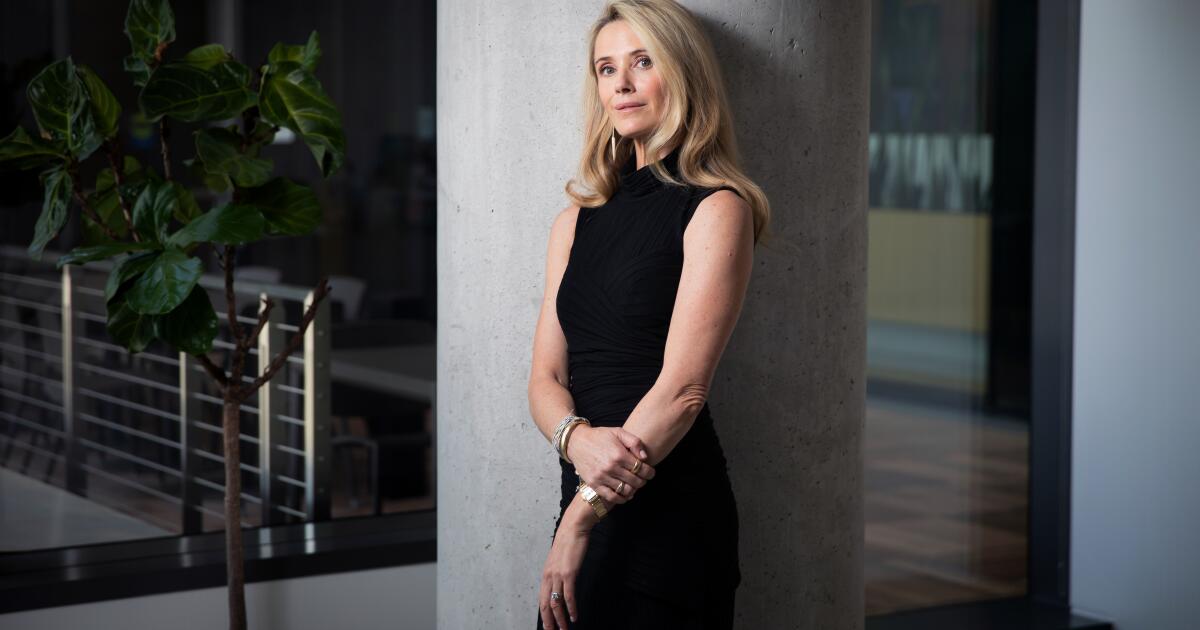
WASHINGTON — Jennifer Siebel Newsom has spent more than a decade cultivating an identity distinct from her husband, Gov. Gavin Newsom, as an active documentary filmmaker and gender equity activist with her own organizations, staff and salary.
The 51-year-old calls herself California’s “first partner,” a title she coined herself to signal an equal footing with the governor and gender inclusivity.
Her independent streak has generated her a steady income. She earns money from a set of organizations she founded or controls. They include the Representation Project, a nonprofit that advocates for gender equity through film and education programs; Girls Club Entertainment, a for-profit production company she owns that holds the copyrights to her documentaries; and the California Partners Project, a second nonprofit that works closely with her government office and receives donations solicited by the governor.
Since its creation in 2020, the California Partners Project has received nearly $5.1 million from so-called “behested payments,” raising alarms over the years about the influence large companies have amassed in Sacramento.
California law allows officials to solicit donations to specific charitable or governmental causes when the payments are reported within 30 days. The public donation system, however, came under scrutiny in 2020 when payments made at Newsom’s behest — to a variety of organizations, not just the California Partners Project — ballooned to an unprecedented $226 million to help fund the response to the COVID-19 pandemic.
With no limit on how much money can be donated by organizations or individuals at the behest of the governor, millions of dollars flowed in to prop up public services during the pandemic and fund Newsom’s favored programs, including an effort to address homelessness and a public safety campaign promoting the importance of wearing masks. The top donor of Newsom-behested payments in 2020 was tech giant Facebook, which gave $27 million for gift cards that went to front-line healthcare workers and for public health ads.
“It’s not illegal, but it certainly pushes the bounds of campaign finance law, and the first couple has been doing this for some time,” said David McCuan, a political science professor at Sonoma State University. “In this battle between Newsom and [President] Trump this makes their [the first couple’s] actions, these payments and the operation of the nonprofits a rich target for scrutiny.”
The Newsoms’ financial arrangements are now the subject of renewed scrutiny. The governor has accused the Trump administration — specifically, the FBI and the Internal Revenue Service — of questioning their friends and former employees about him and his wife. The governor said the probes are politically motivated, a personal vendetta because he’s considering a run for president in 2028.
Newsom said he and his wife have nothing to hide, and promised to release all of his recent tax returns — though he has not announced when.
In turn, the governor has demanded that the Department of Justice release all records pertaining to the probe.
“The American people deserve to know who ordered this abuse of power and how far it goes,” the governor wrote on social media last week.
“These are dark days in our nation’s history when the leader of the free world spews animus openly and without shame — aiming to silence and destroy not only his political opponents, but their friends, colleagues, and families,” Siebel Newsom said in a statement to The Times. ”My husband and I will continue to push back on this vindictive attack — and I certainly will not let this distract me from the important work ahead to protect the health, wealth, and safety of women and children and give California kids the best start in life. Together, we can set an example of strong leadership that protects people rather than preys on them.”
To better understand the finances, here is a breakdown of how Siebel Newsom’s company and nonprofits are working.
The Representation Project
Alongside the release of her first documentary, “Miss Representation,” in 2011, Siebel Newsom created her nonprofit, which originally shared the same name as her film. The organization licenses her films and reimburses costs to her production company.
The nonprofit earns some revenue from licensing the first partner’s documentaries for use in classrooms, college campuses and workplaces. Licensing for film screenings at schools starts at $49, while corporate licensing for her films starts at $995; purchase of screening rights also comes with curricula to facilitate discussions.
The Representation Project has earned more than $5.2 million in revenue from film screenings, licensing and speaking fees since 2011, according to a review of its tax filings.
The Representation Project is not required to disclose its donors but has received at least $2.6 million since 2014 from various charitable foundations that disclosed the gifts in their own tax filings. Several corporations that have had business before the state have donated to Siebel Newsom’s nonprofit, including Pacific Gas & Electric Co., AT&T and Kaiser Permanente.
Its past donors also include entrepreneur and progressive donor Susie Thompkins Buell, who is credited as a producer on several of Siebel Newsom’s documentaries, as well as the Marin Community Foundation and Onward Together, the political action organization founded by Hillary Clinton.
Four months after Newsom took office in 2019, the state Department of Education recommended that high schools screen two of his wife’s films, “Miss Representation” and “The Mask You Live In,” a move that has garnered criticism from conservative media outlets. The state said the films “can help facilitate a discussion about the impact of mass media and gender socialization on self-image and relationships with others.”
Though it does not specify where its films have been licensed, the nonprofit boasts in annual impact reports that its films and curricula have “reached over 2 million students” and “are being used in over 5,000 schools in fifty U.S. states.”
Since founding the Representation Project in 2011, Siebel Newsom has received more than $1.9 million in compensation from the nonprofit organization, according to a review of federal tax records. Her separately owned film production company, Girls Club Entertainment, has collected about $2.2 million in independent contracts from the nonprofit, records show.
Combined, the two streams of money total about $4.1 million flowing from the charity to Siebel Newsom personally or to entities she controls over the span of a little over a decade.
Her current annual salary is $161,250 for a 40-hour workweek, records show. Siebel Newsom earns income from both her production company and her nonprofit, according to state financial disclosures.
Jeff Tenenbaum, a nonprofit attorney with 30 years of experience advising nonprofit, tax-exempt organizations, declined to comment on Siebel Newsom’s specific case. But generally, he explained the legal framework that would apply to an arrangement like the one described in the filings.
Under federal tax-exempt organization law, he said, the “private benefit doctrine” governs whether a nonprofit’s overall activities unduly benefit any single individual — including through indirect payments to entities they own. The tax law asks whether too much benefit flows to one person or entity.
This is separate and distinct from the “private inurement” doctrine, which prohibits nonprofits from paying greater-than-fair market value compensation to insiders, including founders, and which requires that such compensation arrangements be approved by individuals with no conflicts of interest.
“Theoretically, a situation like this could raise some private benefit concerns,” Tenenbaum said, when the structure of the arrangement was described to him.
The doctrine does not prohibit all private benefit, he said, only what the federal tax code calls “impermissible” private benefit.
“There has to be too much benefit compared to the benefit to the public,” he said. Whether that threshold is crossed here, he said, would require a fuller review of the organization’s finances, contracts, and other considerations, including copyright ownership issues relating to the films produced.
Girls Club Entertainment
An actress and documentary filmmaker, Siebel Newsom founded her production company to develop independent films with a focus on combating gender stereotypes and empowering girls and women. She serves as the company’s chief creative officer.
She has written, produced and directed five films exploring themes of inequality and traditional gender roles. Siebel Newsom is best known for her 2011 documentary “Miss Representation,” which focused on the few and narrow representations of girls and women in American media.
Tax records show that the production company owns the rights to “Miss Representation” and has licensed the film to the Representation Project for a minimum of seven years for the purpose of distributing and screening the film in public. Costs associated with film production — including the writer, director and producer fees — have been reimbursed by the Representation Project, tax filings show.
Her latest documentary, “Miss Representation: Rise Up,” examines “the rising backlash against women’s progress and the hostile landscape of technology designed to harass and, ultimately, silence women.” The film premiered this month at the Tribeca Film Festival.
California Partners Project
In 2020, Siebel Newsom founded the California Partners Project, a nonprofit focused on improving gender equity in the workplace and the safety and well-being of children in online spaces. She does not collect compensation from the nonprofit or serve on its board.
It hosts an annual “gender equity summit” and provides resources for parents on issues such as social media safety and child mental health.
In the fall of 2024, Siebel Newsom and the California Partners Project hosted representatives from TikTok, Meta, Pinterest and other social media platforms for an event about children’s online safety. A day before the panel, state Atty. Gen. Rob Bonta took a more forceful tack to go after the tech industry by joining with 13 other states in a lawsuit against TikTok that accused the platform of exploiting young app users with its addictive features.
In September of 2024, the governor signed a bill to prohibit internet services and applications from providing “addictive feeds,” defined as media curated based on information gathered on or provided by the user, to minors without parental consent.
The California Partners Project also does not publicly disclose its donors in its tax filings, but much of the nonprofit’s funding appears to come from behested payments. Siebel Newsom does not receive a salary from the organization.
Since its founding, the Newsoms have steered more than $5 million to the nonprofit via behested payments, according to a review of the disclosures. While many donations to the California Partners Project come from charitable foundations, it also received hundreds of thousands from companies including Silicon Valley Bank, Pinterest and the charitable arm of Blue Shield of California.
Its biggest funder is the Federated Indians of Graton Rancheria, a Sonoma County tribe that operates a casino in Rohnert Park and spends heavily in state and federal elections. The tribe has given $2.3 million to the nonprofit since 2022. In June 2023, Newsom appointed tribal Chairman Greg Sarris to the University of California Board of Regents. Newsom has also supported efforts by the tribe to block a smaller tribe from building a casino in nearby Vallejo.
Blue Shield, which has reported giving $100,000 to Siebel Newsom’s nonprofit, also has a cozy relationship with her husband. The nonprofit health insurer was an early donor to Newsom’s 2018 campaign for governor and later received a $15-million no-bid contract to distribute COVID vaccines. State regulators in 2024 also signed off on the nonprofit’s request to restructure and establish a new parent corporation out of state, a move that raised alarm among healthcare advocates.
The California Partners Project did not respond to questions about its donors and spending.
June 24 (UPI) — Democratic lawmakers accused the Trump administration Wednesday of seeking to push through a multimillion-dollar arms deal with Turkey by bypassing congressional review, the latest executive action critics say usurps the lawmakers’ authority.
Rep. Gregory Meeks, D-N.Y., ranking member of the House Foreign Affairs Committee, said he was informed by the Trump administration late Tuesday that it would bypass congressional review of an arms sale to Turkey worth more than $700 million.
“The State Department did not even attempt to justify its decision,” Meeks said in a statement.
“It did not invoke any emergency authority, did not present a written rationale and for months refused to make a good-faith effort to brief me on implications of the sale for the U.S.-Turkey relationship, Turkey’s continued possession of the Russian S-400 system and other regional security concerns,” he continued.
“It simply informed my office that it would immediately proceed with a formal notification of the sale.”
The United States and NATO opposed Turkey’s adoption of the S-200 system, and Washington removed Turkey from the F-35 fighter program in 2019 during Trump’s first administration.
Meeks called the decision to bypass congressional review “yet another deeply troubling example of this administration’s open contempt for Congress’ oversight authority.
“There can be no pretense that this was urgent or unavoidable,” he said, stating the items will not be delivered to Turkey for years.
“This was a deliberate choice to shut Congress out and to treat legitimate oversight as an inconvenience to be brushed aside.”
Trump is scheduled to visit Turkey early next month. During a White House press conference alongside NATO Secretary-General Mark Rutte on Tuesday, he praised Erdogan as “a great friend.”
Erdogan is known to be seeking to acquire U.S.-made fighter jets, including the F-35. Asked if he was planning to announce a potential deal when he visits Ankara, Trump replied: “I’m going to probably do something that’s going to make him very happy.”
It was unclear if jets were part of the arms deal.
UPI has contacted the State Department for comment and to detail the contents of the sale.
Democrats and other critics of President Donald Trump have repeatedly accused his administration of bypassing Congress through executive orders and unilateral decisions, particularly in its use of the military.
The Trump administration has faced staunch criticism from opponents for launching a war against Iran in late February without congressional authorization. Democrats have frequently argued that the Constitution gives Congress, not the president, the power to declare war.
Democrats have also criticized the administration’s use of the military to attack suspected drug-trafficking boats in the Pacific and Caribbean without congressional authorization.
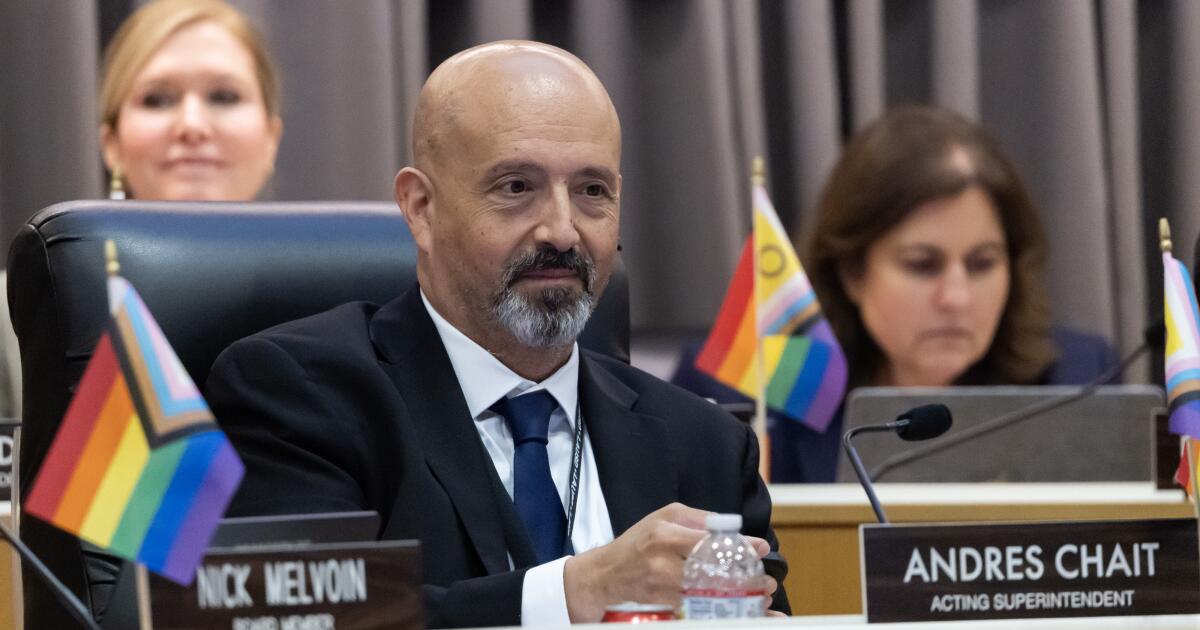
Andrés Chait has been named superintendent of the Los Angeles Unified School District three days after the resignation of Alberto Carvalho in a lightning-speed transition that elevates a well-liked insider to the top of the nation’s second-largest school system.
The Board of Education announced its unanimous decision Wednesday, which was made official during the board’s last scheduled meeting before August.
“I firmly believe in leading with gratitude and never taking the work and support of others for granted,” Chait said after the announcement. “So I begin today in that spirit of gratitude. Thank you to the board for your faith in me and for this opportunity.”
“I have always known that there is no greater accelerator of change and opportunity than the school house, and that is still true today,” Chait added. “Throughout my career in various roles, that has remained my focus. How I can be of service and support to our students and families in accessing these opportunities. Please know that commitment has not changed.”
Chait had been serving as acting superintendent since Feb. 27, two days after the FBI raided the home and office of his predecessor, Carvalho. Law enforcement sources have confirmed that the ongoing investigation includes a review of Carvalho’s actions related to a company hired to create an ill-fated AI chatbot. Carvalho has not been charged and maintains that he is innocent of wrongdoing.
Chait’s style and background stands in sharp contrast to Carvalho‘s, who had 14 years of experience leading one of the nation’s largest school systems in Miami.
Carvalho carefully curated his appearances — before and during his L.A. tenure he maintained a high national profile as a sought-after voice in education. In 2018, he had accepted the job leading the school system in New York City before changing his mind and staying in Miami. He was a familiar face in national conclaves on education and among national leaders. He took charge in L.A. in February 2022.
Chait is a district parent who started off as a kindergarten teacher at Queen Anne Place Elementary School and rose gradually through the ranks. He has never worked in another school system, although his experience in L.A. Unified included a variety of roles, including elementary school principal, regional superintendent. Most recently he served as director of operations — a non-academic function — for the entire school system.
Chait was not among the phalanx of senior officials who sat directly behind the school board on the elevated stage during board meetings. Instead, Chait’s was stationed in the back next to the audiovisual equipment, where he was off camera and frequently able to joke and interact with other district staff and community members. He’d also sometimes deal directly with a community member or employee who brought forward a personal problem or issue during the public hearing portion of a board meeting.
Over the last two years, Chait has presented periodically at board meetings, including over such issues as school safety.
The announcement was made by school board President Scott Schmerelson after the board emerged from a closed session.
“This board’s decision reflects the confidence in Mr. Chait’s leadership, his decades of service to Los Angeles Unified, and his demonstrated ability to guide the district during this period of transition,” Schmerelson said. “Throughout his career, and most recently as acting superintendent, he has shown deep commitment to our students, families, employees, and school communities.”
The decision to offer the job to Chait was not entirely a surprise because he already had taken on key tasks typically handled by a long-term superintendent. These included finishing up a four-year strategic plan and selecting administrators to fill key senior positions.
The Board of Education approved a four-year strategic plan Tuesday with academic targets and measures of college, career and social-emotional readiness.
Chait also received good marks from board members and union leaders during a trial-by-fire experience with a labor dispute that came within hours of a three-union strike that would have shut down the school system.
Chait was a key participant in getting to a deal, along with Mayor Karen Bass.
“It was wonderful to have the cooperation from the leadership of the district, from the superintendent, from the school board, from the entire school board, all of that … made a difference,” Bass said in a City Hall news conference, referring to Chait, after the all-nighter.
Leaders of the three unions each praised Chait at the time.
“I want to give you a thanks, Superintendent Chait, for showing humanity. Humanity. Humanity for seeing us, seeing the workers, and believing that you can get it across the finish line,” said Cecily Myart-Cruz, the outgoing president of United Teachers Los Angeles.
Last week, Myart-Cruz said in an interview that Carvalho needed to be replaced and that Chait appeared to have the skills needed to take over — although she said she would prefer a formal selection process that included input from labor leaders and others.
Max Arias, executive director of Service Employees International Union Local 99, also praised Chait after the contract was settled.
“I want to appreciate you … for coming into a very difficult situation and stepping in and showing leadership,” Arias said. “We are ready, our members are ready, to always give a chance to building relationship or partnership.”
Interviewed last week, Arias said Chait should be offered the job outright — that a search process was unnecessary.
Also praising Chait during that April gathering in City Hall was Maria Nichols, president of Associated Administrators of Los Angeles, which represents schools principals and assistant principals among others.
“Thank you so much for listening,” Nichols said. “I know the acting superintendent’s style — collaborative, listens. He takes action. He’s humane, and he wants the best for our students, because he’s a parent and has students in LAUSD.”
The deals accepted by Chait also have critics, who contend is it more than the district can afford.
This $20.6-billion spending plan that was approved Tuesday incorporates the layoffs of up to several hundred workers with due-process rights and perhaps 1,000 more without job protections. Over the next three years, officials project thousands of additional layoffs.
The spending plan for the 2026-27 school year is nearly $2 billion higher than last year’s figure of $18.8 billion. The district’s projected revenue is $18.6 billion, although that figure could rise based on promising state tax revenues.
In the meantime, the district will cover the shortfall with reserves, which may or may not be exhausted over the next two to three years. The increased spending results largely from significant salary increases, maintaining health benefits amid rising costs and expanding the number of part-time employees eligible for benefits.
Also straining the budget has been the expiration of COVID-relief funds, inflation surpassing state funding increases and steadily declining enrollment. L.A. Unified, with about 390,000 students in transitional kindergarten through 12th grade, is about half as large as in the early 2000s.
The board did not immediately release details of the new superintendent’s contract, including the length of the term, on the grounds that is not yet in final form.
Chait’s salary as acting superintendent was $395,867. He also has received $250 per month for expenses and the use of a district car and driver for work-related activities. In his previous job as chief of school operations, which he held for about 20 months, Chait had earned $278,205.
Carvalho’s salary was $440,000 per year with an additional $50,000 paid annually into a retirement annuity. District officials have so far declined to say if Carvalho received a severance package.
Carvalho’s predecessor as permanent superintendent, Austin Beutner, was paid $350,000 per year.
BOSTON — A federal judge on Wednesday permanently barred President Trump’s administration from implementing most of his first executive order on elections, part of which sought to require people to show documentary proof of citizenship when they register to vote.
The ruling by U.S. District Judge Denise Casper in Boston in effect converts a preliminary injunction she issued a year ago, in which she temporarily blocked many of Trump’s efforts to overhaul elections, into a permanent ban.
Casper rejected the administration’s argument that the lawsuit to block the changes brought by Democratic state attorneys general was premature because the rules had yet to be implemented. Instead, she agreed that the Constitution gives states and Congress the authority to regulate elections, and that Trump’s requirements violated the separation of powers.
The Constitution “does not grant the President any specific powers over elections,” she wrote.
Among other proposed changes, Trump’s order would have required people to provide documentary proof of citizenship when registering to vote, prevented mail ballots from being counted if they arrive after election day, even if they were postmarked by then, and punished states that failed to comply by withholding certain federal money.
In a statement, New York Atty. Gen. Letitia James said she was grateful the court had blocked Trump’s “unconstitutional attempt to seize control of our elections” and would continue to defend voting rights in this year’s midterm elections.
“Generations of Americans fought tirelessly for the right to vote, and we honor their legacy by protecting that right against anyone who tries to undermine it,” she said.
Requests for comment sent to the White House and Department of Justice were not immediately returned.
It was the latest in a string of rulings against the elections executive order Trump signed just months after taking office for his second term. He has since signed another executive order on elections, seeking to create a national voter list and limit mail balloting. That directive also faces multiple legal challenges.
In the fall, a federal judge in Washington overseeing a separate challenge to the first election executive order by civil rights and Democratic Party-aligned groups blocked the government from taking steps to include the proof-of-citizenship requirement on the federal voter registration form. That judge later barred the secretary of Defense from requiring documentary proof of citizenship when military personnel register to vote or request ballots.
In an apparent nod to the difficulty of implementing a proof-of-citizen requirement by executive order, Trump is pushing legislation in the Republican-controlled Congress to create such a mandate. The SAVE America Act has passed the House but has stalled in the Senate, leading Trump to advocate for eliminating the filibuster that is blocking the legislation.
On Wednesday, he abruptly canceled the expected signing of a bipartisan housing bill, saying he won’t do so until Congress passes his proof of citizenship requirement for voting.
The president and many of his Republican allies have been promoting the narrative that voting by noncitizens is a major problem, when in fact it’s quite rare. The federal voter registration form already requires people to attest that they are U.S. citizens, and violating that is punishable as a felony that can lead to prison or deportation.
In another major voting case, the U.S. Supreme Court is due to issue an opinion soon on whether mail ballots must arrive by election day. That could immediately change the rules in 14 states that allow grace periods ranging from days to weeks if the ballots are postmarked by election day.
The top strategist for Los Angeles Mayor Karen Bass’ reelection bid has left her campaign, just as she is gearing up for a bruising showdown against City Councilmember Nithya Raman in the Nov. 3 runoff.
Douglas Herman, who has worked with Bass since 2021, told The Times on Wednesday that he stepped down from the campaign earlier in the day. He is being replaced by Julie Chávez Rodriguez, who was campaign manager for the Biden and Harris presidential campaigns in 2024, a Bass spokesperson said.
Chávez Rodriguez has spent the past few months running Unidos Con Karen Bass 2026, an independent expenditure campaign that focused on Latino voter turnout during the primary.
Herman, asked about his departure, said he left due to “strategic differences” regarding the direction of the reelection campaign. He did not provide details.
The Bass spokesperson, Alex Stack, declined to discuss Herman’s exit.
“Going into the general election, our campaign is proud to announce that Julie Chávez Rodriguez will be leading the team,” he said in a statement.
The granddaughter of César Chávez, co-founder of the United Farm Workers union, Chávez Rodriguez worked in both the Obama and the Biden administrations. She ran Joe Biden’s 2024 campaign until he dropped out and then ran Kamala Harris’ campaign, losing to President Trump. While working for Harris, she courted Latinos and working-class voters in battleground states.
Herman was a combative messenger for Bass, issuing broadsides against her rivals as she fought for a second four-year term. He had been advising her since her first run for mayor, when she defeated real estate developer Rick Caruso by about 10 percentage points. He also helped her fend off a recall attempt while in office.
Bass was the top vote getter in the June 2 primary election, securing 34% of the vote, compared to 29% for Raman and about 26% for reality TV personality Spencer Pratt. With a majority of voters registering disapproval of her performance, she faces a tough runoff campaign.
Raman, first elected in 2020, is expected to be a formidable opponent, drawing on her support from younger voters, entertainment industry workers and activists in the YIMBY movement, which seeks to tear down regulatory barriers to housing construction.
US Secretary of State Marco Rubio said Washington will be “completely aligned” with Gulf allies in Iran peace talks. Rubio met Kuwait’s Crown Prince Sheikh Sabah Al Khalid Al Sabah during a visit to the region after the US and Iran signed an MoU.
The June 16 appearance by Vance gave the program its most-watched episode since November 2024.
The first appearance by Vice President JD Vance on ABC’s “The View” delivered the most-watched edition of the talk show since November 2024.
The June 16 program averaged 3.3 million viewers, according to Nielsen data. The figure was well above the average of 2.6 million viewers for “The View” in the 2025-26 season.
Vance appeared on the liberal-leaning program to promote his new book on his decision to become a Catholic. While the co-hosts mostly questioned him on the Trump administration’s policies on immigration and race, the discussion was cordial.
The panel of co-hosts — Whoopi Goldberg, Joy Behar, Ana Navarro, Sunny Hostin and Alyssa Farah Griffin — did not ask Vance to address the program’s ongoing tension with the Federal Communications Commission.
ABC has asked the FCC to rule on the status of “The View,” which received an exemption from the rarely enforced equal time provision in 2002. ABC has maintained that “The View” books politicians based on newsworthiness and not partisanship.
“‘The View’ has welcomed your favorite guests and covered the issues you care about for nearly 30 years,” the spot says. “Now the FCC wants to control who is allowed to appear on the show.”
The National Republican Senatorial Committee and the National Republican Congressional Committee submitted comments Monday, asserting that “The View” takes advantage of its exemption and favors Democratic candidates and permits “only rare appearances by Republican-aligned figures.”
ABC has told the FCC that “The View” has invited politicians from both sides of the aisle to appear on “The View,” including Health Secretary Robert F. Kennedy, Jr., Secretary of State Marco Rubio and entrepreneur Elon Musk. They have declined the invitation as did Vance before his appearance last week.
The letter from the GOP committees also cited the ideological leanings of the co-hosts, saying they are “not selected for their journalistic talent or excellence in commentary, but for their partisan tilt.”
Over the last two decades, “The View” has used five liberal hosts and filled one seat designated for a conservative voice. The right-leaning co-host role has had the most turnover.
“The View” has been the most-watched daytime program for the last nine years. As a live, topical program, it has remained an important media platform while the rest of the talk show genre has largely faded due to diminishing audiences.
Carr’s targeting of “The View” is part of his ongoing criticism of broadcast platforms that annoy President Trump, who has urged that TV station licenses be pulled when he’s been unhappy with coverage.
WASHINGTON — President Trump said Wednesday he would not sign the landmark housing bill Congress passed this week as scheduled, in a striking decision to jeopardize a rare bipartisan success in order to demand that lawmakers pass voter ID legislation.
It escalated tension between Trump and Senate Republicans, which had already neared a breaking point this week over the proof-of-citizenship bill, dubbed the SAVE America Act. GOP leaders have told Trump the bill does not have the votes to pass.
“Today’s Housing News Conference and Signing is hereby cancelled until such time as we pass the desperately needed SAVE AMERICA ACT, which I consider to be a National Emergency,” Trump wrote online.
The president’s willingness to threaten a bill that he could have framed as a win on affordability ahead of the midterm elections is a remarkable gamble as Republicans fight to keep House control.
The reversal also underscored Trump’s fixation on asserting some federal control over elections processes and his apparent indifference to the cost-of-living issues that voters are most focused on. He has repeatedly dismissed affordability as a “fake” concept, and inaccurately claimed on Sunday that the U.S. has the “BEST ECONOMY EVER.”
Last week, polls from NPR/PBS News/Marist Poll and Fox News poll showed record dissatisfaction with the economy among Americans and Trump’s support slipping among key demographics. Trump also lashed out about that on Truth Social on Wednesday morning, writing without evidence: “MY REAL POLL NUMBERS ARE THE HIGHEST THEY HAVE EVER BEEN. THANK YOU!!!”
The housing bill, which passed with overwhelming support in the House on Tuesday evening and the Senate on Monday, aims to boost housing supply. It is the most significant legislation Congress has passed on housing in more than 30 years, and it contains a host of provisions aimed at removing regulatory barriers, improving federal programs and incentivizing new building.
As president, Trump has 10 days to sign or veto bills after they are presented. House Speaker Mike Johnson (R-La.) indicated to reporters Wednesday that a signing could still be on the table, saying he had spoken to Trump about “delaying” the housing bill before the president announced the cancellation.
Johnson said he had promised an effort to advance the SAVE America Act.
“He decided — I didn’t announce it, I wanted him to announce it — but we’re delaying this,” Johnson said. “As you know, he has a window of time before he has to sign a bill and he’s going to use a little bit more of that window of time and we’re gonna go through this together.”
Bill Owens, chairman of the National Assn. of Home Builders, telegraphed hope that the legislation would be signed at some point.
“Although there was no bill signing today, we are confident the 21st Century Road to Housing Act will eventually become law,” said Owens, a home builder and remodeler from Worthington, Ohio.
Democrats were shocked, angry and confused when they found out about the cancellation Wednesday morning, according to a source within the House Committee on Financial Services, which led the legislation.
Lawmakers believed the bill was a done deal and are now scrambling, the person said. A stage for the bill signing had already been set up in the Capitol when Trump posted online. The night before, White House press secretary Karoline Leavitt had posted on X: “Tomorrow’s historic bill signing is another promise made, promise kept.”
Frustration with the president has been steadily mounting among Senate Republicans for more than a month, triggered by a host of issues including Trump’s endorsement of Republican primary challengers to sitting lawmakers. On Tuesday, four Republican senators joined with Democrats to approve a war powers resolution seeking to block U.S. military action in Iran.
Senate Majority Leader John Thune (R-S.D.) has told Trump the SAVE America Act doesn’t have enough support to pass, the Associated Press reported this week.
The legislation would require voters to provide proof of citizenship when they register, require Americans show identification when casting a ballot and require states to send voter data to the Department of Homeland Security. Voting rights advocates say it would create unnecessary barriers to voting for citizens.
The effort is rooted in Trump’s baseless claims of voter fraud and cheating by Democrats. He has said the bill would “guarantee” the midterms for Republicans.
Trump has previously called for the federal government to “nationalize” elections and “take over” voting in some states. He renewed accusations against Democrats of cheating in California this month.
Rep. Brad Sherman (D-Sherman Oaks) said Trump was holding the bill hostage in a bid “to control California’s elections.”
“The stage was set both physically and metaphorically for the president to sign a historic housing bill for the American people,” said Sherman, who contributed a provision to the housing bill that would help disabled veterans get rental assistance. “Trump must put his ego aside and put the American people first and sign this bill into law.”
Less than an hour before Trump posted online that he had canceled the bill signing, he labeled the legislation “the Elizabeth ‘Pocahontas’ Warren centric housing bill” in a Truth Social post, and railed about the SAVE America Act.
“That is what Americans, both Dumocrats, Republicans, and everyone else, care about. Get the bad Republicans to approve it or, better yet, Terminate the Filibuster and approve it, AND EVERYTHING ELSE REPUBLICANS HAVE EVER DREAMED OF,” Trump wrote.
Sen. Elizabeth Warren (D-Mass.), who was one of the four bipartisan lawmakers leading the deal across the two chambers, said Wednesday morning on CNBC that Trump’s reversal “doesn’t make any sense.”
“It’s a complete indifference to the cost squeeze on American families and to genuine efforts to do something about it,” Warren said. “He could be over here claiming a victory lap and instead he’s saying no, no, he doesn’t want anything to do with it.”
NEW YORK — A chief of staff to former New York City Mayor Eric Adams has been charged with accepting more than $100,000 in bribes to steer a lucrative migrant shelter contract to a Queens hotel, according to a federal indictment unsealed Wednesday.
Frank Carone’s arrest Wednesday was the latest in a string of corruption allegations that have rocked the one-term mayor and his inner circle. And it came the same day federal authorities executed search warrants related to a separate bribery investigation involving high-ranking police officials under Adams, the latest sign that prosecutors are continuing to hone in on the previous administration.
In the indictment, returned June 12, prosecutors accused Carone of leveraging his position as Adams’ chief of staff to commit multiple acts of bribery, wire fraud and money laundering. His brother, Anthony Carone, as well as the Queens hotel owner, Yan Po Zhu, and Crystal Chen, an employee of the hotel, were also charged.
They were expected to appear in federal court in Brooklyn on Wednesday afternoon.
Prosecutors said Carone accepted a series of bribes from Zhu and Chen in order to steer a multimillion dollar shelter contract to their hotel, which city officials had said was smaller than two other proposed hotels and could house fewer migrants. The contract was awarded amid an influx of migrants to New York that overwhelmed the city’s homeless shelters.
Frank Carone’s lawyer, Arthur Aidala, called the new indictment “not worth the paper upon which it is printed.”
“Today’s indictment is a sad day for our criminal justice system,” Aidala said in a statement. “It epitomizes the government first finding a target and then spending three years and enormous taxpayer resources to find a crime.”
Frank Carone known for link to Sabrina Carpenter church controversy
Carone, a longtime Brooklyn power broker, is widely credited as one of the architects of Adams’ political rise. Among the wider public, he is perhaps most notorious for his role in an episode that led to a Brooklyn pastor being stripped of his duties partly for allowing pop star Sabrina Carpenter to film scenes for a provocative music video at his Roman Catholic church.
The church was later subpoenaed by federal investigators seeking information about business dealings between Monsignor Jamie Gigantiello, who approved the video, and Carone.
Adams himself was indicted on bribery charges in 2024 for allegedly accepting illegal campaign contributions from Turkish officials and others in exchange for political favors. The case was tossed by the Justice Department, which said it was distracting Adams from assisting in President Trump’s immigration crackdown. Adams has denied wrongdoing but abandoned his campaign for a second term last year.
The former mayor was not accused of wrongdoing in Carone’s indictment.
A lawyer for Zhu, Stephen Scaring, said the hotel owner “will be entering a plea of not guilty and is anxious to establish his innocence.”
Chen’s lawyer declined to comment. Messages were left for Anthony Carone’s lawyer.
Hotel at center of alleged bribery had been rejected by city
In total, Frank Carone was paid around $120,000 by Zhu and Che for the emergency shelter contract, prosecutors said. The money was passed through a law firm owned by his brother, Anthony Carone, according to the indictment.
The city’s Social Services Department had initially rejected the hotel’s application to house migrants due to growing resistance to the high number of shelters already operating in the neighborhood, the indictment said.
Carone then interceded on the hotel’s behalf, prosecutors allege. In one text exchange in September 2022, Zhu wrote: “Thank you my big guy,” according to the indictment.
The Carones and Zhu socialized frequently and attended gatherings at Zhu’s Long Island home, the indictment said.
In a separate statement, Todd Shapiro, a spokesperson for Adams, said Frank Carone “dedicated decades of his life to public service, the legal profession, and helping countless individuals, businesses, and charitable organizations throughout New York.”
Carone played a key role in Adams’ campaign for mayor in 2021 and served as Adams’ chief of staff in 2022. In 2023, he formed a political consulting firm. He also was a one-time lawyer for the Brooklyn Democratic Party.
Separately Wednesday, federal agents searched the homes of current and former New York Police Department leaders as part of a bribery investigation that grew out of an inquiry into Jeffrey Maddrey, the chief of department under Adams, according to a law enforcement official briefed on the searches.
As part of that inquiry, the FBI and the NYPD executed warrants on the home of NYPD Chief of Manhattan South James McCarthy and former Deputy Commissioner Tarik Sheppard, according to the person, who requested anonymity because they were not authorized to discuss the investigation.
Maddrey’s home was also searched by federal agents, the person said.
The searches were not related to the arrest of Frank Carone, according to another person familiar with the matter who also spoke on condition of anonymity because they were not authorized to publicly discuss details of the case. There is no public indication of any arrests as part of those searches.
Once the highest-ranking uniformed officer in the department, Maddrey resigned in late 2024 over allegations that he demanded sex from a subordinate in exchange for opportunities to earn extra pay.
An inquiry to his attorney was not immediately returned. Attorney information for Sheppard and McCarthy was not immediately available.
Collins, Offenhartz, Sisak and Richer write for the Associated Press. Collins reported from Hartford, Conn., and Richer reported from Washington.
NEW YORK — When Varun Venkatesh cast his ballot in New York’s primary this week, he thought about “a good litmus test for me as a voter.” He wanted to know what the candidates are doing for the Palestinian cause.
The 27-year-old Brooklyn resident decided to support Claire Valdez, who was backed by Mayor Zohran Mamdani, over Antonio Reynoso, another progressive who was the choice of the Democratic establishment, because she had “a clear and more consistent stance.”
Valdez triumphed in her congressional primary, as did two other insurgent candidates endorsed by Mamdani, and Israel was a key issue in each of the races. Now the question for Democrats is how many more voters like Venkatesh are out there as the party charts its path toward the November midterms and the next presidential election.
The war in Gaza, which began during Joe Biden’s presidency and undermined Kamala Harris’ bid to replace him, remains an open wound, and how Democrats attempt to stitch it closed will help define their future. A step in any direction risks alienating pieces of the party’s unwieldy coalition at a time when it’s trying to unify around the mission of retaking control of Congress.
“The Israel question has become defining,” said Matt Bennett, who leads the centrist Democratic group Third Way and frequently criticizes progressives as jeopardizing outreach to independent voters. He said some in Mamdani’s camp have embraced “a new level of extremism,” warning that “Republicans are very good at weaponizing crazy ideas on the fringe against mainstream candidates.”
Mamdani has no such concerns as he tries to reshape the Democratic Party from the mayor’s office of the country’s largest city. He sharply criticized the American Israel Public Affairs Committee for defending what he calls “a status quo of immorality” in Gaza, and voters who celebrated his slate’s victories on Tuesday night chanted “Free Palestine.”
The mayor, meanwhile, argues that New York should shape Democrats’ search for their national identity in the coming years.
“When does the race for 2028 begin?” Mamdani asked last week on a stage with his slate of candidates. “It starts now.”
Israel-Palestine conflict animates Democrats’ left flank
Even for a party accustomed to searing debates between progressives and moderates, the schism over Israel has been blistering. Although the U.S. alliance with Israel once had bipartisan support, the ascendancy of Israel’s right wing led by Prime Minister Benjamin Netanyahu strained those ties over the years. Then the war in Gaza shredded them.
Biden was denounced as “Genocide Joe” by pro-Palestinian supporters, who shifted their attention to Harris once she replaced him as the Democratic nominee for president two years ago.
“She was trying to the right thing,” said Jamie Harrison, who led the Democratic National Committee at the time. “It was a hard and awkward place to be in.”
Harrison said the war in Gaza helped cost Harris the state of Michigan, which has a sizable Arab American population. However, he doubts that it was a defining national issue then or now.
“It’s one thing to be in New York. But I can tell you that most places, including where I am in South Carolina, it’s not what people are talking about,” he said. “They are concerned about affording gas and groceries and housing.”
Harrison expects Democrats to look for middle ground in the future, which includes “still supporting Israel’s sovereignty” while calling for “reducing U.S. aid to Israel and changing the nature of the relationship.”
One primary victor blasted the ‘hug Bibi’ strategy
Finding middle ground has been difficult so far, as demonstrated by the primary in New York’s 10th congressional district.
Brad Lander, the former city comptroller backed by Mamdani, successfully challenged U.S. Rep. Dan Goldman in the race.
Both candidates are Jewish, and both have criticized the Israeli government. But Lander says the war in Gaza is a genocide, and Goldman does not.
“Our party needs to admit that Joe Biden’s ‘hug Bibi’ strategy was a catastrophic mistake,” Lander said in his primary victory speech. He added, “We cannot keep paying for Netanyahu’s wars with our tax dollars. Democratic voters are saying this, loud and clear.”
Ari Rassouli, a voter in the district, said the incumbent’s views on Israel were “one of the many reasons that I didn’t like Dan Goldman.”
Describing the war as a genocide, she said “a candidate that is in support of that has no place in our democracy at all.”
While talking to reporters on Tuesday, Lander acknowledged that Israel was among the top issues along with affordability and immigration.
“I like talking to Jewish voters who feel anxiety about the times we live in and say, ‘I have these values, I want to treat everyone like they’re equal and with dignity and created in God’s image. How do we navigate the times we’re in?’” he said.
He added with a smile, “Those are probably the longest conversations at the polls.” ___
Barrow, Peoples and Offenhartz write for the Associated Press. AP writers Anthony Izaguirre and Larry Neumeister contributed to this report.
U.S. Immigration and Customs Enforcement is retreating from a plan to use warehouses to hold up to 10,000 people on a single site, jettisoning a key piece of former Homeland Security Secretary Kristi Noem’s $38-billion plan to rapidly expand detention capacity this year.
The federal government, which was sued by Michigan and a Detroit suburb, informed a judge Monday that a warehouse purchased in Romulus will be sold. Plans also are unraveling in Social Circle, Ga., and the El Paso suburb of Socorro, local officials said.
The three cities are among 11 where the federal government spent a combined $1.074 billion on warehouses.
The New York Times first reported last week that federal immigration officials now plan to get rid of seven of the 11 warehouses — either giving them to other federal agencies or selling them outright.
DHS didn’t confirm the reports but said in a statement that it is “moving swiftly to utilize EXISTING detention space with our state and county partners.”
“Wildly foolhardy” is how Claire Trickler-McNulty, a former ICE official under the Obama, Trump and Biden administrations described the plans to convert the buildings into immigrant detention.
One issue was that Noem’s purchases were largely carried out of public view and angered communities that were caught by surprise. Some only learned about ICE’s ambitions after the agency bought or leased space for detainees.
After Noem was fired, her replacement, Markwayne Mullin, quickly paused the purchase of new warehouses.
Objections came from Republicans and Democrats alike
Some were opposed on moral grounds to ICE’s presence in their neighborhoods, while others questioned whether the facilities would be a drain on local resources, such as sewer and water systems.
Seven federal lawsuits were filed, and regulatory roadblocks created hassles elsewhere.
Meanwhile, questions about how much DHS paid for some warehouses triggered an internal audit. The agency shelled out double what the New Jersey warehouse was valued at in tax records and nearly five times more than the assessed value of the Social Circle warehouse.
Trickler-McNulty, the former ICE official, said ICE does have a few facilities that it owns that it inherited from its predecessor agency, the Immigration and Naturalization Service, but generally ICE has contracted out its detention needs.
“Facilities over 2,000 people just break down. It’s very hard to run a very big facility, to keep it staffed, to keep all of it moving,” she said.
Former head of plumbing business takes over for Noem
Mullin, who took over and expanded his family’s plumbing business before representing Oklahoma in the U.S House and Senate, acknowledged there had been issues at his confirmation hearing.
He noted that most municipalities don’t have the capacity in their infrastructure for waste and water.
Indeed the water issues were such a challenge that a federal lawsuit filed over the Salt Lake City warehouse, the costliest purchased at $145.4 million, said ICE officials told the mayor that they might need to truck water and sewage from the facility as an “interim solution.”
Plans begin to unravel
The New York Times story, which cited internal documents that the newspaper obtained, said the Salt Lake City warehouse is among those that federal immigration officials plans to hand off or sell. Also on the list is the Romulus warehouse, as well as one in New Jersey and two each in Georgia and Pennsylvania.
Michigan Attorney General Dana Nessel said it would have been an “abomination” if the 249,000-square-foot Romulus warehouse was transformed into immigrant detention, as was planned when it was purchased for $34.7 million,
“The ICE warehouse proposal was every bit as ill-conceived as it was cruel and unnecessary, and I am relieved that this chapter is coming to a close,” Nessel, a Democrat, said.
Social Circle, Georgia, announced last week in a statement that it has received notification from U.S. Rep. Mike Collins, a Republican, that the Department of Homeland Security is no longer pursuing an ICE detention facility there.
Meanwhile, acting ICE Director David Venturella told officials in the El Paso area during a visit there earlier this month that the agency has changed its plans for three warehouses it purchased in nearby Socorro for $122 million, said Rep. Veronica Escobar, who was present for the visit.
Escobar, a Democrat who represents El Paso, said during a news conference that ICE no longer plans to detain up to 8,500 immigrants in the facilities as originally envisioned, and instead will convert the property into an ICE campus, she said. The site will include an unspecified smaller number of detainees but also ICE offices and training space, she said.
Frustrations persist as communities seek details
However, many of the communities remained frustrated, as they struggled to get information about possible sales.
In Pennsylvania, state and local officials said Tuesday that they hadn’t received any new information from DHS about two warehouses bought earlier this year by the department. Both are being held up by the state’s denial of permits over concerns that drinking water and sewer service are inadequate to handle thousands of inhabitants.
U.S. Rep. Dan Meuser, whose district includes both warehouses, said he met Friday with DHS personnel, but that the agency hadn’t made a decision whether to use them as detention centers or sell them.
In Georgia, the city manager in Oakwood, said Tuesday he is talking to his state congressional delegation, trying to confirm rumors that a warehouse there will be sold. “I have not heard anything yet,” B.R. White said.
Work appears to continue on other warehouses
In Maryland, where a judge extended a stoppage on transforming a sprawling warehouse into a processing facility for immigrants, ICE is currently collecting public comments about the environmental impacts of the facility. And an announcement earlier this month disclosed more details on plans for the facility, including six secure recreation yards.
Patrick Dattilio, the founder of Hagerstown Rapid Response, which formed in opposition to housing ICE detainees in the warehouse, said there has been little communication outside of the lawsuit. But he remains committed to keeping it from opening.
“It’s a big warehouse,” Dattilio said. “It’s not meant for people.”
Hollingsworth, Foley and Santana write for the Associated Press. AP writers Marc Levy and Ed White contributed to this report.
US Secretary of State Marco Rubio has said Iran will not be permitted to charge tolls or fees for vessels transiting the Strait of Hormuz under any final agreement with Washington, exposing one of the biggest points of friction in negotiations aimed at ending months of conflict across the Middle East.
The dispute comes after Iran announced it would waive planned transit fees through the strait that crosses through its territorial waters for 60 days while talks with the United States continue in Switzerland, suggesting charges could be introduced once the negotiating period expires.
Recommended Stories
list of 4 itemsend of list
Washington and Tehran signed a preliminary agreement in Switzerland this week to halt hostilities and launched a 60-day diplomatic process focused on sanctions relief, Iran’s nuclear programme and the future administration of the Strait of Hormuz.
Pakistan, which helped mediate the talks alongside Qatar, has said negotiations to end the four-month US-Israel war on Iran are expected to resume early next week, likely on Tuesday.
The future of Hormuz has already emerged as a key sticking point after Iran effectively closed the waterway during the war, severely disrupting maritime traffic through one of the world’s most important energy chokepoints and causing the price of oil to soar.
In peacetime, one-fifth of the world’s oil and natural gas supplies are shipped for export by Gulf producers through the waterway.
In April, the US imposed a corresponding naval blockade on Iranian naval ports in a bid to stem Iranian oil exports.
While a number of ships have crossed through the strait since the US-Iran agreement was signed last week, uncertainty remains over whether Tehran intends to impose permanent fees or service charges on shipping operators using the route. Here’s what we know – and what else is happening in the Strait of Hormuz this week.
(Al Jazeera)
What are the US and Iran saying?
On Friday, Iran’s Persian Gulf Strait Authority (PGSA) said planned fees for ships using the waterway would be suspended during the 60-day negotiation period established under the memorandum of understanding (MoU) signed with the US.
Earlier this week, Iran and Oman said in a joint statement that they would study the future administration of the trade route as well as possible charges for services provided there, while maintaining their sovereignty claims over territorial waters bordering the strait.
Speaking at the start of a regional tour in the United Arab Emirates, Rubio rejected the idea of transit fees. “It’s an international waterway. No country is allowed to charge tolls or fees on an international waterway,” he said, adding that he believed “all the countries in this region would agree”.
Iran’s chief negotiator, Mohammad Bagher Ghalibaf, has signalled that Tehran views the post-war arrangement as fundamentally different from the status quo that existed before the conflict, however. Experts also say that Iran will not give up control of the strait, which has proved to be its greatest point of leverage in the conflict with the US.
“Hormuz will never return” to its prewar status, Ghalibaf said, despite both sides agreeing on Monday to establish “communication mechanisms” aimed at keeping the waterway open.
What does international law say?
International law protects the right of transit through strategic waterways such as the Strait of Hormuz, preventing coastal states from imposing explicit tolls simply for passage through international shipping lanes, even when they are passing solely through territorial waters.
However, countries can charge for specific services, including inspections, navigation assistance, security measures and certain insurance-related requirements, insurance experts say.
Examples include fees associated with transit through the Suez Canal and Panama Canal, as well as some services provided in Turkiye’s Bosporus and Dardanelles straits.
Mohammad Reza Farzanegan, an economist at Germany’s Philipps-Universitat Marburg, told Al Jazeera last month that Iran, like Turkiye, could justify a negotiated mechanism for transit fees or service-based contributions through natural straits as payment for maintaining a safe passageway, reducing environmental risks and providing predictability in a waterway that supports global energy, food and technology supply chains.
A key difference, however, is that while those waterways pass through the territory of a single state in each case, the Strait of Hormuz passes through the territorial waters of both Iran and Oman, while also connecting to waters used by the United Arab Emirates and other Gulf states.
“This sort of arrangement is unprecedented, and there would not be such an outcome, unless there is a complete coordination between the GCC [Gulf Cooperation Council] countries and Iran, with the approval of major international powers, such as China and the United States,” Nader Habibi, an Iranian American economist, told Al Jazeera.
How many ships are getting through the strait now?
Ship movements through the Strait of Hormuz remain well below prewar levels, when between 120 and 140 ships transited the passage each day, including tankers carrying about 20 million barrels of oil from the Gulf.
As the strait begins to open up, Oman says it is working with the United Nations’ International Maritime Organization (IMO) on temporary arrangements to facilitate safe transit through the strait, launching an operation to evacuate more than 11,000 sailors stranded in the area after the conflict left hundreds of vessels trapped for months.
Traffic through the strait has also been held back by ongoing concerns about the possible presence of sea mines in the central shipping channels used by international vessels before the war.
The Joint Maritime Information Center (JMIC), which includes representatives from the US and other maritime partners, has warned ships to avoid the area “due to the existence of mines”.
Other countries, including Japan, are currently weighing up whether to send ships to help with efforts to remove mines from the strait.
While Iran has never confirmed the presence of mines in the strait, when it first issued a map of the waterway for vessels it had approved for transit while the conflict was ongoing, it ordered ships to pass close to its coast to avoid possible mines. Ships had previously passed much closer to the coast of Oman.
The graphic below illustrates how much shipping through the strait dropped off as a result of the US-Israel war on Iran.
Could the dispute over strait fees derail a peace deal?
Mostafa Khoshcheshm, a professor at the University of Applied Sciences in Tehran, told Al Jazeera that Iran is unlikely to abandon plans to introduce long-term service fees in the strait.
“According to the MoU, Iran is not going to charge service fees for 60 days, but afterwards, Iran is definitely going to do that,” Khoshcheshm told Al Jazeera.
He said many Iranians were already unhappy that Tehran had agreed to suspend fees for the duration of the negotiating period.
“The money is not the real core of the issue,” he said. “The point here is how to impose your new protocols in the region. This is highly important for the Iranians.”
Cyrus Schayegh, professor of international history and politics at the Geneva Graduate Institute, told Al Jazeera the success of any new administrative arrangement would depend heavily on regional support.
“I think this is a very big question, and the biggest question is whether they will be able to sell it to the Emirates,” Schayegh told Al Jazeera.
“I think the Emirates will need to be involved in a really substantive way for any sort of new authority to actually work.”
More broadly, he said, the future of Hormuz forms part of a wider debate over Gulf security architecture following the war.
“It is only one piece of a much larger puzzle,” Schayegh said, adding that several regional states now accept that Iran has strengthened its deterrence capabilities following the conflict.
What other issues remain unresolved?
Hormuz is far from the only serious obstacle to a peace deal.
Questions also remain over the future of Iran’s nuclear programme, with Kazem Gharibabadi, Iran’s deputy foreign minister for legal and international affairs, saying that access for international inspectors to nuclear facilities damaged during the war would only be addressed as part of a final agreement with Washington.
His comments came after US President Donald Trump claimed Iran had agreed to “the highest level” of nuclear inspections.
Iranian officials insist no commitments were made in Switzerland regarding Tehran’s nuclear programme and say they did not meet representatives of the International Atomic Energy Agency (IAEA), including Director-General Rafael Grossi.
Regional security remains another major source of disagreement, with Israeli Defence Minister Israel Katz insisting Israeli forces will not withdraw from southern Lebanon “even if there is an American demand” to do so.
Meanwhile, Ghalibaf has identified the withdrawal of foreign military forces from the Middle East as one of Tehran’s strategic objectives in the negotiations.
The future of Iran’s frozen assets also remains a sticking point, with Trump indicating Washington is reluctant to release large sums of Iranian funds directly, arguing that money could ultimately benefit the Islamic Revolutionary Guard Corps (IRGC).
Instead, he has suggested a mechanism under which some funds would be used to purchase US goods.
“Food is desperately needed in Iran, and we will be purchasing it for them exclusively from the United States,” Trump said. Iran has not confirmed plans to do this.