Chinese Foreign Minister Wang Yi (L) and Mongolian Prime Minister Ukhnaa Khurelsukh shake hands during their meeting in Ulan Bator, Mongolia. Photo by BYAMBA-OCHIR / EPA
June 14 (Asia Today) — Mongolian President Ukhnaa Khurelsukh reaffirmed his country’s support for China’s position on Taiwan and said issues involving Hong Kong, Tibet and Xinjiang were China’s internal affairs during a meeting with Chinese Foreign Minister Wang Yi.
Khurelsukh met Wang in Ulaanbaatar on Saturday and said maintaining friendly relations with China was one of the most important priorities of Mongolia’s foreign policy, according to Chinese state media.
“Mongolia understands and respects China’s positions and concerns and firmly adheres to the one-China principle,” Khurelsukh was quoted as saying.
He said Mongolia considers Taiwan an inseparable part of Chinese territory and does not support any form of Taiwanese independence.
Khurelsukh also said issues involving Hong Kong, the Tibet Autonomous Region and the Xinjiang Uyghur Autonomous Region were China’s internal affairs.
He said Mongolia would not take any action that harmed China’s interests because of its relations with other countries.
Khurelsukh said the two countries have consistently respected each other’s independence, sovereignty and territorial integrity while deepening mutually beneficial cooperation.
He predicted that bilateral trade would reach $20 billion this year.
Mongolia shares a roughly 2,900-mile border with China, the longest land border China has with any neighboring country.
Wang arrived in Mongolia on Saturday for a three-day visit after accompanying Chinese President Xi Jinping during Xi’s visit to North Korea on June 8 and 9.
Wang is a member of the Political Bureau of the Communist Party of China Central Committee, China’s foreign minister and director of the Office of the Central Commission for Foreign Affairs.
During his meeting with Khurelsukh, Wang said China has consistently placed its relationship with Mongolia in an important position within its diplomacy toward neighboring countries.
China is willing and able to serve as “a dependable neighbor, a trustworthy friend and a partner that helps accelerate Mongolia’s development,” Wang said.
He said China respects Mongolia’s independence, sovereignty and territorial integrity.
“A close neighbor is better than a distant relative,” Wang said.
He said Beijing highly valued Mongolia’s decision to treat the development of relations with China as a top foreign policy priority, describing the approach as consistent with Mongolia’s fundamental interests.
China regards Taiwan, Tibet and Xinjiang as matters involving its sovereignty and territorial integrity and routinely seeks public support for its positions from neighboring countries and diplomatic partners.
Mongolia has long maintained a one-China policy while balancing relations with China and Russia, its two immediate neighbors, and pursuing ties with other democratic countries.
WASHINGTON — A year after the Trump administration kicked off its aggressive immigration enforcement tour with military-style raids across greater Los Angeles, federal officials have veered toward a less flashy but broader strategy: making immigrants’ lives harder so they will leave.
The changes range in scale and scope, from disqualifying immigrants from certain jobs to indefinitely pausing the processing of visa applications. They target those lawfully present as well as the undocumented.
Since President Trump’s second term began, the administration has used executive orders and federal regulations to chip away at services or benefits, such as work permits and small business loans, that immigrants could obtain in the past.
Now, immigrants are finding that freedoms — the ones that once made the U.S. a desirable place to start over — are disappearing. Many are retreating back into the shadows as they fear previously routine tasks, such as traveling across states, filing taxes and seeking medical care.
“The priority is to force people to leave the country or not come, regardless of legal status or really any other criteria,” said David Bier, immigration studies director at the Libertarian think tank the Cato Institute. “They’re taking a sledgehammer to the system.”
Trump won the White House in part on his promise to clamp down on illegal immigration, but recent polling shows support for his agenda has waned, especially after immigration agents shot and killed two U.S. citizens in Minneapolis.
In a statement, White House spokesperson Abigail Jackson said Trump’s highest priority has always been the deportation of immigrants with criminal records. The Department of Homeland Security said Trump also prioritizes immigration that strengthens the country financially, socially and culturally.
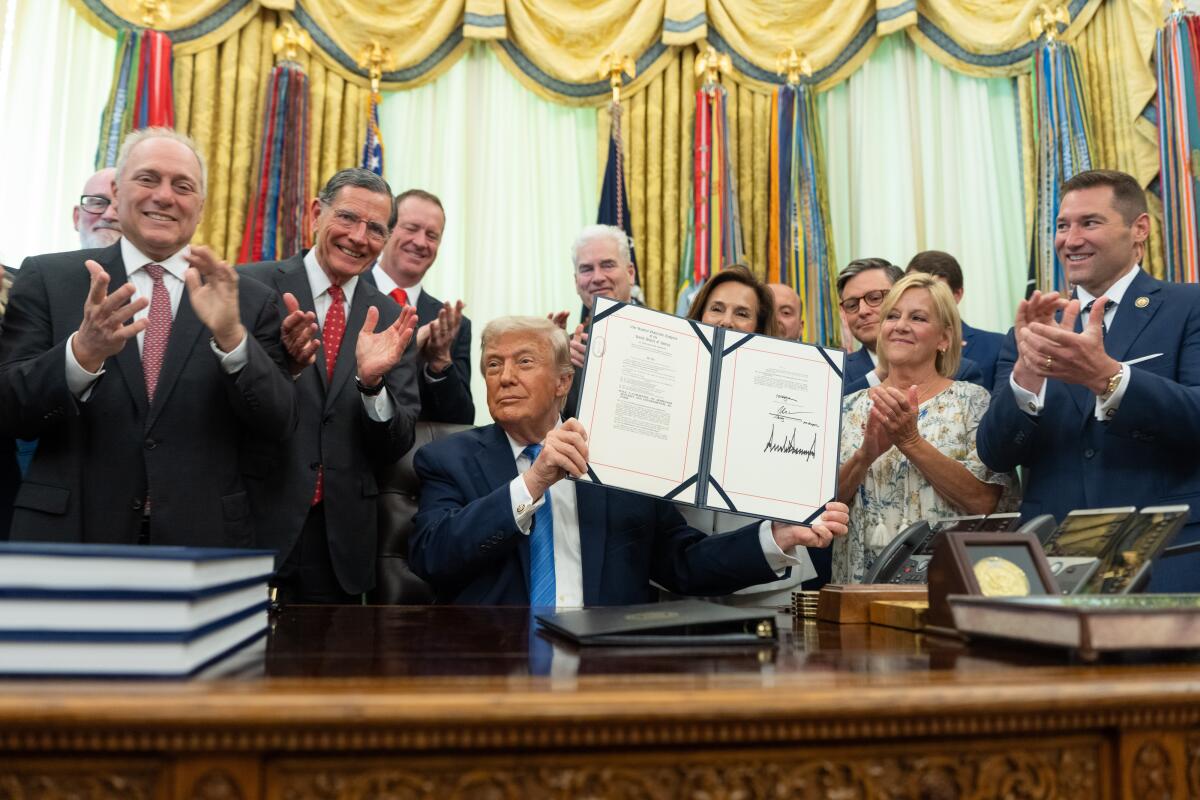
President Trump displays the signed “Secure America Act” during a ceremony in the Oval Office on Wednesday. The act provides $70 billion for immigration enforcement and border-security agencies.
(Aaron Schwartz / CNP, Bloomberg)
The number of arrests by ICE agents has declined. On average, ICE arrested about 1,000 immigrants per day in early March, down from a peak average of just under 1,400 in mid-January, agency data show. And there are fewer detained immigrants — facilities across the country held about 60,000 detainees in April, compared to more than 70,000 in late January.
The downturns prompted some Trump loyalists to say the administration is failing to fulfill his signature promise, which is an assertion the administration rejects.
“ICE is NOT slowing down,” said Homeland Security spokesperson Lauren Bis. “Since Day One, DHS law enforcement has been delivering on President Trump’s promise to the American people to arrest and deport criminal illegal aliens.”
At a border security conference last month, Tom Homan, who leads border policy for the White House, suggested immigration agents would return to more muscular enforcement tactics.
“You ain’t seen s— yet,” he told the audience.
But along with focusing on deportations, the administration is deploying other tactics to deter illegal — and legal —immigration.
ICE agents confront protesters on June 8 as they gather outside the federal immigration center at Delaney Hall in Newark, New Jersey, where ICE is housing detained immigrants.
(Spencer Platt / Getty Images)
Curtailing visas
Last month, the Department of Homeland Security announced that “except in extraordinary circumstances,” immigrants seeking lawful permanent residency must leave the U.S. to complete the process. After a backlash, the administration defended the policy, saying it won’t prevent anyone who qualifies for a green card from getting one.
U.S. Citizenship and Immigration Services, the agency in charge of processing immigration benefits, has upped security screening since Trump took office. The agency says that’s to root out fraud, but critics say all it does is unnecessarily slow down a system that already vets applicants vigorously.
The administration indefinitely banned people from 75 countries from receiving immigrant visas, which allow people to move permanently to the U.S.
In a similar move, the government halted the processing of immigration applications for people from 39 countries and who are already in the U.S. On June 5, a federal judge struck down the policy in a scathing ruling that said the administration “justifies its actions with pretextual concerns of ‘national security’ that mask anti-immigrant sentiments.”
Children of Guatemalan origin, from left, Areimy, Mariela and Enrique, arrive at Miami International Airport on Dec. 4, 2025, as they prepare to leave the United States to reunite with their recently deported parents in Guatemala.
(Chandan Khanna / AFP via Getty Images)
The judge’s ruling may offer relief, but for many immigrants, the effects of the policy are devastating. Armin, a 42-year-old from Iran, said he has racked up more than $15,000 in debt since the pause took effect in December. Armin asked The Times not to fully identify for fear of jeopardizing his immigration case.
The nutritional scientist came to the U.S. in 2019 on a student visa and has a pending green card application under a provision that allows certain highly skilled immigrants to apply for permanent residency without needing an employer to sponsor them.
After receiving his PhD and completing a postdoctoral program, Armin was in between jobs when he received a research grant in November. But with the processing of his work authorization halted, the university that issued the grant said it couldn’t hire him as a research associate. In February, he was turned down for another job.
Armin said he is confused about why the administration won’t differentiate between legal immigrants and those who should be deported.
“I can’t believe it,” he said. “I’m doing research and my research has national interest benefits. You expect support from the government. Unfortunately they don’t differentiate. They don’t care about your resume.”
Bier said the visa policies affect half of all legal immigrants coming from abroad. He published a report in April about how Trump has cut legal immigration far more than illegal immigration, noting that the administration’s policies have led to big drops in visas for international students, high-skilled workers and refugees.
“The legal immigration system is being used as a means to carry out the mass deportation agenda,” he said.
Alessandro Negrete, who lived most of his life in the U.S. undocumented, crosses into Mexico after deciding to leave.
(Robert Gauthier / Los Angeles Times)
Encouraging self-deportation
More than 90,000 immigrants have been granted voluntary departure since the start of the Trump administration, according to federal immigration court data through April that was analyzed by TRAC, a data research organization. Voluntary departure avoids official deportation and can leave open the possibility of an immigrant returning to the U.S. legally.
Homan, who declined to be interviewed for this story, has said self-deportations were part of the administration’s immigration plan all along.
“We knew if we surged unlimited ICE resources in the interior, and we do these operations, that that will force those that are here illegally to leave on their own,” he recently told the Washington Examiner.
Halting work permits
In the past, asylum seekers and others with deportation protections have had the ability to seek permits to work legally in the U.S. But work is now an administration target.
One proposed regulation would prevent asylum seekers from working legally in the U.S. Another proposal, published Friday, would further restrict access to work permits for other immigrants.
Under a rule that took effect last month, asylum seekers pay an annual $102 fee within 30 days of receiving a notice from U.S. Citizenship and Immigration Services. If the deadline is missed, their applications will be rejected — with no opportunity to appeal — and they could be placed in deportation proceedings. Those who apply for asylum with the agency have entered the U.S. legally, such as on a visa, and are not undocumented.
Asylum seekers rest at a Tijuana migrant shelter a day after President Trump began his second term in the White House.
(Robert Gauthier/Los Angeles Times)
Conchita Cruz, co-executive director of the Asylum Seeker Advocacy Project, said many asylum applicants have not received notice that the fee is due.
Cruz said she believes the Trump administration is using these changes as an excuse to dismiss people’s asylum claims. While the president has the power to decide whether to offer or rescind humanitarian programs, such as Temporary Protected Status, the right to seek asylum is enshrined in law.
“We’re worried this is a pretext for people to fall out of the asylum system and fall out of the workforce,” she said.
The processing of work permits has already been slowed, leaving many immigrants who still qualify for employment authorization unable to work.
During a House Homeland Security Committee hearing last week, Rep. Lou Correa (D-Santa Ana) asked Homeland Security Secretary Markwayne Mullin to help him speed up the work permit renewals for two police officers who were recently fired by agencies in his district because their DACA status expired.
Mullin said he would help but that Congress ultimately must pass a permanent solution for DACA recipients.
“These are police officers on Main Street, sir,” Correa responded.
“Not all of them are,” Mullin said. “I’m not just going to wave a magic wand and fix them all.”
“You have that magic wand — that’s your job,” Correa said.
It wasn’t just Democrats complaining about slow processing. Rep. Gabe Evans (R-Colo.) similarly asked Mullin for help because many of his constituents — “farm workers, youth ministers, nurses, grocery store business managers” — who have lived and worked in the U.S. legally for decades are now having trouble renewing their visas.
Secretary of Homeland Security Markwayne Mullin, left, and President Trump, center, walk to the motorcade after exiting Air Force One at Joint Base Andrews, Maryland, on May 20.
(Kent Nishimura / AFP via Getty Images)
Calls for mass deportations
Mullin, who took the reins in March after Trump fired his predecessor, Kristi Noem, rolled back some of Noem’s policies, including telling agents to stop entering homes without judicial warrants and canceling some contracts she had initiated.
But the changes and the downturn in arrests have drawn criticism from some fervent Trump supporters.
“Trump’s legacy is tied up in this,” said Mike Howell, a former DHS attorney who founded a group called the Mass Deportation Coalition. “It’s going to be hard to tell a younger voter to get excited to show up when one of their top issues is mass deportation and, a year and a half in, it doesn’t appear it’s going full-steam ahead.”
Howell said enforcement at work sites is critical to scaling up arrests and deportations. That more such operations haven’t happened, he said, is a political decision to appease wealthy donors and special interest groups who don’t want to see their workers deported.
The architect of Trump’s immigration agenda is Stephen Miller, a top White House aid who has called for a “moratorium on immigration from third-world countries,” demanded 3,000 arrests per day and said that immigrants and their descendants “recreate the conditions, and the terrors, of their broken homelands.”
Royce Bernstein Murray, a former Homeland Security official who worked on immigration policy under the Biden administration, said the winding down of flashy enforcement surges has given the administration more time to “focus on tearing down the legal immigration system.”
“This is Stephen Miller’s sweet spot,” she said. “He was never in enforcement — he’s a policy guy. This is really an opportunity for him to make good on all he has planned for years.”
While ICE has, in recent months, returned to its more conventional targeted enforcement tactics, Homan has sought to make clear that mass deportations are still a goal.
“For the people out there saying ‘President Trump’s getting weak on mass deportation,’ you don’t know what the hell you’re talking about,” Homan said at the border expo.
On Monday, Homan told Fox News that he had just reviewed plans for an ICE operation that would surge agents to New York City.
WASHINGTON — Dozens of House Democrats are asking the new director of Immigration and Customs Enforcement to roll back a policy that they say hinders their ability to speak with detainees during oversight visits.
The new policy requires that lawmakers identify detainees by name at least two business days before a visit and provide a signed consent form from each detainee. It’s the latest point of conflict in an ongoing battle over when and how lawmakers can inspect immigration facilities.
In a letter Thursday to acting ICE Director David Venturella, Rep. Mike Levin (D-San Juan Capistrano) and 77 other members of Congress, including two dozen from California, argued that they need to conduct constant oversight of immigration facilities because of historic levels of reports regarding the mistreatment of detainees, deaths in custody and substandard facility conditions.
“This Administration has enabled a revolving door of arbitrary policies, directives, and guidance on member access to facilities or on communication with detainees designed to hinder any productive oversight,” they wrote.
The letter was written in response to the new policy, which was outlined in a memo last month.
In the letter, Levin and the other members wrote that detainees have a hard time accessing the visitation form because it is at times unavailable at a detention center’s law library. They said it limits their ability to speak broadly with detainees, particularly those from vulnerable populations, such as the elderly.
Detainees previously used a sign-up sheet to meet with members of Congress or just started talking to detainees they encountered during facility tours.
In the memo outlining ICE’s new policy, then-acting director Todd Lyons said the increased visits by members of Congress have become a burden and a time suck. Homeland Security didn’t immediately reply to a request for comment, but previously said that the policy doesn’t prevent lawmakers from speaking with detainees.
Levin said the increase in visits was necessary because the agency slashed staffing of its oversight offices. The letter notes that for next fiscal year, the president requested additional cuts to the Homeland Security Office of Inspector General.
“These actions, coupled with the constant changes to policies surrounding member access to facilities, reveal a clear attack on the levers that ensure government transparency at every level,” the members wrote.
Democratic House members sued the Trump administration last July after they were repeatedly denied access to immigrant detention facilities in California and across the country.
Homeland Security officials previously implemented a policy requiring lawmakers to give seven days’ notice before a visit, but that policy was temporarily blocked in federal court.
This week, lawyers said a Belizean man who helped organize hunger strikes at the Adelanto ICE Processing Center was moved to facilities out of state and scheduled to be deported after he spoke to three members of Congress about conditions at the detention center in San Bernardino County.
The first serious legal challenge to the House settlement will come courtesy of a USC freshman linebacker.
Talanoa Ili, a top-100 recruit in the Trojans’ vaunted 2026 class, joins Stanford quarterback Charlie Mirer as one of two lead plaintiffs in a class-action lawsuit that takes aim at the system implemented since the settlement ushered in a new era of direct payment from universities to athletes. The suit, which was filed Tuesday, accuses the NCAA, the Power Four conferences and the enforcement arm they created — the College Sports Commission — of participating in a “conspiracy” by creating a system of policies that have “direct anti-competitive effects, including the suppression of [name, image and likeness] compensation below competitive levels.”
Those policies, their attorneys argue, violate state laws in California that prohibit restrictions on NIL rights, as well as federal antitrust statutes. They’re seeking monetary damages, as well as an injunction that would upend the enforcement structure created to determine whether individual NIL deals over $2,500 meet criteria, including whether they have “a valid business purpose” or fall within a reasonable range of market value.
The clearinghouse, NIL Go, was created with the hope of eliminating an influx of booster-funded NIL deals that were basically direct payments from donors to the program. But since its inception, the system has been more restrictive and worked less efficiently than some schools and athletes might have hoped. As of last month, according to Yahoo Sports, more than $125 million worth of NIL compensation that had been promised to athletes had been rejected by the clearinghouse or was still under review.
In Ili’s case, the complaint states that he received a “substantial multi-year offer” from USC’s House of Victory collective in 2024 that led him to commit to the Trojans, only to have the offer disappear after approval of the House settlement.
“Absent the NIL Restrictions on Direct Pay NIL Compensation, Ili would have received more for his NIL rights than he now receives,” the complaint states. “The Agreement has thus injured Ili.”
Mirer, meanwhile, claims that he has received no NIL compensation from Stanford’s collective or revenue-sharing money from the university since 2024 as a result of the settlement.
Stanford quarterback Charlie Mirer during a game last season.
(Godofredo A. Vásquez / Associated Press)
“The [CSC agreement] has suppressed, deterred, and effectively terminated the economic relationships that had produced his prior NIL compensation,” the lawsuit says.
Even the plaintiffs in the House settlement, which created the CSC, are in the process of challenging the current system. On Wednesday, plaintiff attorney Jeffrey Kessler will argue in a hearing that school-affiliated businesses such as multimedia rights holders or corporate sponsors, should not be subject to the CSC’s rigorous criteria for NIL deals. That decision could also open the floodgates, with schools using those entities to circumvent the cap.
Two U.S. senators are hoping to pass legislation they believe would bring more stability to college athletics and thwart legal challenges. Ted Cruz (R-Texas) and Maria Cantwell (D-Texas) spoke with presidents and chancellors from the Big Ten Conference on Tuesday about a bipartisan bill, the Protect College Sports Act, which would codify some of the CSC’s policies into federal law.
Republican Steve Hilton, a former Fox News commentator, clinched one of the top spots in California’s gubernatorial primary on Tuesday, earning him the right to challenge veteran Democratic politician Xavier Becerra in the November election to determine the state’s next governor.
The contest offers voters two starkly different politicians. Hilton was endorsed by President Trump and has wooed his MAGA supporters, blaming Democratic policies for California’s homelessness crisis, high cost of living and other entrenched ills. Becerra campaigned as a battle-tested warrior against the Republican president and a champion of affordable healthcare. He could make history as the state’s first elected Latino governor.
Hilton’s victory was declared by the Associated Press on Tuesday, days after Becerra secured one of the top spots and a week after the June 2 election. Under California’s primary system, the two candidates who receive the most votes in the primary advance to the November general election, regardless of their party affiliation. According to the latest vote count, which is ongoing, Becerra has a slight edge over Hilton.
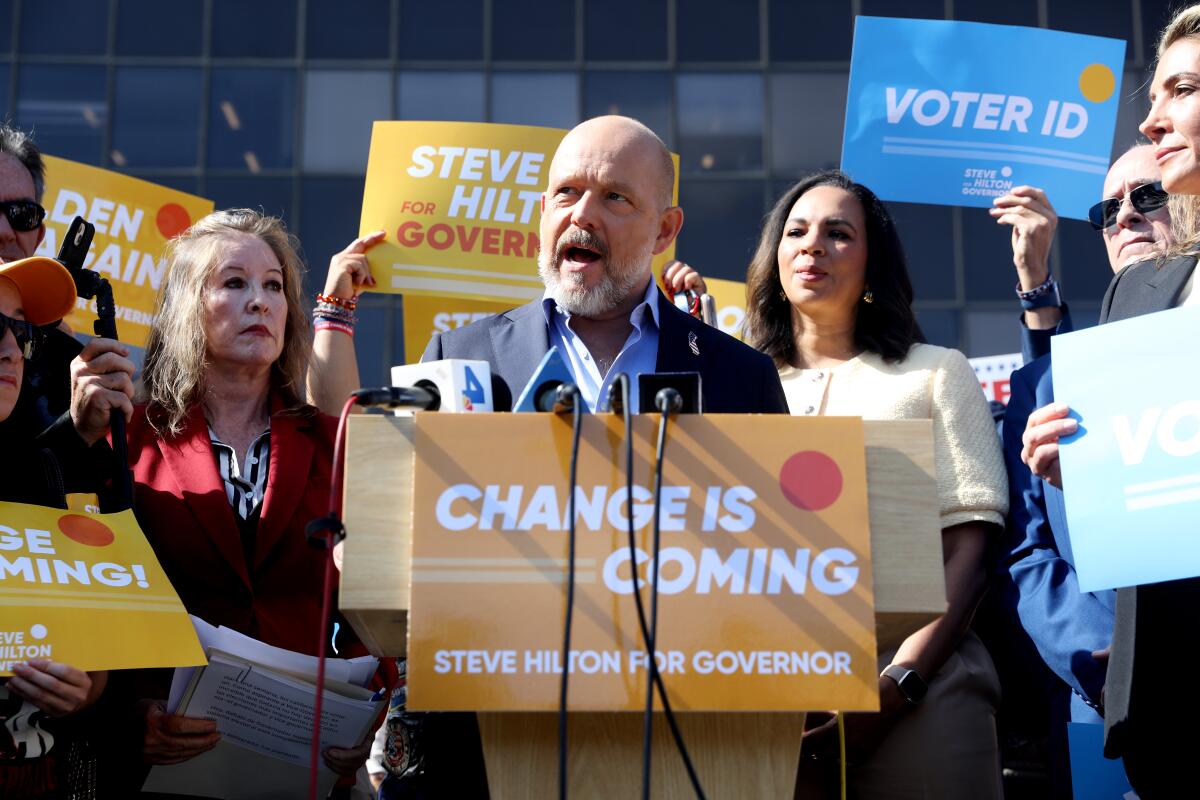
California Republican gubernatorial candidate Steve Hilton, center, flanked by lieutenant governor candidate Gloria Romero, left, and California Republican Party Chairwoman Corrin Rankin, right, hold a press conference to discuss election and voting reforms at the Los Angeles County Registrar-Recorder/County Clerk headquarters on Tuesday in Norwalk.
(Gary Coronado / For The Times)
Democrat Tom Steyer finished in third place. The hedge fund founder and environmental activist spent $216 million of his own money on his campaign, and now joins the legion of other high-profile, self-funding candidates rejected by California voters.
Becerra heads into the Nov. 3 election with a distinct advantage — Democratic voters in California outnumber Republicans by an almost 2-to-1 margin, a telltale reason why no GOP candidate has won a statewide race since 2006.
The contrast between Becerra and Hilton, both on policy and political personas, couldn’t be more pronounced.
A British immigrant and former political advisor to U.K. Prime Minister David Cameron, Hilton, 56, embraces traditional conservative ideals that have echoed across the country since the days of President Reagan — cutting taxes, weeding out government fraud and waste and promising to unbridle entrepreneurs and homebuilders from stifling state regulation.
But he’s also ventured into MAGA territory, declining to acknowledge that Trump lost the 2020 presidential election and promising to extradite California doctors who provide abortion pills to other states for prosecution.
Becerra, 68, came up in Los Angeles politics in the 1980s and has long supported policies to expand protections and resources for immigrants with or without legal status. Married to Harvard-educated OB-GYN Carolina Reyes, Becerra has also staunchly opposed abortion restrictions throughout his career.
In Congress and other positions, Becerra earned a reputation as a cerebral, analytical politician who would fully commit to his positions after taking time to mull them through.
A straight-laced family man with a Catholic upbringing, Becerra was more reserved during the debates — a quiet confidence that drew some voters to support him. He also faced criticism from his rivals for failing to offer detailed housing and healthcare policies.
Hilton, who cuts an unmistakable image with his bald crown and clipped English accent, proved himself as a polished communicator during the debates, skills honed by his years as a Fox News analyst.
Television hosts must translate complex issues into easily digestible sound bites, said Republican strategist Matt Klink. “Most voters want a CliffsNotes version of the issues,” Klink said.
Republican strategist Kevin Spillane credits Hilton’s TV show, “The Next Revolution,” which ran for six years, with boosting his profile, calling Fox News the most important media vehicle within the conservative and Republican framework.
Hilton “understands how politics and how communications work,” Spillane said.
He often appeared relaxed during the gubernatorial debates, at points even complimenting or joking with his rivals as they parried on stage.
At a CBS debate earlier this year, Becerra referred to President Trump, who endorsed Hilton, as the Republican candidate’s “daddy.” Hilton responded with a quip that quickly deflated the attack.
“It would be rather amazing,” said Hilton, at the possibility of being Trump’s son. “My daddy was the goalie for the Hungarian national ice hockey team.”
In an interview last week, before the election, Hilton said he enjoyed the debates. “In a weird way, I was sad when we had the last one,” he said. “I’m looking forward to debating whoever it is.”
As a former political advisor to Britain’s Conservative Party, Hilton helped usher in a green, socially liberal strain of conservatism.
He also infuriated colleagues in the coalition government, the British press reported, proposing a stream of unconventional ideas: scrapping maternity leave, abolishing job centers, even buying cloud-bursting technology so Britain would have more sunshine. In 2012, he moved full time to the Bay Area.
Hilton, who founded a nonprofit on California policies, was known for his frequent visits in the last couple of years to the state Capitol for discussions with legislators.
By contrast, Hilton presented himself as the “more cosmopolitan” candidate who “can talk to the hedge fund manager or the small-business owner or the Sacramento lobbyist,” said Klink said.
“Hilton was more energized at the end, when it mattered,” said Spillane, contrasting the two Republicans.
Past Republican candidates, including businessman John Cox in 2018 and former eBay CEO Meg Whitman in 2010, have self-financed their campaigns with their vast fortunes.
By contrast, Hilton spent just a few million dollars on media advertising, he said in an interview last week.
He said he ignored advice from consultants who told him to do a launch announcement and then unleash a wave of ads in the last month of the campaign.
“I just said, ‘I want to do it the old-fashioned way,’ and that’s what we’ve been doing,” said Hilton in the interview before the election. “We’ve been to nearly every single county…. stepped it up with our town halls.”
Nina Royal, 83, who lives in Los Angeles and is a community advocate for her Tujunga neighborhood, voted for Hilton, saying that he understands California’s problems.
“He’s a realist,” said Royal. “He has a clear view of what needs to be done.”
Times staff writer Jenny Jarvie contributed to this report.
New York Mayor Mamdani was among those critical of FIFA’s decision to ban water bottles at World Cup stadiums.
Published On 7 Jun 20267 Jun 2026
FIFA has made changes to its stadium policy, allowing fans to bring disposable water bottles into match stadiums after a ban earlier this week drew backlash from supporters and tournament host city officials.
FIFA’s initial policy permitted fans to carry empty, transparent, reusable plastic bottles up to 1 litre (34oz). However, the governing body made a U-turn on that policy on Thursday and banned fans from carrying reusable water bottles into venues due to safety concerns.
Recommended Stories
list of 4 itemsend of list
The move essentially meant fans would have to buy water or soft drinks from concession stands in the stadium, where prices would “remain consistent with other events held at each stadium”, according to FIFA.
The backlash prompted FIFA to issue what it called a “clarification” on its stadium policy, saying: “All fans will be permitted to bring in one soft, plastic, 20-ounce (590ml), factory-sealed disposable water bottle into any FIFA World Cup 2026 match in the USA and Canada.
“Fans will not be permitted to bring in hard-sided, reusable water bottles due to safety and security reasons.”
The updated policy made no mention of the policy for stadiums in Mexico.
New York City Mayor Zohran Mamdani was pleased with FIFA’s decision to reverse the water bottle ban.
“No one should have to fear being priced out of being hydrated, especially fans who are often waiting for hours before a game in extreme heat,” said football fanatic Mamdani, who has championed equitable prices for this World Cup in his home city. Last month, he made 1,000 tickets costing $50 available to city residents as match tickets reached well into four figures.
Forecasters have warned that fans could face health risks from extreme heat at open-air venues during the World Cup, which is being cohosted by the United States, Canada and Mexico from June 11 to July 19.
A report published by the World Weather Attribution research group last month estimated that 26 of 104 games at the World Cup are likely to be played in conditions where the Wet Bulb Global Temperature (WBGT) exceeds 26 degrees Celsius (78.8 degrees Fahrenheit).
WBGT is a measure of heat stress on the human body, which combines temperature, humidity, wind and sunlight.
At last year’s FIFA Club World Cup in the US, where fans complained of searing temperatures, supporters were also barred from bringing water bottles into venues.
FIFA has noted that misting stations, fans, hydration stations and cooling tents would be available in “the stadium footprint”.
Fans at the 2022 Qatar World Cup were also not permitted to bring reusable water bottles into stadiums.
A federal judge sided with California and other Democratic states on Friday in a preliminary injunction that blocked the Trump administration’s attempt to condition food benefits on compliance with the president’s policies on gender and immigration.
Twenty states and the District of Columbia filed a lawsuit in March against the Trump administration in U.S. District Court in Massachusetts, arguing that the “unlawful” and “unconstitutional” funding requirements are vague and designed to force policies on states.
Billions in federal funding are ultimately at stake, including money for school lunch programs that provide meals to 30 million children nationwide and food stamps that support about 40 million Americans living in low-income households.
“As the Trump Administration tries to use essential programs and billions in funding as leverage to advance their hateful, discriminatory agenda, California continues to fight to uphold the law and ensure that our communities can continue to access the funding they need to thrive,” said California Atty. Gen. Rob Bonta in a statement.
The policy shift from the United States Department of Agriculture marks another effort by the president to force left-leaning states to submit to his positions on hot-button political and cultural issues to receive government funding. California’s current budget relies on $174.5 billion in federal dollars, or roughly one-third of the overall state budget funds.
The funding conditions from the USDA relate to gender ideology, women and girls’ sports and immigration, according to the lawsuit.
States argue that the conditions do not explain what activities are prohibited for entities that receive grants. The USDA did not cite any law allowing the organization to impose anti-discrimination policies that go beyond federal law, the suit states.
The states that joined the lawsuit contend that they are left with the “unlawful” choice of adhering to the conditions or risk losing up to $74 billion in collective federal assistance from the USDA.
U.S. District Judge Myong Joun approved a preliminary injunction Friday and is expected to issue a memorandum later explaining the decision, according to the Associated Press.
BOSTON — A federal judge on Friday struck down a Trump administration policy enacted after the shooting of two National Guard members that made it harder for immigrants from dozens of countries to stay and enter the U.S.
In a ruling harshly criticizing the administration, U.S. District Chief Judge John McConnell Jr. said the policy “threw the lives of countless immigrants living in the United States into indeterminate legal limbo,” and he accused the U.S. Citizenship and Immigration Services of ignoring the law.
“In enacting its latest immigration policies, USCIS: claims statutory and regulatory authority that it does not possess; makes decisions without the reasoned explanations that it must provide; acts without regard for the reliance interests of applicants that it must consider; and justifies its actions with pretextual concerns of ‘national security’ that mask anti-immigrant sentiments that it is forbidden from letting influence its decision-making,” he wrote. “In legal terms that means USCIS’s actions are contrary to law and arbitrary and capricious.”
A spokesperson for the Department of Homeland Security did not immediately respond to a request for comment.
The policies enacted after the National Guard shooting last year meant that immigrants from 39 African, Asian, Latin American and Middle Eastern countries have been “categorically barred” from receiving final decisions on, among other things, their asylum, work permit, green card and citizenship applications.
“This ruling reaffirms a basic principle: the federal government cannot shut down lawful immigration pathways or discriminate against people based on where they come from,” said Skye Perryman, president and CEO of Democracy Forward, which represented the plaintiffs in the case. “These unlawful policies caused enormous harm to families, workers, asylum-seekers, and communities across the country who were left in limbo, unable to work, access protections, or move forward with their lives.”
The policies apply to U.S. Citizenship and Immigration Services, which approves applications for immigrants to work and become citizens. The agency, which is within the Homeland Security Department, often grants asylum, but only for those already in the United States when they apply. Immigration judges grant asylum to those who are stopped at the border; the ruling does not affect them, and neither do the policies that sparked the lawsuit.
It is part of an ongoing effort by the administration to tighten U.S. entry standards for travel and immigration, in what critics say unfairly prevents travel for people from a broad range of countries. The administration suggested it would expand the restrictions after the arrest of an Afghan national suspect in the shooting of two National Guard troops over Thanksgiving weekend.
In its motion to dismiss, which the court denied, the government argued that Congress gave the executive branch broad authority over immigration policy, including “the entry of aliens into the United States as well as discretion within the statutory scheme to confer as well as withdraw various discretionary benefits.”
“This case rests on a remarkable premise: that a federal court should prevent an agency from issuing the very policy guidance that provides government personnel with the guardrails necessary to ensure consistent, non-arbitrary, and individualized decisionmaking consistent with federal law,” the government wrote in its brief.
Immigration groups celebrated the ruling.
“This ruling sets a powerful precedent that the administration cannot ignore the law as laid down by Congress and cannot arbitrarily bar immigration benefits on the basis of national origin by fiat,” said Jamal Abdi, president at the National Iranian American Council. “Fortunately, this is still a nation of laws, and those who uphold America’s values have recourse to challenge and push back on such discriminatory, arbitrary policies.”
Shawn VanDiver, a Navy veteran who heads a coalition that supports Afghan resettlement efforts called #AfghanEvac, said the ruling was a “significant victory for the rule of law and for thousands of Afghan allies and other immigrants who followed every requirement asked of them.”
“Just this week in Dallas and Fort Worth, we met people who feared losing jobs because delayed work permit renewals threatened their livelihoods, families who postponed education, travel, and homeownership because they did not know when their cases would be resolved, and future Americans who had expected to become citizens only to see their applications stall without explanation,” VanDiver said.
Sonja Shaw — a Trump-aligned conservative Republican whose public profile rose as she became identified with culture-war causes, including banning transgender athletes from girls’ sports — has emerged as the leading vote-getter in the June primary for California’s superintendent of public instruction.
With more than 80% of precincts at least partially reporting, Shaw was well ahead of Democrat Richard Barrera, holding a lead that would be difficult to surmount.
Both Shaw and Barrera are school board presidents.
Shaw heads the elected Board of Education for Chino Valley Unified in San Bernardino County, a diverse but substantially conservative inland portion of Southern California.
Barrera heads the school board of San Diego Unified, the state’s second largest school district, serving an area with liberal leanings, but that is also politically diverse.
In the primary Shaw was greatly helped by a candidate field that included seven Democrats — most with a voter and financial base that would make them competitive. Incoming results show they divided votes among themselves.
Shaw managed to consolidate the Republican vote, which put her on top for the primary. A second Republican candidate finished far behind her.
On Tuesday night, Shaw sounded hopeful and confident that her campaign themes were resonating beyond her conservative roots.
“I am humbled and grateful that Californians from every corner of our state have rallied behind this campaign,” Shaw said in a statement. “What we’ve built is more than a campaign. It’s a diverse movement of communities who believe our schools can do better and who are determined to make that happen.”
Among its high-profile actions, the Chino Valley board majority put forward a policy that would require parents to be notified if their child expressed gender-identity issues at school. Shaw and her allies also approved a policy that allows parents to challenge the content of library books.
Positioned in a runoff against one Democrat — in a state where Democrats dominate — makes for a challenging campaign.
“Tonight is not the finish line,” Shaw said. “It’s the beginning of the final stretch.”
Barrera, who was not available for comment late Tuesday night, benefited immensely from a $5 million independent expenditure campaign from the California Teachers Assn., which, in the recent past, has seemed determined to spend whatever it takes to get an ally into the state superintendent’s office.
Barrera, besides his work as a longtime public official, has been a senior aide to current state Superintendent Tony Thurmond. Thurmond could not run again because of term limits and instead mounted an unsuccessful campaign for governor.
The state superintendent has limited authority over school districts, which are locally managed. The officeholder instead manages the California Department of Education. This agency guides local school districts and also provides partial oversight. The state superintendent also typically takes advantage of the bully pulpit on education issues.
The office has an uncertain future because Gov. Gavin Newsom is pushing a proposal to reimagine the office and redistribute some of its duties.
In recent years, the security strategy and foreign policy of the United States have witnessed a fundamental transformation in their main principles, as demonstrated by the second US-Israeli war against Iran, which this author refers to as the “Second Iran War” to distinguish it from the first military confrontation between these three parties in the summer of 2025, known as the “Twelve-Day War.”
The leadership factor, represented by President Donald Trump, has become an unprecedentedly broad influence on the decision-making process related to US foreign policy and national security, whether concerning the declaration and conclusion of war, or even in peacetime, particularly regarding Washington’s relations with its traditional allies in Europe and the Middle East.
This analysis focuses on the case of the “Second Iran War” as a clear example of the increasing role of the US president’s personal characteristics in shaping strategic decisions related to this war and managing Washington’s relations with its partners in the Arabian Gulf region.
This analysis is divided into two main sections, as follows:
First, the traditional determinants of US security strategy and foreign policy.
Second, the Trump administration and the growing role of the president in foreign policy and national security.
Third, the Second Iran War as a model for the increasing influence of the leadership factor in the US decision-making process.
First, the traditional determinants of US security strategy and foreign policy:
There is a set of traditional constraints governing decision-making in the United States, both in domestic and foreign policy. These constraints stem intrinsically from the nature of the American political system, the constitutional and societal environment within which it operates, and the historical development of the nation some 250 years ago.
In summary, these constraints can be divided into the following:
1. Constitutional and historical constraints, including the federal constitution and the practical actions of foreign and security policy-making institutions over the past decades.
2. Institutional determinants, which consist of the roles exercised by the legislative, executive, and judicial branches as defined by the Constitution, including: Congress (the House of Representatives and the Senate), and the federal departments and agencies concerned with U.S. foreign policy and national security (the Departments of State and Defense, the National Security Council, and the various intelligence agencies, most notably the Central Intelligence Agency (CIA)).
3. Political determinants, foremost among them the role played by the President of the United States in decision-making—what political literature calls the “leadership factor”—which is determined, broadly or narrowly, by a range of considerations, including: the President’s political experience, personal characteristics and interests, and ideological orientations, convictions, and personal preferences.
Traditionally, American historical experience indicates that constitutional and institutional constraints have a dominant influence on foreign policy and national security decision-making, compared to the limited influence of the president’s personal characteristics and psychological environment.
This has resulted in a near-consistency in the general direction of US foreign policy and security strategy across successive administrations, regardless of the president’s party affiliation (Democrat or Republican) or personality traits.
Second, the Trump administration and the growing role of the president in foreign policy and national security:
Unlike previous administrations, Republican President Donald Trump, since his first presidential term (2016-2020), has expanded his role in the decision-making process related to US foreign policy and its security strategy abroad, to the point of bypassing the federal institutions responsible for making this policy and strategy, or at the very least marginalizing the role of these institutions and failing to coordinate with them in advance in an unprecedented manner.
Trump’s interference in this regard, and his violation of institutional limits during his second presidential term, which began in January 2025, has increased to the point of causing great embarrassment to those in charge of American foreign and security policy-making institutions on the one hand, and on the other hand, it has led to pushing towards taking decisions – or at best adopting a declared political discourse – that has caused great damage to the foreign relations of the United States and posed a threat to its strategic interests as a superpower, whether with its immediate geographical neighborhood in the Americas (Canada, Mexico, Venezuela, and Cuba), or with its traditional transatlantic allies (Europe and NATO), and finally with important partners in the Middle East region.
Without going into detail about the reasons for this excessive interference by President Trump in American foreign policy and security strategy, in our estimation, this is largely due to the psychological and personal characteristics of the Republican president, whose political discourse and vocabulary indicate that he considers himself the “savior” of the United States and personally qualified to restore it to its glory, which he expresses in his election slogan “Make America Great Again.”
Third, the Second Iran War as a model for the increasing influence of the leadership factor in the US decision-making process:
The events of the second Iran-Iraq War, which began on February 28, 2016, provide a clear example of the growing influence of leadership dynamics, at the expense of constitutional and institutional constraints, in shaping and implementing American foreign policy and security strategy decisions under the Trump administration.
This assertion is supported by two key indicators, as follows:
1. Washington’s Decisions to Launch the War and the Negotiations Related to Ending It:
A close examination of Washington’s decision to launch the war against Iran on the morning of Saturday, February 28, 2026, reveals that President Trump based this decision on his personal convictions regarding the reliability of the reports and information provided to him by Israeli Prime Minister Benjamin Netanyahu – with whom he has a friendly and politically harmonious relationship – concerning the threat posed by Tehran’s nuclear program and its ballistic missile capabilities to Israel, America, and the region. He believed that the opportunity was ripe to quickly eliminate the religious regime in Iran by launching a powerful and swift military strike that would lead to its downfall after instigating an internal uprising.
In contrast, Trump ignored warnings from US foreign policy, national security, and defense institutions about the risks and feasibility of a war against Iran from the perspective of vital US interests in the Middle East. The Republican president also disregarded the reservations of senior administration officials regarding this military strike, including Vice President J.D. Vance, Secretary of State Marco Rubio, and Special Envoy for Middle East Peace Steve Wittkopf.
Further bolstering this claim are Trump’s attempts to deny that Israel pushed him into this war. He has asserted on more than one occasion that he made the decision himself, and even that he was the one who pushed Tel Aviv to engage in it. He has also emphasized on other occasions that the matter of negotiating and ending the war is solely his responsibility, and that Netanyahu is simply doing what he asks of him regarding the war with Iran.
According to the literature of political psychology and the principles of political communication, when politicians exaggerate their denial of something, or deny it without directly accusing them, it often confirms the accusation, not the other way around.
This claim is is further supported by reports in the US indicating that Trump sent the Israeli Prime Minister a draft memorandum of understanding between Washington and Tehran to end the war, as part of the US president’s consultations to reach a final decision on ending the conflict.
This means that Trump made his decision to wage war on Iran—and will most likely make his final decision regarding negotiations to end it—based on elements of his psychological environment and personality traits, and not on the factual data contained in the reports and recommendations of the foreign policy and national security agencies, which are based primarily on the strategic interests of the United States and its international and regional orientations.
2. The Harshness and Crudeness of US Presidential Rhetoric Towards Strategic Partners in the Arabian Gulf:
President Trump’s public political discourse since the start of the war has included statements characterized by an unprecedented level of harshness in American policy towards Washington’s strategic partners in the Gulf Cooperation Council (GCC) countries.
For decades, the United States has maintained a balanced and rational approach to its relations with the Gulf states, a relationship cemented by strategic alliances and defense agreements since the 1991 Gulf War. This was true even during periods of open tension or simmering resentment between the US and some Gulf capitals.
In our estimation, this is explained by the fact that successive administrations and presidents in the White House have based their decisions, policies, and political discourse in general, and towards their allies and strategic partners in particular, on the constitutional and institutional parameters for drawing up and making Washington’s foreign policy and security strategy, especially in the vital geographical areas for national security and American strategic interests, as is the case with the Middle East region and at its heart the Arabian Gulf region.
However, in a departure from this approach and in an unprecedented move, the second Iran-Iraq War witnessed Trump’s political rhetoric, which included insults to some Gulf Cooperation Council (GCC) states and belittling of others. He even went so far as to issue explicit and public threats against one of the Gulf Arab states, the Sultanate of Oman, in a surprising, shocking, and unprecedented act.
On May 28, 2016, Trump threatened Oman, saying he would “blow it up” if it cooperated with Iran on joint management of the Strait of Hormuz. The US Treasury Department also threatened to impose sanctions on Muscat if it proceeded with an agreement with Tehran to manage the strait, which Iran had used as a weapon of economic pressure during the war.
Conclusion:
The leadership factor, represented by the president’s personal characteristics, psychological environment, and political beliefs, has become the pivotal and most important factor in shaping US foreign policy and national security decisions during the administration of President Donald Trump, including the decision to go to war. This has come at the expense of the diminishing influence of other objective determinants, most notably constitutional and institutional ones.
This was clearly evident in Trump’s behavior and political rhetoric during the Second Iran War. This unprecedented development is likely to continue during the remaining two years of the Republican president’s term, until 2028.
The second Iran war demonstrated that such actions would negatively impact Washington’s future relations with its allies and strategic partners, or at the very least, erode trust in it as a reliable and credible international partner.
Furthermore, it would severely damage the prevailing image of the United States, both in the eyes of American and international public opinion, as an international superpower governed by institutions rather than individuals.
WASHINGTON — A Trump administration policy illegally banned transgender troops from military service, a divided panel of federal appeal court judges ruled on Monday.
The majority opinion by a three-judge panel from the U.S. Court of Appeals for the District of Columbia circuit largely upholds a March 2025 ruling by U.S. District Judge Ana Reyes in Washington, D.C. Reyes concluded that President Trump’s executive order to exclude transgender troops from military service likely violates their constitutional rights.
The administration appealed after Reyes issued a preliminary injunction requested by attorneys for six transgender people who are active-duty service members and two others seeking to join the military. The appeal court’s majority decided that the injunction should be narrowed to the plaintiffs currently serving in the military but not those seeking to join.
The ruling won’t immediately go into effect, allowing the administration time to ask the full appeals court to hear the case.
The U.S. Supreme Court allowed the transgender military ban to go into effect last year, as litigation continues to play out. Another lawsuit challenging the ban was filed in Washington state and led to a ruling in favor of the plaintiffs challenging the policy in that case.
In January 2025, Trump signed an executive order that claims the sexual identity of transgender service members “conflicts with a soldier’s commitment to an honorable, truthful, and disciplined lifestyle, even in one’s personal life” and is harmful to military readiness.
In response to the order, Defense Secretary Pete Hegseth issued a policy that presumptively disqualifies people with gender dysphoria from military service. Gender dysphoria is the distress that a person feels because their assigned gender and gender identity don’t match. The medical condition has been linked to depression and suicidal thoughts.
The policy “appears to be driven by the bare desire to harm a politically unpopular group: persons who identify as transgender,” Judge Robert Wilkins wrote for the majority. Wilkins was nominated to the court by Democratic President Obama.
In a dissenting opinion, Judge Justin Walker said judges lack the power to second-guess the decision to exclude transgender troops.
“We have neither the expertise nor the authority to decide whether the military can exclude the plaintiffs from its ranks. The Constitution assigns that authority to Congress and the Commander in Chief,” wrote Walker, who was nominated by Trump, a Republican.
Judge Judith Rogers, who was nominated by Democratic President Clinton, joined Wilkins’ opinion but also partially dissented.
Kunzelman and Whitehurst write for the Associated Press.
The airline may now have to walk back its recently revised policy after significant backlash from some customers – it has been a point of contention for passengers online
Rachel Vickers-Price UK and World News Reporter
07:49, 29 May 2026Updated 07:50, 29 May 2026
(Image: Getty Images)
An airline that faced significant backlash for its controversial “customers of size” policy may now be forced to walk back on recent changes regarding plus-sized passengers.American commercial carrier Southwest Airlines changed its Customer of Size policy in January, when the airline moved to assigned seating. The updated guidelines require travellers who were unable to fit between lowered armrests to buy a second seat ahead of their journey. Passengers arriving without a prior reservation for an extra seat faced being rebooked if the flight reached capacity, or they were compelled to pay high same-day prices for the additional space.
But on Tuesday (May 26), one TikTok user reported to have been told “the best news ever” by a Southwest gate agent.
Content cannot be displayed without consent
In the short social media clip, the traveller claimed Southwest is “rescinding at least part of their new customer of size policy” that went into effect at the start of year. January. “They will be changing back to the original policy, at least in some form, where you can come into the airport and get an additional seat booked for you at no cost,” the woman in the video claimed. “You will no longer have to pre-purchase the seat.”But, as per a statement shared with Newsweek, the airline recently said: “On flights where seats are available, our agents at the airport are empowered to provide an additional seat at no extra cost to customers who require one.”
The statement added: “If another seat is not available., we will work to accommodate the customer on a later flight. We continue to encourage customers who need an additional seat to book it in advance to help alleviate any last-minute inconvenience at the airport.” The statement to Newsweek left several questions unanswered, specifically regarding the timeline for these implementations and whether passengers who choose to pre-purchase an additional seat would remain eligible for refunds.
President Trump’s administration is suing four states over their refusal to issue undercover license plates to federal agents, the latest front in the wider struggle between the White House and Democratic-led states over the Republican president’s immigration crackdown.
The Department of Justice alleges in separate lawsuits announced Thursday that Maine, Massachusetts, Oregon, and Washington state are imposing unconstitutional restrictions that it says impede law enforcement and threaten agents’ safety.
“By denying undercover license plates to DHS components, including ICE, while issuing them to their own state agencies, these governors are pursuing discriminatory and obstructionist policies against federal law enforcement,” said acting Atty. Gen. Todd Blanche in a statement.
“These actions undermine federal immigration enforcement, allow dangerous criminals to escape justice, and terrorize American communities,” Blanche added.
The Justice Department filed the suits on Wednesday in U.S. district courts in the respective states. The four state governments are accused of trying “to obstruct the Federal Government’s immigration enforcement efforts, even though control over immigration and the nation’s borders is an exclusive federal power.”
Additionally, the Justice Department argues in the suits that the U.S. Constitution’s Supremacy Clause bars state governments from regulating federal law enforcement.
Maine Secretary of State Shenna Bellows, who oversees her state’s plate program and is also a Democratic candidate for governor, said she’s confident her decisions will hold up in court.
“What ICE did in Maine and continues to do was terrorize our friends and neighbors,” Bellows said in an interview Thursday. “There are no secret police in a democracy and we will always stand up for our Mainers safety and freedom.”
A spokesperson for Massachusetts Atty. Gen. Joy Campbell said the state’s lawyers are “reviewing the complaint and will defend the RMV policy to the greatest extent possible.”
Officials in Washington and Oregon did not respond to a request for comment on the federal action.
Feds say agents are endangered when easily identified
The administration asserts that federal agents “frequently investigate and apprehend violent criminals, including cartel members, gang members, sex offenders, human traffickers, and other violent offenders” and says making those authorities easily identifiable subjects them to increased harassment and potential physical harm.
The lawsuit comes after a back-and-forth between the DOJ and some state officials. The administration previously sent state officials letters demanding they justify their policies.
Maine Atty. Gen. Aaron Frey answered the Justice Department last week, defending his state’s policy and disputing the DOJ’s contention that it has hampered federal enforcement actions.
“Rather, the program reflects a legitimate and constitutional policy choice by the SOS not to allow its resources to be commandeered by the federal government for use in civil immigration enforcement activities that have, in Maine and elsewhere, resulted in multiple incidents of abusive and unconstitutional conduct by DHS officials,” Frey wrote.
Bellows, in her role as secretary of state, announced a pause on confidential license plates in January, after federal authorities ramped up their immigration enforcement activities in the state. Bellows said at the time that the state wanted to be “assured that Maine plates will not be used for lawless purposes.”
The federal suit against Maine argues that the state “has issued confidential license plates to law enforcement agencies for many years” and that “such plates are explicitly authorized under Maine law.” The state’s review this year, the suit argues, resulted in unlawful state regulation of the federal government by requiring federal applicants for state license plates to attest that federal vehicles that obtained confidential plates would not be used for civil immigration enforcement. The suit also states that Maine did not impose commensurate requirements on state or local agencies applying for the plates, making the program discriminatory against the federal government.
Bellows has previously defended her decision.
“When ICE asked for confidential license plates, I said no” because “covert civil immigration enforcement is not something Maine will facilitate,” she said last week.
Arguments are similar to debate over agents’ masks
The Trump administration’s arguments on the license plates are similar to its defense of federal agents wearing masks on their deployments to American cities. That became a flashpoint in an extended government shutdown over Department of Homeland Security funding, as Democrats on Capitol Hill demanded key changes to how Trump’s mass deportation plans were carried out after masked federal agents killed two U.S. citizen protesters in Minnesota.
The White House and DHS have maintained the agency’s mask policy, and the administration already has won a federal court order blocking a California law that barred law enforcement officials from covering their faces in the state.
Additionally, the administration has been at odds with so-called sanctuary cities where local law enforcement does not assist federal authorities with immigration enforcement. And Blanche has instructed the Justice Department’s Civil Division to identify all state and local laws, policies, and practices that could impede what the administration describes as “lawful federal operations.”
Barrow and Whittle write for the Associated Press. Barrow reported from Atlanta. Whittle reported from Scarborough, Maine.