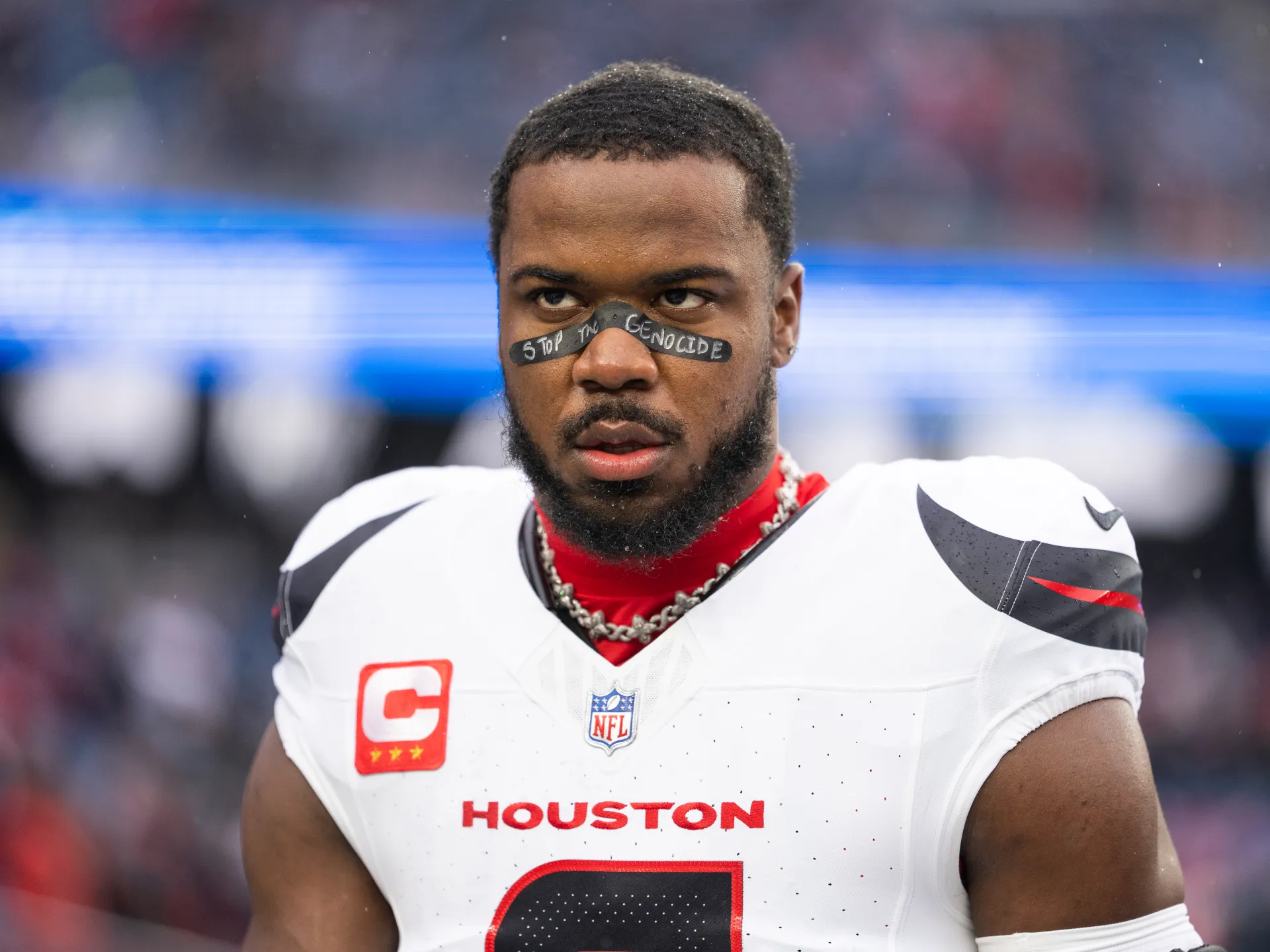
Basketball superstar Kyrie Irving has offered to pay a fine for American football player Azeez Al-Shaair, who was penalised for wearing the name of Hind Rajab, a Palestinian girl killed by Israeli forces in Gaza.
Al-Shaair was handed a fine of $11,941 by the National Football League (NFL) on Wednesday as he was found to be in breach of the NFL’s rules on players’ equipment and clothing during his team Houston Texans’ game against the Buffalo Bills last weekend.
Recommended Stories
list of 3 itemsend of list
Shortly after the fine was announced by an NFL reporter on X, the pro-Palestine basketball player responded to the tweet by saying he would “take care” of it.
Al-Shaair, 29, is a linebacker for the Houston-based NFL team and a vocal advocate for Palestinian rights.
During his team’s last NFL game, Al-Shaair wrote Rajab’s name on his eye black, a sticker or paint frequently used by NFL players to reduce glare.
Five-year-old Rajab was killed in Gaza after Israeli soldiers opened fire on her family’s stranded car. A phone call by the Palestinian Red Crescent documented her final moments and was the subject of an Oscar-nominated docudrama.
Al-Shaair, a Black American Muslim player, has frequently spoken about the plight of Palestinians and has paid the price for it.
He was also fined in January, during the NFL’s last season, when he displayed the message “Stop The Genocide” on his nose tape. While it did not specifically refer to a particular conflict, it was widely understood to be about Gaza and Sudan.
NFL criticised for ‘inhumane’ fine on Al-Shaair
The NFL’s fine on Al-Shaair comes at a time when Robert Kraft, the owner of the Boston-based team New England Patriots, confirmed that he pressured pop star Ed Sheeran to drop rapper Macklemore from his tour of the United States.
The billionaire is the owner of Gillette Stadium in Foxborough, Massachusetts, one of the venues where Macklemore was due to appear on stage as the opening act for Sheeran’s US tour in late September.
Letting Macklemore perform in Gillette Stadium would, Kraft said, cross a line, as he described the rapper’s recent performances as including a “broader history of anti-Semitic rhetoric and imagery”.
Kraft is known for launching a so-called “anti-Semitic campaign” during Israel’s genocide in Gaza in 2023, when players, coaches and executives from his Patriots team wore blue pins.
On October 15, 2023, the NFL observed a moment of silence for Israel during a game between the Baltimore Ravens and the Tennessee Titans in London, United Kingdom, while the league has sanctioned its player for raising awareness for Palestinians.
The NFL was criticised on social media for slapping a fine on Al-Shaair, with one user calling the move “inhumane”.
“He is advocating for the murder of this innocent child Hind Rajab in Palestine and they fine him?! Nah, that is so inhumane. You should be ashamed of yourself,” the user wrote.
Prominent American Muslim scholar Omar Suleiman questioned whether Al-Shaair would have faced a similar punishment if his tape carried the name of Holocaust victim Anne Frank instead.
“Why is honoring murdered Palestinian children ‘an unauthorized message’?” he asked in a post on X.
Meanwhile, the Texas chapter of the Council on American-Islamic Relations backed Al-Shaair over his continued advocacy for Palestinians.
“We commend Al-Shaair for using his platform to highlight the memory of Hind Rajab, one of the many children murdered by the Israeli government during its genocide in Gaza,” the rights group said in a statement on its website.
“The NFL has no problem with coaches wearing pins developed for genocide supporter Robert Kraft’s “Stand Up to Jewish Hate” campaign, and it should have no problem with an NFL player mentioning the name of a girl killed in that genocide,” the statement went on to add.
“Al-Shaair’s message was rooted in basic human decency and concern for innocent lives. That should not be controversial, much less subject to a fine.”
Irving’s pro-Palestine stance
Meanwhile, nine-time National Basketball Association (NBA) All-Star Irving has previously made his pro-Palestine stance on Israel’s genocidal war on Gaza clear.
In February, Irving wore a shirt reading “PRESS” at the NBA All-Star Game to honour journalists who had been killed in Gaza while covering the war.
According to reports, the tag on his shirt read: “Dedicated to our beloved journalists in Gaza showing the world the truth.”
In April, Irving changed his display picture on Instagram to an image of a Palestinian child blocked from attending school by Israeli soldiers in the occupied West Bank.
During a pre-game interview in 2024, he was seen wearing a chain with the Palestine flag in the shape of Israel’s landmass.
In 2023, the basketball player wore a keffiyeh, a cotton headdress with a distinctive checkered pattern worn in many parts of the Arab world that represents Palestinian identity, during a post-match news conference.
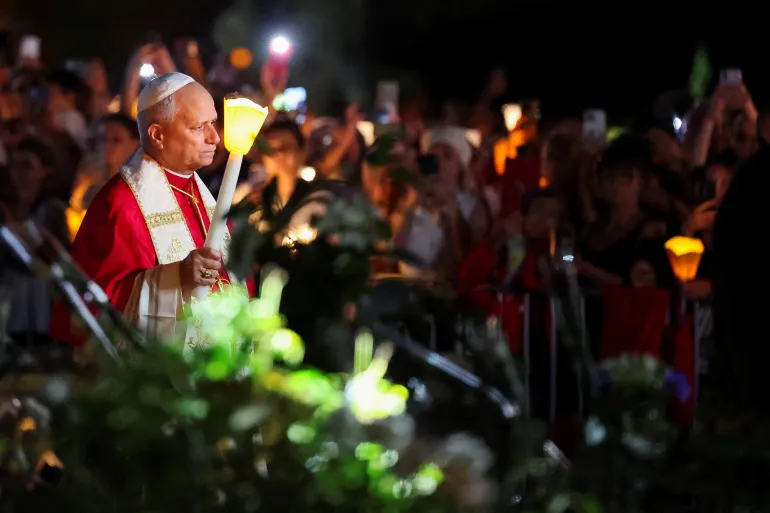
![Pope Leo participates in a candlelight procession at the Sanctuary of Our Lady of Lourdes as part of his four-day apostolic journey to France, in Lourdes, France, September 27, 2026 [Stephane Mahe/Reuters]](https://i0.wp.com/occasionaldigest.com/wp-content/uploads/2026/09/2026-09-27T202553Z_140704132_RC2VRNAYDPZJ_RTRMADP_3_POPE-FRANCE-1790546103.jpg?w=640&ssl=1)




![British Prime Minister Andy Burnham looks at French President Emmanuel Macron as they pose for photos ahead of a bilateral meeting at 10 Downing Street on September 3, 2026 in London, UK [Leon Neal/Reuters]](https://i0.wp.com/occasionaldigest.com/wp-content/uploads/2026/09/2026-09-03T133923Z_1327001305_RC2MBNAX5ATT_RTRMADP_3_BRITAIN-FRANCE-1788466043.jpg?w=640&ssl=1)

![Demonstrators burn tyres and block a road during a protest over the country's ongoing electricity crisis and persistent power outages in Brusubi on September 8, 2026. [AFP]](https://i0.wp.com/occasionaldigest.com/wp-content/uploads/2026/09/afp_6aa0b264c94c-1788916324.jpg?w=640&ssl=1)