playoff

College Football Playoff expansion to 24 teams could benefit USC, UCLA

Neither USC nor UCLA has made the College Football Playoff since its inception in 2014. Yet the Trojans finished six of those 12 seasons ranked in the Associated Press top 25, while UCLA finished in the top 25 twice and is currently ranked No. 12.

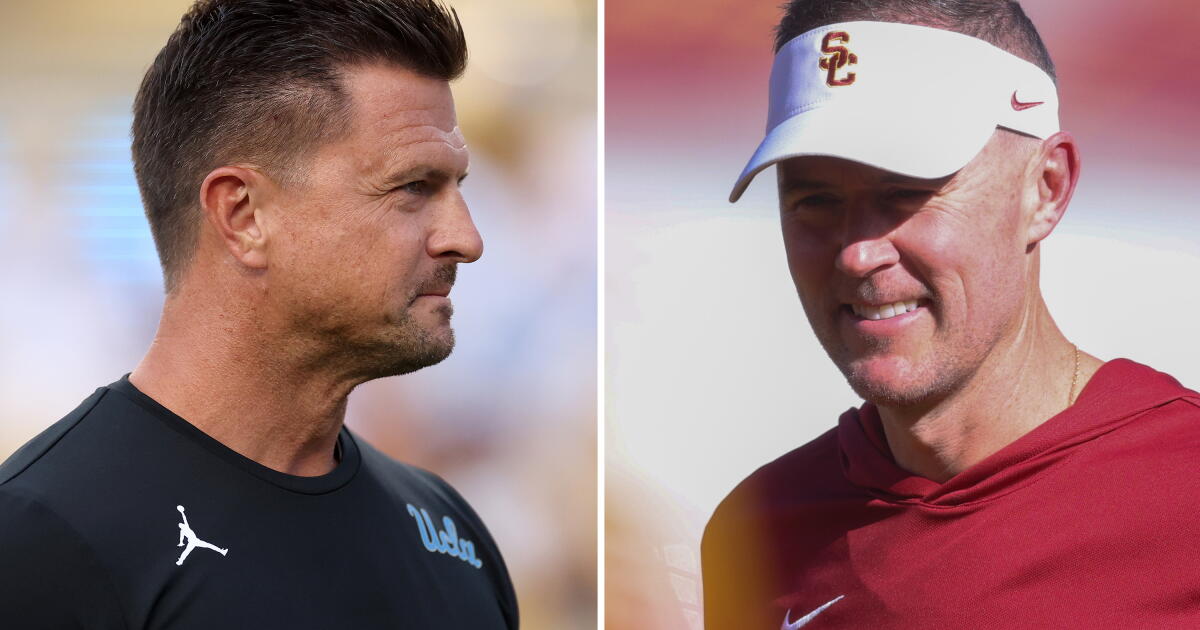
Reports that the CFP is nearing a deal to expand the field from 12 to 24 teams in 2027 should be tremendous news for both schools. UCLA (5-0) is surging after its rousing upset over Oregon, and USC (6-1) is ranked No. 19 after beating Washington and Penn State.

Arduous tests loom during the second half of the season, however, making the chances of getting the nod from the CFP selection committee a coin flip at best.

Next season, however, all it would take is being among the top 24 teams as deemed by the 13-member committee, which considers on-field performance, head-to-head results and strength of schedule the primary criteria.

The Big Ten was the primary driving force behind the expansion, which gained momentum recently when the Southeastern Conference gave its blessing. The CFP management committee, made up of 10 FBS conference commissioners and Notre Dame’s athletic director, met Thursday to discuss the negotiations with ESPN, according to the Athletic and ESPN.

“When you get a room of 50 coaches or whatever we have in this conference together, it’s hard to get everybody to be unanimous on something,” USC coach Lincoln Riley said earlier this season. “This is something where our room has been unanimous.”

ESPN reported that the network would acquire the additional games and continue to be the exclusive home of the CFP through the length of its current six-year contract.

“Constructive discussions with ESPN continued this week,” the CFP said in a statement Thursday night. “We have enjoyed a strong partnership with ESPN since our inception and are appreciative of the productive dialogue we have had throughout the negotiating period and continuing over the last several days. We will provide additional updates on the matters of future format and media rights when appropriate.”

Expanding the CFP would not be without concessions. The lengthier postseason would force the regular season to begin one week earlier and likely eliminate Power 4 conference championship games, which while lucrative, can be redundant and potentially problematic in impacting the CFP slate. Lower and mid-tier bowl games might become extinct, although the six prominent bowls on and around New Year’s Day — Rose, Fiesta, Sugar, Orange, Cotton and Peach — should continue to host the CFP quarterfinals and semifinals.

The format has not been formally approved, but one scenario would give the top eight seeded teams a first-round bye and a home game in the second round. The other 16 teams would play first-round games hosted by the higher seed. It would take five games for a team seeded from nine to 24 to win the championship and four games for one of the top eight.

That’s a lot of football beyond the regular season. The wildly popular NCAA men’s basketball tournament will expand from 68 to 76 teams next spring, but the physical demands of the two sports are markedly different, making the expansion there less onerous on players. Still, if the expansion is approved, the CFP will have its own version of the NCAA’s trademarked titles Sweet Sixteen, Elite Eight and Final Four.

March Madness is another trademarked term, although the NCAA would need to come up with something new for the CFP: December Delirium, anyone?

USC and UCLA presumably would be happy with any name as long as they are invited to the festivities.
Source link

Dodgers should have taken Shohei Ohtani off the postseason roster

The Dodgers never waver in their game plan for the regular season: win enough games to secure a bye in the opening round of the playoffs and, in so doing, afford players all the down time they need during the summer to be in top form come fall. They do not need to hurry anyone off the injured list so they can squeak out another National League West title.

Unfortunately for the Dodgers and their increasingly perilous hope of a three-peat, they did not follow that game plan with Shohei Ohtani. The Dodgers failed Ohtani this summer, and now all that remains is for them to cross their collective fingers and hope for the best.

Hope, as they say, is not a strategy.

The Dodgers should drop Ohtani from the postseason roster.

They won’t. They won’t even take him out of Wednesday’s lineup.

Amid headlines about how the Dodgers might have benched Ohtani for Game 3 of the NL Championship Series, manager Dave Roberts said the thinking was more about coupling Tuesday’s day off with a second consecutive day of rest.

“It was never a benching,” Roberts said.

Roberts drew a parallel between what might have happened with Ohtani and what did happen with Freddie Freeman during the NLCS two years ago, when the Dodgers provided what the manager called a “reset” — a day off for the team, followed by a rest day for Freeman.

“And he ends up winning the MVP in the World Series,” Roberts said.

Freeman had been playing with a bad ankle for three weeks, and even then he had been more productive that October than Ohtani has been in this one. Ohtani has been playing with a bad knee and biceps for three months, and the Dodgers already have tried intermittent rest.

They tried that in September, twice. They touted their bye week before the start of the playoffs. They talked up their three days off before the start of the NLCS.

They went 0 for 4. Enough already.

Roberts said the Dodgers — not just Ohtani, but the coaching staff and the training staff — see progress. True, no doubt. But we’ve heard similarly encouraging words after each of Ohtani’s rest breaks.

“We’re listening to Shohei, and we’re going to support the crap out of him and believe in him,” Roberts said, “and that’s it.”

Ohtani said Tuesday that his symptoms have subsided since the Dodgers put him on the injured list, for the minimum stay. That was a month ago.

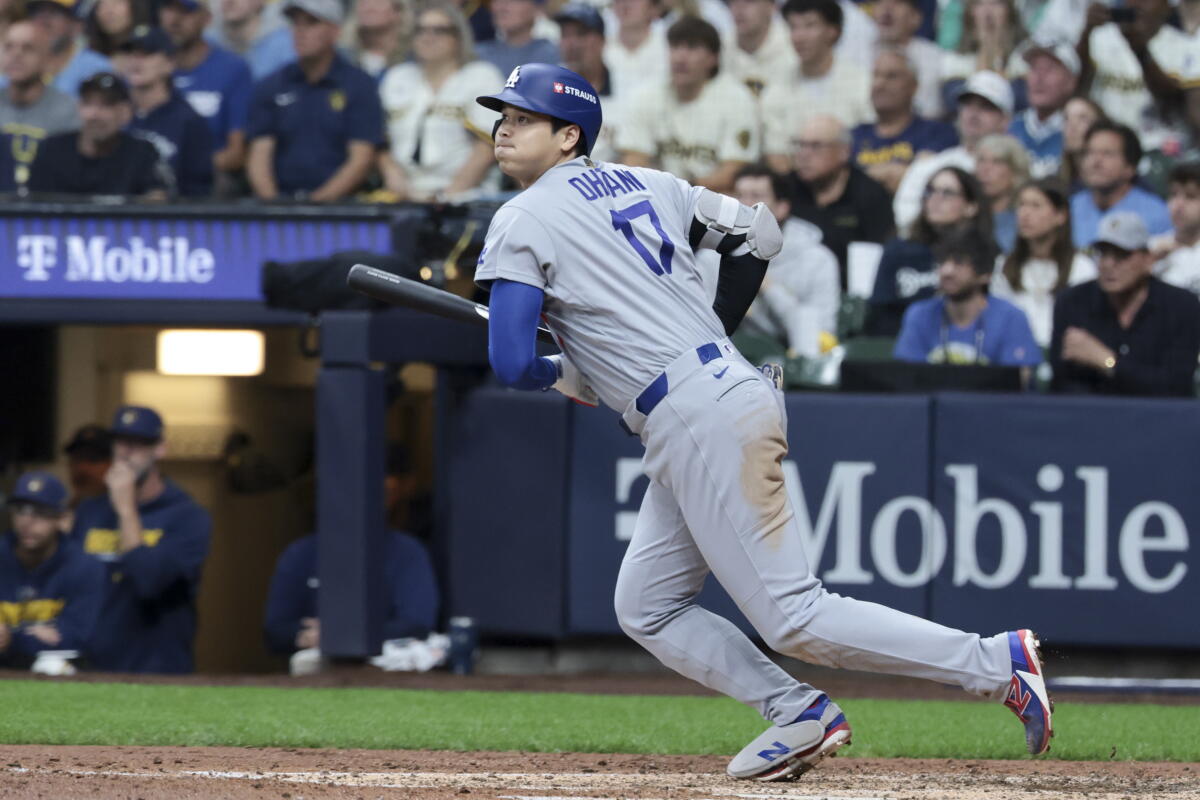
Shohei Ohtani is just three for 20 this postseason.

Shohei Ohtani is just three for 20 this postseason.

(Robert Gauthier / Los Angeles Times)

On Tuesday, he said his approaches can alternate between “focusing on reducing the symptoms and getting rid of the pain and/or just making sure that I’m moving well in the swing.”

There is no evidence so far that this might work, and an uncomfortable and increasing body of evidence that it might not.

Ohtani is batting .150 in the playoffs, with three hits in 20 at-bats. Of the 39 players with at least 20 at-bats this postseason entering play Tuesday, only three have a lower OPS than Ohtani’s .411.

One of them, Dodgers catcher Will Smith, has one hit in 23 at-bats. But he is hitting the ball hard: in the NLCS, one ball hit at 102 mph, another at 101, and every ball hit harder than the one Ohtani hit the hardest.

That exit velocity: 86 mph.

He has not pulled a ball in the series for a hit, or for an out.

Over his major league career, he has homered once every 14 at-bats.

He has not hit a home run since Aug. 18, a span of 107 at-bats. He has driven in one run since then; the Dodgers batted him cleanup in Game 2.

And, since hitting that last home run, Ohtani is batting .036 against fastballs thrown 95 mph or harder. The average fastball in this postseason: 96.2 mph, according to analyst Mike Petriello’s close-up of all the different ways Ohtani’s swing is fouled up.

Breaking balls? Brewers reliever JoJo Romero threw him one low and away in Game 2, and Ohtani lost his bat as he lunged to make contact.

When Ohtani spoke with reporters before the playoffs started, he said he might not know the full extent of his injuries or what he might need to do to rehabilitate them until after the postseason.

“I haven’t been able to get a good grasp of the root cause of all this,” he said then. “I think that process is going to happen during the offseason, when I’m going to have a little bit more time to be able to address it. But as of now, it’s something I’m just going to have to manage.”

The Dodgers did not need Ohtani to win the NL West. They needed to shut him down for an extended period to maximize their chances of winning in October.

They failed to do that. They believed a few days of rest would allow them to nurse Ohtani through the rest of the season.

One big swing in October, and who cares? Ask Kirk Gibson, who hobbled to bat and then hit one of the most dramatic home runs in World Series history.

Here is what the Dodgers ought to keep in mind: That was the only at-bat Gibson took in that 1988 World Series.

Source link